
Police need a complete ‘culture shift’ to ensure Ontario doesn’t see another Project South
The behaviour of police officers in Ontario is once again facing intense public scrutiny after February and March delivered a one-two punch of shocking revelations.
The inability, or unwillingness of policing leaders in Ontario to shift a deep-rooted culture of dysfunction and disregard for the law within their own institutions is part of a decades old pattern.
Like the widespread carding scandal first exposed by Black leaders two decades ago, the months following the G20 protests in Toronto in 2010, or the intense calls for police reform across the U.S. and Canada after the murder of George Floyd in 2020, the public, media, legal experts and policing researchers are again paying close attention to the latest disturbing revelations.
In February, Ontarians watched as York Police opened the curtain on one of the largest police corruption probes in the province’s history. At least 7 Toronto Police officers, and one retired member, were allegedly feeding criminal networks classified information, which they used to carry out shootings, extortions, robberies and drug trafficking. In one particularly shocking allegation, the address of a corrections officer was given to a group of criminals planning to kill him. That murder plot was foiled by York Police in a dramatic standoff. Video footage shown during the chilling February press conference provided an overhead view of the suspect’s vehicle ramming a police cruiser.
A total of 19 others have also been arrested as part of Project South.
Three Peel officers have been suspended in connection to the investigation. Peel Police have declined to provide any further comment on the suspended officers. It is not known if they are off work with, or without pay. The Pointer has published the names of the three officers, obtained from multiple sources (Peel Police has not released them). The conduct of Sergeant Adrian Shipp, Constable Scott King, and Constable Paul Binns with Peel Police is currently being reviewed by the Law Enforcement Complaint Agency (LECA). Their possible connection to Project South has not been explained.
Just under seven weeks later, with the shockwaves from Project South still rippling across Ontario, Western Law released a startling report detailing the disregard Ontario’s largest police forces have for the Canadian Charter of Rights and Freedoms.
Authors Sunil Gurmukh, Adjunct Research Professor, Western Law and Scot Wortley, Professor and Acting Director, University of Toronto Centre for Criminology & Sociolegal Studies, found that between January 2015 and May 2025, Ontario’s five largest police departments (Toronto, Peel, York, Durham and Ottawa) violated the Charter over 1,000 times, in 600 different cases. On a per capita basis, Peel Police is the worst offender, more than tripling the rate of Toronto’s force for serious violations per 1 million residents.
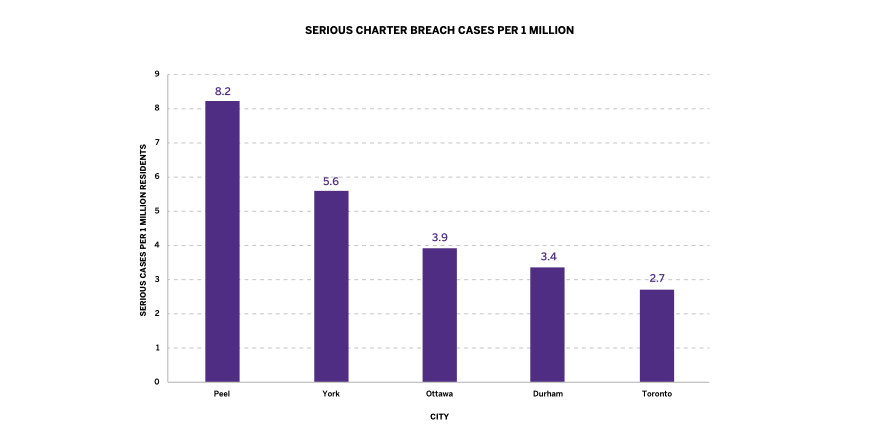
A Western Law study found Peel is the worst among Ontario’s five big police agencies for serious violations of the Charter of Rights and Freedoms.
(Western Law)
“To enhance public trust, legitimacy and safety, there must be: monitoring, accountability, transparency and
independent oversight,” the report, Unlawful Enforcers, details. “Systemic issues at the Peel Regional Police and Toronto Police Service must also be addressed.”
While the Project South probe is ongoing—York police declined to provide any further comments on the investigations—the systems and policies that supported the conduct of these officers are now being reviewed by the Inspector General of Police, Ryan Teschner. Announced on February 9, Teschner revealed his plan to conduct an inspection of all 45 police forces across Ontario, evaluating “effectiveness of police services, police service boards, and the Ontario Provincial Police in preventing, detecting, responding to, and fortifying their organizations from corruption.”
Teschner’s connections to the Toronto Police Services Board, where he used to serve as the executive director, are already raising questions about the objectiveness of his ongoing investigation.
In an email sent to The Pointer, the IOP said appropriate safeguards under the Community Safety and Policing Act will be put in place to ensure the Inspectorate of Policing’s work remains objective and impartial.
As investigations continue, experts and advocates are already pointing to areas of improvement, and lessons police agencies must learn from what is quickly becoming another period of reckoning for law enforcement.
For many, the hope is this will finally lead to a real cultural shift within Ontario’s police agencies.
Assistant professor at the University of Toronto, Patrick G. Watson, said when it comes to Project South, he's never seen anything at this scale of internal police investigation into corruption and criminality, aside from the review and scrutiny that followed the mass arrest of protestors by Toronto Police following the G20 protests. Those arrests resulted in numerous lawsuits including a class action.
Watson expressed concern that without strong accountability mechanisms in place for officer misconduct, it allows a culture to permeate police agencies that permits, and often encourages, looking the other way.

Assistant professor at the University of Toronto, Patrick G. Watson, says a culture of silence among officers can contribute to illegal behaviour, like what is alleged in Project South, going unreported.
(Submitted)
“Police officers do not like other corrupt police officers. They don't like incompetent police officers. They won't talk about it publicly,” Watson told The Pointer. “It's not like they're not aware of this stuff, but the way the culture sort of impacts upon them is that they do not speak about it publicly, and they will not comment.”
David Bosveld, a local advocate who has for a decade been pushing for change to eradicate systemic anti-Black racism within the Peel Police force, believes the law enforcement culture that normalizes bad behaviour extends to the highest ranks of police leadership, compromising the entire organization.
“It does beg the question: is there not supervision for these officers? Does it take getting to trial on a serious criminal case for a judge to uncover these Charter violations, this anti-Black racism, this obnoxious, systemic behaviour by multiple officers? Should they not be able to catch it before it unravels cases against people who are walking around with loaded weapons?” Bosveld is one of many advocates and researchers who has witnessed first hand the lack of processes, internal accountability and external enforcement to ensure police are effectively policed. “At what point does police leadership and police supervisors know what’s happening under their noses?”
The scale of what the Western Law report outlines makes it hard to fathom how senior leaders would not be aware of the bad behaviour of such large numbers of officers under their command. (Over a five-year period starting in 2010, one third of Peel Police officers had to be disciplined for misconduct; sources told The Pointer the consequences were usually a slap on the wrist for getting caught.)
When the leader of the Peel Police union, Constable Adrian Woolley, the man who is the public face of all patrol officers in Brampton and Mississauga, was convicted of stunt driving in 2019 while drunk, going 74 kilometres over the limit on the QEW with a blood alcohol level almost 50 percent above the legal limit, the punishment was an eight month demotion within the constable ranks. Critics said it wasn’t even a slap on the wrist.
A year later, Woolley reposted an overtly racist comment in a Twitter post, disparaging the capital of Somalia as a lawless place, and equating Minneapolis as the same following protests against the police killing of George Floyd. He then attacked the mayor of Mississauga at the time (who sat on the Peel Police Board) for publicly declaring her support of the Black Lives Matter movement. It was a clear violation of the Police Act, but Peel’s chief, Nishan Duraiappah, refused to take any action and remained silent on Woolley’s drunk driving conviction as well.
MADD Canada called his conduct "appalling".
Critics said Peel Police’s protection of a man like Woolley, who should have been immediately fired after putting so many lives at risk while stunt driving drunk on a major highway, illustrates the utter loss of public trust, when officers who should be thrown out of the profession are instead supported, even promoted into high profile roles like the one Woolley enjoys as the head of Peel’s police union, representing the values and character that exemplify the more than two thousand officers who are supposed to keep Mississauga and Brampton residents safe.
The Unlawful Enforcers research uncovered 11 cases where officers from Toronto Police or Peel Police lied or provided false testimony.
In six of these cases, more than one officer was caught lying. In all but one, evidence was excluded, or a stay of the charge was granted.
Fifteen cases of unlawful investigations between Toronto and Peel were found, including into allegations of child sexual abuse material.
“In eleven of these cases, the courts excluded reliable evidence of child pornography from trial because of officer violations of the Charter,” the report reveals.
Researchers also detailed 13 cases of “hidden racial profiling” of Black people by Peel and Toronto police.
“Hidden racial profiling is where the court decision notes the race of the accused, racial profiling was not an issue before the judge and an inference can be drawn that there was a racial profiling or racial discrimination,” Unlawful Enforcers explains.
One such case involving evidence being dismissed in an impaired driving charge as a result of excessive use of force by Peel officers who tasered and beat a Black man who was mostly cooperative, has already been detailed by The Pointer.
Fixing this type of behaviour was one goal of the partnership between the Ontario Human Rights Commission and the Peel Police.
It resulted in a long list of recommendations for change. Despite the binding agreement, Peel Police continue to cause disproportionate harm through use of force to the region’s Black communities.
Peel recorded a disturbing 111 percent increase in use of force last year. The data show that 28 percent of use-of-force encounters by officers in 2024 involved Black residents, while they only made up 9.87 percent of the population in Mississauga and Brampton (Caledon is policed by the OPP). Peel Police attempted to deflect blame for the dramatic increase onto the Black community, a tactic experts labelled as blatantly racist.
Hired in late 2019, Chief Duraiappah was brought in to change a force that had long discriminated against its visible minority communities, officers were repeatedly caught lying to the courts and breaking the law. The force was led by a core group of senior officers resistant to change, particularly controversial former chief Jennifer Evans who repeatedly defended the blatantly racist practice of police carding in Peel. Duraiappah has largely failed to eradicate many of the deep-rooted problems that continue to cause generational harm to residents.
Bosveld believes it will take a true, independent review to get to the heart of what is plaguing Ontario police agencies.
“There needs to be somebody external to policing looking at these allegations and looking to see if they’re tied to multiple police forces or if there is just Toronto or GTA based.”
After years advocating for change, he still has deep doubts these failed mechanisms will be able to change the police culture.
“Reform has never worked. These guys resist reform at the frontline level and some cases at the senior level,” Bosveld says. “What we’re talking about is a structural redefining of what policing should be in the community, especially in a highly racialized one.”
For Bosveld, “redefining” involves a redistribution of funding away from policing and into the agencies that can help individuals build and maintain a healthy life. It involves transparency from a police agency, instead of one that builds walls between itself and the community it is supposed to serve.
For others, it involves creating real accountability mechanisms for police officers who break the rules.
“You can educate them all you want, if there are no consequences to the bad behaviour nothing is going to change,” Notisha Massaquoi, an assistant professor in the Department of Health and Society at the University of Toronto, previously told The Pointer. Massaquoi co-chaired the Anti-racism Advisory Panel for the Toronto Police Services Board, which led to the creation of the first mandatory, race-based data collection policy for a Canadian police force.
“Now it’s about what are the disciplinary measures that are going to be put in place and the hard lines and the zero tolerance for the racist behaviour and the racist engagement with communities.”
Peel Police have mostly refused to address the Project South probe, or its own officers' involvement. Chief Duraiappah has not released any public statements about the police corruption investigation and has not not commented on any support of the work of the Inspector of Policing coming in to review the policies and procedures of his organization.
The ongoing refusal to denounce the bad behaviour of officers sends the wrong message to the frontlines, Bosveld says.
“Why don’t we know exactly what they’re alleged to be involved with?” he says of the three suspended Peel officers. “Does that not feel to you that someone is trying to protect, either the badge, the individual officers, or the services?”
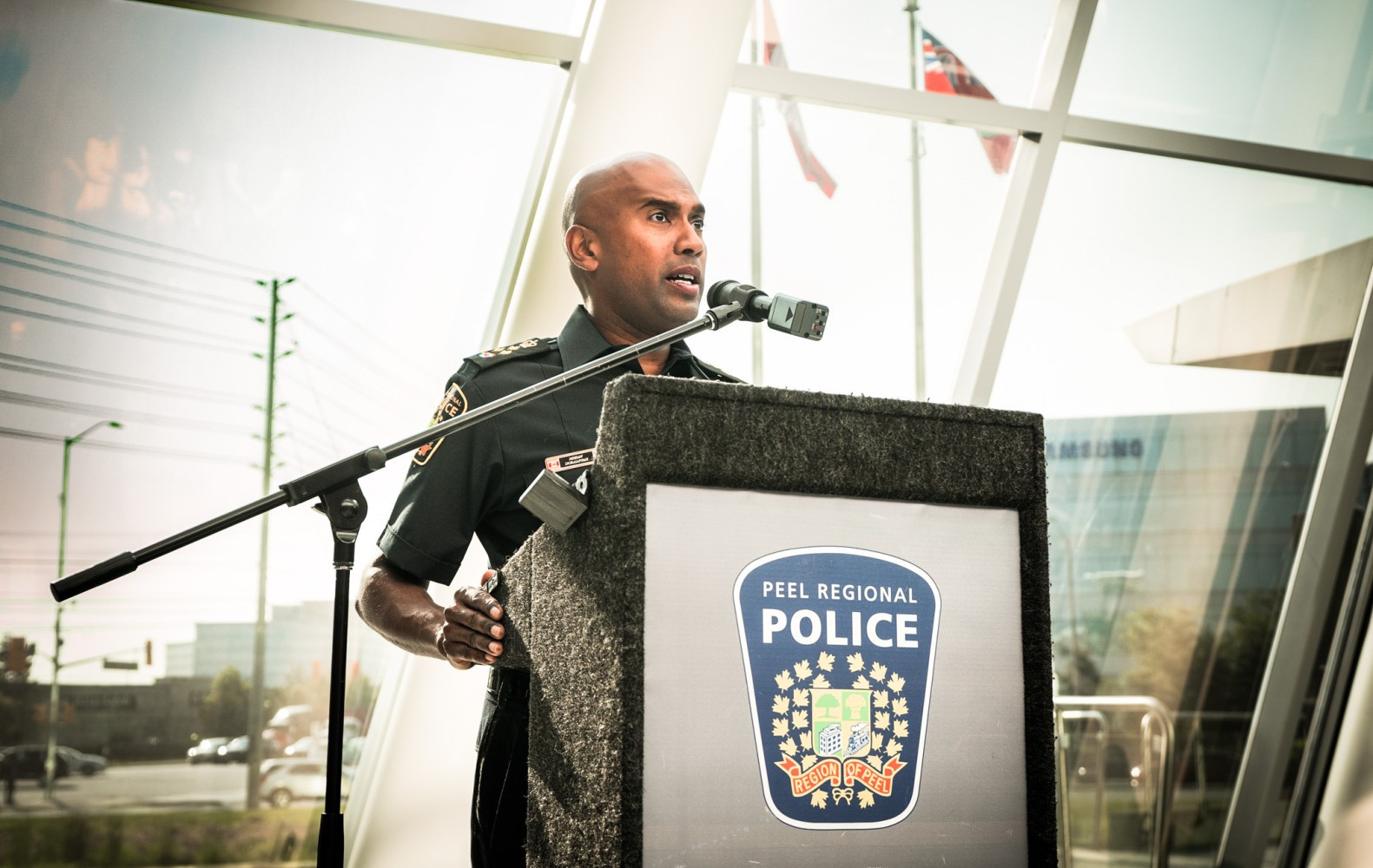
Peel Police Chief Nishan Duraiappah was hired in 2019. He has since largely failed to eradicate the systemic anti-Black racism that permeates his organization.
(Peel Regional Police)
Aside from the complex work of shifting the culture within police agencies in Ontario—something Peel has largely failed to do despite scathing external reviews—there are practical policy changes that need to be implemented, experts say.
Project South exposed how easy it is for officers to access confidential information illegally, without consequence.
This is not a new problem for police agencies.
It has been allowed to continue despite repeated warnings that illegal searches on the Canadian Police Information Centre (CPIC) database were becoming an issue more than a decade ago.
In 2012, the Ontario Civilian Police Commission detailed how “unlawful CPIC searches are a serious issue” when detailing how an Ottawa police officer used the database to illegally search for information on his ex-girlfriend. The ruling outlined recent cases where officers were caught illegally searching people’s names in the database “in some incidences in excess of 100 times”.
Indicative of the scale of the issue, a Toronto Police officer was charged just last week with the same thing. The officer had just three years on the force and allegedly accessed police databases illegally on numerous occasions between January 2024 and April 2025, according to a press release.
In their letter to the Inspector General of Policing, Toronto Police Chief Myron Demkiw and Toronto Police Services Board Chair Shelley Carroll recognized that the improper use of this database was a problem that could extend beyond Toronto.
When asking him to review “access to police databases and information systems, including permissions, controls, and clearances”, the pair asked the upcoming investigation to consider “the extent to which these issues are not unique to any one police service and the extent to which they highlight the need for a sector-wide strategy.”
Police officers accessing private data for their own personal use is not new to Watson.
“What we're looking at right now from the IOP, has to do with these illegal searches of police databases that were being done, as well as some of the other consorting with criminal folk,” he said. “They're going to have to figure out what the hell happened there, but the IOP is going to focus on how we can control officers accessing that type of information. This is incredibly, incredibly serious, and that cannot be diminished.”
He said part of the issue is the lack of training officers receive, which can contribute to their lack of knowledge about how to use vital investigative tools.
Police training overall in Ontario typically lasts less than a year, with recruits hired by a local service before attending the Ontario Police College for a single semester. During that brief period, trainees learn their use of force training, the Criminal Code, along with radio and weapons training before being sent back to their local police service for some additional instruction.
“It's cuckoo bananas that they do this in three months, we're talking like six months to a year of training, plus like probationary stuff and the street,” Watson said.
In contrast, candidates in Germany, Finland and Northern Ireland must go through degree training for up to four years focusing on civil and legal rights before becoming a police officer, Watson notes.
The lack of training here is of particular concern regarding forces like Peel’s, which has been in the midst of a hiring blitz in recent years, thanks to a regional government routine of approving unsustainable budget increases, that many residents have a hard time supporting.
The force plans to hire 175 new officers this year. This is in addition to the 300 in 2025, 135 in 2024, 70 in 2023, 26 in 2022, 27 in 2021 and 35 in 2020.
As of 2026, Peel Police has about 2,400 officers. This means that if Peel adds the additional 175 as planned this year, starting next year, nearly 30 percent of the force will have less than six years of experience on the job.
Email: [email protected]
Email: [email protected]
At a time when vital public information is needed by everyone, The Pointer has taken down our paywall on all stories to ensure every resident of Brampton, Mississauga and Niagara has access to the facts. For those who are able, we encourage you to consider a subscription. This will help us report on important public interest issues the community needs to know about now more than ever. You can register for a 30-day free trial HERE. Thereafter, The Pointer will charge $10 a month and you can cancel any time right on the website. Thank you
Submit a correction about this story

