
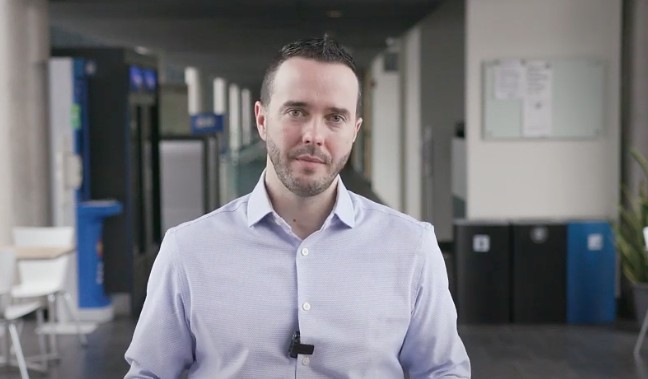
From Niagara to Brampton to the Yukon, detailing the scandalous past of David Barrick
Editor’s Note: Reporter Ed Smith is a former member of the Niagara Peninsula Conservation Authority board who joined in 2019, and as a private citizen participated in public efforts to hold David Barrick accountable, before Smith joined The Pointer as an investigative reporter covering Niagara Region.
How does David Barrick continue to find work?
Among Ontario’s municipal government sector professionals it is a running joke. But it’s certainly no laughing matter.
Never qualified in the first place, Barrick has been fired repeatedly, is embroiled in scandal constantly, but thanks to the municipal politicians, primarily mayors, who seek out someone just like Barrick to do their bidding, accountability is no concern.
For taxpayers across Ontario, and now in Whitehorse, it’s a different story.
Top municipal officials who asked not to be named told The Pointer they are astounded each time the man is hired for a senior role in the public service despite his termination or sudden departure from every municipal job he has briefly held.
The Pointer has tracked the debris field of Barrick’s career.
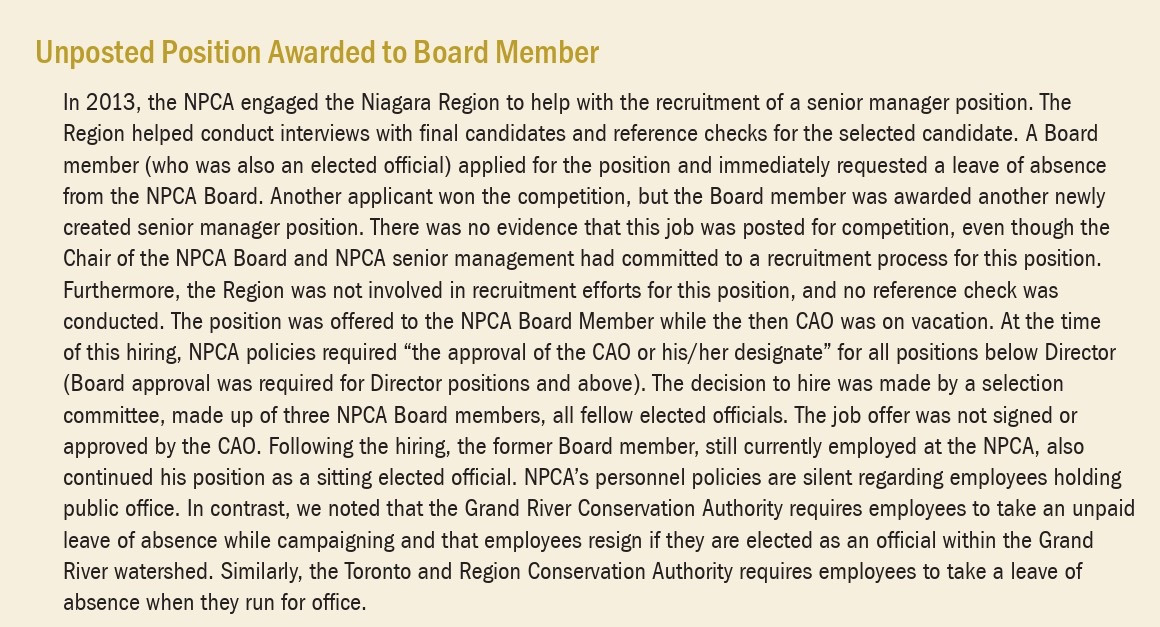
Ontario’s Auditor General wrote the above section in a critical 2018 report on Niagara’s Conservation Authority. David Barrick is the employee who was awarded the position in a deeply flawed process highlighted by the Auditor General.
(Government of Ontario)
It started in Niagara Region where his connections as a young, inexperienced conservative politician in his 20s elected to regional council in Port Colborne led to his hiring by the local conservation authority in a process later described by Ontario’s Auditor General as inherently flawed: Barrick was put on the CA’s board, was given the senior staff position by three other board members (all fellow councillors), the CAO did not approve or sign the offer and Barrick continued to serve as a Niagara Regional councillor after landing the job. He had quickly become part of a conservative group of Niagara politicians who worked closely with the development industry and subverted democratic processes across Niagara’s regional government, which was laid bare in a deeply disturbing 2019 report by the Ontario Ombudsman that was titled Inside Job and detailed the behind-the-scenes maneuvering of Barrick and others inside the government who treated the local municipal sector as their privately owned corporation. During Barrick’s time serving simultaneously as a councillor and eventually as the top bureaucrat at the conservation authority, the Auditor General highlighted various conflicts of interest between builders and the councillors who also served as board members that granted controversial development approvals following inappropriate dealings with the companies. When Barrick soon became the CAO of the conservation authority, while refusing to step down as a councillor, his spectacular financial mismanagement of the land use agency, including lavish perks such as taxpayer-funded car allowances handed to friends and the inability to explain hundreds of thousands of dollars in spending, led to his firing after local citizens took to the streets demanding his termination.
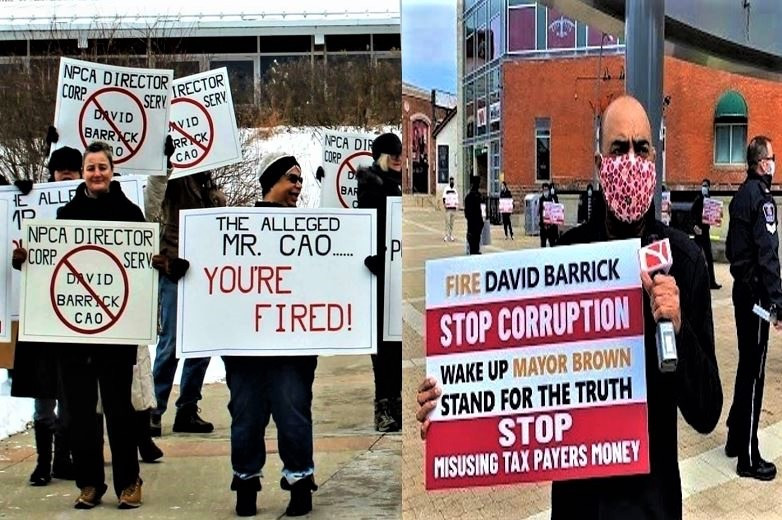
Twice in his career, citizens have demanded David Barrick be fired from his municipal sector jobs.
(Left: Doug Draper/Niagara-at-Large; Right: YouTube screenshot)
Then, despite being vastly unqualified and never holding a single job inside a city hall administration, and getting fired for his failure to manage a small public agency, he was quickly hired as CAO, the highest ranking bureaucrat who oversees thousands of City Hall staff, in 2019 by Brampton’s controversial conservative Mayor, Patrick Brown, who as the former leader of the provincial party had worked closely with some of the same conservative politicians in Niagara that had groomed Barrick. Brown had been embroiled in a series of scandals and faced sexual assault allegations from two young women before he was forced to leave Ontario’s PC Party in 2018 (Brown denies the allegations). The Mayor was looking for a chief administrative officer who, instead of representing the taxpayers and maintaining the required independence from the politically elected head of council, would effectively report to Brown, after he orchestrated Barrick’s hiring. He was quickly fired from Brampton after a majority of councillors declared democracy was “under siege” as a result of Brown’s authoritarian leadership, which Barrick was hired to defend. Barrick claims investigations into widespread corruption outlined by councillors and reported on by The Pointer cleared him of any wrongdoing. This is false.
He then moved to Thames Centre, where sources said he was walked-out the door after serving as CAO for a year. The municipality claims he resigned. People close to the situation have told The Pointer he was fired.
The same thing happened at Barrick’s next job in South Stormont where he lasted less than three months as CAO before being let go in March. His firing came after OPP officers were called regarding a planned visit to the municipality's public council meeting by The Pointer’s reporter Ed Smith. The municipality had labelled Smith as a “stalker” following false claims by Barrick to ensure the journalist would not be able to report on him inside a public space. When The Pointer reached out to the municipality and the local OPP detachment (which shared details of what had happened) for answers about the Charter-breaching behaviour, it was quickly announced that Barrick was no longer the Town’s CAO. It was in a letter from Barrick’s own lawyer threatening The Pointer with legal action that Barrick’s departure was described as a firing. The Town has never made that information public.
Barrick then engaged obscure online sites after his job termination in South Stormont in the spring, to mislead the public about his conduct and the string of firings in Ontario’s municipal government sector. Articles have appeared in small publications online that did not cover the dozens of controversies Barrick caused since his time in Niagara, but have suddenly published glowing accounts of him that read more like his own dubiously crafted resume. Barrick was clearly attempting to whitewash his name using false or misleading information about the scandals he either caused directly or was a part of in his previous roles.
It’s not clear why these little known online sites suddenly became interested in clearing David Barrick’s name at the same time, but the internet campaign paid off.
On September 1 it was announced Barrick is the new City Manager in Whitehorse, Yukon’s capital.
In a press release, Whitehorse Mayor Kirk Cameron touted Barrick’s “strong background in municipal governance and executive management” and claimed “his unique combination of organizational leadership and public administration experience will bring valuable perspective to the City.”
In subsequent media articles, the mayor said he believed Barrick had been “exonerated” from the controversies in his past—which is far from the truth—and that the City of Brampton had issued him an apology for what happened during his time there. Cameron admitted to having not read the apology letter.
It’s unclear if the mayor is aware that the apology he referenced was only issued by the City of Brampton after Barrick threatened officials with a $1 million lawsuit, demanding a glowing reference to avoid legal action (Ontario’s public salary disclosure shows Barrick was paid approximately $750,000 between 2022 and 2025 by the City of Brampton, after he was fired early in 2022). Similar letters praising Barrick’s work, in obvious contrast to the underlying causes that lead to such a quick jettisoning of dangerous hires, were also issued by Thames Centre and South Stormont. The conduct that led to Barrick’s hastily severed employment was never revealed in either of the small municipalities, unlike the constant flow of daily turmoil exposed in Brampton.
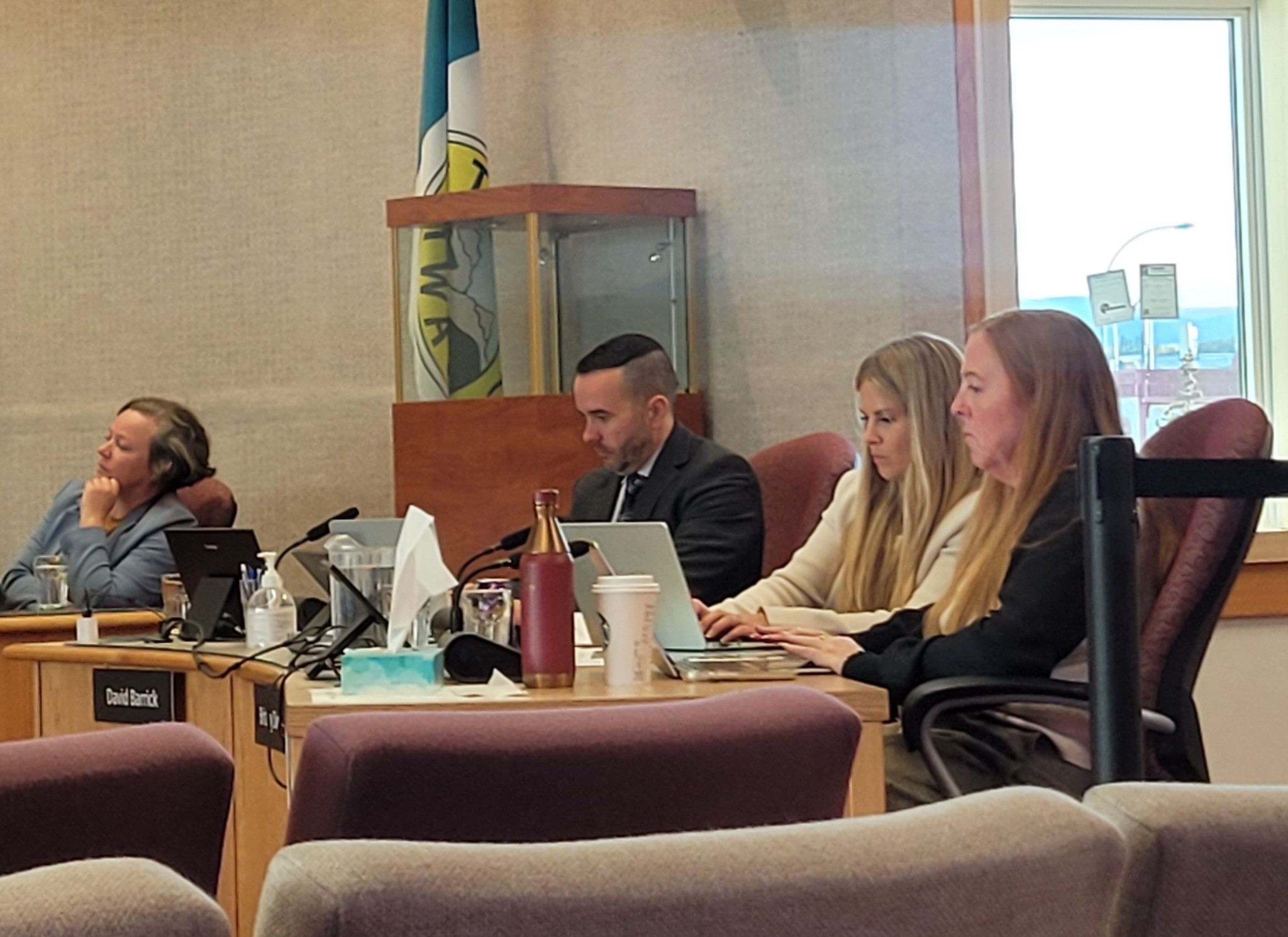
David Barrick (centre) in his new role as City Manager for the City of Whitehorse.
(Submitted)
Heading into the Ontario municipal election in October, the controversial saga of David Barrick raises numerous questions about local hiring processes and the hundreds of thousands of dollars each top municipal bureaucrat is paid by taxpayers. Legislative maneuvers pushed through by the Doug Ford PC government handing mayors the ability to hire and fire CAOs using “strong mayor” powers have raised more questions about how taxpayers are protected from questionable municipal government hiring decisions.
Municipal stakeholders are concerned that David Barrick’s glaring example could become even more common across Ontario.
“While the personal ethical and professional standards that individuals bring to the CAO role are critical to good governance, the rules governing their appointment and dismissal also matter to the perception of the integrity of the system,” a white paper from the Canadian Association of Municipal Administrators cautions. “It makes a big difference if the CAO is perceived as ‘serving the Council,’ or as ‘the Mayor’s appointee.’”
As Barrick has claimed himself in interviews, the CAO role is one that acts as a “bridge” between two worlds—the political realm of council and the administrative work of staff. His story clearly shows the damage that happens to local municipalities and taxpayers when mayors in particular try to control the other world.
Barrick started his career in Niagara Region, not as an administrator, but a politician.
From the very beginning the rigid separation and independence from the political machinations of municipal government that define the early careers of bureaucrats who after decades of working on the administrative side of the civil service rise to senior positions such as chief administrative officer, were absent in the experiences that shaped Barrick’s rapid ascent to the very top of city hall.
Instead of the career administrators who learn from the start the importance of protecting taxpayer interests by keeping politicians in check, serving as objective public servants committed to professional standards, impartial guidance and conduct free from any political interference, whatsoever, David Barrick’s introduction to municipal government serves as a textbook example of how to smash together public and political interests, with damaging consequences.
He was first elected in 2006 in his early 20s as a city councillor in Port Colborne, the small town where he grew up. His conservative views and developing alliances with other like-minded local politicians springboarded him after one term to regional council with the upper tier Niagara Region, a position he would hold until 2018.
It was during this period that Barrick’s name became intertwined with two of Niagara’s most turbulent governance controversies in recent memory: the crisis at the Niagara Peninsula Conservation Authority (NPCA) and the tainted hiring scandal at the Regional Municipality of Niagara. The widely reported scandals ultimately resulted in provincial investigations and precipitated a sweeping shakeup of the region’s governing leadership.
During his time as a councillor, as development pressures across Niagara began to define many of the most controversial issues local elected officials dealt with, Barrick was appointed to sit on the Niagara Peninsula Conservation Authority governance board with the help of his conservative colleagues who were also on the board.
The land use agency was the key guardrail against unchecked construction and often acted as a foil to developers stopped in their tracks when applications for projects were not aligned with the conservation authority’s broad mandate to safeguard Niagara region’s vast protected, environmentally sensitive spaces.
In December 2013, while still a member of the board, he was hired by the organization as the senior manager of operations; he did not resign from the Board until January 2014. The conservation authority, which was chaired by fellow Regional Councillor Bruce Timms, never posted the position publicly. Responding to the controversy at the time, Timms said that although Barrick was unsuccessful in his application for the original position he applied for, “we found him a better fit in a different position.”
The rapid shift from an appointed oversight role of the most critical land use agency in the region, entrusted with safeguarding the public interest, to a senior salaried management position within the very organization he had been responsible for overseeing, raised concerns about optics, his qualifications and the integrity of the hiring process. Allegations of nepotism and impropriety quickly followed. Ontario’s Auditor General would later criticize Barrick’s hiring, labelling it improper as part of a sweeping audit of mismanagement and financial issues at the NPCA.
Timms, a political ally and friend of Barrick, addressed those concerns and the public optics surrounding it when Barrick was first hired.
“I understand the optics of it, but he was the best person for the position,” Timms said, offering no explanation to justify the hiring of a man who had never worked in conservation, had never held an administrative job in the municipal sector and was simultaneously serving as a regional councillor for the government that was supposed to hold the Niagara conservation authority accountable.
In 2014, after Barrick finally stepped down from the board amid questions about how he could be both a manager and a member of the body required to hold staff accountable, another conservative regional councillor and close ally of Barrick, Tony Quirk, would join the conservation authority board.
By 2016, Barrick was promoted to director of corporate services, playing a key administrative role within the NPCA overseeing human resources and finances. His time in the role was plagued with repeated internal restructuring and escalating tension between staff, board members and regional council.
In 2017 those issues came to a head.
In April of that year the Ontario Public Service Employees Union (OPSEU) publicly called for Barrick’s resignation. The union pointed to low staff morale exacerbated by significant firings and departures—in the four years prior, a third of the NPCA staff were terminated and replaced. The questions about management under Barrick’s tenure became so glaring, nine area municipalities and four MPPs called for a forensic audit and a sweeping investigation into mounting allegations of widespread mismanagement. Under Barrick, lavish spending on staff skyrocketed, board members interfered in day-to-day operations, spending on administrative costs jumped while funding for conservation plummeted and questionable approvals for development projects were granted.
“David Barrick was appointed to senior management without a competition three years ago, directly from the NPCA Board,” OPSEU President Warren Thomas said at the time. “Three years of bad management is more than enough.”
The unprecedented public call by a major provincial union for the resignation of a senior municipal administrator was a clear signal of how far the crisis had deepened under Barrick's leadership.
It would not be the last demand for a resignation letter Barrick would see in his career.
The calls for an investigation into allegations of political interference, questionable hiring and procurement practices and internal dysfunction were finally answered in October 2017.
Ontario’s Auditor General launched an investigation into the NPCA following mounting public pressure. The resulting report released in September 2018, just before a municipal election, was scathing, detailing “significant operational issues”, governance failures, financial irregularities, conflict of interest, mismanagement, blurred lines between political oversight and administrative function and systemic weaknesses in accountability.
For many observers, the report validated years of concern and seemed to mark the bottom of a long and steady fall of the organization under the leadership at the time, with Barrick at the centre of it all.
The bottom, however, had not yet been reached.
In the final weeks of 2018, the deepening dysfunction inside the Niagara Peninsula Conservation Authority spiraled into open institutional breakdown after then CAO Mark Brickell fired Barrick.
Days later, the NPCA board—now led by another political ally of Barrick and a fellow former regional councillor, Sandy Annunziata—summoned Brickell to a closed-door meeting. Brickell was denied entry to the boardroom and subsequently placed on paid administrative leave. Within weeks, the board terminated Brickell’s employment altogether. He later filed a $2.3-million wrongful dismissal lawsuit. It was eventually settled under undisclosed terms.
Within minutes of firing Brickell, the NPCA issued a press release announcing that its administrative clerk, Lisa McManus, who was on bereavement leave at the time, had been appointed interim CAO.
One of her first actions was to reinstate Barrick.
Shortly thereafter, McManus went on leave and never returned.
Within days, Barrick was elevated to acting CAO.
Barrick had been fired, rehired and then promoted to CAO, within a matter of weeks.
The legitimacy of these decisions was immediately challenged. Incoming regional councillors, elected weeks before in the October 2018 election, argued the outgoing board had already been replaced and no longer possessed the authority to hire or fire senior staff. One newly appointed interim board member publicly described the situation as “ridiculous”, arguing the outgoing members “have no ability to hire or fire anyone because they aren’t board members anymore.”
The turmoil culminated in a dramatic December 2018 Superior Court hearing forced by residents who had seen enough. Justice James Ramsay declared the situation at the NPCA “intolerable,” stating that constitutional order needed to be restored.
At that hearing, Barrick appeared as interim CAO representing the NPCA. Notably, when he introduced himself to the court as the CAO of the NPCA, Justice Ramsay added the word “allegedly.” No lawyer was present for the conservation authority.
Ramsay was quick to rule against Barrick and the position he had taken in locking out the new democratically appointed board, and ordered the new board into place. This meant Barrick’s time within the organization was now measured in days, as the institution began the slow, expensive task of rebuilding and repairing years of damage.
At the same time the legal and administrative turmoil was being exposed at the NPCA, another high-profile governance controversy at the Regional Municipality of Niagara was slowly unravelling. It also involved Barrick.
In October 2016, the Region hired Carmen D’Angelo as its new CAO. While Barrick was hired from the board for the management position at the Niagara conservation authority in 2013, D’Angelo, a fellow board member, had been selected as a consultant to provide sole-sourced contracted services to the agency. After Barrick’s hiring, D’Angelo, who had served alongside Barrick on the NPCA board, was handed—by the same board he served on—the job as CAO of the conservation authority in 2014. Like Barrick, D’Angelo eventually stepped down from the volunteer board to take on the salaried position leading the conservation organization, and serving as Barrick’s boss.
The 2018 probe by Ontario’s Auditor General reported that both appointments D’Angelo benefited from, the sole-source consulting work and the CAO job, “could be perceived as a conflict of interest given the individual’s involvement in decision-making processes prior to each hire.”
The damning accountability audit found that “the Board member (D’Angelo) was involved in proposing the creation of the consultant position he was later hired to fill. There was no replacement NPCA Board member during this leave. In fact, email communication with the NPCA Board Chair indicated the NPCA Board member would continue to receive Board-related communication during his leave.”
The investigation by one of Ontario’s key government accountability offices exposed the alarming conduct of Barrick, D’Angelo and others who worked closely in their conservative circle at the conservation authority.
“During his role as consultant, this individual (D’Angelo) was involved in staff restructuring decisions related to hirings and terminations, and negotiating the terms and timing of the then CAO’s retirement,” the Auditor General reported. “Shortly before the CAO vacancy was posted, this individual returned to the Board and submitted his application for CAO. He was on the Board (although not on the hiring committee) when the hiring committee selected which candidates to interview for the CAO position. He took a leave of absence only after being selected for an interview. Following the interviews, he was appointed to the CAO position. As before, there was no replacement NPCA Board member during his second leave of absence.”
It would not be the only time D’Angelo and Barrick would be caught in a Niagara hiring scandal.
In late 2016 it was announced that D’Angelo was moving on from his controversial appointment as CAO of the NPCA to become the CAO of Niagara Region, a decision that drew significant public attention, with some observers and regional politicians suggesting the hiring reflected long-standing alliances among a group of conservative councillors and the Region’s chair, including Barrick, widely referred to in Niagara as “the Cabal”.
The group was a loose bloc of approximately 13 to 15 conservative regional councillors and chair Alan Caslin who consistently supported one another on a range of controversial decisions at the Region. Among the issues on which they acted as a voting bloc was the defeat of measures intended to shed light on allegations of corruption and misconduct at the Niagara Peninsula Conservation Authority (NPCA) and within the Region itself.
The bloc voted against the appointment of an integrity commissioner; did not support a value for money audit of the NPCA (Barrick was absent for that vote); and all voted to close the CAO hiring process after D’Angelo was chosen despite widespread concern about how he had been selected.
In response to widespread public pressure, council commissioned an independent review of the hiring practices within the Region. The investigation was conducted by a firm selected by council itself. When the investigator delivered the findings at an open council meeting, it concluded that the process leading to the hiring of D’Angelo did not violate legal or procedural standards. The council-controlled “investigation” was widely panned as a whitewash.
Political pressure intensified as residents organized, voiced their frustration and increasingly called for provincial oversight of regional governance in Niagara.
The public outcry did not relent and in August of 2018 the Ontario Ombudsman announced he would conduct a thorough investigation of the Niagara Region after receiving 113 separate complaints about D’Angelo’s hiring. The resulting probe entitled “Inside Job” revealed what Barrick and others in the “cabal”, along with Caslin’s staff, did to make sure their man was handed the CAO role.
The report detailed Barrick’s efforts to clear the way for D’Angelo’s hiring at the Region. It shares the details of an email sent by Barrick following a meeting with then regional treasurer Jason Burgess (who is now the CAO at the City of Niagara Falls). According to the report, Barrick reached out to the regional employee to discuss D’Angelo as the next CAO.
“The employee told us it was clear to him that Mr. D’Angelo was the councillor’s choice for the position; he said the councillor assured him that he could ‘get the votes’ to complete the hire,” the Inside Job report details.
In the email, Barrick thanks Burgess for the meeting and suggests how he could help ensure D’Angelo became the staff favourite to become the next CAO. If Burgess played along, “you would have influence with him”, Barrick told the regional employee.
When asked by the Ombudsman about this meeting with Burgess, Barrick claimed he did not remember having the meeting.
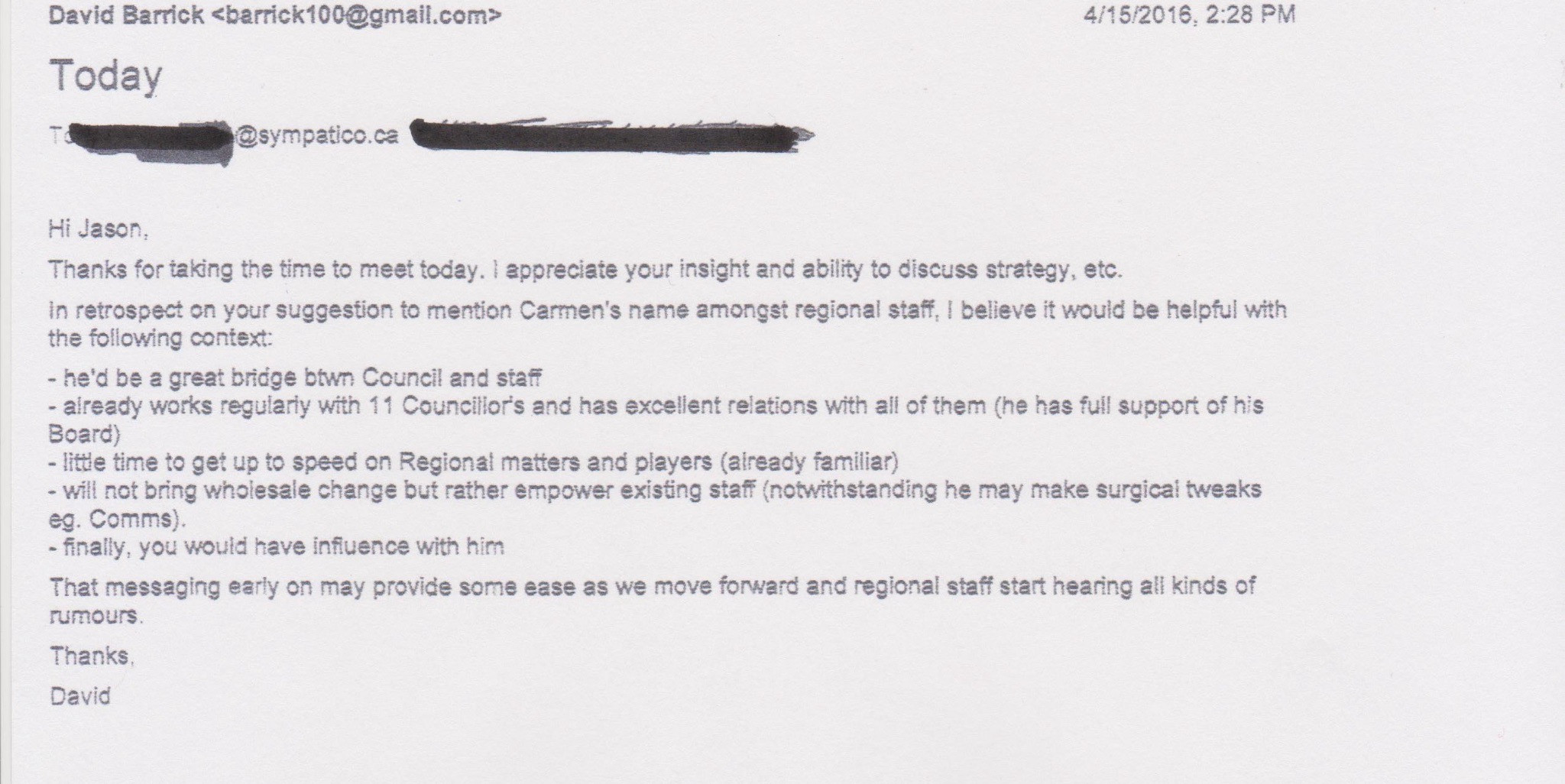
An email sent by David Barrick to the treasurer of Niagara Region at the time suggesting ways to discuss Carmen D’Angelo as the next CAO. The email was used as evidence by the Ontario Ombudsman in his investigation into the corrupt hiring practice that eventually led to D’Angelo’s hiring as Niagara CAO.
The “Inside Job” report details how Caslin’s head of communications, a man named Jason Tamming, helped draft the questions for the CAO candidates, then secretly handed those questions and the answers to D’Angelo. No other candidate was given the questions and answers. Another staffer, Robert D’Amboise, also participated in the scheme.
Niagara Region eventually sued Caslin, Tamming and D’Amboise for $850,000 collectively, alleging “The Defendants, Alan Caslin, Robert D'Amboise, and Jason Tamming, engaged in an unlawful conduct conspiracy and that each of the Defendants breached their respective duties of confidence to the Region, their respective fiduciary duties to the Region, and their implied duties of good faith and fidelity to the Region.”
After the matter was settled confidentially, the late Jim Bradley, who was the Niagara chair at the time, issued a scathing release in 2023: “On behalf of Regional Council, I want to unequivocally restate our position that the actions of the former regional chair, and his staff, were entirely inappropriate and truly inexcusable for any individual holding public office or serving in a position of influence. The facts as they were laid out by the Ombudsman speak for themselves and the actions of Caslin, D’Amboise and Tamming shook the public’s trust in Regional government. In short, Niagara’s tax payers deserved far better from their elected officials.”
The Ombudsman’s investigation identified serious governance concerns, corruption and systemic failures affecting both the NPCA and Niagara Region. A common thread in all of it was David Barrick.
He became the laughing stock across the Hamilton-Niagara area when Barrick brought forward the NPCA 2019 budget, but could not explain how portions of the roughly $9 million he was asking for would be spent, and would not answer questions from area councillors who demanded Barrick detail how more than $2 million in unexplained spending the previous year was handed out by the CAO.
In January of 2019, Hamilton councillors prepared to appeal Barrick’s proposed conservation authority budget for the year. It was common practice for the agency’s CAO to present to the municipal councils that approved part of the funding for the conservation authority, but when Barrick was told to appear before Hamilton council at a budget meeting to answer unexplained spending, he instead sent a junior staffer who had been employed for three weeks and had no experience in finance.
After sustained public criticism, David Barrick, who had simultaneously been serving as a regional councillor, chose not to seek re-election in the 2018 municipal campaign. He remained as the embattled CAO of the NPCA for a few more months, then the new board announced in February 2019, following the budget debacle, that Barrick had left the conservation authority after a “mutual separation agreement” was signed.
Before the end of the year and despite the release of the Ombudsman’s blistering Inside Job investigation report, Barrick was just the type of person needed by another man desperately trying to rescue his own political career.
Patrick Brown was elected mayor of Brampton late in 2018 after being driven out as leader of Ontario’s PC Party following allegations of sexual assault, which he denies.
Brown and Barrick were connected through a former Niagara-area Conservative MP, Rick Dykstra, who served with Brown when they were both backbench MPs under Stephen Harper. Dykstra served as the president of the Ontario PCs, working hand-in-hand with Brown before the former Niagara politician also stepped down in 2018 following a sexual assault allegation, which he denied. Dykstra was a key member of the conservative “cabal” in Niagara that Barrick also belonged to.
Brown made Barrick the CAO of Canada’s ninth largest city with a budget approaching a billion dollars—100 times bigger than the NPCA budget he had run into the ground.
The hiring raised eyebrows across Ontario’s municipal sector. The Pointer was told by sources that some of the well known names of those who applied for the job would shock residents, if they ever found out who Brown passed over for a man with zero experience running even a small city hall department.
Brown defended Barrick and claimed the Inside Job investigation had found Barrick did nothing wrong. This is categorically false.
Perhaps equally shocking were the names of two men who would work directly under Barrick inside Brampton City Hall, also hand-picked by Brown—Jason Tamming and Robert D’Amboise, who had been fired and sued by Niagara Region for their involvement in the corrupt Inside Job CAO hiring process.
They eventually left after a majority group of councillors fired Barrick in 2022.
Following the 2022 municipal election, when most of the councillors opposed to Brown did not return, he rehired Tamming.
Tamming, whose disqualifying conduct in Niagara would make it difficult to land a job in the private sector, is currently a commissioner with the City of Brampton, and made $275,000 last year.
It’s unclear if D’Amboise was rehired by the City of Brampton.
When Barrick was given the CAO job by Brown in 2019, some of Brampton’s councillors questioned why his troubling history in Niagara was not revealed by Feldman Daxon, the executive search firm used by Brown to find the next CAO.
“I now question the lack of transparency in the way the information on candidates was presented by the Executive Search Team (led by Brown) to the Council,” Brampton councillor Jeff Bowman told The Pointer at the time. “I would have expected a more fulsome disclosure from their exhaustive background checks.” Feldman Daxon Partners did not respond to a request for comment at the time. “I was never given any information during the interview process about any of the accusations from newspaper articles or the Ombudsman’s report. Having a professional executive placement firm vet the candidates, I would expect that all candidates were of the highest trustworthiness and experience, and were prepared to represent our City to the highest standards,” Bowman said.
Each hiring of Barrick, after each departure, involves an executive search firm, and similar questions are raised about how he could be recommended for a role overseeing tens of millions of dollars provided by taxpayers, when the disqualifying scandals and disturbing conduct have been so widely documented.
South Stormont used a firm called Legacy Search Partners that recommended Barrick for the CAO job. He lasted less than three months.
In Whitehorse, where Barrick is now the City Manager (the same as a CAO) it was Leadership Source Inc. that was used by the City to find its next CAO. It’s unclear how much of Barrick’s controversial background was provided to council members before the decision was made. The firm did not answer questions about Barrick and whether his history was shared with Whitehorse officials, citing confidentiality.
Upon his arrival in Brampton, the municipality was one of Ontario’s fastest-growing cities. It carried its own significant pressures: rapid development, expanding service demands, and intense political scrutiny over municipal administration.
Barrick’s leadership sparked concern immediately.
Key projects were either ignored or dealt with outside of public view, accountability mechanisms were sidelined, and taxpayer money flowed to people connected to Mayor Brown, other councillors…and Barrick.
Before the end of 2019, less than three months after Barrick was hired, the City of Brampton was being invoiced by an unregistered company, Q Project Management, run by Tony Quirk, the former Niagara councillor who had slid into Barrick’s seat on the conservation authority board in 2014 when he was handed the management position while both continued to work closely as regional councillors.
Three City of Brampton cheques totalling $110,288 were sent to Quirk by the end of February 2020, for work he did for Barrick, according to FOI documents obtained by The Pointer. It remains unclear what, specifically, Quirk did. There was no work produced by him included in the FOI documents the City provided.
Councillors who spoke with The Pointer said they were not aware of any work done by Quirk and they were not familiar with his name until The Pointer sent them questions and they read about the money he received from Brampton taxpayers, thanks to Barrick.
In total Quirk’s company received $218,000 of taxpayer money.
A few months later, in early 2020, Barrick took control of the process to form a Municipal Development Corporation in Brampton. The firm that was handling the work since it began in 2017 was dismissed, and the contract was then given to Brett Bell, a man whose consulting firm was not even registered when contacted by Barrick’s staff about the job, and had no experience with the work he was hired for. Bell is a long-time Conservative insider with connections to Brown.
As media scrutiny and questions from councillors not aligned with Brown mounted, Barrick began sweeping key accountability functions under his control.
In early 2021 he tried to shift the Freedom of Information function into his office, a clear violation of City bylaws and provincial legislation. The department is meant to be managed independently by the City Clerk.
The same month it was revealed he had taken control of the City’s Internal Audit department, an autonomous gatekeeper function meant to be independent of staff, to hold the CAO and all employees accountable to taxpayers. Reporting by The Pointer found soon after he was hired by Brown, Barrick fired the head of the internal audit department and quietly shifted the function under his authority.
Staff members began to express concerns to The Pointer that Barrick was blocking audit and investigation work that would reveal the disturbing behaviour he was directing.
Those concerns were soon justified; council found out Barrick altered the results of a damning internal audit report, including removing a number of “Priority 1” recommendations from an initial report that eventually went to council.
He also placed the City’s corporate fraud hotline under the control of staff he hired.
Between 2019 and 2021 Barrick directed more than $600,000 worth of City contracts for a new university project to friends of Brown and local councillor Rowena Santos, the mayor’s loudest supporter. The amount paid was more than double what council had approved not knowing the funds were being directed to friends of Brown and Santos who had no experience doing such work. The money was supposed to be used to study and launch a project to build a standalone Brampton university Brown promised. Much of the work was never done. Taxpayers still do not have answers about what the money was used for, and are still without the post-secondary institution Brown vowed to build.
After less than two years of Barrick’s disastrous management, Bramptonians had seen enough. For the second time in his career residents protested in the street, demanding Barrick be fired.

Protesters gathered outside Brampton City Hall in 2021 demanding David Barrick be fired from his role as CAO. A majority group of councillors opposed to Mayor Patrick Brown fired Barrick early in 2022.
(YouTube screenshot)
The budget Barrick presented in December 2021 for the upcoming fiscal year was so blindingly flawed that Brampton’s Board of Trade, representing hundreds of local businesses, publicly stated it had lost trust in City Hall under Barrick’s leadership. He was criticized for other financial decisions. Questions were raised when he initially claimed the pandemic would not have any deep impacts on the City’s budget; unlike municipalities across the country, Barrick failed to account for financial shortfalls caused by the loss of critical revenue due to the public health crisis.
When a majority of councillors were able to seize control of council from Mayor Brown, a series of independent investigations were launched into the corrupt behaviour exposed by The Pointer and also revealed in a bombshell report by City Hall whistleblower, Nikki Kaur.
Screenshots provided by Kaur show Barrick hired an employee who would “grind” other staff members out and provided further proof of Barrick directing her to hire Brett Bell, the man connected to Brown, for the municipal development work, despite his lack of qualifications.

Screenshots of messages from David Barrick directing former city staffer Nikki Kaur to contact Brett Bell, a close associate of Mayor Patrick Brown who was handed a lucrative contract, despite not having a consulting firm set up to do such work.
A report by Deloitte, made public in the fall of 2021, exposed how Barrick had hired underqualified individuals to key roles within the City.
According to the report, in July of 2020, Barrick quietly handpicked two new “Directors for departments responsible for managing critical city infrastructure.” The job postings clearly stated that university engineering degrees were a requirement for the jobs, along with all professional accreditations needed to carry out the critical director roles.
The successful candidates had to have “7-10 years of managerial experience with at least 5 years of experience in project management and construction.”
The men Barrick chose himself had no such experience and didn’t even have engineering degrees. “Deloitte did not identify any indications of construction experience on either candidate’s CV.”
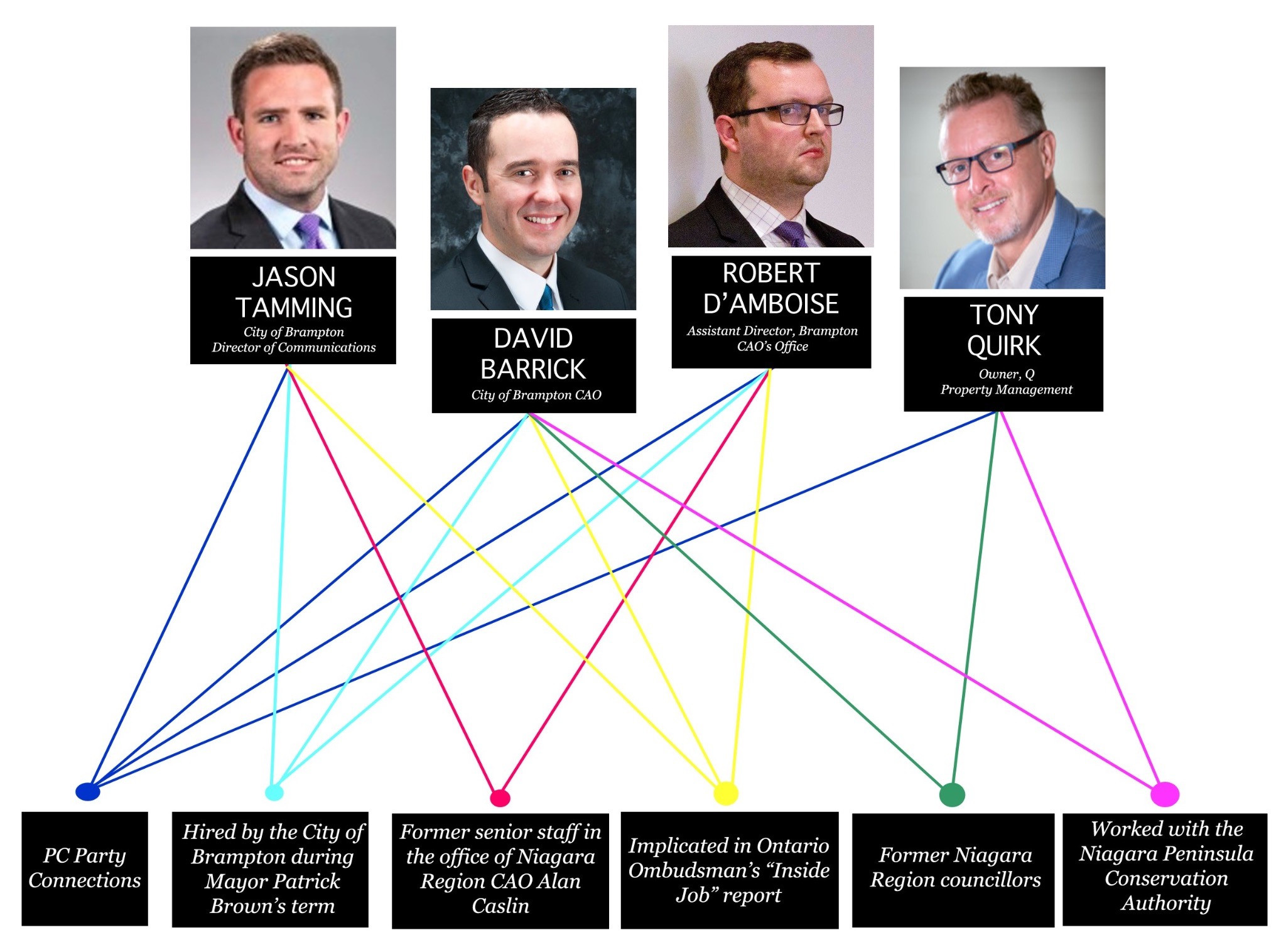
A web of the political and professional connections David Barrick used during his time as CAO in the City of Brampton.
(The Pointer files)
The majority group of Brampton councillors declared democracy was “under siege" in the city and that the administration was being run “like a scene from an authoritarian dictatorship”.
In a stunning open letter, the bloc of six councillors directly pointed to Barrick’s behaviour during his tenure.
“Some local elected members of Council and certain senior staff hired during the current term have taken a blowtorch to the rules that are supposed to govern our city,” the open letter detailed. “Staff complaints have been swept aside under the current bureaucratic leadership, public accountability functions protected by provincial law have been trampled on and matters that should be debated with the full participation of the public are routinely forced into closed-door meetings, which is against the rules that govern Council procedure.”
In February 2022, the six councillors who penned the public letter had enough votes to fire Barrick.
A statement regarding the decision released by the City of Brampton’s communications department—run by Jason Tamming, the staffer implicated alongside Barrick in the corrupt Inside Job hiring scandal in Niagara—was the complete opposite of the letter from councillors made public a few days prior.
In March of 2022, Barrick returned to Brampton with a lawsuit, threatening the City with a $1 million claim if officials didn’t agree to his 12 demands.
He had asked for $40,000 to “engage in education courses” and to be set up with six months of outplacement services through a human resources firm.
He demanded $250,000 in damages and for the City to absorb all the costs associated with selling his Brampton condo.
He asked Brampton taxpayers to pay out certain expenses, including legal fees when he was under investigation for the allegations brought forward by Kaur, and five days of vacation accrued during the pandemic.
He wanted 36 months of salary, including “regular increase[s] to his base compensation” and “a positive letter of reference along with an undertaking that all oral commentary about him will also be positive”.
Barrick’s lawyer said the former CAO could provide a draft copy of the reference letter he would like. It’s unclear if this was ever sent.
“Mr. Barrick requires a public commentary be issued by Council providing a recognition of his very positive service and outline of achievements as CAO of the Corporation,” one demand detailed. “This is vital to Mr. Barrick to try to at least engage in some attempt at repair of his reputation.”
It’s unclear which of these demands the City agreed to. But until at least 2025, Barrick remained on the City of Brampton payroll.
Despite being fired in February 2022, Barrick took home $307,985 from Brampton taxpayers that year. In 2023 they paid him $286,001, and in 2024 he earned $249,009, despite being fired nearly three full years before.
For more than a year, Ontario’s municipal sector did not include David Barrick.
In Niagara, the NPCA had regained its managerial and financial footing, in Brampton investigations were launched into the corrupt behaviour alleged against Brown and Barrick.
Then, in August of 2022, Brown called a surprise meeting near the end of summer when some councillors were still on vacation, and the mayor voted to cancel the investigations despite his clear conflict of interest. Santos also voted for the cancellations, after evidence was revealed in a preliminary investigation report that showed her backroom dealings to get her friend the university contract.
Less than six months later, after the 2022 municipal election saw Brown take control of the entire council, the City of Brampton issued a glowing apology to Barrick, just as he had demanded in his legal threat to officials.
He was then able to start looking for work again.
In June 2023, Barrick was hired as CAO in Thames Centre, a small municipality of about 13,000 people outside of London.
According to sources who contacted The Pointer, councillors were well aware of his background, but proceeded with his hiring anyway, pushed by the mayor. Sources described staff turmoil and mass departures, after spending, expense issues and the hiring of unqualified individuals, according to multiple sources.
The problems started almost immediately after Barrick was hired.
On June 25, less than two weeks after taking over the CAO role, Barrick hired Blaine Lucas as the Town’s deputy treasurer. Lucas was also hired by Barrick in Brampton as the City’s director of projects and liaison. He departed the City soon after Barrick was fired in 2022.
According to Kaur, the Brampton whistleblower, Lucas was hired by Barrick to intimidate employees — “grind” them out— to prevent employees from interfering with Barrick’s questionable conduct.

Screenshots of text messages sent by David Barrick while CAO of the City of Brampton detailing how he hired Blaine Lucas specifically to “grind” another employee out.
Another well known name also resurfaced alongside Barrick in Thames Centre.
He hired his old friend Carmen D’Angelo to be the Town’s treasurer and director of corporate services in January 2025, despite the widespread chaos D’Angelo had caused in Niagara region.
The Pointer learned staff in Thames Centre quickly began to worry that what happened in Brampton City Hall was unfolding again in Thames Centre as the same cast of characters involved in unethical conduct in Niagara and then Brampton had found their way to their small town.
Then, in August 2025, Town officials announced they had “reluctantly” accepted Barrick’s resignation “after a term marked by notable successes in obtaining grant funding, and the modernization of some municipal operations.”
The reasons for Barrick’s departure were never explained.
Numerous sources told The Pointer that Barrick did not resign, but was fired. It’s unclear what led to the release of the Town’s letter praising Barrick. At the NPCA and in Brampton, Barrick made demands for a positive public announcement—in Brampton he threatened a lawsuit if such a declaration was not made (among a long list of demands).
Around the same time the Town announced Barrick’s departure, D’Angelo’s name was removed as treasurer from the Town’s website.
Then, just two months later, as Barrick launched his online media campaign to clear his name by having wildly misleading versions of his history published, he was hired as the CAO in South Stormont. In a press release from the Town Barrick said he was “returning to my roots” as his grandparents are from the area.
He officially started in the role in January 2026.
Barrick lasted less than three months.
The details of what led to his departure have not been made public by the Town.
His abrupt departure was quietly announced on March 24 following an emergency council meeting the day before. The meeting was called only days after The Pointer reported that the OPP blocked reporter Ed Smith from covering Barrick two weeks earlier.
The OPP’s Sylvain Ladouceur, an administrative Sergeant at the detachment that serves South Stormont, provided details to The Pointer about the complaint that led to the reporter not being allowed inside the Town Hall building on March 11.
He explained that a request was received by the local OPP from South Stormont Mayor Bryan McGillis prior to the public council meeting that day. McGillis informed the OPP that information had been provided to him regarding a “history” between David Barrick and Ed Smith, and the Mayor requested Smith be denied access to the property due to that history communicated by Barrick.
Sergeant Ladouceur said the incident report he was reading from does not mention anything about stalking or include any details about the history between Barrick and Smith.
Smith was one of the Niagara residents who obtained documentation through freedom of information requests that showed Barrick’s involvement in the Niagara CAO “Inside Job” recruitment scandal that resulted in the hiring of Carmen D’Angelo, who had been Barrick’s boss at the local conservation authority.
Controversies in Niagara around a group of Conservative politicians prompted Smith’s advocacy efforts to bring accountability to the region, and Barrick who was one of the group of Conservative politicians, was opposed to much of the citizen-led advocacy work Smith was a key part of.
Smith has worked as a reporter for The Pointer since 2023 and recently sent Barrick questions as part of an investigation into his hiring and subsequent departure in Thames Centre where he served as CAO.
Smith has never been accused of stalking and has no recollection of any communication initiated by Barrick.
In a brief statement released about 24 hours after the closed emergency meeting of South Stormont Council to deal with a staffing matter, the Township announced Barrick was no longer the CAO, and expressed gratitude for his work. He was in the job for less than three months.
“We are grateful for the positive impact David has made on the organization and wish him continued success in his future endeavours,” South Stormont Mayor Bryan McGillis wrote in the press release announcing the departure. “The Township of South Stormont will offer no further comment on this matter at this time.”
When Brampton council fired Barrick from his CAO role in 2022, then issued a sparkling endorsement of his work under a $1 million legal threat that also demanded a 36-month severance payment, a positive reference letter and $250,000 in damages, Brampton officials under Patrick Brown’s leadership released the positive appraisal Barrick wanted, with no mention of all the controversies.
After his departure as CAO in Thames Centre last year, a similar positive statement was released by the municipality.
While no communications were made public by South Stormont, a legal letter sent to The Pointer by Tyr LLP on behalf of Barrick, revealed he had been fired from his latest role, prior to his recent hiring in Whitehorse.
“The March 19 Article directly resulted in Mr. Barrick’s recent termination as Chief Administrative Officer for the Township of South Stormont,” the letter from lawyer Michael O’Brien threatening The Pointer with a libel lawsuit detailed, referring to an article published in The Pointer that described what happened when an effort was made to report on Barrick inside the public Town Hall.
The letter demanded a “full and fair retraction and/or correction of the defamatory statements” in The Pointer’s reporting.
No changes were made to the article.
Barrick did not file a libel suit against The Pointer.
In the days following Barrick’s hiring in the Yukon, residents were made aware of his controversial history and began to immediately question his hiring by the mayor and others on council.
“What the christ…” one commentator wrote on Reddit.
“Omg how did we end up hiring this guy!!!!” wrote another.
When someone using an AI summary tool concluded, “the claim that Barrick simply bounced from one scandal or firing to another isn't supported by the complete record,” the post defending Barrick was quickly condemned by others.
“STOP posting bullshit AI overviews….you can see that he WAS directly implicated (along with others) in the Carmen D'Angelo hiring scandal in the "Inside Job" report, and that his ‘exoneration’ is a joke: He threatened to sue the city of Brampton for 1 million dollars, essentially extorting them to ‘exonerate’ him with a predatory lawsuit. And just like all his other recent hirings (all of which ended in scandal and failure), some bullshit leadership hiring firm led to his hiring here. How can we trust our elected officials if they don't even have the brain power to hire someone using their own research, experience, and leadership acumen. Shame!”
Email: [email protected]
Email: [email protected]
At a time when vital public information is needed by everyone, The Pointer has taken down our paywall on all stories to ensure every resident of Brampton, Mississauga and Niagara has access to the facts. For those who are able, we encourage you to consider a subscription. This will help us report on important public interest issues the community needs to know about now more than ever. You can register for a 30-day free trial HERE. Thereafter, The Pointer will charge $10 a month and you can cancel any time right on the website. Thank you
Submit a correction about this story

