
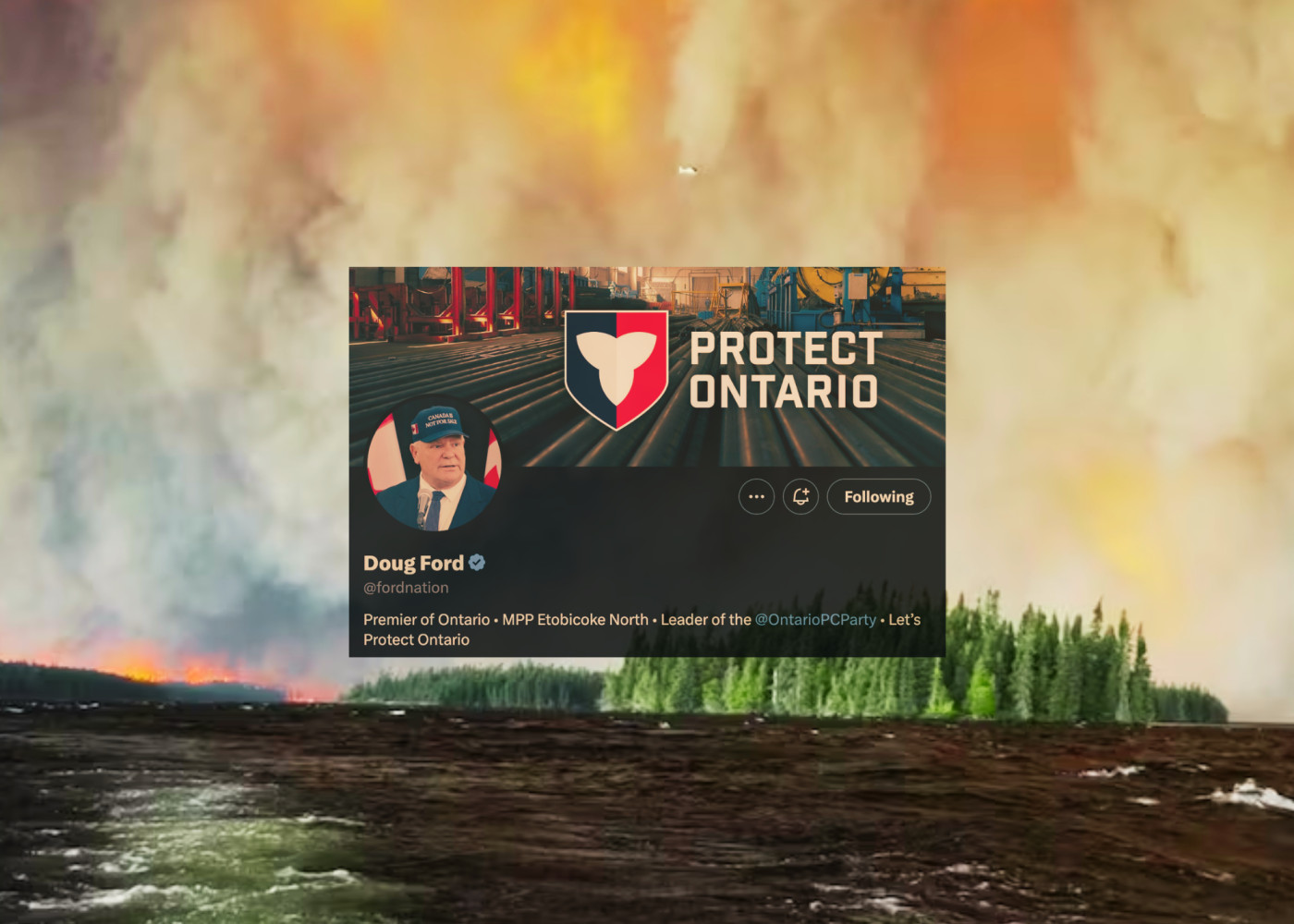
‘In his heart, Doug Ford doesn't believe that climate change is a thing’: PCs quietly dismantle climate change division
As Ontario chokes its way through the worst wildfire season on record, the Doug Ford PC government has quietly dissolved the provincial body responsible for reducing greenhouse gas emissions and helping communities prepare for the worsening impacts of climate change.
During the week when wildfire smoke blanketed the Greater Toronto Area, Chris Winter, who worked as a senior policy analyst for the province from April 2018 until his retirement in February, heard through “word of mouth” that the Climate Change and Resiliency Division had been eliminated.
How could that be?
Unconvinced, Winter checked for himself. What he found stunned him into belief.
“The branches and staff are still there, but they have been reassigned to other divisions,” he told The Pointer.
There was also a new addition to the Ministry of Environment, Conservation and Parks (MECP) — Protect Ontario Priorities Division, with two new branches under its authority including the Environmental Assessment and Permissions Modernization Branch, and the Science Integration and Renewal Branch.
The names seem like something out of George Orwell’s 1984. The government authorities in his famous dystopian novel stood for the exact opposite of what they were called by the fascist Government of Oceania: The Ministry of Truth; The Ministry of Peace; The Ministry of Love; The Ministry of Plenty.
Ford’s new Environmental Assessment and Permissions Modernization Branch is responsible for modernizing Ontario's environmental assessment program, according to the province's Info-Go directory. The branch works with other government divisions, ministries, regulated industries and Indigenous communities to maintain environmental oversight while reducing delays for projects the Province considers a priority. Ford and the development industry that has funded his political campaigns have repeatedly criticized the role previous environmental oversight has played in regulating builders who have made clear their desire for profits above all else.
The directory does not describe the mandate or responsibilities of the newly created Science Integration and Renewal Branch.
The Pointer reached out to MECP to learn more about what the move means but did not receive a response.
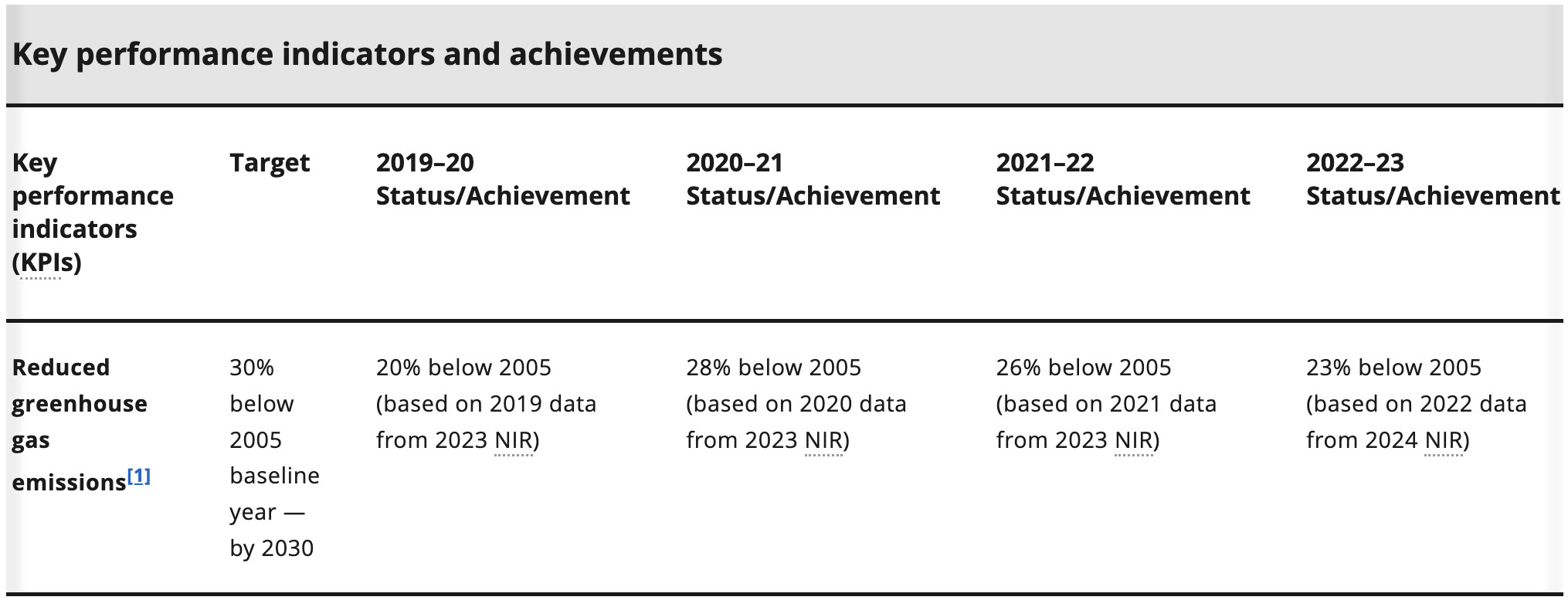
The Ministry of the Environment, Conservation and Parks comprises seven specialized divisions that develop and implement environmental legislation, regulations, standards, policies, guidelines and programs. One of its core divisions was the Climate Change and Resiliency Division that led “the government’s efforts to lower greenhouse gas emissions to meet our 2030 target and to help communities prepare for the impacts of climate change”. It was quietly eliminated recently.
(Government of Ontario)
“Little has changed in substance, but quite a lot in priorities. It means that addressing the immediate and long-term impacts of a changing climate is not one of the priorities for “protecting Ontario”,” Winter explained.
“Not that it ever has been for this government.”
The change signals that meaningful consultation, coordinated planning and government leadership on a clean economy and healthy communities have been pushed aside, as the PCs charge ahead with highways, sprawl, the Ring of Fire mining activities, private spas and jails.
Newly retired and no longer bound by the constraints of public service, Winter now has the freedom to pursue projects that interest him and to speak publicly about the government's decisions.
When he started working for the provincial government in 2018 after a long career in nongovernmental climate policy, he was expecting to use that experience to help shape Ontario’s next climate strategy, focusing on environmental policy and community engagement.
Instead, two months later, the Progressive Conservative government took office with Ford as its leader and “ripped up everything” the previous Liberal government had been working toward.
That same month, the Ministry of the Environment and Climate Change was renamed to the Ministry of the Environment, Conservation and Parks.
Ford claimed only “radical environmentalists” opposed the pro-development agenda he pushed through. He repeatedly said regulations and oversight processes meant to protect communities and prevent damage to our landscapes, ecosystems and watersheds were nothing more than “red-tape”.
Ensuring Ontarians have clean air to breathe was just another barrier for developers and private-sector infrastructure companies.
Within a year, Ford abolished Ontario's independent Office of the Environmental Commissioner, a non-partisan officer of the Legislative Assembly of Ontario charged with upholding the province's Environmental Bill of Rights (EBR), moving its duties under the Office of the Auditor General of Ontario. In 2025, Auditor General Shelley Spence’s report concluded the Ford government was actively eroding Ontarians' EBR-protected laws.
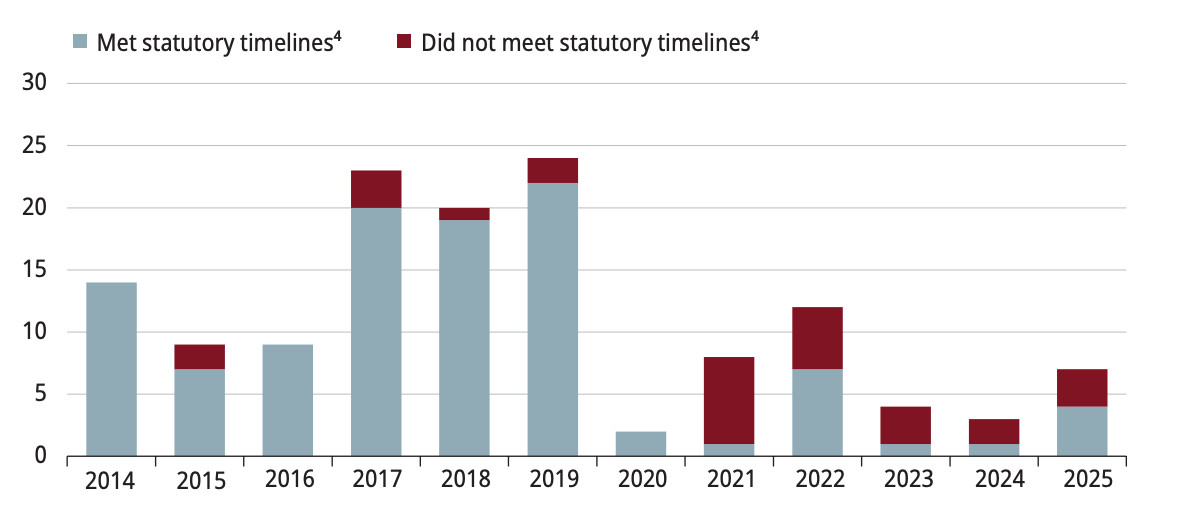
The Auditor General’s latest report revealed that both the environment and natural resources ministries repeatedly failed to meet the legally mandated timelines for handling applications submitted under the Environmental Bill of Rights since 2019, even as the number of applications has fallen, despite having no discretion to extend the deadlines except when formally prolonging an investigation. Of the 12 applications for review or with active investigation, or completed in 2024-25, the ministries missed statutory timelines in half of the cases.
(Auditor General of Ontario)
“They then wrote a draft for a new climate plan that has yet to be approved,” Winter added.
Last year, Ford abandoned Ontario’s emissions reduction targets, took out provisions to develop a climate plan and report on its progress while fast-tracking multiple pieces of legislation that weakened environmental assessment in favour of infrastructural and housing projects including Bill 5, the Protect Ontario by Unleashing Our Economy Act, which allows the provincial cabinet to exempt specific projects and controversial Special Economic Zones from standard environmental rules.
That steamrolling continued this year. Before Queen’s Park adjourned for its 21-week summer recess, the PCs passed Bill 97, the Plan to Protect Ontario Act (Budget Measures), which consolidated Ontario’s 36 conservation authorities into nine regional bodies while Bill 98, the Building Homes and Improving Transportation Infrastructure Act, removed municipalities’ ability to pass environmental protection bylaws and limited their authority to enforce sustainable design standards—thereby also acting as the “final death knell” for birds. The legislation also created a framework allowing the province to transfer municipal water and wastewater infrastructure to designated public corporations, which legal experts fear could still leave room for private-sector involvement. The impact will be first felt in the Peel region since it is the testing ground for the province’s risky experiment.
“If you got rid of all of [the] environment and climate change initiatives in one fell swoop, people would notice,” Ontario’s former environment minister, Chris Ballard, said, highlighting the Ford government’s strategy.
“Instead, you do it over two or three steps.”
Ballard, who served as Ontario’s last environment and climate change minister before the ministry was renamed, viewed the inclusion of climate change in the ministry’s title itself as a representation of the government’s priorities shifting away from climate action and environmental regulation.
“The fact that Doug Ford renamed the ministry: Environment, Conservation and Parks speaks to the fact that as far as he's concerned, if we have some nice parks, that's all we need to worry about,” he criticized, noting MECP’s central objective used to be addressing both climate mitigation and adaptation.
“The rest of the province can be ravaged for corporate gain.”
The province’s Climate Change and Resiliency Division comprised a team of scientists, policy experts and public servants focused on understanding climate risks, developing and tracking emissions-reduction strategies while advising government on how to coordinate climate-related work across ministries and make informed policy decisions.
The division supported initiatives such as Ontario’s Emissions Performance Standards (EPS) program, which aimed to bring down industrial emissions while providing an alternative to the federal carbon pricing system.
It worked with industries on emissions-reduction projects and supported climate adaptation efforts in communities around the Great Lakes. One of its core mandates was to “build on the province’s Climate Change Impact Assessment and support ongoing work to better understand where and how Ontario is vulnerable to the impacts of climate change”.
“It really was a different time in how we addressed environmental problems. It was much more integrative, consultative and collaborative,” Winter added.
“But gradually over time, it got whittled back until we've got to the point now where there's very little connection between the provincial government and the people and the organizations that they are supposed to be helping and supporting.”
That scientific expertise was central to developing policies like Ontario’s cap-and-trade program, which was cancelled by the PCs as soon as they were elected while nearly 800 wind and renewable energy development contracts were axed by repealing the Green Energy Act—early signs of the Ford government's new direction.
“Cap and trade was about driving down GHG [greenhouse gas] emissions and doing it in a way that didn't hurt the average consumer's pocketbook,” Ballard noted.
Under the system, revenue generated from carbon markets was directed toward projects intended to reduce greenhouse gas emissions through investments in public transit, energy efficiency (home retrofits) and clean technology.
“We wanted a mechanism that would incite polluting businesses to clean up their act. It became beneficial economically, and all of this was coordinated, researched and developed by these departments that no longer exist, and by the scientists that most likely won't be around for long.”
He is referring to the Climate Change and Resiliency Division’s branches and staff being reassigned to other divisions — “the first step in getting rid of them” — gradually “diluting” scientific capacity and efficiency, making it harder for the government to maintain accountability and for climate work to remain visible.
“This is a major step forward to take science out of the permitting process and get rid of public accountability,” Ballard said.
“We'll see major infrastructure projects, mines and pipelines move ahead without, in Doug Ford's view, those pesky legislation that actually puts the environment in the equation through rigorous assessments.”
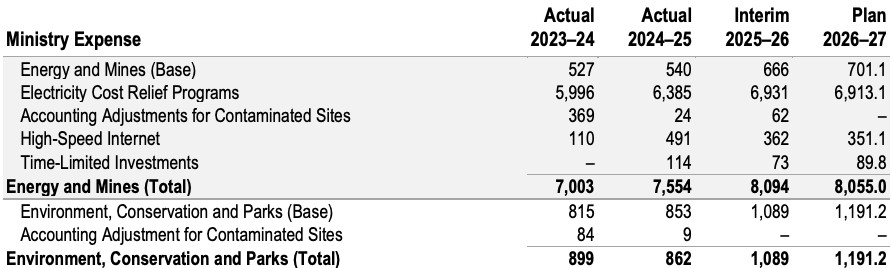
In the 2026 Budget titled ‘A Plan to Protect Ontario’, the Progressive Conservative government maintained over $8 billion in funding for the Ministry of Energy and Mines.
(Government of Ontario)
Despite consistently weakening environmental regulations under the guise of protecting Ontario, under Ford’s leadership, the Province’s deficit has nearly doubled to $13.8 billion, almost twice the $7.8 billion projected last year, pushing the return to surplus to 2028–29 rather than the balanced budgets originally promised by the PCs.
“Within North America’s Great Lakes region, Ontario is clearly an economic laggard and its living standards are falling behind those of its neighbours,” Jake Fuss, Fraser Institute’s Director of Fiscal Studies, said while releasing a report in April.
Between 2001 and 2024, GDP (Gross Domestic Product) per person grew 22.5 percent across the Great Lakes region compared to just 12.7 percent in Ontario. In 2024, the province ranked second-lowest among jurisdictions studied, ahead of only Quebec, with a GDP per person of $74,143.
Last year, Ontario was among the two provinces where extreme weather events fueled by climate change caused over $490 million in insured damage, according to the Insurance Bureau of Canada.
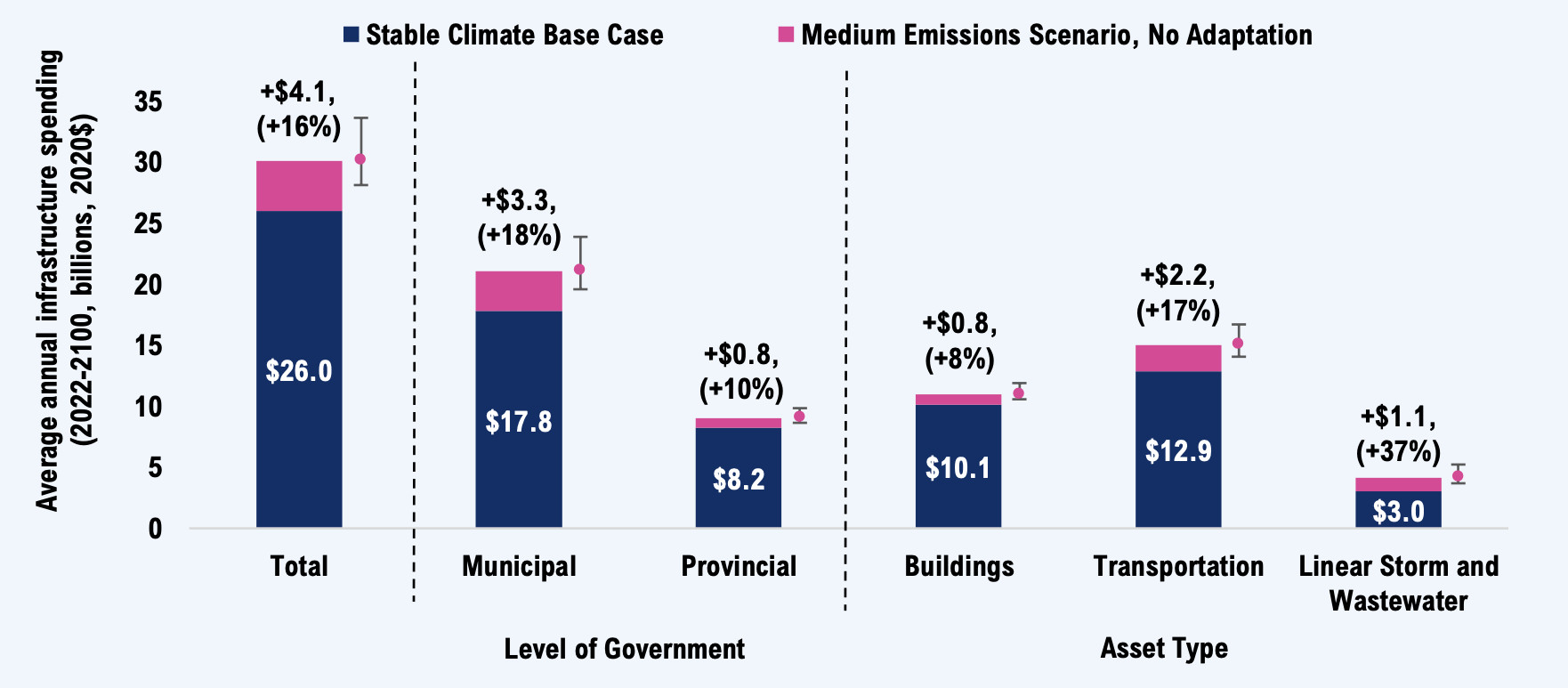
Climate hazards are driving up infrastructure costs: without adaptation, maintaining Ontario’s $708B public assets could cost an extra $4.1B per year and who will bear the brunt? Ontario’s municipalities will be managing over 70 percent of the portfolio at most risk, according to a 2023 Financial Accountability Office of Ontario report.
(Financial Accountability Office of Ontario)
Northwestern Ontario faced one of the driest summers in 75 years as 77 percent of Canada experienced drought conditions. The direct result of this is visible today with much of the region evacuated due to wildfires; as of July 24, there are 145 active wildland fires in the Northwest Region—49 are not under control, as per Ontario Forest Fires.
“But Doug [Ford] will tell you this is all part of the natural forest burn cycle,” Ballard said.
“The average Ontarian should be really concerned about what this province is actively denying and that is the impact of climate change…Because in his heart, Doug Ford doesn't believe that climate change is a thing.”
Winter fears Ontario is facing a moment where “climate leadership is sorely missing” as communities grapple with increasingly frequent wildfires, flooding and other climate impacts.
While the PCs have not hesitated to spend a record-breaking $111.9 million on Protect Ontario advertising, its own Emergency Management Minister Jill Dunlop has struggled to answer basic questions as Indigenous communities bear the brunt of a ravaging wildfire crisis — abruptly ending a media interview after concerns were raised from First Nations leaders about the province’s wildfire response.
“When the government is spending all this money on Protect Ontario ads, they are taking a very limited and dark image of what it means to protect Ontario,” Winter noted.
“And ignoring what is actually the real deep underlying problems that are going to threaten our future security and economic viability and our quality of life down the road.”
He firmly believes addressing climate change requires more than simply releasing another government plan; it requires climate action to be integrated across all areas of policy including transportation, housing, development and economic planning while involving communities, businesses and organizations in shaping solutions—tasks that the Climate Change and Resiliency Division helped complete.
The good news is climate solutions are already being driven by communities and markets responding to practical needs, visible through growing adoption of technologies such as heat pumps, electric vehicles and alternative transportation.
“People are making choices in their lives, companies are responding to that and the government that is aligning with the old fossil dinosaur industry is behind the times and becoming irrelevant,” Winter said.
“Ontario has so much potential to be a leader in building a clean, resilient and better future, but I guess it's up to us folks. But we already knew that, right?”
Email: [email protected]
At a time when vital public information is needed by everyone, The Pointer has taken down our paywall on all stories to ensure every resident of Brampton, Mississauga and Niagara has access to the facts. For those who are able, we encourage you to consider a subscription. This will help us report on important public interest issues the community needs to know about now more than ever. You can register for a 30-day free trial HERE. Thereafter, The Pointer will charge $10 a month and you can cancel any time right on the website. Thank you
Submit a correction about this story

