
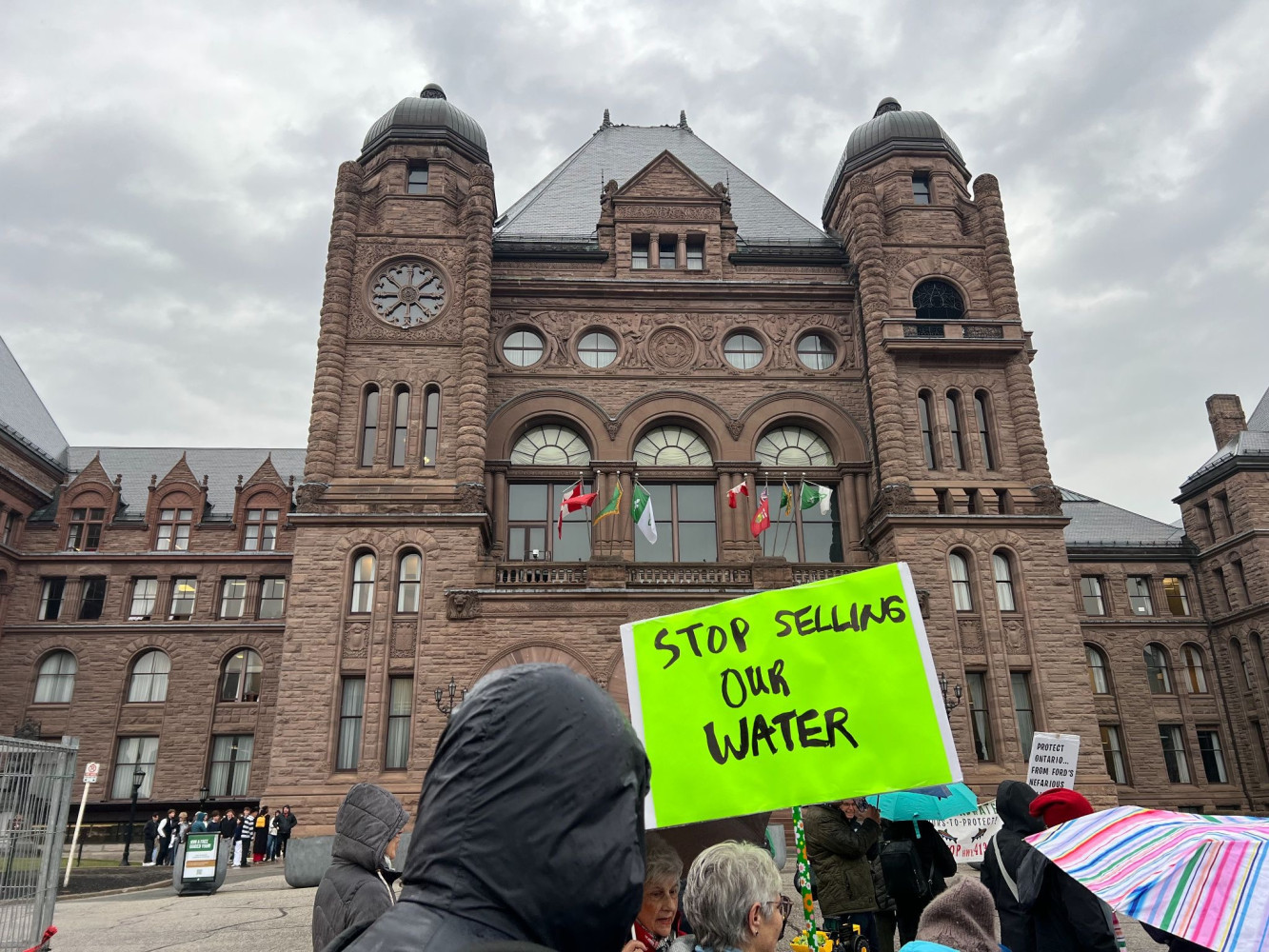
Niagara residents oppose Ford government’s ‘disastrous’ push for water privatization
Before people’s morning routine when they turn on their taps standing wearily in front of the bathroom mirror, Niagara resident and water compliance technician Dan Hales has worked long hours testing, repairing and safeguarding an invisible network that keeps a community healthy and safe.
“Being an operator just isn’t an abstract for me, it is my livelihood,” Hales said bluntly during a press conference organized by the Canadian Union of Public Employees (CUPE) on April 21.
“When I first came into water, and I learned about the tragedy at Walkerton, I knew I was gonna follow a path that would help never let that happen again.
“Water is not just another commodity. It is vital. It is a fundamental foundation of life.”
Behind the scenes, he is one of many highly trained operators with certifications and licenses that take years to obtain, working to keep that lifeline secure by monitoring systems, repairing infrastructure, responding to emergencies like “when a home is flooded with backed-up sewage”, “when water mains burst in underground, collapsing a roadway”. It’s demanding, often invisible work, but essential.
Hales was born in Thorold, it’s where he met his wife and where they are raising their family. That strong connection is what pushes him to go the extra mile. He takes immense pride in going to work every single day, knowing that he has a hand in caring for his family and his community.
It is why he believes that work belongs in public hands. He argues systems should be accountable to people, not profit because the stakes are simply too high.
“The work we do keeps water safe, in turn, keeping our community safe. And we perform that much better and we always will, than any private contractor. That's why Ontario's public water systems are among some of the best in the world,” he noted.
Hales is among the 61 percent of Niagara residents who want their local mayor, councillors and regional councillors to oppose the forced transfer of water and wastewater operations from municipalities to business corporations under the Doug Ford government’s recently fast-tracked legislation — Bill 60, dubbed Fighting Delays, Building Faster Act, that passed on November 27 and opened the door to water privatization.
Tabled on October 23, Bill 60’s Schedule 16 introduced the Water and Wastewater Public Corporations Act, handing the Ford government sweeping authority over how water infrastructure is managed across Ontario, giving the Minister of Municipal Affairs and Housing power to designate corporations under the Business Corporations Act to operate municipal water and sewage systems.
The entities would have the ability to “collect and impose fees or charges,” effectively placing control over water rates in their hands while the Province retains influence over key decisions including the “issuance of shares” and the “composition of the board of directors”. If required, corporations must submit a “rate plan that establishes the rates” charged to users that the Minister can approve, reject or require changes to.
The Province chose the Region of Peel as its testing ground for this experiment — one that could prove highly costly for the region already facing a potential shortfall in development charge (DC) revenue of up to $1.7 billion, primarily driven by provincial changes to how infrastructure costs are collected under Bill 23 and Bill 17.
“Our government is piloting a new publicly owned water and wastewater delivery model in Peel Region to save homebuyers money,” Daniel Strauss, a spokesperson for housing minister Rob Flack, told The Star.
“Publicly owned municipal service corporations will be wholly owned by municipalities, not private entities. Our legislation gives municipalities more tools to respond to growth pressures — all while maintaining strong local oversight.”
Immense backlash followed with many legal experts highlighting that the government’s claims of the model guaranteeing public ownership do not hold up under scrutiny.
“There’s nothing in the legislation itself that requires the shares of these corporations to be owned by the municipality that creates it, or own public sector entity,” Goldblatt Partners lawyer and Partner Simon Archer, who was engaged by the Canadian Union of Public Employees Ontario (CUPE) to analyze the legislation, said during a press conference on March 13.
“The word public in the name of these corporations does not have any real legal effect.”
After 17 days of backlash, the Ford government tabled Bill 98, officially titled Building Homes and Improving Transportation Infrastructure Act, which provides some clarity on the changes introduced as part of Bill 60.
The new legislation proposes to tighten ownership rules, stating that “the shares of a water and wastewater public corporation can only be issued to a municipality, the Province of Ontario, the Government of Canada or an agent of any of them” and further restricting transfers so they can only move between those public entities.
It also sets limits on infrastructure control, introducing a new section that “prohibits a water and wastewater public corporation from transferring part or all of an asset used to provide water and sewage services unless the board of directors” declares that the asset is “no longer needed,” locking core infrastructure in place unless formally released.
On the financial and legal side, the amendments prevent liabilities from being shifted away as transfer bylaws cannot move obligations tied to certain debt or financial agreements. They also protect workers by ensuring continuity of employment for transferred staff.
Perhaps most significantly, Bill 98 expands the Minister’s reach beyond structure into execution itself. New provisions allow the Minister to make regulations determining “the legal effect of a transfer” including their “effect on existing rights or obligations” and to require parties to enter into, modify or terminate agreements.
A Better Niagara Director Liz Benneian, who described the bill as “yet another anti-democratic power grab by the Ford government”, said the “new wording” is merely an attempt to “assuage fears about these boards becoming for-profit corporations and about the neglect of workers’ rights”, but she is “not convinced”.
“I believe this is a temporary fig leaf to tamp down opposition that can easily be swept away by a couple of lines in a future 900-page omnibus bill,” Benneian warned.
She believes the creation of these corporations — the costs of which are “as yet unknown” — will not reduce public costs.
“The public will still bear the burden of paying off the debts already incurred by municipalities in building and maintaining water and wastewater infrastructure,” including Niagara’s planned wastewater treatment plant, a situation she linked in part to provincial policies encouraging sprawl.
“Bill 98 leaves the door open to so-called agents including private, profit-driven investors, operating on behalf of governments,” CUPE Ontario Municipal Workers (OMW) Representative Krista Laing added.
“That's the poison pill at the heart of Bill 98. The same one that was in Bill 60. Nothing has changed.”
While the new boards may be able to borrow and take on debt in ways municipalities cannot, “the debt and the interest on that debt will still have to be paid for by taxpayers” — Benneian fears the changes “will not relieve their tax burden” and could “add to it” instead.
A survey, conducted by Research Co. and commissioned by CUPE, revealed that 62 percent of Niagara residents are already happy with the quality of the water and wastewater systems in their regional municipality in Niagara, even as the system faces significant infrastructure and financial pressures including more than $680 million in overdue repairs for ageing, poor-condition assets and projected bill increases driven by rising capital, operating and fixed costs.
As of 2024, much of Niagara’s system relies on infrastructure that is over a century old. About 90 percent of the region’s water capacity is supplied by three plants that are roughly 100 years old, carrying a combined repair and equipment backlog of more than $280 million with 44 percent of water facility assets rated in poor to very poor condition.
About 90 percent of wastewater capacity is supplied by plants more than 50 years old and a backlog of over $400 million in required upgrades. Nearly half of wastewater assets (49 percent) are rated in poor to very poor condition, and some of the oldest facilities still reportedly use equipment described as “literally wooden paddles and leather belts”.
Distrust in the Ford government is reflected in strong public preference for keeping water infrastructure under provincial and municipal control rather than shifting it to private corporations that can borrow independently.
Privatization of hydro utilities and the corporate delivery of natural gas have been two issues Queen’s Park has routinely faced criticism for. Weak regulation has fallen short of protecting tax and rate payers, while businesses have made handsome sustained profits on the backs of Ontario consumers.
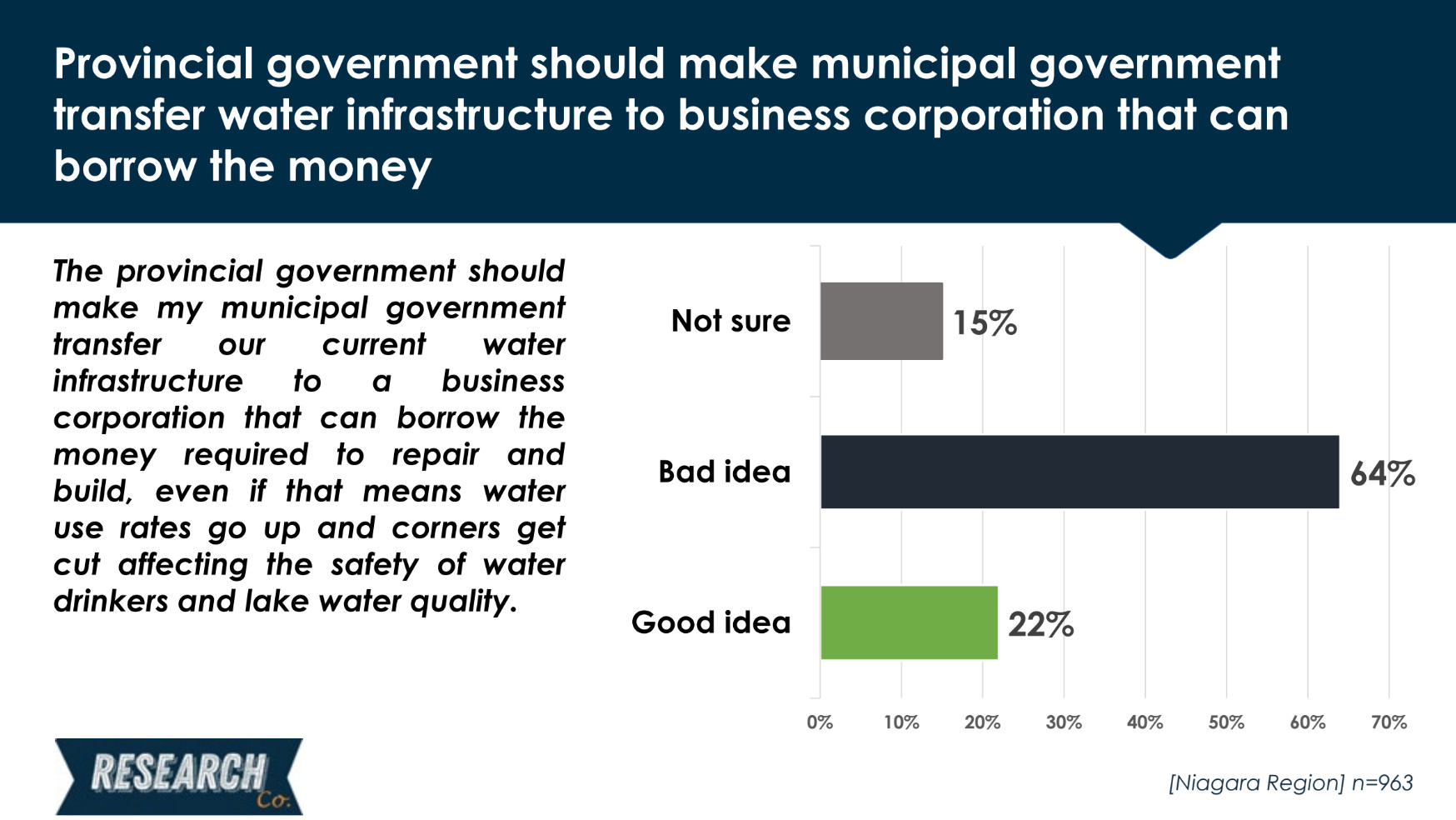
64 percent of Niagara residents think it is a bad idea for the provincial government to make municipal governments transfer water infrastructure to business corporations that can borrow the money.
(Research Co./CUPE)
According to the survey, 65 percent of residents said the province should borrow the money needed to repair existing water infrastructure, even if it means increasing taxes on corporations and individuals earning $250,000 or more, while allowing municipalities to charge developers fees to help recover the costs of new infrastructure, given the profits made from new housing development.
An even larger share (71 percent) agreed that the Province should take on this borrowing directly, since it can access lower interest rates, to fund both repairs and new water infrastructure in Niagara, funded in part through higher taxes on high-income earners and corporations.
“We all know that when water is privatized, the outcome is predictable: higher cost, lower services,” Hales said.
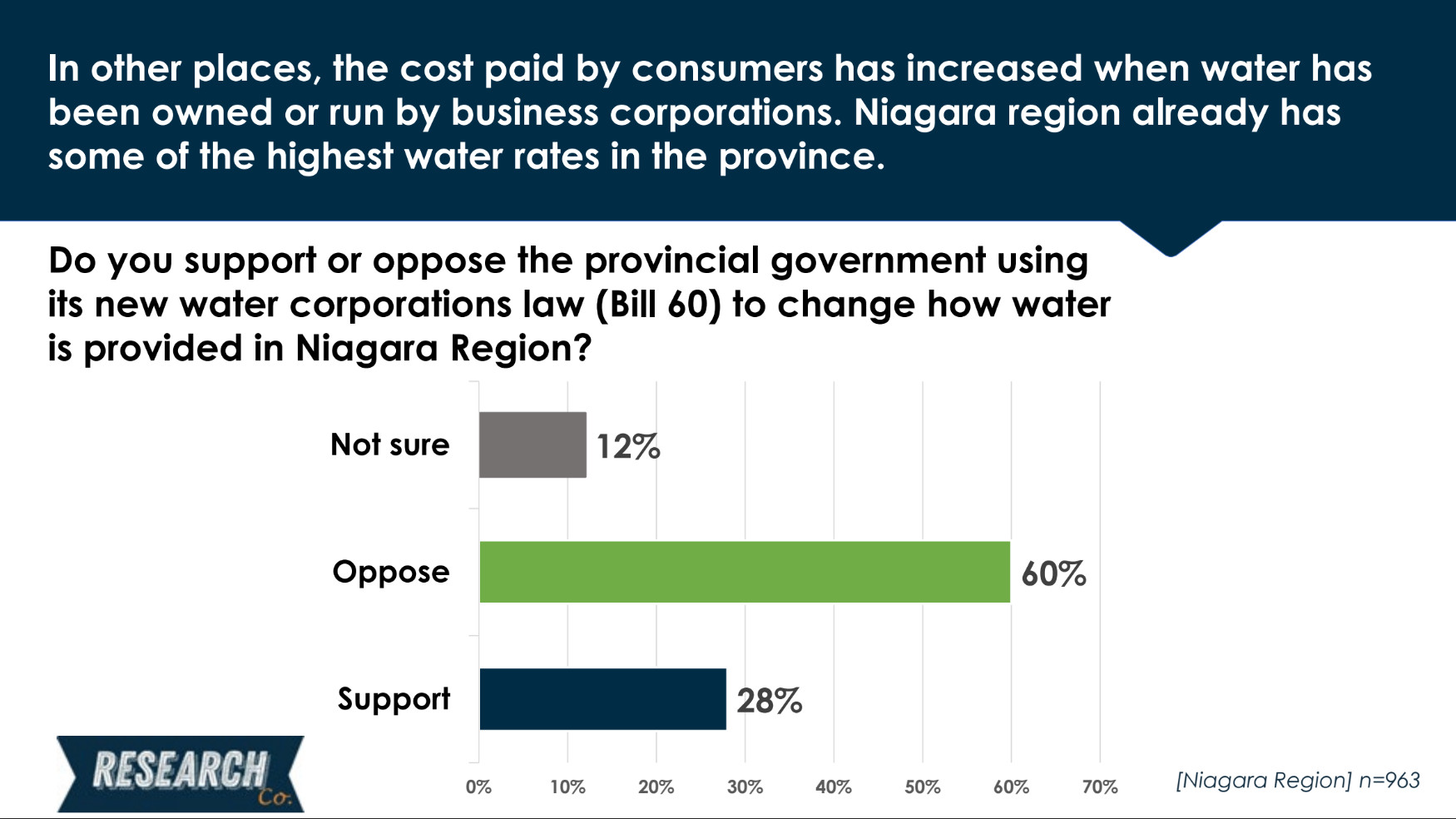
Even when eleven municipalities within the Niagara region have some of the highest water rates in the province, 60 percent of residents oppose the Doug Ford government using its new water corporations law as part of Bill 60 to change how water is provided in the region.
(Research Co./CUPE)
He stressed that in Niagara, residents can turn on the tap 24/7 and pay about $2 to $3 per cubic metre for treated drinking water, but those rates can rise by 20 to 30 percent or more under privatized systems at a time when the costs of essentials like gas and food have already surged. Affordability of water should not become an additional concern.
In 2017, the Town of Taber, Alberta, reversed its decision to privatize water services and brought water and sewage operations back under municipal control after private operator EPCOR proposed a 68 percent increase in utility rates.
The City of Kingston is currently reviewing a KPMG report and business case recommending a Public Municipal Services Corporation (MSC) for water and wastewater under the Municipal Act, arguing it is the only framework that guarantees full public ownership because it explicitly prohibits privatization and keeps the City as sole shareholder, contrasting it with Bill 60, which it says introduces a more provincially directed model with less clarity on ownership protections.
The report emphasizes that a Kingston MSC would be 100 percent municipally owned with no private equity interest and provide greater financial and governance flexibility to address major infrastructure needs. An estimated $100 million annually is required for aging system replacement that current revenues cannot cover, positioning the MSC as a way to maintain local control and long-term financial sustainability without shifting decision-making to the province.
But there’s another piece of legislation in the equation that is being overlooked. On November 3, when Bill 56, the Building a More Competitive Economy Act, received royal assent, the Ford government effectively centralized control over Ontario’s drinking water protections by giving itself greater authority over the wording and implementation of water protection rules, reducing the flexibility of local committees that have long overseen region-specific plans.
The government framed the changes as a way to streamline processes and support housing and infrastructure development, but critics have cautioned the move risks weakening safeguards established after the 2000 Walkerton tragedy, which left seven dead and thousands ill.
“When systems are publicly owned, their primary goal is to serve the people. They are accountable to the citizens, not shareholders,” Hales added.
“The idea that someone could lose access to clean water because they can't afford it, challenges our sense of fairness and dignity. Public control helps ensure water is treated not as a luxury, but as a right, one that must be protected.”
The intent behind the recent wave of legislation becomes clearer when Bills 60 and 98 are viewed alongside Bill 100, the Better Regional Governance Act, put forth on April 2—just days after Bill 98.
Bill 100 proposes further amendments to the Municipal Act and the Municipal Elections Act, 1996, reshaping governance structures in several upper-tier municipalities such as Peel, Durham, Halton, Muskoka, Niagara, Simcoe, Waterloo and York.
It proposes to allow the Minister to appoint regional chairs following the 2026 municipal election and beyond, with authority to remove and replace those appointed leaders.
The bill also opens the door to regulations defining the powers and duties of these appointed heads, which the province has billed as “strong chair” powers similar to the “strong mayor” system introduced in 2022 under Bill 3, Strong Mayors, Building Homes Act, — already misused in many cases like pushing for 12 zoning bylaws by Caledon Mayor Annette Groves.
If passed, Bill 100 would enable the Minister to regulate voting systems within upper-tier councils including the introduction of weighted voting and would restructure councils such as Simcoe and Niagara to include appointed leadership alongside lower-tier municipal representatives.
“Bill 60, Bill 98, Bill 100 — when you connect those dots, the direction is clear. They want to turn water into a for-profit business and concentrate power in the hands of unelected regional chairs,” Laing with CUPE Ontario said.
Oliver Gaskin, a paramedic, Niagara resident and CUPE 911 member, shared that his work in emergency medicine has shown him how quickly systems can fail, often with no second chance. It has taught him that failures in water services are not theoretical but “immediate” and “dangerous”, and that cutting corners can threaten public health, lead to preventable illness and further strain an already stretched healthcare system.
“Public water systems are built on one principle above all else — protecting people, not profit, not development, not speed, not convenience,” Gaskin said.
“Opening the door to privatization is a disastrous move by this government…there is no place for profit in our water.”
Email: [email protected]
At a time when vital public information is needed by everyone, The Pointer has taken down our paywall on all stories to ensure every resident of Brampton, Mississauga and Niagara has access to the facts. For those who are able, we encourage you to consider a subscription. This will help us report on important public interest issues the community needs to know about now more than ever. You can register for a 30-day free trial HERE. Thereafter, The Pointer will charge $10 a month and you can cancel any time right on the website. Thank you
Submit a correction about this story

