
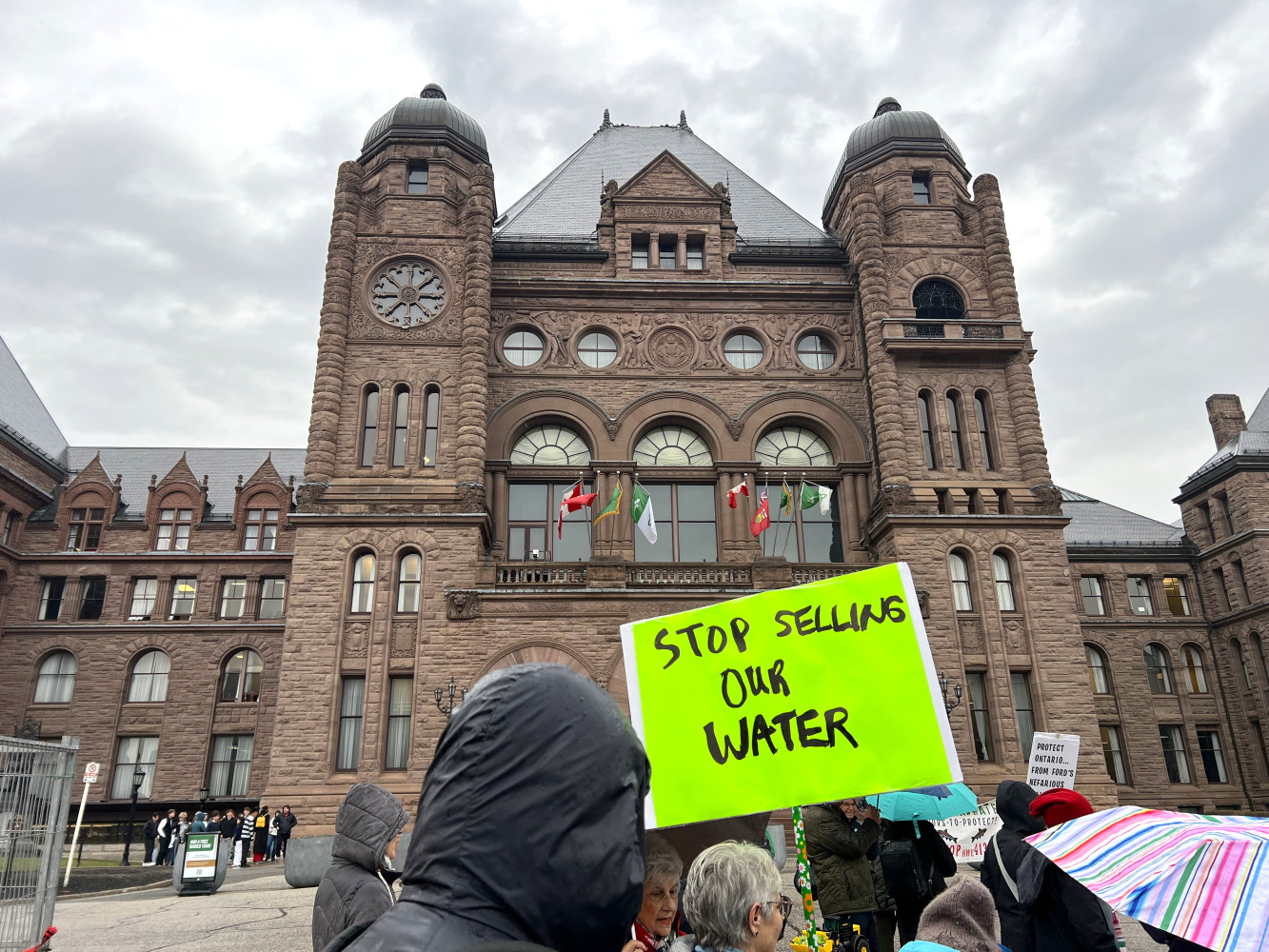
Doug Ford targets Peel to test his water privatization plan
“There is simply no way to overstate the water crisis of the planet today. Many now predict that the wars of this century will be over water,” Canadian water warrior Maude Barlow wrote in her book, Whose Water Is It, Anyway?.
“While governments have been slow in coming to terms with this crisis, the private sector has identified water as the last great untapped natural resource to be exploited for profit.”
Barlow has devoted the last decade shattering the comforting myth that Canada has endless water, fighting to keep every drop clean, safe and in public hands — all of that work might have been undone by a new law pushed through by the Doug Ford government.
“Anytime a Bill is rushed through without proper consideration and discussion, there is usually something to be covered up,” Caledon resident Kate Hepworth said.
Hepworth has been watching her community increasingly squeezed by provincial and local decisions as development and the aggregate industry place a growing strain on Caledon’s water and green spaces.
A thought that consumes most days is that the Ford government “doesn’t care” — a conclusion etched deeper by the latest omnibus bill that opened the door for water privatization, leaving people of the province vulnerable to past mistakes — with the Region of Peel poised to become the testing ground even if it can’t afford to be one.
Despite thousands of comments on Ontario’s Environmental Registry against the legislation, Bill 60, dubbed the Fighting Delays, Building Faster Act, was fast-tracked, in a similar fashion to Bill 5, becoming law on November 27 in less than a month of being introduced.
For many Ontarians, it’s starting to feel like déjà vu: Another omnibus bill. Another promise to fix housing.
“Owning a home is not an option,” Brampton resident Anna Persaud told The Pointer a year ago.
The Progressive Conservative government first tabled Bill 60 on October 23, stating the aim was to speed up housing construction and streamline the Landlord and Tenant Board (LTB) — which first triggered attention from tenants' advocacy groups.
Advocacy Centre for Tenants Ontario and ACORN Canada pointed out that the legislation was “one of the most dangerous attacks on tenant rights” in history, forcing massive evictions and “leaving tenants with fewer tools and time to advocate against their displacement and harassment”.
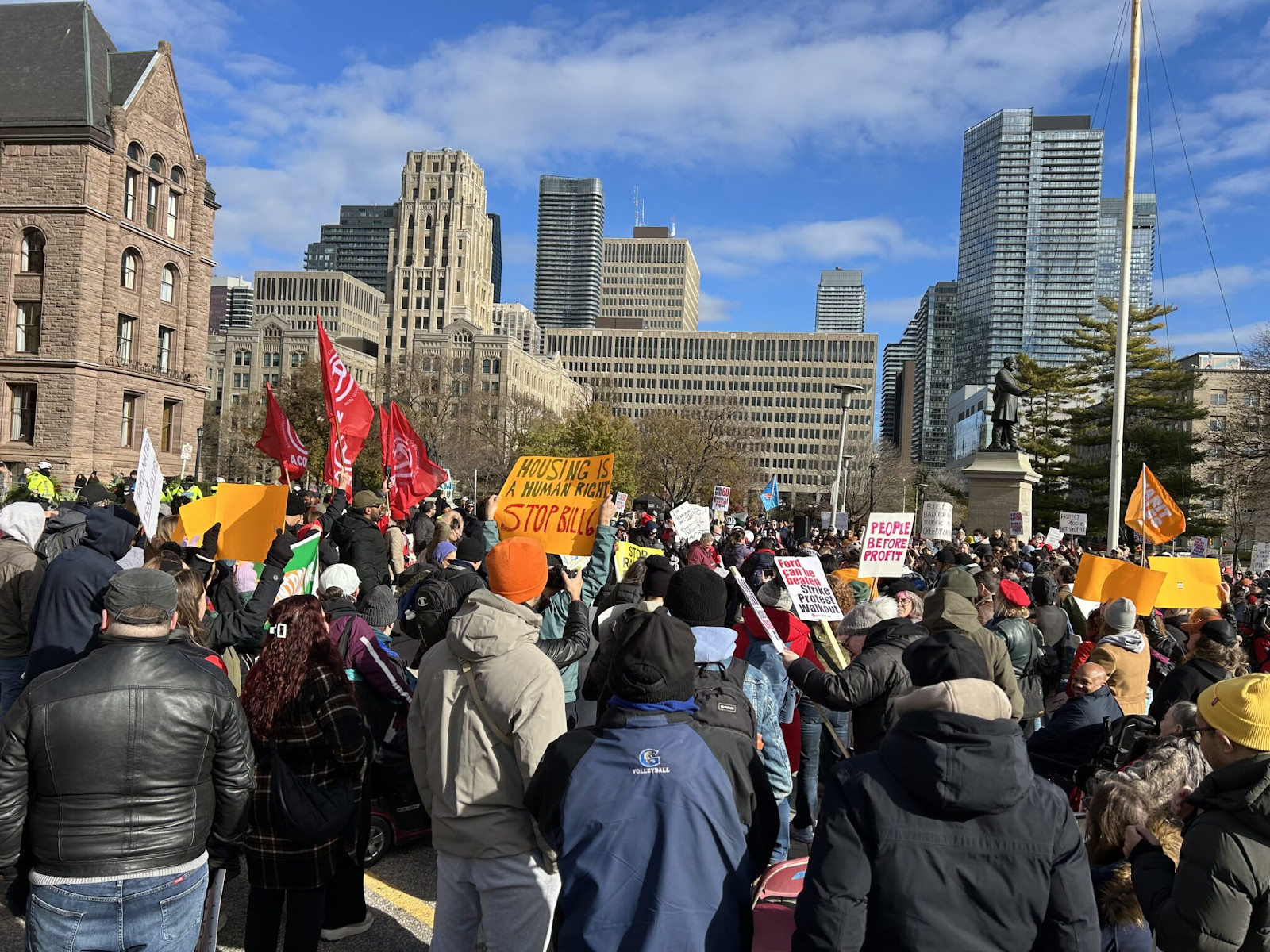
On November 22, also National Housing Day, thousands of tenants from across the Greater Toronto and Hamilton Area filled the front lawn of Queen’s Park to send a message: “Doug Ford, hands off our homes!”
(ACORN Canada)
As protests erupted outside Queen’s Park, environment advocates, opposition leaders and union representatives caught alarming language buried deep in a section within the bill that had initially gone unnoticed — a new framework for delivering municipal water services.
Under Schedule 16, the province introduced the new Water and Wastewater Public Corporations Act, giving the Ford government sweeping authority over how water infrastructure is managed in Ontario.
The Act conferred on the Minister of Municipal Affairs and Housing the power to designate, by regulation, a corporation that is incorporated under the Business Corporations Act as a water and wastewater public corporation to provide water and sewage services on behalf of particular lower-tier municipalities.
These corporations would have the “power to collect and impose fees or charges” from users, effectively giving them control over water rates.
It allows the province to regulate the “issuance of shares of a corporation” and “the composition of the board of directors”, raising concerns about who ultimately owns and controls these entities.
If required, corporations must submit a “rate plan that establishes the rates” charged to users that the Minister can approve, reject or require changes to.
“Our government is piloting a new publicly owned water and wastewater delivery model in Peel Region to save homebuyers money,” Daniel Strauss, a spokesperson for housing minister Rob Flack, told The Star.
“Publicly owned municipal service corporations will be wholly owned by municipalities, not private entities. Our legislation gives municipalities more tools to respond to growth pressures — all while maintaining strong local oversight.”
But legal experts note the government’s claims that the model guarantees public ownership do not hold up under scrutiny.
“There’s nothing in the legislation itself that requires the shares of these corporations to be owned by the municipality that creates it, or own public sector entity,” Goldblatt Partners lawyer and Partner Simon Archer, who was engaged by the Canadian Union of Public Employees Ontario (CUPE) to analyze the legislation, said during a press conference.
“The word public in the name of these corporations does not have any real legal effect.”
On March 13, Ontario New Democratic Party (NDP) leader Marit Stiles was joined by Archer, CUPE President Fred Hahn and frontline municipal workers to break down the devastating impacts of Bill 60 on the province’s water systems and to ask the Ford government to repeal the legislation.
“The fight to keep water in our province safe, clean, affordable, and public…is going to affect every person and every community in Ontario,” Stiles said during a press conference.
“It turns water infrastructure from an asset into a liability and allows
corporations to make money off of what is a basic human right.”
Bill 60 took a “public system that has been built on accountability” and turned it into a “corporate model based on profiteering” by hiding behind “a lot of jargon”.
Archer explained the legislation grants the province “wide powers” over how these new corporations are structured and controlled and ownership rules can be set or changed through future regulations.
While government officials have repeatedly referred to these entities as “municipal service corporations”, that term does not appear anywhere in Bill 60.
Under current regulations, a municipal service corporation must be owned by a municipality. The Association of Ontario Municipalities also reinforces the idea that “water systems are and should remain a publicly owned infrastructure.”
“Since this type of corporation is already available under the municipal act, it's unclear why the government would pass an entirely new act that does not use that term and then say it will create municipal service corporations to house water infrastructure,” Archer emphasized, especially when a precedent has been set previously by Ontario’s electricity system.
In the late 1990s, Ontario broke up its public electricity system and turned local utilities into corporate entities (forming companies such as Hydro One) that were initially kept in public hands through the introduction of Ontario’s Energy Competition Act (ECA) and Electricity Act (EA). However, over time, those same corporations were opened up to private investors with the province gradually selling off shares to the public market.
Critics are now raising an eyebrow over whether water could now be headed down the same path.
It isn’t just electricity and water; Ontarians have seen this playbook before with Bill 60 1.0.
In 2023, another Bill 60 received royal assent — the Your Health Act expanded private-sector involvement in Ontario’s public healthcare system. It allowed for-profit clinics to perform OHIP-covered procedures including cataract surgeries, MRIs and knee and hip replacements with the stated goal of reducing wait times through as-of-right rules and improved community-based care.
But a 2024 Ipsos poll on behalf of the Ontario Medical Association (OMA) found 68 percent of Ontarians believe healthcare has worsened while 83 percent say wait times for surgeries, specialist appointments and diagnostic tests have increased.
“When profit becomes the priority, safety becomes secondary,” CUPE President Fred Hahn said.
Around the world and in Ontario, attempts to privatize public water systems, once considered a basic human right, have often backfired.
Until the 1980s, water was treated like another essential public service alongside energy, transport and social housing. Then, the tide of neoliberal economic policy soon swept through.
Across the pond, in England and Wales, former prime minister Margaret Thatcher’s government privatized state-owned facilities in 1989, promising private investment would modernize infrastructure and deliver better service at lower costs.
The opposite unfolded: water bills soared by around 40 percent, staff were laid off and aging pipes leaked nearly three billion litres of water daily, carrying untreated sewage into rivers and seas — as profits flowed to investors and pension funds rather than being reinvested in infrastructure.
Closer to home, Hamilton became the first major Canadian city to privatize its water system in 1994 by signing a ten-year $180 million deal that was pitched for the same reasons as the United Kingdom.
City leaders envisioned turning Hamilton into a hub for an international private water industry but the reality quickly unravelled. Within a year, a massive spill sent an estimated 182 million litres of untreated sewage containing human waste, heavy metals, and chemicals into Hamilton Harbour and Lake Ontario, flooding more than 115 homes and businesses.
By 2004, after a decade marked by persistent problems, the City brought its water services back under public control, saving approximately $5.66 million between 2005 and 2008.
Matthew Manassis, a water treatment operator and Vice President of CUPE Local 241, which represents Guelph municipal workers, argued the current system works because the people who run it are part of the community it serves.
“My coworkers go above and beyond to conserve and to steward, to ensure that it remains a source of clean city groundwater for generations to come,” Manassis said, noting he lives less than two kilometres away from both the City of Guelph’s main treatment plant and its primary groundwater source, Arkell Springs.
“We’re distributing and treating water for our friends, our family and our neighbours. We would not let those people down.”
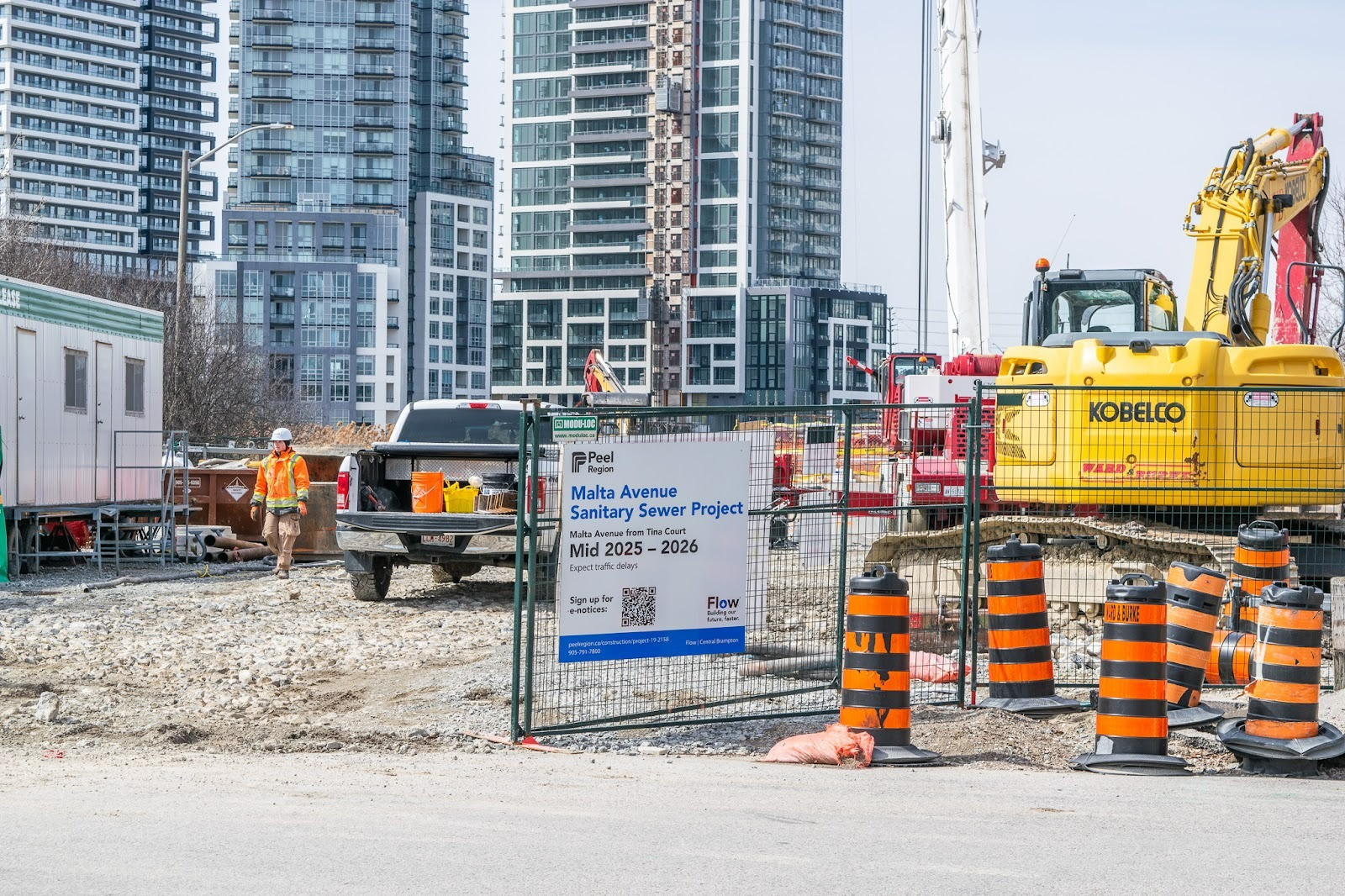
In July, the Region of Peel started construction on a new sanitary sewer along Malta Avenue, near St. Kevin Catholic Elementary School in Brampton.
(Alexis Wright/The Pointer)
The breadth of “in-house” expertise across the municipal systems ranging from highly trained operators, electricians, plumbers to technicians, who handle maintenance, emergency repairs and system upgrades, make public ownership reliable.
“We get truly world-class water to our taps — 24 hours a day, seven days a week for $2 a cubic metre. Show me a better deal,” Manassis said.
“If you have a problem with your water, you phone City Hall. It just makes sense. Why would we want it any other way?”
He reiterated that clean drinking water is not a commodity and Ontario’s system is widely regarded as among the safest in the world and workers like him “want to keep it that way”.
“Bill 60 does not privatize water today, but it does move control of water systems from municipalities to new corporations that operate under corporate law,” Mississauga resident George Tavares told The Pointer.
“Loss of local control could happen quickly once regulations are issued, potentially within weeks to months. Cost impacts would appear over several years as rates are set and adjusted.”
The City of Mississauga shared that it can’t yet speculate on the on impact of residents’ water bills.
“The Province has not yet shared details about the implementation of Bill 60,” the City shared in a statement with The Pointer.
“However, the Bill states that the new entity which will manage water/wastewater will be functioning as of January 1, 2029. This timeline provides sufficient time for the Province to share details and answer any questions we may have.”
But if a similar model like the UK’s hit the Region of Peel — where average quarterly household bills are about $206 (ranging between $130 to $300 per billing period for single-unit homes), a 40 percent increase would push them to nearly $290 per quarter or around $96 per month (an extra $329 per year for the average household) — privatization could make water far less affordable for residents.
Tavares observed that Bill 60 also does not clearly define any stormwater or rainwater charges. “The province can decide through regulations whether they are included in the new system or remain with municipalities.”
“Right now in Mississauga, stormwater fees go to the City or Region and fund local infrastructure like drainage and flood control,” he noted.
“If stormwater is included in the new system, that revenue would likely shift to the corporation and the City could lose that funding stream. If stormwater is excluded, the city keeps collecting those fees as it does now.
“The city could lose that revenue, but it depends entirely on future regulations.”
He believes there are legitimate policy reasons a government might pursue this model: centralizing control, standardizing operations, speeding up infrastructure projects, using different financing tools, reducing duplication between municipalities, and shifting long-term financial risk away from municipal balance sheets.
“But the timing raises reasonable questions”: It follows the proposed restructuring of Peel Region and discussions about Mississauga separating, where some services would move from the Region to the City. The changes could be administrative, financial or simply optics — presenting as modernization or efficiency during municipal transitions.
On March 26, Region of Peel Commissioner of Public Works Kealy Dedman presented a report to council highlighting the complexities Bill 60 brings on board when combined with Bill 45, officially titled Peel Transition Implementation Act.
Peel has invested heavily to accelerate housing-enabling infrastructure with the ten-year water and wastewater capital program growing from $6.8 billion to over $18.4 billion in the past five years.
However, residential construction has slowed to historic lows, especially for medium- and high-density housing, reducing development charge revenues as anticipated provincial and federal funding has not yet materialized, increasing pressure on Peel’s finances and limiting available revenue tools to meet housing targets.
Backbone water and wastewater infrastructure, such as treatment plants, pumping stations, reservoirs and large-diameter pipelines, represents more than 70 percent of the Region’s capital budget, requiring long lead times of up to ten years and must be delivered well before housing construction occurs. Peel plans infrastructure based on long-term growth projections rather than building permits, which occur at the final stage of development to ensure capacity is available when construction resumes, even during market slowdowns.
The Water and Wastewater Infrastructure Plan Update noted capital cash flows have increased significantly from $350 million per year prior to 2022 to over $800 million in 2025 with construction tender prices coming in below estimates, saving approximately $140 million.
But the slowdown in housing starts has reduced development charge (DC) collections, increasing reliance on debt and putting long-term financial sustainability at risk. While Peel retains a AAA credit rating, S&P Global Ratings has revised the outlook to Negative, citing record-high capital spending and reduced DC revenues.
Bill 45, which will transfer regional roads and related stormwater infrastructure to municipalities in 2027, alongwith Bill 60, might impact Peel’s programs, finances and capital plans and depend on future provincial regulations, which remain unclear.
Beyond financial risks, water privatization is a dangerous rope that Ontario simply cannot afford to walk on.
In 2000, the province faced the tragic consequences of similar policies when the Walkerton water crisis claimed seven lives and sickened over 2,300 people as E. coli bacteria entered the town’s water supply following heavy rainfall.
Three senior officials with the Ministry of the Environment testified in 2001 revealing that Ontario’s auditor warned about a lack of inspection at the town’s water and waste treatment plants as early as 1987.
By 1990, more inspectors were hired and all of the municipal water works were inspected. But when Mike Harris’ Conservative government came into power in 1995, it privatized water testing and cut hundreds of jobs at the ministry. Inspections were, therefore, inconsistent and even when serious problems were identified, no enforcement or follow-up occurred.
Finally, the inquiry led to the creation of the Safe Drinking Water Act of 2002.
“The Walkerton water crisis was a preventable tragedy. We remember and honour those who died or became ill. This horrific event has had a profound impact on many lives. Nobody should fear the water they drink,” Ontario Regional Chief Abram Benedict said in a statement last year on the 25th anniversary of the Walkerton Tragedy.
“But for many First Nations people in Ontario, there is a different, persistent crisis that threatens their water and wellbeing. We cannot let it continue. The status quo must change.”
Caledon resident Hepworth, whose concerns over water governance have been building for years, sees decisions like Bill 60 being one piece of a larger puzzle where increasing pressure from development is overtaking environmental safeguards that have kept Ontarians and their natural world safe for years.
In Summer last year, a series of Environmental Registry proposals caught her attention: one made it easier for proponents to reapply for permits when previous ones have been cancelled or expired and another aimed to “streamline environmental permissions” to accelerate infrastructure and housing development.
“On so many levels, the Province doesn't give a damn about water, just take it, we don't really care why,” Hepworth said, feeling agitated.
She argued these policies are already playing out on the ground in places like Caledon, where water-taking for quarries, aggregate washing and dewatering is reshaping local hydrology.
While recycling water is technically possible, she questions its effectiveness given declining water quality. “Used water runs downhill, literally from Caledon,” Hepworth said, describing how sediment and runoff ultimately flow south toward Lake Ontario.
“What is turning into dirty water is now sucked up…to provide water to the higher population of Peel.”
Even land-use changes that have permitted infilling of man-made lakes like the controversial proposal for Swan Lake have increased skepticism among Caledon residents since such changes could alter water tables and potentially create new flood risks by “inevitably” creating issues for “natural groundwater movement”.
“Privatizing Ontario's water will remove protections currently in place because the Provincial Government can only focus on building; they have lost focus of the most important natural resource,” Hepworth said.
“Water will be required by every single new build, no matter the size of the new build. Expanding aggregate will eventually redirect water tables. Natural habitats will die, and, although it pains me to say this, people will die because safety protocols will either be too weak or non-existent.”
Canada sits on a staggering share of nearly 20 percent of the planet’s freshwater with Ontario’s 250,000 lakes alone holding about a fifth of it. It is an inheritance most regions could only dream of — one that increasingly feels taken for granted but for how long?
In January, the United Nations (UN) warned in a report that the world is slipping into an era of “global water bankruptcy” as water systems are pushed beyond recovery.
“For much of the world, ‘normal’ is gone,” Kaveh Madani, Director of the UN University Institute for Water, Environment and Health, said.
“This is not to kill hope but to encourage action and an honest admission of failure today to protect and enable tomorrow.”
Email: [email protected]
At a time when vital public information is needed by everyone, The Pointer has taken down our paywall on all stories to ensure every resident of Brampton, Mississauga and Niagara has access to the facts. For those who are able, we encourage you to consider a subscription. This will help us report on important public interest issues the community needs to know about now more than ever. You can register for a 30-day free trial HERE. Thereafter, The Pointer will charge $10 a month and you can cancel any time right on the website. Thank you
Submit a correction about this story

