
‘Real power of people’: Under fierce public pressure Caledon council halts developer-led Swan Lake fill proposal
Christmas came a little early for Caledon’s Swan Lake neighbours and supporters, who have spent the last eight months living with the anxiety of a bleak future.
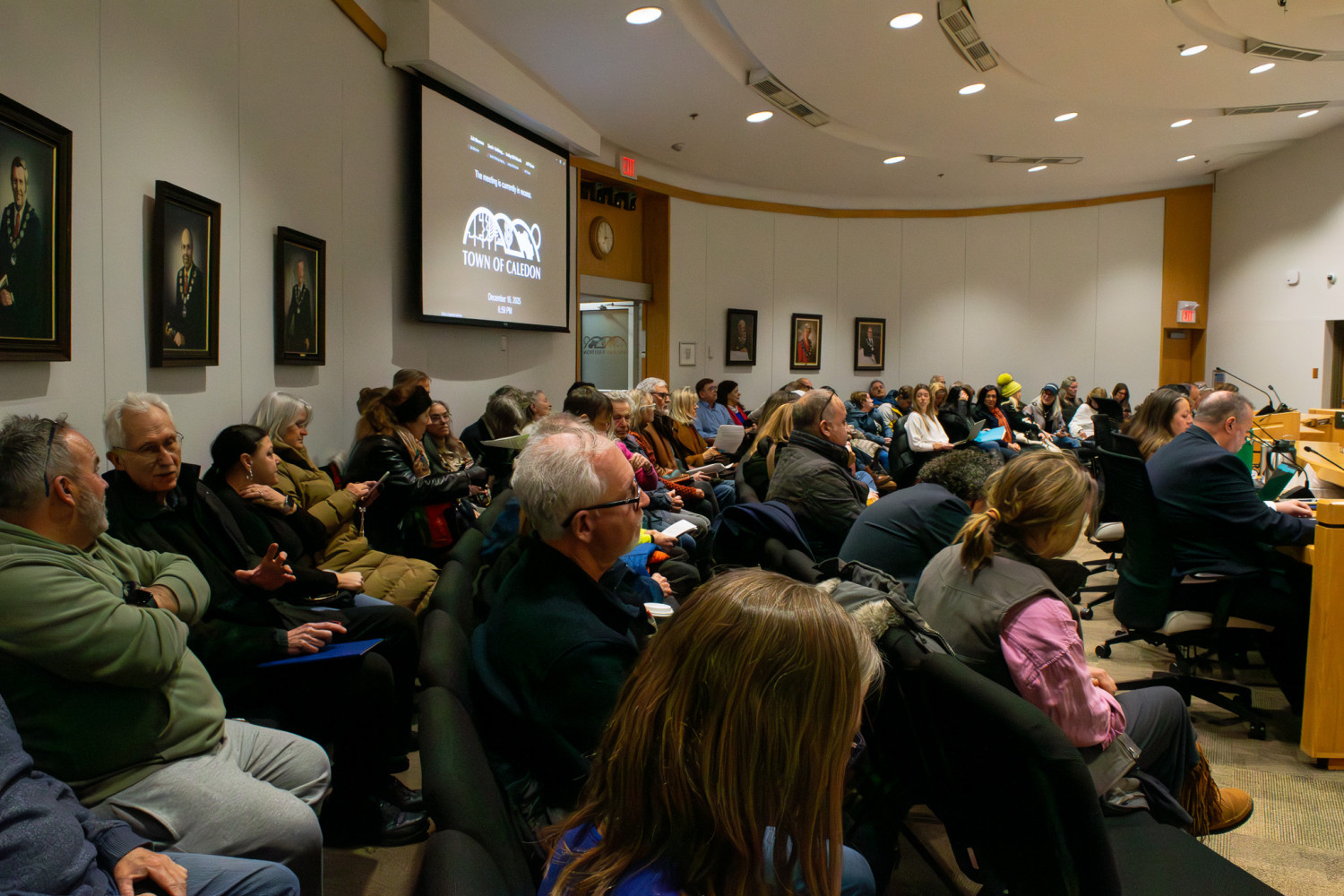
December 16 was no ordinary council meeting at the Town of Caledon. Town Hall seats packed, thundering applause after every delegation in support of Swan Lake, gasps gripping the room, tense back and forth, a rare scene of a smiling Mayor Annette Groves, some poetry and singing to celebrate a temporary but hard-earned victory.
Since May, Chickadee Hill Farm owners Jean-François Morin and Jennifer Casu-Morin as well as Belain Farm’s Karl and Anna de Langley have faced sleepless nights, worrying about what would happen to their livelihood and the well-being of their livestock after Mayor Groves introduced a motion in the spring without public consultation, opening the door for construction fill to be dumped into a rehabilitated body of water where a gaping aggregate pit had swallowed the land at 0 Shaw’s Creek Road (behind their farms) which is now a groundwater-fed, below-water table reservoir known as Swan Lake.
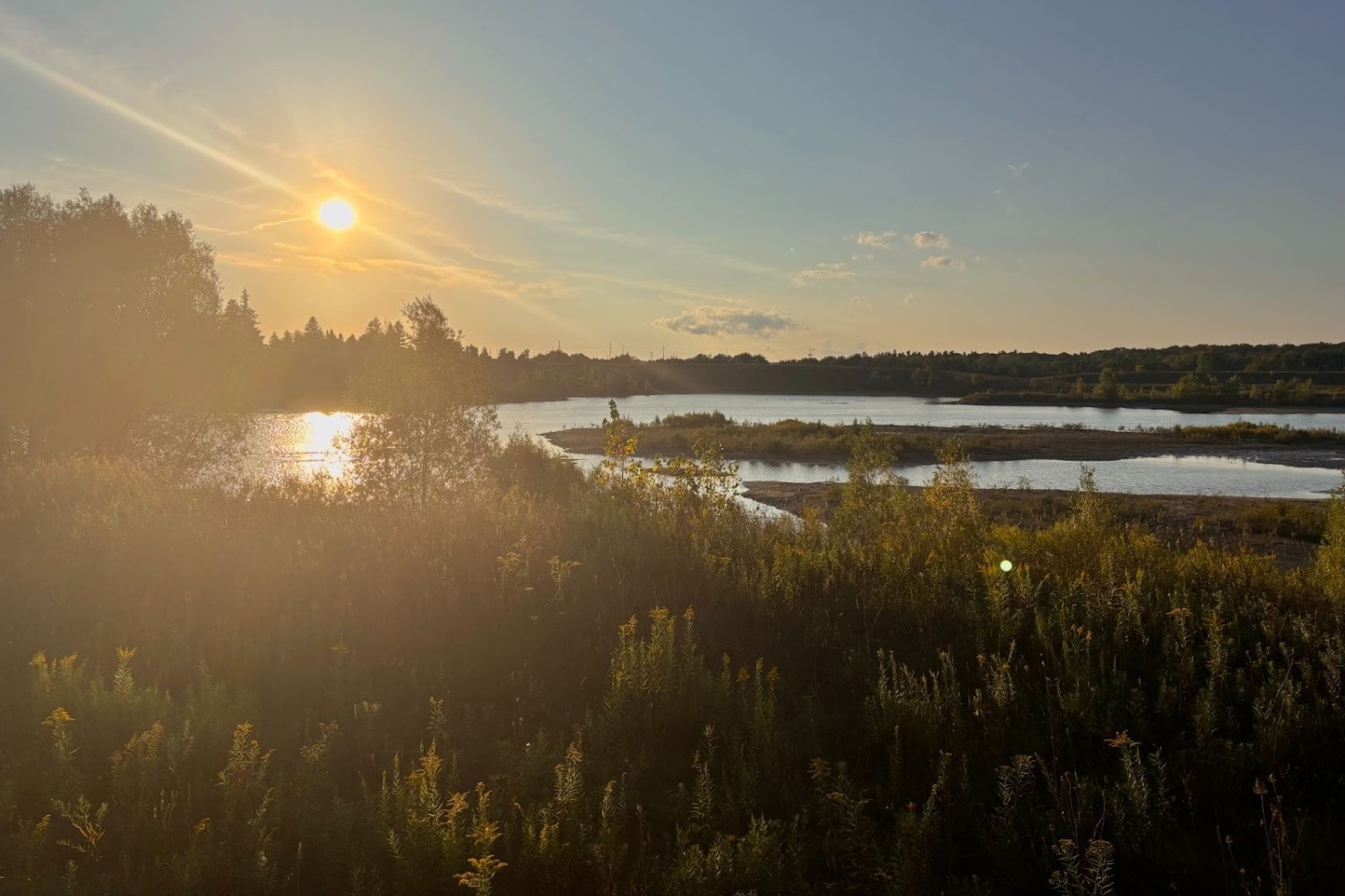
Following strong public backlash, Town of Caledon councillors have halted a plan to allow a developer to fill Swan Lake with construction waste.
(Alexis Wright/The Pointer)
Jennifer Casu-Morin said the motion was approved without notifying directly affected landowners or requiring a hydrogeological study, despite the known risks of dewatering and contamination.
“That combination matters because when decisions affect drinking water, the threshold for due diligence must be higher and not lower,” she said.
“For Chickadee Hill Farm, this is not theoretical. We rely on a well. That well supplies our family, our family is [that] drinking water and the water that our animals depend on. If Swan Lake is dewatered or if fill contaminates the system, we do not just face inconvenience. We lose our livelihood. We lose safe drinking water. This is not a reversible harm. You can't trial water contamination and then roll it back later.”
Some of the impact on their livelihoods was already being felt. Jean-François Morin told Council that many of his customers were asking whether the farm was closing, when it might happen, or if they should start looking for alternative suppliers.
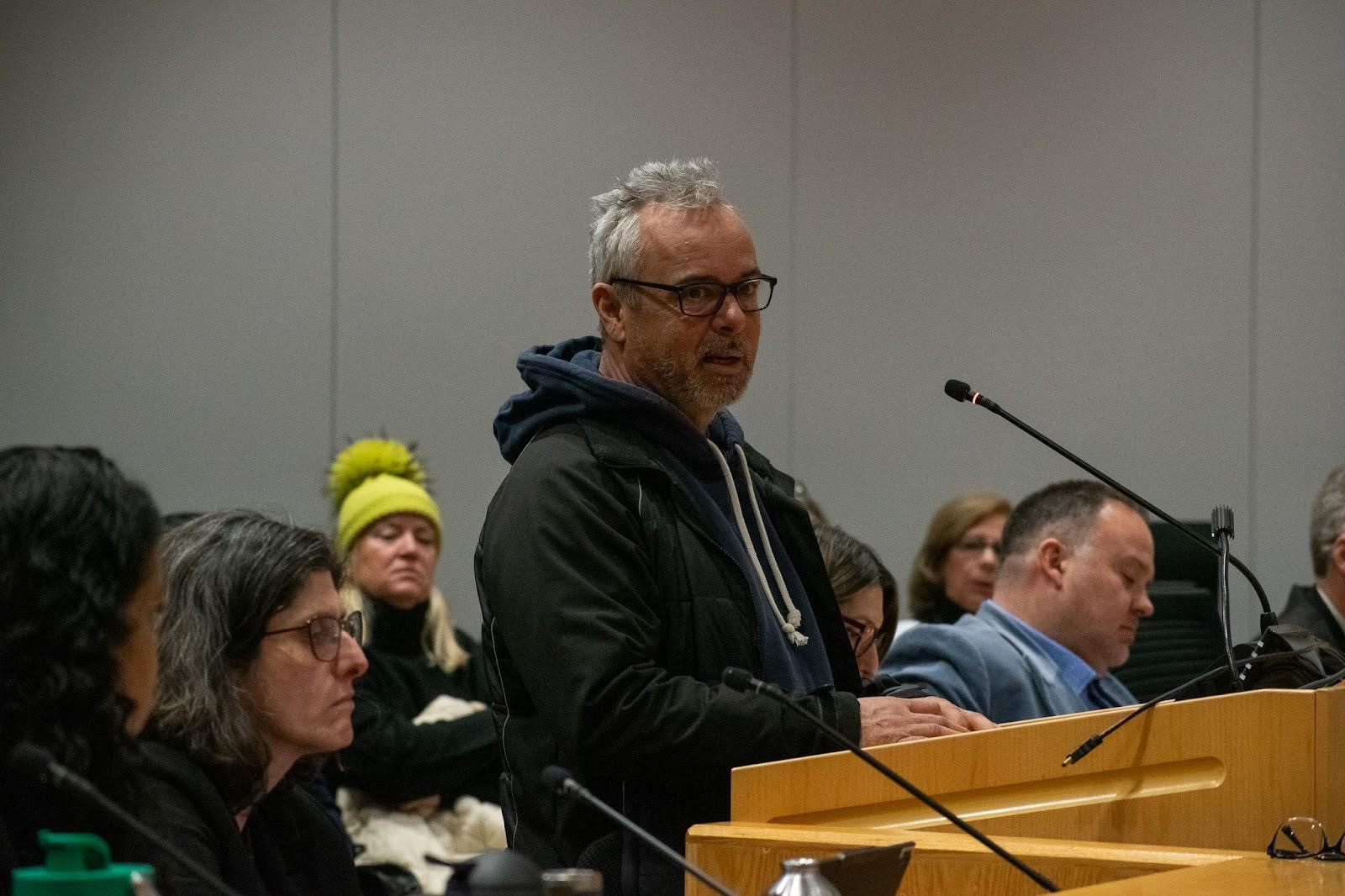
Jean-François Morin is a Caledon-based farmer who moved with his wife, Jennifer Casu-Morin, from North York in 2017 to the pristine town with a simple dream of raising their children closer to nature.
(Alexis Wright/The Pointer)
“I want to be very clear that this is not an argument against development. It is an argument against deciding first and studying later…it’s about risk management and duty of care,” Jennifer said firmly, urging council to rescind the vote, conduct a full study and hold meaningful consultations to protect public health, legal standing, and public trust.
“Rescinding this vote is not an admission of failure, it is an acknowledgement that good governance requires sequencing, consult study, then decide, not the other way around.”
At the council meeting, the Town’s Commissioner of Engineering, Public Works and Transportation, Domenica D’Amico, confirmed that required studies for the proposed import of fill had not been submitted by the “prominent developer”, preventing a recommendation on a grading agreement and the property owner had declined an offer to sell the land to the Credit Valley Conservation Authority, as reported by The Pointer recently.
Among the dozens of residents who spoke at the council meeting was John Rutter who challenged council members and staff with a question: By a show of hands, how many had truly listened to the words of Joni Mitchell’s 1977 song Big Yellow Taxi?
Only a few hands went up. Rutter urged the rest to listen closely, saying the lyrics were “more than applicable to the situation we’re currently facing at Swan Lake.”
Then he began to sing.
“Don’t it always seem to go
That you don’t know what you’ve got till it’s gone
They paved paradise, put up a parking lot…”
The audience joined in, the room filling with smiles and an unexpected sense of spirit. Even Mayor Groves laughed along as the chamber briefly turned from tense to joyful. It was as if the room was bracing for a celebration.
Less than a minute after Rutter finished, council voted unanimously to rescind the motion to dump construction waste into the 44-acre Swan Lake, which also sits on protected Greenbelt land, for the remainder of the current council term.

Swan Lake neighbours Anna de Langley(left), Jennifer Casu-Morin(center) and Swan Lake advocate Keirstyn Parfitt have been actively spreading awareness on the issue, speaking at council meetings and engaging the community to protect local water and farmland.
(Alexis Wright/The Pointer)
The decision felt “surreal” to Anna de Langley even until days after the council meeting “after living with the stress” of their “unknown future, for so long”.
“I’m eternally grateful to all those who raised their voices and contributed to saving Swan Lake - I wish I could hug every one of you,” she told The Pointer.
“I know we have other wrongs to right in Caledon but after last night, I feel hope for our future.”
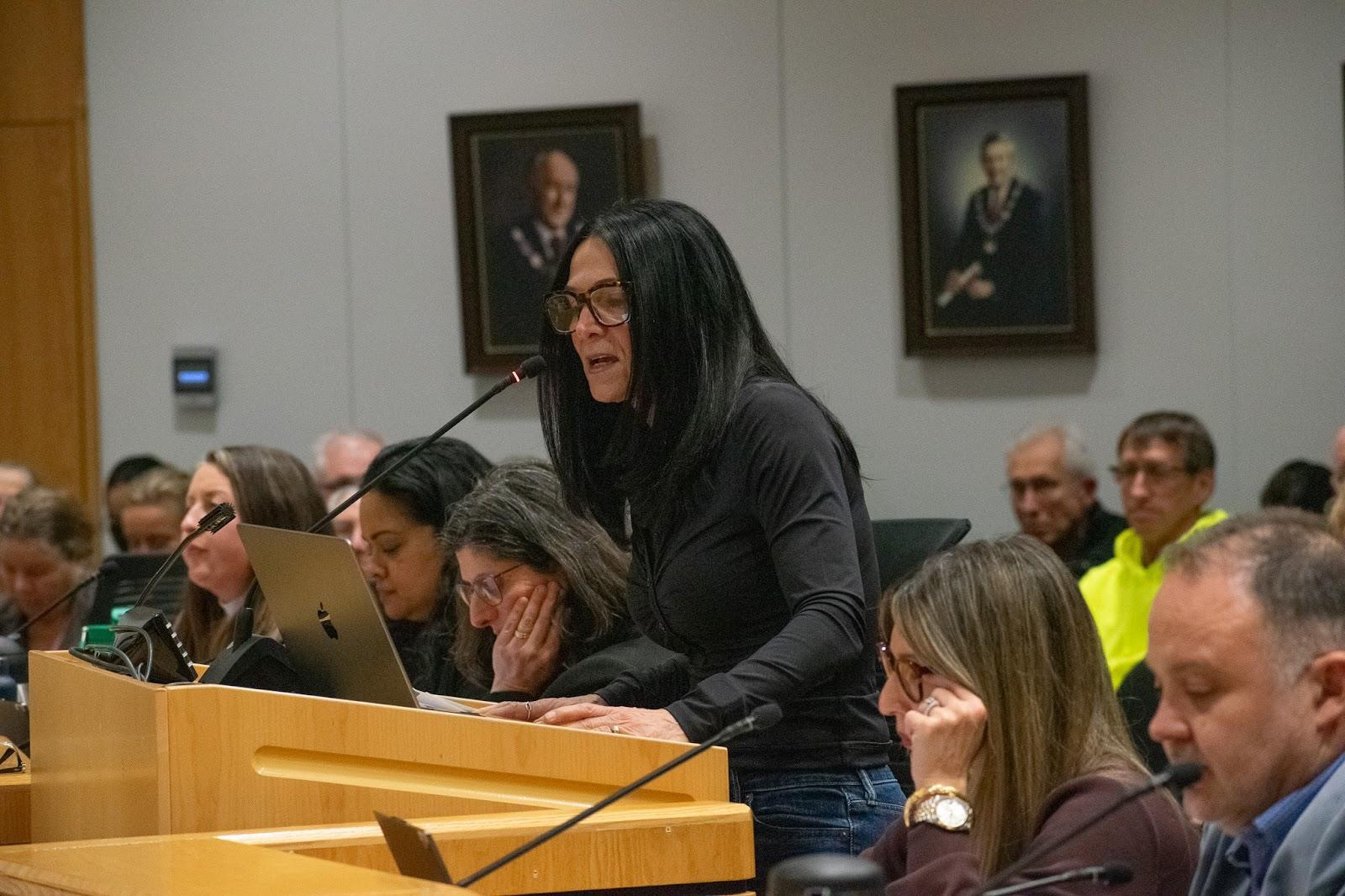
Caledon resident Mira Budd recited a poem she wrote during her delegation: “Swan Lake, not a hole in the ground. Before there were motions or lines on a plan, before reports were commissioned and timelines began, this groundwater lake, steady and intact, feeds drinking water wells and that's just the fact. It gathers the rain and the melt from the snow, allowing life to root and quietly grow. Swan Lake breathes while the town sleeps at night, quietly, keeping balance and light. It cools the air, steadies the land, protecting, rehabilitation and exactly what nature planned. More important than policy, stronger than doubt, a living system, no report should ever leave out. The seasons that move in their natural bond depend on this lake being left alone and not gone. This is not a hole in the ground or a wasted land. This is not an empty space. It is nature doing its job with patience and grace. Swans return because instinct tells them it's safe. Turtles lay eggs where the shoreline still waits. Birds sing with rhythm and flair…you cannot replace this with a report or a chart. You cannot backfill a living, beating heart. Once the trucks come, once the water is gone, what's filled is not land. It's a promise withdrawn. A lake is not a pit. It is not expendable ground. When you fill what's protected, you hollow our town. Council, this choice will echo in time, long past the vote, long past this line, history won't ask what reports were reviewed. It will ask who stood up and who quietly moved. So I ask you this before the damage gets done. If you won't hear the residents, please, then do it for the turtles, the swans, the birds and the bees…please rescind your vote and save Swan Lake.”
(Alexis Wright/The Pointer)
But the decision did not come without debate, reflection and disagreement among some councillors about how the issue had reached this point as they listened to the heavy experiences shared by residents, not only from Caledon but also from another Ontario municipality.
Whitchurch-Stouffville resident, soil biologist and firefighter Mark Carroll drove nearly 80 kilometres to caution Caledon council: Swan Lake looks eerily similar to what his community was told decades ago.
Whitchurch-Stouffville adopted a fill bylaw over two decades ago believing it would tightly control excess soil. Instead, one approval became two, then more, Carroll shared. Today, his municipality lives with multiple long-running fill operations, thousands of truck movements daily, dust, noise, road degradation and no clear end dates.
“The aggregate industry is now recognizing fill, not as a land-management tool, but as a revenue stream,” Carroll said during his delegation.
“Under the guise of rehabilitation, fill has become a mechanism to expand profits. What was once a municipal attempt at responsible oversight has turned into a system that communities struggle to control.”
In an interview with The Pointer, Carroll stressed this is not just a Caledon or Whitchurch-Stouffville issue, it is “an Ontario problem”.
He warned that importing soil is not benign, pointing to international studies showing that fill material can introduce contaminants that do not easily dissipate, particularly in groundwater-dependent areas like Caledon and the Oak Ridges Moraine.
A 2023 study examining contaminant containment found that pollutants such as poly- and perfluoroalkyl substances (PFAS), also known as “forever chemicals”, are commonly associated with construction debris, landfills, wastewater treatment byproducts, firefighting foams and contaminated biosolids. Once introduced into soil, these substances can migrate through groundwater unless complex containment systems are installed and continuously monitored.
Containment methods such as impermeable barriers, soil stabilization and phytostabilization can reduce risk but they require long-term oversight and regular inspections to prevent contaminant mobilization. Without such safeguards, buried contaminants can form plumes that spread beyond the original site, posing long-term risks to drinking water and surrounding ecosystems.
“You’re bringing in something completely different and you don’t know how it’s going to behave once it’s in the ground,” Carroll said.
He described current proposals in Whitchurch-Stouffville involving dormant extraction sites with large ponds, nearly identical to Swan Lake, where developers are seeking approvals that would bring an estimated 300 trucks in and 300 trucks out every day. To accommodate them, municipalities are being asked to install traffic lights on rural roads and accept dust, noise and road damage as the cost of doing business.
Acknowledging that Councils are often pressured to approve projects out of fear that rejection will simply push proponents to the province or the Ontario Land Tribunal, Carroll warned that that approach only worsens the problem.
“I'm challenged that, if that's our narrative, what's the point of Council?,” Caledon Ward 1 Councillor Lynn Kiernan agreed.
Drawing on his experience as a firefighter, Carroll said he has seen firsthand the consequences of heavy truck traffic on rural roads including fatal collisions as dust control becomes virtually impossible when trucks move between multiple pits along north-south and east-west corridors.
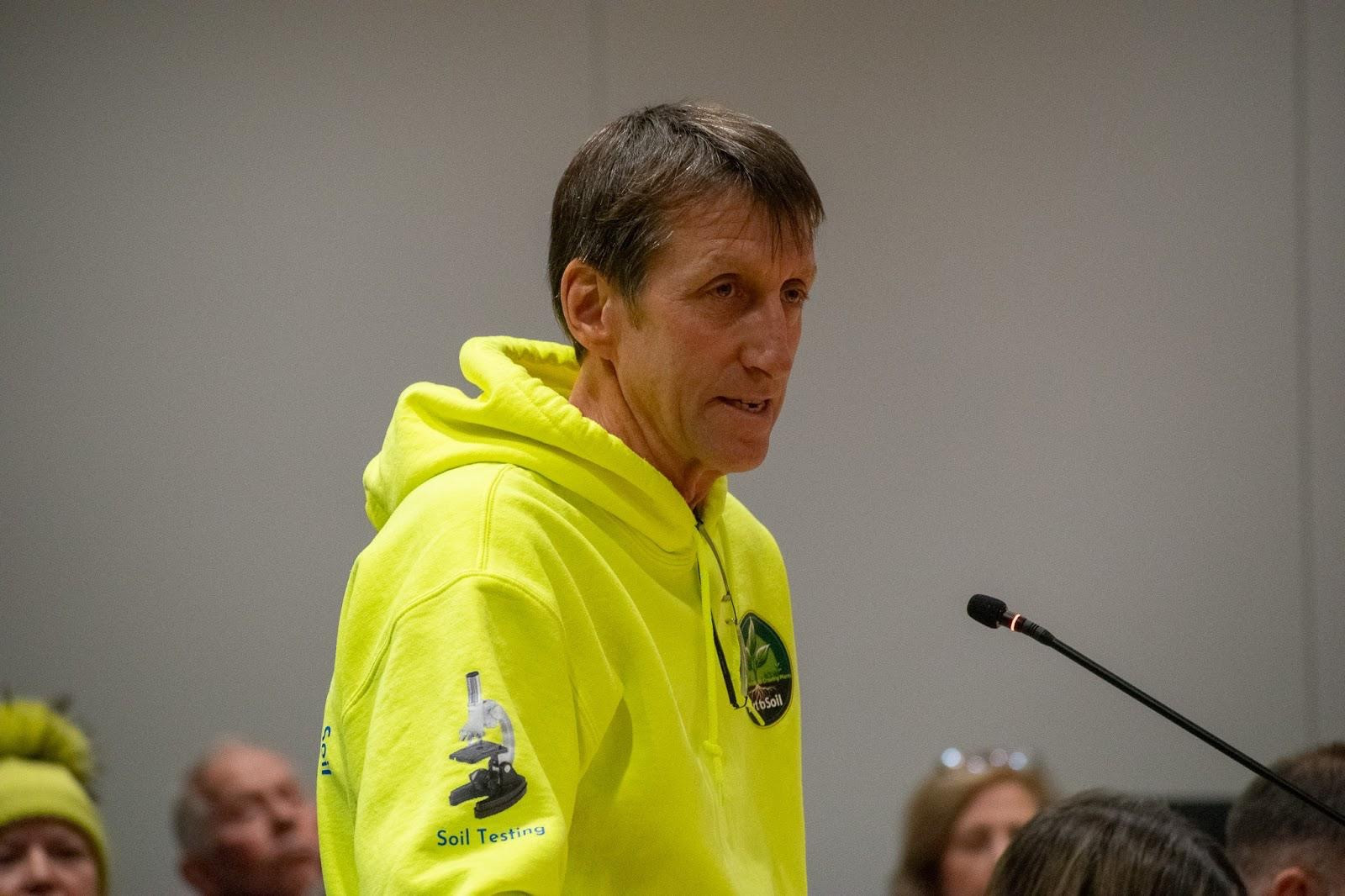
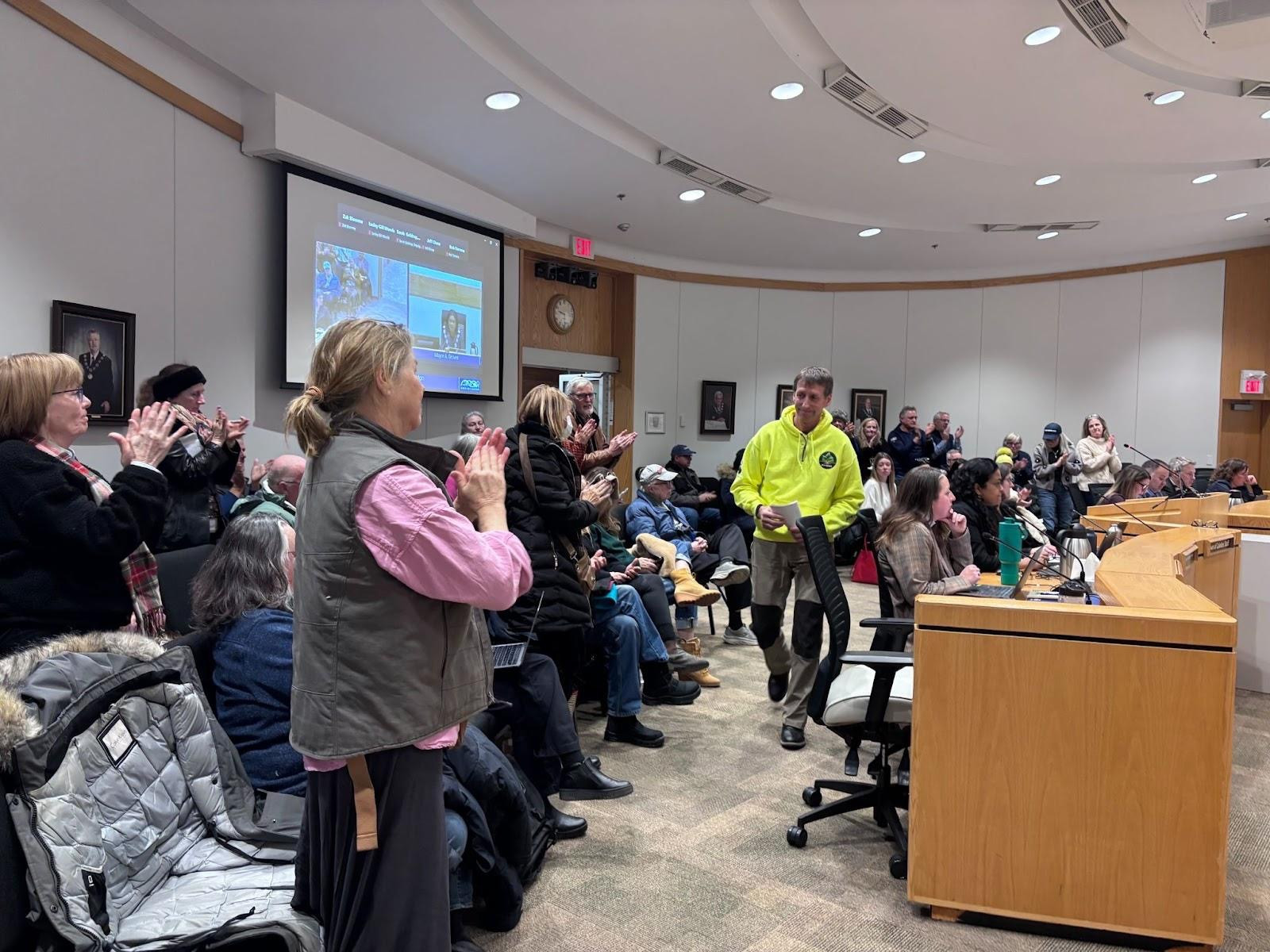
On December 9, a Whitchurch-Stouffville resident, Mark Carroll, wrote to Caledon Mayor Annette Groves and council with a stark warning about the Swan Lake proposal, having “been repeatedly plagued by the continuous filling of retired aggregate pits” in his own municipality. On December 16, Carroll spoke about his experience at Caledon council, later receiving a standing ovation and applause from Caledon residents attending the meeting.
(Alexis Wright/The Pointer)
He admits he has often thought about leaving but says hardship is no longer confined to any one place. Instead of walking away, Carroll has chosen to show up wherever he is needed. That conviction is what drove him to Caledon, where he stayed through more than three hours of council debate on Swan Lake.
“I have grandkids who are eight, nine and ten. I wonder what is Ontario going to be like, what is the world going to be like when they hit my age?,” Carroll said.
“I have no idea what's going to be left for them when they get old. That's why I continue getting involved in whatever I can.”
Ward 4 Councillor Nick de Boer said the proposal for directing the Director of Engineering to enter into a Grading Agreement to import fill into Swan Lake “should have stopped long before the first motion ever came to the table”, citing past issues on Highway 9 as an example of the consequences of poorly managed fill projects.
De Boer added that the previous fill bylaw had intentionally restricted large-scale fill operations in Caledon because the community could not safely manage them and had observed negative outcomes in other areas.
Councillors Christina Early and Kiernan expressed concerns with the Town’s proposed Site Alteration By-law, which would repeal and replace the Town’s 18-year-old Fill Bylaw (2007-059).
The proposed bylaw is designed to regulate the placement and removal of fill, topsoil, vegetation and drainage changes on private land, setting out rules for permits, studies, public notice and enforcement in line with provincial legislation.
A Town statement said the goal is to reduce nuisance impacts and better protect natural features. Staff insisted the bylaw is a “modernization” effort, something technical, overdue and necessary.
But many residents fear a lack of accountability and enforcement, as well as the risk of contaminated materials being placed without sufficient oversight under the new bylaw. Democracy Caledon President Debbe Crandall previously told The Pointer that she sees a direct connection between the recent Swan Lake decision and the sudden push to revise the fill bylaw.
Crandall explained that the current fill bylaw is “highly restrictive,” allowing fill permits only under specific conditions, primarily for agricultural land zoned A1, A2 or A3. Swan Lake, however, is zoned extractive industrial, which under current rules makes it ineligible for a fill permit.
“The only reason the mayor could proceed was by bypassing the bylaw altogether. It didn’t meet the conditions. So a motion was brought forward to leapfrog the rules,” Crandall noted.
Critics have pointed out that beneath the technical language and ambiguous wording, the draft bylaw contains loopholes and weak protections that could allow large-scale fill dumping with limited transparency and community input while handing significant authority to the commissioner, who can approve permits, override council decisions, and decide when public meetings are required.
“I still think there’s going to be work in the future to make sure we protect our pits and our land in Caledon,” Early said.
The clock had passed 10 p.m. when delegations and question periods wrapped up, and Wards 3 and 4 Councillor Mario Russo addressed Council, saying he wanted to “take action” after “having heard loud and clear from residents” their opposition against dumping fill into Swan Lake.
“I feel that continuing to proceed with no time frame being definitive only increases the anxiety of those nearby that have expressed concerns and continues to require and consume staff time to be spent needlessly,” Russo noted.
“However, I still have some apprehension.”
He acknowledged that taking the matter out of the Town’s hands risks provincial imposition, especially given the numerous pits currently being filled without local input or oversight, and emphasized that while some may agree with his concerns and others may not.
“None of the discourse that we've shared today or shared previously, none of the delegations are heard, just action imposed on the lands within the town with no town oversight,” Russo explained.
“This is a cautionary tale that must be considered.”
Russo also believes the original motion regarding the grading agreement to import fill into 0 Shaws Creek has been “misunderstood from day one”.
The landowner came to Council only because the existing fill bylaw prohibited permits for fill exceeding 10,000 cubic metres, leaving staff without the authority to process the application, he explained.
In May, after hearing delegates’ concerns that the issue was too important to delegate to staff, Ward 3 Councillor Doug Maskell introduced an amended motion, which Russo seconded, calling for additional studies and ensuring authority would not be delegated to staff but that a full report would return to Council after analysis for consideration.
“Then and only then, a decision was to be made. No position in favour or opposed was taken,” he reiterated.
However, strong public opposition, concerns about groundwater, wildlife and drinking water, and the absence of required studies ultimately convinced him that continuing the process would only prolong uncertainty.
Mayor Groves also acknowledged the stress residents had endured, sharing she knew the process had caused “a lot of anxiety” and emphasized that Council was acting in response to months of public concern, emails and repeated calls to rescind the decision.
“I don’t know if I personally am buying that one,” Swan Lake advocate Keirstyn Parfitt said, questioning the framing of the decision when residents had sent hundreds of letters over the summer without effect.
“They could have reconsidered in September – no, October – no, November – no. December – yes, finally.”
Why?
On October 20, Member of Provincial Parliament for Kingston and the Islands, Ted Hsu, formally asked the Doug Ford government the legal status of Swan Lake: “Would the Minister of Natural Resources please say (regarding the former aggregate pit, sited at 0 Shaws Creek Road, in the Town of Caledon, which has been inspected, declared successfully rehabilitatied and, as a result, had its aggregate licence surrendered on August 2, 2023) whether the Government of Ontario now considers, legally, the remaining below-water-table feature on the site as an aggregate pit, or as a lake or wetland.”
In response, the Ministry of Natural Resources stated that the licence had been surrendered under the Aggregate Resources Act and “once a site is rehabilitated, it is no longer considered a pit or quarry under the Aggregate Resources Act.”
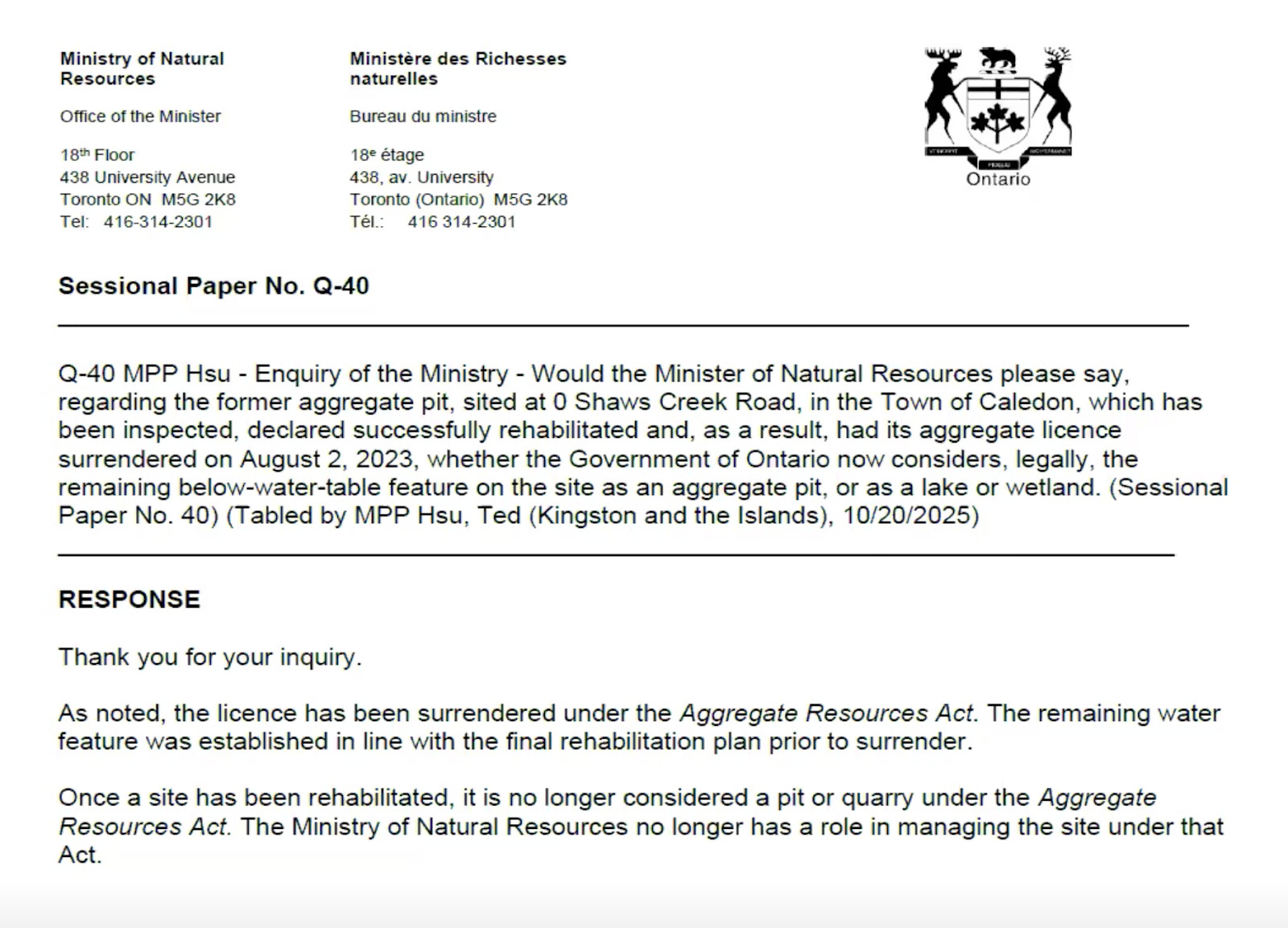
The Ministry of Natural Resources also clarified that it no longer has a role in managing the site at 0 Shaws Creek Road under the Aggregate Resources Act.
(Obtained by Keirstyn Parfitt/Government of Ontario)
Parfitt questioned whether the timing of Council acting roughly one week after the response was a “coincidence”.
To undo the earlier decision, Council first followed a formal reconsideration process set out in its procedure bylaw, since the grading agreement for Swan Lake had already been approved earlier in the term, it could not simply be rescinded with a single vote.
Instead, Russo was required to give notice of a motion to reconsider the previous decision. Council then voted to waive that notice requirement, which required a two-thirds majority. That vote passed, allowing the reconsideration to proceed.
A second two-thirds vote was then required to formally bring the original May 20 resolution back to the table for reconsideration. Once that threshold was met, Council had the ability to vote again on the original motion itself.
Under the Town’s procedure bylaw, defeating the original motion at this stage has the same effect as rescinding it and since a reconsideration can only occur once per term of Council, the decision cannot be revisited again before the next municipal election which is slated for October 2026.
“This is the final thing that we can do this term of Council on this matter,” Town Clerk Kevin Klingenberg said.
Council ultimately voted unanimously against the original resolution, defeating it and permanently ending the Swan Lake fill proposal for the remainder of this term.
Parfitt says she truly believes “this is just the beginning for protecting Caledon” and it is important to stay “vigilant” to protect both the town and Swan Lake.
“This was a real power of the people movement,” she said with a big smile, expressing gratitude for all the people, too many to count, who despite long distances and competing priorities, continued to show up and helped win a major victory…for now.
Email: [email protected]
At a time when vital public information is needed by everyone, The Pointer has taken down our paywall on all stories to ensure every resident of Brampton, Mississauga and Niagara has access to the facts. For those who are able, we encourage you to consider a subscription. This will help us report on important public interest issues the community needs to know about now more than ever. You can register for a 30-day free trial HERE. Thereafter, The Pointer will charge $10 a month and you can cancel any time right on the website. Thank you
Submit a correction about this story

