
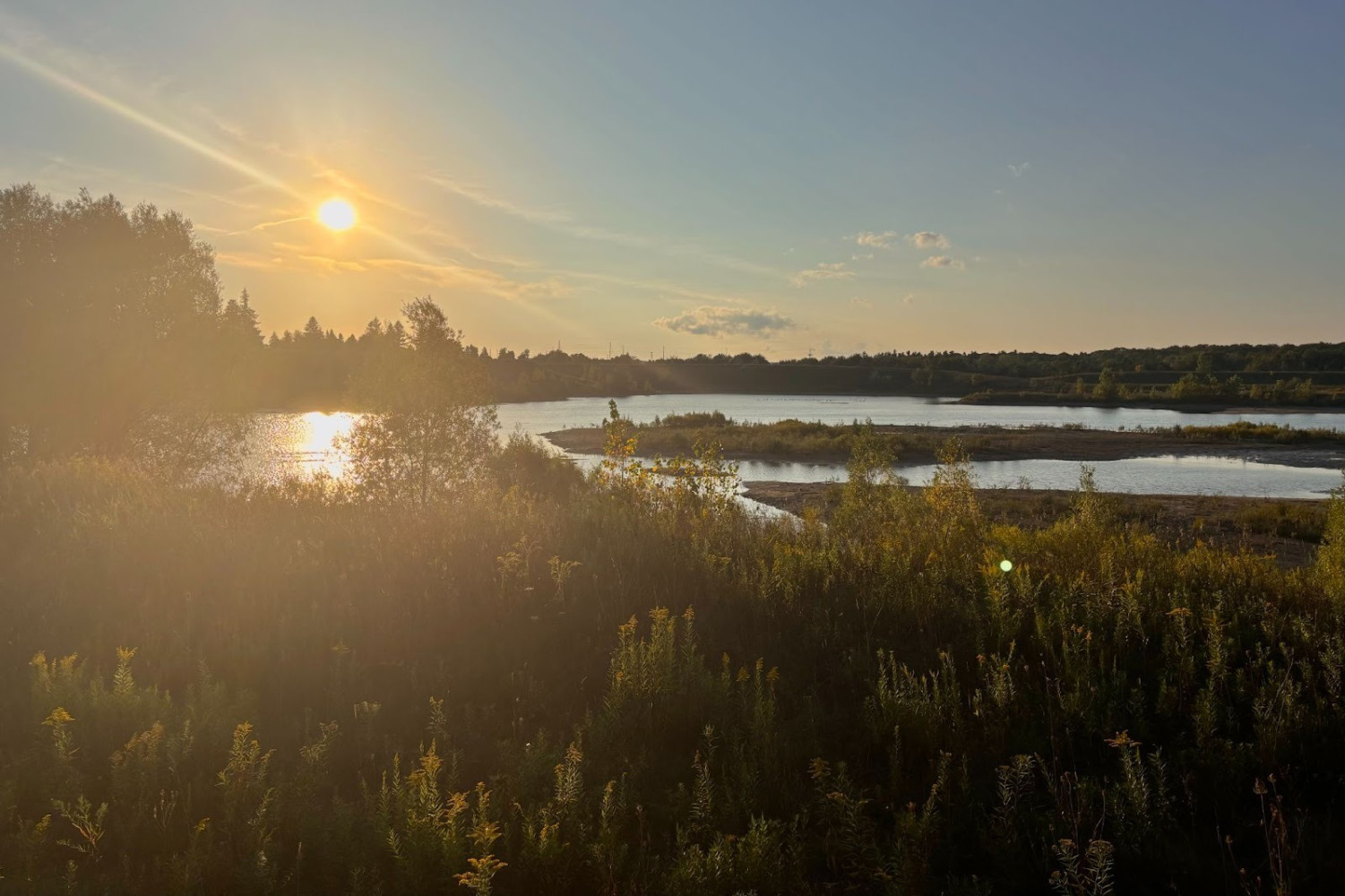
‘This is about profit, not restoration’: neighbours vow to fight developer seeking to dump waste in Swan Lake
Caledon residents and farm owners Anna de Langley and Jennifer Casu-Morin spent their summer not in the fields, but in council chambers and webinars, piecing together binders of research and asking the same question over and over: are their lives about to change forever?
Those plans began to fall apart on May 13, when Mayor Annette Groves quietly introduced a motion without public consultation, opening the door for fill to be dumped into a rehabilitated aggregate pit at 0 Shaw’s Creek Road (behind their farms) which is now a groundwater-fed, below-water table reservoir known as Swan Lake.
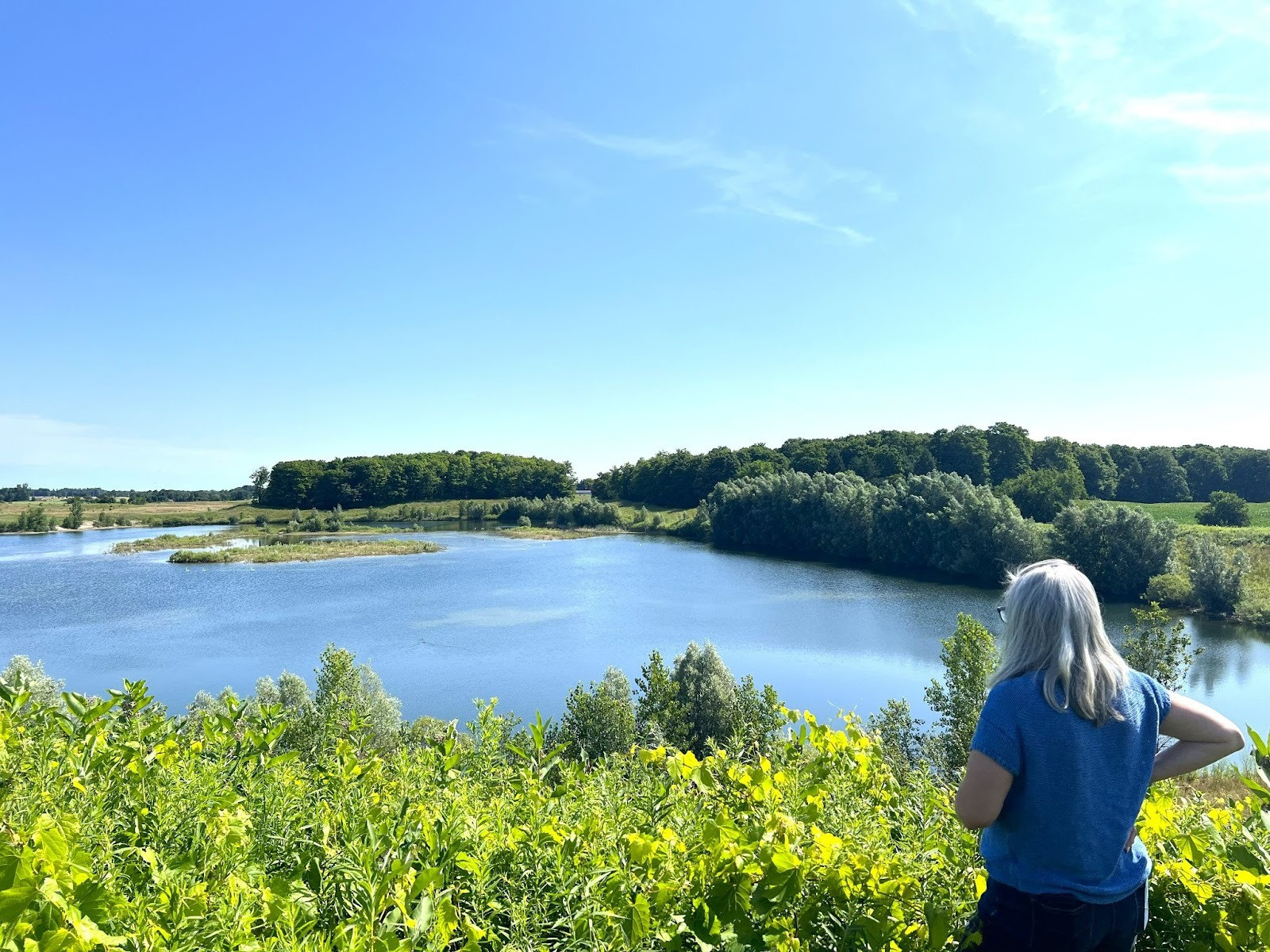
Jennifer Casu-Morin looks out over Swan Lake in Caledon this summer. The beloved property, restored and fed by underground aquifers after it was used as an aggregate pit, is now under threat. The developer who owns the land wants to dump construction waste into the lake.
(Anushka Yadav/The Pointer)
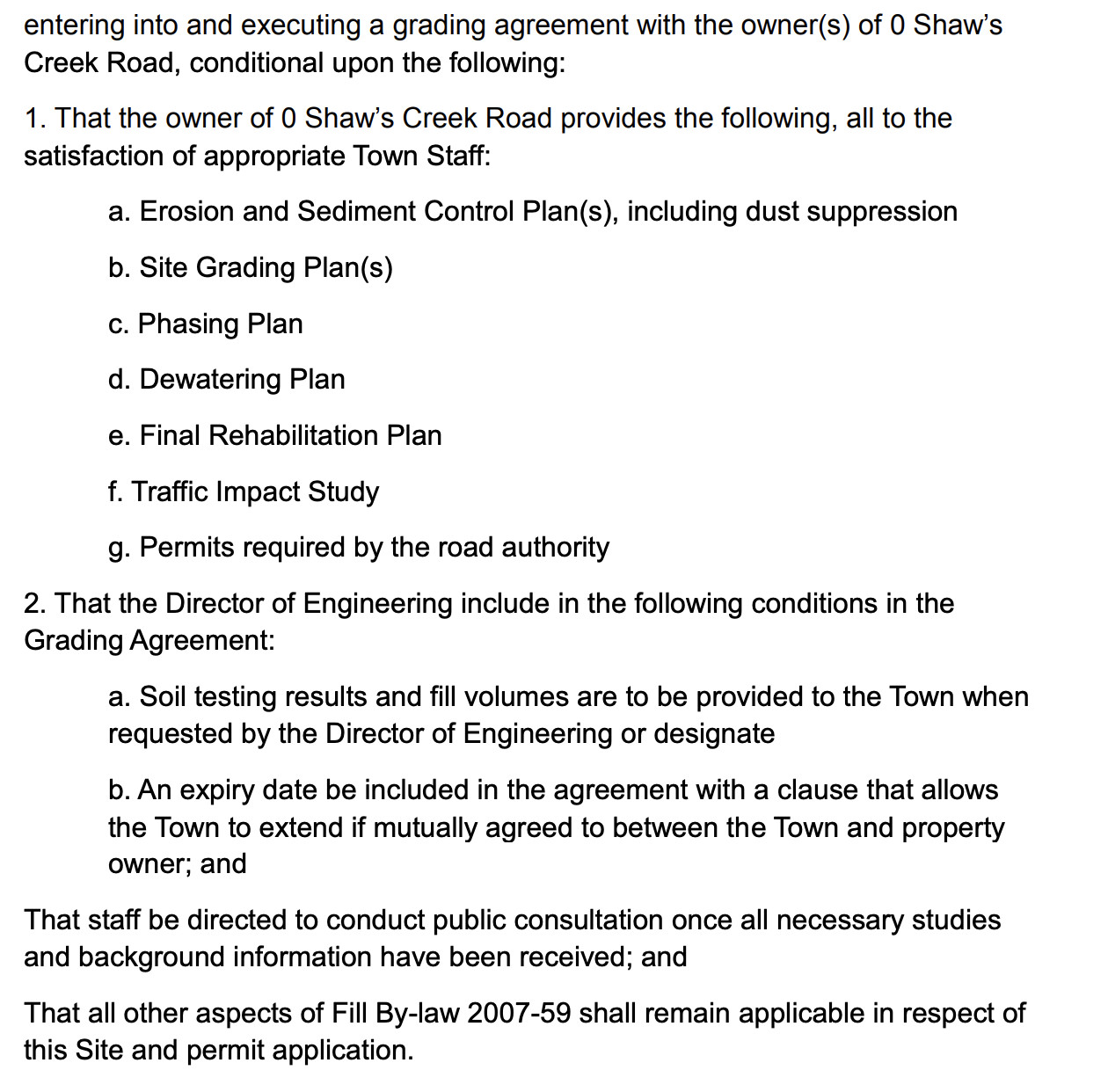
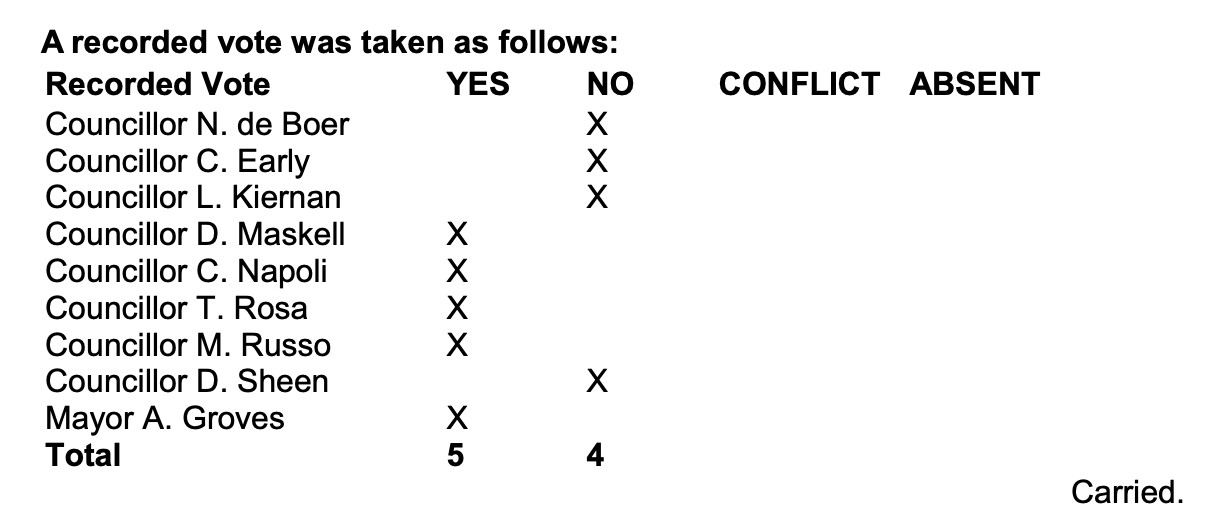
The motion was passed in a vote on May 20, around 9 p.m., during a meeting where only three residents were able to raise concerns during the question period, and amendments were added to require traffic, water and other related studies. Among the council members who voted in favour, Ward 5 councillor Tony Rosa received a $1,200 campaign contribution from Nicola Cortellucci. Ward 1 Councillor Christina Early received the same amount (she voted alongside the residents in opposition) according to the Town’s 2022 candidate results and financial statements.
(Town of Caledon)
The neighbours-turned-friends have now become unlikely guardians of Swan Lake, which supplies water to their wells and sustains their farms and their livelihoods.
“We’ve got a dug well under there, and a drilled well too. It’s all tied to the same water table. And the water is incredible; we don’t even have a filter on some of it, and it tastes amazing. We’re seriously worried that any contamination could ruin the quality or even poison it,” Anna told The Pointer previously.
“And we have animals too. Horses, donkeys, llamas. They all depend on that water.”

Karl and Anna de Langley’s Belain Farm shares about 1,100 feet of property line with Swan Lake, which, along with the connected wetlands behind their property, has become a vital water source not just for their family and their animals but for an entire ecosystem of wildlife that depends on it daily.
(Anushka Yadav/The Pointer)
This year, with every meeting Anna and Jennifer attended and every document they sifted through, a shared hope grew that someone with the authority to protect the land might finally step in.
That hope slipped away in late November.
On November 28, Anna learned the offer made by the Credit Valley Conservation authority (CVC) in October to purchase 593 Charleston Sideroad, also known as 0 Shaw’s Creek Road or the Swan Lake property, from the current owners, Brookvalley Project Management, a subsidiary of the Cortell group owned by “prominent developer” Nick Cortellucci, had been declined.
“While the offer itself is confidential, the offer value was based on a property appraisal conducted by a third-party accredited appraiser and in accordance with CVC and Region of Peel Greenlands Securement Program (GSP) Terms, on current permitted uses for the property and in keeping with values for other recent sales of similar lands in the area,” CVC’s marketing and communications senior manager Sophia Maio told The Pointer in a statement.
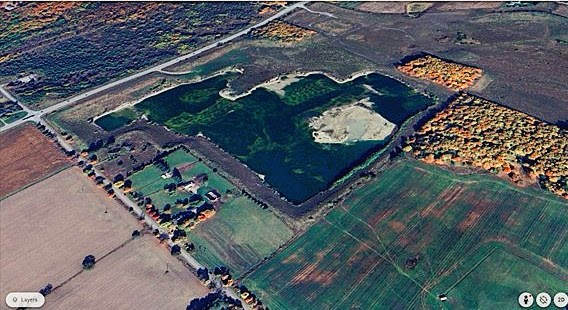
The rehabilitated gravel pit at 0 Shaw’s Creek Road and Charleston Sideroad in Caledon’s Ward 1, now a tranquil natural refuge with a 44-acre lake and valuable wildlife habitat, could be transformed into a dumping ground for excess construction fill under a proposed permit.
(Google Earth)
In an email to Swan Lake advocate Keirstyn Parfitt and Ward 1, 2 and 3 Councillor Christina Early, CVC’s Chief Administrative Officer Terri LeRoux shared that “Brookvalley intends to proceed with their initial proposal for the property and will be moving forward to complete the necessary studies to obtain approvals from the Town of Caledon for an excess soil operation to support agricultural end uses for the site.”
The news was “incredibly disheartening” for Anna, who had hoped to enter the holiday season and prepare for her daughter’s wedding with a sense of exhilaration, after months of dread.
“I feel like he [Nick Cortellucci] could have been a hero to so many people, including his own family. He could have put his name on the lake…what a legacy that would have been,” she said.
“The only reason I can imagine him turning down a fair offer is because he stands to make millions from this. It’s all about profit. And if that’s the path he chooses, then that will be his legacy. Shame on him.”
The Cortellucci family is widely recognized as major donors to the Progressive Conservative Party and was previously identified as directing $250,000 in contributions through 25 different sources, mostly corporations, while also donating $132,000 to the Liberal Party between 2004 and 2011.

For Jennifer Casu-Morin and Jean-François Morin, one of the greatest joys of farm life is sharing it with others. They love welcoming visitors who stop by their farm, Chickadee Hill, to buy eggs or chicken and end up spending time with the animals, especially the chickens, who are a favourite among kids.
(Anushka Yadav/The Pointer)
Jennifer felt the same weight of disappointment.
“I'm very disappointed. Frankly, I would have thought that that would have been such a nice outcome for everyone involved,” she told The Pointer.
“It's such a beautiful place. Just the idea that Caledon citizens could enjoy it because it would be part of a greater conservation area…I just find it a little sad.”
For Early, framing the initiative as a rehabilitation project intended to support future agricultural uses—as the motion from Mayor Groves attempts to do—is concerning as it does not set limits on the timeline or the volume of soil to be brought in.
“Agricultural end use could be 20 or 25 years from now, that’s not in a year or two, and that means a multitude of loads of soil they still have not identified as to how much soil from where in the GTA, and what quality,” she told The Pointer.
“There is a plethora of trucks that are going to accompany that soil coming down Highway 10 or coming on Charleston [Sideroad], where we're already bombarded with a significant amount of trucks that is affecting the traffic flow in that area.”
On December 9, a Whitchurch-Stouffville resident, Mark Carroll, wrote to Groves and council with a stark warning about the proposal, having “been repeatedly plagued by the continuous filling of retired aggregate pits” in his own municipality.
“I am warning you plainly: what looks like rehabilitation on paper quickly becomes an environmental, social, and political burden that communities cannot shake loose once the first truck rolls in,” Carroll wrote in his letter.
“We were promised oversight, clean fill, minimal disturbance, and rehabilitation in the public interest. In reality, we were given years of dust, diesel fumes, non-stop truck traffic, damaged roads, diminished quality of life, and an ongoing threat to our water, soil, and health. If Caledon approves Swan Lake, you are not approving rehabilitation, you are approving a dump for other municipalities’ dirt.”
He emphasized that each truckload of fill generates roughly $100 for operators, and tens of thousands of loads can produce millions in profit while residents bear the costs.
“You cannot un-dump fill. You cannot un-poison groundwater,” Carroll said, warning that a single contaminated load or mismanaged industrial waste could jeopardize private wells, surface water and local ecosystems.
“This is about profit, not restoration.”
He pointed to decades-old sites south of Ballantrae, where promised rehabilitation and monitoring failed to prevent leachate migration, methane off-gassing and farmland rendered biologically sterile.
“Once the pit is filled, operators level it off, toss a thin layer of topsoil over it, and lease it out for monoculture cash cropping. Traditional chemical-dependent agriculture follows, synthetic fertilizers, herbicides, fungicides, further degrading soil biology, leaving the landscape biologically empty and hydrologically impaired,” Carroll explained.
“This is not ecological recovery. This is a factory-farmed field on top of buried waste…Caledon must ask itself: Who benefits from this decision? Pit owners do, clearly…Is that worth trading clean air, peace of community, water security, and long-term environmental integrity? We have learned the hard way in Whitchurch-Stouffville that the trade is not equal. We gave up environmental health for truckloads of broken promises. You are being asked to do the same.”
Early noted Brookvalley must still submit a formal application even when previous attempts were rejected by Town staff for six months “before the Mayor’s motion was put on the floor” because the existing zoning did not permit their plans.
The proposal possibly violates the Ontario Planning Act, contradicts the Town’s own Fill Bylaw for the area, and impacts land within the protected Greenbelt.
Former senior Ontario planner and architect of the Greenbelt Plan, Victor Doyle, explained that most municipalities use zoning bylaws under the Planning Act to govern where and how excess soil or fill can be placed.
The Town’s Fill Bylaw permits the dumping of excess soil only in A1, A2, and A3 zones, all designated for agricultural use, but Swan Lake is zoned MX or Extractive Industrial, a classification that does not allow soil placement.
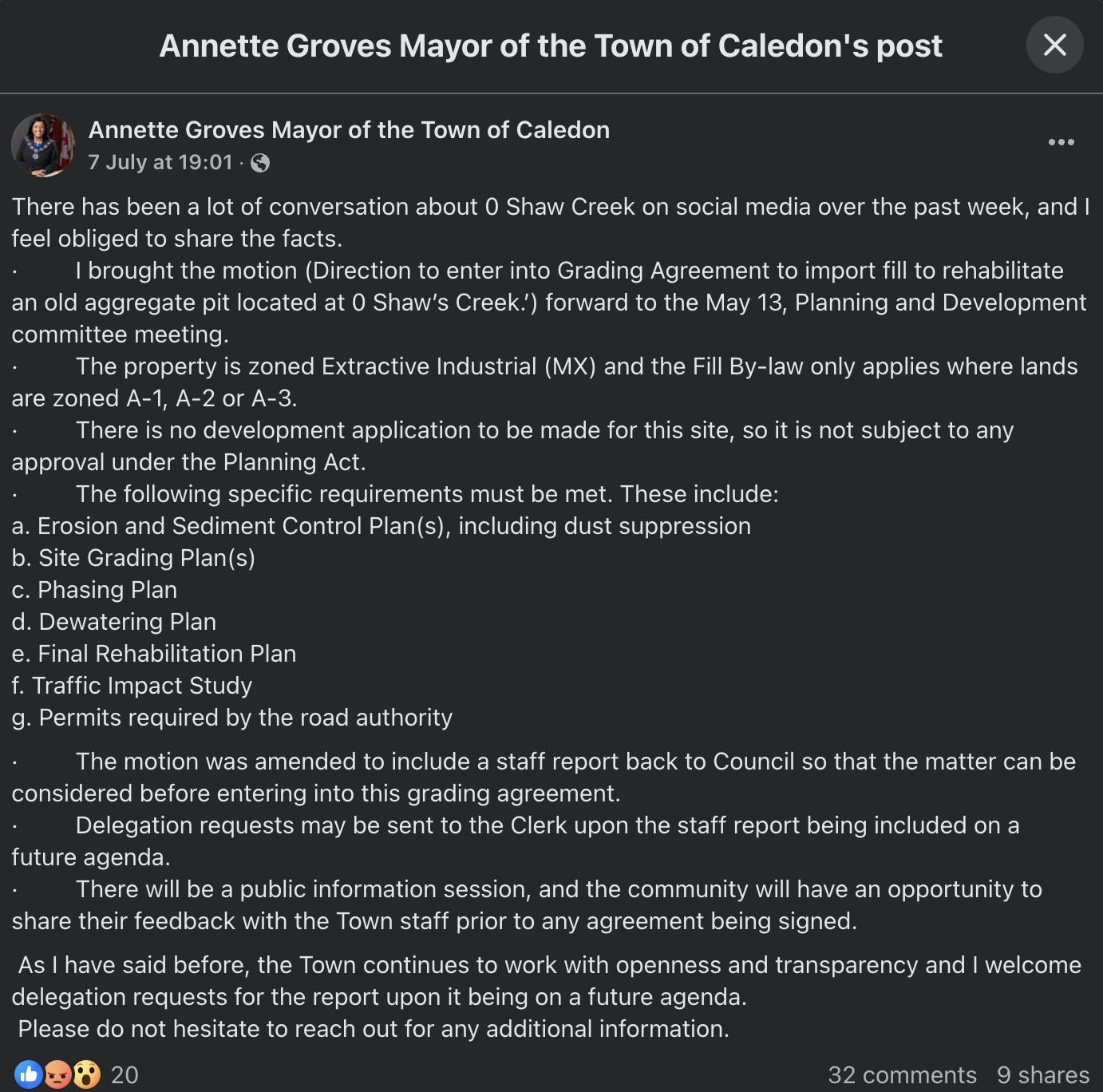
On July 7, Caledon Mayor Annette Groves shared a post on social media clarifying details regarding the proposed fill site.
(Annette Groves/Facebook)
Doyle noted that under normal procedures, a developer would be expected to apply for a zoning change to one of the A-zones before proceeding with such a proposal.
Instead, he said, the motion appears to “do an end run around the zoning issue,” by suggesting that the permit can be issued through the Fill Bylaw, even though the bylaw itself restricts such activity in MX-zoned land.
Then, in October, while CVC was advancing its efforts to protect Swan Lake, the Town introduced proposed changes to the in-fill bylaw, sparking concerns among residents about the draft containing loopholes and weak protections that could allow large-scale fill dumping across Caledon’s exhausted pits and quarries like Swan Lake.
Critics noted the Town’s draft Site Alteration Bylaw, meant to modernize the 18-year-old fill regulations, suffers from ambiguous language, frequent use of “may” and “shall,” and a fragmented public notification process, all of which undermine clarity and public engagement.
"There are times when 'may' is appropriate and times when 'shall' is appropriate, and the by-law terminology would reflect that,” Domenica D'Amico, Town of Caledon’s commissioner of engineering, public works and transportation, told The Pointer.
“All public comments, especially those regarding wording, are being considered. All input received will help inform revisions. If approved, the by-law will be supported by appropriate oversight, from both our municipal enforcement officers and technical experts."
Under the new bylaw, power is also heavily concentrated with the commissioners of engineering, public works and transportation, who will be given the ability to approve permits, decide if public meetings are required and override Council approval for large projects, raising concerns about transparency and public accountability.
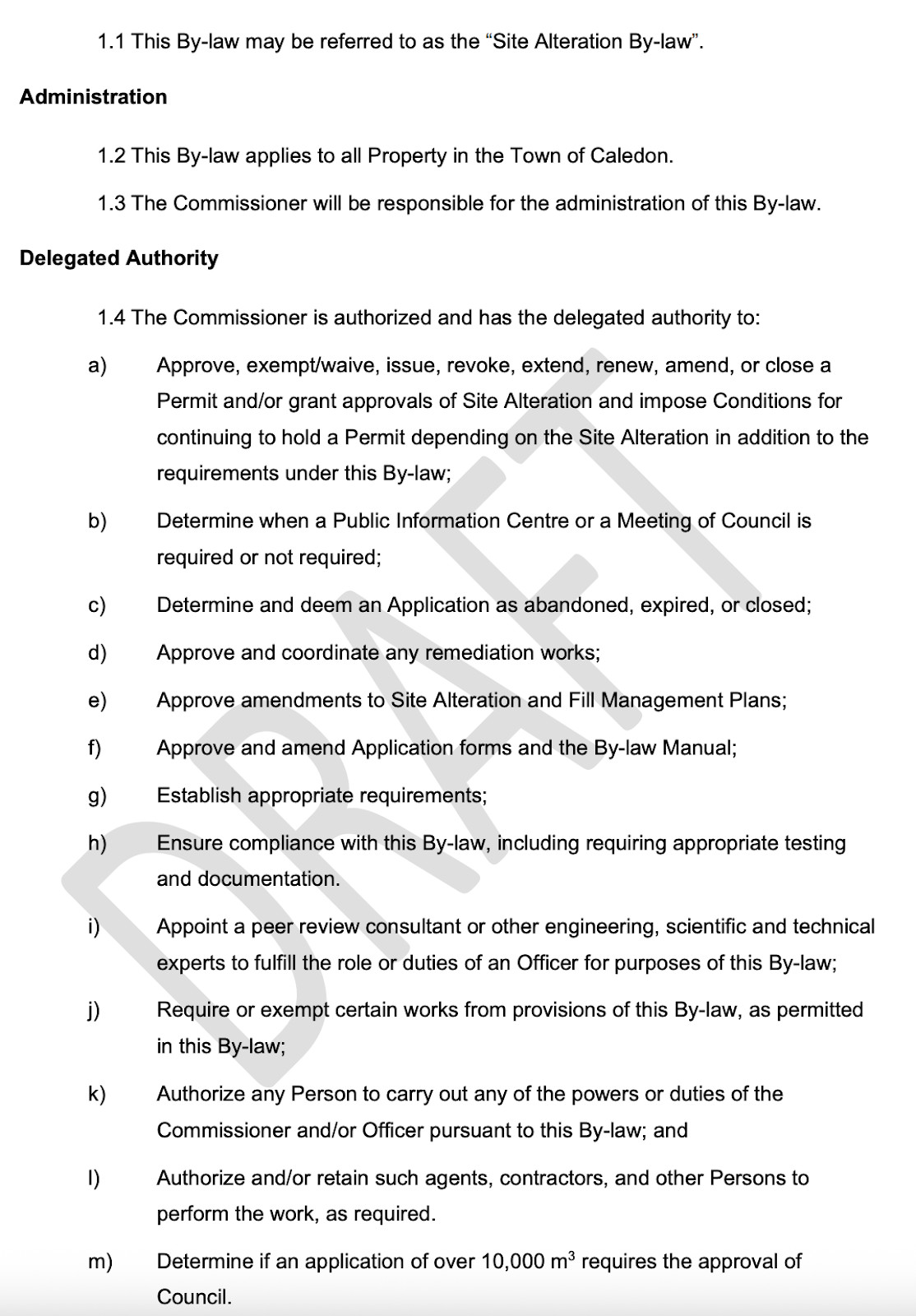
Under the proposed Site Alteration Bylaw, the Commissioner can approve, amend, or revoke permits, decide on public meetings, oversee remediation, hire experts or contractors, and determine if large applications over 10,000 cubic metres need Council approval.
(Town of Caledon)
Public consultation is optional and limited, with exemptions that developers could exploit, and enforcement relies on constrained municipal resources and vague fill quality standards risk allowing contaminated materials to slip through. The bylaw leans heavily on provincial environmental policies, which are already weakened under the current Doug Ford government, without instituting stronger local protections, residents claim.
Belain Farm and Chickadee Hill farms' owners were also present at the bylaw open house on October 6, which was controversial in itself after dozens of residents were alarmed by the presence of Ontario Provincial Police (OPP) officers.
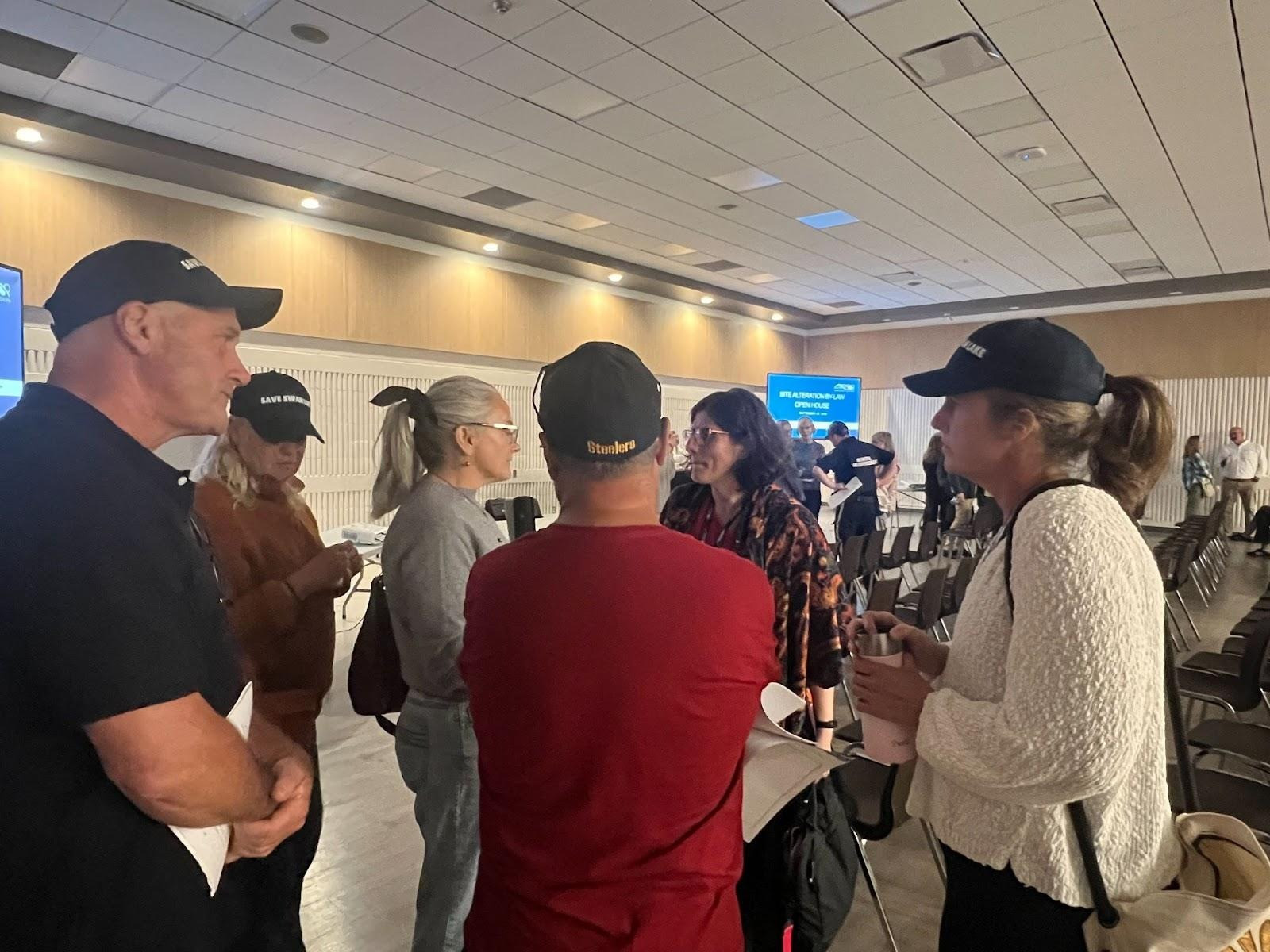
Swan Lake neighbouring farm owners Jean-François Morin, Jennifer Casu-Morin, Karl and Anna de Langley in conversation with Town of Caledon deputy solicitor Paula Boutis.
(Anushka Yadav/The Pointer)
Despite the Groves’ motion, Brookvalley must still submit a formal application, which will come back to council once all required studies are completed.
“Council will still have the ability to vote it down,” Early noted.
“I’ll be looking for a transportation study — how many trucks, for how many years? I’ll be looking at potential disruption. And the biggest thing for me is that Swan Lake is under the water table. How would filling it affect the homes in the area with wells that could be compromised?”
Democracy Caledon president Debbe Crandall cautioned the process carries risks since “the developer is paying for these studies.”
“We don’t have a strong technical advisor for hydrogeology. We haven’t seen a Terms of Reference for these studies. Without transparency, it’s possible data could be selectively used,” Crandall told The Pointer.
If Town staff do not have the expertise to properly assess hydrological or environmental studies, peer reviewers or external consultants will be needed, and with the municipal election approaching in 2026, Early expects the application to surface before the end of this term.
Whether she would oppose filling the lake if the application proceeds, Early cautiously said she would “need to hear what staff say.”
“But I would need very concrete studies to ever support filling a lake under the water table,” she added, noting she has been “tremendously moved” by the community’s organizing.
“There are pits closer to the GTA that could take fill. I don’t think we need to touch a lake that is blue and has swans on it.”
Crandall emphasized “there are still avenues for accountability” including Brookvalley requesting a revised offer or the application resubmitted under the new Site Alteration Bylaw.
“The landscape is complex, but residents can still make their voices heard” alongside local organizations and provincial groups like Environmental Defence, Ontario Nature, to hold authorities accountable.
There are also provincial avenues, although whether they will step in is unclear.
She noted opposition at the provincial level is starting to irritate Ford, describing it as “a burr under his saddle.”
“It’s an old horseman’s term, you imagine a horse with a blank in the saddle, and then there’s a burr. At first it’s just irritating, but over time it becomes something bigger. That’s where we are,” she explained.
“The province is laying down guidelines and pressuring municipalities to adopt these permissive site alteration bylaws, but there’s no regulation requiring it. The province could step in, but historically, they haven’t. And if you push too hard, they could just introduce another omnibus bill to patch the issue. It’s frustratingly complex.”
On October 20, Member of Provincial Parliament for Kingston and the Islands, Ted Hsu, formally asked the Ford government the legal status of Swan Lake: “Would the Minister of Natural Resources please say whether the Government of Ontario now considers, legally, the remaining below-water-table feature on the site as an aggregate pit, or as a lake or wetland?”

In 2023, the Ministry of Natural Resources confirmed that all rehabilitation obligations for the former pit under the site plan had been met and commended Lafarge (Amrize) for completing the restoration to a high standard.
(TOARC)
Although the Aggregate Resources Act specifies that a fully rehabilitated pit is no longer considered an aggregate pit, provincial officials did not confirm this interpretation before the Christmas recess, which began on December 11.
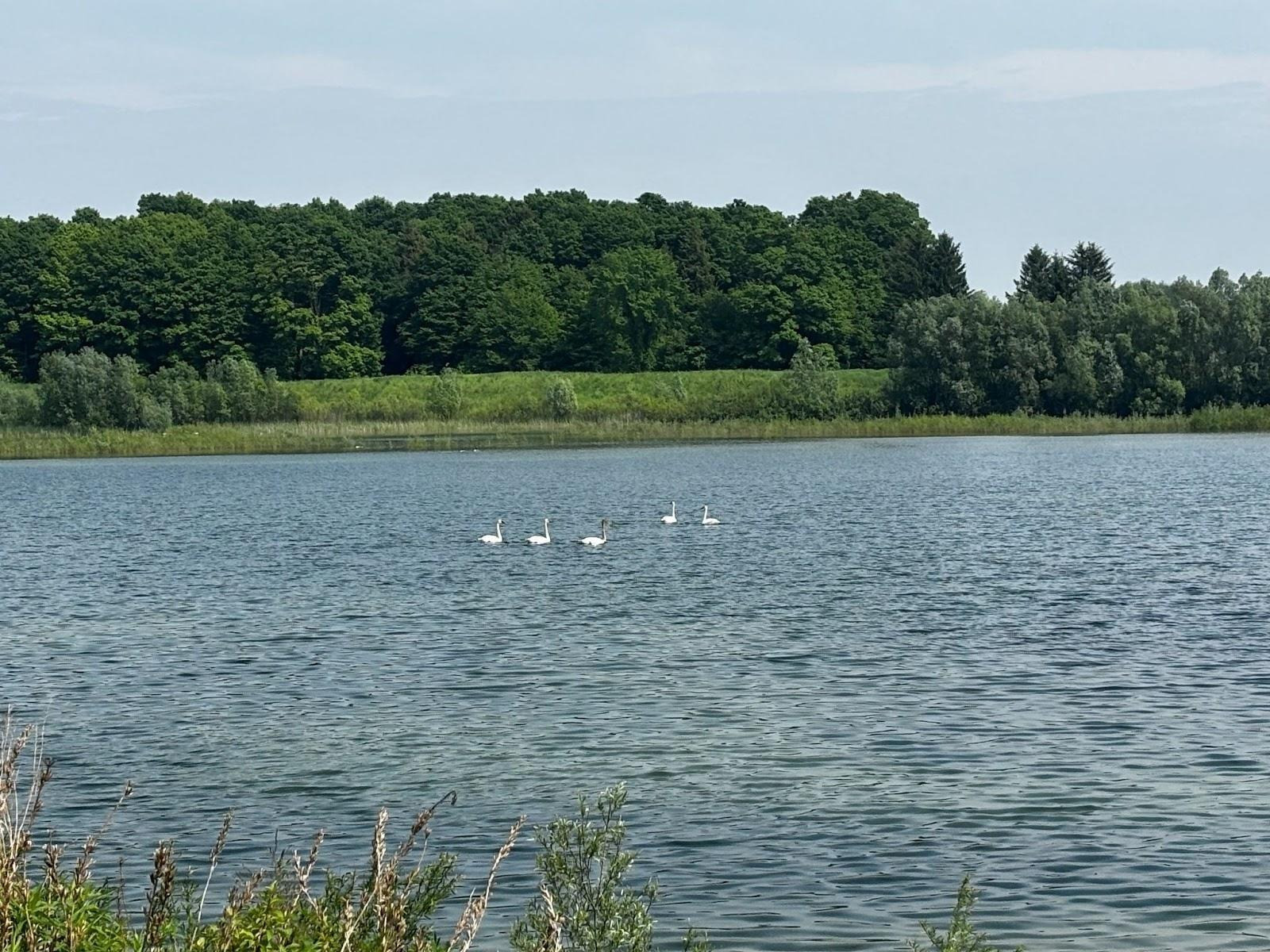
Trumpeter swans, once nearly extinct in Ontario due to overhunting and habitat loss, were spotted during a post-rehabilitation inspection by the Ministry of Natural Resources in 2023.
(Ministry of Natural Resources)
For Anna, Jennifer, and Crandall, one last resort is ensuring that Groves, the councillors who voted for her motion, and her hand-picked Chief Administrative Officer, Nathan Hyde, the town’s top bureaucrat, ultimately responsible for serving taxpayers, are held accountable in the 2026 municipal election.
“My expectations of how important it is to vote in the nation in municipal elections have increased,” Jennifer said.
“The importance of holding our elected officials accountable for doing the right thing for their citizens and for our environment and for the future…they're supposed to be making sure that they're doing things for the best interest of the citizens of Caledon, not developers in Toronto, and not their future career prospects.”
“Shame on our councillors who aren't helping us. We voted for them so that they would protect Caledon,” Anna added, noting they are not the only ones to blame this time.
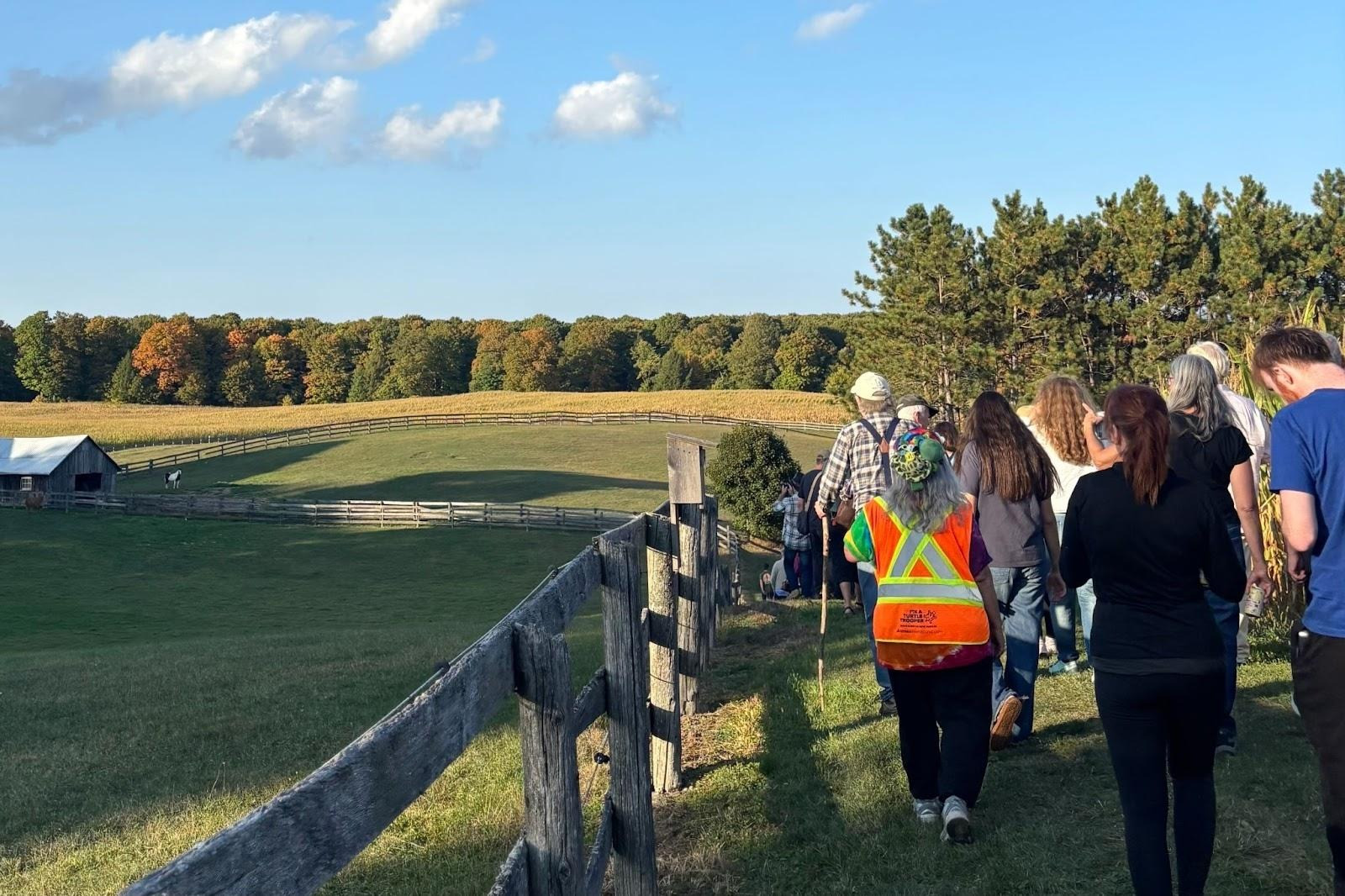
On September 18, Anna de Langley hosted an event at Belain Farm to raise awareness about Swan Lake and its impact on neighbouring ecosystems. She also started a petition, which has garnered close to four thousand signatures.
(Alexis Wright/The Pointer)
Crandall points to what residents have dubbed the “Hyde and Seek Syndrome,” referencing Nathan Hyde’s controversial past as CAO in the Town of Erin.
During his tenure, Hyde’s restructuring efforts sparked criticism for reduced public accountability, leading to Erin being awarded a national “Code of Silence” award for blocking media interviews and Freedom of Information requests.
Caledon resident Tony Sevelka is currently battling a similar issue with hundreds and thousands of formal objections to a proposed blasting quarry missing as part of his FOI request. The Pointer will be publishing the full story soon.
During spring last year, it was found that Groves signed off on a secretive contract with Hyde, giving the CAO exceptionally high severance pay should he ever be fired, without her council colleague’s knowledge, using her Strong Mayor Powers. The document only became public after Ward 2 Councillor Dave Sheen filed an FOI request and when the Town refused to release it, he escalated the matter to Ontario’s Information and Privacy Commissioner, the watchdog responsible for ensuring transparency and protecting taxpayers from misuse of authority.
The Pointer reached out to the Town of Caledon as well as Brookvalley for comment regarding the CVC offer and the future of Swan Lake but did not receive a response ahead of publication.
As Anna and Jennifer continue to explore legal routes, working with the Canadian Environmental Law Association (CELA), they say they have been “immensely touched” by the “community support.”
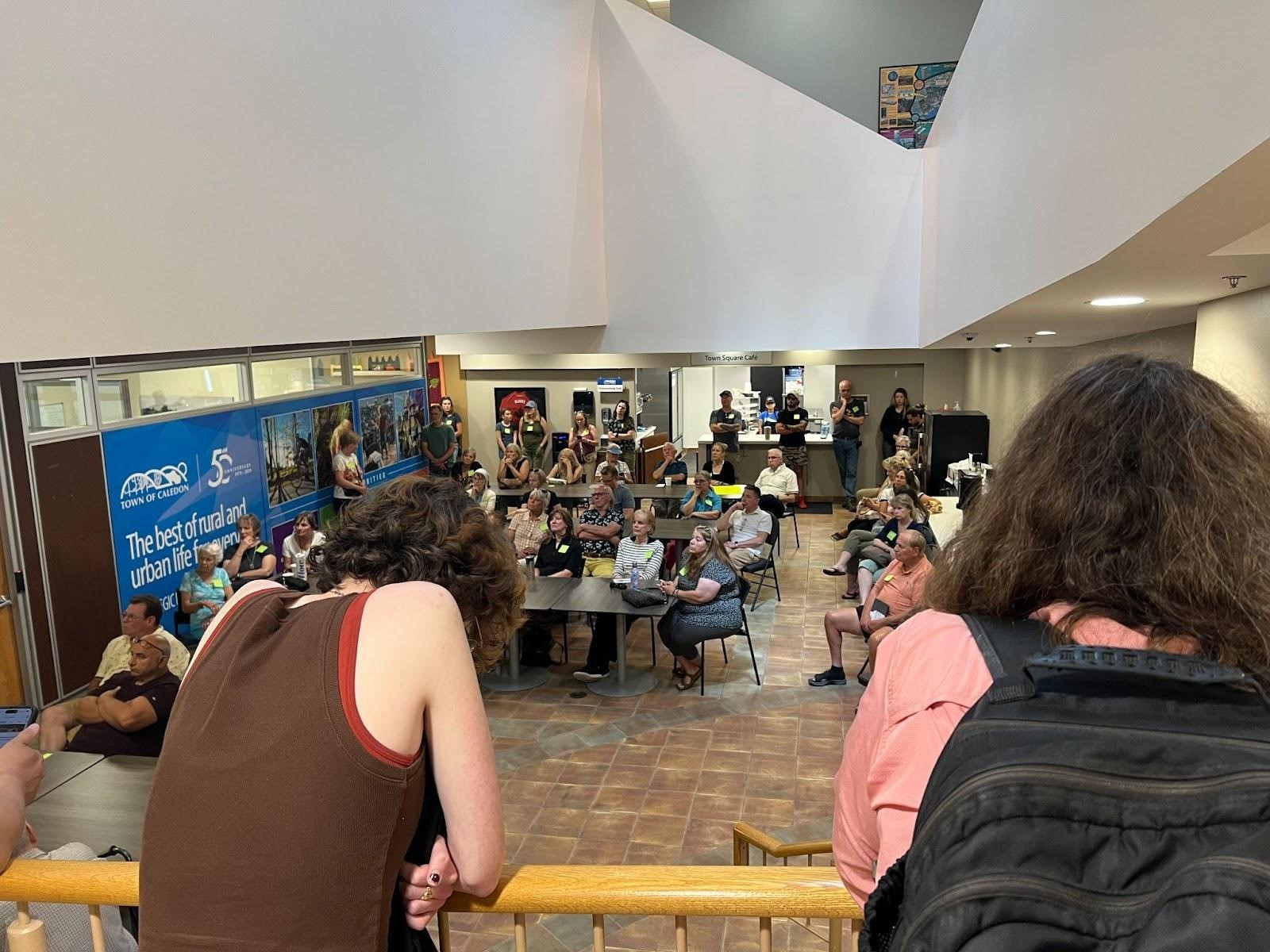
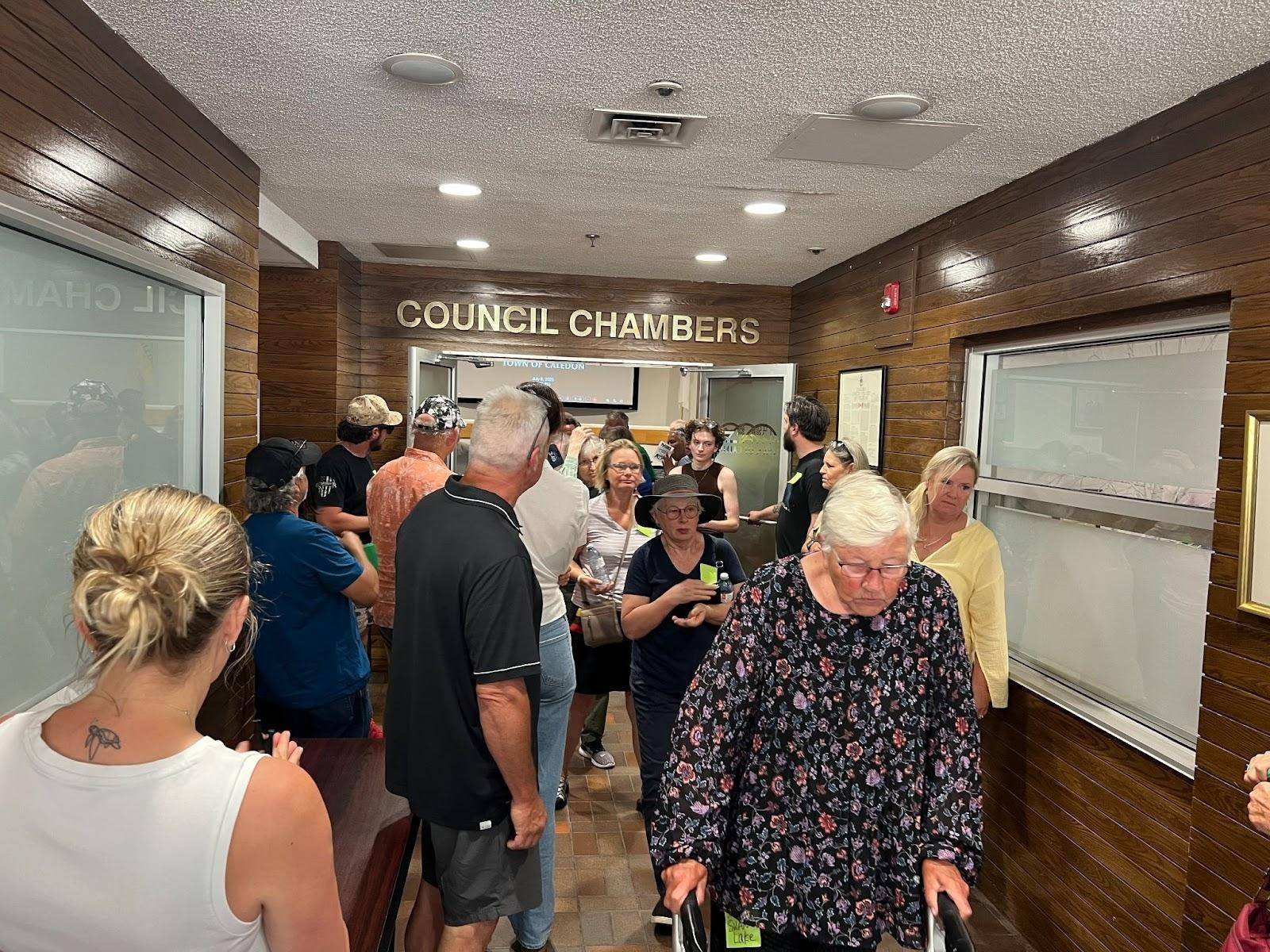
At a July council meeting, residents walked out of the council chambers chanting “SAVE SWAN LAKE”.
(Anushka Yadav/The Pointer)
“It was very lonely at the beginning…it felt like our home, our health, our livelihood as farmers are all at jeopardy,” Jennifer said.
“But the fact that there have been so many amazing people in the community and beyond who really stepped up and are major supporters…it's kept us in a good place. We’re very grateful that there are so many people who care and want to make sure that the right things happen.”
CVC officials also said they remain committed to land acquisition in the Credit River Watershed to strategically expand the amount of protected greenspace.
Email: [email protected]
Submit a correction about this story

