

‘Hostile takeover’: PCs move ahead with conservation authority merger despite widespread concern
Conservation Authorities have had their “boots on the ground, hands in the soil and fingers in the water” for nearly eight decades. That’s how former Credit Valley Conservation chief administrative officer Deborah Martin-Downs describes it.
The relentless work of conservation authority staff has protected watersheds, Ontario’s fish and wildlife, and the millions of residents who rely on clean water and fresh air, in the face of equally relentless development pressures.
“Doug Ford and Minister [Todd] McCarthy see them as an unnecessary hurdle for their developer friends looking to make a profit”, Ontario NDP Shadow Minister for Environment, Conservation, and Parks, Peter Tabuns, warned, minutes after the PC government announced its next steps in a plan to consolidate Ontario’s 36 conservation authorities (CAs).
On Tuesday, March 10, Minister McCarthy and Ontario’s Chief Conservation Executive Hassaan Basit said during a press conference that the PCs will move ahead with a plan to create nine CAs (instead of seven as originally proposed in October), despite widespread concerns shared by municipal and conservation leaders about minimizing local voices and knowledge. They cautioned against the PC strategy to reduce the regionalized CA system, which gave staff with specialized local knowledge the ability to push back against development proposals, and Ford’s own plan for some of Ontario’s most ecologically sensitive areas, which are slated for highways, mines and other environmentally destructive projects.
Southern Ontario has already lost over 70 percent of its wetlands.
The PCs claim the new CA structure, which will be overseen by the Ontario Provincial Conservation Agency (OPCA), will strengthen flood resilience, streamline processes for municipalities and permit applicants — all while maintaining “science-based” environmental decision-making.
“Regional conservation authorities would continue to be independent, municipally governed organizations,” McCarthy noted at the press conference.
“There will be no reduction in staffing levels. And secondly, local expertise will remain central to conservation work.”
Regional CAs will be required to establish Watershed Councils, incorporating Indigenous representatives and stakeholders from agriculture, the development industry and other local sectors to ensure widely informed decision-making rooted in community input.
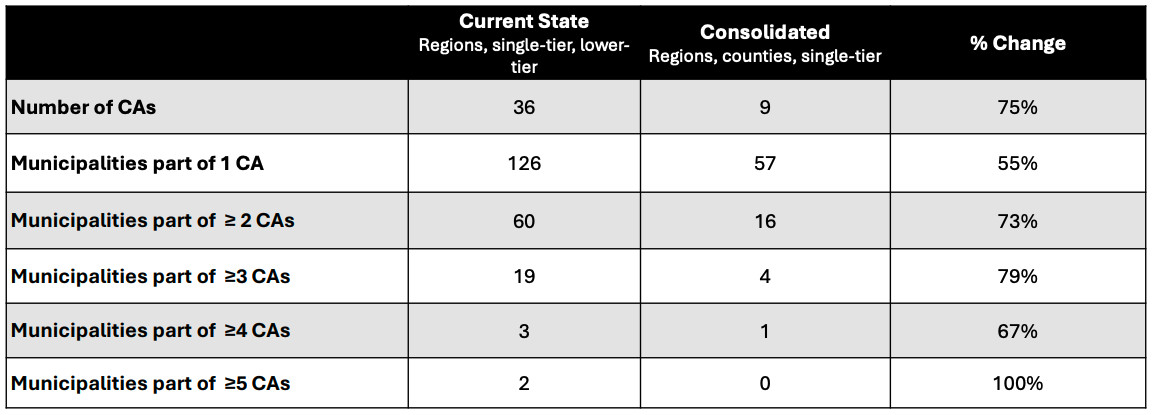
Currently, 36 conservation authorities operate across Ontario: 126 municipalities are part of only one conservation authority, 60 municipalities fall under two authorities, 19 municipalities belong to three authorities, three municipalities are connected to four authorities and two municipalities are tied to five different authorities.
(Government of Ontario)
Provincial officials said the revised model is being introduced after consultations with conservation authorities, municipalities and Indigenous communities where they “listened carefully” and refined and strengthened their plan following six regional workshops.
Credit Valley Conservation (CVC) Board member and Caledon Councillor Christina Early said CVC representatives participated in the provincial consultations this past fall, which was part of the extensive process to gather information from stakeholders.
Ontario Headwaters Institute Executive Director Andrew McCammon said it is “clear” that the 14,000 submissions by the public “had a tremendous impact on the government”.
“The rhetoric of faster permit review to expedite the (PCs’) housing action plan has been significantly replaced with commitments to sound watershed planning based on science, local expertise, and province-wide policies,” McCammon shared.
“It is a bit sad and yet to be appreciated that, after blaming conservation authorities for issues not of their own making, sequential cutbacks to their mandate, and no previous consultation, the government appears to have finally understood the important role that CAs play in protection of watersheds.”
He is wary, however, that the “devil may be in the details”.
“We heard strong support for shared services, updated tools and data. We also heard loud and clear that local knowledge, local priorities and local relationships must remain at the heart of everything we do,” Basit noted.
“This new regional structure achieves both. And because of that, consolidation will strengthen the system, not weaken it. By combining expertise across regions, we can put more resources where they matter the most: the front line.”
On Tuesday, the province announced $3 million in funding for the transition annually in addition to the $20 million announced last year.
Martin-Downs and other critics have pointed out this is not a “re-investment”, as the broader CA budget across the province will eventually see dramatically less money from the PCs.
It was one of many key concerns that have been raised, as climate change puts more pressure on governments to increase funding for watershed management, and other adaptation and mitigation efforts, not less.
In 2020-21, the province approved $10 million in Water and Erosion Control Infrastructure (WECI) funding for 68 projects across 21 CAs, recognizing the benefit to local communities and ultimately, Ontario’s economic recovery. Despite the program being oversubscribed by almost two-fold, with an estimated total cost of more than $19 million for 102 project submissions from 30 CAs, the funding levels were subsequently returned to $5 million.
A group of 74 retired political and conservation leaders, including Martin-Downs and former mayor of Goulbourn Township, and Ottawa City Councillor Janet Stavinga, spoke out about the significant pressure staff are currently facing. They raised concerns that issues outlined in their joint letter dated December 22 to the PC government have largely gone unaddressed.
“We asked the province to pause the approval of the proposed regional consolidation and take time to engage in meaningful dialogue, conduct a transparent cost-benefit analysis and develop a reasonable transition where amalgamation is justified,” Stanvinga said.
“Our concerns have not been addressed at all.”

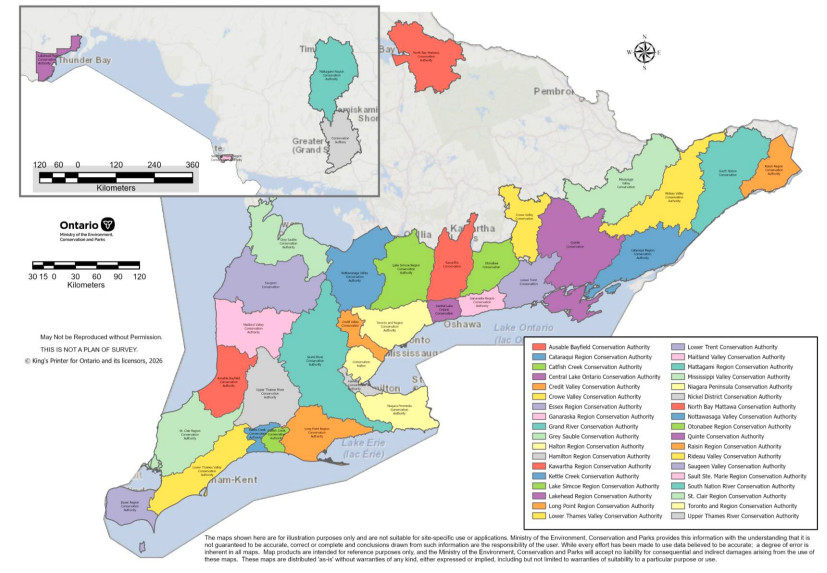
Updated boundaries for Ontario’s nine new regional conservation authorities.
(Government of Ontario)
The proposal traces back to Bill 68, the Plan to Protect Ontario Act (Budget Measures) 2025, which was introduced on November 6. The legislation was passed on November 25, amending the Conservation Authorities Act.
Four months later, nine “watershed-based” regional organizations were put forward: Central Lake Ontario Regional CA, Eastern Lake Erie, Eastern Lake Ontario, Lake Huron, Northeastern Ontario, Northwestern Ontario, St. Lawrence River, Western Lake Erie and Western Lake Ontario Regional Conservation Authority; instead of the 36 that have protected the province for decades.
The government claims this new approach will reduce administrative duplication while introducing consistent provincial standards, improved tools and stronger technical capacity. Little explanation of these claims has been provided.
Upper and single-tier municipalities will be responsible for appointing board members and paying levies to operate the agencies, while lower-tier municipalities will no longer participate directly. Board representation is expected to be based on population; each municipality is guaranteed at least one member and there are limits in place to cap total members and prevent any one municipality from dominating the decision making.
“Some of the groupings make sense. Thunder Bay, for example, is an outlier, so the province left them on their own. But leaving them independent doesn’t help with the issues they cited around technical capacity, tools and resources,” Martin-Downs noted.
She said some combinations, such as Toronto with Central Lake Ontario, make more sense than others but overall the new authorities are “too large” and concerns regarding governance haven’t been answered entirely.
“How many municipalities will be represented in each new authority?,” she wondered.
“One board member per municipality could mean 60 people on a board, how do you make decisions in that structure? That part hasn’t been clarified yet.”
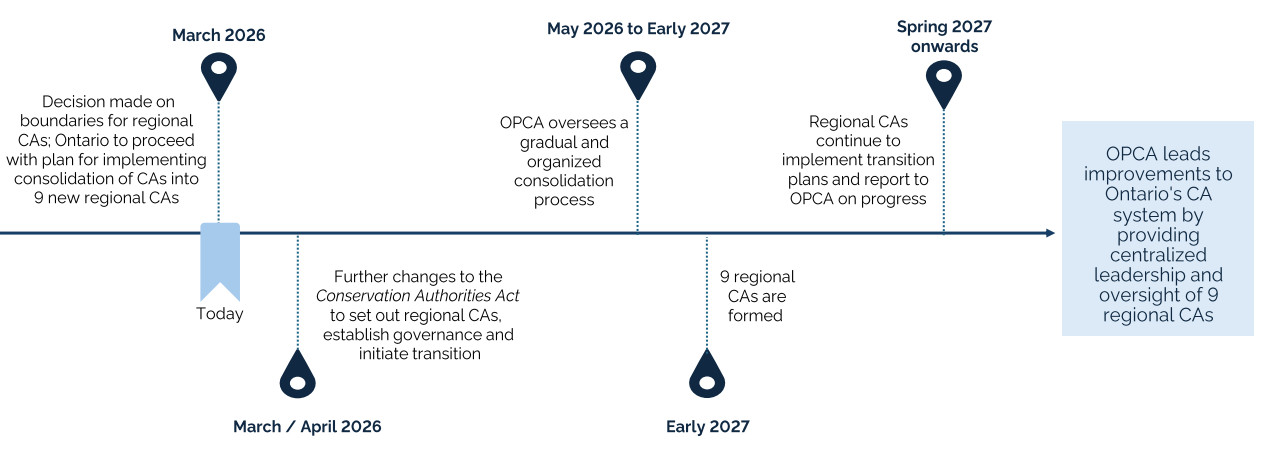
The consolidation for conservation authorities in Ontario is set to take effect starting Spring 2027.
(Government of Ontario)
McCammon raised concerns about PC policies which could influence the way new conservation authorities integrate decision making.
“After all, it is hard to have integrated watershed planning when the province supports municipal sprawl, huge areas of hard surfaces, and issues water-taking permits to aggregate operations that may have contributed to the current water moratorium in Waterloo.”
The Ford government and developers have for years made conservation authorities scapegoats when their projects and plans have been forced to comply with rules that CAs have been governed by, to protect ecosystems, watersheds and wildlife, mitigate flood risk and safeguard municipalities from the various risks created by climate change.
“Ontario currently has a fragmented system of conservation authorities, each of which have different policies, different standards, different fees, and different levels of staffing and technical capabilities,” McCarthy claimed.
“These inconsistencies have hampered the ability of conservation authorities to perform their duties, and this has led to unpredictable and inconsistent turnaround times for approvals — creating uncertainty and delays for farmers, for homeowners, for landowners, for builders and anyone seeking permits.”
Martin-Downs, who served for more than eight years as director of the Toronto and Region Conservation Authority and another eight as chief administrative officer of CVC, with a three-year stint as director of the Walkerton Clean Water Centre, “cringes” every time she hears a provincial leader call CAs “fragmented”.
Ontario has 36 independent conservation authorities just like it has 444 municipalities, each formed to represent local interests and geography — each with its own story of the issues that brought the organizations together to ensure their watersheds were managed to prevent future harm to residents or economies and to protect what was special.
“There is some truth to the fact that there are different policies and different practices across conservation authorities,” she told The Pointer.
“One of the reasons for that is the funding stopped and the provincial support that once helped standardize policies and tools was eliminated.”
Historically, the province funded roughly half the operating costs of CAs, with municipalities covering the remainder.
That fizzled away dramatically in the mid-90s when the Progressive Conservative government led by Mike Harris implemented significant funding cuts to Ontario’s CAs as part of the Common Sense Revolution, reducing provincial support from approximately $50 million to $8 million per year.
It forced CAs to cut staffing by 20 to 60 percent and dismantled a provincial conservation authority branch; they were then left to develop their own tools and policies.
“Authorities had to pivot and rely more heavily on municipal partners to maintain operations,” Stavinga added.
“So, it’s frustrating when ministers today [March 10] said that funding relationships don’t need to change, despite this history.”
Martin-Downs stressed some of the guidance documents authorities were expected to rely on dated back decades and no longer reflected modern realities such as climate-driven storm events.
In response, individual conservation authorities began producing their own stormwater management guidelines, erosion and sediment control standards and technical policies to fill the gap left by the province.
Over the years, limited resources have forced CAs to develop longstanding “reciprocal staff-sharing agreements” with other authorities to ensure uninterrupted services.
During her time as Chair of the Mississippi Rideau Source Protection Committee and previously as Vice-Chair of the Rideau Valley CA, Stavinga observed that the Rideau Valley CA shared resources or took the lead on certain programs on behalf of the Mississippi Valley CA. This collaborative partnership emerged because Rideau Valley CA had a larger funding base, whereas Mississippi Valley CA operated with less funding and limited capacity in certain areas.
For Martin-Downs, the PC track record makes it hard to reconcile the current criticism of policy differences among CAs.
In 2006, the Ontario Clean Water Act (CWA) was established to protect drinking water sources, mandating that local Source Protection Committees identify risks and create legally binding, watershed-specific policies through land-use planning, risk management plans and other measures.
“At that time, the province didn’t say, ‘Here are the standard policies everyone must follow,’” Martin-Downs said.
“They told regions to go out and create their Source Protection Plans.”
Those plans were finalized around 2010, meaning the Province previously accepted policy variation across watersheds. “Somehow, now that’s a problem for conservation authorities.”
The differences between conservation authorities are a consequence of watershed-specific risks and particular development pressures from one region to another. The PCs have seldom acknowledged this in their push to centralize the system.
The TRCA or CVC may face greater constraints in urban areas with hazard lands, requiring more complex technical reports, higher review efforts and consequently higher fees. In contrast, rural areas often deal with smaller-scale projects where hazards are easier to avoid, resulting in lower fees.
The housing crisis the PCs have used as justification for numerous policy changes, has resulted from a range of complex factors, but critics argue that any suggestion CAs have been a barrier to home construction is simply not shown in any evidence. Many developers have notoriously blamed over-regulation as a problem, with an attitude of build first, then deal with the environmental consequences later…when it’s often too late.
Data from Conservation Ontario backs that claim: In 2024, Ontario’s CAs successfully issued 7,180 permits to green light projects in regulated areas; 96 percent were issued within mandated timelines.
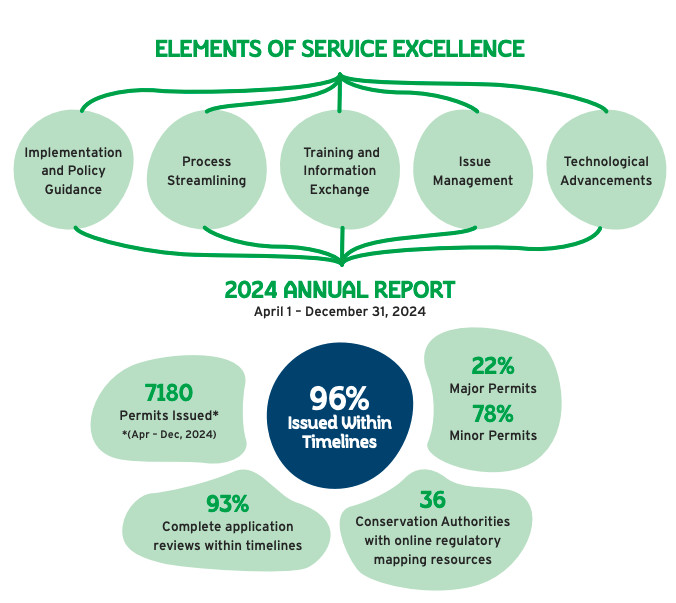
In 2024, Conservation Ontario reported that the 36 CAs across the province were able to issue 96 percent of permits to allow projects within the prescribed timeline.
(Conservation Ontario)
Many of Ontario’s 36 conservation authorities are already the result of past amalgamations.
The Toronto and Region Conservation Authority, for example, was created many years ago when smaller authorities such as Etobicoke-Mimico, Humber and Don Valley were merged to form what was then the Metro Toronto and Region Conservation Authority.
“Amalgamation has happened over the years and in many cases it has worked,” Martin-Downs said.
But there is a “size limit” to how large these organizations can become before they are difficult to manage and lose their connection to individual watersheds.
Having worked for eight years at the TRCA, Martin-Downs said the scale of the organization could already feel unwieldy at times. Under the PCs’ proposed model, that regional authority would be combined with others, expanding its reach even further, making it difficult to incorporate critical local voices in decision making.
“What gets lost is identity,” she warned.
“When I joined Credit Valley in 2013, it was one watershed with one name and people understood it, connected with it. They loved the river.”
That strong relationship and sense of stewardship play a crucial role in building public support for watershed protection.
“The conversation about local impacts and local decisions becomes diluted…when you start lumping everything into large regional entities,” she said.
Stripping away these safeguards doesn’t just put Ontarians at greater risk of floods and natural disasters — it also opens the door to corruption.
“There has been a tendency to assume the reason we have lower levels of corruption is because we’re culturally more honest — that’s not true,” Phil Pothen, program manager of land use and Ontario environment at Environmental Defence, said.
“The reason we traditionally have less corruption is that we don't have this concentration of decision-making power such that there's a single person who you could bribe or improperly influence to approve your project.”
In the 2025 Corruption Perceptions Index (CPI), Canada was ranked 16th out of 182 countries with a score of 75 out of 100, marking its lowest-ever ranking.
“With the consolidation of conservation efforts, and with placing them all under the control of this centralized agency, that diffusion of power is being removed,” he noted.
“There could not be a more dangerous time in world history to allow that to happen; we need to be clinging to those safeguards in a moment like this.”
Martin-Downs agreed the amalgamation seems like a “hostile takeover” similar to the province’s recent supervision of public school boards, where central oversight replaced local control under the justification of financial management.
“Wetlands are Mother Nature’s kidneys but now that’s being taken away from them,” Stavinga mourned.
“[The PCs] are the bullies in the schoolyard.”
Email: [email protected]
At a time when vital public information is needed by everyone, The Pointer has taken down our paywall on all stories to ensure every resident of Brampton, Mississauga and Niagara has access to the facts. For those who are able, we encourage you to consider a subscription. This will help us report on important public interest issues the community needs to know about now more than ever. You can register for a 30-day free trial HERE. Thereafter, The Pointer will charge $10 a month and you can cancel any time right on the website. Thank you
Submit a correction about this story

