
Lavish personal SUVs & overseas travel: Peel Police budget doubled to $1B in 8 years; Patrick Brown & allies shoot down audit request
The sight outside a recent meeting for senior Peel Police officers at a high-end golf course showed just how wide the gap between struggling taxpayers and some working in the public sector has become.
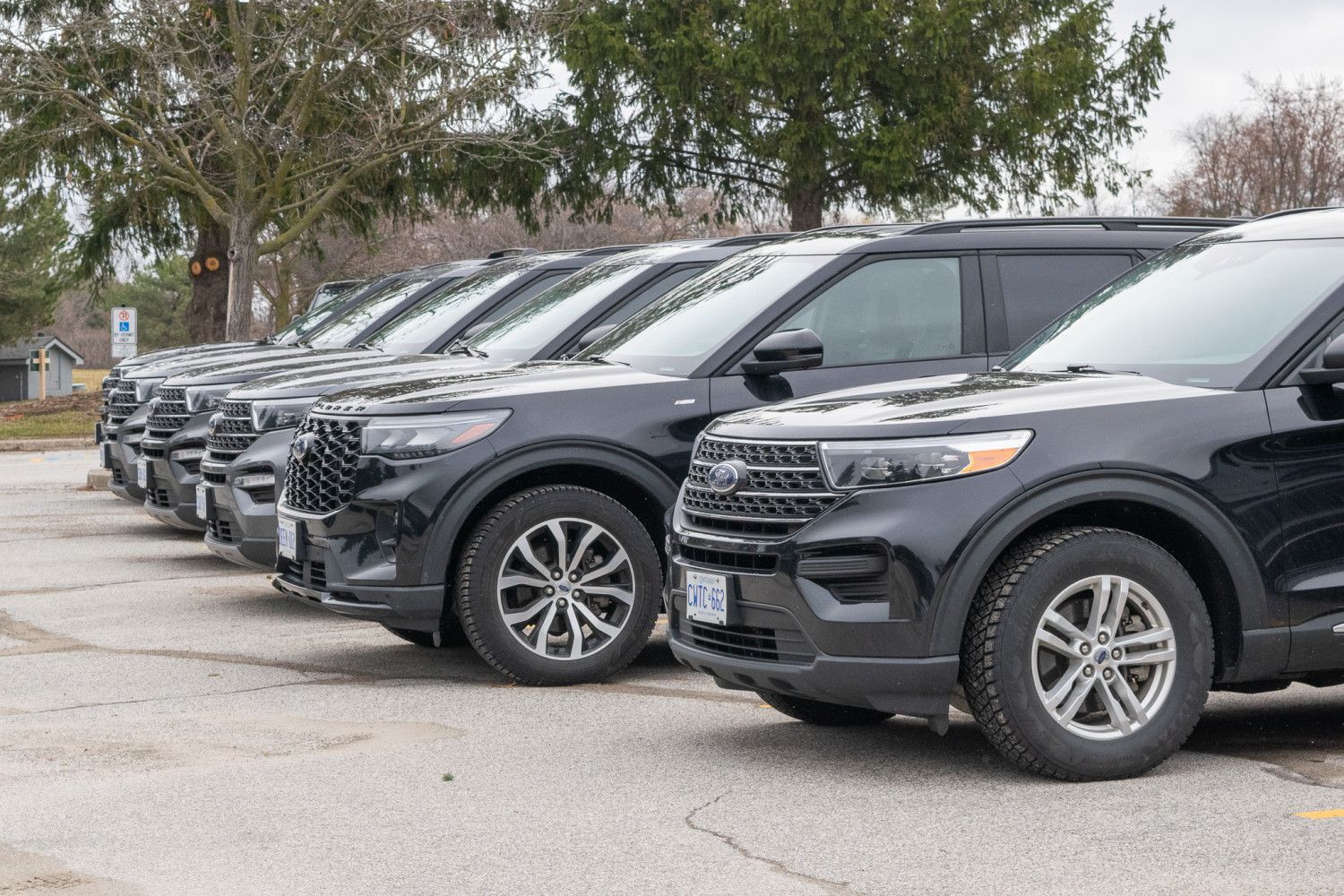
The parking lot was lined with dozens of almost identical dark-grey Ford SUVs, the personal vehicles senior brass with Peel Police enjoy at the expense of the region’s taxpayers.
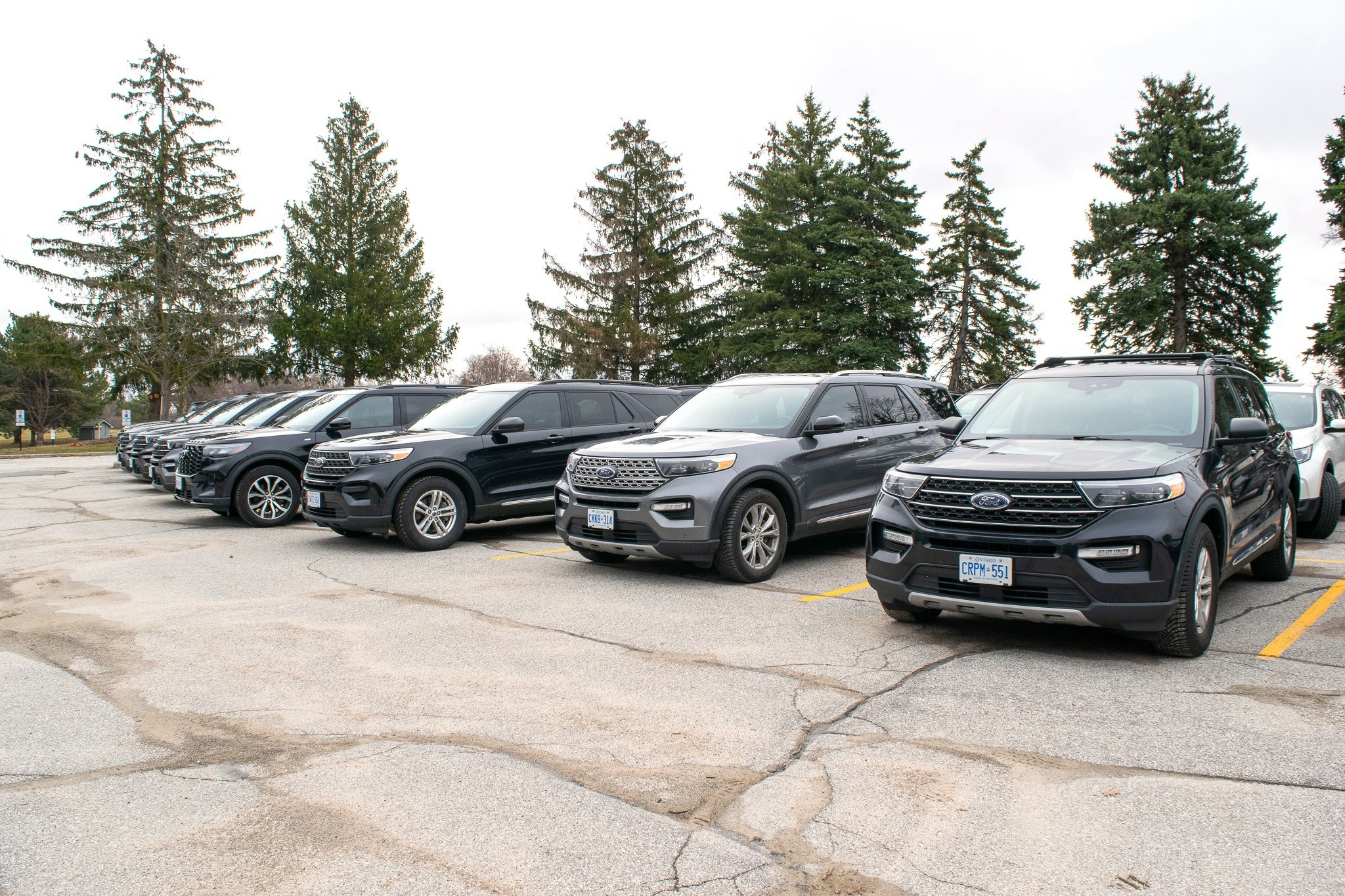
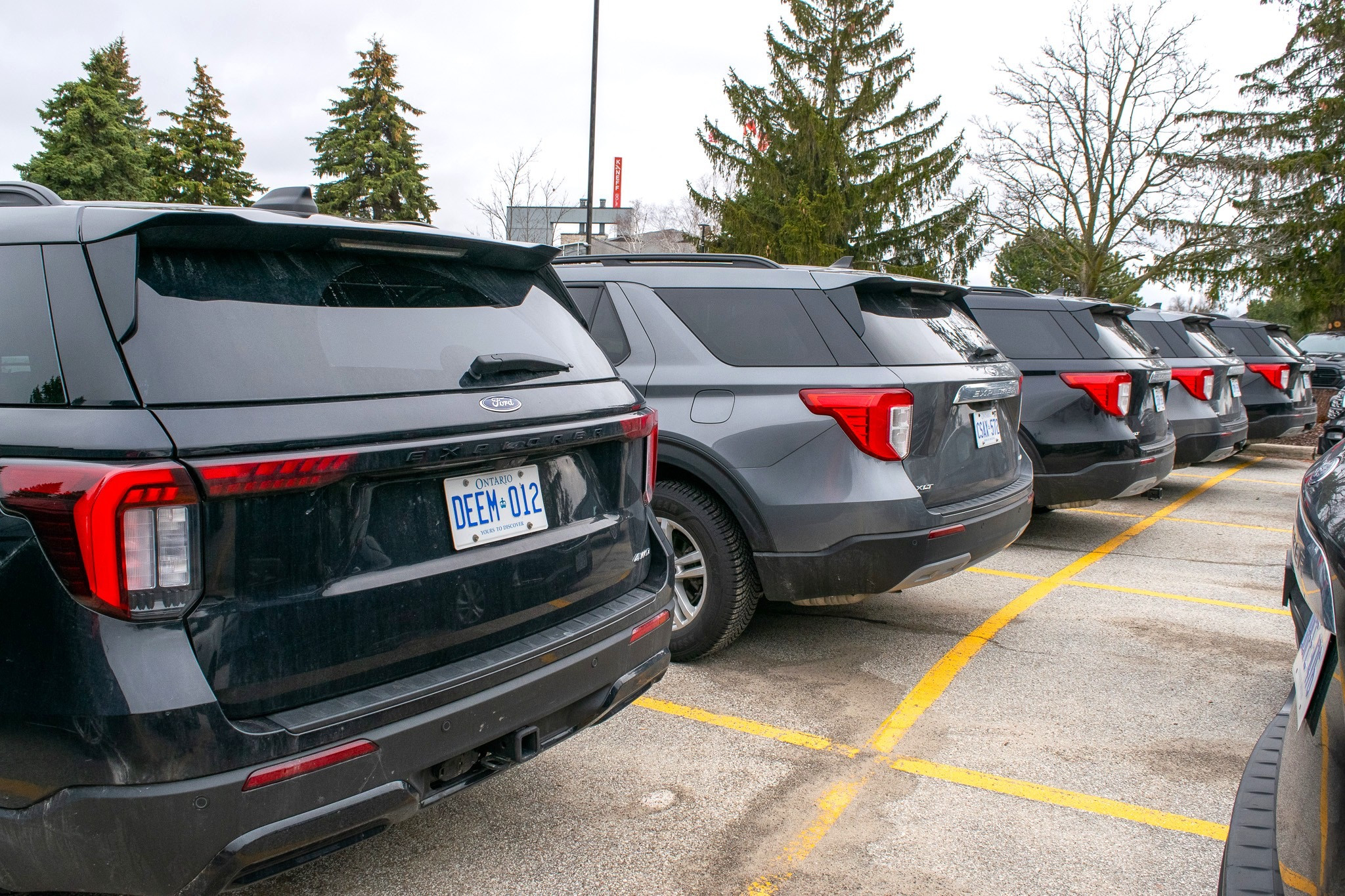
The parking lot of a high-priced golf course in Peel where senior officers with the region’s police force had a recent meeting. The expensive, taxpayer-funded Ford SUVs are given to senior officers to use as their personal vehicles, and cost as much as $85,000 on the retail market.
(Alexis Wright/The Pointer)
The loaded vehicles retail for as much as $85,000 and the officers are encouraged to use them as their family car. The Pointer was told that the Peel Police Board Executive Director, Robert Serpe, was given his own vehicle to use as well. He did not respond to questions previously.
Accountability over the unsustainable spending by Peel Police since Patrick Brown was elected Mayor of Brampton in 2018 and joined the Police Board, has been hard to find. He has overseen an approximately 80 percent increase in the police budget in just five years, which ratepayer groups, council members and even policing experts have said is dangerously unsustainable, forcing tax dollars away from other critical areas.
Despite hearing repeated concerns from Peel residents and several councillors pleading for additional levels of transparency over Peel Police’s runaway budget increases since the arrival of the current chief, Nishan Duraiappah, a good friend of Brown who helped get him hired despite having no experience as a police chief before he took over the country’s third largest municipal police force, the calls for accountability were recently railroaded by the Brampton mayor.
Peel Council, led by Brown’s opposition, rejected a bid for an independent audit after council members butted heads with several residents and other councillors during the April 23 regional council meeting.
Mississauga’s Ward 7 Councillor Dipika Damerla brought forward the motion and said it was for the benefit of residents, noting that if Peel’s auditor general was able to identify specific places where the Region could be saving money in the expensive police budget, millions of dollars could be saved or reallocated to better serve Peel’s residents.
“If you can find any savings, we can put them to the frontline. If the Auditor General comes up with some recommendations and said you can save some money here by doing this, and this, or [that] money isn't being spent as efficiently as it could be, you are able to harvest some savings while those savings can now be used to the frontline,” Damerla said in an interview with The Pointer. “Why wouldn't all of us embrace that?”
Her motion was seconded by Mississauga’s Ward 11 Councillor Brad Butt, and requested the Peel Police Services Board voluntarily allow the Region’s Auditor General to examine spending by Peel’s rapidly expanding police force, even though provincial legislation currently does not give the Auditor General the authority to do so.
Specifically, council wanted the police services board to provide the same access to records, information, and cooperation that other municipal departments would normally be required to provide during an audit. The goal of conducting a value-for-money audit for one of Peel Region's biggest expenditures was to improve financial oversight and accountability by allowing auditors to review whether Peel’s police leaders are spending public money efficiently and effectively, hoping this process would be included in the Auditor General’s upcoming planned work schedule for 2027.
“Frankly, if this wasn't coincided with a social media campaign and sign-up sheets, I'd be less skeptical that this isn't political for a nascent mayoral campaign. Having said that, regardless of the politics behind this, it's redundant and a waste of taxpayer dollars,” Mayor Brown said.
The social media posts he referred to have come on the heels of alarming reports. The Peel Police budget increased 23.3 percent last year, thanks to demands by Brown to support the chief’s request for an additional $144 million in one year, more than the budget increases over the entire decade prior to Duraiappah’s arrival in 2019.
The 23.3 percent hike for 2025 was called an “utter failure of governance” after it was approved by Brown and his fellow members of the police board, who then approved a more than 14 percent increase for 2026. The mayor and his colleagues on the board, who have very little governance or financial experience–two have sales and marketing backgrounds, one led a leasing company, one has worked as a financial planner and three are career politicians–have failed to ask any questions on behalf of taxpayers to find out how their money is being spent, and have refused to call an external auditor to open up the force’s financial books.
With Brown wielding his mayoral influence over the police board, the force’s budget almost doubled in eight years to just under $1 billion; it increased about 80 percent in just five years after Duraiappah was hired immediately following Brown's election as mayor.
After taxpayers began voicing their anger, Brown appears to be ignoring the widespread efforts by residents and taxpayer associations calling for reductions to police spending.
Last year, more calls for increased accountability over the police budget came forward. The discussions ultimately led to the resignation of Mississauga Mayor Carolyn Parrish from the Peel Police Services Board, after she raised tepid opposition to the 23.3 percent budget increase that was approved for 2025.
"Ongoing large tax increases are not sustainable and must stop. The region and the police must find efficiencies and ways to trim their budgets," Sue Shanly, Chair of the Mississauga Residents' Association Network (MIRANET) said during the November 27, 2025 Peel Region budget meeting when a more than 14 percent increase for the 2026 Peel Police budget was approved. “Whilst we have always supported an effective and efficient regional police force, it is difficult to understand the necessity of an over 80 percent increase in the police budget in the past five years, from 2020 to 2025, while residents of Mississauga are struggling.”
Peel Council ultimately voted against Damerla’s recent motion, with Brown and his allies labelling the proposal a waste of taxpayer dollars, and contrary to Peel Police’s internal audit, with some residents blaming the unsuccessful vote on a political divide between Mississauga and Brampton councillors. Caledon is policed by a detachment of the OPP, not Peel Police.
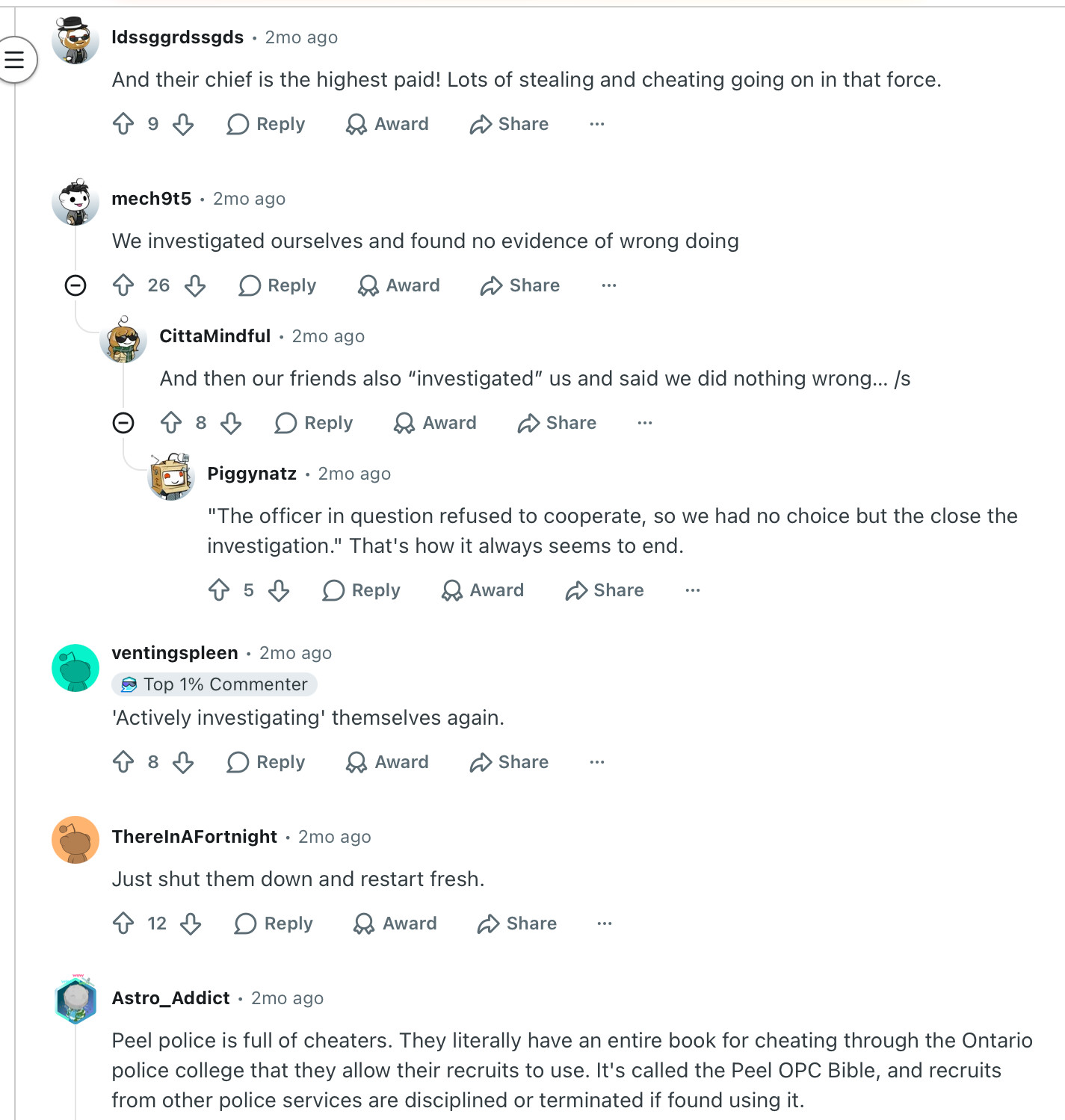

Users on Reddit expressed frustration toward Peel Regional Council's vote to turn down a request to have the municipality’s auditor general carefully examine the budget of Peel Police.
(Reddit)
“Taxpayers cannot afford Peel Region Police excesses. Everyone is struggling to put food on the table and to keep a roof over their head and it is irresponsible to allocate this amount of money to policing, to individual officers and the service as a whole and not allow full scrutiny,” David Bosveld, the Founder of the Black Education Fund and a long time critic of Peel Police, told The Pointer. Bosveld has been a vocal critic of Peel Police and their use of force within the Black community (a recent report showed Peel Regional police had an 111 percent increase in the use of force towards Black minorities in 2024).
“Peel Region Police remain unaccountable and their budget deserves and requires a third-party review given the exorbitant spending on salaries, in the Public Affairs Department, the cloud around favouritism in the promotional process, and the ever-increasing annual police budget.”
Earlier this year, Peel Police announced it had launched an internal review following complaints that a recent promotional process was tainted by favouritism, with certain candidates allegedly being provided the answers to interview questions by senior officers.
As it stands, instead of an independent auditor, the Peel Police Service Board has its own internal auditor. It’s unclear what has been done to ensure proper financial accounting and oversight has taken place, with transparent reporting to the taxpayers who pay for the region’s police service.
Brampton Councillor for Wards 3 & 4 Dennis Keenan, one of Brown’s most loyal followers, said he feared the audit request would add additional financial costs onto the taxpayer.
“We're talking about affordability. Do we even know what this audit would cost? We're obviously going to be paying money, taking away resources from the police to do an audit,” Keenan said before ultimately voting against the motion.
While he was outspoken about his concerns around affordability, he did not raise any issues about the exorbitant budget increases he approved for Peel Police in recent years. He voted in favour of Peel Police’s request for a 23.3 percent budget increase in 2025 ($144 million more than the year prior), despite concerns from residents who were outspoken about their struggles with the cost of living.
Brown was also in direct opposition to the motion. He has close personal ties to Chief Duraiappah and helped him obtain the position in 2019, as previously reported by The Pointer.
Since being hired, Chief Duraiappah’s salary has more than doubled to over $600,000 last year, making him the highest paid police official in all of Canada. Duraiappah’s first full year on the job was in 2020, when he earned $299,196. Last year he earned $604,449 (excluding benefits), resulting in a 102 percent increase in five years.
Brown championed the 23.3 percent budget increase for Peel Police in 2025 while laughing in council chambers, disregarding questions on how the additional $144 million equated to hiring 300 additional officers, with no other detailed explanations for where all the additional money was going.
Duraiappah has not presented any financial analysis, business plan, patrolling or investigative strategy, or external audit to show taxpayers why such massive budget increases are needed.
During the April 23 meeting, Athina Tagidou from the Applewood Hills and Heights Residents Association brought up the substantial increase in the chief's salary over the years, remarking how Toronto’s population is much higher compared to Mississauga and Brampton, while Toronto’s Police Chief is paid significantly less, with the same comparisons about Ottawa’s Police Chief.
Brown, who is known to mislead the public, including around his own municipality’s budget, claimed Chief Duraiappah’s salary is the third highest in the GTA, and that the alarming income he made last year was due to a two-year vacation payout, but Brown provided no documentation as a member of the Peel Police Services Board that Duraiappah was owed any money for vacation time. There have been numerous reports of the Chief visiting foreign countries over the last two years.
The Ontario Public Salary disclosure clearly contradicts Brown’s claim. According to it, Duraiappah made almost $480,000 in 2024, before the vacation payout that Brown claimed, while Toronto’s Chief Myron Demkiw only made $394,000 in 2024. York Chief Jim MacSween, the second highest paid chief in Ontario, made $415,000 the same year.
The huge jump in salary for Duraiappah mirrors the massive increase in the Peel Police budget over roughly the same period. Under his leadership the overall Police expenditure paid for by taxpayers has doubled to almost one billion dollars.
Peel Regional Police Deputy Chiefs Nick Milinovich and Anthony Odoardi have also seen their salaries balloon, by 73 percent and 69 percent since 2021, their first full year with the force. In 2025, Milinovich earned $499,579 from his salary and benefits, more than police chiefs across the GTA and the rest of the province. In 2025, Odoardi’s take-home salary was $423,264.
Serpe, the Peel Police Board’s executive director, has enjoyed huge increases in pay as well, from $157,991 in 2017, to $390,224 in 2025, an almost 150 percent increase in eight years, since Brown became mayor.
Residents have long voiced their concerns about the disturbing use of taxpayer money.
After decades of racist policing across Mississauga and Brampton, Duraiappah was hired in 2019 to be an agent of change for a police force that had completely lost the trust of the residents officers are meant to serve. He assured the public he had plans to institute reforms within the troubled police force, and following the death of George Floyd in 2020 which sparked widespread calls for police reform, he promised “change is coming”.
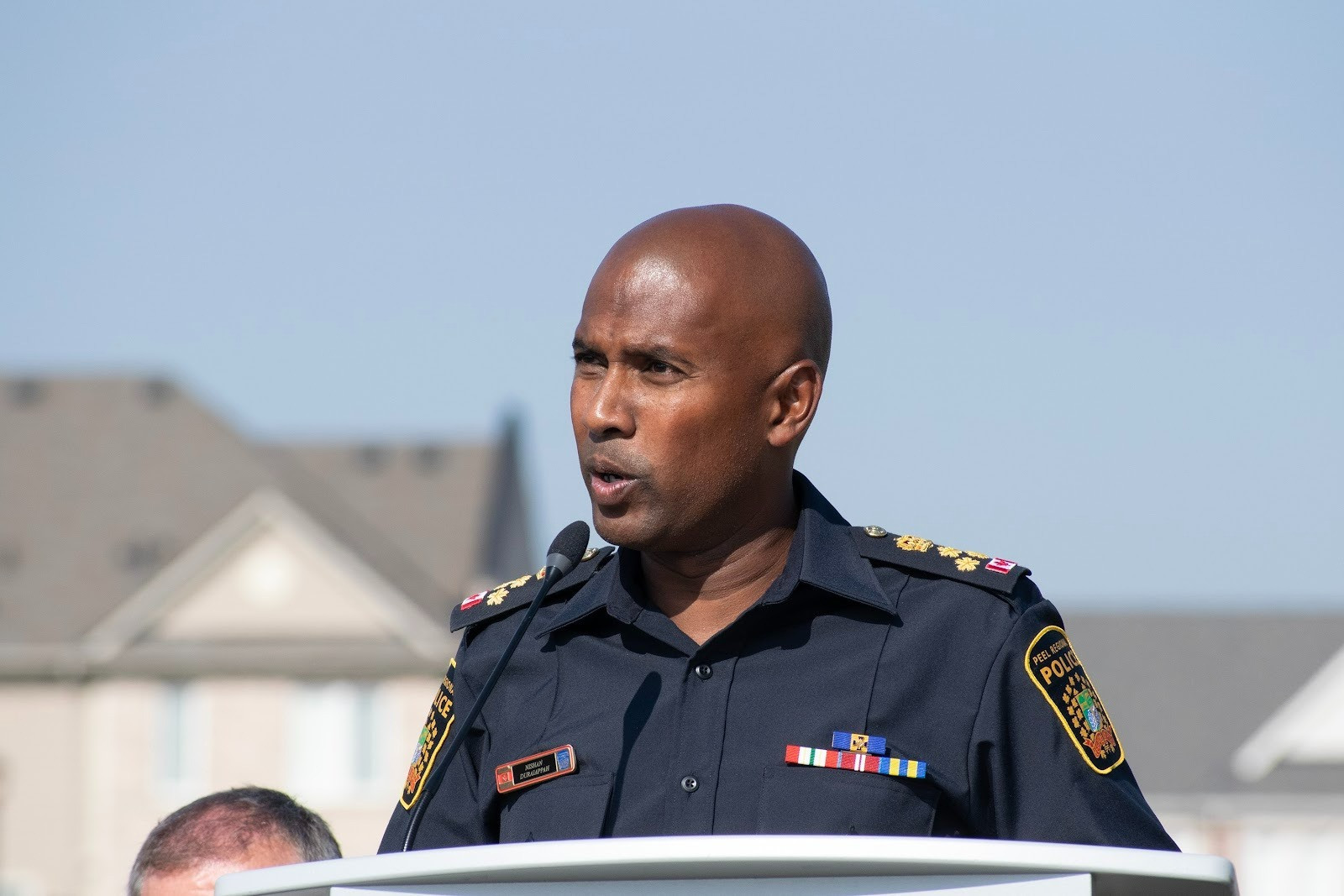
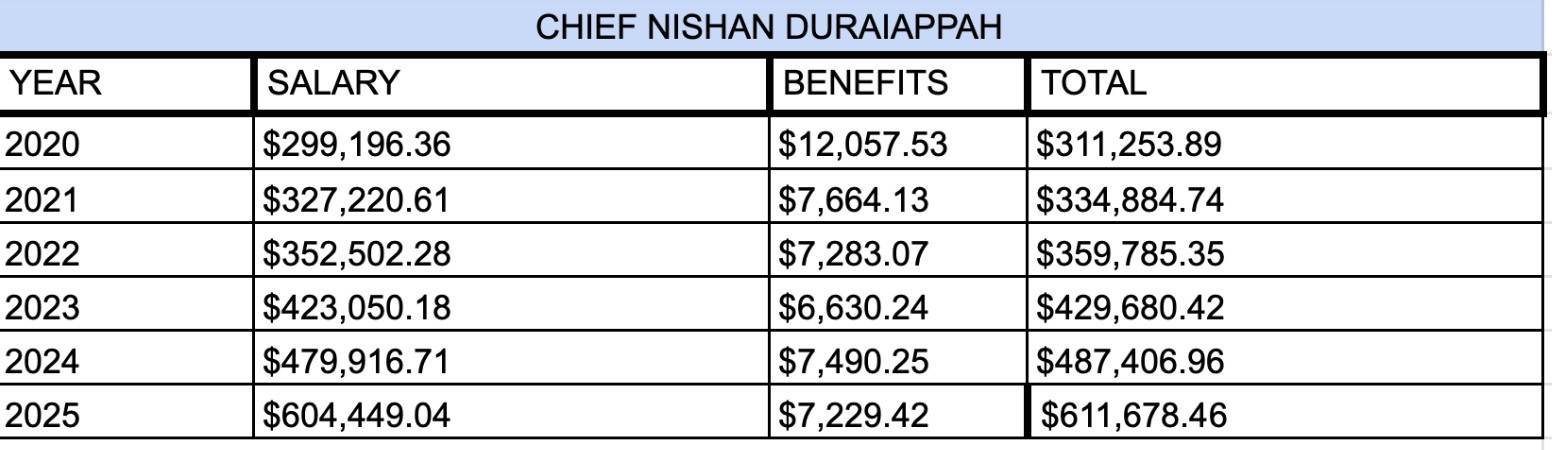
The salary of Peel Police Chief Nishan Duraiappah has more than doubled in his five years with the force, making him the highest paid police official in Canada.
(The Pointer)
With the sizable increases to Peel Police’s budget, Wayne Johnson a Mississauga resident, said he has considered moving away from the city for the first time in his life, labelling the increases “astonishing”. He said he was deeply disappointed by the municipal and provincial process that allows taxation without representation, creating a sense of hopelessness within him and other residents as their concerns are disregarded.
When police board members previously approved the 23.3 percent increase in November 2024, they again did not provide any detailed financial analysis to show how the money would be spent.
Former chair of Toronto’s Police Board from 2005 to 2015, Alok Mukherjee, said the lack of accountability by the board was “an utter failure of governance,” he told The Pointer. “It is absolutely unheard of that in two years, the police budget should increase by 40 percent. There’s no other program that I can think of that receives even 1/10 of an increase of this magnitude, and it is astounding for me that there’s no scrutiny of the budget, no critique or questioning of the budget request by the board.”
Residents told councillors an audit of the police board is also badly needed as the board members who approve the budget year after year refuse to protect taxpayers from blatant abuse by police leaders who constantly demand more and more without any explanation or proof that the huge increases are working.
George Tavares, a Mississauga resident who is now running for mayor, claimed during a delegation at the April meeting that the audit would have substituted evidence for political “noise” allowing officials to manipulate the numbers to paint a rosy picture. Tavares said a truly independent audit would shield the general public from such narratives.
This is not the first controversial issue to embroil the local police force.
Earlier this year, sources told The Pointer that 106 promotions were handed out with 90 percent given to white officers, many of whom were handed answers from senior officers to interview questions during the promotion process.
This followed a presentation by Peel Police to senior staff at the Dufferin Peel Catholic District School Board that included racist remarks and imagery in a presentation, which ignited backlash among community leaders.
When calls for the sweeping audit came up in April, Mayor Parrish took up her previous stance in opposition to police brass, prior to her resignation from the board, when she claimed its inability to keep the budget under control made up her mind to quit.
“My confidence that the police services board will say yes is very low,” Parrish said during the meeting. “I also don't like the politics that follows these motions. I don't like this whole process that we've been going through the last couple of months. Councillor Damerla, I may vote with you, but not because I want to.”
Parrish’s resignation from Peel’s Police Board in November 2024, after Duraiappah’s demand for the $144.1 million budget increase (which Brown gave praise for and said should be higher), came as some Peel Councillors called the increase “unsustainable”. Parrish later said her departure from the board was necessary to voice her opposition to the police budget freely.
On March 24, when speaking at her annual State of the City speech hosted by the Mississauga Board of Trade, Parrish reiterated her desire to create the city’s own police force if funding for Peel Police continues to spiral out of control. She said that under a “patently unfair” 50-year-old funding formula and despite Brampton having a larger population, Mississauga currently pays 62 percent of the Peel Police bill based on the city’s property tax assessments. The mayor gave the province an ultimatum: either move the city to the Ontario Provincial Police billing formula (which is based on population and crime levels) or allow Mississauga to launch its own independent police force, something the mayor mentioned during the April Regional Council meeting: “We have a consultant that's trying to get information out of the police on details [on] the possibility of creating our own police department.”
In 2026, Peel Police received an $837.3 million operating budget—a more than 80 percent increase from $462.5 million in 2021. The budget could go over a billion dollars next year for a force that serves approximately 1.6 million residents.
Toronto Police has an operating budget of $1.43 billion and serves a population of 3.27 million residents; Ottawa’s Police budget is $484 million, serving a population of just over 1.2 million.
Peel police has about 2,400 uniform officers and Toronto has about 5,570. This means the operating budget in Peel comes out to an average of approximately 350,000 per officer; while the average in Toronto, based on its police force budget, is about $256,000 per officer.
Both Toronto and Ottawa police forces do not have an independent auditor, but instead fall under the purview of each city's Auditor General. Peel Police instead has an internal audit function.
“As a not-for-profit leader, it’s disgraceful how little financial support is available to community based organizations and how much is allocated to policing in this region,” Bosveld said.
Ontario has also introduced new legislation titled Bill 119, Protecting Ontario’s Streets and Communities Act, giving Ontario’s Solicitor General, Michael Kerzner, the authority to issue directives to police service boards, requiring them to reflect provincial priorities in their strategic plans, either for that specific force or province-wide.
Kerzner is adamant the move won't allow the Solicitor General to direct law enforcement.
The Bill includes several measures aimed at improving public safety and tackling crime, such as creating a dedicated prosecution team to handle organized retail theft cases, expanding the powers of the Special Investigations Unit to oversee additional information about high-risk offenders, and additional help for victims of human trafficking and criminal harassment by improving access to support services and legal remedies.
Kerzner said the change is intended to ensure police boards across the province align with government priorities and improve consistency within policing.
After learning about Peel Council's ruling, residents of Peel, specifically Mississauga, may feel a sense of deja-vu after in March Damerla brought forward a motion for the City of Mississauga to hire an independent Auditor General, which council later voted down.
“The public deserves accountability from the Region of Peel Council and from PRP,” Bosveld said. “It’s shocking that this motion to audit this spending was defeated.”
At a time when vital public information is needed by everyone, The Pointer has taken down our paywall on all stories to ensure every resident of Brampton, Mississauga and Niagara has access to the facts. For those who are able, we encourage you to consider a subscription. This will help us report on important public interest issues the community needs to know about now more than ever. You can register for a 30-day free trial HERE. Thereafter, The Pointer will charge $10 a month and you can cancel any time right on the website. Thank you
Submit a correction about this story

