
Senior officers directly involved in Peel Police promotions scandal, sources say
Four current employees who spoke with The Pointer on the condition of anonymity have confirmed that senior officers with Peel Police shared interview questions and answers with candidates seeking promotions to more senior roles during the most recent round of advancements within the beleaguered service.
It has since been announced that Peel Police leadership is “actively investigating” the promotion-process scandal which sources allege extends into the highest ranks of the organization.
Sources told The Pointer 106 promotions were handed out, and about 90 percent were to white officers. The Pointer has not confirmed this. Questions to Peel Police were not answered. The force patrols two cities only, Mississauga and Brampton, where approximately 70 percent of the combined population is not white.
The force has long been criticized for failing to hire and promote racialized officers, and more than a decade ago lost a landmark human rights case when it was proven that Peel Police leadership discriminated against a highly decorated South Asian-Canadian officer who was specifically kept out of a promotional process, while far less qualified white officers were selected for career advancement.
The alleged unethical behaviour by senior officers in the recent promotional process is part of an effort to advance individuals “aligned” with Chief Nishan Duraiappah and his six deputy chiefs, according to the sources. By moving certain candidates, despite their lack of experience, into senior positions, the Chief can avoid internal pressure to address mounting problems within Peel Police, sources say.
Names of senior officers who allegedly provided the questions to promotional candidates were given to The Pointer. They are not being published at this time.
Peel Police did not respond to a list of questions from The Pointer.
Leadership was asked if they deny the allegations made by the four current employees; who is conducting the internal investigation into the allegations; and how many officers are being investigated as part of the probe.
The disturbing revelations from the current employees who spoke with The Pointer come after a concerning internal memo was sent to Peel Police employees by Staff Superintendent Hubert Hiltz just before the promotional process began.
In the memo obtained by The Pointer, Hiltz claims: “In my 30 years at Peel, I have not seen a more critical promotional process.”
He then directs those who will be making the critical staffing decisions, that “work experience must not factor into Leadership”, noting “it is already accounted for in the PDF score. This component is critical.”
Peel Police did not respond to questions seeking clarity about why work experience, something police agencies across Canada view as a critical component for senior police leaders, “must not factor into Leadership” when choosing who will be promoted.
The direction to ignore experience directly contradicts the position of Peel Police in deciding not to promote decorated officer Baljiwan (BJ) Sandhu more than a decade ago.
The Ontario Human Rights Tribunal sided with Sandhu who alleged he was discriminated against and purposely denied a promotion based on his South Asian background. The Tribunal decision included the main argument Peel Police leadership used in their justification for excluding Sandhu from the promotional process when he sought an inspector role—his lack of experience disqualified him from the competition in 2013.
“Staff Sergeant Sandhu has completed approximately 812 hours of Acting inspector duties,” his supervisors wrote in their 2013 promotional assessment of the officer, claiming the experience was still insufficient. “[H]e requires the opportunity to experience, acquire and fully demonstrate the core and enabling competencies that are required for advancement to the next rank… The Management Team is not able to recommend Staff Sergeant Sandhu at this time for promotion to the rank of Inspector; we are confident that through future opportunities and continued dedication and commitment to his duties that he will be a fully competitive candidate in the near future.”
The Tribunal decision cited evidence brought forward by Sandhu and his lawyers that showed such experience was not required for many of the candidates—almost all of the 31 candidates who made it into the promotional competition for the available inspector roles were white. Most had far less experience than Sandhu.
“The supervisory officers stated that the applicant (Sandhu) had not yet had the opportunity to acquire acting inspector experience in an operational environment and that the applicant ‘requires the opportunity to experience, acquire and fully demonstrate the core and enabling competencies that are required for advancement to the next rank’,” the decision details. “The officers concluded that they were not able to recommend the applicant for promotion to the rank of inspector at ‘this time’”.
The ruling highlighted that Sandhu’s managers raised a few decisions he made that were described as performance issues, despite a glowing file of exemplary performance reviews that the officer produced in his evidence. The managers claimed, for example, that Sandhu had once failed to follow specific “procedure respecting approval of a sergeant’s vacation carry-over.”
Two of the internal sources that came forward to The Pointer allege that some of the recent successful promotional candidates have egregious histories of misconduct, and that leadership selectively chooses when to use performance to disqualify prospective candidates, and when to look the other way.
Now, in direct contradiction to Peel Police’s justification for denying Sandhu a chance to be promoted due to his lack of experience, the recent memo from Hiltz directs decision makers to ignore experience when considering officers for promotion.
The current employees who contacted The Pointer, three uniform officers and one civilian employee, said the Chief and his senior leadership team do not want gold-standard officers being promoted, and have told those responsible for identifying future leaders to look for people “loyal” to the force, not the rules they are supposed to follow.
“That is the culture, not unlike policing culture, generally. They do not want anyone who will push for change,” one officer told The Pointer.
This culture of loyalty to the Chief and the force was illustrated in the days following York Police’s bombshell Project South announcement and the arrest of seven Toronto Police officers, and one retired member in connection with the ongoing investigation into police corruption.
In an internal memo sent to all employees of Peel Police by Chief Duraiappah and obtained by The Pointer, he wrote that the news had “understandably caused concern and disappointment”.
He then celebrated the work of his officers—three of whom would be suspended a few days later for their alleged connection to the Project South probe.
“Your professionalism and diligence represent policing at its very best. Your work matters. It makes a difference, and it continues to earn the trust and respect of the communities we serve. Thank you for continuing to show up for our community and for one another. I am confident in our ability to persevere together,” Duraiappah wrote. “Please remain proud of the work you do and steadfast in the values that define Peel Regional Police. Look after yourselves and each other. Stay strong, Nish.”
Sources who spoke with The Pointer criticized the memo as the wrong message at the wrong time. Instead of condemning the wrongdoing of police charged with criminal acts, the message from the Chief was viewed as a push to close ranks.
The Chief has yet to release any public statement about Project South or the involvement of the three Peel officers suspended following the investigation’s disturbing revelations.
Two of the sources allege senior officers actively target those with a history of misconduct for promotion because they are the type of employees who are more loyal to the force than the rules.
It’s unclear what, if any, discipline the officers implicated in the ongoing probe into allegations of a fraudulent promotions process could face.
A similar controversy surrounding the Toronto Police in 2024 led to a two-year demotion for the officer responsible. In that case, Superintendent Stacy Clarke was caught providing confidential information to Black constables looking for promotions in 2021. She testified during a disciplinary hearing that her actions were driven by desperation to counteract “anti-Black systemic racism” within the Toronto Police.
According to The Pointer’s sources, the motivation behind the alleged unethical behaviour of senior officers was driven by a desire to promote officers viewed as being “aligned” with Chief Nishan Duraiappah and his senior team. About 95 of the 106 promotions were handed to white officers, sources told The Pointer. This has not been confirmed.
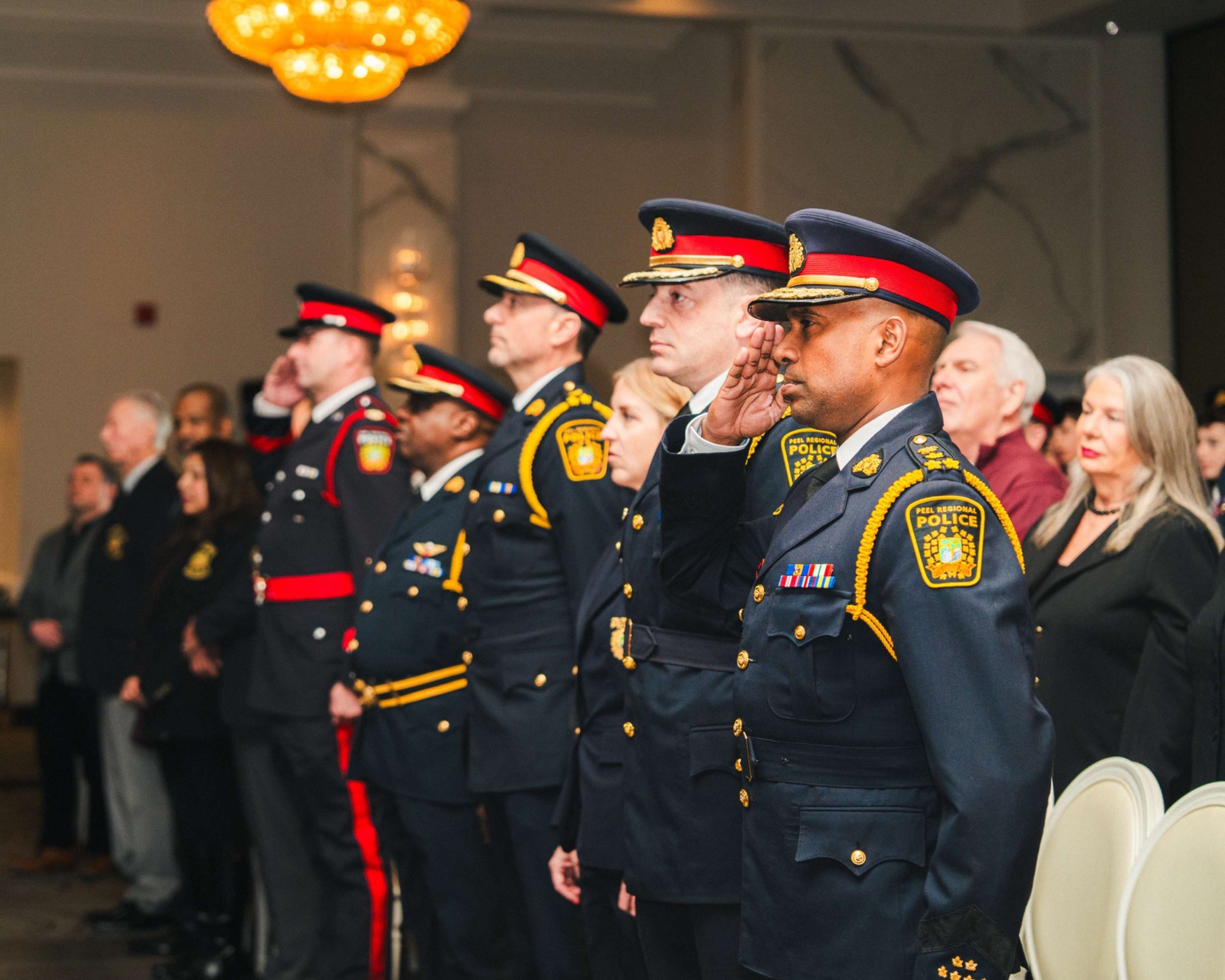
Sources have told The Pointer that questions and answers for a recent Peel Police promotional process were given to candidates viewed as being “aligned” with Chief Nishan Duraiappah and his senior team.
(Nishan Duraiappah/X)
A full list of the promotions has yet to be made public. The force typically publishes a list of those promoted as part of its annual report released later in the year.
While the force showed signs of changing its discriminatory hiring practices for frontline officers in the year after signing an agreement with the Ontario Human Rights Commission (OHRC) in 2020, following the Sandhu decision and a scathing equity audit of Peel Police in 2019, the recent allegations raise concerns that little has changed in the selection process for more senior positions.
Similar discrimination was previously identified in the 2017 Ontario Human Rights Tribunal ruling against Peel Police in the Sandhu case.
Starting his career in 1989, Sandhu amassed an extensive list of commendations for policing excellence (he helped solve numerous high profile cases and was awarded the prestigious Queen’s Diamond Jubilee Medal). In 2013 he filed a discrimination case against Peel Police when he was refused the opportunity to seek a promotion.
The evidence in the Ontario Human Rights Tribunal hearings was shocking.
A culture of widespread racism was detailed in documents and in witness testimony.
The Tribunal found Sandhu had been discriminated against due to his race and that the force’s culture was broadly racist toward Mississauga’s and Brampton’s large visible minority communities, which the force is supposed to serve and reflect.
The ruling stated Peel Police “generally” devalued policing in the huge South Asian community because it involves “the South Asian population”.
Evidence used in the case showed how the lack of diverse hiring and promoting was impacting public safety in Peel.
A report used in the case “indicated that certain criminal elements had become significantly more sophisticated following the increase in the South Asian population within the region. [The authors] specifically identified a lack of knowledge within the [Police] Service of these changes, and as a result crimes within the community were often not being addressed,” the Human Rights Tribunal of Ontario detailed in its precedent-setting decision.
This was particularly disturbing for a force that operated in two cities whose South-Asian Canadian communities represented about half the total population.
A small unit that was created but disbanded shortly after, was referred to by senior officers and others as the “Paki task force”.
The concerns highlighted in the report that had been submitted to senior leadership at Peel Police were largely ignored.
Since his arrival in Peel in late 2019, Chief Duraiappah has inflated the deputy chief ranks with individuals close to him, including deputies Nick Milinovich and Anthony Odoardi who he worked alongside at Halton Police, and Deputy Chief Lauren Jackson, who did multi-year consulting work for Deloitte with the Halton Police while Duraiappah was employed there.
The hiring blitz carried out by Peel Police in recent years has ballooned the number of officers on the force with less than five years experience, increasing the risk of individuals without the proper workplace knowledge being chosen for senior positions, sources have told The Pointer.
Duraiappah himself was hired by the third largest municipal police force in the country despite no previous experience as a police chief, following the 2018 election of his close friend Brampton Mayor Patrick Brown, who is a dominant voice on the police board that hires the chief. Since Brown had him hired, Duraiappah's salary has exploded from $299,196 in 2020 (his first full year on the job) to $604,449 (not including benefits) last year; a 102 percent increase in five years.
Odoardi and Milinovich, who Duraiappah brought over to join him in Peel, have also seen their salaries skyrocket beyond anything any responsible financial monitor would consider sustainable.
Milinovich and Odoardi have seen salary increases of 73 percent and 69 percent respectively since 2021, their first full year on the job. In 2025, Milinovich earned $499,579 in salary and benefits, which was more than police chiefs across the GTA and Ontario, and even more than the OPP Commissioner.
While sources have said the majority of officers promoted in the most recent round are white, Duraiappah, when hired, committed to dismantling a culture that encouraged systemic discrimination and anti-Black racism.
He has failed to do so.
Police brutality against Black residents has led to evidence and charges tossed out by the courts. Last year, a judge, in tossing out evidence against a Black man whose vehicle was illegally searched by officers, declared: “racial profiling is systemic and intractable within Peel Police.” It was a stunning, disturbing acknowledgement by an officer of the court who had first-hand knowledge of racist behaviour by Peel Police officers repeatedly seen in cases.
Peel Police recorded a 111 percent increase in use of force in 2024, then attempted to deflect blame for the discriminatory behaviour of its officers onto Peel’s Black communities.
Email: [email protected]
At a time when vital public information is needed by everyone, The Pointer has taken down our paywall on all stories to ensure every resident of Brampton, Mississauga and Niagara has access to the facts. For those who are able, we encourage you to consider a subscription. This will help us report on important public interest issues the community needs to know about now more than ever. You can register for a 30-day free trial HERE. Thereafter, The Pointer will charge $10 a month and you can cancel any time right on the website. Thank you
Submit a correction about this story

