
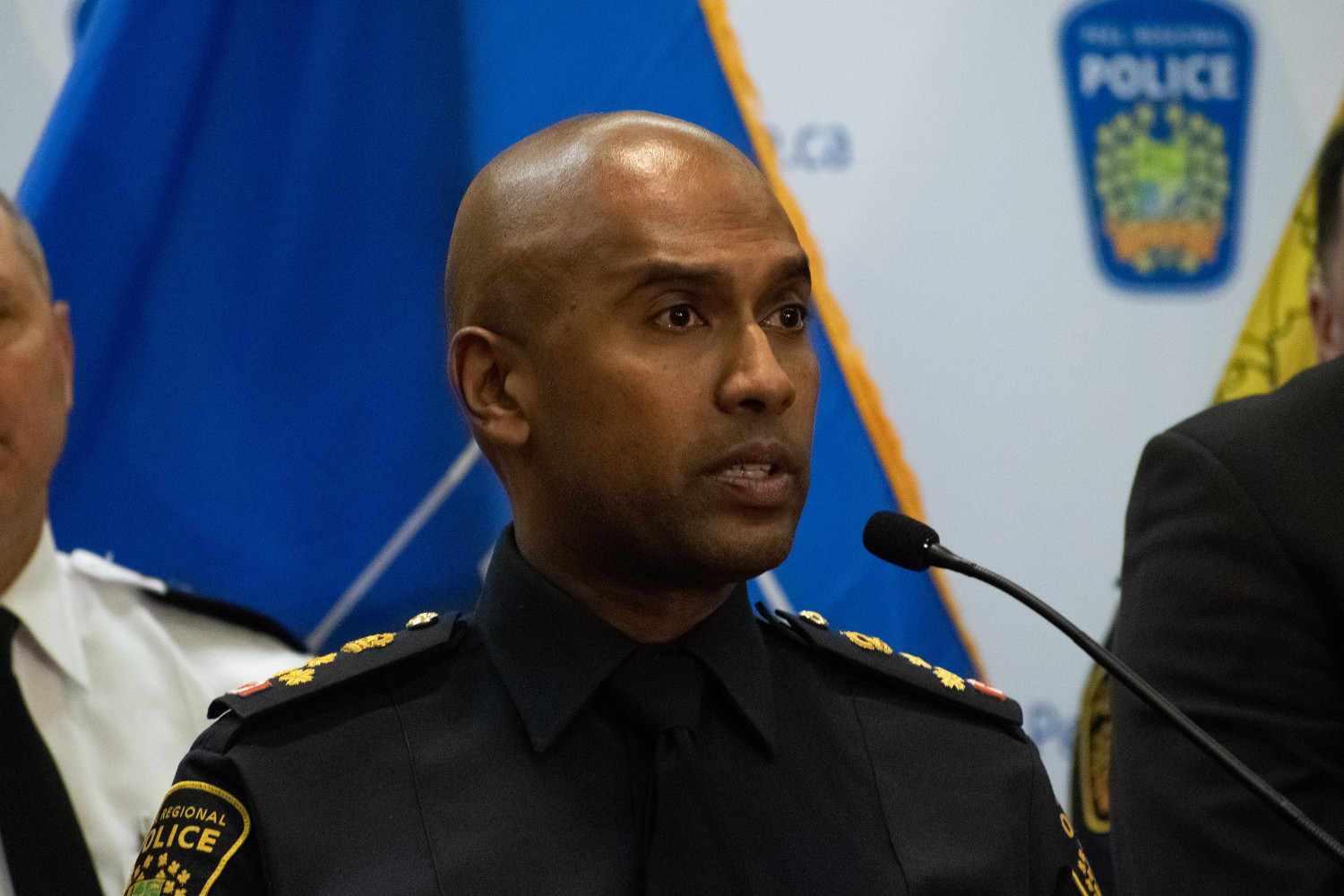
‘This is highway robbery with complicity’: Fury spreads across Peel after Police Chief Nishan Duraiappah’s $611K salary revealed; his deputy made $500K
In less than six years, Nishan Duraiappah has gone from a deputy chief in Halton Region to the highest paid policing official in all of Canada, with Peel residents shelling out $611,678 for his salary and benefits in 2025.
After getting hired with no previous experience as a police chief, following the 2018 election of his close friend Brampton Mayor Patrick Brown who immediately joined the police board, Duraiappah's salary went from $299,196 in 2020 (his first full year on the job) to $604,449 (not including benefits) last year; a 102 percent increase in five years.
Over the last year, he and many of his deputy chiefs have enjoyed pay increases that many Peel residents struggling to make ends meet under record inflation could only dream of.
Though Peel’s Police Chief has failed to achieve many of the large visionary changes Duraiappah promised when he was hired in late 2019, his salary has more than doubled since.
“It shows a total disconnect between the public and the police and political leaders. This is such a callous way to treat the taxpayers who can’t even afford to pay for the house they pay taxes on,” Alok Mukherjee told The Pointer. He served as chair of the Toronto Police Services Board from 2005 to 2015 and has worked on police governance and accountability for two decades. “Unfortunately, the battle to control police costs has been lost.”
The two deputy chiefs Duraiappah brought in to join him in Peel have also seen their salaries skyrocket beyond anything any responsible financial monitor would consider sustainable.
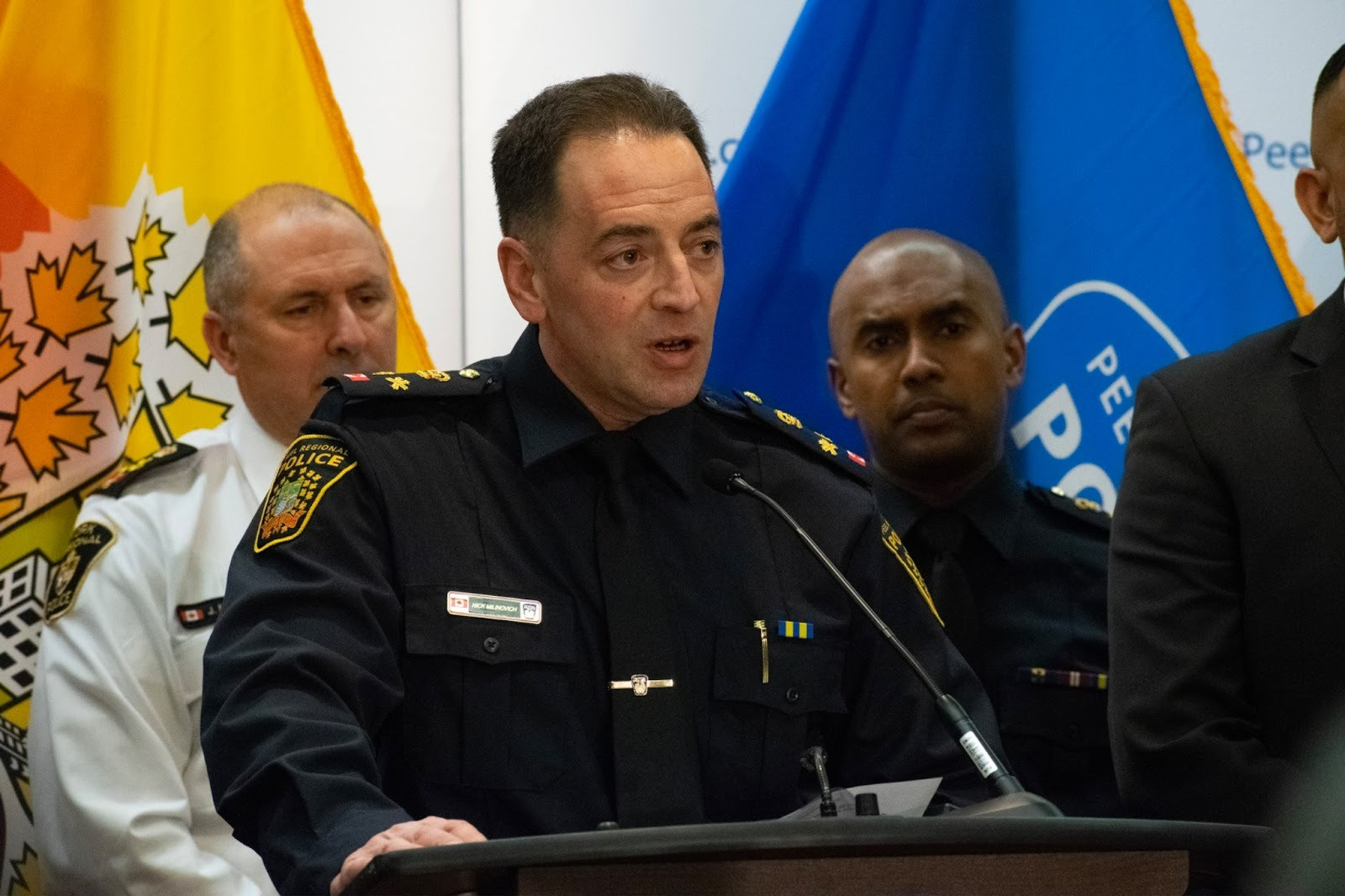
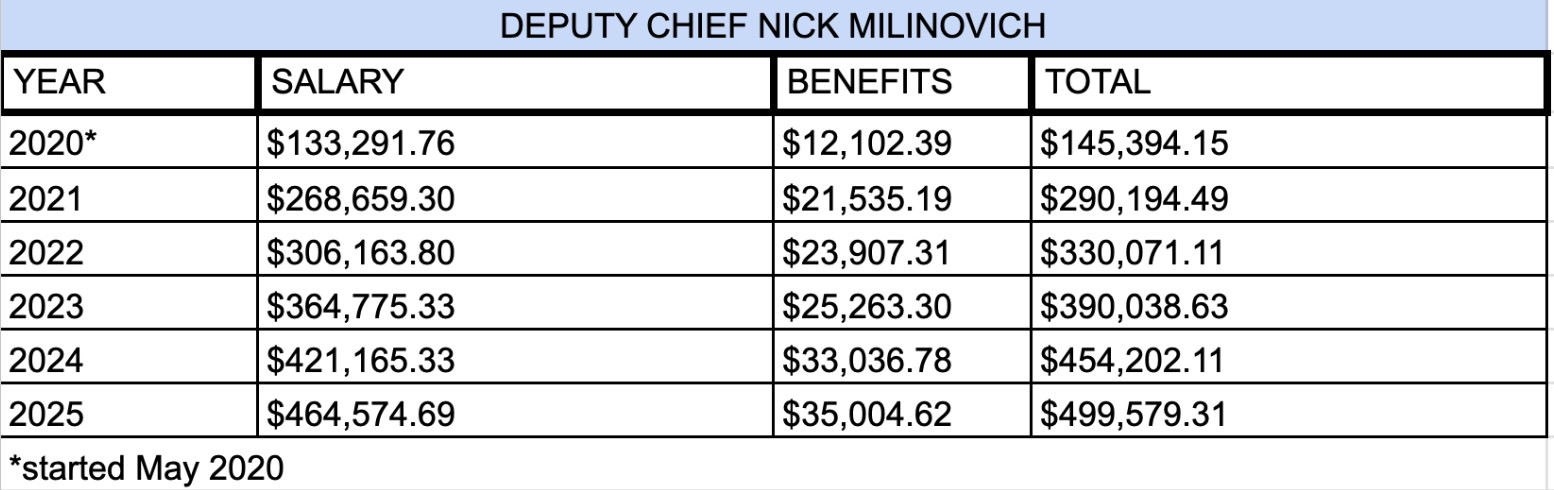
Nick Milinovich and Anthony Odoardi have seen salary increases of 73 percent and 69 percent respectively since 2021, their first full year on the job. In 2025, Milinovich earned $499,579 in salary and benefits, which was more than police chiefs across the GTA and Ontario, and even more than the OPP Commissioner.
According to the 2025 public sector salary disclosure released last week, Duraiappah made $604,449.04 as Chief of Peel Police in 2025, plus $7,229 in taxable benefits. That’s far and above Toronto Police Chief Myron Demkiw’s $445,366.68 salary (he is responsible for double the number of sworn officers); and far more than OPP Commissioner Thomas Carrique’s $468,523.88.
Peel Deputy Chief Mark Dapat’s salary increased 24 percent in 2025 to $388,384.75. Deputy Chief Lauren Jackson and Anthony Odoadi both recorded 11 percent increases to $340,851 and $423,263 respectively.
“This rate of pay is an unconscionable betrayal,” David Bosveld, who has sat on a Peel Police community advisory committee and has for almost a decade advocated for systemic changes in policing including accountability over the way tax dollars are used, told The Pointer.
He has warned Peel’s elected officials for years that the money they are giving to the police is unsustainable. His warnings have largely been ignored by the Chair of the Peel Police Services Board Nando Iannicca, the board’s provincial appointees (many of whom have no policing experience) and the elected officials who sit on the board, including Mayor Patrick Brown, and Mississauga Councillor Matt Mahoney, who replaced Mississauga Mayor Carolyn Parrish on the board after she resigned in November 2024 after a 23.3 percent budget increase was brought forward by the Chief.
“Police chiefs are not rock stars or professional athletes. They are public servants in a time where the public purse is stretched to the limit,” Bosveld said.
The alarming salary increases for Duraiappah and many other senior Peel officers sparked outrage on social media: “Policing isn't like a normal job where your performance is measured and your compensation reflects it. It's an infinite money glitch where you and I owe increasingly larger amounts of money to hand over to these entitled worthless clowns,” wrote one Reddit user in a thread filled with comments critical of the Peel Police salary figures released last week as part of Ontario’s public sector salary disclosure for 2025.
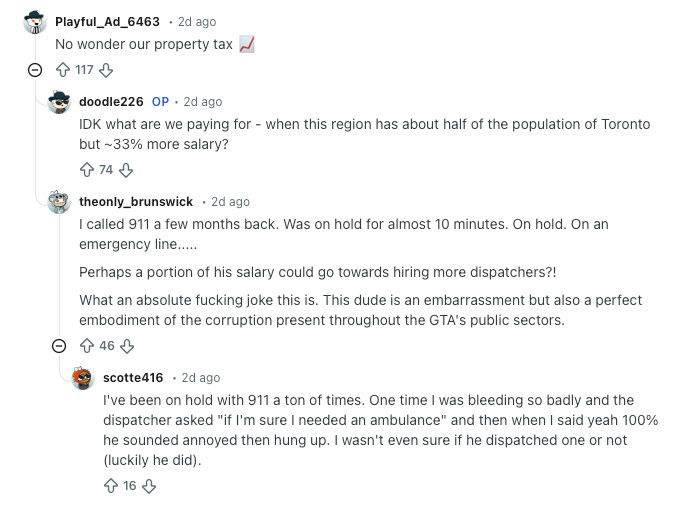
Reddit users expressed their shock over the $611,000 income of Peel Police Chief Nishan Duraiappah.
(Reddit)
“It's outrageous that our taxes are increasing astronomically in large part to fund a ballooning and out of control police budget that seems significantly out of line with other forces. It seems Peel Police budget has increased by 81% in 6 years,” wrote one Reddit user.
“Doubling your salary in five years when you’re already starting at 300k as a PUBLIC SERVANT is insane work,” wrote another.
“What an absolute fucking joke this is. This dude is an embarrassment but also a perfect embodiment of the corruption present throughout the GTA's public sectors,” added another.
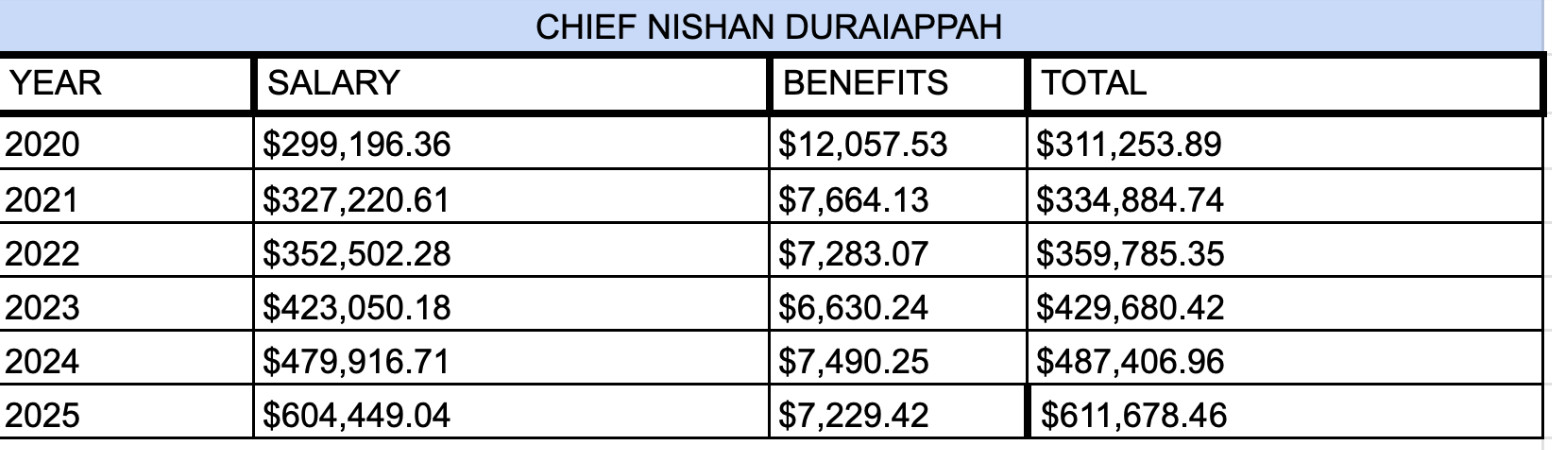
(Alexis Wright/The Pointer; Salary figures from the Government of Ontario)
As inflation has crippled many Peel families and more and more homeowners cannot pay their property taxes, they have watched local elected officials and the appointees on the Peel Police Services Board give Duraiappah, who was recruited by his close friend Brampton Mayor Patrick Brown, whatever he wants.
In 2024, elected officials rubber stamped what was, at that time, one of the biggest budget increases in Police history; 14 percent. In 2024, Duraiappah’s salary increased 13.4 percent.
The next year, residents were floored when Duraiappah returned with a much bigger ask, a 23.3 hike. Despite protests from residents and advocates who labelled the budget request as unsustainable, warning elected officials it was stealing money away from the upstream services like housing, mental health and addictions support that, when left unfunded, lead to much higher rates of crime and police interactions, it was approved with little accountability from elected officials. In 2025, Duraiappah’s salary increased 26 percent.
“The Peel Police Board gave a 20-plus percent increase in funding so I guess they thought the Chief should get a similar increase in his own salary,” Michelle Bilek, an advocate for affordable housing and social supports in Peel Region, said.
“Outrageous,” she added. “What I’d like to see is data and further evidence of needs (crime), roles of hires and outcomes of increases. Does the Chief have a review process yearly like other boards do with the EDs? What does that process look like and what are the set objectives for the year and evaluation methodology for outcomes.”
There is hardly any public information about the Chief available.
His 2025 budget request, $144 million in one year, nearly matched the increase recorded during the entire decade between 2012 and 2022, which saw spending on police rise by 23.6 percent.
The approval meant Peel Police spending increased a staggering 77 percent in just five years under Duraiappah. It dwarfs the increases requested by neighbouring police forces during the same time period. It’s more than double the budget increase Durham Regional Police recorded during that time, 29.7 percent; and dwarfed Toronto—Canada’s largest municipal police force—which recorded a 15.5 percent increase between 2019 and 2024.
This year, elected officials and appointees on the police services board approved yet another far above-inflation increase for Peel Police, 9.9 percent.
It’s unclear what Duraiappah has done to deserve his astronomical pay increases which have made him the highest paid police official in Canada, earning more than the leaders of the OPP and the RCMP.
Peel Police's own data has shown the dizzying budget and salary increases have come alongside a worsening performance in solving crime.
The Chief has failed to meet most of the key commitments he made when he was hired in late 2019.
He committed to increasing accountability and changing the culture at Peel Police that generated numerous scandals—discriminating against a decorated South Asian officer; handcuffing a 6-year-old Black child in school; widespread targeting of Black residents in “random” carding stops on the street to collect identifying information; repeated cases of racial profiling of Black residents; and shooting, tasing and harming Black residents at an alarming rate.
A 2021 survey developed by the Ontario Human Rights Commission found half of Peel’s residents who responded believed systemic racism in policing is a problem and almost 60 percent agreed with the commission’s plans to reform the force’s discriminatory culture.
But under his watch, change has been glacial or non-evident, Duraiappah has refused to acknowledge the role of racism in data that proves discrimination, and the scandals have continued—a tactical unit was sent to a local school to break up a fight between Black teens and one of his own off-duty officers who allegedly triggered the incident; police brutality against Black residents has led to evidence and charges tossed out by the courts. Last year, a judge, in tossing out evidence against a Black man whose vehicle was illegally searched by officers, declared: “racial profiling is systemic and intractable within Peel Police.” It was a stunning, disturbing acknowledgement by an officer of the court who had first-hand knowledge of racist behaviour by Peel Police officers repeatedly seen in cases.
A recent report from Western Law tallied up Charter violations among Ontario’s major police forces between 2015 and 2025 and found more than 1,000 cases. Peel Police was the worst offender for serious Charter violations per 1 million residents.
Peel's large South Asian-Canadian community, particularly Sikhs, have accused the force and its Chief of ignoring mounting violent crime specifically targeting them including home shootings and extortion threats.
The hard to justify salary increases raise questions about the priorities of Peel's police leaders, and a culture that appears to abuse the region's taxpayers, instead of protecting them, critics say.
“I have been speaking up about unsustainable pay increases for police leaders including the chief for quite some time,” Bosveld said. “The ED (Robert Serpe) of the PPSB (Peel Police Services Board) also continues to rake in a massive taxpayer funded salary alongside the PRP senior leaders, the public affairs staff and of course the frontline with their bargained increases. That by the way sets the precedent for higher wages next cycle and also allows other services to continue to escalate pay and benefits based on what these officers make. Police salaries and ever increasing budgets mean less available resources for things that evidence suggests keeps us all safe. Food security, mental health supports, healthcare, high quality public education and early interventions and supports for young people.”
This was echoed by Mukherjee who told The Pointer the unsustainable salary increases (which he previously described as an “Utter failure of governance”) since Duraiappah took over are choking off funding from the social services that can most effectively address the root causes of crime. He said he was stunned the increases were approved so flagrantly while so many in the public are suffering so openly. He says it is not only a sign that the battle to reduce policing costs has been lost, but so has the battle to reduce crime.
“This is highway robbery with complicity, the complicity of the mayors and regional council and board members who collude with the police leaders,” he said.
Serpe, the executive director of the Peel Police Services Board, earned $390,223 in salary and benefits in 2025 (higher than the Chief of Police in the Region of Durham) and a 21 percent increase over 2024. It was nearly $100,000 more than the same position at the Toronto Police Services Board, and it marks more than a doubling of his compensation since 2017 (he started at the board in 2016) when he earned $157,991.
At the request of dozens of readers, The Pointer will be asking Peel’s elected officials, particularly Brampton Mayor and Police Board member Patrick Brown and Peel Regional Chair and Police Board Chair Nando Iannicca, for benchmarks and documentation that show how they determined Chief Duraiappah’s $611,000 income is justified.
Email: [email protected]
At a time when vital public information is needed by everyone, The Pointer has taken down our paywall on all stories to ensure every resident of Brampton, Mississauga and Niagara has access to the facts. For those who are able, we encourage you to consider a subscription. This will help us report on important public interest issues the community needs to know about now more than ever. You can register for a 30-day free trial HERE. Thereafter, The Pointer will charge $10 a month and you can cancel any time right on the website. Thank you
Submit a correction about this story

