
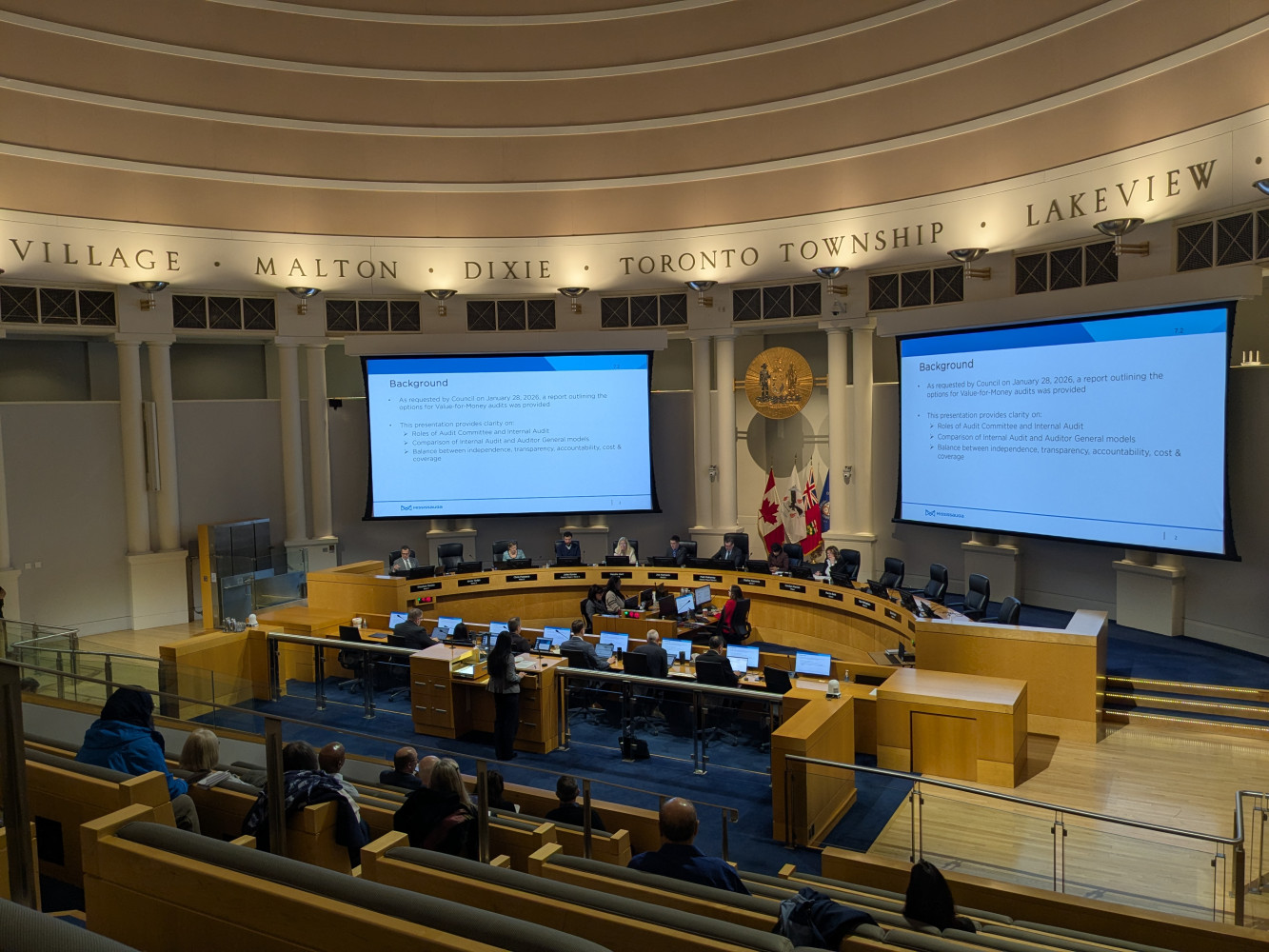
Mississauga taxpayers wanted an independent Auditor General hired for oversight of their money—Council voted no
RK Srivatsa worked in corporate business for over 40 years, and he’s learned that there are always opportunities to identify and address financial inefficiencies or leaks.
As a Mississauga resident, he made a deputation at the March 4 General Committee meeting of Council encouraging local elected officials to support the hiring of an independent Auditor General (AG). “I think it’s money well-spent," he encouraged.
He wasn’t alone.
Ten others representing themselves or resident associations, made their way to council chambers and up to the podium, to implore Council (or at least the eight members present) to vote for an independent AG.
Many were left disappointed when the majority of council members, including Mayor Carolyn Parrish, voted down the idea, instead opting for options to expand the current audit functions and open the City’s fraud hotline to public complaints.
The discussion was sparked by a deputation during the January 13, 2026 Budget Committee meeting, by Athina Tagidou and Mike Harris of the Applewood Hills & Heights Residents’ Association.
They were frustrated with the annual, above-inflation tax increases residents had been subjected to in recent years, and wanted the City to hire an independent AG as a way to examine if the city’s taxpayers are getting value for their money.
A large part of the excessive budget increases is related to unsustainable increases in staffing costs, particularly non-union, senior management. More than half of the City’s budget (54.3 percent) is dedicated to salaries and benefits. Critics of City spending have long called for an independent review of Council priorities regarding the use of taxpayer dollars, but it's unclear when such an audit of City Hall spending was last conducted. Municipalities hire an auditor general to do exactly that—protect the taxpayers elected officials and senior bureaucrats are supposed to be working for.
“What we need is consistent effort each year by council and assisted by staff to ensure maximum attention on city expenses in keeping our annual property taxes locked to CPI [Canada Consumer Price Index]…each year,” Tagidou said.
Later in January, following the deputation by her and Harris (whose association is located in Ward 3), their local Councillor, Chris Fonseca, brought forward a motion to look at the possibility of an independent AG.
Her motion directed staff to prepare a report on the City’s current functions for maintaining fiscal responsibility (the Internal Audit department, the Audit Committee, and value-for-money, VFM, audits) along with options to carry out VFM audits and the costs associated with hiring an independent AG.
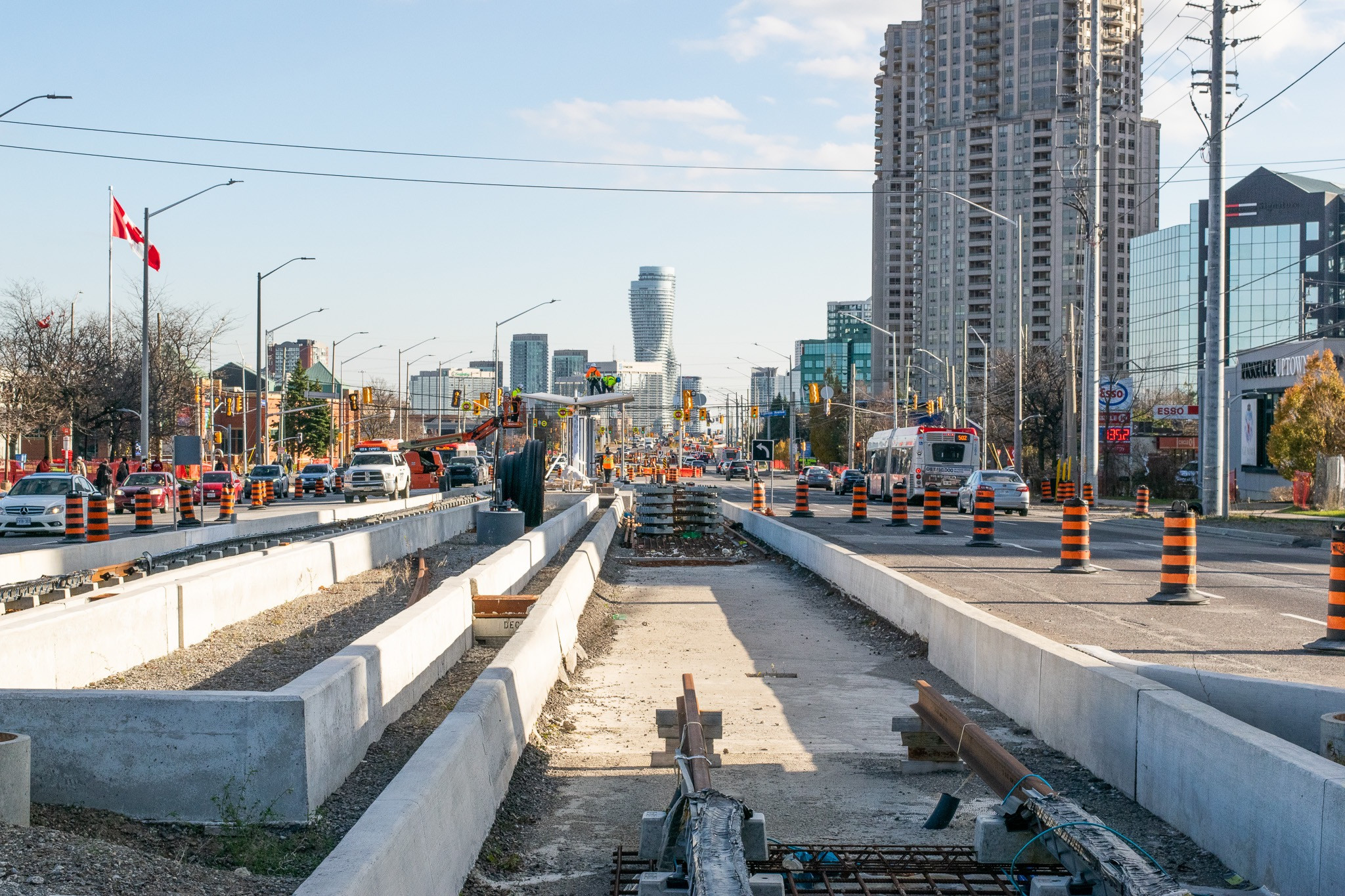
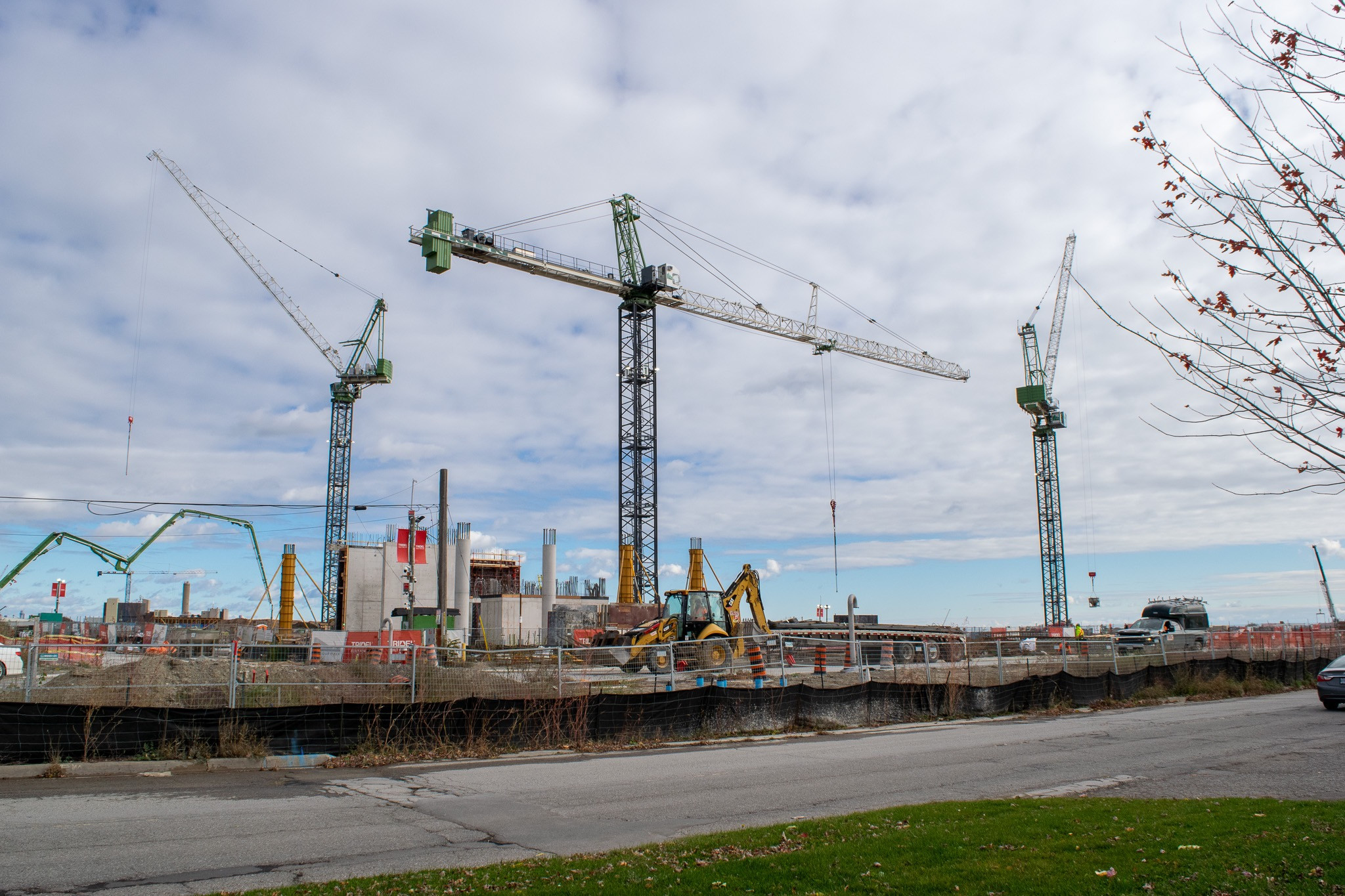
With major projects like the Hurontario LRT and Lakeview Village placing pressure on the City’s budget, numerous residents demanded the establishment of an independent auditor general to monitor fiscal responsibility.
(Alexis Wright/The Pointer files)
While Councillor Fonseca specifically named the “incredible work” that Ward 7 Councillor Dipika Damerla did to lead the Region of Peel’s hiring of an independent AG, Damerla, expressed disappointment that she wasn’t engaged or involved in the motion, or the work that was done around it.
“It’s an issue I was very passionate about,” she said during the January 28 meeting, “I deliberately held off on bringing a motion until everything was dotted at the Region of Peel.”
The ‘i’s’ being dotted that Councillor Damerla referred to relate to the establishment of the Region’s independent Office of the Auditor General. In January, Nick Stavropoulos was announced as Peel’s first independent AG.
Municipalities across Ontario have been criticized since the provincial government gave them the power to hire independent AGs; only a handful, including Toronto have taken the proactive step. It allows an AG to work outside council’s sphere of influence. Though internal auditors are supposed to formally operate under guidelines for independence established by their professional body, examples of interference by elected municipal officials are common.
The Pointer published a series of investigative articles when Brampton Mayor Patrick Brown was behind an attempted takeover of the City’s internal audit function.
Brampton CAO continues erosion of accountability and transparency—moves independent audit function under his authority
‘That is not factual’: Councillor demands CAO answer for misleading council—met with silence
Brampton’s internal audit function hijacked by CAO, fraud hotline taken over by his hires, committee says
After damning internal audit report radically altered, council strips CAO of all power over audit function
Internal audit departments often have to follow audit plans prioritized by elected officials, and can be subject to reporting restrictions imposed by audit committee members who sit on council.
Even external, independent auditors hired in the municipal sector can face pressure to play by council’s rules, or risk being fired if their work exposes conduct not in the public interest, as happened in Oshawa more than a decade ago, when independent auditor general Ron Foster, a highly respected professional in the sector who served as Sudbury’s AG until the end of last year, was fired after bringing forward a report that was critical of the way taxpayer dollars had been spent in the controversial purchase of a parcel of land needed by the municipality.
Stavropoulos comes to Peel with over two decades of experience with the Office of the Auditor General of Ontario. He was the province’s Acting Auditor General for part of 2023, and the annual report he released in December of that year featured 12 value-for-money audits focused on health care, tourism, education, and the environment.
One section of the 2023 report looked at emergency rooms across the province, including William Osler Health System’s Brampton Civic Hospital, where they observed dozens of patients stuck in the ER. This included elderly patients being treated in hallways.
At the Region of Peel, Stavropoulos’ role was established without a study or staff report, said Councillor Damerla. She said that in Mississauga, the same decision could be made.
She was alone in her push for the role. Other members of Council expressed support for Councillor Fonseca’s motion. “I’m happy to support it because it goes to show that we’re doing our homework on this,” said Ward 1 Councillor Stephen Dasko.
Councillor Fonseca’s motion passed, and staff prepared their report for the March 4, 2026 General Committee meeting where the decision was to be made.
Before that March 4 meeting, however, Councillor Damerla continued to publicly discuss the idea and value of an independent AG on her social media.
“Think of an Auditor General as a watchdog of the taxpayer whose full-time job is to look for waste, find savings and even look into fraud,” Councillor Damerla said in a February 4 Instagram post.
It’s unclear what work the City’s internal audit department has done, if any, to examine the salaries, benefits and other perks of non-union staff, including the highest paid employees inside City Hall.
The Pointer is conducting its own review of management spending on salaries, travel by staff and council, and other expenses driving up the taxpayer-funded budget in recent years. The public budget documents overseen by senior staff and approved by council members have done a poor job of providing taxpayers with clear breakdowns of how much is being spent on each level and category of municipal staff.
It’s unclear why council members have not directed the internal audit department to conduct these types of detailed audits, which taxpayers have called for, to find out how their money is being spent on things like travel, salaries, benefits and perks.
In 2024, according to Ontario’s public salary disclosure, which lists all public sector employees in the province who make $100,000 or more, the City of Mississauga employed 2,099 staff who earned more than that threshold. Their total salary in 2024 was $265 million (which only includes employees who earned more than $100,000).
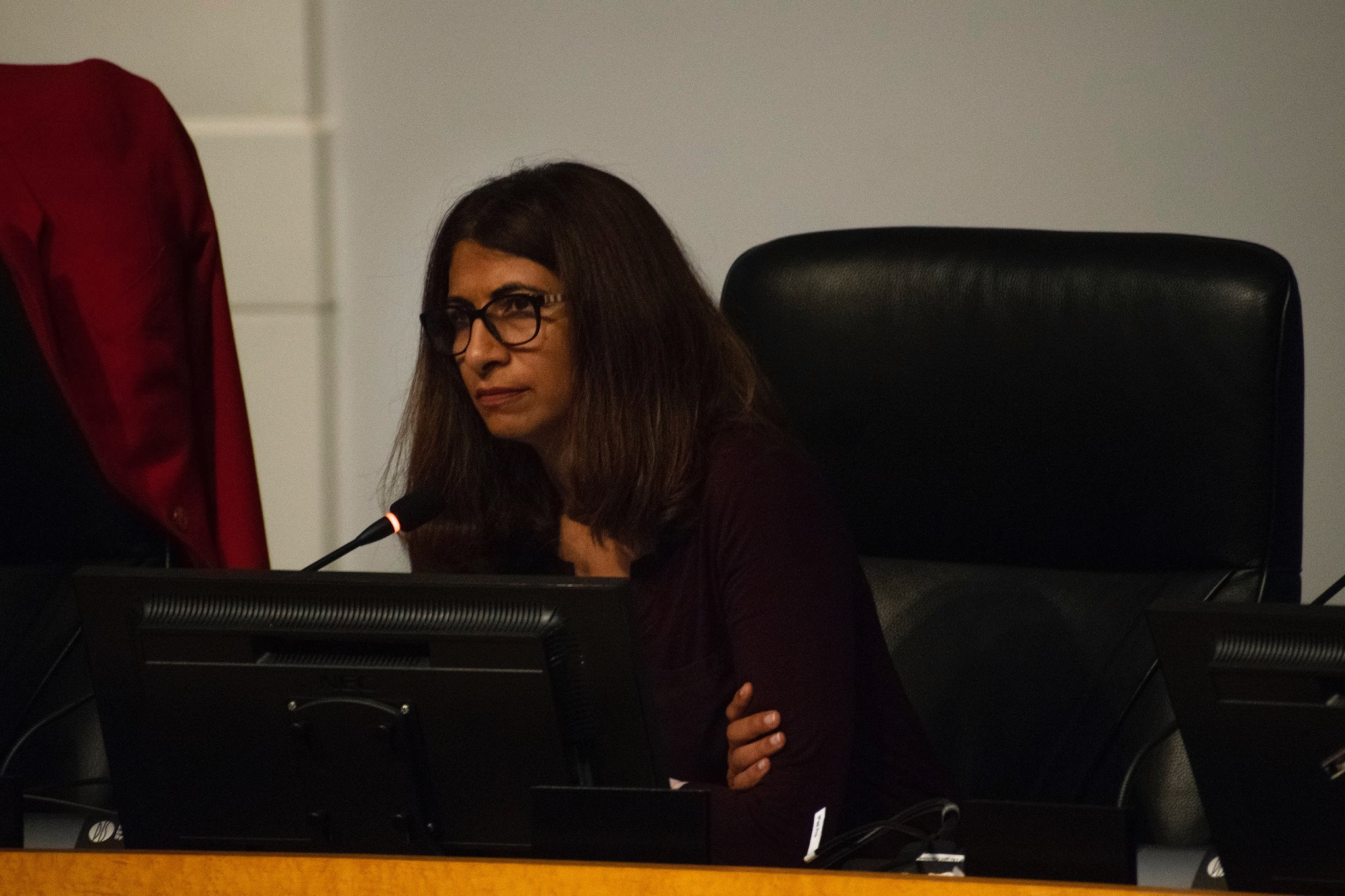
Mississauga Councillor Dipika Damerla was the lone voice in favour of establishing an independent auditor general for the City of Mississauga.
(Alexis Wright/The Pointer files)
There is also significant additional risk to taxpayers due to the scale of projects moving forward or being considered by Council: spending on infrastructure to support the 16,000 units being constructed at Lakeview Village in the coming years (one of the biggest projects in Canada which could add more than 30,000 residents to the city; additional spending to support the Brightwater development plan and other communities that will soon be developed along the waterfront; the long delayed Hazel McCallion LRT project which will require City investment to create transit links, tens of millions for various upgrades, alignments and surface enhancements and potentially hundreds of millions for operational costs; and the $390 million local share needed for the construction of the multi-billion dollar Peter Gilgan hospital.
These and other unprecedented projects at a crucial point in Mississauga’s history, as it continues the urban transformation started almost thirty years ago, could open taxpayers to immense risks, with hundreds of contracts going out the door at City Hall, and spending of taxpayer dollars at a scale never seen before. Parrish is now pushing a $2.5 billion downtown redevelopment plan, to be built on public lands owned by the city’s taxpayers.
An external, independent auditor general would provide another level of accountability for taxpayers at a time when developers and other private sector players are lining up to cash in on Mississauga’s rapid urban growth.
A few days before the March 4 General Committee Meeting, Councillor Damerla hosted a townhall focused on the issue of an independent auditor, to ensure residents had an understanding of what an AG is. The townhall, as well as the advocacy of resident associations is what led to 11 deputations, including by Srivatsa.
The staff report, prepared and presented on March 4 by the City’s Director of Internal Audit, Amy Truong, described the roles of the Internal Audit team and the Audit Committee. The Director reports administratively to the City Manager and Chief Administrative Office (CAO), and functionally to the Audit Committee.
The Audit Committee is a standing committee, and its role is described by the City as “oversee[ing] key City functions including accounting, reporting, ethics and regulations.” Currently, Ward 6 Councillor Joe Horneck chairs the audit committee.
There were recent improvements to Internal Audit processes, according to the staff report, which resulted in a “‘termination of employment requirements’ … whereby the request for removal of the Director, Internal Audit must be reviewed and supported by the Audit Committee prior to termination of employment.”
This is described as one of several improvements that strengthened the independence of the internal Audit team.
The staff report also compared hiring an independent AG with hiring an external consultant for ad hoc audits, with the most significant differences being estimated costs: $2 million for an independent AG, and between $40,000 and $95,000 per VFM audit for external consultants.
The $2 million estimate to establish an independent AG for Mississauga was determined by looking at five other cities’ independent AG costs. As Mississauga’s population is larger than Hamilton ($1.5 million budgeted for its independent AG) and smaller than Ottawa ($2.8 million budgeted for its independent AG), staff estimated $2 million.
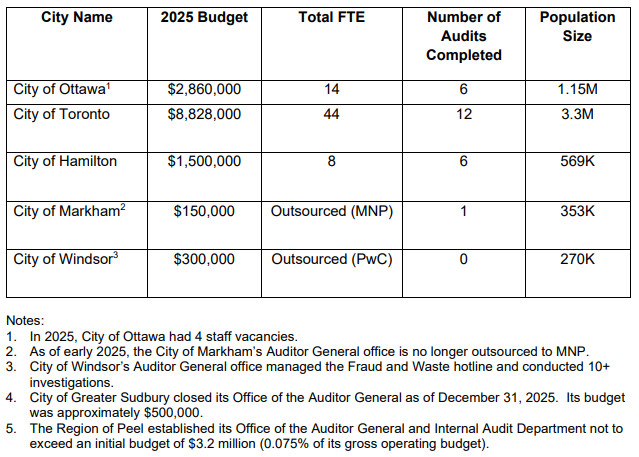
A comparison of other municipalities in Ontario who have an Auditor General, looking at costs, staffing and audits completed. This comparison was provided by City staff in their report to Council on March 4, 2026.
(City of Mississauga)
Speaking to the staff report, Truong’s presentation at the March 4 General Committee included a slide deck describing the similarities and differences between the Internal Audit team and an independent AG.
“Despite structural differences, the Auditor General and Internal Audit share many foundational attributes that are critical to oversight,” said Truong.
These similarities include full and unrestricted access to information and personnel, the fact that both produce public reports and their broad scope of work.
Differences between the two models were in the areas of independence, transparency, accountability, cost and coverage. For each difference, there were considerations listed that implied that the two aren’t actually that different.
For example, the independent AG is appointed by Council, while the Director, Internal Audit is appointed by senior management. However, the Audit Committee has oversight of hiring, removal, and performance of the Director.
“Many of the benefits associated with an Auditor General can be achieved by enhancing and leveraging the existing audit function,” Truong said during her presentation.
The first comments after the presentation came from Councillor Damerla, who thanked Truong and also recognized that she was put in a difficult position, describing it as an “inherent conflict.”
“We’re asking somebody ‘do you want to expand your department’ versus [having] a new one?” Councillor Damerla said.
Truong said that she prepared the report objectively, and identified the options without making any recommendations. These options were:
Option 1: make no changes and maintain the status quote.
Option 2: increase the capacity of Internal Audit by adding two staff positions.
Option 3: hire an external consultant to complete VFM audits on an ad hoc basis.
Option 4: hire an independent AG.
Two additional actions were discussed by Council. Councillor Horneck suggested adding two citizens to Mississauga's Audit Committee, mirroring the Region’s Audit Committee. He asked the City’s Solicitor and Director of Legal Services, Graham Walsh, about the Whistleblower program, which is currently only for staff, and could be set up as a public hotline. This would align Mississauga’s hotline to other municipalities like the City of Toronto. In 2025, Toronto’s Auditor General identified over $4.6 million in actual lost funds based on complaints.
“Many of the things that are touted or being publicized about investigations flowing from that [Toronto] fraud line are very similar to the things that we’ve investigated for the past 11 years,” said Walsh.
While they don’t currently track or report on the financial impact of these investigations, Walsh estimated “we’re well in the multi-millions by this point after 10 years.”
Deputations from residents were unanimous in their support for an independent AG, citing the need for accountability and greater trust, while also easing the tax burden. A few residents asked for more details to be provided – whether by commissioning an independent study or by deferring the vote to give more time for review and community engagement.
“I truly think you should not be doing any voting with a third of Council missing,” said Sue Shanly, chair of Mississauga Residents' Association Network (MIRANET), referring to the absences of Councillors Alvin Tedjo, Martin Reid, Sue McFadden and Brad Butt.
Generally, residents expressed gratitude for the report and Truong’s presentation. But, receiving the slides only four days before the meeting left little time for adequate review.
And, there were gaps in the data provided.
“It does not examine the benefits experienced by other Canadian municipalities where independent Auditor General offices have delivered substantial return on investment, improved service delivery and strengthened public trust,” said resident Christine Koczmara.
The tension in the chamber was clear during some of the snappy back-and-forth between residents and Council. Mayor Parrish, in particular, expressed her frustrations about people being “stirred up” to attend and address council.
In response to the argument that because the Region has an independent AG, Mississauga should too, Mayor Parrish laid things out simply: that there were less opportunities to have oversight with Regional matters. Because Council was present for Mississauga business “24/7” it just wasn’t the same, she claimed.
“We have very little oversight up there. We have very little accountability from the staff up there. They do their best. It’s essentially a dog’s breakfast.”
She went on to express her confidence in staff, believing they are better equipped to identify issues than the public.
“Rushing into an auditor general just because 70, 80, 90 people say ‘gee that’s a good idea.’
Our staff is not recommending that. And I have more faith in them than I do in 100, 200, 300 people complaining,” Mayor Parrish said, referencing the numerous delegates who came forward to speak, and disregarding their concerns.
Despite Mayor Parrish’s comments, the staff report does not make any recommendation, for or against, the establishment of an independent Auditor General’s office.
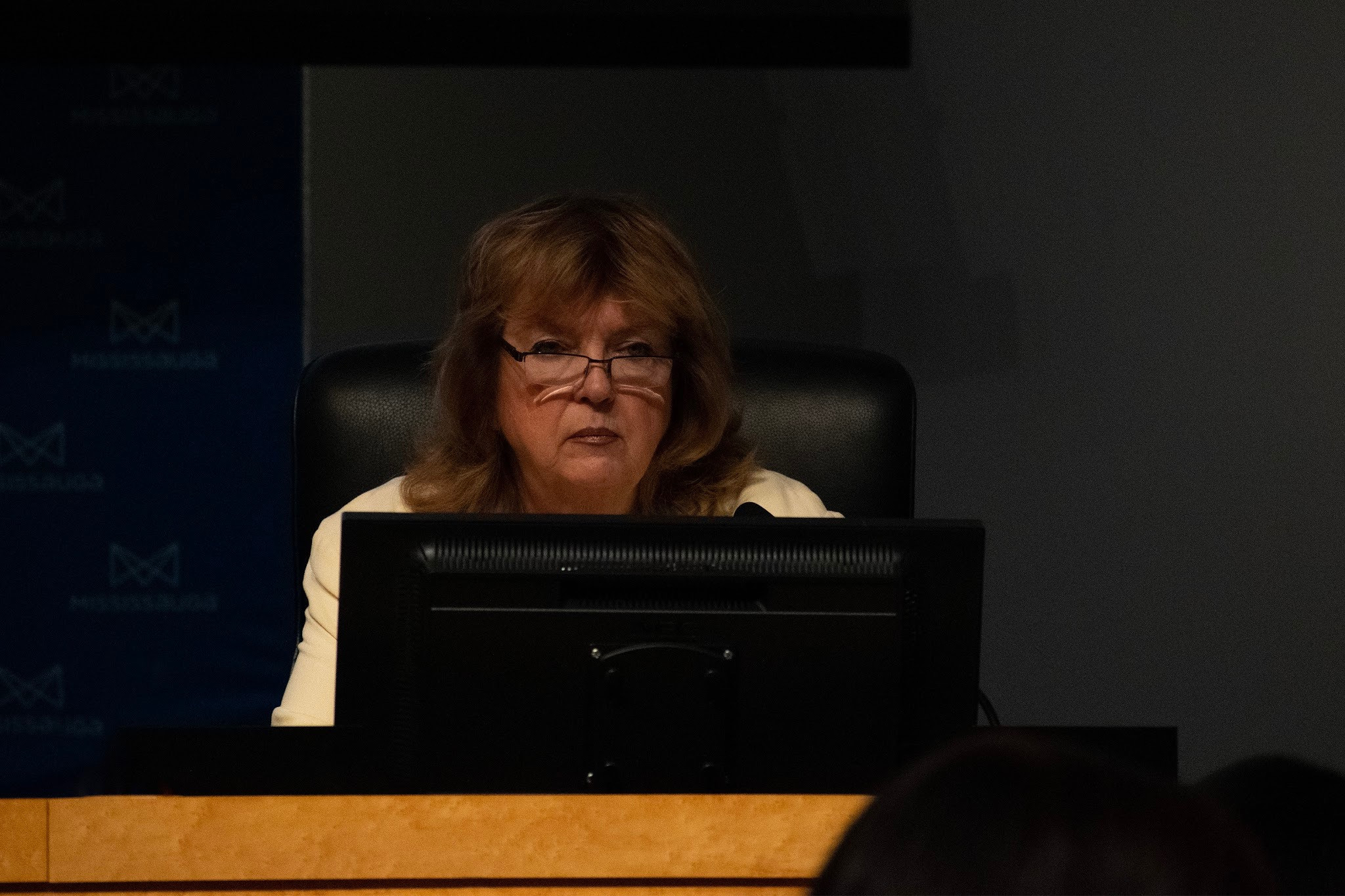
Mayor Carolyn Parrish said the lack of accountability mechanisms at the Region of Peel led her to support the establishment of an auditor general for the upper-tier municipality. She believes similar gaps do not exist in the City of Mississauga.
(Alexis Wright/The Pointer files)
Through the discussions, it became clear that Councillor Damerla was the only one who felt strongly about establishing an independent AG. She brought forward a motion to defer the meeting until April 8, and to hold it in the evening. The motion failed.
Ward 5 Councillor Natalie Hart stayed silent for the entire debate until just before voting on the options.
“When we make major financial discussions … just after we have passed the budget, we’re seeing the budget as a suggestion,” said Councillor Hart.
Councillor Damerla brought a motion for option 4 (an independent AG). She was the only one who voted in favour. Instead, option 2 with the add-ons of citizen appointments on the Audit Committee and establishing a public fraud and waste hotline, passed unanimously.
The decision left many residents upset.
“I think the frustration from a lot of the residents is the fact that our taxes keep going up,” Shanly said. “If inefficiencies could be found and it's a lot of money, then maybe our taxes won't continue to creep up so much.”
Press releases from MIRANET, Applewood Hills & Heights Residents Association and even Councillor Damerla all expressed disappointment and their desire to continue advocating for an AG.
Ward 2 Councillor Alvin Tedjo missed the meeting because he was in Washington on municipal business, but did get caught up on the discussion.
“I was supportive of it when it was first brought up and I'm still supportive of it now. I think the step that council is deciding to take moving forward is fine, but a full independent Auditor General, I still support that idea,” he said.
For Councillor Horneck, he worries that residents are thinking about the independent AG as an immediate cure for lowering taxes.
“Even if you take their most generous results where an Auditor General can return two or three times what they are putting in, cost wise, you're still only talking a few million dollars,” he said.
In a written statement, Ward 11 Councillor Brad Butt expressed that he’s not opposed to a future discussion about an independent AG for the City. “[I] want to see the impact of the AG at the Region of Peel before we make the decision to hire an AG for Mississauga.”
It’s unclear when the impact of the Region’s independent AG will start to be known, considering Stavropoulos only started in his role on March 2.
Stavropoulos “has yet to establish and confirm budget or FTE requirements,” a Region of Peel staff member who was not authorized to officially speak on the matter, said.
At the March 11 Council meeting, the motion from General Committee was approved, as part of the consent agenda. There was one deputation, from resident Dan Anderson, who raised concerns about the way that residents were treated in the March 4 meeting, and disputed the impact of the actions Council approved.
“[D]emonstrating transparency, and rectifying existing credibility issues, seems a more constructive position for Council members to adopt, pre-emptively, particularly well in advance of an election period,” said Anderson in his written submission.
Most residents and Council members have spoken about how the discussions at the Region really brought their attention to this issue of an independent AG, for the first time.
However, it isn’t the first time that this has been raised in Council. In March 2021, Karen Ras, who was the Ward 2 councillor at the time, brought up the idea in the audit committee, asking staff to gather some more information since Brampton Council had been considering the move following its problems with the internal audit function, and had directed staff to produce a report.
Brampton Council did not move forward, however, that decision was likely tied to the issues of CAO accountability in 2021.
Anu Radha Verma is a freelance journalist based in Mississauga, and recently completed a fellowship in journalism and health impact at the University of Toronto’s Dalla Lana School of Public Health.
At a time when vital public information is needed by everyone, The Pointer has taken down our paywall on all stories to ensure every resident of Brampton, Mississauga and Niagara has access to the facts. For those who are able, we encourage you to consider a subscription. This will help us report on important public interest issues the community needs to know about now more than ever. You can register for a 30-day free trial HERE. Thereafter, The Pointer will charge $10 a month and you can cancel any time right on the website. Thank you
Submit a correction about this story

