
Mississauga’s slim election year budget passes with delayed investments & concern that the almost 5% overall tax hike is being misrepresented
Mississauga Mayor Carolyn Parrish’s 2026 budget for the city encountered little resistance on its way through the cogs of council’s bureaucratic machine.
Its easy approval was perhaps best explained by the white flag raised by Councillor Joe Horneck—a known financial stickler on council. Despite his best efforts, the Ward 6 representative, just west of downtown, could find no further savings to be trimmed from this year’s financial blueprint for Ontario’s fourth largest city.
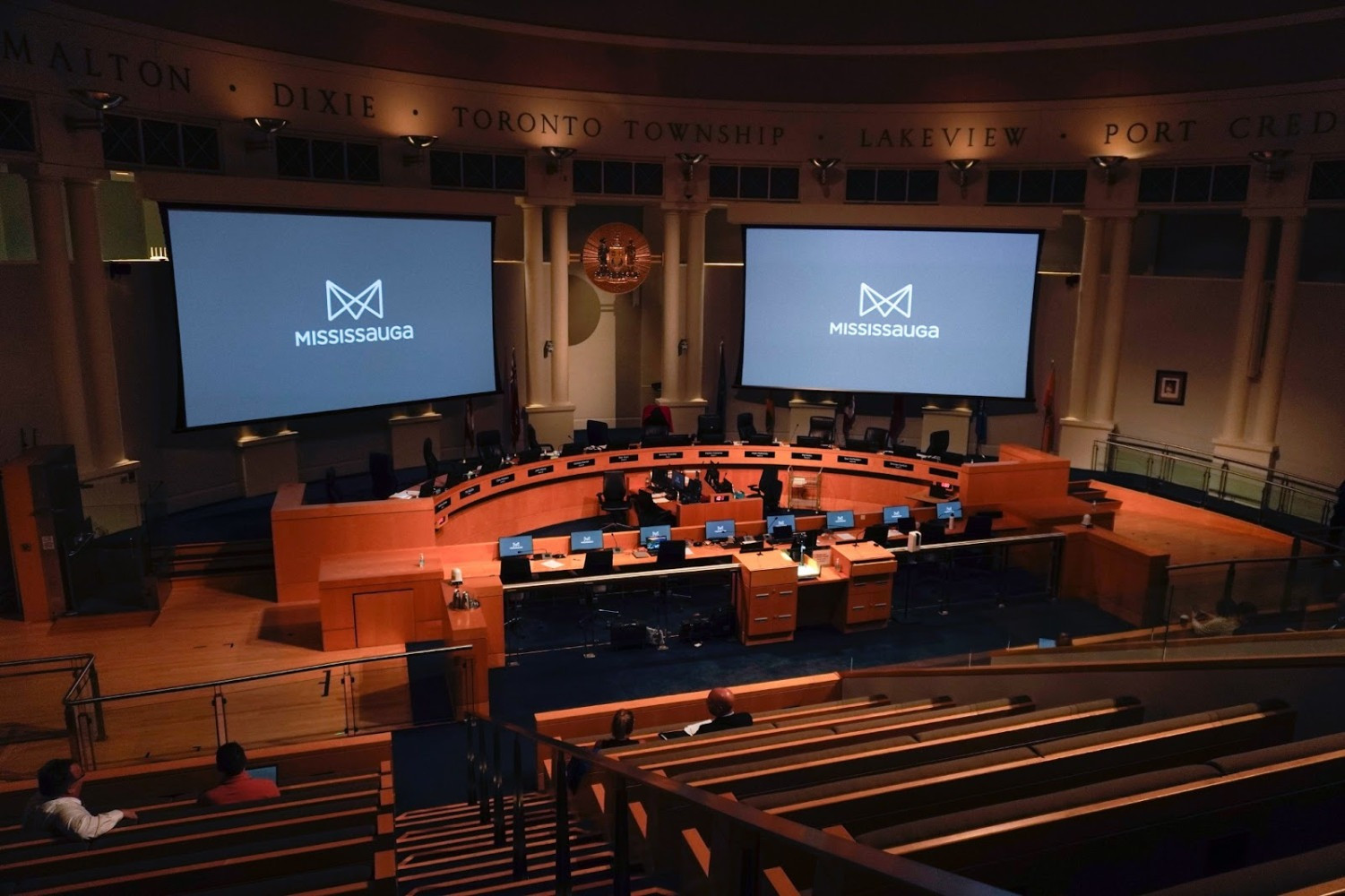
The City of Mississauga 2026 budget has been approved with a 4.39 percent increase to its share of the tax bill. Critics are concerned that officials are using the figure of 1.61 percent, which represents the City’s tax increase after it has been blended with the Region of Peel increase and the amount to cover the provincial education portion.
(The Pointer files)
Under the strong mayor system, councillors were only allowed to directly shape the budget after Parrish brought it forward with the help of staff, who had already been told to trim at least 2 percent from departmental budgets for the coming year to alleviate the burden on taxpayers after a crushing 9.2 percent budget hike last year. Inflation was still gripping Canadians and in Mississauga the affordability crisis is still top of mind, even with some costs, beyond the grocery sector, starting to normalize.
“I don’t have any amendments and I know that shocks the heck out of my colleagues. It’s not for lack of trying and it’s not for lack of inquiry,” Horneck admitted to his fellow councillors on January 28. “In the places where even miniscule adjustments could be made, it wasn’t worth doing because not enough dollars would come from it.”
The process went so smoothly, councillors had no problem unanimously approving a motion to shave a week from the timeline set under the provincial strong mayor powers legislation that provides councillors 30 days to bring forward amendments to the budget shaped by the head of council.
The successful motion from Mayor Parrish moved approval up from February 4 to January 28, putting an end to weeks of presentations and financial discussions.
“Mississauga residents provided candid feedback to help shape the 2026 Budget, and the City listened and responded to keep the tax increase minimal and under the current rate of inflation,” Parrish declared in a press release announcing the budget’s approval. “This was possible through smart, responsible solutions such as finding savings and efficiencies, pausing non-essential investments and is supported by the City’s existing strong, financial position.”
While councillors may have had no suggested changes to Parrish’s 2026 budget, the “candid feedback” from residents referenced by the mayor kept coming until the very end.
Mississauga resident Dan Anderson has been a vocal critic of the City’s financial reporting for years. He has been calling for transparency around the way City Hall reports out the financial impact the annual budget will have on ratepayers as the rising cost of living continues to put daily pressure on more and more families.
The root of Anderson’s concern is what he sees as misleading practices by the City to fool residents into believing the tax impact for 2026 is, as Parrish claimed in the press release, below the rate of inflation. She is a veteran of council and will be fighting to keep her job in October, possibly against popular former mayor Bonnie Crombie who is widely rumoured to be considering a return after she stepped down as Ontario Liberal leader.
Parrish knows another large tax increase would not help her chances for re-election, after she won a by-election halfway through the current term when Crombie stepped down after winning the Liberal leadership race.
But Anderson has very vocally and publicly challenged efforts to frame this year’s tax increase as an affordable decision to help families during tight financial times.
According to Parrish and senior City of Mississauga staff, the 2026 budget will only result in a 1.61 percent increase to property tax bills for residential home owners.
This, as Anderson has pointed out to them, is misleading.
The retired former finance professional has called the 1.61 number a “meaningless metric” used by municipal officials to downplay the true impact of Mississauga’s 2026 budget.
The actual number that should be used, he argues, is 4.39 percent.
The discrepancy is due to the way Parrish and staff have chosen to advertise the number in an election year. Instead of giving taxpayers the number for the budget she and the other eleven council members, along with senior staff inside Mississauga City Hall are responsible for, they are using a figure that gets blended with the Region of Peel budget increase and the provincial education portion, to eventually arrive at the final overall property tax increase for homeowners in the city.
To illustrate this, Mississauga’s municipal taxpayers can imagine each dollar they spend on taxes divided in three parts, about 47 cents would go to the Region of Peel for its annual budget, about 37 cents would go to the City of Mississauga to pay for its 2026 costs, and about 16 cents would cover the provincial education portion to pay for public schools.
Even though Mississauga’s budget spending for 2026 is going up by 4.39 percent, Parrish wants you to think about the 1.61 figure. This number represents how much a 4.39 percent increase to the city’s budget—which accounts for only 37 percent of the overall tax bill in Peel—adds to the total percentage increase, before the provincial education portion and the Region of Peel amount are all added together.
The 4.39 percent increase is the actual representation of how much more residents will be required to pay as a result of financial decisions made by officials inside Mississauga City Hall.
The 1.61 percent represents how much the budget for the City of Mississauga will raise costs to taxpayers after the Region of Peel’s budget increase and the provincial education increase (which has been around zero for more than a decade) are blended in.
This confusion is a direct result of the two-tier municipal system Mississauga has fought so long to eliminate.
Let’s break it down further.
The justification for using this figure stems from the fact that Mississauga only keeps 37 cents of every tax dollar it collects. The remainder goes to the Region of Peel (47 cents) and the Ontario government (16 cents) to fund the education system. The City contends that because it keeps only 37 percent of the property tax money it collects, it is only responsible for 37 percent of the increase to the bill. So, while the overall tax levy budget for Mississauga is increasing 4.39 percent in 2026, Mississauga is only responsible for 37 percent of it. What is 37 percent of 4.39?: 1.61.
Put simply, property tax bills are not increasing by 1.61 percent. As a result of the approved City of Mississauga budget for 2026, and the approved Region of Peel budget, the overall property tax increase for a Mississauga homeowner will be 4.97 percent, on average (1.61 just for Mississauga’s portion and 3.36 percent for the Region’s increase). This assumes there is no increase to the provincial education portion, and is before the impact of the Region of Peel’s 7.8 percent increase to the water utility rate.
“Clear disclosures regarding the percentage increases for each of the City, Region and Education components are important to help residents to more readily assess the total increase effect on the respective property tax component, relative to inflation, arising from each of the City and Region budgets,” Anderson wrote in a February 1 email to City staff. “The clear self-serving intention of the respective CEOs and some Council members, appears to be to obfuscate and misrepresent those facts, even to the point of obstructing efforts to have the facts disclosed, and lying to residents.”
Anderson’s efforts to get answers from councillors and staff during the budget process were repeatedly dismissed, including by City Manager Geoff Wright.
While Parrish was pleased with her fellow councillors during the January 28 meeting, smiling along with Horneck’s light banter about being unable to find anywhere to trim in this year’s budget, and thanking staff for their work, she was clearly frustrated when Anderson took to the microphone.
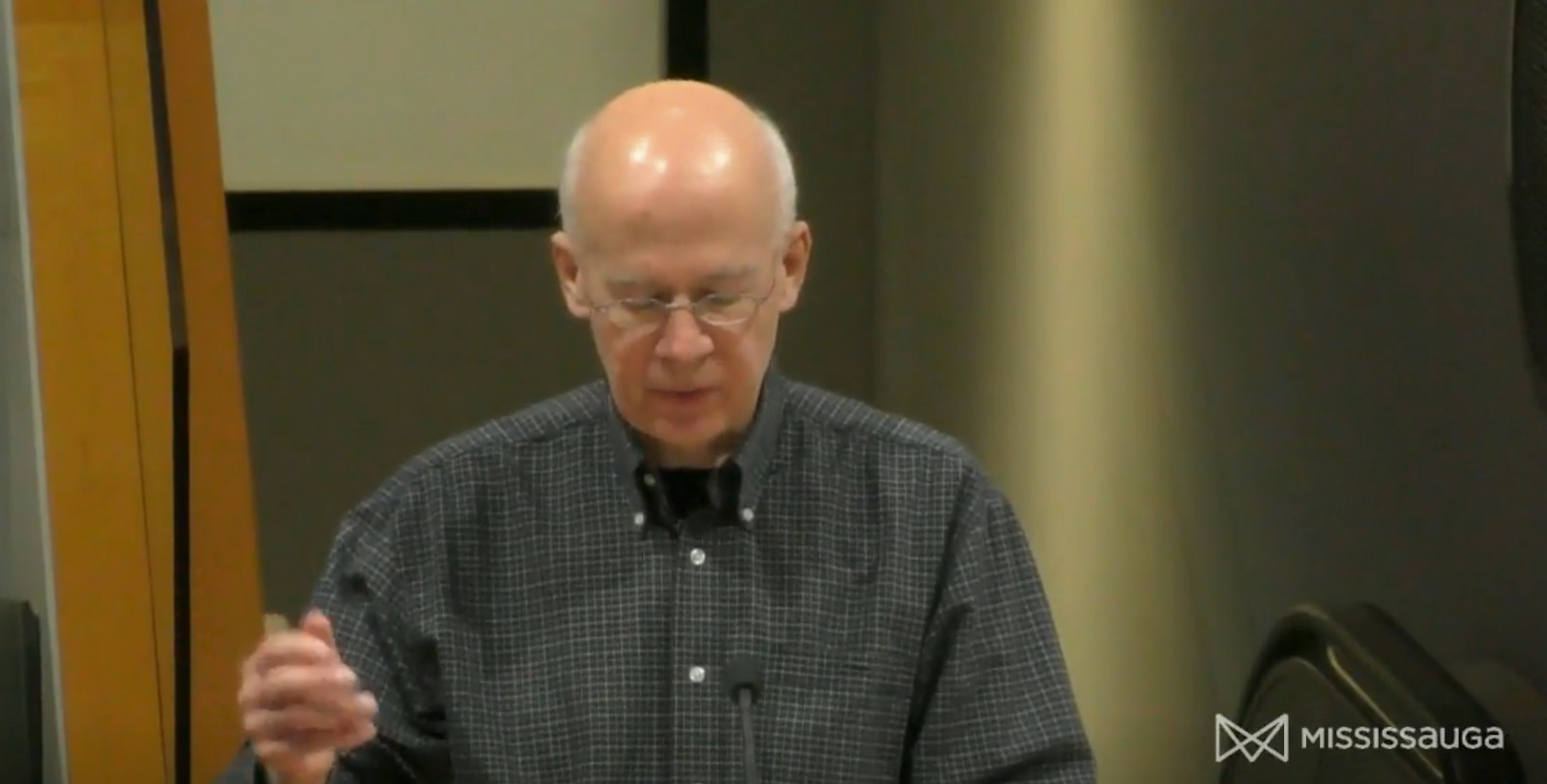
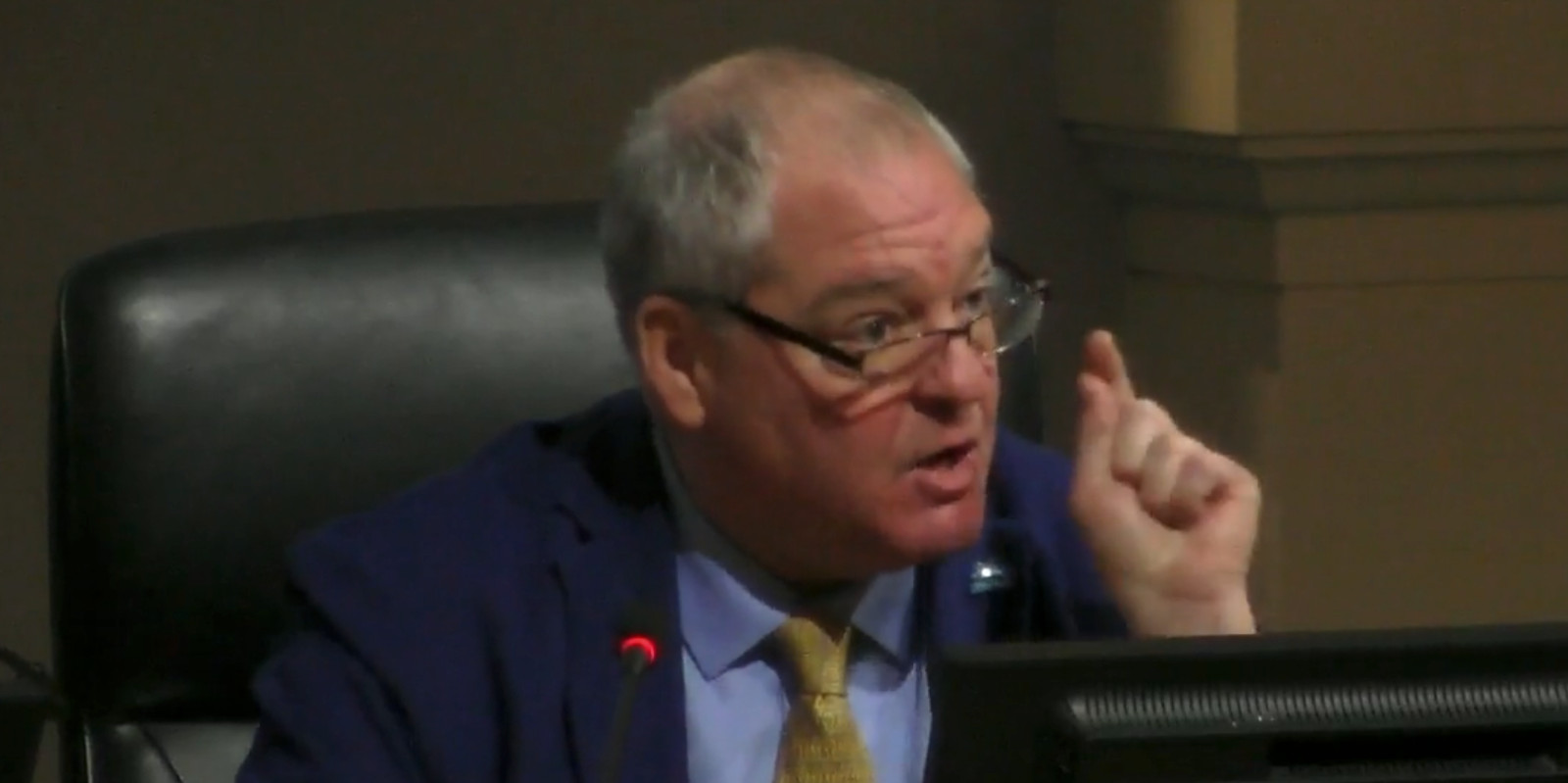
Top: Mississauga resident Dan Anderson calls for better transparency in the budget process and asked council members to use the proper figure of 4.39 percent when communicating the property tax increase for the city’s budget in 2026. Councillor Brad Butt (bottom) asked the mayor to “shut him down” when Anderson attempted to ask a question about the city’s budget.
(City of Mississauga)
He started by telling councillors they were “politically undermining” the 2026 budget process, and misleading people by providing a “political spin perspective regarding the direct financial implications to residents”.
Parrish repeatedly jumped in, telling Anderson to ask his questions, as she kept preventing him from doing so. While the Public Question Period portion of the council’s agenda is meant just for that, asking questions, it is not uncommon for residents to be given leeway to speak briefly ahead of time.
“You’re getting me worked up here, I just want to read what I’ve got here,” he said.
Anderson tried to continue:
“The question by residents should be a relatively simple question for the budget team because the budget report shows the tax levy budget is expected to increase by 4.39 percent, and based on prior year’s financials, the fact that the tax levy budget increases by 4.39 percent apparently implies that the property tax levy rate… .”
Parrish jumped in again: “I’m running out of patience, would you please ask your question.”
Then it was Councillor Brad Butt’s turn. He also was clearly angry with the assertions being made by Anderson.
“You wanted to make a deputation here today, you should have registered as a deputant and you did not,” Butt said. “Madam Mayor, please shut him down.”
Anderson calmly replied that he was unable to delegate before council as he had previously done so at the Budget Committee. Council’s Procedural Bylaw prohibits delegations on the same topic to both Committee and Council.
Anderson tried to continue, and again was cut off by Parrish.
“My question relates to the fact that the press releases from strategic communications… .”
Parrish cut him off again.
“Okay, we’re not going to have you speak anymore.” Anderson attempted to continue, only to again be cut off by Parrish: “No, no, I said no.”
She then asked Wright to address Anderson’s concern that using the 1.61 percent figure was a misrepresentation.
“Mr. Anderson indicating that we are presenting falsified and misleading information, I would reemphasize that that is not the case. Our financial staff are led by a professional and certified accountant who has ethics and morals in how we present our financial information.”
He did not deny that the 4.39 percent is the actual increase before repeating the misleading claim that this “translates into a 1.61 percent property tax increase on the residential side for Mississauga residents.”
At 4.39 percent, the budget increase for 2026 is considerably lower than last year’s 9.2 percent spike—largely fuelled by the addition of windrow clearing services and additional transit investments. Despite the additional services, it left many residents furious, Horneck says.
“After last year’s budget it was rare that I could go to a public event last summer and not have people, in a negative way, talk about what we did last year…It was everyone’s conversation piece,” he told The Pointer prior to the 2026 budget approval. “There was an extreme discontent with what happened last year from the public, because of the affordability issues, and frankly, just a bit of shock I think of the level of what happened last year.”
Balancing things out this year will welcome relief for many taxpayers, but achieving this scaled back budget came with difficult decisions, decisions staff made clear were not sustainable in the long run.
Approximately $259 million worth of tax-funded infrastructure work has now been deferred to later years. The critical Infrastructure Levy, a tax collected from residents to replenish reserves dedicated to preserving city assets, was reduced from a planned 3 percent to 1 percent. The City’s efforts to revitalize its fire department and aging stations—something a three-part investigation by The Pointer showed was desperately needed—has also been put on hold in 2026.
Mississauga found itself in trouble more than a decade ago, after longtime mayor Hazel McCallion insisted on keeping property tax increases near zero percent for almost twenty years, forcing later councils to approve hikes that were well above the rate of inflation.
Heading into an election this year, it’s clear the current slate of council members seems willing to once again do what’s politically popular, even if it means possibly having to punish taxpayers next year or the year after, while they might still be struggling with high living costs.
A staff report outlining the changes made it clear that the spending delays would have impacts beyond 2026.
Cutting the Infrastructure Levy by 2 percent means the crucial reserve fund will be permanently reduced “and has a compounding effect on the reserve fund balance and the amount of debt the City can issue.”
Staff made it clear this should be a “one-time measure”.
“In the long term, the Infrastructure Levy will need to be brought back to 3 percent to ensure the City’s capital plan can be sustained and the need to maintain and replace assets are met.”
The deferred items include $59.7 million in Parks, Forestry & Environment work; $109.9 million for roads; $26.3 million for Fire & Emergency Services; $23 million for Mississauga Library; and $34.4 million for Recreation & Culture spending.
The deferrals come at a time when the City’s infrastructure gap—the difference in available funding for infrastructure repairs compared to what is actually required—is already $119 million annually.
“It is a balancing act…“There’s no perfect answer,” Horneck said when asked about the potential impact on future residents when projects needed now are kicked to later years. He says the City has been contributing healthy amounts to its reserves for years, making room for a lighter year.
“You could say, after a 9.2 increase last year, do people not deserve a bit of relief?”
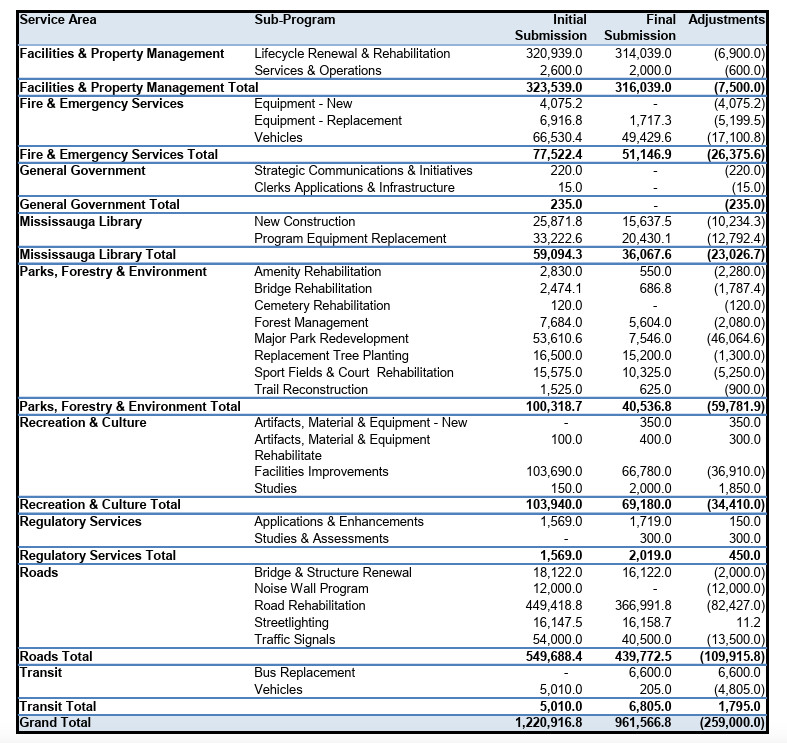
A total of $259 million worth of infrastructure work in Mississauga has been deferred in 2026.
(City of Mississauga)
The chopping or deferral of capital investments has some questioning why the City is not looking within its own walls to find savings.
More than half (54.3 percent) the City’s budget is dedicated to salaries and benefits. For years, critics have asked for a review of non-union labour costs, including senior managers, directors and commissioners, and council members themselves. It’s unclear when this was last done.
The City is adding 41 new staff in 2026, and Horneck says most will be covered by the revenue they generate from their respective programs, meaning the burden will not fall on taxpayers.
“I always want to be very critical about the addition of new staff,” he said. “You look at in terms of the long-term salaries, we give guidance to staff on what salary increases would be to keep up with inflation and we try to hone in on that.”
The delay in infrastructure funding may have a compounding effect as a result of a similar decision made by the Region of Peel.
Despite warnings from regional staff, Peel councillors approved a reduction to the upper-tier’s infrastructure levy.
With the decision by the PC government to download certain assets and services from the Region of Peel to the lower tiers, some of these regional assets going without investment in 2026 may soon belong to Mississauga.
Horneck says the City has received assurances from the provincial government that financial assistance will be available to help the municipality deal with any financial burden. But no actual funding has started to flow.
Lower tier municipalities were meant to take control of waste collection services from Peel starting at the beginning of this year. The shift was delayed until October 2027 following a vote of council last year. Regional roads were meant to be downloaded in July of this year, but a snap decision by the PC government in December could see that shift delayed until July of 2027.
“Im hearing very clearly from the province that that is their intent, to do something there,” Horneck said. “We don’t have it in our account today, but we hear nothing but positive signs that the province is willing to act on these things… . We have to take them at their word, and if for some reason that were not to come then we acted in good faith and the public can judge people appropriately, right?”
Email: [email protected]
At a time when vital public information is needed by everyone, The Pointer has taken down our paywall on all stories to ensure every resident of Brampton, Mississauga and Niagara has access to the facts. For those who are able, we encourage you to consider a subscription. This will help us report on important public interest issues the community needs to know about now more than ever. You can register for a 30-day free trial HERE. Thereafter, The Pointer will charge $10 a month and you can cancel any time right on the website. Thank you
Submit a correction about this story

