
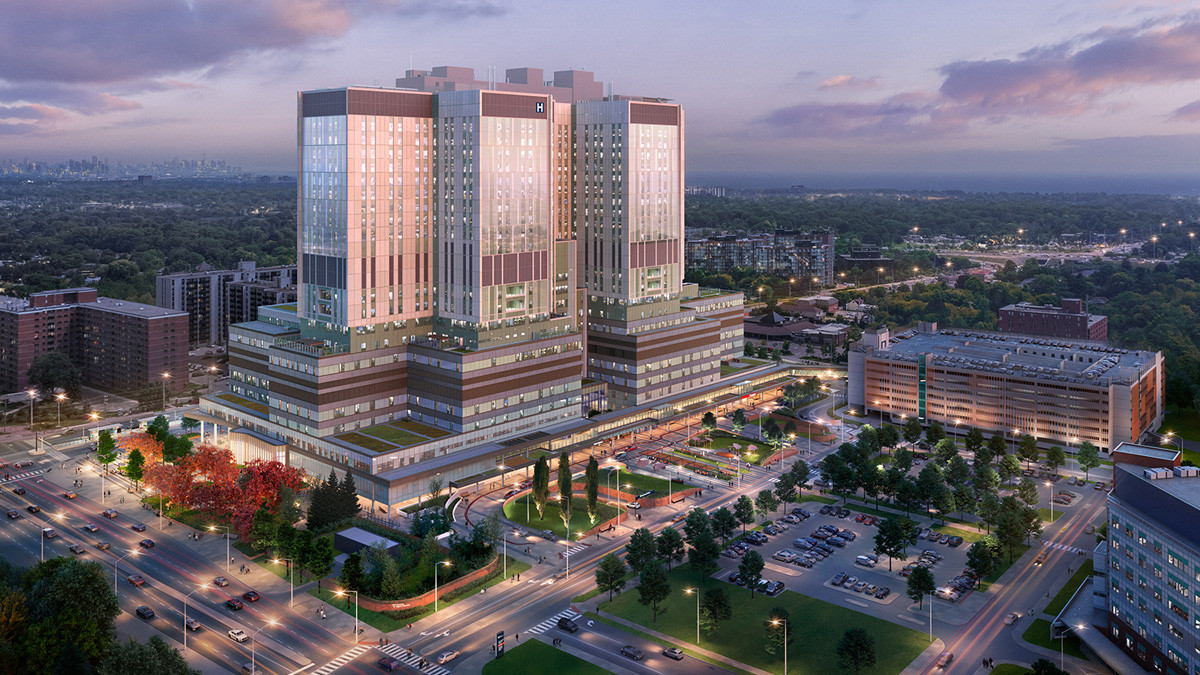
With construction of Mississauga’s massive new hospital underway, $4B cost-overrun still unexplained
Trucks continue to line the busy thoroughfares at the heart of the city to haul away giant loads of excavated dirt, to make way for the massive rebuild of the Mississauga Hospital. As the work continues on what will eventually become Canada’s largest teaching hospital, the final price tag taxpayers will cover for the multi-billion-dollar signature healthcare project remains unknown.
What is known, thanks to a sweeping audit by Ontario’s Auditor General released in December of 2024, is the cost will likely be more than $16 billion dollars—already $4 billion over the budget approved prior to construction by the province’s Treasury Board.
The Pointer contacted EllisDon (the giant developer in charge of designing, building and maintaining the new Peter Gilgan Hospital) and the Ministry of Health for updates about the project’s budget. Neither responded.
In an email to The Pointer, the Auditor General of Ontario explained that since the $13.9 billion contract was awarded in June 2025—after the 2024 audit was complete—officials do not have details on how the project will be funded.
“The contract price that was announced is not the total project cost as it excludes some internal costs such as legal, consulting and other contingencies,” officials from the AG’s office explained. “Since this occurred after our report publication, we would not have the details of how this final contract price compared to the estimates we reviewed during our audit in 2024.”
According to the AG’s office, a follow-up on the 2024 audit will be conducted as part of the 2026 annual report to be released in December.
“Our audit noted several funding increases approved by the Treasury Board in May 2021, May 2023 and June 2023 that occurred during the project, but we did not review the final approval or potential funding requests after our audit was completed in December 2024. For government projects, the funding is typically approved before construction begins.”
The AG audit report attributed the budget difference to a variance in Infrastructure Ontario’s initial cost estimates based on information provided by EllisDon, the development partner, with design and construction costs alone estimated to exceed the Treasury Board budget by $2.337 billion.
The report found the remaining cost discrepancy, approximately $1.7 billion, is due to higher financing and additional 30-year maintenance costs.
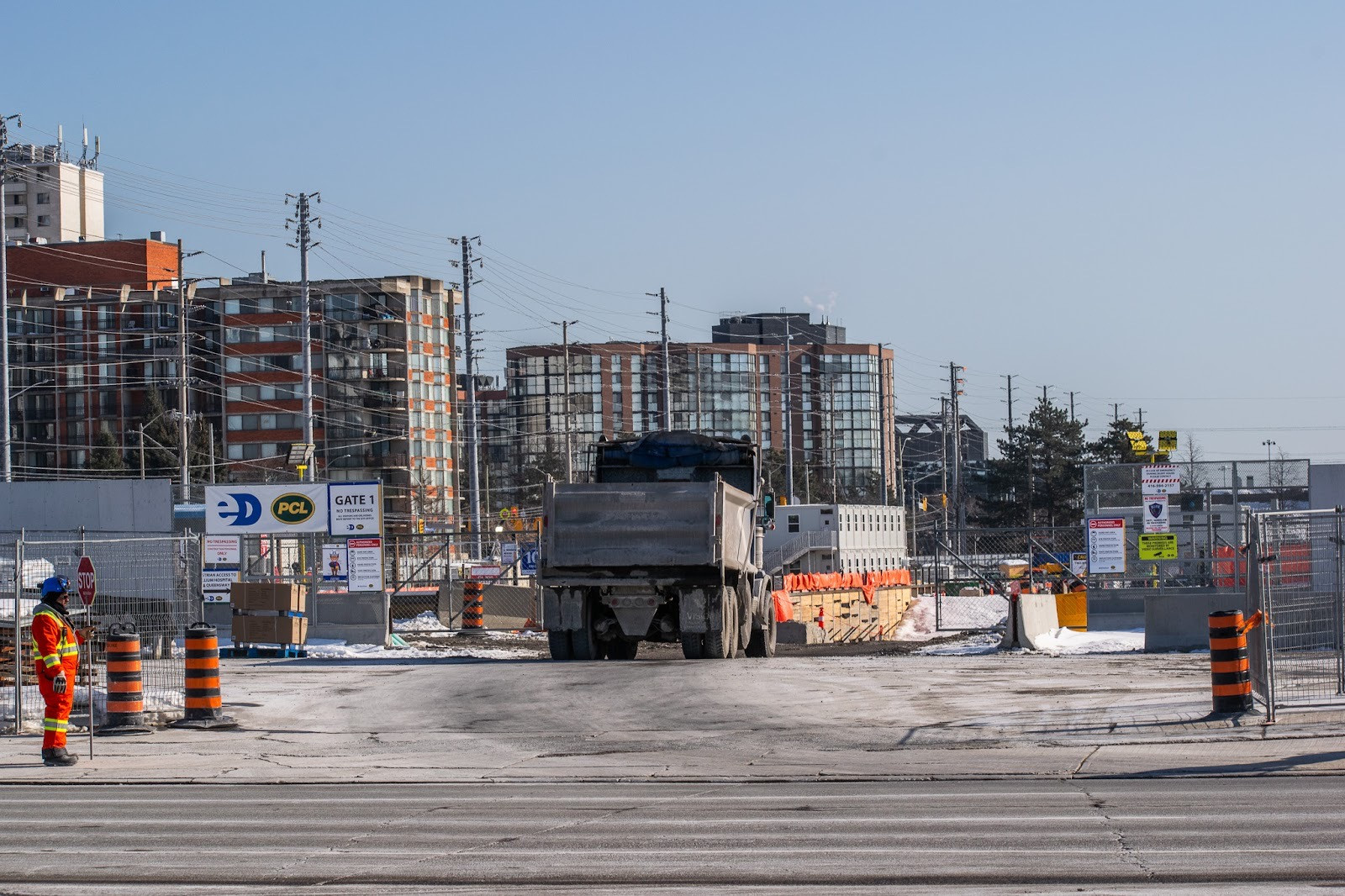
Construction crews have begun to dig out the foundation footprint for the new Mississauga Hospital.
(Alexis Wright/The Pointer)
According to the City of Mississauga’s 2026 budget, the municipality plans to begin collecting its share of the $1.5 billion local contribution—$390 million—from residents through a 1 percent tax levy starting in 2029.
The levy will only collect a fraction, less than a quarter, of the total needed; debt will be taken on to cover the rest. “A debenture will be issued to cover any remaining shortfalls between the approved contribution amount and the balance of the levy collected as of January 1, 2033,” the City of Mississauga’s budget document explains. “Mississauga’s share of the new hospital represents a major investment in the city’s future health care capacity. The City of Mississauga is committed to working with its provincial and federal counterparts to ensure the needs of Mississauga residents are met now and in the future.”
The required contribution from the City was not without its detractors. The initial $450 million request from Trillium Health Partners in the fall of 2024 was met with swift opposition.
In October 2024, Mississauga Mayor Carolyn Parrish publicly declared her opposition to the $450 million request from Trillium, citing the burden it would place on local taxpayers.
Trillium, which will use its own revenue generating tools to make up the difference, later agreed to reduce City Hall’s contribution to $390 million, which councillors approved.
In an email to The Pointer, Senior Communications Advisor Priyanka Niranjan Nasta from Trillium Health Partners, said the site is now more than 45 percent excavated, with 20,000 truckloads of soil removed in preparation for the next phase of construction.
Slated for completion in 2033 with full operations to commence in 2034, the hospital will accommodate 2,400 healthcare workers and approximately 400 additional doctors to serve Mississauga and the surrounding area.
At a projected 2.8 million square feet, the hospital expansion will include approximately 950 beds and 23 operating rooms to provide care for Peel’s rapidly growing population.
Ontario is facing a primary care crisis with estimates that 3.3 million Ontarians currently lack a regular primary care provider according to the Registered Nurses Association of Ontario.
While billions are being spent to expand healthcare capacity in Mississauga, the PC government under Premier Doug Ford has been heavily criticized for failing to invest adequately to end the hallway healthcare crisis in Ontario. He promised to end hallway medicine when he was elected in 2018, but recent data show the situation is only getting worse, with an increasing number of people being treated in nontraditional spaces as a result of under-resourced and over-capacity hospitals.
During a press conference at Queen’s Park on February 5, MPP Dr. Robin Lennox, the NDP’s Shadow Minister for Primary Care, and MPP France Gélinas, Shadow Minister for Health, said the lack of investment by the PC government is putting patients at serious risk across Ontario. Reporting by the Investigative Journalism Bureau found more than 60 percent of Ontario hospitals were in a deficit position at the end of the 2025 fiscal year. Many were turning to bank loans to support their operations, the reporting found.
“People in this province are being forced to wait for care in places that were never meant to be treatment spaces,” Lennox, who is a practicing family physician, said. “That is what happens when a government knowingly underfunds hospitals year after year.”
“This government cannot pretend this is a surprise,” Gélinas added. “They were warned. They were shown the data. They heard from workers and hospital leaders. And they chose not to act. Hallway medicine exists because this government allows it to exist.”
With construction on the new Mississauga Hospital continuing over the next several years, Ward 7 Councillor Dipika Damerla worries about the impact truck traffic, combined with the nearby work on the Hurontario LRT, will have on her constituents.
“Originally, the LRT was supposed to have been completed by now, and so with the hospital project starting now I have two mega projects going on in my ward and nobody, no one person in charge,” she said.
With the ongoing delays on the LRT project, and many residents and businesses stuck with its disruptions until the recently announced completion date sometime in 2028, she said the addition of hospital construction could devastate local businesses along Hurontario Street, where the giant new healthcare facility will rise 22 storeys above the ground, just north of the QEW.
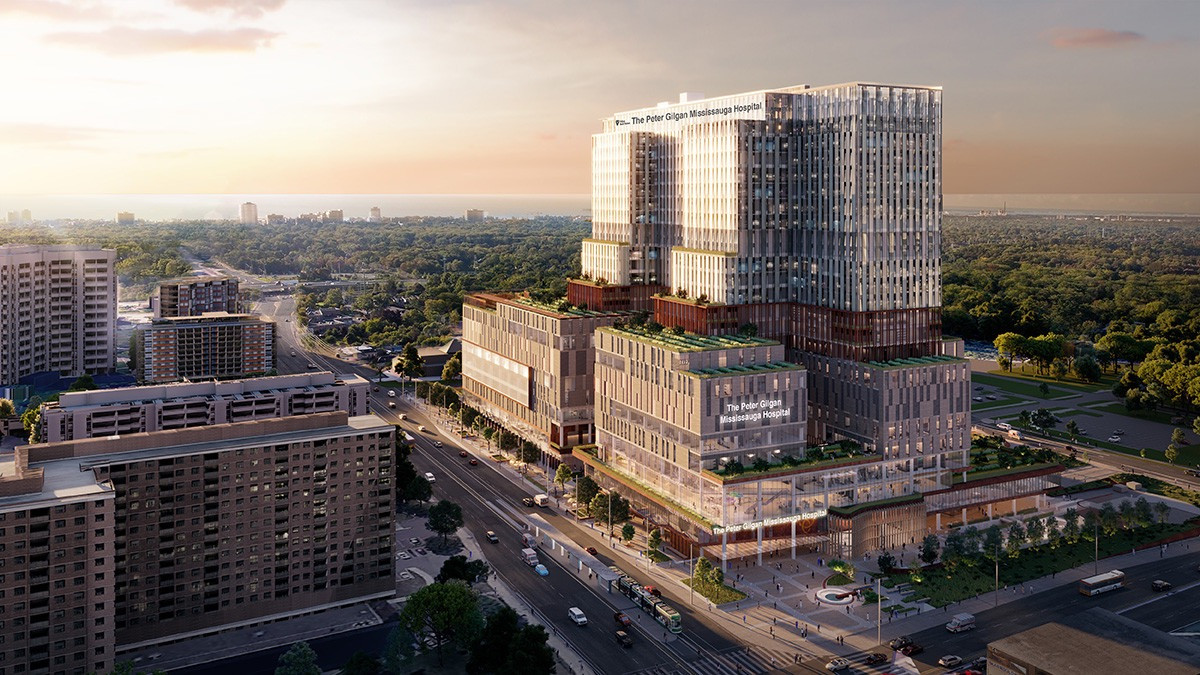
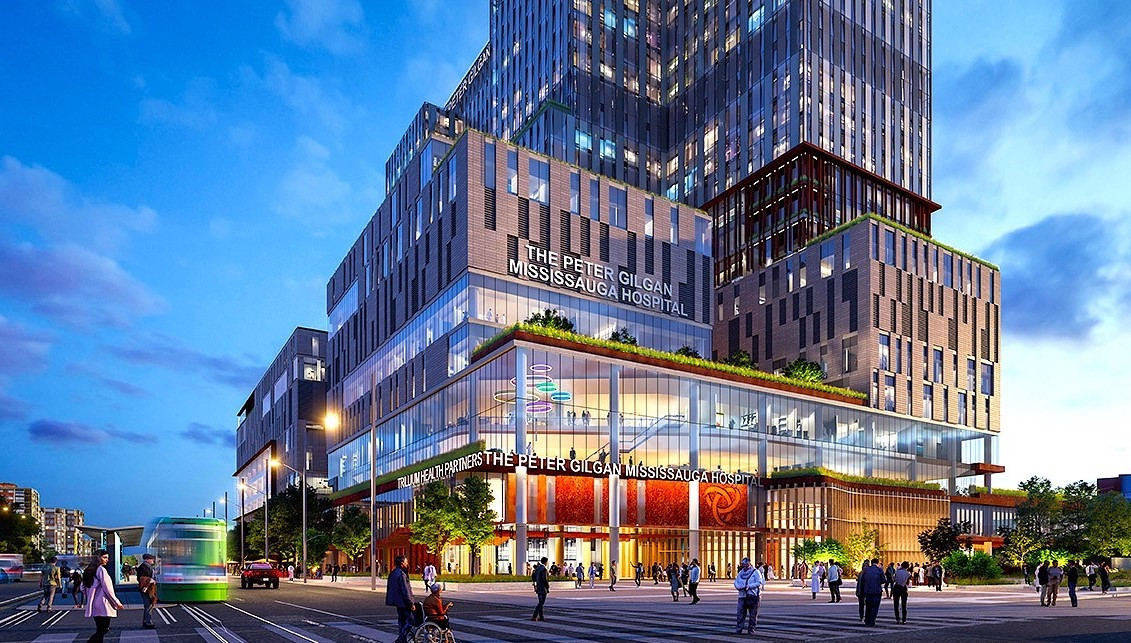
(City of Mississauga)
“What happens if at the same time that the hospital wants to add more trucks onto Hurontario because of construction, but meanwhile Infrastructure Ontario wants to shut down lanes on Hurontario because they want to do construction?”
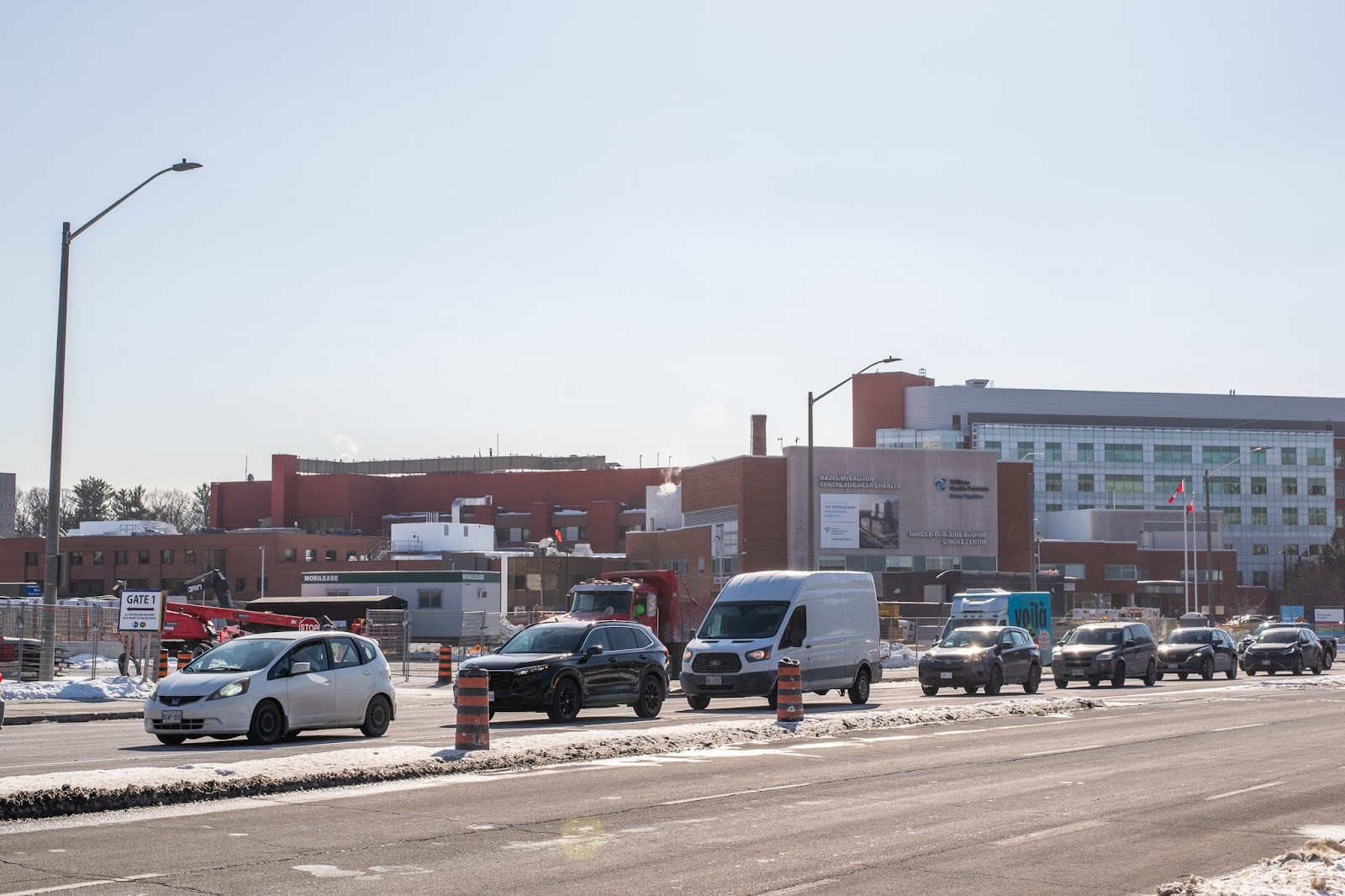
Traffic backing up adjacent to the ongoing construction for the Mississauga Hospital.
(Alexis Wright/The Pointer)
Damerla said she has tried to contact representatives in charge of managing both of the massive projects, but has struggled to find anyone who can answer questions.
“Who's in charge? Who's going to get both of them at the table and say, ‘hey, what about the residents? Like, you cannot do this.’ Who is that one person?”.
Nasta, the communications representative with Trillium, says the organization is in regular communication with partners including the provincial government and Metrolinx to help minimize disruption for residents.
“On site, a comprehensive noise management plan is in place, including a 12-foot sound barrier along the truck waiting area and ongoing monitoring,” she explained in an email.
A 24-hour community contact line has been set up (416-594-2157) and an email address ([email protected]) can be used by residents who have concerns.
Email: [email protected]
At a time when vital public information is needed by everyone, The Pointer has taken down our paywall on all stories to ensure every resident of Brampton, Mississauga and Niagara has access to the facts. For those who are able, we encourage you to consider a subscription. This will help us report on important public interest issues the community needs to know about now more than ever. You can register for a 30-day free trial HERE. Thereafter, The Pointer will charge $10 a month and you can cancel any time right on the website. Thank you
Submit a correction about this story

