
Debt balloons, projects shelved: Patrick Brown’s 2026 budget lacks key investments as his previous spending freezes catch up to taxpayers
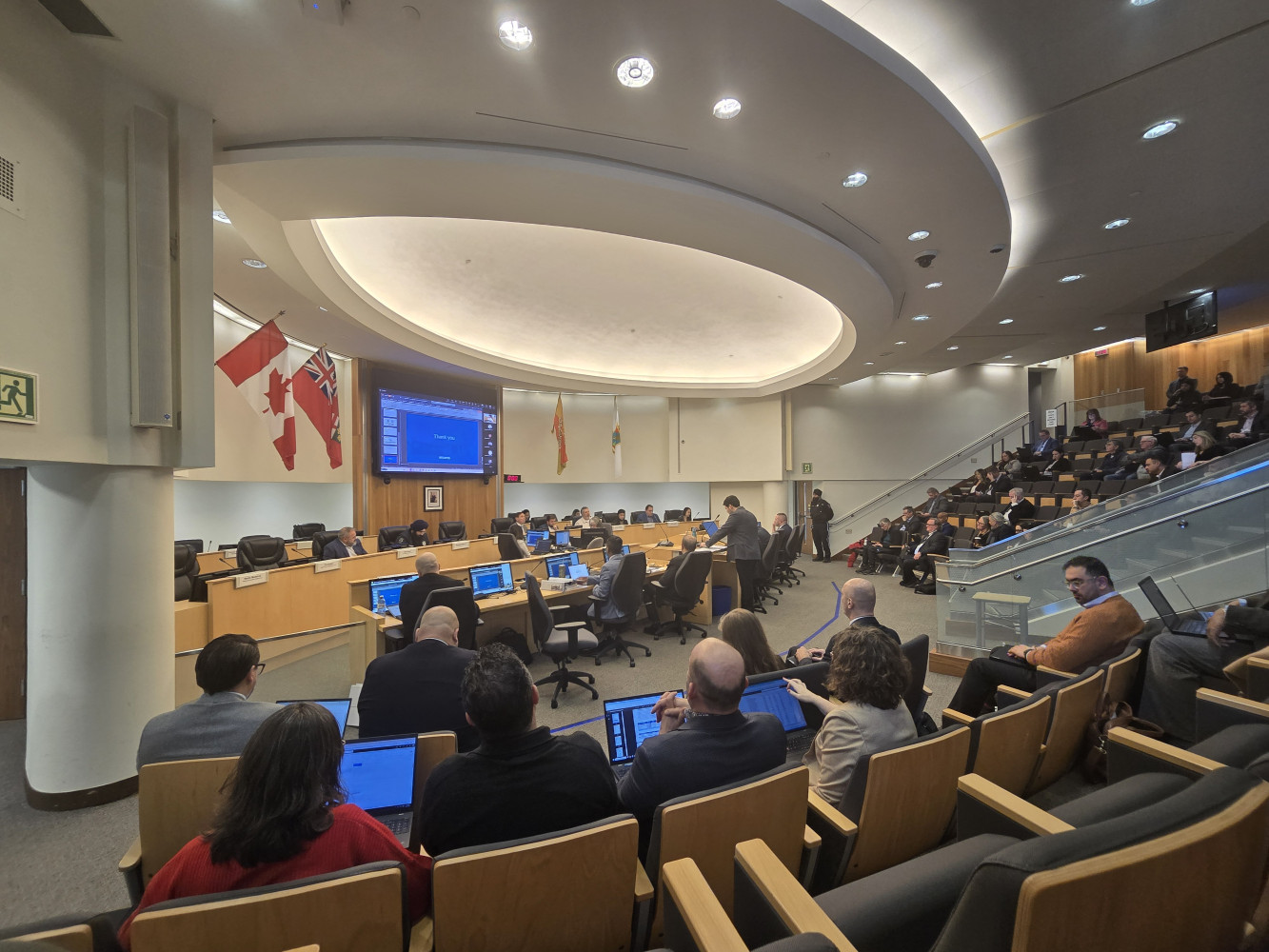
Patrick Brown’s 593-page financial blueprint introduced earlier this month—strong mayor powers dictate that local mayors are responsible for bringing forward the municipal budget—promises to advance “transformational change” for Brampton.
Through “disciplined decision-making” and “unprecedented” funding from other levels of government Brown claims Brampton is on “solid financial footing”.
“Brampton is set up for continued success,” the City’s January 9 press release announcing the 2026 budget declares.
As is the case almost always with Brown, what he claims and the reality around his claims are usually galaxies apart.
His buzzwords and wild assumptions (how does he plan to secure the “unprecedented” funding from Queen’s Park and Ottawa, which he has failed to attract for almost eight years?) create a rosy picture of Brampton’s situation. The reality is that years of budget freezes he forced, cutting tens of millions from critical projects, are catching up to the taxpayers now being squeezed to cover shortfalls (a shocking $1.2 billion has been taken from taxpayers for work that never happened), while the cancelled and delayed projects are nowhere to be seen. Instead, even more badly needed infrastructure and capital is being kicked down the road while residents will still see a 4.86 percent uptick on their tax bills when blended with the Region of Peel’s budget increase. The thin veneer of Brown’s words is exposed by the numbers at the heart of his 2026 budget.
Brown did not answer questions from The Pointer about the impacts of his previous financial decisions in Brampton, or the delays to investments that do not appear in his 2026 budget but were previously committed by Brown.
For instance, no new capital investments have been planned for the necessary Transit Maintenance and Storage Facility or the Riverwalk project. The 2026 budget raises many questions about both of these initiatives.
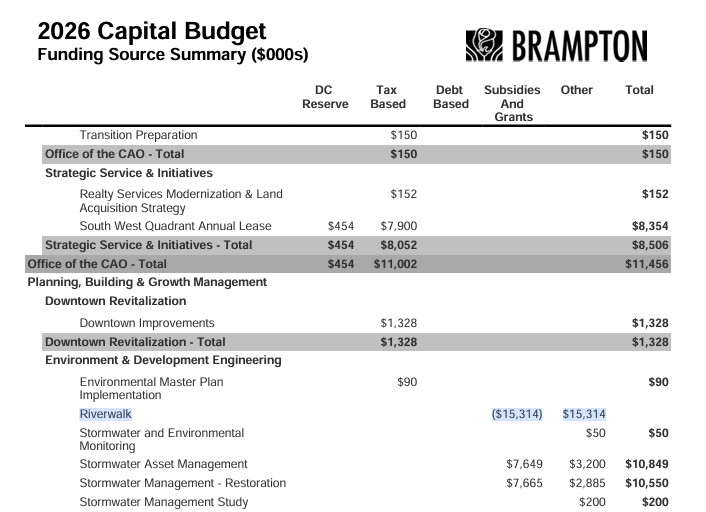
While neither appears under the Capital Budget section of Brown’s budget document, both are listed in the Funding Sources Summary section. The transit facility will eat up $50 million being spent in 2026, but it was supposed to be paid for through development charge revenue. Now, the new plan under Brown’s 2026 budget is to use debt to cover the amount. For the long-delayed Riverwalk project to revitalize downtown and protect it from flooding, $15.3 million is outlined, but instead of being covered by Subsidies and Grants as previously planned, the funding source is now unknown, simply listed as “Other”.
It’s unclear if this means the $38 million in grant funding approved by the federal government in 2020 for Riverwalk has been revoked because Brown failed for years to match it. The City of Brampton did not answer questions from The Pointer seeking clarification. The 2026 budget claims construction of the flood mitigation infrastructure along Etobicoke Creek as part of the Riverwalk project will occur in 2026. The City is attempting to move forward with development approvals in the downtown area prior to the completion of this work, despite failing to mitigate the risk of flooding. The Riverwalk project, approved before Brown became mayor in 2018, was supposed to be completed years ago, but his budget cuts have stalled efforts to attract new development that can only move forward once the flood risk is taken care of.
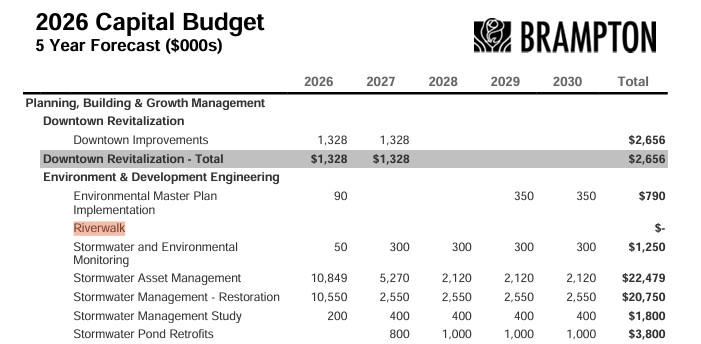
ABOVE: No new funding is listed for the crucial Riverwalk project in the 2026 Capital Budget. However, the project does appear to be receiving $15.3 million of previously approved funding that has been shifted from Subsidies and Grants to “Other” (BELOW). The City did not answer questions about what this means.
Many other projects are also either stripped from the 2026 plan or delayed altogether:
- An $800K plan to expand the parking lot at the Clark Transit facility slated for 2026 has been pushed to 2028.
- $600K worth of work in the City’s sidewalk program has been delayed until 2029.
- $7 million for a new “Fire Communications Facility” has been removed, along with $1.6 million worth of dispatch equipment upgrades for the fire department being reduced to just $100K, and a $150,000 cut in “miscellaneous initiatives” for the department.
- $8.1 million worth of planned improvements to the city’s cricket fields, including lighting and other enhancements has been cut to $4.5 million.
- The Urban Forest Canopy Program has been cut by $1 million.
- Projects meant to foster innovation have also been slashed, including $1.2 million for the “Brampton Entrepreneur Centre Innovation District”; $1.2 million for a “Clean Lab”; $150,000 for “investment attraction”; and $1.2 million for a new co-working space downtown.
- A previously planned investment of $4 million for Garden Square is not included in the 2026 budget.
- $6.3 million planned for Housing Brampton, the City’s housing strategy and action plan, has been pushed off to 2027, with now only $6 million allotted.
- Scheduled bridge repairs have been cut from $3.5 million to $1.3 million.
In the struggling downtown, where sustainable and long-term investments are required, as most of the area sits in a floodplain and is designated as a Special Policy Area (SPA) which limits development, Brown promised years ago that he would invest in the future of the heart of the city. Instead, his 2026 budget slashes $4 million from the Downtown revitalization funding, from the initially planned $5.3 million to $1.3 million (Brown cancelled the previously approved Downtown Reimagined master plan to finally revitalize the decaying city centre shortly after becoming mayor). After he was first elected in 2018, Brown immediately cancelled the entire Downtown Reimagined program that was supposed to reshape the design of the aging Four Corners precinct. As much as $100 million that had been committed to finally improve the fading downtown core was suddenly removed from the capital budget.
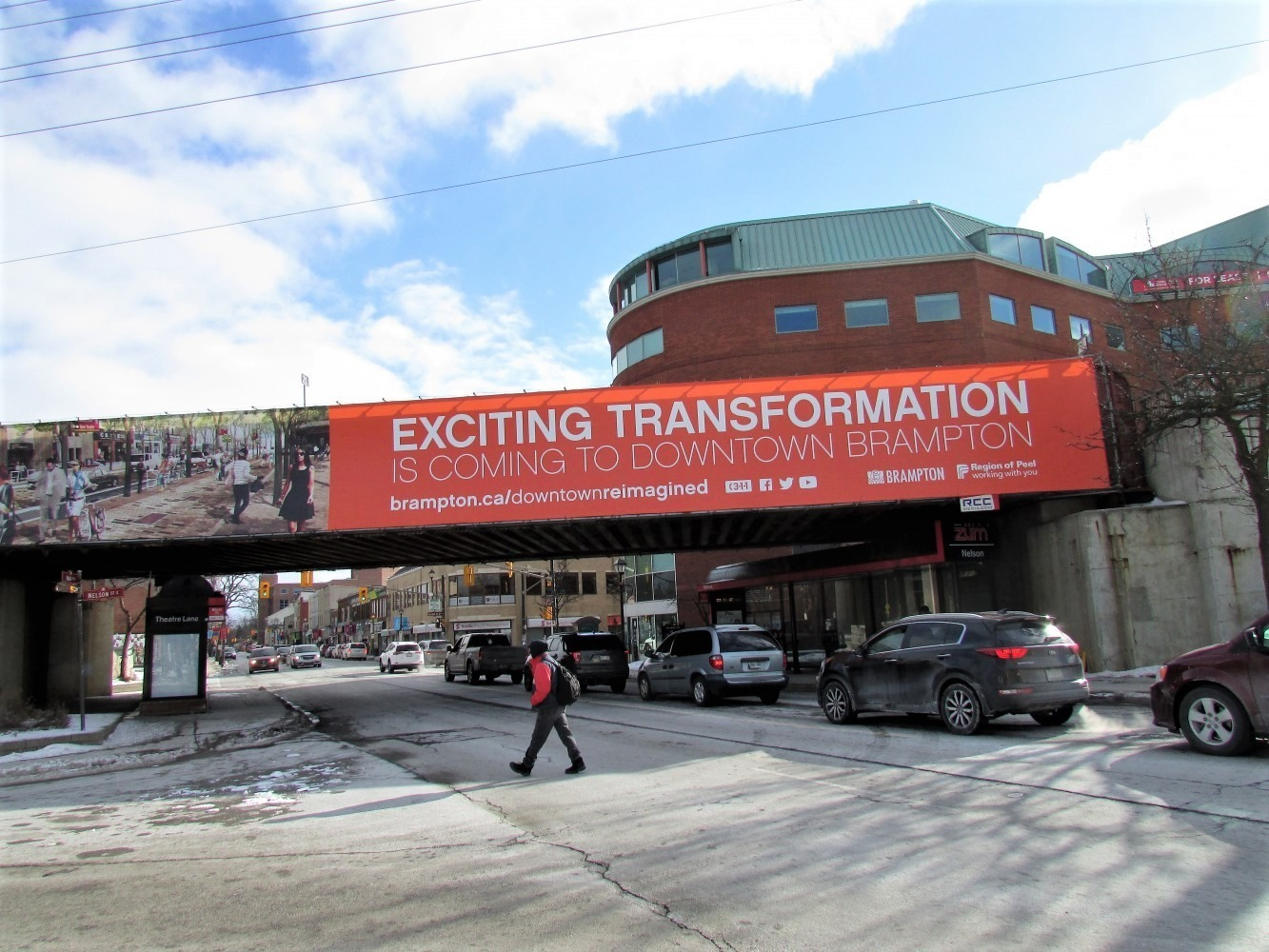
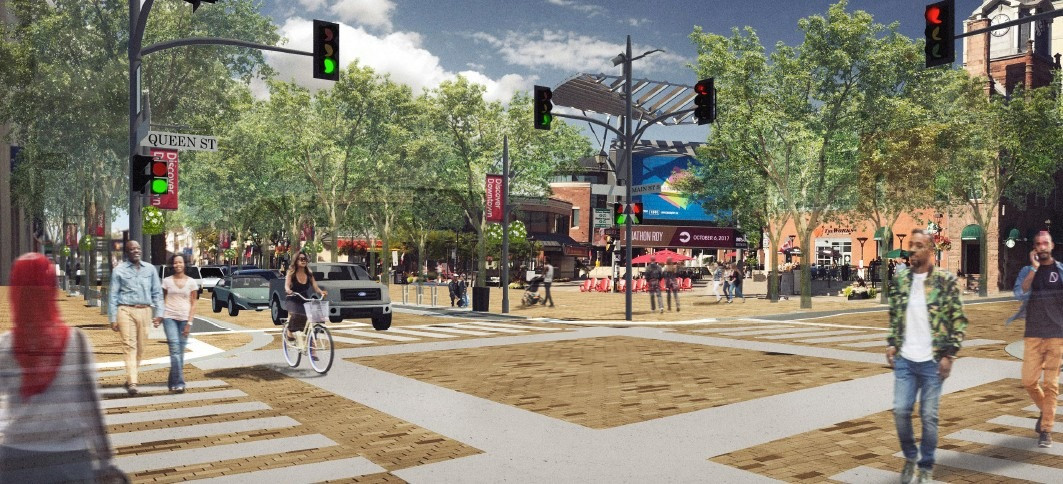
The “Exciting Transformation” of Brampton’s downtown never happened. Patrick Brown cancelled the Downtown Reimagined plan shortly after becoming mayor in 2018 and immediately slashing the City budget.
(Top: The Pointer files; Bottom: City of Brampton)
Brown has broken many other promises made to Brampton taxpayers since getting elected: he guaranteed the city a world-class cricket stadium (it was added to budgets but kept being postponed and is now nowhere to be seen); the standalone Brampton University (a scandal that handed $630K in taxpayer money to friends and associates of Brown and Councillor Rowena Santos) he promised is no longer mentioned and funding no longer appears in Brown’s budgets; a tunnelled LRT into downtown which Brown claimed would be paid for by Ottawa and Queen’s Park (no funding has been secured, despite the City and Brown’s attempts to mislead the public) is no longer mentioned in budget documents ($220,000 is included in the 2026 Capital budget to study possible future extension of the Hurontario-Main LRT, which currently has no committed funding from any level of government), even though taxpayer funded, campaign style brochures the mayor mails to thousands of residents claim the project is moving forward.
A mountainous backlog of capital projects has forced Brown to play a financial shell game with new capital investments. He claims upper levels of government will provide the money despite failing to secure commitments.
The marquee investments included in the capital budget—transit and stormwater assets—will require grants and subsidies from upper levels of government. The City did not answer questions about these grants and subsidies, if the money has already been received by the City, and if the funding has even been approved by Ottawa or Queen’s Park.
Of the $340.4 million capital budget for 2026, 34.6 percent is funded through subsidies and grants. Another 26.3 percent will be covered by nearly $90 million of debt; nearly half will fall to the Brampton taxpayer ($50 million will have to be covered by development charges; it is unclear what will happen if the current poor real estate market causes a significant drop in expected development fees).
At the end of 2026, Brampton will have nearly $390.5 million worth of debt.
While debt alleviates the need to place the immediate burden on residents—many are dealing with financial pressures themselves during a time of record unaffordability—it only draws the pain out long-term as residents will be forced to make interest payments for years to come. Brampton taxpayers are already paying $10.9 million annually on the debt taken out for projects like the City Hall West Tower expansion completed a decade ago and the new fire headquarters. That repayment amount is expected to nearly double by 2030.
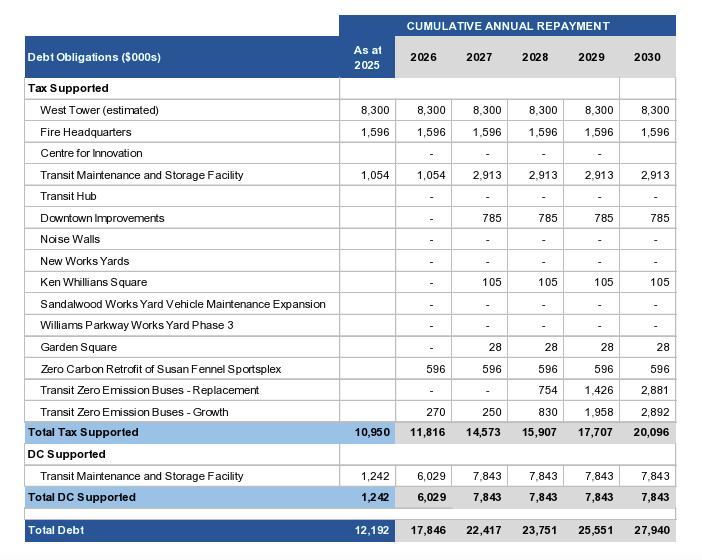
By 2030, Brampton taxpayers could be covering $20 million in debt payments annually to fund necessary projects.
(City of Brampton)
The budget document explains a key focus for City staff in 2026 will be clearing projects from the massive capital backlog—583 projects—previously highlighted by The Pointer.
The list of these previously approved capital projects that have not moved forward has grown since last year. During the special council meeting on January 20, in response to questions from Brampton Councillor Michael Palleschi, City staff said the amount of unspent capital for previously approved projects (money already taken from taxpayers) is now between $1.5 billion and $1.6 billion.
Addressing this backlog, which one financial analyst labelled a “confusing mess”, has ripple effects throughout the 2026 budget. With staff time focused on projects already approved, it leaves less time for new initiatives that could drive innovation and opportunities in Brampton. Work previously slotted to be operationalized this year has once again been postponed. The capital budget is filled with projects previously planned for 2026 that have been delayed or removed outright.
Brown’s fiscal strategy of freezing budgets for three consecutive years after being elected in 2018, and the turmoil at City Hall that has been a common theme under his leadership, have resulted in a series of planning failures. Without new revenue, Brown was forced to delay or cancel projects altogether. The dysfunction at City Hall under his leadership has also caused turnover among staff and mismanagement that also contributes to the backlog.
Brown claims focusing on the previously approved project list is enough to maintain city infrastructure in working order.
“Funding and projects currently approved were determined to be sufficient to maintain existing levels of repair and replacement for the 2026 fiscal year,” his budget claims.
He does not address the growing list of projects previously planned for this year that have now been delayed, and the impact on those assets.
Municipal infrastructure investments are scheduled based on their age and current state to determine when investments will be necessary. Ignoring those timelines leads to infrastructure in need of repair being ignored. This is particularly concerning as Brampton’s population has increased significantly over the last four years, meaning infrastructure is being placed under more strain than previously planned for, with a need for more attention to state of good repair, not less.
The effects of freezing budgets for three straight years show up in Mayor Patrick Brown’s 2026 financial plan for Brampton.
(Alexis Wright/The Pointer files)
The overall budget (capital + operating) is shrinking year-over-year. Dropping from $1.398 billion last year, to $1.378 billion this year—a 1.4 percent decline. Yet, residents are being asked to pay 1.5 percent more for the City’s portion of their property tax bill. The overall increase will be about 4.8 percent including the Region of Peel share. At the same time, labour costs, the biggest expense in the operating budget, are increasing 1.9 percent.
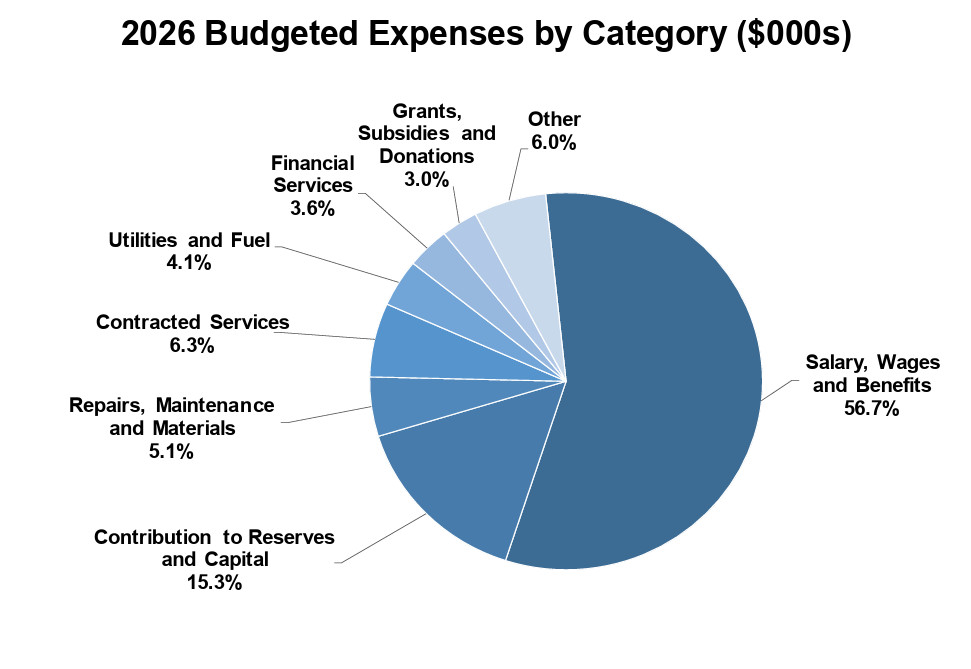
Salaries, wages and benefits, one of the biggest expenses for the City of Brampton are increasing by 1.9 percent in 2026.
(City of Brampton)
There are some key investments currently planned in the 2026 budget.
It maintains a one percent hospital levy to generate Brampton’s share of the cost for the Peel Memorial Phase 2 expansion. It is expected to generate roughly $4.9 million annually. This levy may need to increase in the coming years. Brampton needs to raise an estimated $125 million for the expansion of Peel Memorial. As of December 31, $90.4 million was in the reserve account dedicated to Peel Memorial.
The largest capital investments for the coming year are being made into transit and stormwater assets. A planned $58.1 million for bus purchases has increased to $90.9 million, and $18.2 million has been added for bus refurbishments, an uptick from $10.99 million to $29.2 million. The entirety of the cost for refurbishments and $45.4 million of the purchases are being covered by grants and subsidies. A further $39.6 million of debt is being taken out to cover the bus purchases. These investments include a small fraction of the more than $3 billion the City has been told it needs to transition away from dirty diesel vehicles to clean electric technology buses. Brown has so far failed to make any investments in clean buses, despite his misleading claims.
With the $91 million for bus purchases, the City is finally planning to add 44 battery-powered electric vehicles to its fleet of diesel buses.
Other notable investments made in Brown’s budget include:
- $7 million for Computer-Aided Dispatch/Automatic Vehicle Location, a technology in public transit used for vehicle tracking (via GPS) and providing assistance in monitoring fleets, route adherence details, and driver performance, among other benefits.
- A $479K investment in the Clark Transit Facility has been added
- $3.5 million has been added for the “Operational Support Facility” through a partnership with the Peel Regional Police.
- $30K has been added to buy vests for bylaw enforcement officers along with $7.8 million to fund the expansion of Brampton’s Residential Rental Licensing program.
- $20 million will be invested this year for a new Howden library and recreation centre. Another $30 million for the facility is allotted in 2027.
- $4 million has been included for “High Order Transit on Steeles Corridor,” along with $4.2 million for the study process for rapid transit along Queen Street, a project that has faced delays and funding questions for the better part of four years.
During the December 20 special council meeting, Jaipaul Massey-Singh, CEO of the Brampton Board of Trade (BBOT), warned the Queen Street BRT project is stuck at an early planning stage, and if not properly funded, it could vanish from the Province’s priority list.
While emphasizing the importance of the project, calling the corridor “critical infrastructure for Brampton,” connecting students and workers to Queen Street and Highway 7, he urged Brampton council to speed up its advocacy efforts to secure funding from higher levels of government.
Of the overall capital budget of $340.4 million, 42 percent is planned for transit, followed by 29.2 percent for public works and engineering projects.
There is a long list of capital projects that are heavily reliant on federal and provincial grants and the Canada Community Building Fund: $7.64 million in stormwater asset management; $2.5 million for the interior renovation at the Susan Fennell Sportsplex; $1 million for the CAA Sports Centre; and $5.3 million in vehicle replacements for fire and emergency services.
The City did not answer questions about funding approvals by upper levels of government, and why so much of Brown’s 2026 budget appears to rely on money from Ottawa and Queen’s Park, without details of the status of the required assistance. Municipal budgets typically do not assume revenue unless it can be reliably counted on. Brown has a history of claiming funds have been secured without any guarantees.
The 2026 budget deliberations and consultations are ongoing, with final approval expected on January 27.
Brown’s efforts to justify a minimal budget increase to ease affordability pressures contrast with his continued efforts to dramatically increase the Peel Police budget. The force’s budget has seen a massive hike of 80 percent in the last five years and remains one of the biggest drivers of the overall tax increase. Brown, who sits on the police board, has been the loudest champion of giving the police whatever they want.
Despite residents raising concerns during Peel Region budget meetings to find ways to reduce police spending, no changes were made.
Since 2019, the first year Brown froze Brampton’s budget, the City’s finances have been operating behind the eight ball. The City’s previous financial strategy in place prior to Brown’s arrival outlined how “modest” tax increases between 3 and 5 percent were necessary to fund necessary services and infrastructure in the coming years. Brown ignored that advice, and his budgets have since been lessons in kicking the can down the road.
Last year, a $25 million investment was planned for the Brampton Arts and Culture Centre. It has now been delayed to 2028 and the budget has increased to $30 million.
Construction along Clark Boulevard originally planned to cost $10 million in 2027 has been delayed to 2029. The price tag has doubled.
Work to widen McVean Drive had a budget of $15 million and was originally planned for 2027. It has been delayed to 2030 and it will now cost taxpayers $25 million.
On January 18, a budget coffee chat hosted by Brampton Councillor Paul Vicente provided residents an opportunity to raise concerns prior to the approval of the 2026 budget.
The event was attended by Mayor Brown and Councillor Rowena Santos. Residents raised multiple concerns, from unaffordability due to rising inflation, high water and sewer bills linked to the property tax increases, overcrowding in rental units and challenges seniors are facing.
“We are hearing about affordability; some people are finding it hard to survive,” one participant said.
Tracy Pepe, a vocal Brampton community activist and the Chair of the Canadian Association of Retired Persons (CARP) Brampton Chapter, said elected officials and staff are not effectively communicating with seniors through their media platforms, leaving them without any proper guidance on resolving pressing issues.
Instead of sending newsletters or “Christmas cards” (paid by taxpayers) she wants to see open communication about the problems residents are struggling with.
“There has never been a presentation at City Hall to the seniors’ group about how these seniors get a rebate,” she said.
Brown responded: “Feel free to share any ideas with him (pointing to a staff member).”
Email: [email protected]
At a time when vital public information is needed by everyone, The Pointer has taken down our paywall on all stories to ensure every resident of Brampton, Mississauga and Niagara has access to the facts. For those who are able, we encourage you to consider a subscription. This will help us report on important public interest issues the community needs to know about now more than ever. You can register for a 30-day free trial HERE. Thereafter, The Pointer will charge $10 a month and you can cancel any time right on the website. Thank you
Submit a correction about this story

