
REDACTED: City of Brampton’s $4-billion electric bus deal leaves taxpayers completely in the dark
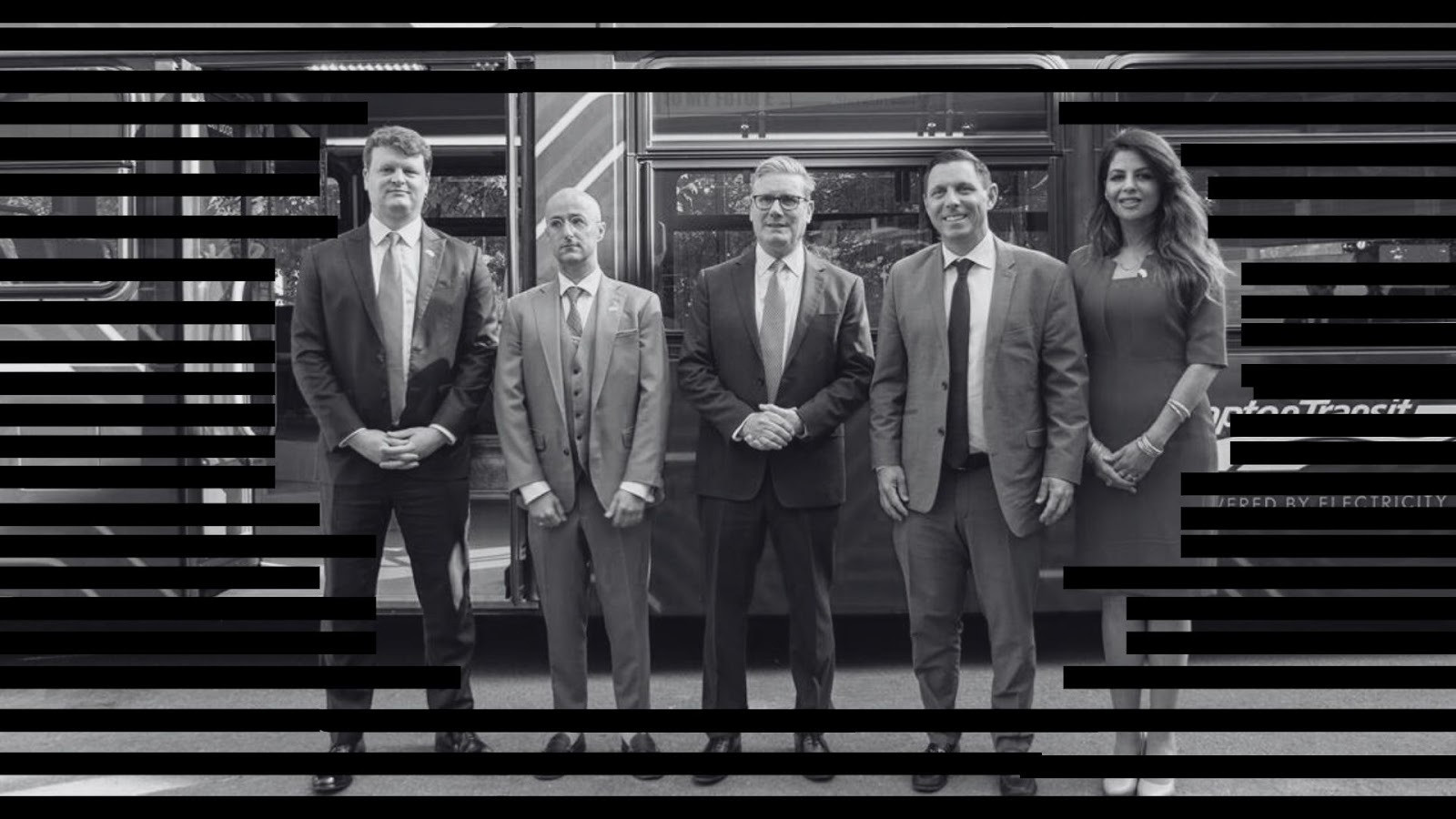
$245 for 1,799 pages: 1,622 completely redacted—words covered by large blocks of black to hide them from the public.
The Pointer is trying to uncover the details behind a $4-billion deal, the largest of its kind in the municipality’s history, between the City of Brampton and a foreign company that not many in Ontario have ever heard of.
On June 15, Brampton Mayor Patrick Brown stood alongside U.K. Prime Minister Keir Starmer in Ottawa, announcing a monumental partnership with U.K.-based electric-fleet management and battery storage company, Zenobe, to support 1,000 new vehicles on a newly designed electrified platform, for more than 40 million annual passenger trips.
Municipal transit systems across Canada have traditionally been managed and operated internally (through council-governed agencies or commissions like Brampton Transit, Mississauga’s MiWay or Toronto’s TTC), with annual budgets that commonly reach hundreds of millions, even billions of dollars. The deal to bring a foreign company to take over critical management and operational aspects of a future electrified bus fleet in Ontario’s third-largest city has left Brampton citizens in the dark. The mayor and other officials have failed to inform taxpayers about the future of a core publicly funded service that tens of thousands of residents rely on.
The financial details of the widely promoted $4 billion-deal are almost entirely unclear. How much taxpayers might have to pay for the services that will be provided is not known. What exactly Brampton will get is not known. Details of any possible contribution by other levels of government are vague. And Brown, in a pattern he has displayed throughout his political career, has not prioritized transparency to the people who will be directly impacted by the decision.
It’s even unclear how the mayor and council will pay for the roughly $3 billion needed to purchase the new electrified buses, which the deal hinges on. The entire timing of the sudden Zenobe announcement makes little sense, as Brown has failed to budget for the purchase of new buses, while the city’s transit system has continued to acquire dirty diesel models.
Deals a fraction of this size normally undergo extensive scrutiny, with detailed staff reports developed and debated over months or sometimes years before being approved. In this case, no such process appears to have been followed. The Pointer could not find any council work to engage Brampton taxpayers for input and direction on the $4-billion deal. There does not appear to be one council vote that was taken to approve the agreement, or even any mention of it on a public agenda.
It’s unclear if the City of Brampton used an open bidding process and conducted a widespread competition to ensure taxpayers are protected from a bad deal and possibly crippling cost escalations. No details about the contract award process have been provided.
None of this has stopped the mayor from promoting a deal that allows him to project leadership on the transit file ahead of this year’s municipal election.
“This historic investment marks a turning point for Brampton and for public transit across Canada,” Brown said in a press release following the announcement, calling the initiative one of the “largest zero-emission transit projects” in North America.
The announcement was framed as a landmark moment for public transit and climate action in one of Canada’s fastest-growing municipalities. It also appeared to align with expert advice Brampton had received months earlier.
In January 2024, Canadian Urban Transit Research and Innovation Consortium (CUTRIC) president and CEO Josipa Petrunic warned council about diesel buses nearing the end of their viability, leaving Brampton with little “option” but to begin decarbonizing its transit fleet within the next few years as diesel vehicles are phased out.
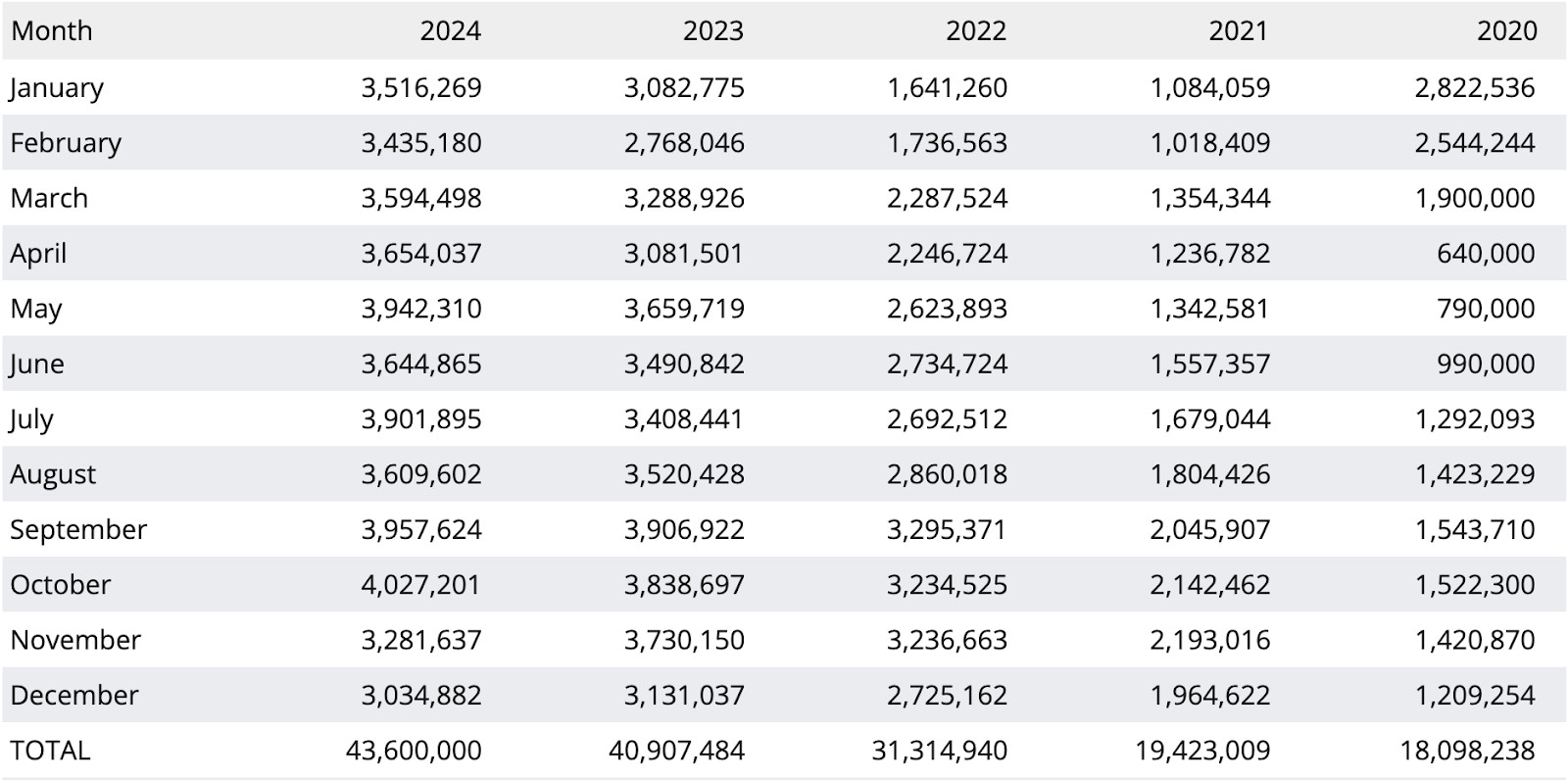
According to the City of Brampton, more than 43 million riders took transit in 2024, a 6.6 percent increase from 2023’s 40.9 million trips and a 30.6 percent surge from the 31.3 million recorded in 2022.
At the time, Brampton operated 476 diesel buses. CUTRIC projected the city would need nearly 1,200 zero-emission vehicles by 2040 to meet demand, and fulfill commitments to dramatically reduce the municipality’s carbon footprint which is largely shaped by the use of dirty diesel buses that criss-cross the city night and day. The total 18-year lifecycle cost of the plan is $8.94 billion, with $3.4 billion in capital expenses and $5.7 billion in operating costs.
Three transition scenarios were presented, combining battery-electric and hydrogen fuel-cell buses, with total costs for the most expensive option as high as $9.85 billion through 2041. Petrunic told council that cutting transit emissions alone, which account for roughly 70 percent of Brampton’s corporate greenhouse gas emissions, could bring the city close to its 2040 climate target.
But only if the City committed to the complex work and deep investments needed to support electrification: charging infrastructure, new transit depots and a long-term capital plan.
Upgrading Brampton’s two existing transit maintenance and storage facilities alone would cost at least $132 million and one or two additional depots would be unavoidable, costing hundreds of millions more.
The City has yet to sign an implementation agreement tied to a $400-million financing offer from the Canada Infrastructure Bank, first put on the table in 2022 to transition the bus fleet from diesel to more sustainable options. Accepting it would require budgetary commitments, something Brown has repeatedly refused as he pushes to freeze municipal spending. The controversial mayor has played a game he has been fond of throughout his political career: signing onto provisional deals, arrangements and agreements so he can claim leadership on critical needs for his community, while failing to actually deliver on his so-called commitments.
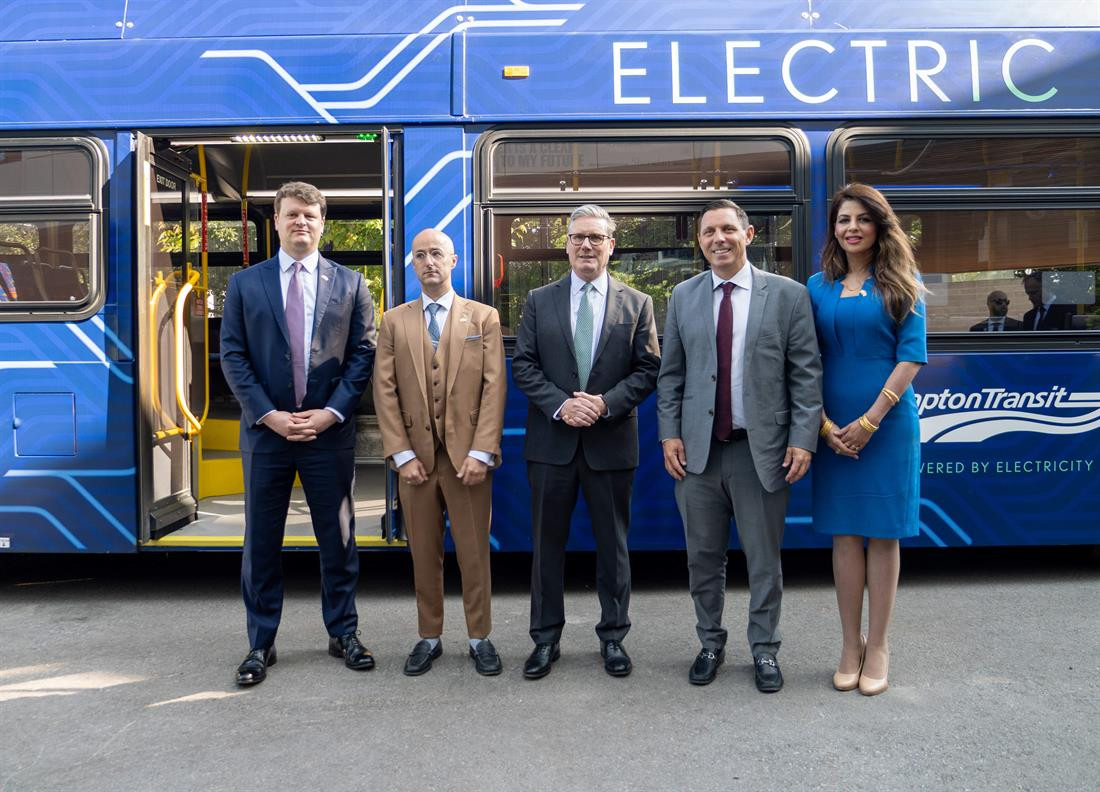
Zenobe Global Direcor of EV Fleet Tim Boothman (from the left), Zenobe Co-Founder and Director Steven Meersman, U.K. Prime Minister Keir Starmer, Brampton Mayor Patrick Brown and Fouzia Younis, U.K.’s Consul-General to Ontario at the June 15 announcement.
(City of Brampton)
The Zenobe deal has been trumpeted by Brown, who has ignored transit electrification despite claiming during his failed 2022 Conservative Party of Canada leadership bid that he oversaw the biggest bus electrification undertaking of any Canadian city—a blatant lie. In 2024, Brampton was the only municipality in Peel to see transit emissions increase, according to the latest data from The Atmospheric Fund. While cities across Canada, including Mississauga, have made the financially difficult but environmentally important decision to transition to electrified buses, Brown has completely ignored the responsibility, continuing to rely on cheaper, dirty diesel buses.
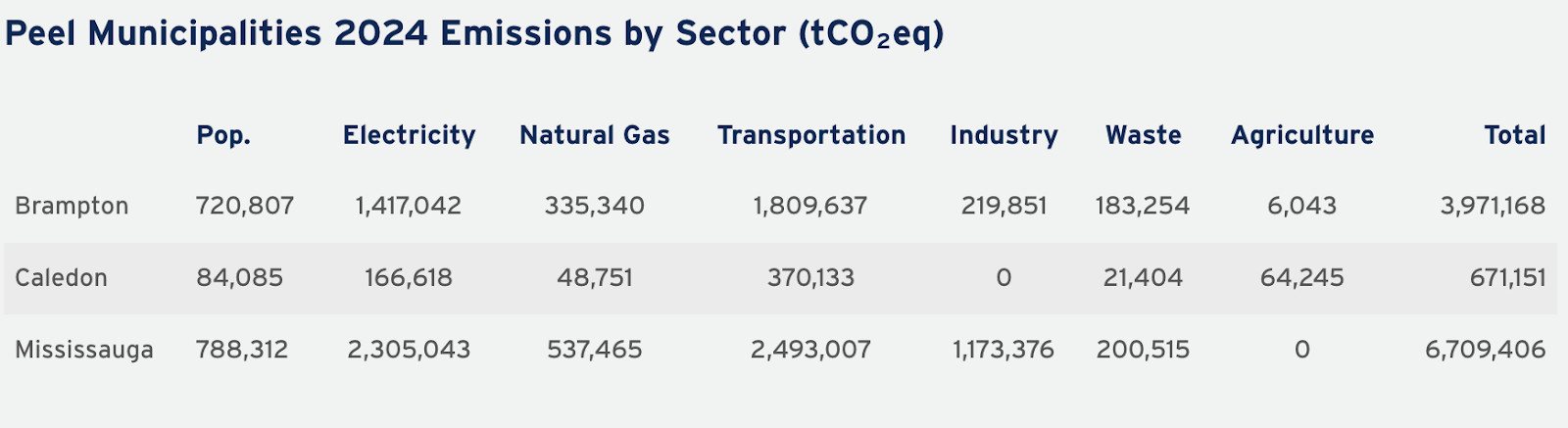
Transportation remains the highest emitting sector in all three municipalities in the Region of Peel. In 2024, Brampton’s transportation emissions stood at 1.81 million metric tonnes of carbon dioxide equivalent.
(The Atmospheric Fund)
While the Zenobe deal provided Brown with political cover and he projected leadership on the critical issue of municipal pollution reduction—despite his woeful record—little was known about the U.K.-based company or the recently announced partnership.
Founded in 2017, Zenobe has been promoting its projects in the U.S., Europe, Australia and New Zealand, with claims of supporting more than 2,000 electric vehicles (there are about 1,000 municipal buses in Peel) before the company entered the Canadian market, in Brampton.
Weeks before the announcement in Ottawa, Zenobe provided $48 million in debt financing to Montreal-based EV-as-a-Service provider, 7Gen, for up to 500 electric vehicles and their charging infrastructure.
“We see momentum behind decarbonization in Canada’s supportive government policies and the clean, affordable power that will ensure a lower total cost of ownership for zero-emissions vehicles,” Zenobe co-founder and director, Steven Meersman, said in a press release.
Now, under the proposed partnership with the City of Brampton, Zenobe is expected to bring roughly $1 billion in foreign investment into Canada and would be responsible for the software, supply-chain coordination, planning and capital-markets expertise to operationalize an electrified fleet. Meanwhile, Brampton is expected to purchase electric buses from Canadian suppliers, partially financed through repayable Canada Infrastructure Bank loans.
Heidi Dempster, City of Brampton’s general manager of transit, described the collaboration as a “new standard for sustainable, modern public transit” and said it would drive local economic growth, creating thousands of jobs and building expertise within the city, with the first phase of the ten-year project expected to begin in 2027.
But key questions remain unanswered. How is the multi-billion-dollar agreement structured? How was it approved?
On June 27, after receiving multiple inquiries from Brampton residents, The Pointer filed a Freedom of Information request for all documents including but not limited to emails, memos, staff reports, meeting notes, text messages, WhatsApp messages, and any other written communication or correspondence related to the Zenobe deal.
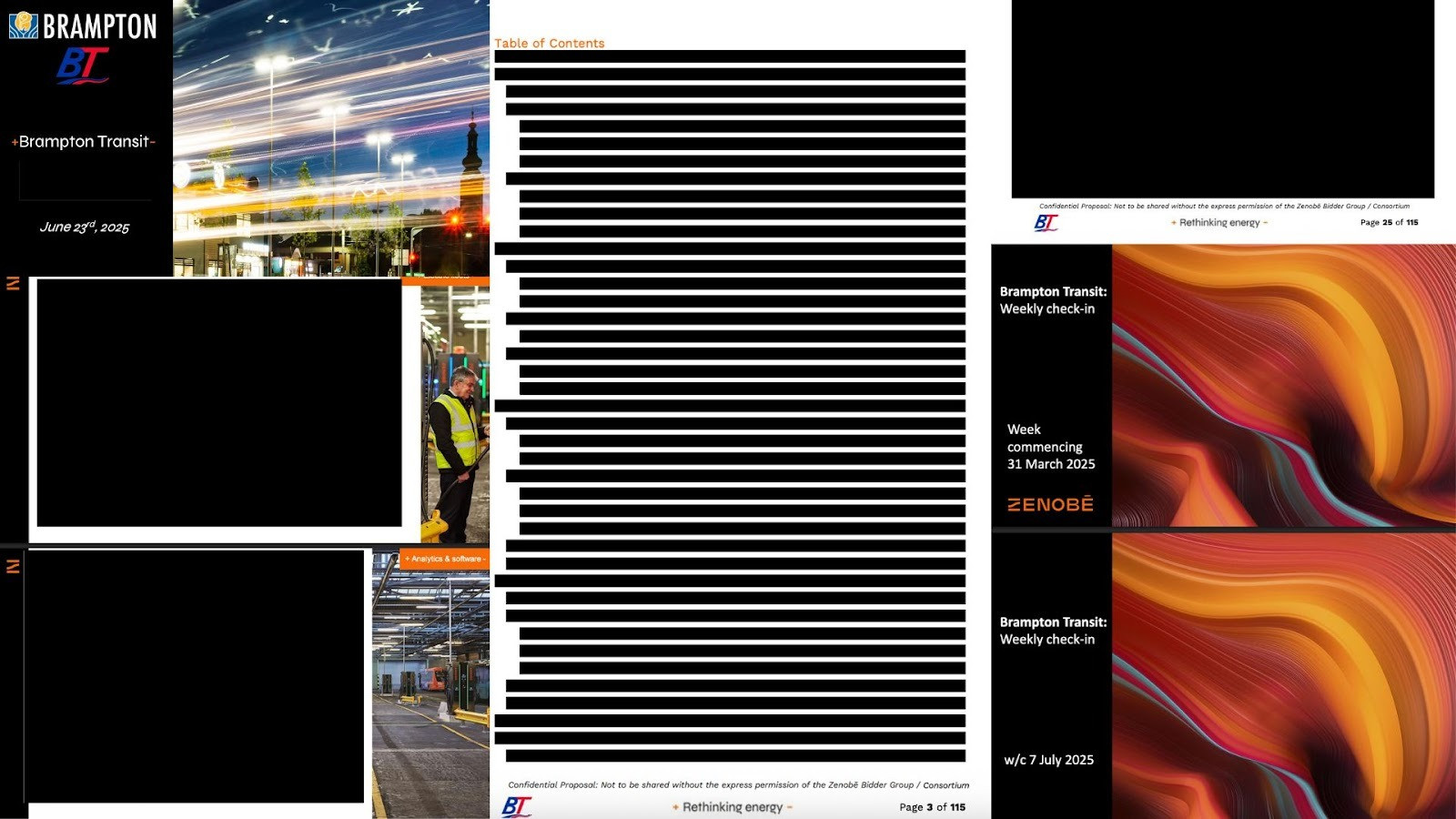
Around 90 percent of the documents shared with The Pointer following the Freedom of Information request, after a wait of more than six months, were redacted.
(The Pointer/Canva)
On January 5, 2026, nine documents, totalling 1,799 pages, were sent to The Pointer from the City. Many pages appeared to be repeated and only 177 were not fully redacted.
What did we learn from the pages that were only partially redacted?
They show that Microsoft Teams was the preferred communication platform for Brampton Transit officials, City of Brampton employees, and Zenobe staff.
There is email correspondence about meetings dating back to January 2025. On January 22 last year, Brampton employees were emailing Zenobe officials to coordinate access and walkthroughs for certain project processes.
One email from a Zenobe official requested if someone could “accommodate 27th March at Brampton Transit’s Sandalwood facility,” indicating early planning for site visits.
By March 2025, Zenobe was already presenting findings from initial site visits, including cost estimates and due diligence reports, followed by regular weekly check-ins between the teams over the subsequent months.
There were discussions about battery capacity: “(Nova Bus LFSe (76kWh) – 18 645KG, New Flyer Xcelsior Charge (213kWh) – 19 795KG, Nova Bus LFSe+ (564 kWh).”
Browser cache issues were solved. People were thanked for “prompt” responses. Meetings were rescheduled due to differences in U.S. and Canadian holidays as Zenobe's team is based in the U.S. and City of Brampton officials managed cross-border collaboration.
The City denied disclosing closed session council reports entirely, with only the news release and “request for expression of interest” provided in full.
The Municipal Freedom of Information and Protection of Privacy Act (MFIPPA) allows municipalities to withhold records under certain exemptions including sensitive legal advice, personal information about identifiable individuals, labour negotiations or confidential third-party information that could harm a private partner’s commercial confidentiality interests.
Part of the documents, heavily inked in black, included the Memorandum of Understanding (MoU). Using MFIPPA’s Sections 10 and 11, the City claimed: “the record contains information that reveals trade secrets, technical, commercial, financial and labour relations supplied to the City in confidence by a third party.”
“The record also contains information relating to positions, plans, procedures, criteria or instructions to be applied to negotiations carried out by the City.”
The Information and Privacy Commissioner of Ontario (IPC) has emphasized that municipalities must exercise caution when applying these exemptions.
Guidance posted on the IPC’s website highlights that Section 10 generally does not protect the contents of contracts between an institution and a third party. Similarly, Section 11 only applies to information related to “ongoing negotiations, or to negotiations that will occur or are anticipated or intended to occur in the future.”
It’s unclear how the City could claim sensitivity around ongoing negotiations, after it announced the $4 billion deal in the summer. The City has not explained what bidding process was used, if any, to ensure taxpayers are being protected in a deal of this scope.
The Pointer reached out to the City of Brampton about details of the contract. No response was received.
In that FOI request, the City returned nearly 1,500 pages of records, more than 86 percent were fully redacted, including the final contract itself. The City cited the same MFIPPA exemptions related to third-party commercial interests and ongoing negotiations, despite the agreement already being signed, leaving residents unable to access basic information about how millions in taxpayer dollars were approved and spent.
The Pointer has appealed the City’s decision to the Information and Privacy Commissioner in the Argo case and will now also challenge the Zenobe FOI disclosure by the City.
In the Argo matter, the IPC will review the City’s reliance on these exemptions and, following mediation or adjudication, may order the records released in full, disclosed with conditions, or uphold the City’s decision to withhold the information from the public.
Email: [email protected]
At a time when vital public information is needed by everyone, The Pointer has taken down our paywall on all stories to ensure every resident of Brampton, Mississauga and Niagara has access to the facts. For those who are able, we encourage you to consider a subscription. This will help us report on important public interest issues the community needs to know about now more than ever. You can register for a 30-day free trial HERE. Thereafter, The Pointer will charge $10 a month and you can cancel any time right on the website. Thank you
Submit a correction about this story

