
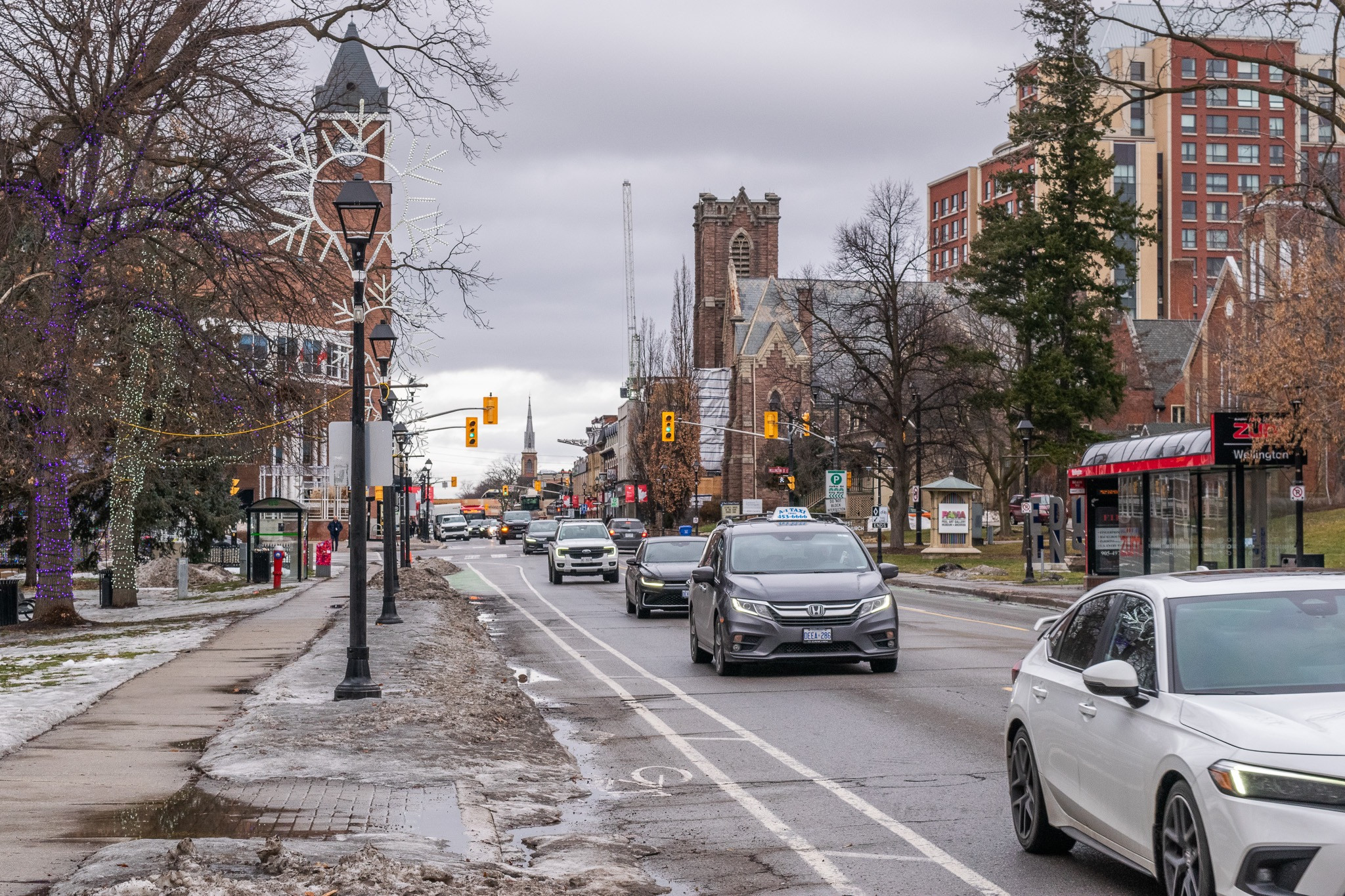
Delays & Deceit: Nearly 8 years after its revival, Main Street LRT is no closer to breaking ground while City, Mayor Brown continue to mislead residents
It has been nearly eight years since Mayor Patrick Brown and several of his fellow councillors put the Main Street route for the extension of the Hurontario LRT back on the table.
The decision, only weeks after the 2018 municipal election that saw Brown win the mayor’s seat for the first time, was an attempt to undo the mistakes of the past.
The previous council turned down a provincially approved route along Main Street—causing the Hurontario LRT (renamed the Hazel McCallion Line) to turn around at Gateway Terminal.
Since that time, Brampton residents have seen little in the way of concrete progress on bringing high-order transit to the downtown.
The promised tunnel has not broken ground.
Metrolinx’s official project page still describes the four-kilometre Downtown Brampton extension as being in the “planning and design stage”, with environmental studies and public engagement listed as the next steps.
There is no construction schedule on the page, and little in the way of visible progress for a project once billed as a transformative investment for Brampton’s city centre.
The project has moved through Metrolinx’s Initial Business Case (accepted by the province in March 2024) while remaining without a construction funding agreement from any level of government.
For Peter Miasek, the President of Transport Action Ontario, an independent transit advocacy organization that has tracked the Hurontario LRT for years, the entire project is “frustratingly non-transparent”.
“The amount of silence is scary,” he said. “I’d like to see more transparency for sure.”
While advocates and residents complain about the lack of progress updates on the project, the information they do get from the City of Brampton and its local elected officials is often misleading.
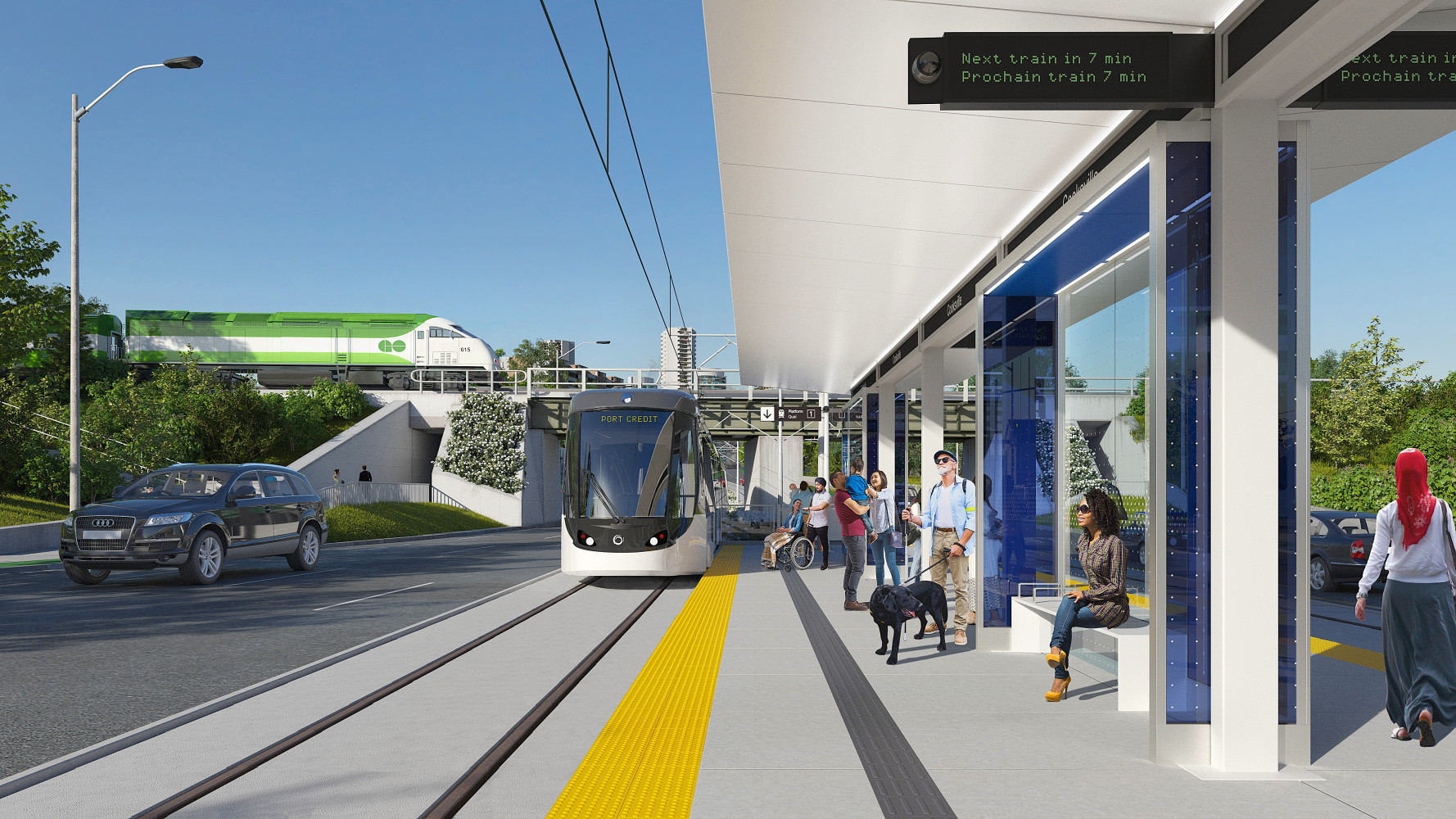
The proposed extension of the Hazel McCallion Line would connect downtown Brampton to Port Credit.
(Alexis Wright/The Pointer)
In January 2025, Premier Doug Ford was in Brampton alongside Brown announcing support for the downtown LRT extension and the expensive tunnel that will carry it through parts of the city centre.
This was a month before Ford’s snap election at the end of February last year.
After the announcement, a press release from the municipality declared: “City of Brampton welcomes Ontario’s rapid transit tunnel”.
Despite the claims of the City, Mayor Brown, and councillors Paul Vicente and Rowena Santos, who heralded the “historic investment”, there was no actual funding attached to this announcement.
The 2025 Ontario PC budget merely mentions that the government “plans to study options to tunnel the Brampton portion of the segment”.
No funding was included in the budget for an actual tunnel.
The 2026 budget is slightly more definitive, noting the government now “plans to tunnel the Brampton portion of the line”.
But again, no funding appears in the budget to actually start construction on the project.
Despite being well aware of this, in March, a few weeks before the 2025 federal election, the City of Brampton and its elected officials repeated the deceptive claim.
The City of Brampton held a press conference alongside local MPs and MPPs holding signs reading “Brampton’s tunnelled LRT is on the way”.
A press release from the City declared: “City of Brampton welcomes federal funding support for the development of rapid transit tunnel”.
The problem was, the announcement actually did not include any money.
All that could reasonably be said was the federal government had agreed to support the project in principle, and there were funding streams that could potentially provide assistance if the City applied for funding.
The announcement was nothing more than a publicity stunt with a federal election just weeks away.
As the federal officials told The Pointer following the event, “no specific monetary commitment was made to the LRT expansion project as part of the Metro-Region Agreement stream announcement on March 21, 2025.”
When asked last week whether the City of Brampton has actually applied for any funding following this announcement, Housing, Infrastructure and Communities Canada declined to comment.
“To maintain partner confidentiality and the integrity of application processes, Housing, Infrastructure and Communities Canada (HICC) does not comment publicly on its discussions with partners about potential, future or pending funding decisions for specific projects,” federal officials said in an emailed response. “Funding commitments are announced in collaboration with partners in due course.”
The City of Brampton did not respond to questions about any funding applications that have been submitted for the LRT project.
This is not the first time Brampton residents have been fed questionable claims about the status of this crucial transit infrastructure project. These issues date back to when Brown and much of the current council (Santos, Vicente, Michael Palleschi, Harkirat Singh, Pat Fortini and Martin Medeiros) revived the idea of running the LRT along Main Street, and Mayor Brown introduced the tunnel option.
The idea for a tunnel was first seriously considered in December 2018 as a potential solution to an issue that had contributed to the previous Brampton council voting down the route for the Hurontario LRT. That issue being the impact on the historic sections of downtown.
“If we’re going to fix transportation for a generation, we don’t need a band-aid solution. We need the right solution, and tunnelling through the downtown alleviates the concerns that existed that we would rip up historic areas of the city,” Brown said in early 2019 when LRT routing options came to council for a vote. At that time, staff estimated the tunnel option could cost as much as $1.7 billion.
As previously reported by The Pointer, Brown was backed in his original mayoral bid by former Ontario premier and legendary Brampton resident Bill Davis, whose stately house still sits along Main Street in the heritage district. Before he passed away in 2021, Davis made it clear to the current mayor, who commonly refers to the former Ontario leader as his mentor, that he did not want to see an LRT running in front of his Victorian home.
The tunnel debate initially divided council. At a meeting in the spring of 2019, councillors Vicente and Santos—now two of Brown’s closest political allies—tried to oppose him and introduced a motion for council to approve a surface option along Main Street from Gateway Terminal into the downtown. It was vehemently opposed by Brown and the motion was deferred to the following month.
When it returned, council passed a motion unanimously to undertake a new study of the linear surface alignment along Main Street and to update the existing environmental assessment on the route long favoured by Vicente and former mayor Linda Jeffrey. Jeffrey’s unrelenting position that the LRT had to be a surface route and had to run along Main Street into downtown, led to a deep division on the previous council, as opponents argued that Main Street did not offer room for expanded ridership, that it would be difficult to get approved because of its proximity to Etobicoke Creek (where engineering and flooding challenges exist) and because of concerns that it would disrupt the heritage character of the area.
This division was the main reason that, in October 2015, the previous council voted against the provincially approved Main Street route that would have extended the LRT into downtown Brampton, connecting with the GO Train station. The Brampton portion would have received about $400 million in funding from the Province, but when council rejected the route, the previous Liberal government said the money would be put in a pool of money for other transit projects in Ontario.
The other potential routes for the LRT included travelling along McLaughlin Road and Kennedy Road, instead of Main Street. These other options were quickly scrapped by Brown and council, who quickly agreed to place the future LRT on Main Street. Then, it became a question of running it on the surface or tunnelling portions of the track into downtown.
Mayor Brown has consistently maintained that upper levels of government are prepared to give the City money when the time comes, but has repeatedly misled residents about the state of those funding agreements.
In 2019, following the annual conference of the Federation of Canadian Municipalities (FCM) where Brown claimed he met with “half the federal cabinet and the prime minister,” he hinted that a funding announcement on the LRT could be coming soon.
“I’m not allowed, at liberty, to tell you, but you will get a notice probably two or three days before the press conference,” Brown said at the time.
No funding announcement ever came.
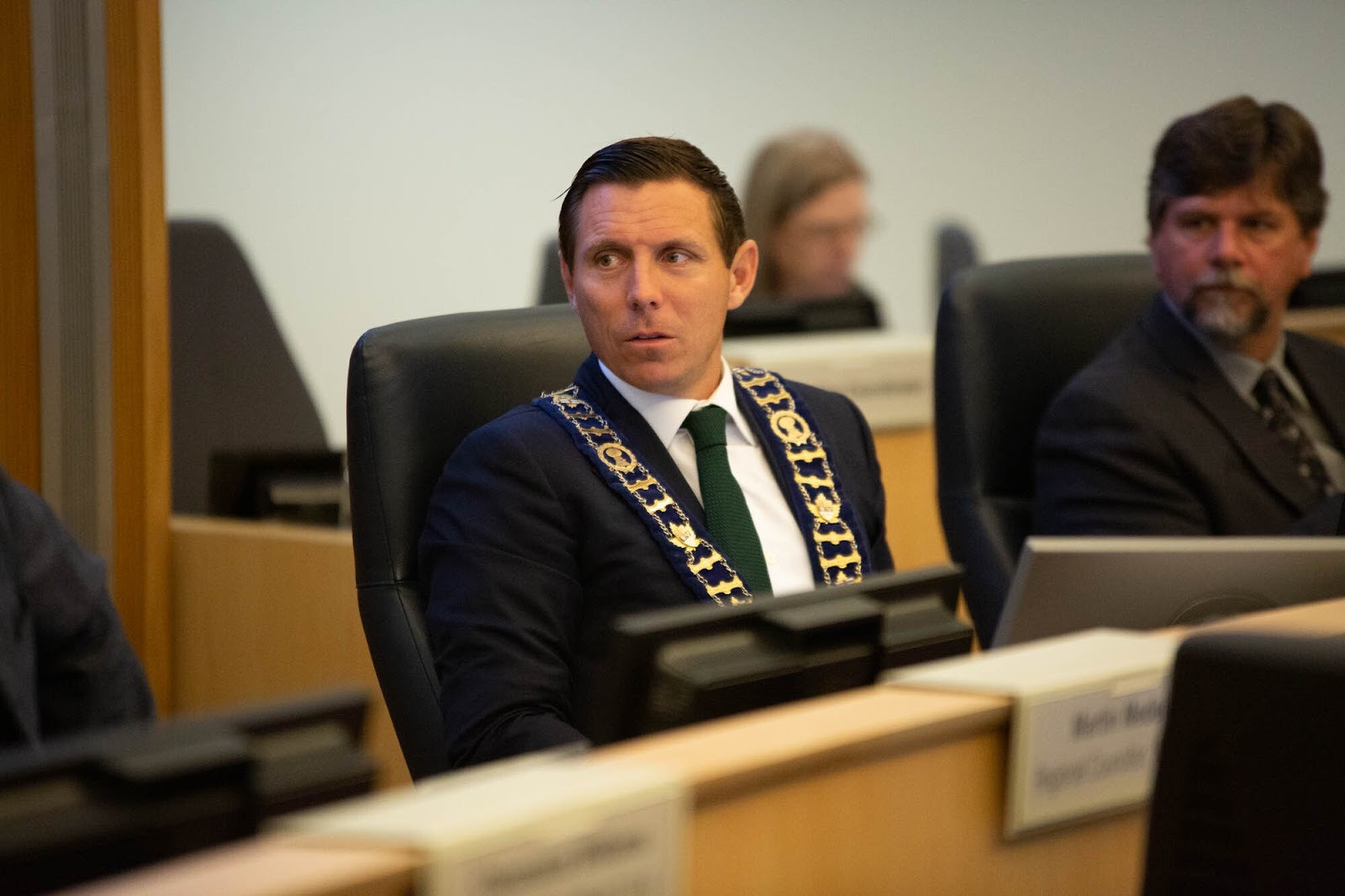
Mayor Patrick Brown has made repeated promises since 2019 that funding for the extension of the Hurontario LRT into downtown Brampton was coming from upper levels of government. To date, no funding for construction has been secured.
(The Pointer files)
By September that year, Brown was claiming council was in agreement that the tunnelled option was the best for the city. He claimed it would be faster than constructing a surface option because of preexisting underground channels beneath downtown. It’s unclear where he got that information from or whether these old pieces of flooding infrastructure would be suitable for repurposing to high-order transit. “We have partners for it,” he claimed, referring to the tunnelled option. No partners were ever announced.
Brown claimed the City was ready to apply for funding to support the project, despite no environmental assessment being completed—a requirement of both upper levels of government for a project like this.
By June of 2021, the study work had still not been completed, and City staff recommended further studies of both the surface and tunnel option.
This delay not only cost taxpayers $650,000 for the studies themselves but also saw the cost estimates for both options climb dramatically.
When staff returned in March 2023, the cost estimate to run the LRT along Main Street into downtown had risen from between $400 million and $450 million to as much as $933 million. The studies concluded the tunnel option would be best for travel times as the LRT would not have to compete with vehicular traffic.
Council eventually agreed on the tunnel option in May 2023—five years after reviving debate on the Main Street LRT in 2018. The tunnel option was now going to cost approximately $2.8 billion.
The following year, the City’s own budget included only modest amounts for project office costs, and an environmental assessment that still hadn’t been completed, which was a prerequisite for accessing funding.
Peter Miasek, President of Transport Action Ontario, says his organization still believes a well-designed surface-level option is preferable to a costly tunnel.
(Alexis Wright/The Pointer)
Transport Action Ontario remain unconvinced the tunnel option is worth the extra cost.
“I still worry about money,” Miasek said. “It’s an extra 2 billion…I think we can make a surface LRT work in that stretch. It’s used in all sorts of historical districts in Europe.”
His read, after years of following the file, is that only a planning and design contract appears to be funded. Even then, he does not know who the consultant is, since no announcement has named one.
“I’m going to take Metrolinx and the City and the Province at their word that planning and design has been funded,” he noted. “But I’ve certainly seen zero announcement that construction has been funded. We’ve certainly seen no number and we’ve seen nothing in the way of a request for qualifications for construction companies.”
The federal piece is murkier still.
Miasek said Ottawa had “announced that they are willing to throw in some money,” but he does not know whether an agreement was ever signed between the federal and provincial governments.
Miasek believes Metrolinx should also share the responsibility for any extension delays or ballooning costs.
“The project owner is accountable, which in this case is Metrolinx,” he added. “I don’t see how any citizen can go after the contractor because they just don’t know the story well enough, but you can go after Metrolinx.
“It’s a question of Metrolinx being accountable.”
The Pointer sent questions asking about the funding status to Metrolinx, the City of Brampton and Councillor Rowena Santos’s office. As of publication, they have not responded to these questions.
Email: [email protected]
At a time when vital public information is needed by everyone, The Pointer has taken down our paywall on all stories to ensure every resident of Brampton, Mississauga and Niagara has access to the facts. For those who are able, we encourage you to consider a subscription. This will help us report on important public interest issues the community needs to know about now more than ever. You can register for a 30-day free trial HERE. Thereafter, The Pointer will charge $10 a month and you can cancel any time right on the website. Thank you
Submit a correction about this story

