
‘I think it's garbage’: Six years after agreeing to end systemic anti-Black racism, critics say little has changed with Peel Police
In October of 2020, following decades of harm done by Peel Police to racialized communities, what was heralded as a landmark agreement was announced by the province’s human rights watchdog.
“The Ontario Human Rights Commission (OHRC), the Peel Regional Police (PRP) and its Board (PRPSB) have signed a Memorandum of Understanding (MOU) committing to develop and implement legally binding remedies to identify and eliminate systemic racism in policing, promote transparency and accountability, and enhance Black, other racialized and Indigenous communities’ trust in policing throughout Peel Region.”
The MOU has since been called little more than lip service by community advocates tired of the harm Peel Police continues to cause to racialized communities.
In December 2023, a Peel Police officer detained and arrested a Black man in a Brampton apartment building. More than two years later, an Ontario Superior Court judge concluded the officer's treatment of him had been influenced by racism.
In January 2026, Justice Faisal Mirza ruled that Peel police officer Simon Beduz had violated Jaheim Hussey's rights under sections 7, 8, 9 and 10 of the Canadian Charter of Rights and Freedoms. Judge Mirza found the officer's treatment of Hussey during parts of the interaction was influenced by anti-Black racism and concluded that allowing firearm evidence in the case would be embarrassing for Peel Police.
It was clear that the suspect had been racially profiled and without proper evidence, other than the colour of his skin, was targeted for committing the crime.
Hussey was stopped on December 20, 2023, after an officer was investigating a possible armed robbery. As an altercation unfolded, the officer eventually tackled the suspect and arrested him. The court found that prior to the arrest the officer did not tell the man why he was being stopped or detained, and during the altercation the gun on Hussey’s person fell onto the ground.
Justice Mirza found the officer's conduct prior to and during the arrest was influenced by racism and that the officer had breached several Charter protections. The Ontario Human Rights Commission (OHRC) later summarized the decision by noting the court had relied on OHRC research about anti-Black racism and racial profiling when assessing the interaction.
Justice Mirza emphasized that police decisions influenced by racism cannot be considered reasonable even if there may have been a legitimate cause for police involvement. Whatever that cause might have been during an investigative process, it is what should have informed the actions of any officer in such a situation. Making assumptions based solely on race and then later obtaining incriminating evidence is a violation of Charter rights. That principle is directly relevant to the Human Rights Project (born from the 2020 MOU), which repeatedly addresses the ways racial bias can influence otherwise discretionary decisions.
The 91 recommendations brought forward by the OHRC in 2023, as part of the MOU three years earlier, when Peel Police was under fire for its decades of systemic racism, instructed the force to recognize that racial profiling can and has occurred, calling for internal policies that recognize intentional, unconscious and systemic sources of racial profiling. The history of over-policing experienced by Black, Indigenous and other racialized communities in Peel was supposed to become part of the force’s operational understanding.
The recommendations called for the top officer to automatically initiate a Chief's complaint investigation when findings or comments from courts, the Human Rights Tribunal of Ontario, the Law Enforcement Complaints Agency, the Special Investigations Unit or other legal decisions involving Charter breaches pointed to conduct consistent with racial profiling or discrimination.
Despite numerous examples that should have triggered a Chief’s complaint, it remains unclear if Nishan Duraiappah has followed the agreed upon requirement.
Issues of racial bias in policing are incredibly complex. An Ontario Court of Appeal decision released this week illustrates that complexity.
In April 2025, Ontario Superior Court Justice Renu Mandhane issued a major ruling involving a Black driver who had been stopped, detained and searched by a Peel Police officer in October 2023.
Peel officer Anand Gandhi, who arrested and handcuffed a Black driver before confirming whether his licence was actually suspended, seized his possessions and placed him in the back of his cruiser. Justice Mandhane found that the officer's actions were influenced by racial stereotypes and concluded that the driver “was subjected to the arrest, detention and search because he was a Black man.”
Earlier that same day, Constable Gandhi had pulled over a woman whose licence was suspended, but the officer did not call for backup, handcuff the woman or search her vehicle. Justice Mandhane described racial profiling within Peel Police as “systemic and intractable” citing decades of examples, and disregarded the gun the officer found within the driver’s vehicle during the search as evidence.
The man was eventually acquitted on four firearms charges. But the Crown later appealed the decision by the judge to dismiss the evidence on the grounds of racial bias.
The original ruling was difficult to separate from the OHRC recommendations Peel Police is supposed to have implemented. The recommendations specifically require the service to collect race-based data on traffic stops, consider the history of over-policing experienced by racialized communities and use alternatives to charges and arrests where appropriate.
The Ontraio Court of Appeal ruled this week the judge made errors in law and overturned her decision to dismiss the evidence on the grounds of racial bias. A new trial has been ordered.
The Gandhi case demonstrates why institutional reform cannot simply be measured by whether new policies exist or are effective, as the officer's actions, regardless of whether or not he used racial bias, occurred within an organization that had already been subject to years of criticism about racial profiling while its leadership claimed they had been working on the systemic issues. The existence of policies, new or old, was part of a systemic culture that has been shaped over decades.
The new trial will presumably rest whether or not Peel Police deserved to still be labelled as systemically racist, and the Crown will have to explain why the accused was not afforded the same treatment as the woman who had been stopped earlier in the day with a suspended licence, but only received a ticket—with no other suspicion and no search for other evidence conducted.
The ruling from Justice Mirza was the kind of judicial finding that speaks directly to the problem Peel Police, and the Ontario Human Rights Commission have spent six years promising to address, problems that have affected the Black community for decades.
On August 18, the OHRC, Peel Police and the Peel Police Service Board quietly announced that they had signed a “first-of-its-kind” Binding Arbitration Agreement intended to create a formal mechanism for overseeing and enforcing the implementation of recommendations aimed at eliminating systemic racism in Peel policing and the culture of the force.
The agreement between the three parties aims at creating an independent verifier who will oversee Peel's implementation of the recommendations. The verifier will be jointly selected by the three parties and in discussion with the community-based Anti-Racism Advisory Committee that works in tandem with PRP on eliminating systemic racism within the force.
If the parties disagree over how the recommendations are being implemented, those disputes can be sent to an external arbitrator to further be evaluated and discussed. If it’s determined during arbitration that PRP must implement a specific recommendation, the decision of the arbitrator is binding and enforceable meaning Peel Police must implement the recommendation.
Peel Police, the police board and the OHRC presented the agreement as a major accountability milestone, but for some community advocates who have watched the process unfold since its beginning, in person and from the sidelines, the announcement raises a fundamental question: why did it take six years to arrive at a mechanism intended to make promises enforceable?
David Bosveld, a Black community advocate and former member of Peel Police's Anti-Racism Advisory Committee, said the delay itself is part of the problem. For more than half-a-decade, he has served as The Pointer’s primary contact on matters involving Peel Police and concerns around anti-Black racism.
“One of the difficulties I have with it is it's taken over, or around six years to get to this point,” Bosveld said. “They've had a series of recommendations forward and supposedly implemented some of the things that would address some of the discriminatory practices, and it's only now that they have at least signed the agreement and then added in this arbitration process, which remains to be tested.”
The agreement does not erase the history that led to it nor does it not undo court findings, human rights decisions or internal reports. Started in October 2020, after George Floyds murder by Minneapolis police officer Derek Chauvin on May 25, 2020, The Human Rights Project started when PRP, Peel Police Services Board and the OHRC signed a memorandum of understanding committing to work on systemic racism, racial profiling, transparency, accountability and public trust.
The work eventually produced a lengthy set of 94 recommendations in 2023 covering virtually every aspect of policing from traffic stops and use of force to body-worn cameras, artificial intelligence, officer training, school policing, discipline, community engagement and the way Peel collects and releases information about race.
Peel Regional Police emphasized in the announcement that the agreement is not an admission that nothing has been done and said the service had been working to implement the recommendations since they were released.
According to the announcement, those efforts include acknowledging systemic racism, engaging with diverse communities, reviewing and revising policies, human-rights-focused training, de-escalation and longer-term approaches to serving vulnerable populations.
The OHRC, Peel Police Service Board and Peel Regional Police described the independent verifier as the next step and will assess the work that has already been completed and the work still required. That is important because the recommendations are not simply aspirational statements about police culture but contain instructions on how to approach their next steps on rebuilding trust with the community.
Peel Police was directed to publicly acknowledge the reality of racial discrimination in its service delivery, recognize the impact on trust and specifically acknowledge the effects on Black, Indigenous and other racialized communities.
The force was asked to publicly apologize for racially discriminatory service delivery as part of its commitment to ending systemic racism within Peel Regional Police. The apology that was promised to be posted on PRP’s website years ago still hasn’t been published to this day.
Peel police did not respond to questions for this story.
Peel Police was directed to work with diverse communities on issues related to systemic racism, alternative approaches to police service delivery, non-core police functions and opportunities to redirect resources and establish a community experiences portal where residents can share their views and experiences. The force is also required to collect and release survey data about community perspectives on policing and information about officers under disciplinary review.
Peel Police was also directed to revise its racial profiling and bias-based policing directive by incorporating the OHRC's definition of racial profiling, while under-policing is to be addressed as part of racial profiling. Incidents and complaints around alleged racial profiling are supposed to be integrated into a broader system connected to disciplinary review and case management.
Concerns about over-policing of the Black community and persistent complaints about racial profiling have continued, while more questions have been asked about how Peel Police spends taxpayer money. And whether or not Mississauga and Brampton residents, who are overwhelmingly not white, are getting good value for their money.
Since Peel Police Chief Nishan Duraiappah took over in 2019, the police service's operating budget has increased dramatically, reaching $837.3 million in 2026, up more than 80 per cent from $462.5 million in 2021, and set to surpass $1 billion next year, for a force serving approximately 1.7 million residents.
At the same time, Peel's reported ability to solve crimes has declined.
Previously reported by The Pointer, according to Peel Police's 2025 annual report, clearance rates from officers and investigators have steadily declined over the last several years. In 2019, officers solved 49.3 percent of 41,268 Criminal Code violations. In 2020, the rate fell to 47.2 percent despite the board approving 35 new officers and 5,000 less violations. It dropped again to 43.9 percent in 2021 with an additional 27 new officer hires and 1,000 fewer reported crimes, and 39.8 percent in 2022 and 36.7 percent in 2023.
The decline has continued across major categories of crime. Crimes against persons increased from 8,574 in 2020 to 14,965 in 2025, while the percentage of those offences solved dropped from nearly 78 percent to 63.7 percent. Property crime solvency additionally decreased from 25.7 percent to 18.9 percent over the same period.
In 2023, the board approved 70 new officers, the largest increase in years, but only 36.7 per cent of the 53,057 criminal violations were solved. The trend continued into 2024 and 2025.
The service hired 135 additional officers in 2024 and another 300 uniformed employees in 2025, the largest single-year increase in its history. Despite that expansion, crimes against persons rose from 14,643 in 2024 to 14,965 in 2025, while the solvency rate for those offences stood at 63.7 per cent.
Property crime solvency was 18.9 per cent in 2025, only slightly higher than the 17.8 per cent reported in 2024 but substantially below the 29.8 per cent recorded in 2019. The numbers have prompted questions about whether continually increasing police budgets automatically produce better policing outcomes.
Critics have argued that relying on policing stereotypes, such as anti-Black perceptions, distracts police from utilizing more effective, and relevant, investigative approaches to solving crimes, and preventing them from happening in the first place.
Throwing money at hiring more officers is also a proven bad approach, which also leads to over-policing that disproportionately impacts racialized community members.
Patrick Watson, an assistant professor at the University of Toronto's Centre for Criminology and Sociolegal Studies who researches policing oversight and municipal government, said “There’s no correlation between police funding and crime rates.”

Assistant professor at the University of Toronto, Patrick G. Watson, said data shows no direct tie between higher police budgets and lower crime rates. (Submitted)
He said adding 300 officers, as Peel Police claimed it would do with a 23.3 percent operating budget increase in 2025, would not necessarily produce an immediate reduction in serious crime because professional criminals are unlikely to be deterred simply by the arrival of additional uniformed officers.
Watson did, however, point out that additional officers can eventually free experienced investigators to concentrate on complex cases while newer officers gain experience. That benefit may take several years to emerge.
“It's not going to be next year,” Watson said. “Even if you've got 300 new officers coming on, you won't start to see downstream effects for that until three, four or five years later. And by then, the entire political class has changed over.”
That creates another accountability problem. Political leaders approving a large police budget today may not be the people in office when the promised results are supposed to materialize. Meanwhile, taxpayers continue paying the cost immediately, even though it has been acknowledged that Peel Police does not even have the capacity to bring on 300 new officers in a year.
Patrick Brown, Brampton’s Mayor who has been the driving voice behind the skyrocketing police budget as the dominant member of the police board, has refused to explain why so much money has been needed each year, when it can’t even be spent, or how the board justified what the additional money will be spent on.
The $837.3-million operating budget Peel Police received in 2026, was almost $400 million more than its budget six years ago.
The force was asked what funding has been designated specifically to eradicate systemic racism in policing across Mississauga and Brampton, under the binding agreement with the Human Rights Commission. There was no response.
As previously reported by The Pointer, according to Ontario's Public Sector Salary Disclosure list, Duraiappah earned $299,196 during his first full year on the job in 2020. In 2025, he earned $604,449, excluding benefits, a 102 percent increase in five years, making him the highest-paid police official in Canada.
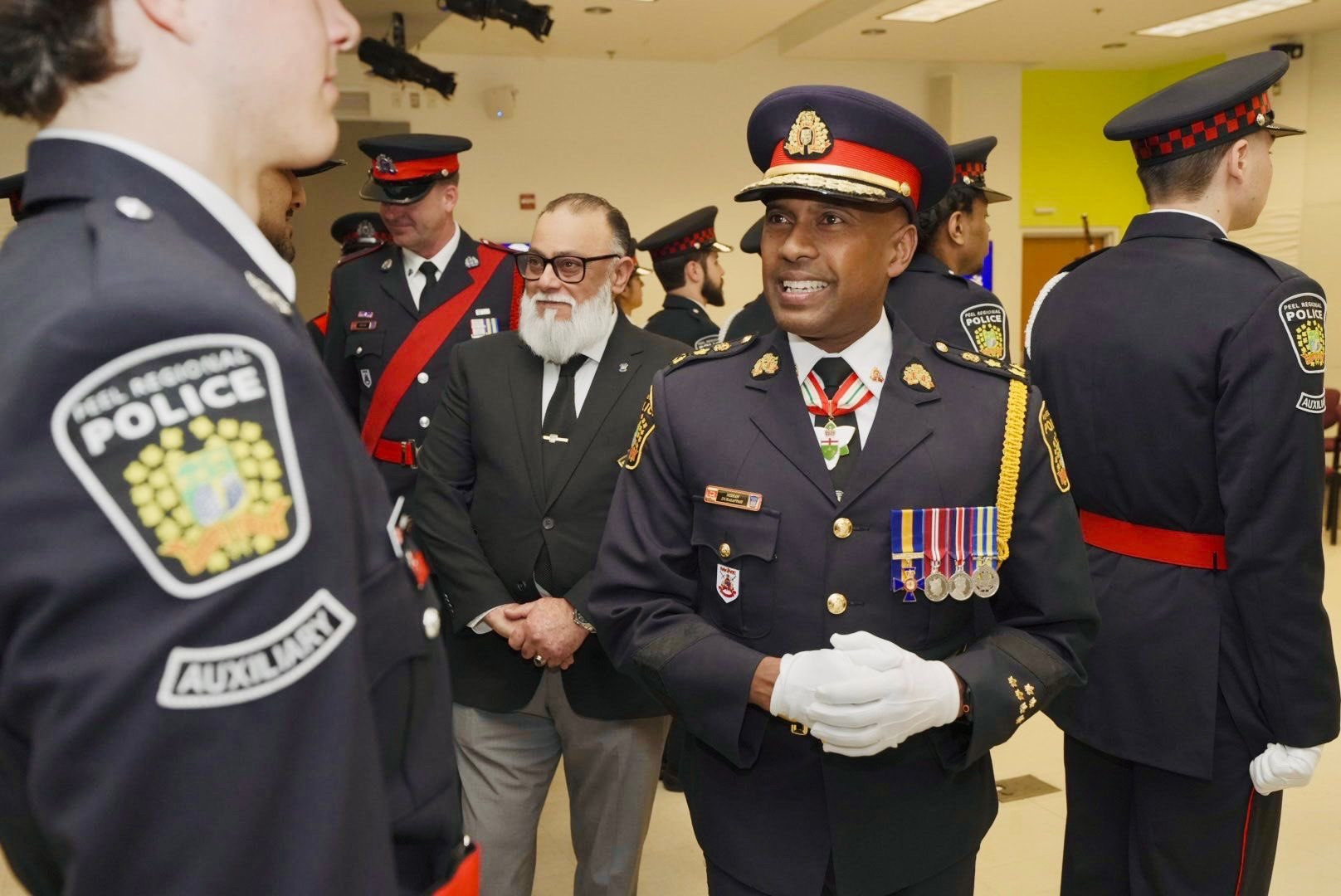
Peel Police Chief Nishan Duraiappah has seen his salary double in five years, making him the highest paid police official in Canada. (Peel Police)
“How do you hold the police force accountable when the police chief makes more than the mayor and the premier?” Bosveld asked. “How is that acceptable? This is a publicly funded institution. It operates off of our tax dollars.”
The Human Rights recommendations also proposed an Anti-Racism Advisory Committee consisting of anti-racism experts and people with lived experience who could provide different perspectives on policing. Many members, including Bosveld, resigned. He said it was clear to them that the only committee voices the force’s leadership wanted to hear from, followed whatever the police brass said.
Bosveld's skepticism is shaped by his own experience with Peel Police's Anti-Racism Advisory Committee. He eventually left after a presentation to senior staff at the Dufferin-Peel Catholic District School Board included imagery and language that portrayed Black residents as gang members.
The School Board quickly apologized and acknowledged what Peel Police had presented was blatantly racist.
As both a member of the community and a former advisory committee member, he raised several concerns to the police board. When he did not receive answers he considered “adequate” he copied the force’s director of equity on emails to Peel Police. According to Bosveld, the response was that he was violating the committee's non-disclosure agreement by including the equity director in the email list.
He believed the response indicated he would soon be removed from the committee, so he chose to leave himself. The episode was troubling to him not simply because of the original presentation by Peel Police members to the school board, but because he said he never received clear answers about what happened afterward.
“They apparently investigated themselves, which on its own is problematic, although I guess it's better than not looking into it at all,” Bosveld said.
He wanted to know how the material was created, who was responsible, whether anyone was disciplined and what safeguards would prevent a similar situation from happening again.
“Their investigation must have produced findings,” he said. “How did this happen? Was anybody disciplined? Who was responsible for creating this content and delivering it? And why was this allowed to occur? And what will we do to put some safeguards in place in the future? All of these things were never answered.”
Although he believes the anti-racism committee did some positive work, he said his overall experience left him questioning Peel Police’s willingness to change.
“The committee did some good work along the way, but at the end of things, I didn't feel like the police were interested in any kind of criticism.”
For years Black residents in Mississauga and Brampton were disproportionately subjected to street checks. Previously reported in 2019, between 2009 and 2014, Peel Police conducted more than 159,000 carding stops. While Black residents represented approximately nine percent of the population at the time, they accounted for almost one-quarter of Black residents illegally stopped and detained, more than three-and-a-half times compared to the white population.
The practice of illegal carding was meant to be abolished under Ontario’s new Community Safety and Policing Act, from an earlier legislative decision under the old Police Act in January 2017, but many Black residents have reportedly continued to be subjected to random street checks. The current Human Rights Project recommendations specifically address the practice, illustrating the need for a new accountability framework to replace the one rooted in problems that have existed for decades.
Since his hiring, Chief Duraiappah stated he was committed to increasing accountability and changing the culture at PRP that has since found themselves at the root of numerous scandals, such as discriminating against a decorated South Asian officer and handcuffing a 6-year-old Black child in school. A 2021 survey developed by the Ontario Human rights Commission found almost half of Peel’s residents who responded believed systemic racism in policing in a problem and almost 60 percent agreed with the commissions plans to reform the force’s discriminatory culture.
The question from critics is whether the new accountability framework can detect patterns that individual investigations may miss. Recommendation 41 attempts to address that problem by creating an Early Warning System capable of identifying patterns of misconduct and racial discrimination. The system is supposed to capture use-of-force incidents, Charter violations, findings of racial discrimination, complaints, civil claims and disciplinary action involving racial discrimination, but would also capture cases in which a court or tribunal concluded that race or another protected ground under the Human Rights Code played a role in an officer's conduct.
The recommendations go further by requiring the chief to initiate a Chief's complaint investigation when courts, tribunals or other oversight bodies make findings consistent with racial profiling or racial discrimination with the police board also supposed to receive information about those investigations and their outcomes.
Bosveld was skeptical that if a court finds that one officer acted on racial stereotypes, could similar conduct occur elsewhere in the organization, and whether supervisors are recognizing it and if training along with policies are working and being enforced.
“We don't have access to their everyday working implementation of this particular project,” he said. “So, they can say whatever they want [but] how do you scrutinize it? How is anybody from the community able to say, ‘okay, here's these recommendations, we can see they've been implemented. And here's some data that demonstrates that Peel Police are operating in a less discriminatory manner.’”
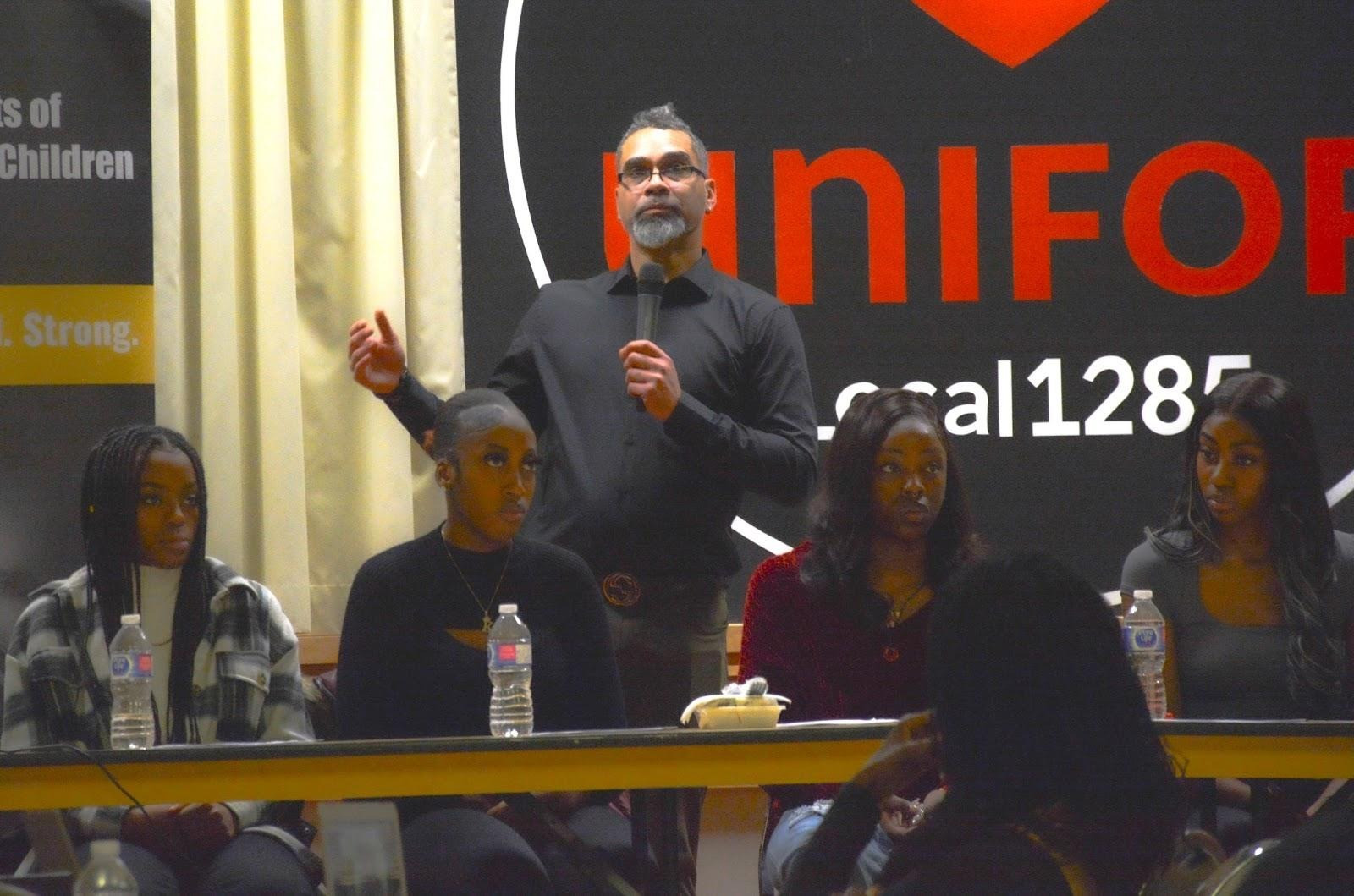
Dave Bosveld has long been an active community member and advocate, but remains skeptical that the new arbitration agreement will prove fruitful for a region that has been slow to implement change that has affected Black and marginalized communities of all ages for years, while false promises has shaken his faith in the police forces recovery.
(Joel Wittnebel/The Pointer files)
Use of force provides one example of why measuring outcomes has proved challenging. Peel's recommendations call for stronger requirements around de-escalation, communication and the use of alternatives before force is deployed. They call for officers to consider disengagement, repositioning and taking time to de-escalate when circumstances permit that according to Bosveld, residents have felt little that the de-escalation practice to have proved little implementation towards Black individuals.
The recommendations also call for annual reporting to the police board identifying potential racial bias found during audits and any remediation or discipline that resulted, yet Bosveld noted the publicly available use-of-force data does not show the kind of improvement he would expect after years of reform efforts.
“It's hard for me to measure the implementation, but where they do release data like use of force data, that hasn't improved significantly,” he said.
The Pointer previously reported that Peel Police had deflected an 111 percent increase in use of force involving Black residents in 2024. Residents were outraged when Peel police released a report that claimed, “data clearly indicates that any population that has the follow risk factors are most likely to have a Use of Force encounter: Youth (under 30) and male; Unstable home life; Addictions and mental health; Basic need challenges; Prior police arrests; Nature of crime – gun, gangs, drugs and/or organized crime.”
The force serves approximately 1.6 million people and employs about 2,400 uniformed officers. Toronto Police has an operating budget of approximately $1.43 billion and serves 3.27 million residents with about 5,570 uniformed officers.
Ottawa's police budget is approximately $484 million for a population of just over 1.2 million. Based on those figures, Peel's operating budget works out to approximately $350,000 per uniformed officer, compared with about $256,000 per officer in Toronto.
The issue is not that Peel Police spends more money, the issue is that residents are being asked to fund a police service whose budget has increased dramatically while some key measures of policing performance have moved in the opposite direction with little to no knowledge about how the force allocates its funding.
That has led some residents and politicians to demand an independent examination of the service's finances. Former Mississauga Councillor Dipika Damerla proposed that Peel's auditor general conduct a value-for-money review of the police budget and its spending. Her argument was that an independent audit could identify potential savings or inefficiencies and determine whether money could be redirected toward frontline policing or other public priorities.
“If you can find any savings, we can put them on the frontline,” Damerla previously told The Pointer. “If the Auditor General comes up with some recommendations and said you can save money here by doing this, and this, or [that] money isn't being spent as efficiently as it could be, you are able to harvest some savings while those savings can now be used to the frontline.”
Her motion was ultimately defeated.
The defeat came after Peel Police had received a 23.3 percent budget increase in 2025, approximately $144 million more than the previous year. The police board has instead relied on its existing internal audit structure. Toronto and Ottawa police services fall under their municipalities' auditors general, while Peel Police maintains an internal audit function.
An institution that is being asked to demonstrate that it is changing may be more credible if some of the evaluation is conducted by an independent body that is not part of its internal structure. That is essentially the same question now being raised about the Human Rights Project’s new agreement. The new arbitration agreement is intended to provide independence that previous mechanisms did not, but Bosveld wants to know exactly how that independence will work.
“I think part of their commitment to this project was that at some point they would implement the process where they had their independent verifier, looking over the work,” he said.
“But I think it largely depends on who this person is, what their expertise is. Are they a person who has a community lens and is accountable to the community? Or is it just a person who's paid by Peel Police to sit there in that position?”
The recommendations cover an enormous amount of ground. There are requirements dealing with racial profiling, use of force, artificial intelligence, training, recruitment, promotions, body cameras, community engagement, traffic enforcement, data collection and discipline. Bosveld therefore questions whether one verifier can meaningfully assess such a broad institutional reform program.
“I don't envision this in an excellent way or a good way of being impactful, but I'd like to hear their explanation for how they're going to use this one person to verify 94 recommendations in their implementation.”
The concern is not necessarily that independent verification is a bad idea but of the effectiveness of independent verification depends on what the verifier can see. If Peel controls the information, limits access to underlying data or reports only on whether policies technically exist, then the process could provide less accountability than residents expect. If the verifier has broad access to information, independent expertise and a meaningful ability to challenge Peel's claims, the agreement could become considerably more impactful. However, that distinction was not visible from the announcement itself and will become only become apparent when the verifier begins their work.
The recommendations also call for Peel to acknowledge racial discrimination and apologize publicly posted on their website that has yet to been released. Peel Police did not answer questions on when this apology will be posted. Bosveld believes an apology is meaningful only when it is tied to measurable changes in behaviour.
“They're quick to put a press release when they take a gun off the street, or when they find a stolen vehicle, or when their helicopter finds kids riding dirt bikes,” he said. “But this is a missing piece, because it's not just a one-time apology acknowledgement crafted and posted to your website, it's when things do go wrong, how are we going to go about acknowledging it that we've aired publicly.”
“It can't just be scripted, there has to be a genuine acknowledgement of what happened, and a meaningful apology and repair,” he said.
For him, the apology should instead become part of a broader cultural change in how Peel responds when its officers are found to have acted improperly.
“When we get it wrong, we investigate, we repair, we acknowledge, we bring in outside investigations, we subject ourselves to scrutiny,” Bosveld said. “We listen to the community, but that's not happening.”
“So as far as I'm concerned, a written apology on their website intended to sort of be a catch-all and to cover every wrongdoing or every act of racism that occurred is just letting themselves off the hook.”
He said the community needs to see an apology accompanied by “changed behavior and repair and transparency and acknowledgement of what went wrong.”
When Duraiappah was hired in 2019, expectations were high. Peel had faced years of criticism over discrimination, racial profiling and workplace culture, and Duraiappah arrived promising a different approach. Considered an unknown at the time (he was a friend of Patrick Brown), he had been brought in with the expectation that he could help modernize a police service that had lost the trust of its diverse community.
Duraiappah said the organization needed cultural change and that reform had to be genuine rather than a matter of simply checking boxes. Nearly seven years later, Bosveld does not believe the culture has changed much.
“We had high hopes when he replaced the chief because that's what he said he would do,” Bosveld said. “But, as far as I can see, the culture shift hasn't happened in Peel region.”
Bosveld says the current political climate has only one solution to fix all the problems with policing in Peel—radically increasing the budget.
“The political climate that we're operating in is more money for police, more money for the chief and his deputies. More toys, more weapons, newer weapons, helicopter, AI technology, automated licence plate readers, and a budget that is grossly rising rapidly, and knows no bounds, because the politicians are happy to keep on funding the police.”
He says it makes it look like the politicians approving mounds of new money for police every year are helping solve problems.
“I think it's garbage.”
Submit a correction about this story

