
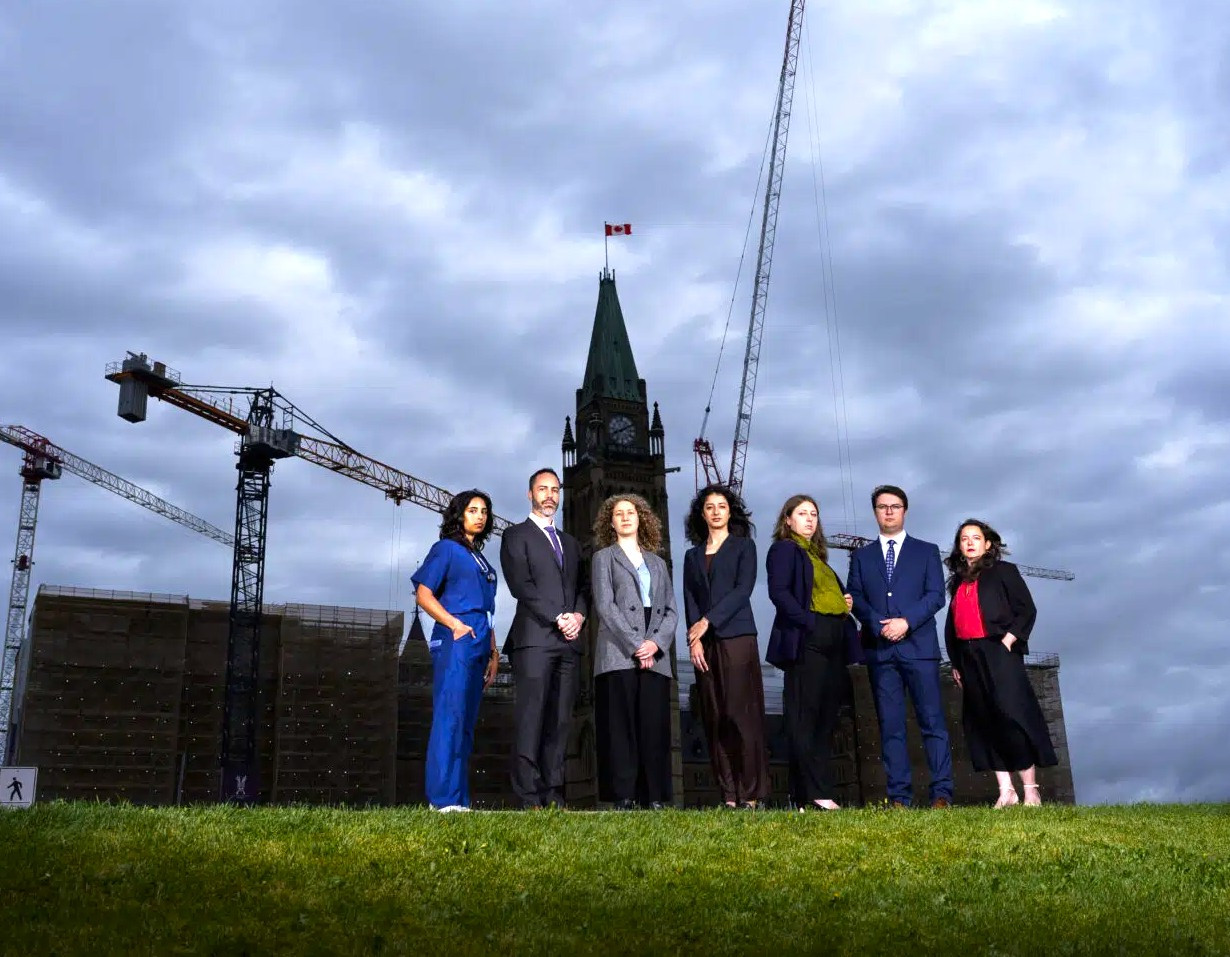
Federal Court rejects Carney government’s bid to block youth climate case as Liberals ignore emissions targets
In the middle of taking the federal government to court over climate change, Quebec activist Shirley Barnea was confronted by the implications of two recent reports: a planet pushing past the 1.5-degrees Celsius warming threshold and a Canada nearly 5 degrees hotter, where “irreversible” changes are altering our natural world.
“It was quite a shock,” she told The Pointer after reading a United Nations report and one by our own federal government, detailing recent scientific climate change measurements.
“I do take a lot of action in different ways but oftentimes it feels like we’re so small faced with a huge challenge.”
What shocked Barnea almost as much as the dire warnings themselves was Ottawa’s response: rather than treating the findings with the urgency they demand, the government appeared to be “trying to bury this information” while “barreling forward with deregulation of [the] environment”.
“The press release came out on a Thursday evening, and the [environment] minister was not available for comment on Friday,” she said.
“This is critical information that the public needs to be aware of.”
Canadians should be able to understand the consequences of their government’s choices, particularly as Prime Minister Mark Carney has acknowledged climate change is a “big threat” while arguing that other priorities currently take precedence.
“If you’re making that choice, at least make sure the population is informed as to what the consequences of that choice is as opposed to trying to pretend that this is not going to change everything for us,” she said.
Barnea draws on the information, as bleak as the latest research is, to continue her fight—in the courts and outside—bolstered by a recent ruling that allowed her own climate accountability case to move forward.
In June, she joined two other activists, Environmental Defence and the Canadian Association of Physicians for the Environment (CAPE), to file an application at the Federal Court for judicial review, suing Prime Minister Mark Carney for “dangerous” and allegedly illegal rollbacks that undo decades of progress. The 2021 Canadian Net-Zero Emissions Accountability Act (CNZEAA) is at the heart of the dispute; it set Canada’s emissions targets and requires the environment minister to create emissions-reduction plans to meet them.
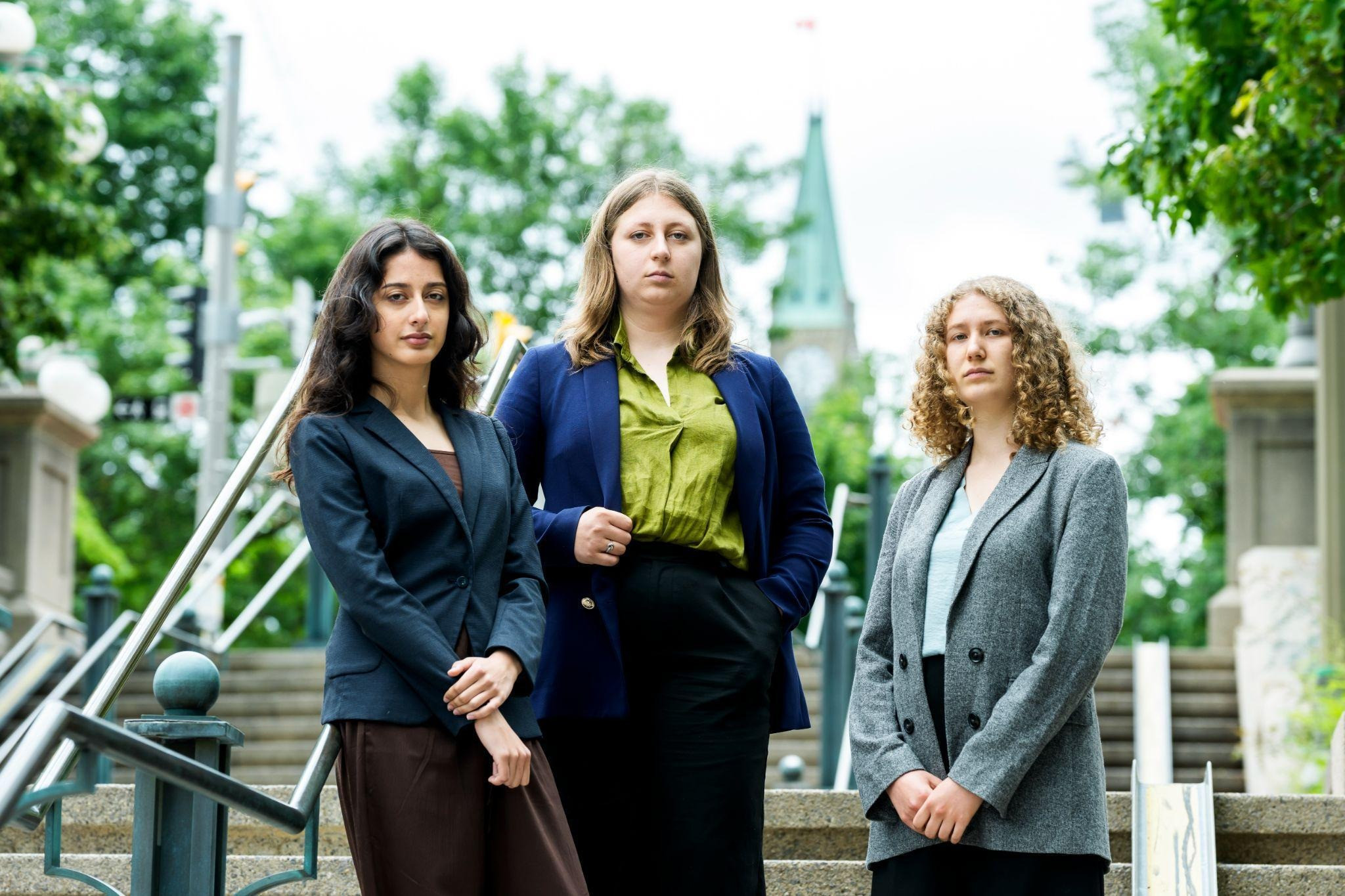
Sophia Mathur (left), Marie Maltais (center) and Shirley Barnea are taking the Mark Carney government to federal court over recent climate rollbacks and a failure to follow its legal mandate of meeting climate targets. (Justin Tang/Ecojustice)
On August 14, Ottawa filed a motion asking the court to strike the lawsuit before it proceeds to a full hearing following a summer of environmental rollbacks.
Federal lawyers argued that climate policy falls “beyond the Court’s institutional capacity to address” while focusing on section 11 of the CNZEAA, which says the minister “may” amend an emissions target or emissions reduction plan, provided the changes are consistent with the purpose of the legislation.
“Read in its ordinary and grammatical sense, the use of the word ‘may’ clearly does not impose any obligation to amend,” the motion submitted to the court emphasized.
Nearly two weeks later, the youth and advocacy groups pushed back against the federal government’s attempt to have the case dismissed by filing legal submissions opposing the motion and asking the Federal Court of Canada to order an expedited hearing on the merits.
“If the Carney government believes its climate plan is credible, it should be willing to defend it in court,” another applicant and Greater Sudbury resident Sophia Mathur said.
Ecojustice lawyer Fraser Thomson explained the minister’s “public legal duties” under sections 9(1) and 10(1)(b) of the CNZEAA are mandatory, meaning the government must maintain an emissions reduction plan “for achieving” the 2030 target and one that describes the key measures it intends to take to achieve it.
Therefore, Ottawa’s focus on section 11 mischaracterizes the case because that provision is not the source of the underlying legal duties.
Thomson pointed to the federal government’s own reporting as evidence that the existing plan can no longer achieve the emissions target: even with additional measures, the reduction was projected at only 28 percent — well short of the 40 to 45 percent target. A House of Commons Standing Committee also stressed Canada was “not on track to meet its greenhouse gas reduction targets and has no plan to meet them”.
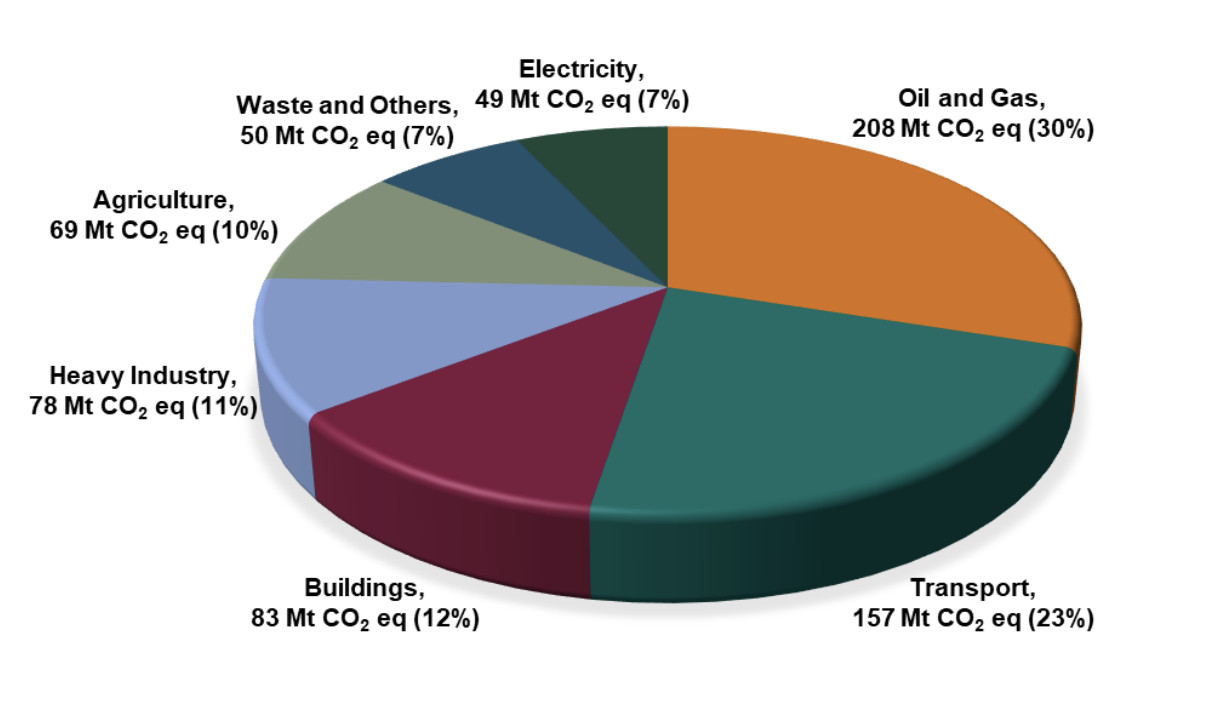
Ottawa’s 2025 Progress Report on the 2030 Emissions Reduction Plan clearly demonstrates that the oil and gas industry accounts for the highest emissions in the country, sitting at 30 percent. (Government of Canada)
The admissions mean the existing 2030 Emissions Reduction Plan has effectively become “obsolete”, blocking “any ability to transparently understand the government’s climate plans or to hold the government to account”.
“They (the federal government) were saying that there was no public duty and no accountability embedded in the Canada Net-Zero Emissions Accountability Act,” Thomson said.
However, he challenged that position by pointing out that the law was specifically designed to prevent governments from setting climate targets without credible plans to meet them following the Stephen Harper government’s dismantling of environmental policies including pulling Canada out of the Kyoto Protocol in December 2011.
Former environment minister Peter Kent stated that meeting Canada's targets under the treaty would force the country to face financial penalties estimated at roughly $14 billion for non-compliance.
“To meet the targets under Kyoto for 2012 would be the equivalent of either removing every car, truck, ATV, tractor, ambulance, police car and vehicle of every kind from Canadian roads or closing down the entire farming and agriculture sector and cutting heat to every home, office, hospital, factory and building in Canada,” Kent said at the time.
He critiqued the previous Liberal government for signing onto Kyoto in 1997 without intending to meet its targets.
Thomson emphasized the CNZEAA was intended to prevent future governments from repeating that pattern by legally binding Canada to achieve net-zero greenhouse gas (GHG) emissions by 2050.
Their legal case is challenging the same problem that’s resurfacing now with federal documents projecting Canada could fall as much as 177 million tonnes short of its 2030 emissions target.
On September 11, the Canadian Climate Institute’s analysis of Canada’s current emissions trajectory warned that the country is more than 20 years behind reaching its 2030 emissions target, “let alone achieve net zero emissions” by 2050 under current policies.
“By failing to plan, this government is really planning to fail,” Thomson told The Pointer.
Using the writ of mandamus (a remedy that judges have available to them to order a government actor to take action when they have a public duty, and that actor is failing to fulfill that public duty), Thomson argued it is appropriate for judges to “order the [environment] minister to set a 2030 target that complies with the law, and specifically that sets out how the government can achieve the 2030 target”.
On September 18, Federal Court Justice Patrick Gleeson “dismissed” the Carney government’s motion to strike the application, finding the applicants’ case was not so clearly incapable of succeeding that it should be struck before a full record could be developed.
“Used in its ordinary and grammatical sense”, “may” signals a “permissive or discretionary authority” but the government’s argument that the meaning of the provision could be “solely” settled by pointing to the word was rejected by the court.
The two sides had advanced competing interpretations of section 11 and its relationship with sections 9(1) and 10(1)(b), relying on parliamentary intent and the broader factual and legislative context.
“These are not arguments identifying a fatal flaw in the Application or the delivery of a knock-out blow,” the judge wrote in the ruling.
“They are nuanced submissions that are properly considered with the benefit of a full record. Not just “some” legal analysis is required to identify a fatal flaw in the Application, a full interpretive analysis is required to allow the Court to correctly interpret the statutory provision at issue.”
The court noted that an application should only be struck in rare circumstances where there is a fatal flaw making it “so clearly improper as to be bereft of any possibility of success” — but the government had not met that threshold.
Ottawa’s argument that the applicants’ questions were beyond judicial review was also rejected.
In order to determine whether the dispute is justiciable, the judges require a thorough examination of whether the issues contain a sufficient legal component for a court to decide and whether Parliament intended the statutory duties imposed on the minister to be subject to “judicial scrutiny”.
“This is not a win…it’s just a step along the way, but I think it is an important step,” Barnea said.
Crossing that hurdle got a renewed definition for her after she read Bill C-39, titled An Act respecting certain measures to strengthen the economy, that the Carney government introduced on September 21 to fast-track major infrastructure projects by introducing a one-year federal review timeline and reforming federal labour rules.
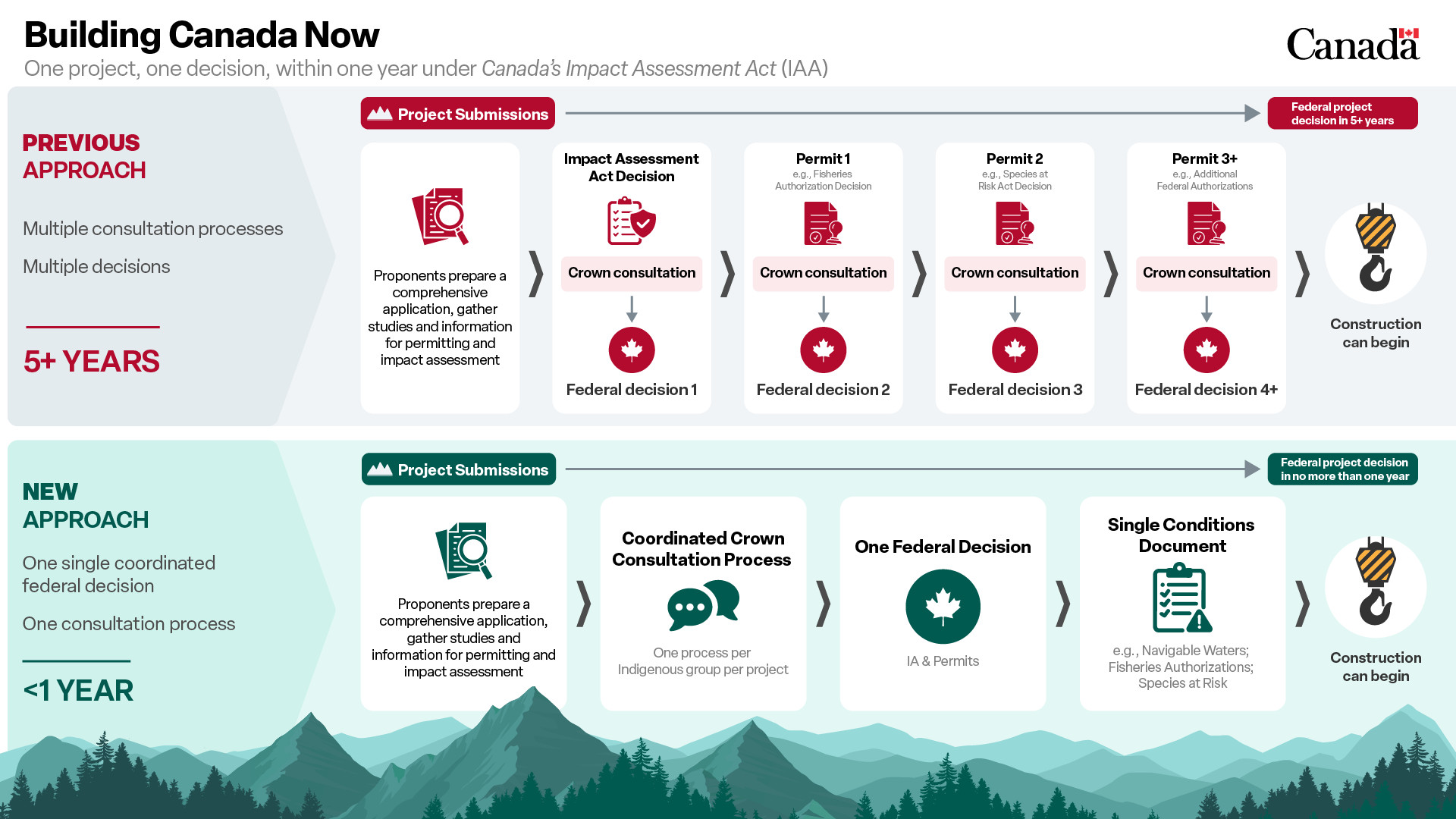
On September 18, Bill C-39 was introduced by Ottawa with the intention to accelerate major project approvals by introducing a one-year timeline for federal reviews, consolidating permits and assessments into a single decision and giving agencies such as the Canada Energy Regulator and Canadian Nuclear Safety Commission greater responsibility for certain projects. The changes claim to reduce duplication and provide greater certainty for investors while maintaining environmental standards and Indigenous consultation. (Government of Canada)
By shortening environmental review timelines, giving ministers greater decision-making powers and shifting assessments of pipelines and nuclear projects away from the federal environmental assessment agency, she felt the government was continuing to “undermine the environment again and again”.
“This lawsuit that we’re bringing is becoming more relevant as Carney continues to pass more laws. It’s clear that the government is not listening at all,” she added.
“When social movements fail, when politics fails, the legal system is supposed to be our last sort of fortification against things going really wrong.
“I would like to be able to just ask more nicely and as a movement, bring proposals that will be heard and maybe participate in public consultations that will be heard, but this is clearly not the approach that Carney is taking.”
The federal government now has 45 days starting September 18 to serve any evidence it wishes to file before the schedule toward a full hearing can move forward.
“The time for delay is over," Thomson emphasized, "and this government must now answer for its climate record in open court.”
Email: [email protected]
At a time when vital public information is needed by everyone, The Pointer has taken down our paywall on all stories to ensure every resident of Brampton, Mississauga and Niagara has access to the facts. For those who are able, we encourage you to consider a subscription. This will help us report on important public interest issues the community needs to know about now more than ever. You can register for a 30-day free trial HERE. Thereafter, The Pointer will charge $10 a month and you can cancel any time right on the website. Thank you.
Submit a correction about this story

