
‘Not a reason to give up’: Canada warms twice as fast as world to breach 1.5-degree limit
“We really did have everything, didn’t we?”
In the political satire Don’t Look Up, Dr. Randall Mindy, portrayed by Leonardo DiCaprio, reflects on the bountiful life humanity was gifted—existence, connection and nature—as the world ignores his warnings about a comet hurtling toward Earth after a tech billionaire convinces the government to abandon a safe mission to destroy it and instead exploit the comet for trillions of dollars in rare minerals.
The film’s allegory feels uncomfortably familiar as scientists warn of the escalating climate crisis, only to see their warnings compete with politics, profits and public indifference and exhaustion for decades now.
A peek into the irony we live in can be exemplified by the actor who portrayed the astronomer: DiCaprio, known as a prominent environmental activist, takes private jets and yachts while being spotted vacationing with Jeff Bezos, owner of e-commerce firm Amazon that produced 68.82 million metric tons of carbon dioxide equivalent in 2023 alone—higher than the individual annual emissions of countries like Switzerland, Hong Kong and Denmark.
It may be comfortable to keep looking away instead of looking up — or around — but for how long?
For years, climate scientists have treated 1.5 degrees Celsius (an ambitious lower limit established under the 2015 Paris Agreement) as a critical line the world must avoid crossing.
But “decades of insufficient action” have forced experts to dive into what happens after that line is crossed.
On September 2, a United Nations Environment Programme (UNEP) report titled ‘Limiting Overshoot’ warned “global temperature rise is set to cross 1.5 degrees Celsius, likely within the next few years, pushing climate risks and impacts to increasingly dangerous heights”.
Global emissions reductions have not happened at the pace needed due to existing and planned fossil fuel infrastructure; even an optimistic scenario based on full implementation of current government pledges and additional net-zero commitments puts expected peak warming at about 1.8 degrees Celsius.
“But this is not a reason to give up,” the report’s author Joeri Rogelj told The Pointer.
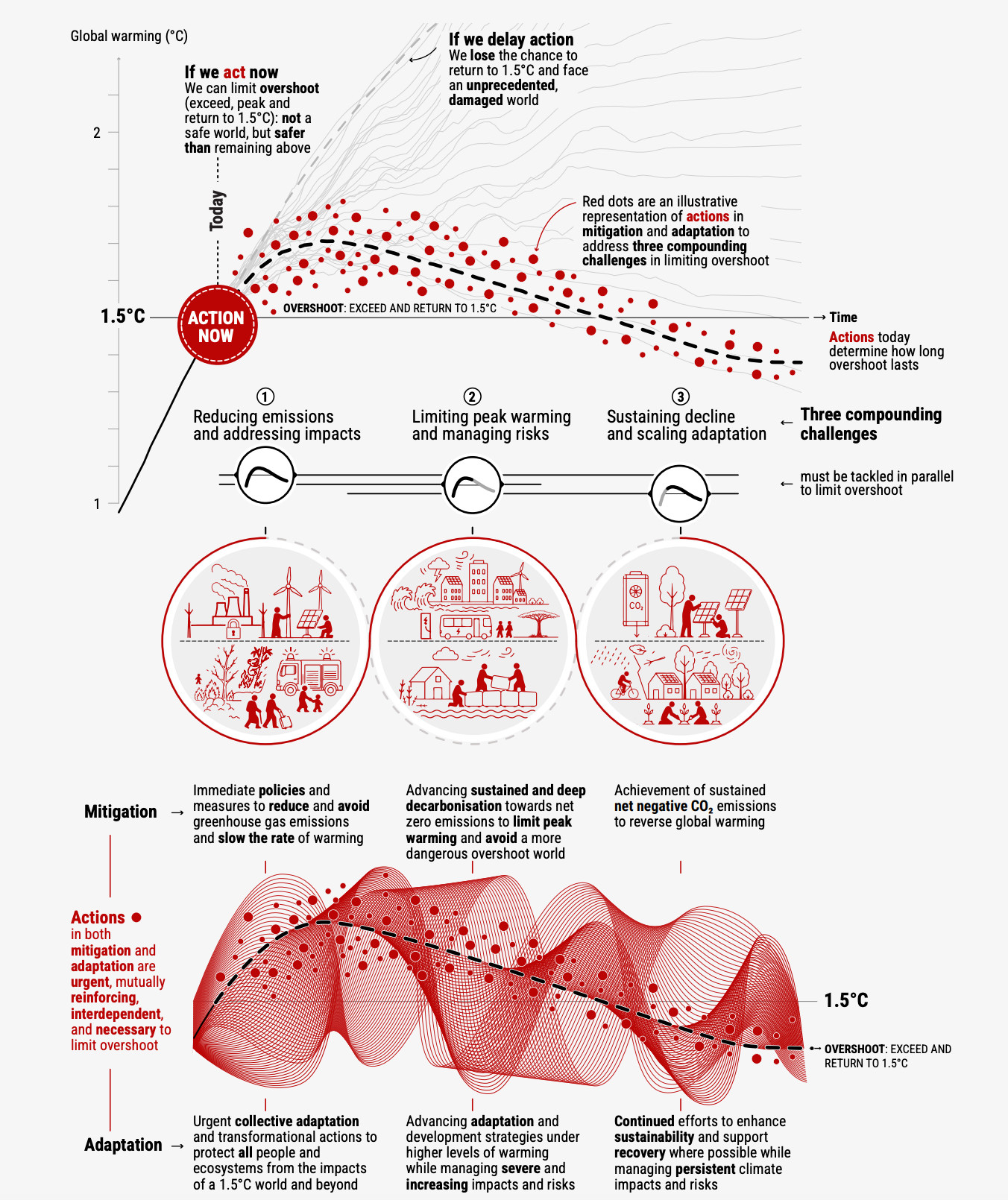
The UNEP Limiting Overshoot Spotlight Report confirms burning fossil fuels has driven global emissions so high that temporarily breaching the 1.5 degrees Celsius warming limit is now unavoidable, requiring an urgent shift to an overshoot strategy. (UNEP)
The next day, Ottawa’s scientists reported that changes to Canada’s climate are now “irreversible” with the country being on track for an average temperature rise of 5 degrees Celsius (C) by 2100 under “current policies”.
David Suzuki Foundation’s Manager of National Policy, Lisa Gue, broke down after reading the two reports as she thought of what was ahead for her “two young children”.
“Because of our failure to reduce emissions over the past few decades, the 1.5 threshold will be crossed before the end of this decade under virtually any scenario, even if countries meet their current targets,” she told The Pointer.
“This isn’t an abstract future scenario that we can ignore if we put our heads in the sand. These are impacts that we will feel, and that our children growing up today will unavoidably have to face.”
On September 11, the Canadian Climate Institute’s latest analysis highlighted that Canada is “more than 20 years behind reaching its 2030 emissions target”.
“If the country remains on its current course, by 2050 Canada’s emissions would be 460 megatonnes higher than the legislated target of net zero,” the report warned.
For Simon Fraser University’s Professor of Climate Science, Kirsten Zickfeld, who has been sounding the alarm for years, the findings of the two reports were not surprising.
In 2018, an Intergovernmental Panel on Climate Change (IPCC) Special Report warned that global warming is likely to reach 1.5 C between 2030 and 2052 if current trends continue, and human activities already caused about 1 C of warming above pre-industrial levels.
Zickfeld was one of the authors of the report.
“One of our key messages was every 10th of a degree matters. So, the more we keep warming, the worse the impacts will become,” she said.
“The risk of ecosystem collapse and tipping points will increase but what is very important to understand is that this should not be an excuse to reduce ambition.”
As Rogelj explained, the world needs to embark on an “overshoot, peak, and decline” pathway where temperatures will temporarily rise above 1.5 C, reach a higher peak, then decline before potentially stabilizing at or below the threshold.
“We need to change that,” he said before advancing fossil fuel infrastructure including the $35-billion West Coast oil pipeline, which would carry oil from Alberta to British Columbia, and the $28.5-billion Ksi Lisims LNG terminal project—projects that were also part of Canada Investment Summit’s pitchbook.
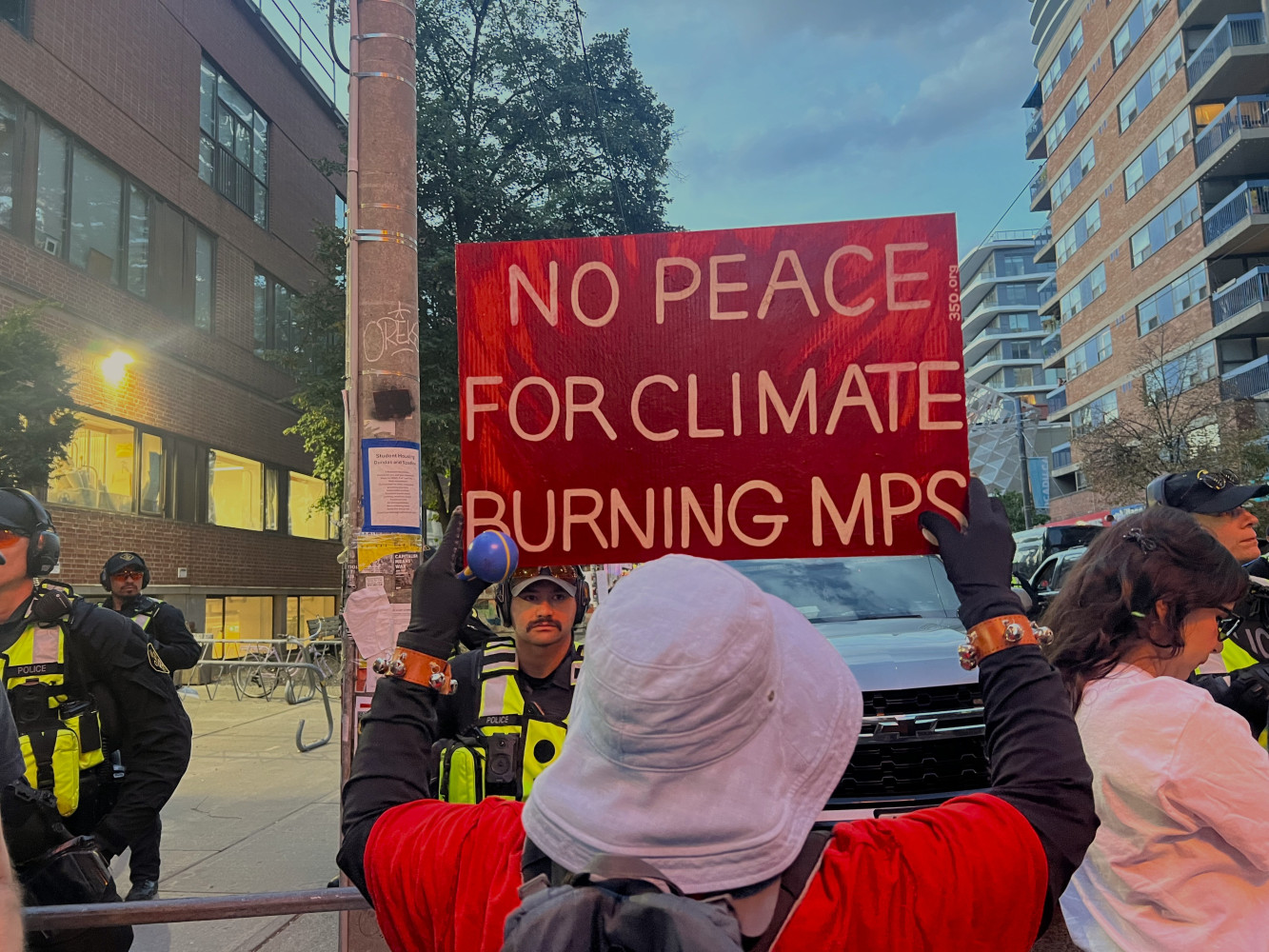
On September 14, as Carney opened the doors of the Art Gallery of Ontario to more than 100 of the world’s largest investors, pitching 167 projects in a bid to secure $1 trillion in investment over the next five years—outside, more than 2,000 protesters faced a sea of police presence from the Ontario Provincial Police, Toronto, Peel, Durham and York forces and rallied against projects they said would expand fossil-fuel infrastructure, artificial intelligence and military production.
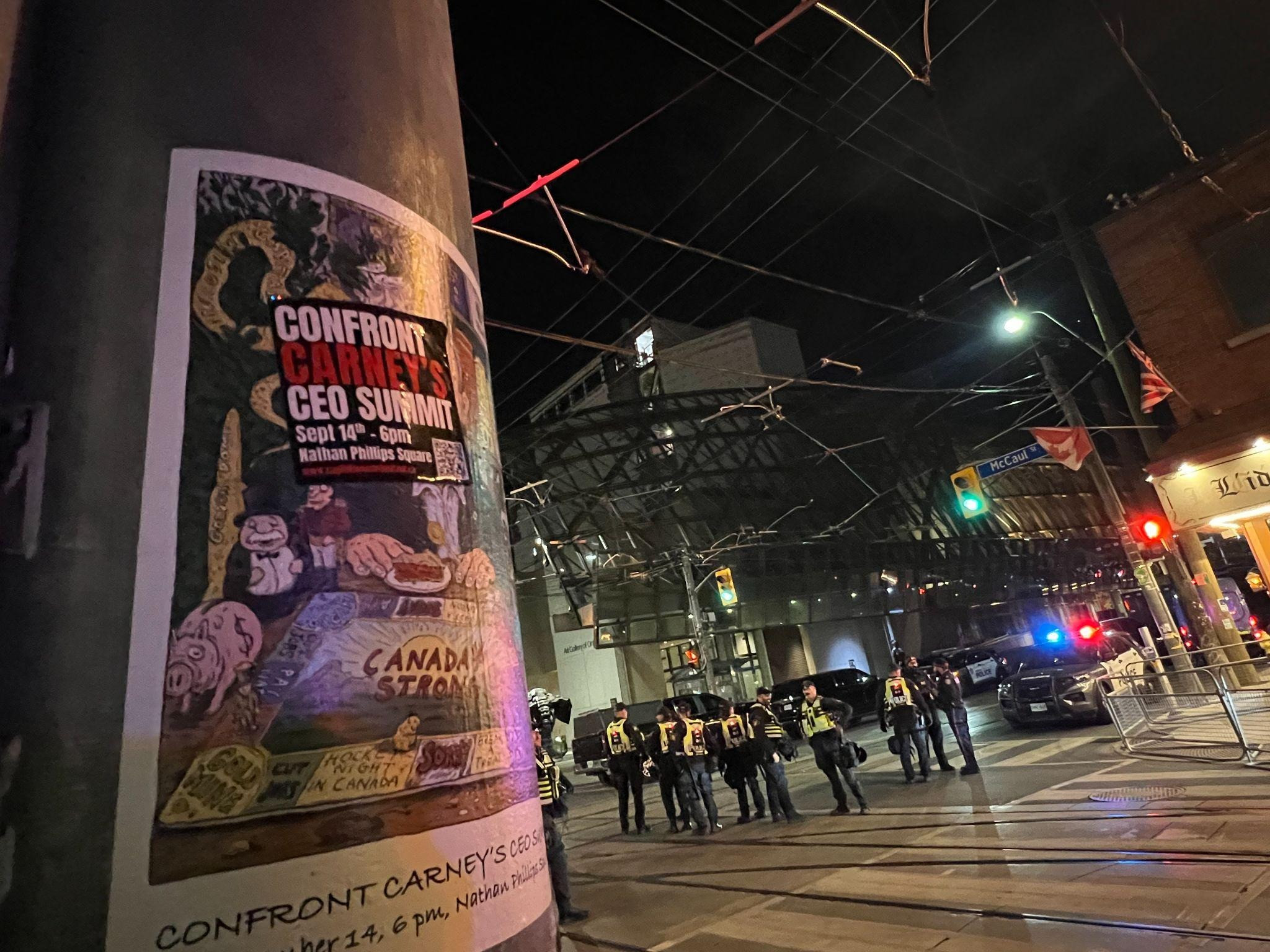
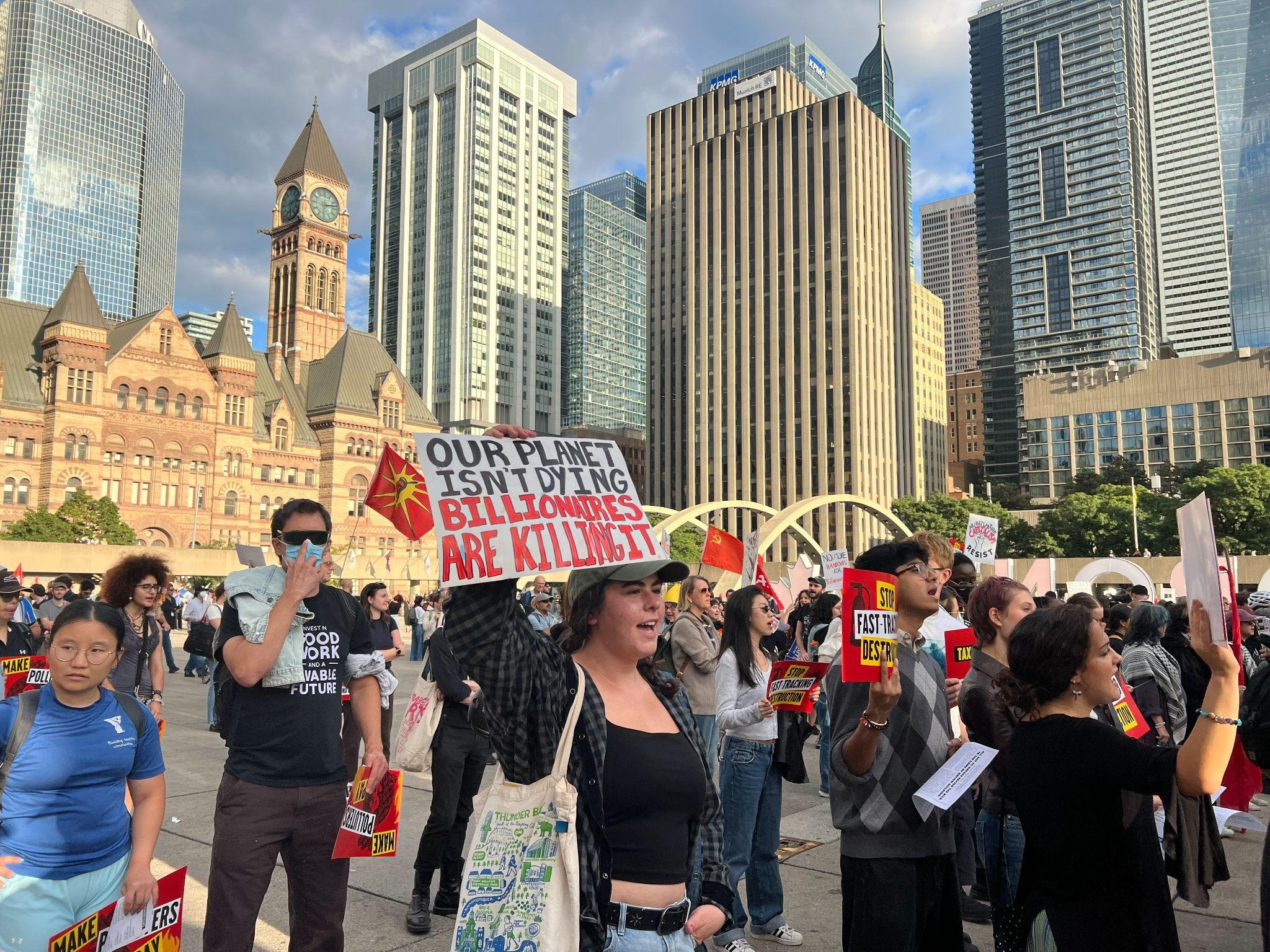
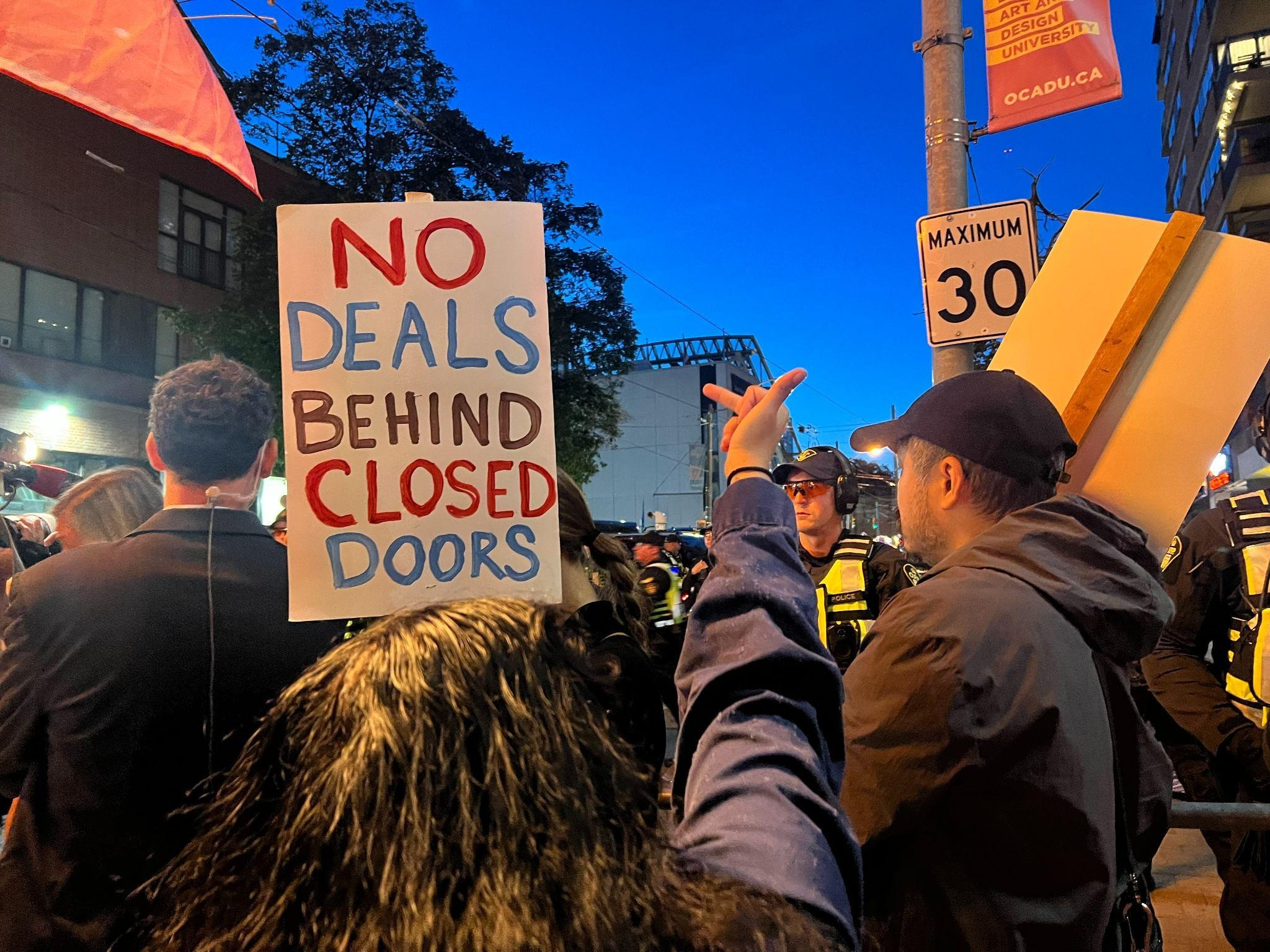
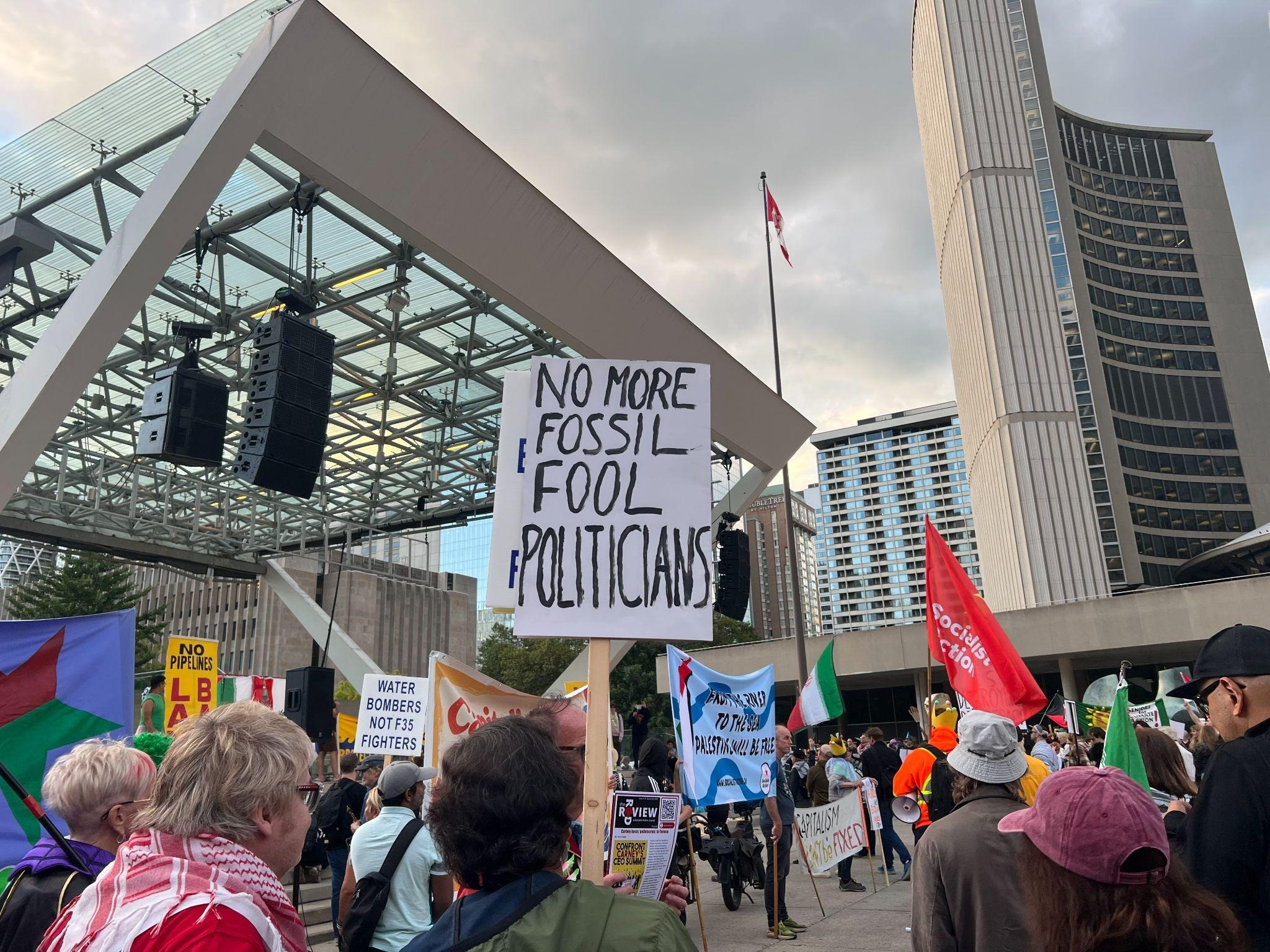
Thousands of protestors marched from Nathan Phillips Square to the Art Gallery of Ontario to express dissent for the Canada Investment Summit. (Anushka Yadav/The Pointer)
Wet’suwet’en Hereditary Chief Na’Moks remarked that he does not agree with the federal government’s argument for building more major projects to protect Canada from U.S. President Donald Trump’s policy. “Canada is getting very good at blackmailing the public,” Na’Moks said while addressing demonstrators.
“That’s their story. Their story is false, the same way that they think that these projects will go on without your support, without our support.”

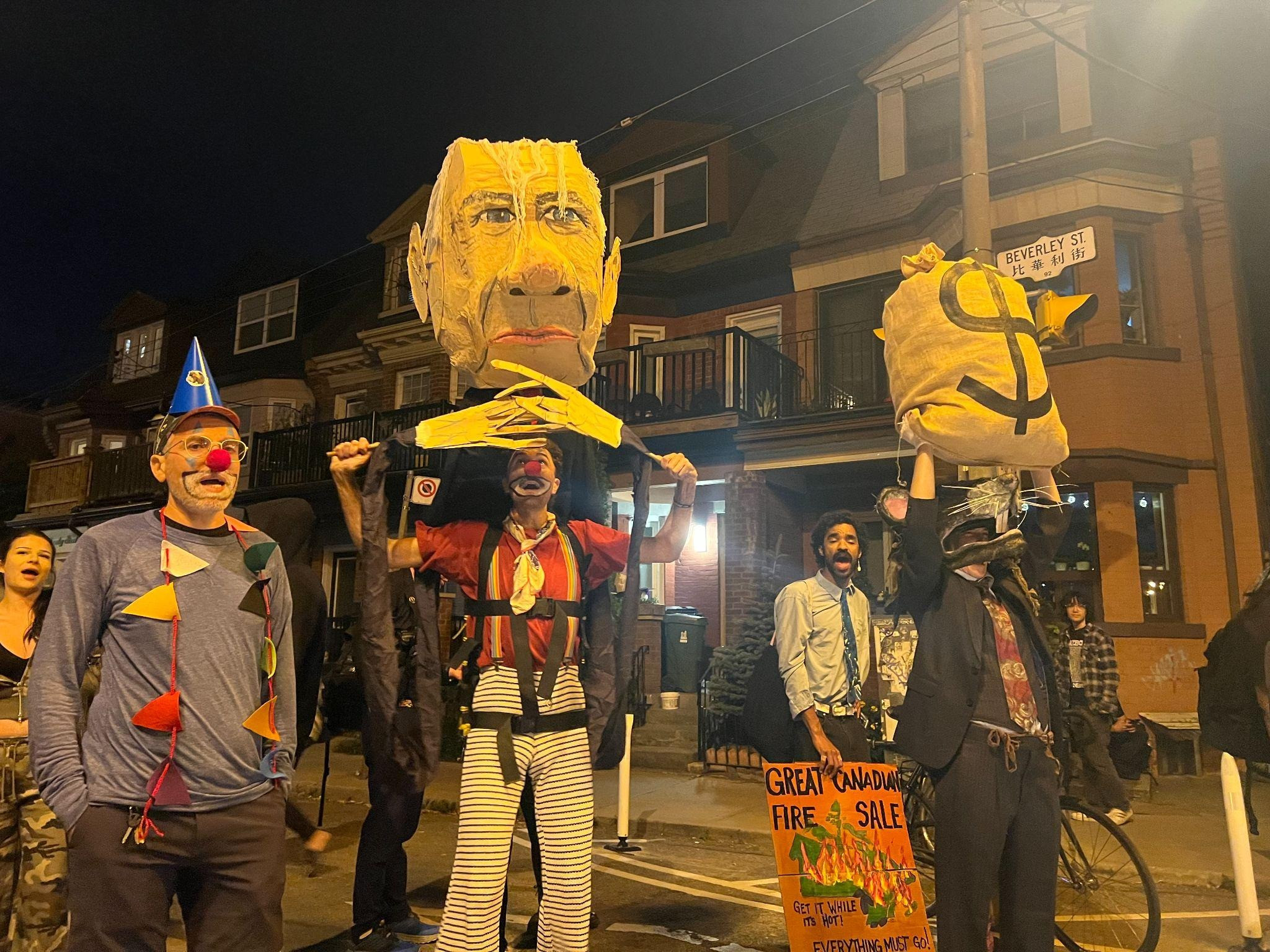
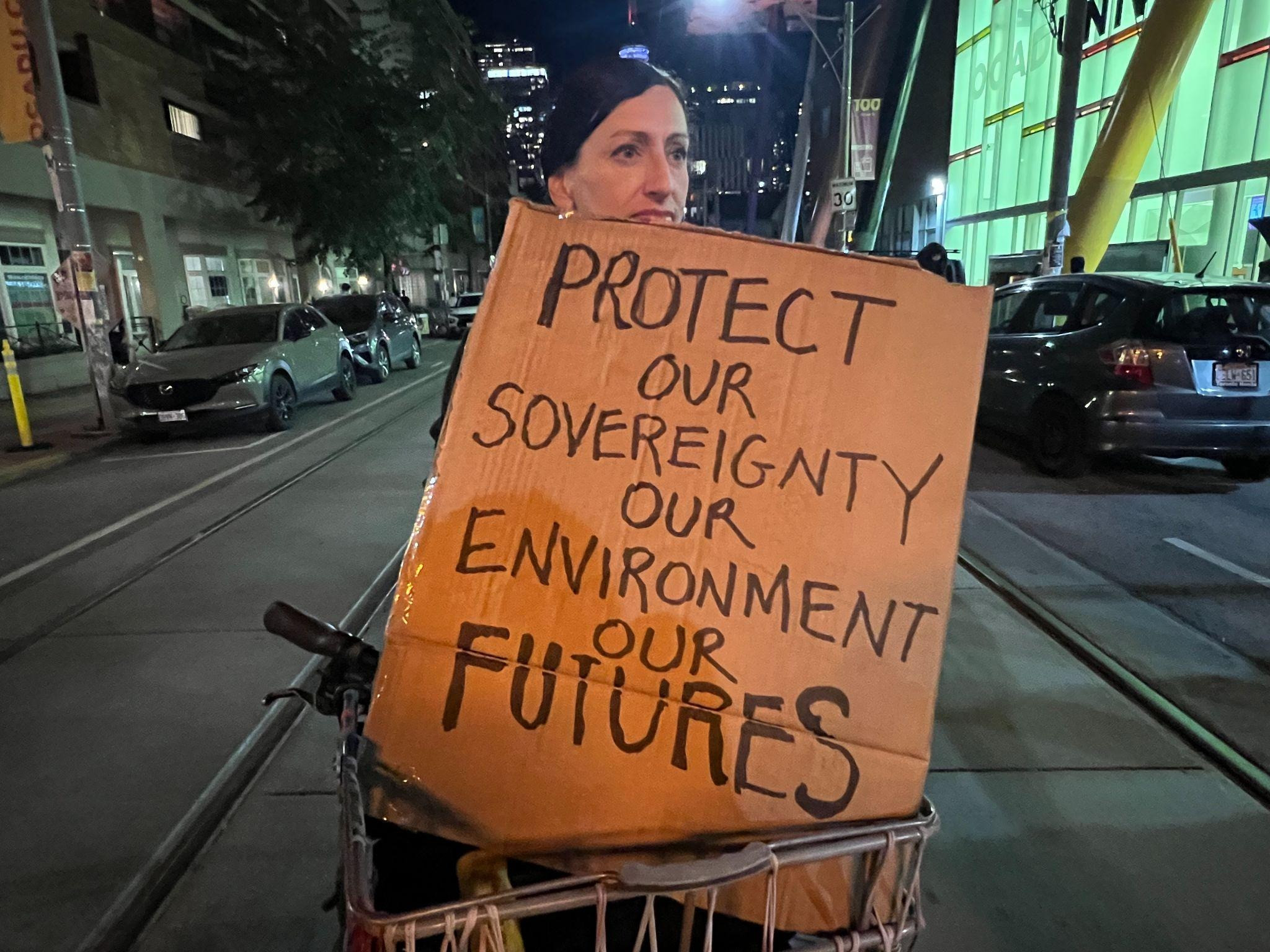
Wet’suwet’en Hereditary Chief Na’Moks standing at the starting line of the September 14 protest (in first photo). (Anushka Yadav/The Pointer)
While safeguarding a country from economic blows seems necessary in an increasingly uncertain geopolitical environment, the UNEP report warns temperatures exceeding 1.5 C “should not be interpreted as safe or acceptable”.
“The world we're in is already not safe,” Zickfeld said.
“But 1.5 is not a point of no return.”
Rogelj agreed that the possibility of overshoot makes action more urgent, not less.
“It's a reason for renewed focus on both reducing greenhouse gas emissions to slow down that warming first, and then at least at some point, stop it,” he explained.
“We also need renewed focus on making sure that the adaptation measures are in place that will protect vulnerable populations from the climate impacts that we know that will now become unavoidable.”
The timing of the latest international and national reports matters as they tell a climate story from opposite sides of the same door: if the UNEP report is the warning about the storm gathering outside, Ottawa’s report is a look inside the house.
“The truth is the situation facing Canada is even worse than what the UNEP report says,” Deborah McGregor, Canada Research Chair in Indigenous Environmental Justice at Osgoode Hall Law School, observed.
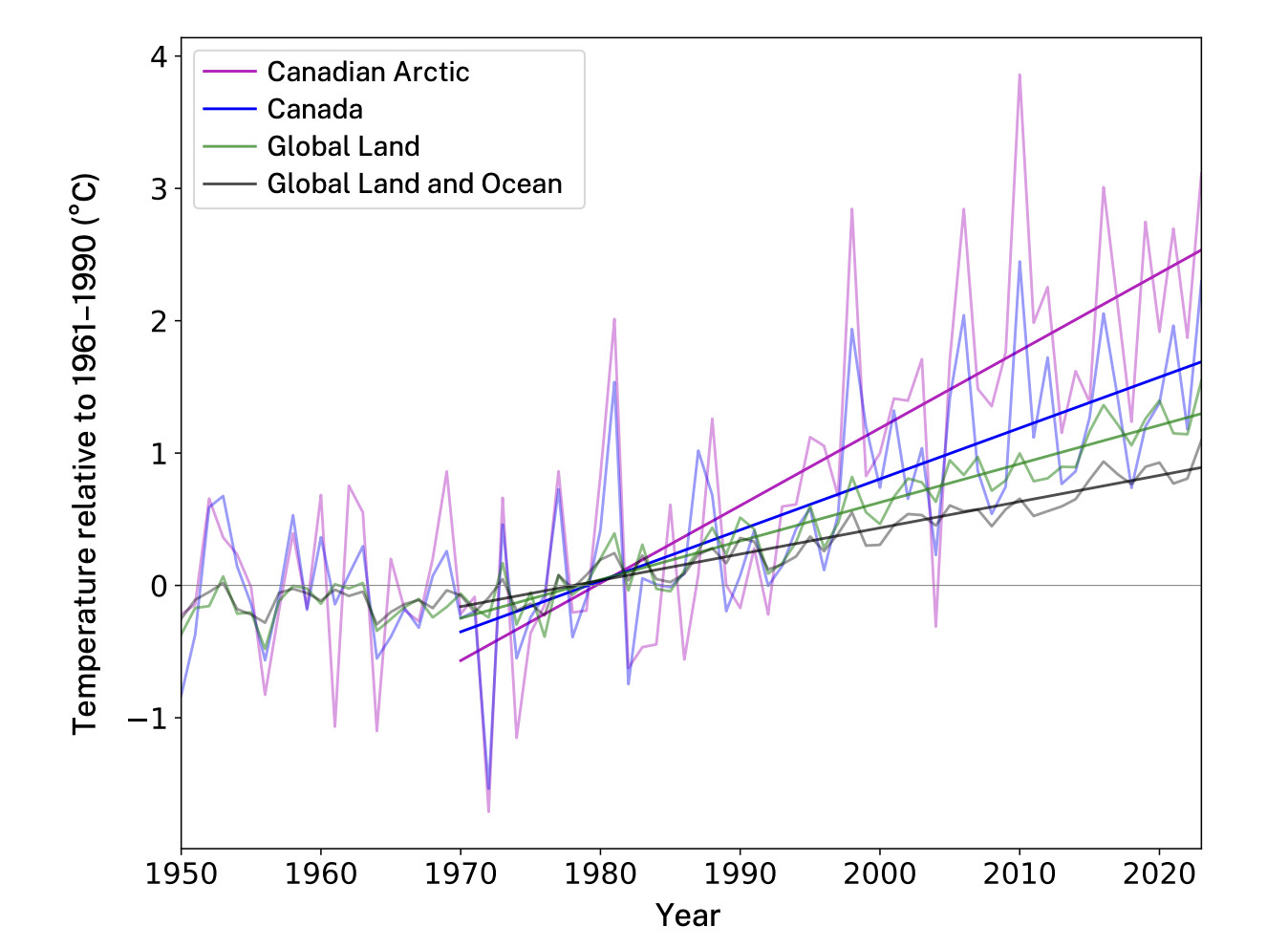
Canada has warmed by 2 degrees Celsius since 1948, while the North has warmed by 2.6 degrees Celsius. (Government of Canada)
Federal scientists say Canada has “warmed nearly twice as fast as the global average, and the Canadian Arctic has warmed three times as fast as the global average since 1970”.
As a result, it is already experiencing a climate significantly warmer and wetter than it was decades ago with changes being recorded across every part of the climate system. “The changes include more extreme heat, less extreme cold, longer growing seasons, longer fire seasons, earlier peak stream flow, shorter snow and ice cover seasons, thinning glaciers, thawing permafrost, warming oceans, and rising sea level.
“Human-caused warming is the only explanation for the collective changes observed.”
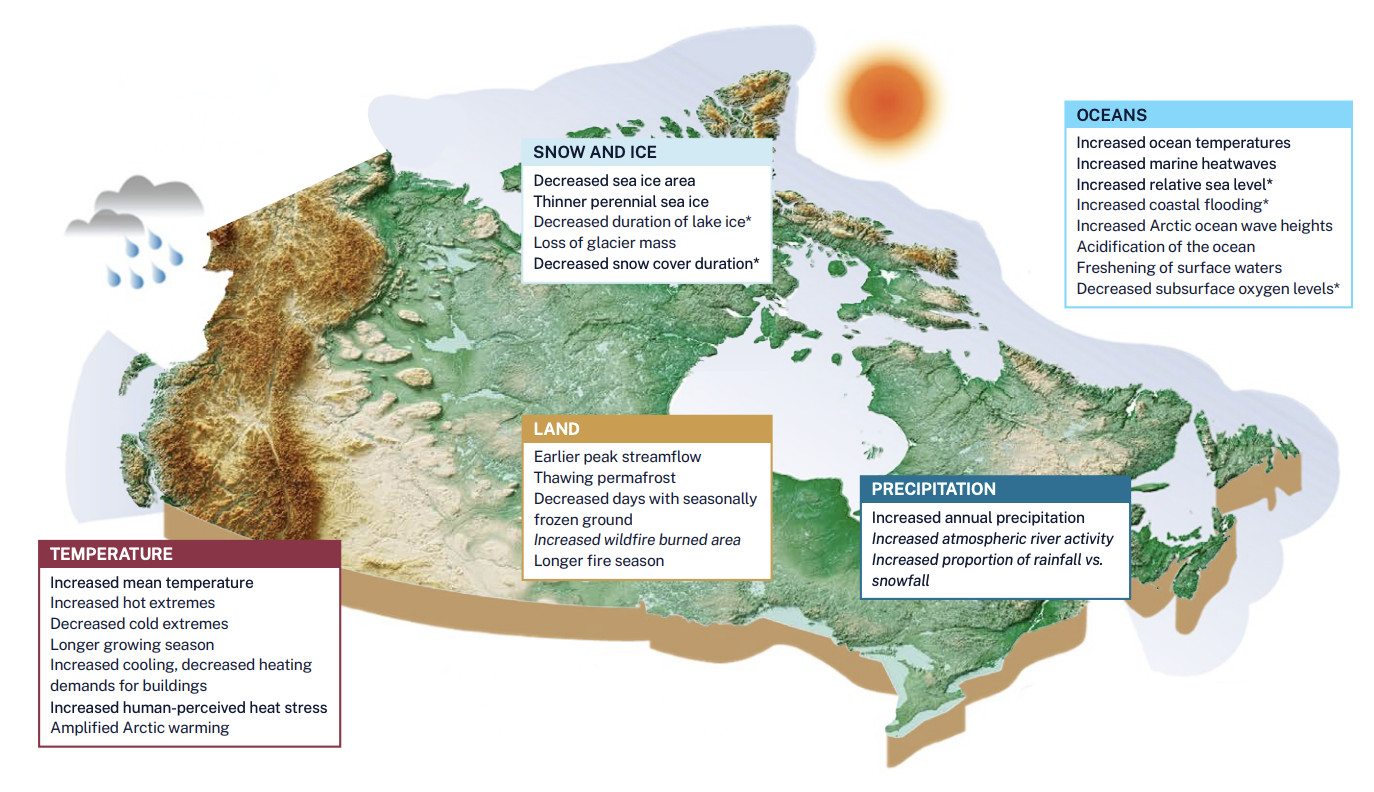
“Warming temperatures have driven wide-ranging, interconnected, and sustained changes across Canada,” a new federal report found.(Government of Canada)
McGregor noted that means Canada’s already in the “overshoot position” as it has already warmed by 2 C since 1948.
“Canadians need to prepare themselves for the fact that by the end of this century, most of the glaciers in western Canada will be gone,” ECCC modelling director Chris Derksen forewarned.
“That’s an important water supply; it flows from west to east across the country.”
On September 9, as Environment Minister Julie Dabrusin launched public engagement on Canada’s first National Water Security Strategy, acknowledging the growing pressures on freshwater from droughts, floods, pollution, aging infrastructure and a changing climate, The Pointer asked why a similar public announcement or consultation had not accompanied the federal climate report, particularly given its stark warning about Canada’s future water supply.
Dabrusin noted the climate report was fundamentally different from the water-security strategy because it was a scientific assessment rather than a public-engagement exercise.
“This was not a political exercise,” Dabrusin responded.
“The science of climate change is real. This is the work that shows that we take the work of scientists and experts seriously in how we address it and in recognizing what the problems are.”
But then how are the latest scientific findings informing the Carney government’s rationale for expanding its oil-export capacity?
Dabrusin pointed to the federal government’s latest investments in clean electricity and infrastructure including the Churchill Falls project, the largest clean-energy project in North American history, that would generate enough electricity to heat, cool and light homes in Toronto, Montreal and Vancouver combined.
“We are in a very important moment for our country. When we talk about building Canada, we also talk about building it well,” she said.
She also pointed to the Northwest Corridor project in northern B.C. and federal-provincial work toward a clean-electricity corridor as she argued that expanding clean power is imperative to supporting electrification and reducing emissions.
“We are doing the heavy work,” Dabrusin added.
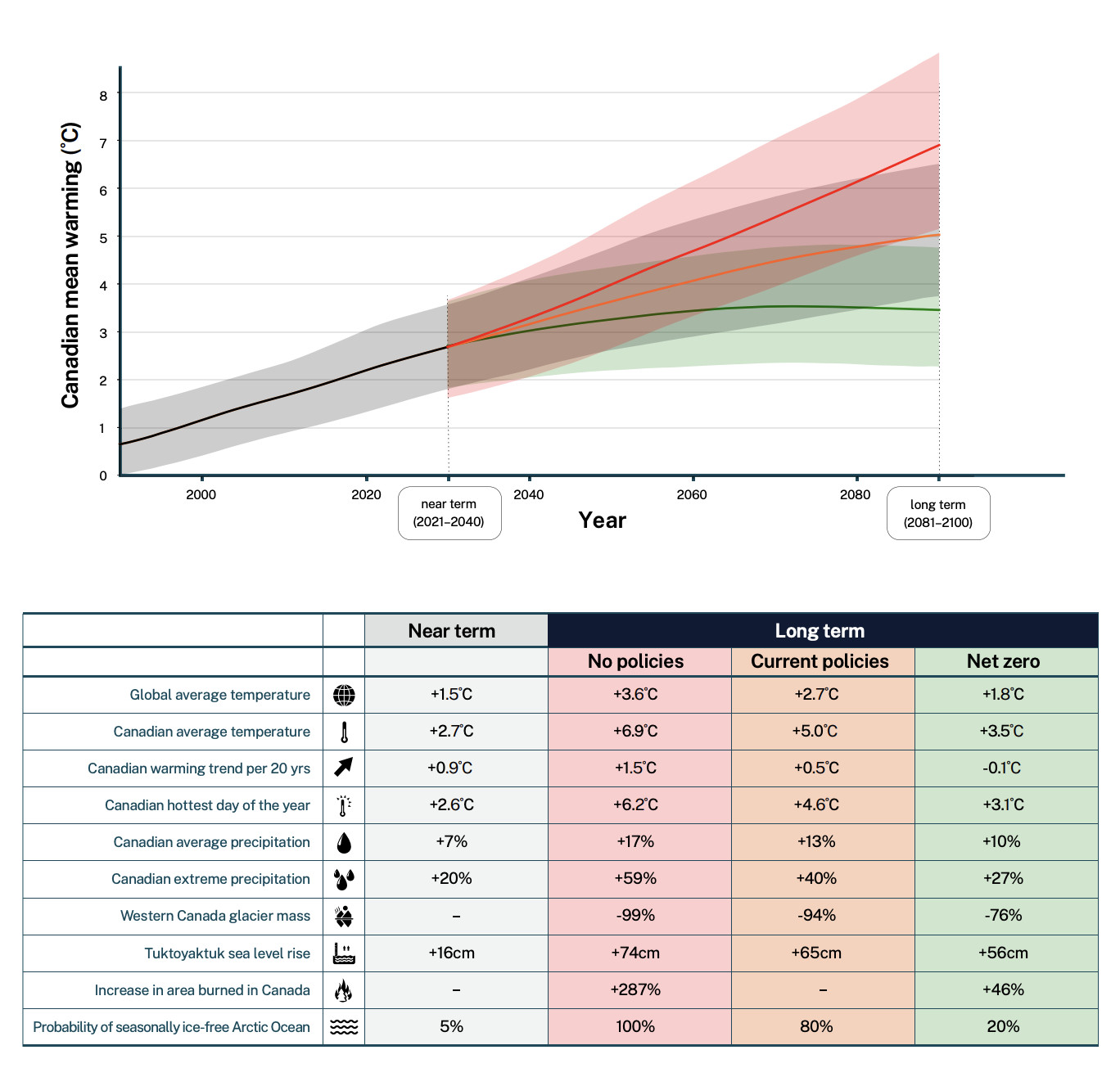
“Future climate-related changes in Canada would be much larger under current or weaker policies than under a net-zero pathway,” a new federal report found. (Government of Canada)
How long will that “heavy work” take to bring national emissions down remains to be seen.
But for McGregor, one thing is certain: the impacts of climate change, as expected, will not and are not being felt evenly: the North including Nunavut, the Northwest Territories and Yukon, where Indigenous communities are numerous and the pace of warming is greater than anywhere else nationally.
“They’re the ones who are going to be experiencing the most impact,” she added.
Despite contributing the least to Canada’s GHG emissions, Indigenous communities are already paying the price of climate change-induced weather disasters: this summer, 83 First Nations on reserve and eligible under the Emergency Management Assistance Program have been impacted by wildland fires, according to Indigenous Services Canada.
The same imbalance is playing out on the other side of the planet.
Nepal contributes only about 0.1 percent of global GHG emissions but the residents and those visiting the surreal valleys of the Himalayan wilderness suffered the consequences of a warming world, as a catastrophic rock-and-ice avalanche on August 26 triggered a debris flood that tore through the mountain landscape—taking the lives of over 1,400 people with more than 6,100 still missing.
“In my memory, I've not heard any reports of landslides and flash floods of this scale that really would destroy entire valleys,” Rogelj said.
“It was a shock to me as a human. At the same time, from a purely scientific point of view, there is no surprise.”
It is not only the ice at the tops of mountains that is melting but also ice embedded in the soil beneath them, weakening the ground’s structural stability. Lakes can also form beneath glaciers, gradually fill and then suddenly release large volumes of water.
As frozen ground thaws and climatic conditions change, such events are scientifically “explainable” and increasingly foreseeable.
The 2019 Canada’s Changing Climate Report had warned that warming is “effectively irreversible” for centuries with glaciers, permafrost and global sea levels continuing to change long after temperatures stabilize.
The timing of snowmelt, spring freshet and groundwater recharge has shifted earlier and is expected to continue shifting.
Snow cover duration has shortened across Canada over the past four decades. In northern Canada, southern Ontario and parts of eastern Canada, the reduction has been between one and four weeks.
Sea ice in Canadian waters has also deteriorated over the past four to five decades. In regions with seasonal sea ice, the number of ice-free days is projected to increase by approximately one month for every additional degree of global warming.
Landfast ice provides habitat for wildlife and is important for transportation, hunting and the culture of northern communities. The movement of multi-year ice into parts of the Northwest Passage can create hazardous shipping conditions even as overall sea ice declines.
Even if global warming is limited to 2 C, more than 55 percent of western Canada’s glacier ice is projected to disappear by 2100.
The country's water cycle is rapidly altering through increased precipitation, changes in the balance between rainfall and snowfall, warm-season evaporation and greater potential for flash flooding and summer drought—a reality that many Ontarians faced this year.
But the problem isn’t too much water; in other parts of the country, it is too little.
At the end of August, 65 percent of Canada was classified as Abnormally Dry or in Moderate to Severe Drought, impacting 39 percent of the country's agricultural landscape.
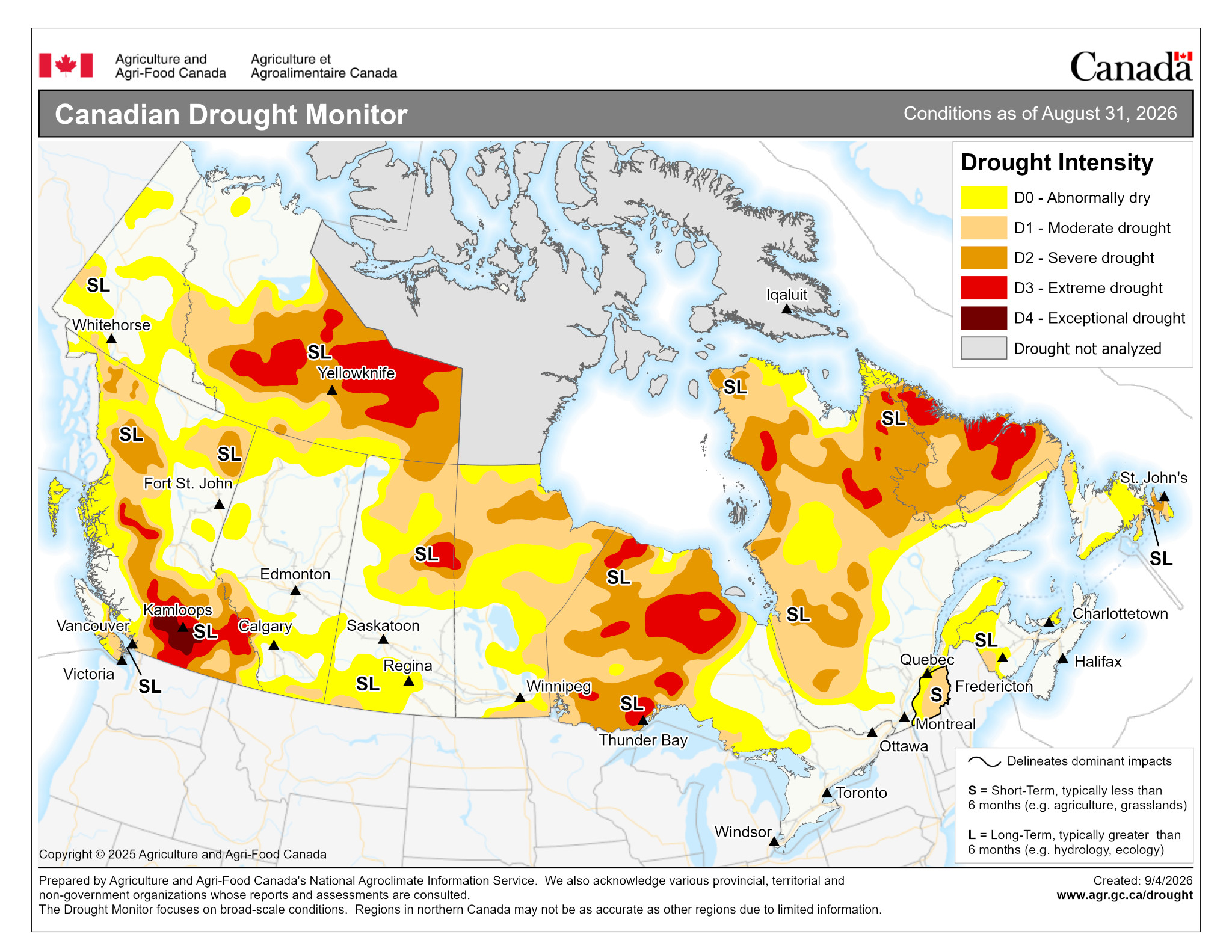
Drought conditions affected 39 percent of Canada's agricultural landscape by August this year, driven by hot, dry weather in regions like northwestern Ontario, northwestern Quebec, and parts of the northern Prairies. (Agriculture and Agri-Food Canada)
Summer droughts in central and southern Canada are projected to become longer, more frequent and more intense as warming increases.
“Even if we stabilize global mean temperature, many other impacts actually will continue to worsen,” Zickfeld said.
As a result, mitigation or cutting emissions now and adapting later is not enough—the two have to “move together”.
Weak mitigation pushes climate impacts to the brink, leading governments to divert resources toward emergency response and reconstruction, which can then undermine the long-term investments needed for both adaptation and emissions reductions.
It reinforces a damaging cycle: more warming produces more disasters; disasters consume more resources; fewer resources remain for long-term climate planning; and vulnerability grows.
“Mitigation is avoiding the unmanageable, and the role of adaptation is to manage the unavoidable,” Rogelj explained.
The combination will play a key role in the “overshoot, peak, and decline” pathway, which in itself will present its unique challenges.
The initial period would require slowing warming by cutting GHG emissions including methane and other short-lived climate pollutants while protecting people and ecosystems from impacts already occurring.
“For Canada, that means we need to ramp up our ambition and put policies in place that allow us to reach net-zero emissions by mid-century, which is actually a legislated climate target in Canada, so instead of giving up, we need to double down,” Zickfeld said.
At the second stage —peak—, the challenge becomes sustaining deep decarbonization and reaching at least net-zero emissions while dealing with increasingly severe climate impacts.
During the decline, the world would need sustained net-negative carbon emissions, meaning human-caused removals of carbon dioxide would have to exceed human-caused carbon emissions while continuing adaptation and resilience efforts.
“If we want to reach net zero by mid-century, if that remains the goal, there is no room for fossil fuel infrastructure that locks in greenhouse gas emissions for decades into the future,” she added.
This is also where carbon dioxide removal becomes an “essential” part of the discussion.
“But removal can really only complement deep emission cuts and not substitute for them,” Rogelj emphasized.
Zickfeld agrees.
Much of the removal the world is counting on would depend on natural systems such as forests, soils and restored ecosystems to draw carbon dioxide from the atmosphere.
But the more warming the world allows, the harder it becomes to rely on the same ecosystems needed to extract carbon back out of the atmosphere.
“Carbon removal that is based on these natural solutions only works if we limit warming to close to 1.5 degrees,” she said.
“What we do now decides what the climate risks of the future will look like. We still have agency.”
When governments and societies direct investment and innovation toward mitigation and adaptation, solutions emerge.
Renewables make up one-third of global electricity generation, according to the International Energy Agency (IEA). In 2026, they are projected to supply 36 percent of the world’s electricity, overtaking coal as the world’s top power source.
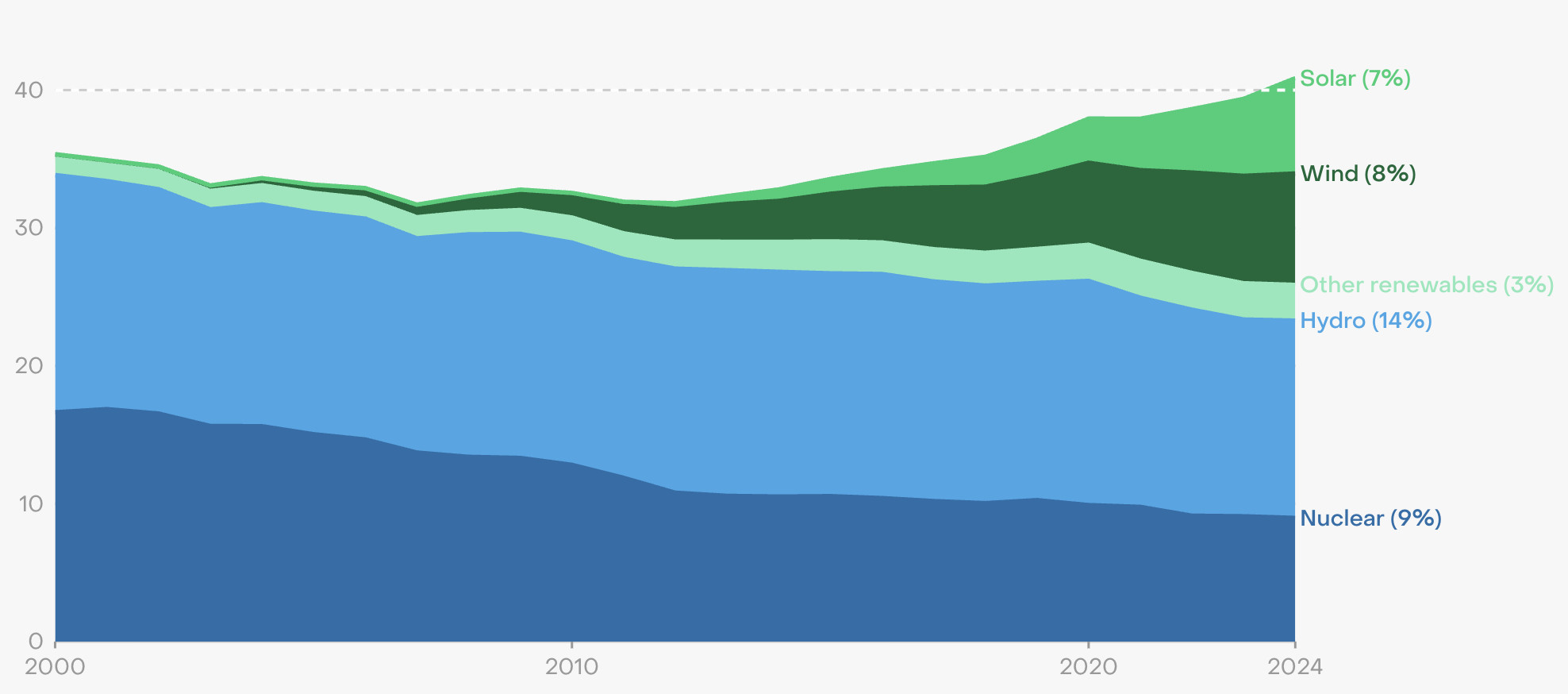
Solar and wind boom pushed the world past 40 percent clean electricity in 2024 for the first time since the 1940s. (Ember)
Carney seems to be walking a tightrope between the world of fossil fuels and clean energy to maintain sovereignty and kickstart a “new world order” where middle powers are solidifying their economic, technological and defence resilience instead of solely relying on “hegemons”.
“If you need clean, affordable power—and who doesn’t? Canada is your answer,” Carney told investors during the Canada Investment Summit.
The Canadian Renewable Energy Association found that Canada had approximately 25 Gigawatts (GW) of wind energy, solar energy and energy storage installed capacity across the country by the end of 2025.
“The number one reason we're not going to meet our climate targets is because we are currently expanding oil and gas production, and not making nearly comparable investments in renewable energy while the world moves ahead,” Liz McDowell, Senior Campaigns Director at Stand.earth, told The Pointer.
“We do ourselves a disservice when we only compare ourselves to the U.S. which, by the way, is growing its renewable energy more than we are right now.”
Even south of the border, despite U.S. President Donald Trump’s recent environmental and anti-renewable rollbacks, the green energy transition is hard-wired into the American economy. In 2025, clean energy investments hit a record $378 billion, a 3.5 percent increase from the previous year, making it the world’s second-largest energy transition investor after China, which accounted for roughly 34 percent of global clean energy spending, according to a recent report by the Renewable Energy Institute.
In Canada, fossil fuels accounted for 76.3 percent of domestic energy consumption in 2024, down only slightly from 76.8 percent in 1995, a Fraser Institute report noted.
This year, the Carney administration attended 1,318 meetings with fossil fuel lobbyists during its first year in office, according to Environmental Defence.
For Rogelj, who has been working on UN climate reports for 15 years, the time for both delayed actions and inaction “comes with consequences” that are felt across the board.
“Climate impacts are also amplifiers of geopolitical tensions and socioeconomic challenges”, making climate action increasingly relevant to national security strategies as countries contend with a more unstable world.
And as warming increases, so does the difficulty of reversing it.
“But there is always an opportunity to avoid more harm,” he reiterated.
Can Canada meet its net-zero goal?
“Technologically? Yes. Because we have the solutions,” Zickfeld said.
“Can we do this politically? That is more challenging — there is a lack of political will and courage to step up to the fossil fuel industry.”
As a scientist, it is “hard” for her to “stay motivated, especially here in Canada” after a summer marked by severe climate impacts while fossil fuel infrastructure continues to expand.
“This cognitive dissonance from witnessing the consequences of sustained fossil fuel use and yet expanding fossil fuel use is hard to make sense of,” she said candidly.
What keeps her going, however, are the “signs of progress” in individual countries and municipalities, alongside her “innate curiosity” about the climate system and the questions that remain unanswered.
“There is never a point where action becomes irrelevant or becomes ineffective but it requires political will,” Rogelj added.
Email: [email protected]
At a time when vital public information is needed by everyone, The Pointer has taken down our paywall on all stories to ensure every resident of Brampton, Mississauga and Niagara has access to the facts. For those who are able, we encourage you to consider a subscription. This will help us report on important public interest issues the community needs to know about now more than ever. You can register for a 30-day free trial HERE. Thereafter, The Pointer will charge $10 a month and you can cancel any time right on the website. Thank you
Submit a correction about this story

