
‘We’re not alone’: From St. Catharines to Ottawa, Ontario floods prompt NDP calls for Ford to boost disaster relief
“With climate change, weather events are becoming more violent…Develop communities, get to know your street, your city block, your neighbours; in a crisis, the government won’t be able to get to you with help as quickly as you might like.”
A simple call from David Suzuki Foundation co-founder Tara Cullis in March became a hard-learned lesson for one St. Catharines neighbourhood, where three 100-year-storms in July and August forced residents to turn to one another.
On July 28, Hanson Drive resident Mike Enns woke to the sound of water gurgling through his basement around 3 a.m. in the middle of deep sleep. When he and his wife went downstairs, they found sewage rising through the pipes.
“We panicked,” Enns told The Pointer.
They looked outside. The street was flooded.
Within hours, Enns was searching for pumps “in a state of shock” while his wife was on hold with their insurance company for an hour and a half, eventually learning they were roughly 50th in line among thousands of people dealing with flooded homes.
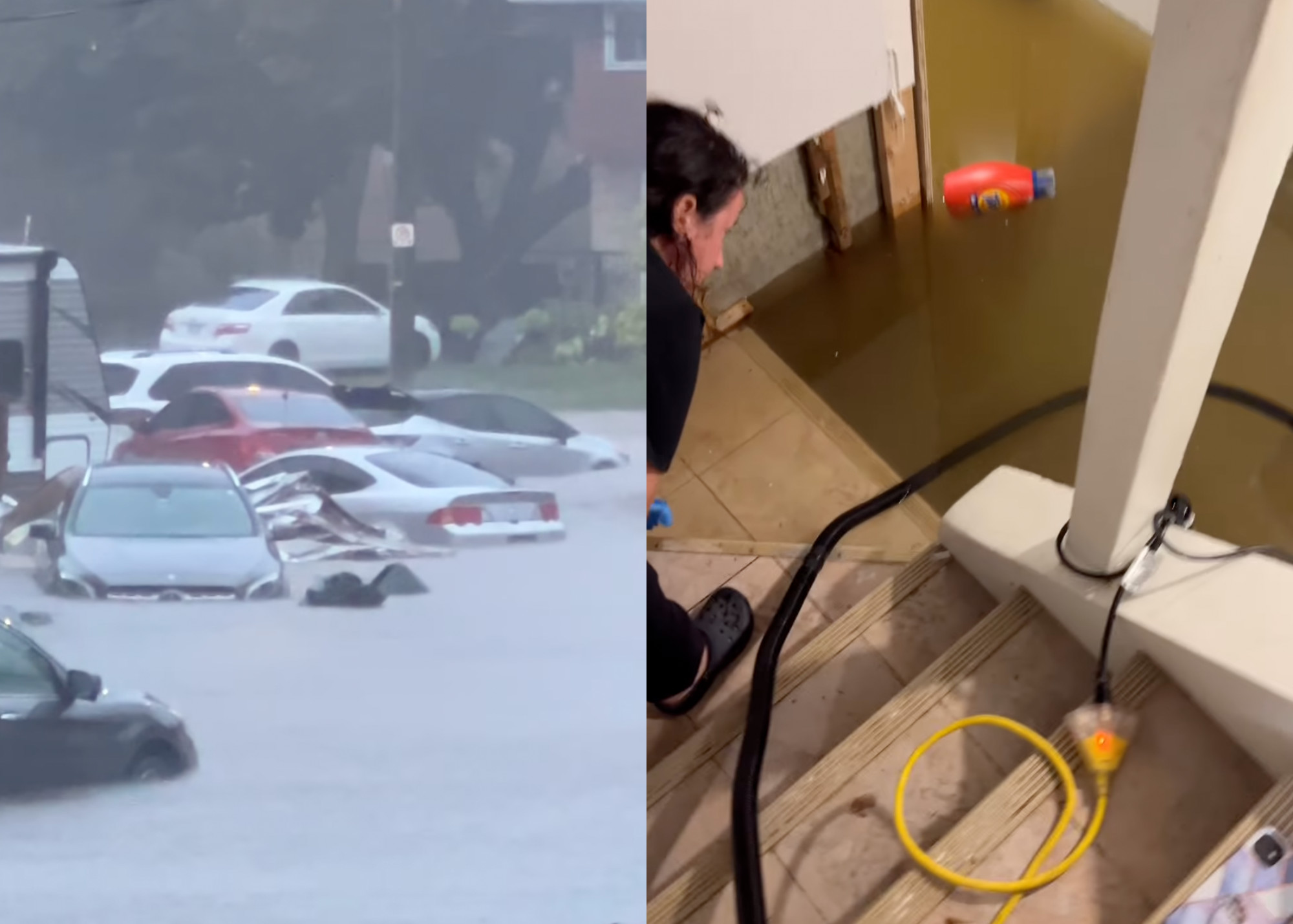
(Screengrabs from Mike Enns’ videos)
The couple started knocking on doors only to realize their neighbours were facing the same crisis; some had three or four feet of water rising in their basements.
Enns brought extra pumps to neighbours and “helped pump all the water out” while trying to salvage whatever they could as they watched floodwater swallow everything in their basements.
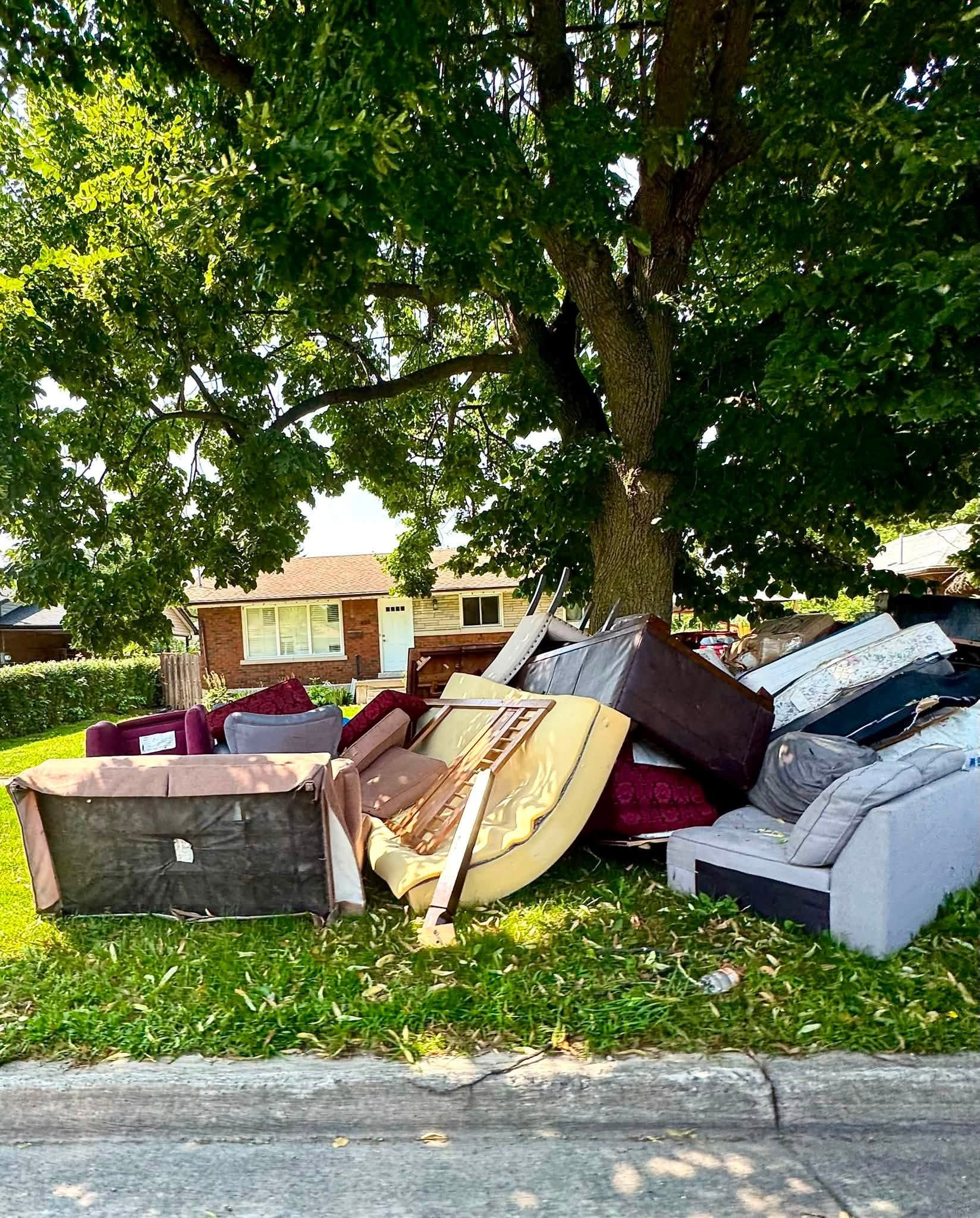
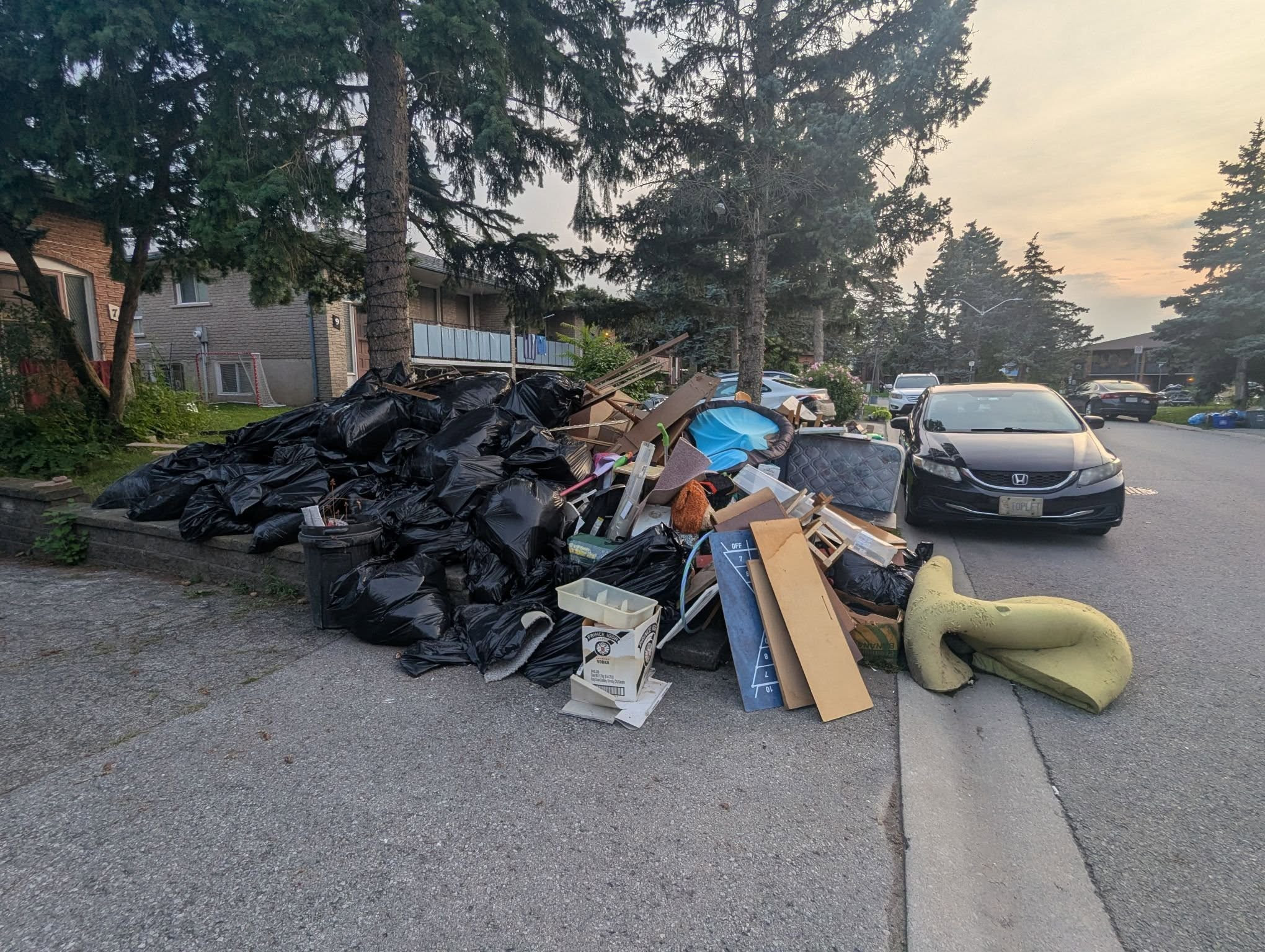
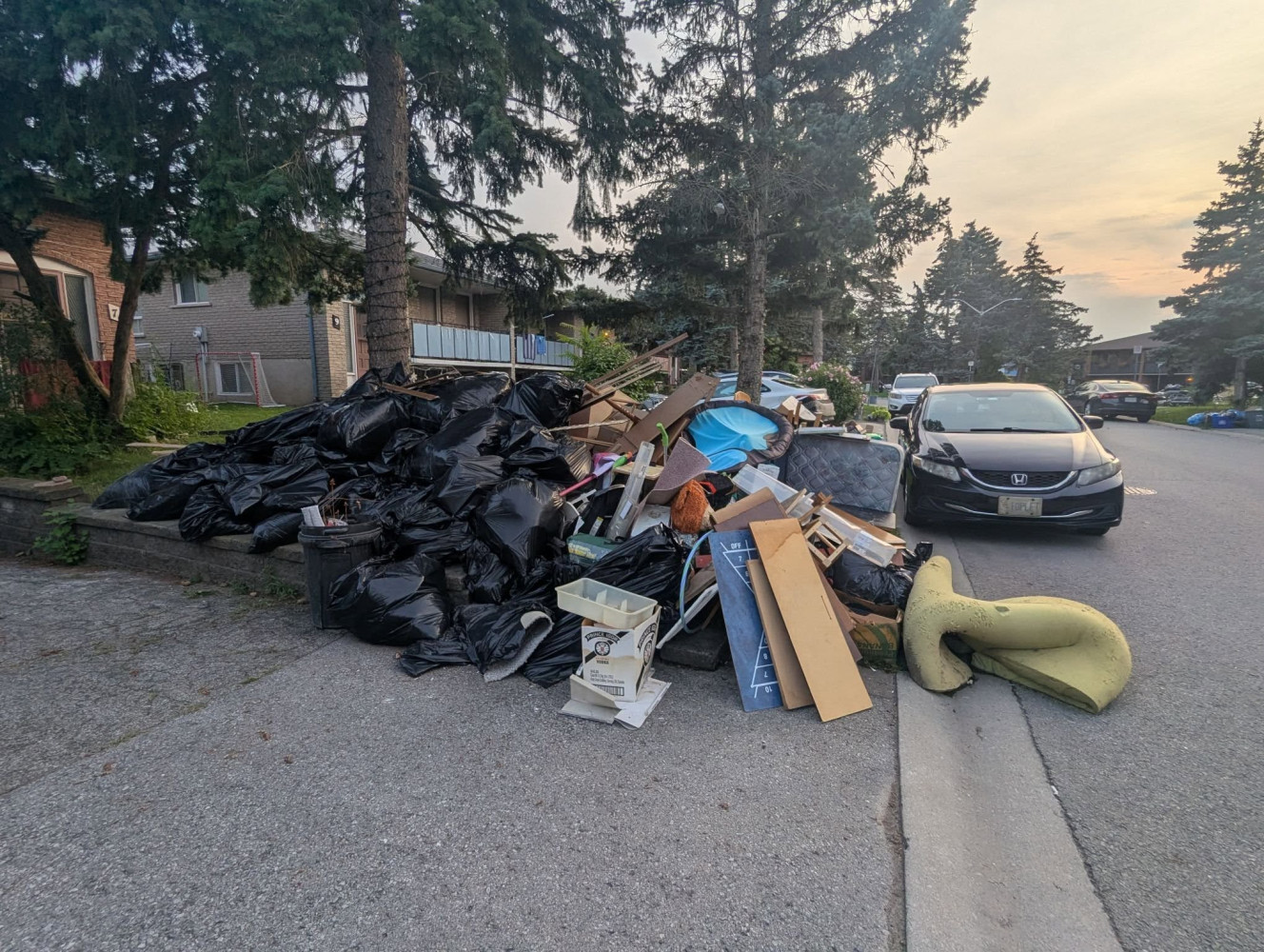
Many St. Catharines residents shared on a community group the heaps of garbage dumped outside houses post-flooding. The city-wide enhanced curbside pickup for flood waste ran for three extra weeks, concluding on August 22.
(Facebook)
For weeks, homes along the street were being stripped of soaked belongings, drywall was cut away and families tried to figure out what could be saved, what had to go and how to document it all for insurance.
Torrential rain on July 21, 27 and 28 had already dumped almost 400 millimetres of rain on St. Catharines. On July 28 alone, the city got 45.7 millimetres of rain, shattering the record, when 30.7 millimetres fell in 1902.
“Then, we had forecast for more rain,” Enns said nervously, his voice deepening with anxiety as he recalled what was still to come.
On August 2, his basement had just been cleaned and disinfected by a property restoration company, Disaster Kleenup International (DKI). Workers had removed the dehumidifiers and fans at approximately 8 p.m.
Half an hour later, it started raining again and Enns and his wife “anticipated in fear” their basement would flood again.
He was out with his neighbours driving around in a golf cart — “it turned from a joyride to panic again within five minutes”.
Street water climbed to three to four feet. Manholes were blown off. Cars were floating and moved with the waves created by water surging through the sewer system.
It activated the filmmaker in him… which would later help him to measure the extent of losses for insurance claims.
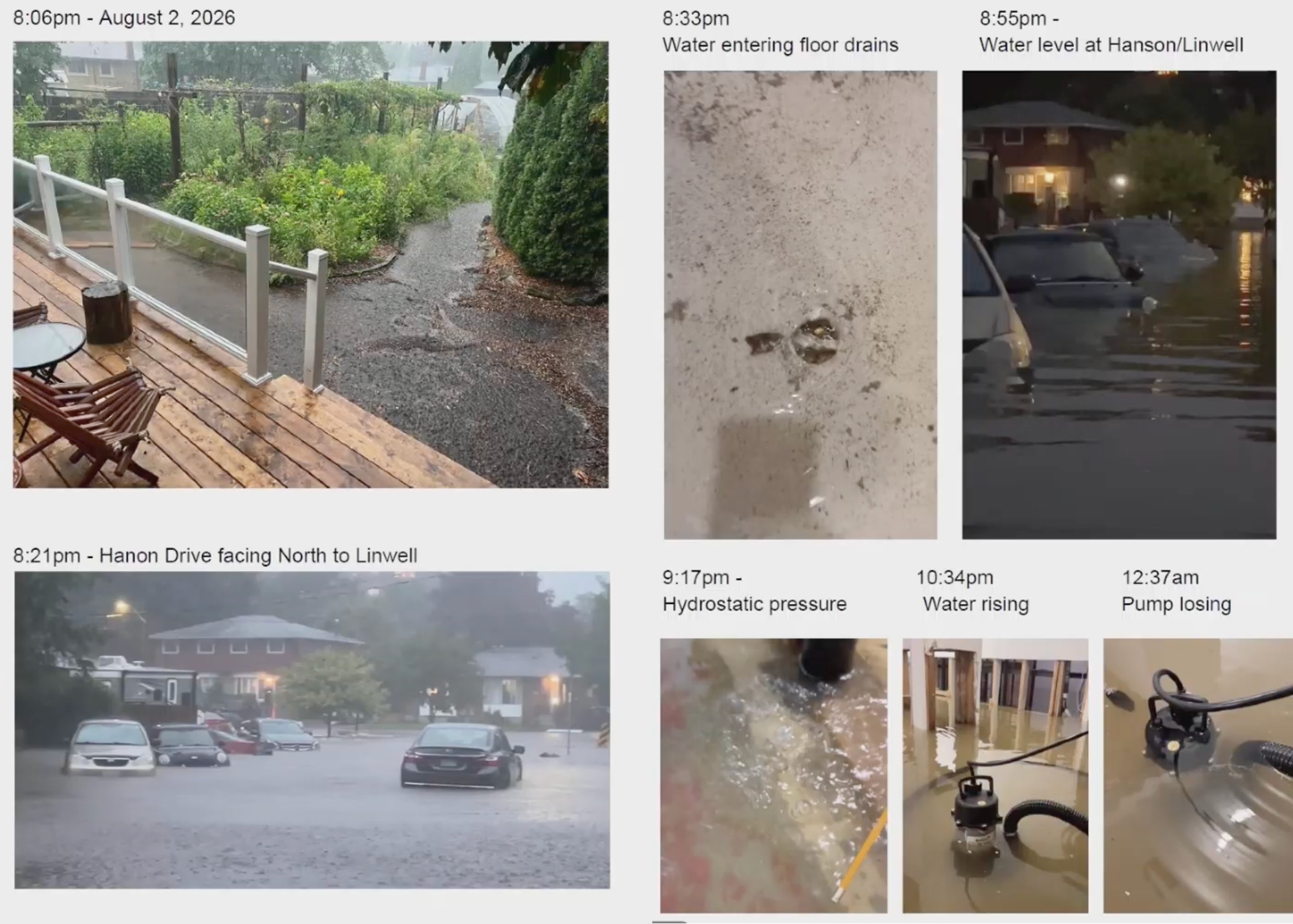
St. Catharines resident Mike Enns documented the scary, steady rise in water due to the heavy rainfall on August 2 that engulfed many parts of the city including his neighbourhood.
(Facebook)
“I started filming and documenting everything…because insurance was on our mind,” he added.
“Here we were awake, seeing where the water was coming in from, where it was flowing our basements and we couldn’t ever start pumping it out because it wasn’t high enough to have our pumps run yet.”
In the many videos that Enns put out on social media to spread awareness and help fellow St. Catharines residents, one video “of water bubbling out of foundation and cracks” caught the attention of a man south of the border in Connecticut.
Enns hopped on a call with the Connecticut resident who had experienced a similar flooding incident and told him, “it was hydrostatic pressure that was causing that to happen, and it was an infrastructure issue”.
The community had eventually hired engineers and organized collectively before sewer replacements were completed, only to discover more problems with the slope of private sewer laterals that contributed to additional backups.
“We have a combined sewer and stormwater infrastructure; a lot of the roofs and runoffs all go into the storm sewer, which adds pressure to the septic,” Enns noted.
“We’re living with the reality that we have outdated infrastructure, and now us as residents are in a place where we have to pay for that…we have neighbours on fixed incomes who can't afford a backflow prevention.”
While some homeowners can spend $20,000 or $25,000 on flood mitigation, he believes even that level of personal spending does not necessarily address the pressure pushing groundwater through foundations.
“We lost half of our house. We don’t feel confident rebuilding it,” Enns said, disappointed and uneasy about the future.
The Connecticut resident urged Enns and his neighbours to organize and push for infrastructure changes—a conversation that helped shift the neighbourhood’s focus from merely surviving the next flood to asking why the water was getting into their homes in the first place.
A 2020 presentation by the Niagara Peninsula Conservation Authority (NPCA) referencing a 2019 study shows that a 100-year flood could affect 169 private land parcels along Walker and Beamer creeks including 18 habitable structures, four public parks and other institutions and businesses.
“Climate change can increase flood flows and rise flood levels,” the report warned.
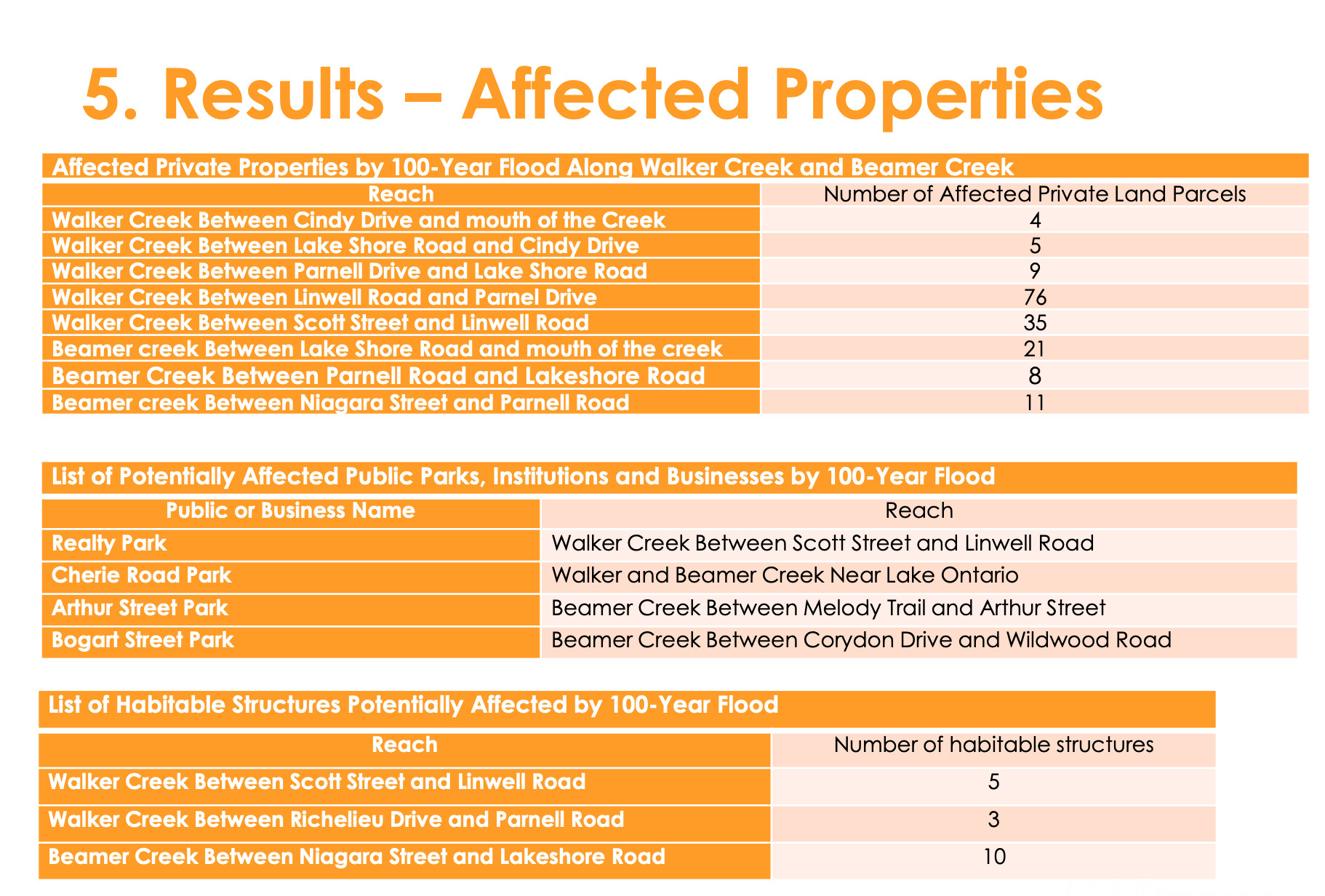
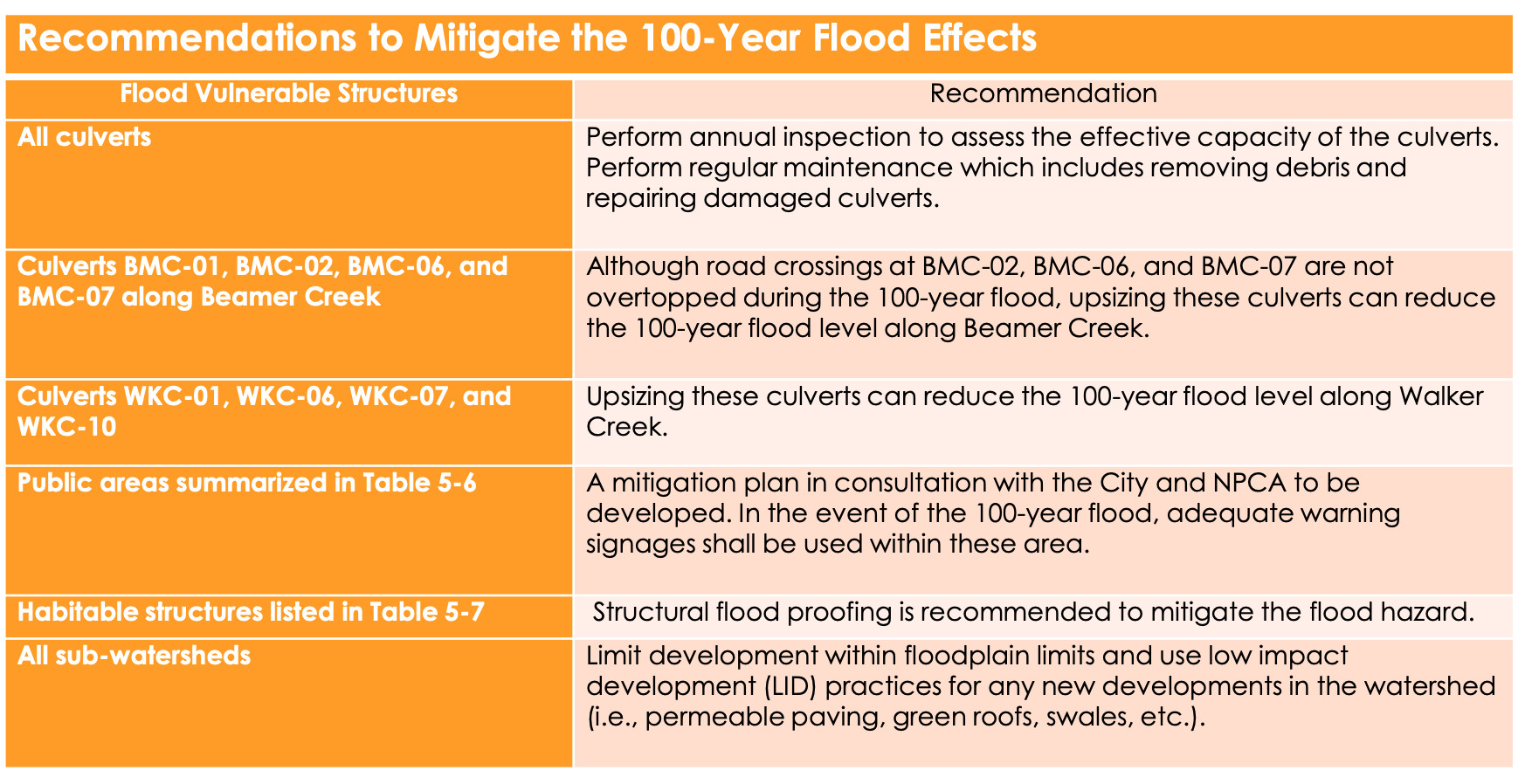
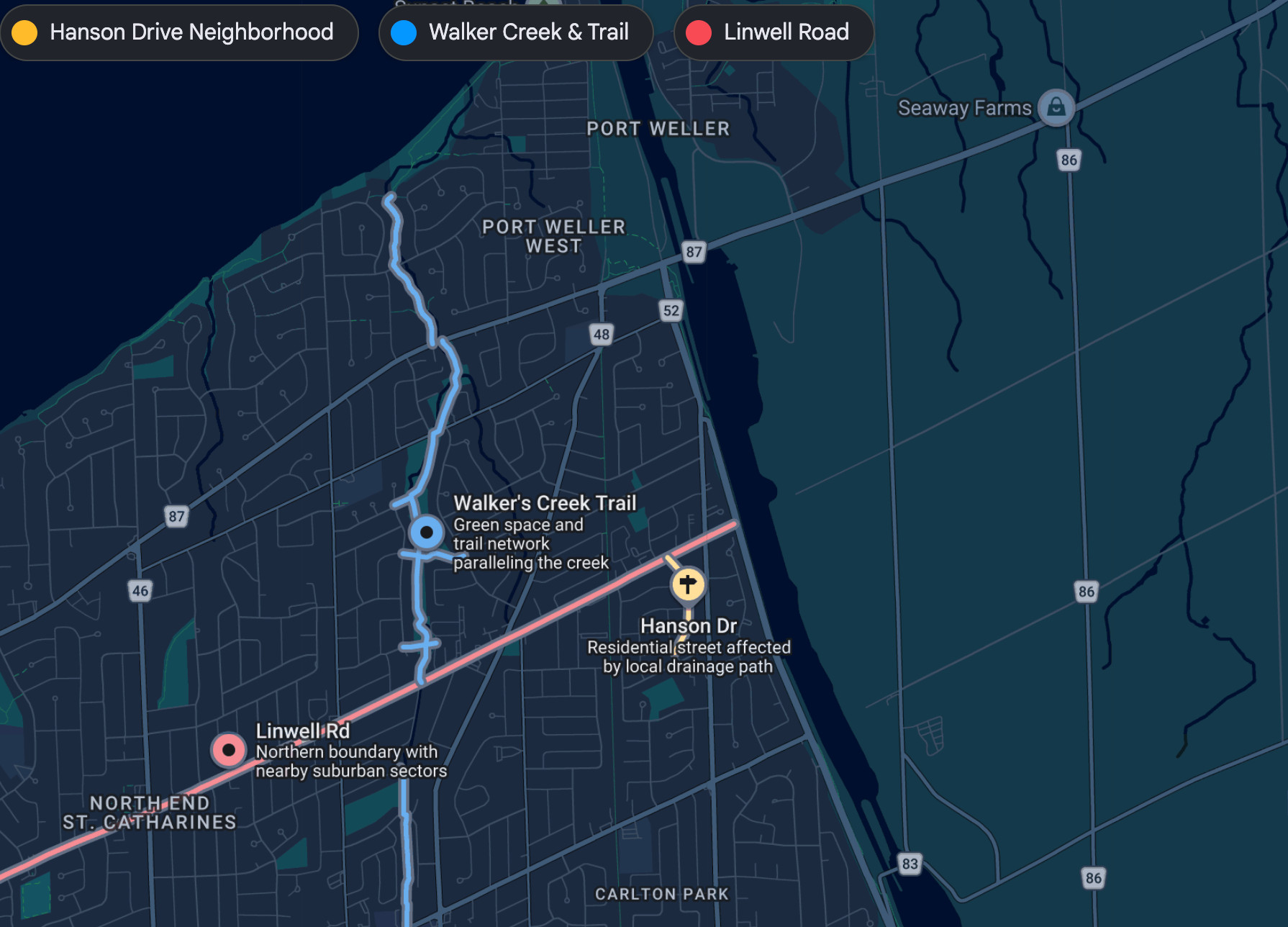
A 2020 presentation by the Niagara Peninsula Conservation Authority (NPCA) highlighted that a 20 percent increase in flood flows could raise flood levels by between 0.04 and 0.73 metres with an average increase of 0.2 metres.
(TOP: Stantec/Niagara Peninsula Conservation Authority, BOTTOM: Google Maps)
The affected area includes the Linwell Road area, where Hanson Drive branches from, with 76 private land parcels between Linwell Road and Parnell Drive—the largest affected reach in the study—identified as potentially affected if a once-in-a-century storm were to occur.
Enns’ father-in-law, Ian Woods, who used to live in the neighbourhood, remembers when the area was once a creek, with photos of “bulrushes” and the creek where children “used to play ice hockey”.
Ward 6 Councillor Bruce Williamson, who lived on Hanson Drive for 24 years, remembered “playing in the ditches”.
“We’ve had a few floods but not like what you've experienced,” he said.
The NPCA claims its 2019 floodplain mapping remains accurate with recent flooding on Walker’s Creek and Beamer Creek “closely match[ing]” what its 100-year maps predicted.
“Because of the demonstrated accuracy of the NPCA’s floodplain mapping in St. Catharines, the NPCA did not revise its floodplain mapping in 2024,” the conservation authority noted in a statement shared with The Pointer.
“NPCA is currently developing a framework to support the prioritization of floodplain mapping projects based on key defensible criteria such as existing mapping and data availability, technical adequacy of existing models, watershed change and drivers, potential impacts of flooding, and other strategic or funding considerations.”
The agency NPCA credited the federal-provincial Flood Hazard Identification and Mapping Program (FHIMP) for “recent funding support for several local floodplain mapping projects”.
The history of the area helps explain its vulnerability to flooding: it sits on a high water table with the street acting as a low point where water from surrounding areas drains.
Enns remembers when his family moved into his home, they had found standing water in the backyard as early as June. Hoping to grow vegetables in the large backyard that had drawn him to the property, he installed about 900 feet of French drains connected to a basin that pumps groundwater into large totes so it can be reused.
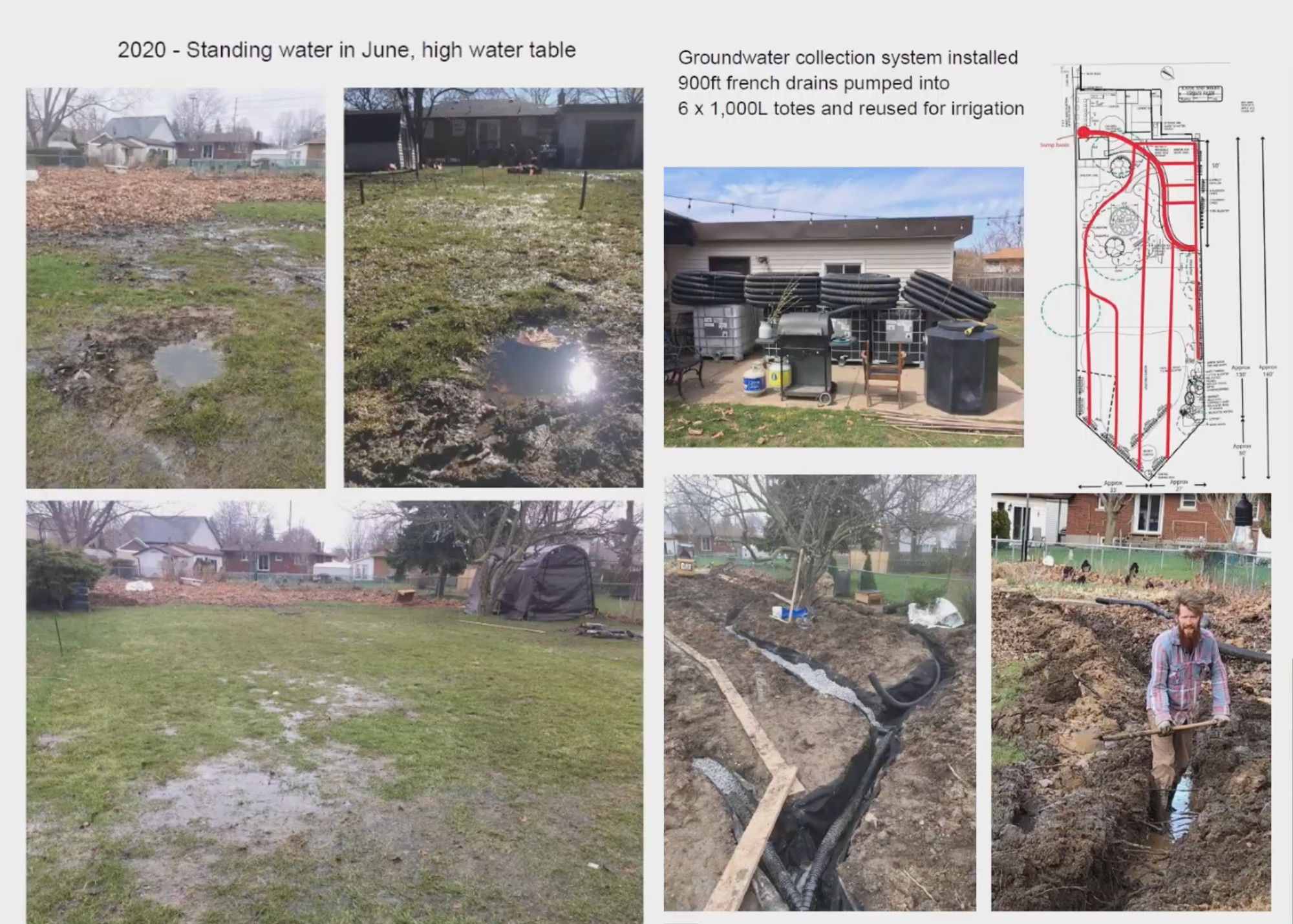
Mike Enns shared with St. Catharines council on August 24 the longstanding issues with the Hanson Drive neighbourhood that need to be rectified for the future of families like his that want to spend their entire lives in the same house.
(Mike Enns)
He isn’t alone.
At one of the lowest points on the street, where water from surrounding areas drains toward Port Weller and its sewage treatment plant, one of Enns’ neighbours has flooded three times.
The street is graded so water from both the north-south and east-west directions flows toward the area.
During one flooding event, about four feet of water filled the neighbour’s basement as water rushed in “from all directions” — through the garage door, into the basement and even through the toilets.
With few options left to protect the home, the homeowners are worried they cannot afford another major flood.
“There’s nothing else they can do,” Enns said.
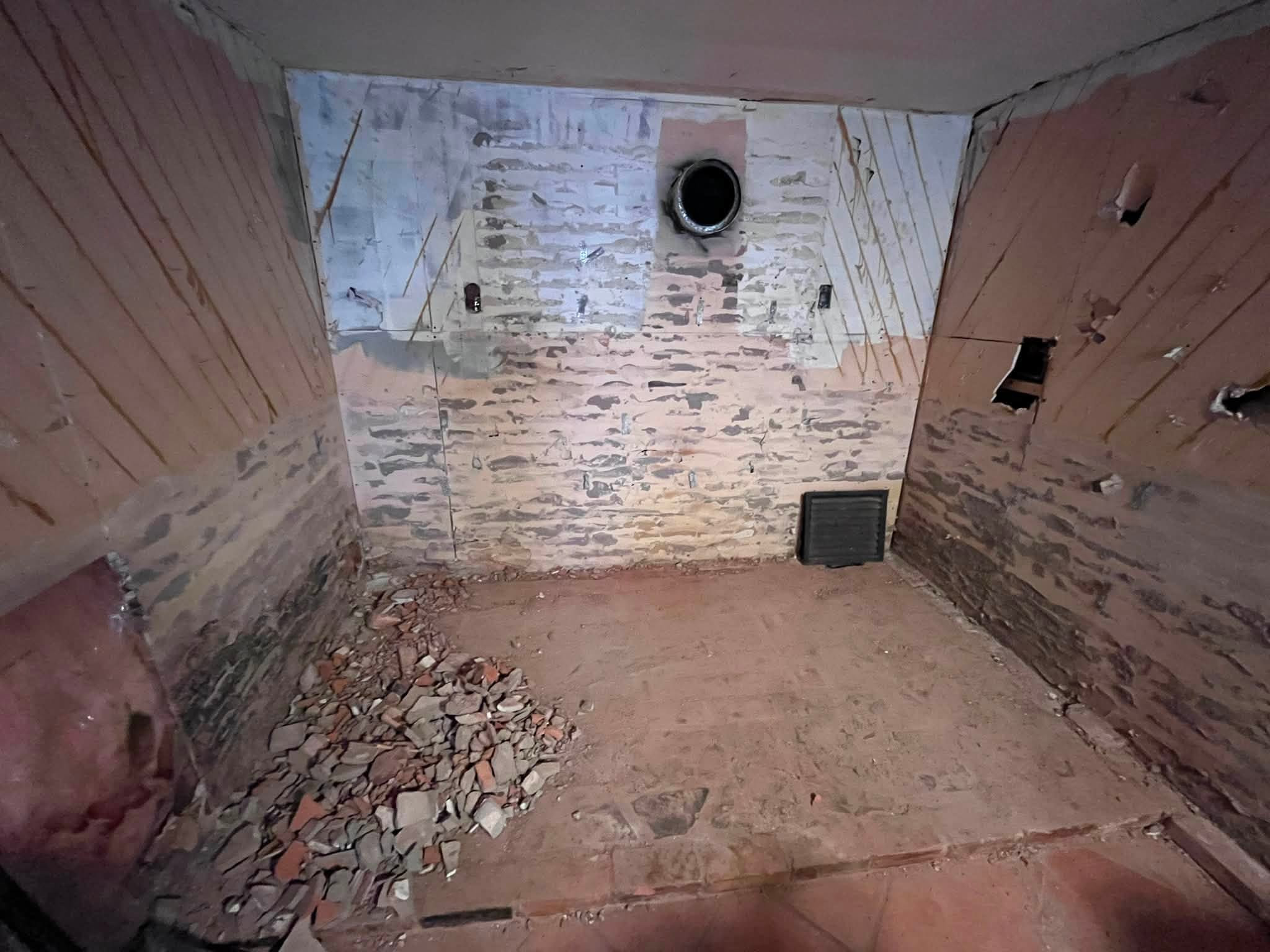
“I’m already at over $70,000 just in itemized damaged belongings, and I haven’t even finished all the small items. That doesn’t include the demolition, remediation, building materials or the cost of actually rebuilding the basement,” St. Catharines resident Jen Hart shared in a community group.
(Facebook)
On August 24, Mayor Mat Siscoe identified Hanson Drive as a priority flood-mitigation area during the council meeting, praising Enns’ videos for helping demonstrate to the province how severe the flooding was.
“I don’t think there was an understanding at the provincial level of just how serious this was, how disastrous this was from our neighbourhood,” Siscoe said, noting that it took the province more than 10 days to provide any sort of assistance.
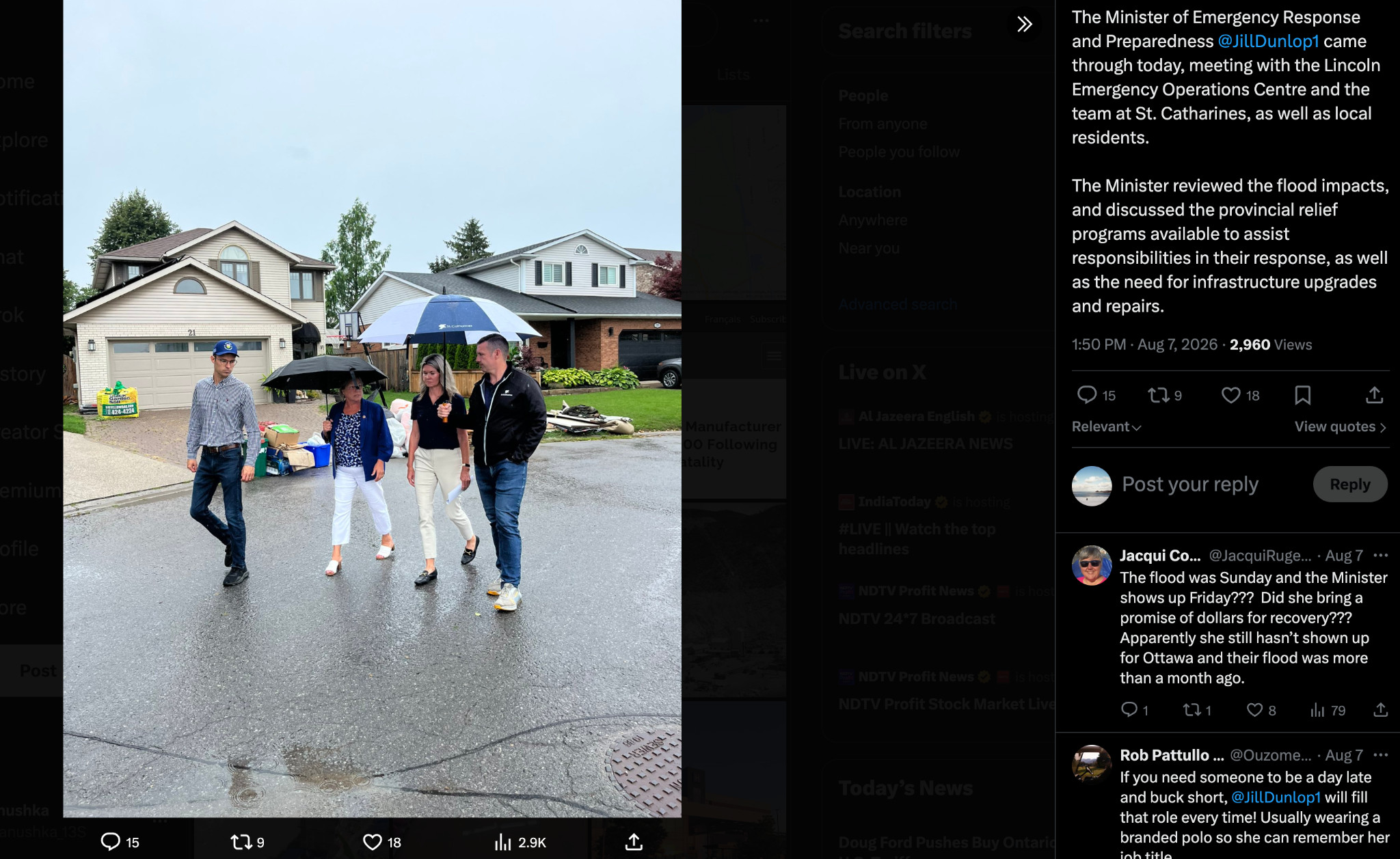
On August 7, Ontario Minister of Emergency Preparedness and Response Jill Dunlop toured St. Catharines neighbourhoods to assess the impact of the July and August flooding events along with Niagara West MPP Sam Oosterhoff and St. Catharines Mayor Mat Siscoe.
(Sam Oosterhoff/X)
But the troubles for residents impacted by floods don’t end just there.
After the second flood, Enns learned any new damage would be treated as a separate claim—a lesson he learned from a friend living northeast of St. Catharines.
On July 1, over 140 mm of rainfall within a five-hour window disrupted Ottawa’s Canada Day celebrations, knocking out power in the region and leaving many residents to deal with the aftermath, similar to St. Catharines residents.
“It was an unimaginable disaster,” Member of Provincial Parliament for Ottawa West-Nepean, Chandra Pasma, said on August 27.
“It has now been eight weeks since the flooding, and neither the Premier nor one of his ministers has set foot in one of the communities impacted…On top of that, the decision to limit the Disaster Recovery Assistance for Ontarians program to cover only a few households is a slap in the face.”
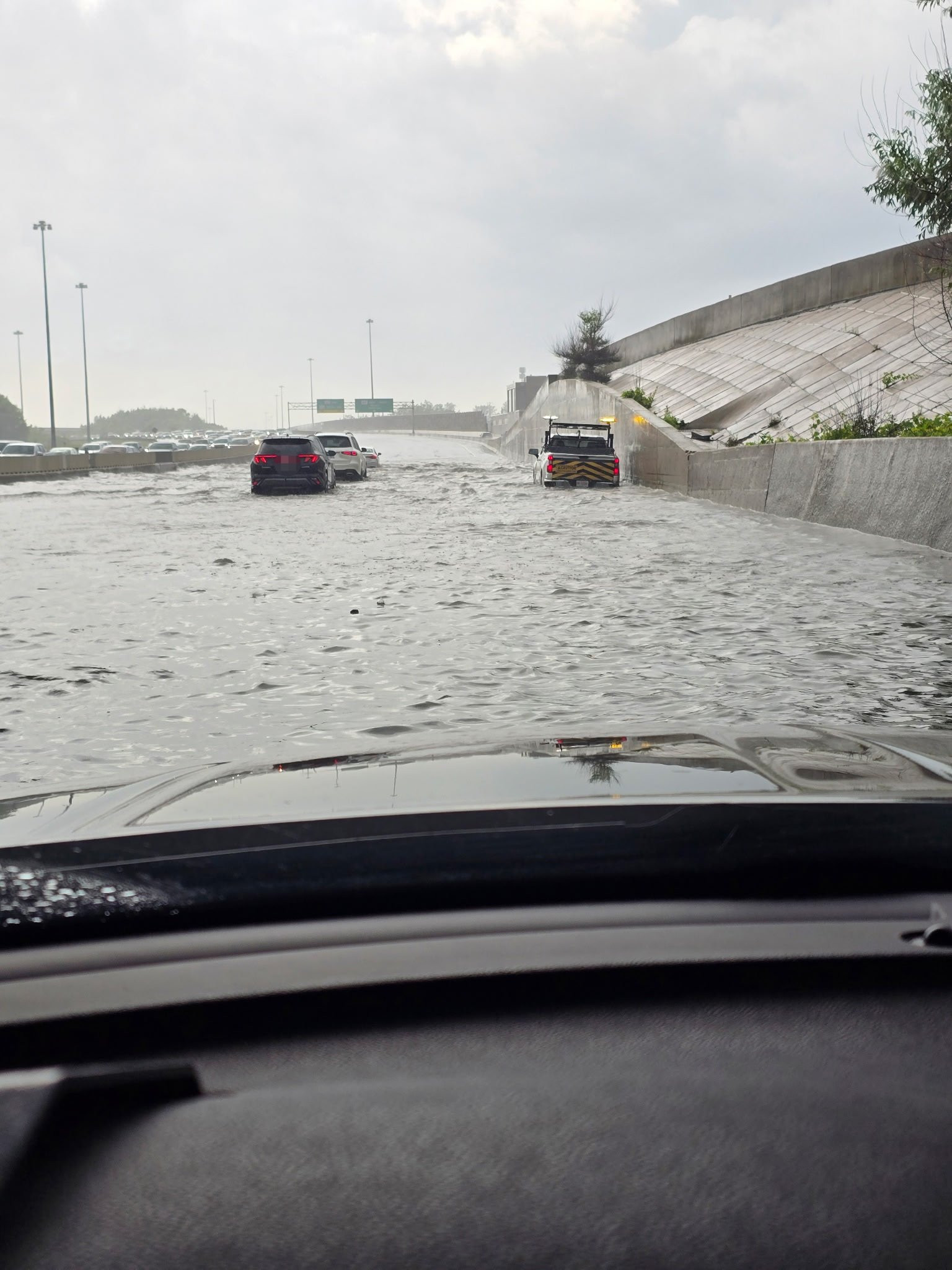
On July 1, intense downpour led to flooding in many parts of Ottawa including Highway 417, according to the Ontario Provincial Police East Region.
(OPP East Region/X)
Enns’ friend in Ottawa told him his insurer had dropped him after he made two claims in the same year, leaving him facing insurance quotes that were about four times higher.
His own insurer did not explicitly instruct him not to make another claim but the possibility was enough to make him reconsider. He ultimately decided not to file and instead cleaned up the damage himself with guidance from a professional cleaning company.
“Everything we’re doing in our basement is assuming that this will happen again in the Fall,” he remarked.
“With El Niño and the weather front coming, it looks like we’re going to have a really wet fall.”
It is a reality that even the insurance systems are not prepared for, already operating at a “catastrophe level”. Adjusters are overwhelmed by the volume of claims while residents await weeks for contractors to assess damage and schedule repairs.
“You could hear in their voice from the beginning to like 22 days later. There’s fatigue. They’re exhausted,” Enns observed, adding that many residents are frustrated because insurers often have little new information to provide.
He now worries that insurers could eventually raise premiums for the entire area or stop offering flood coverage altogether as the neighbourhood’s claims history grows—mirroring the reality for many Mississauga residents who experienced two 100-year-storms in summer 2024.
“Many of my neighbours have a fear, thinking, we’re kind of screwed because who’s gonna buy a house on Hanson Drive?,” Enns emphasized.
The harrowing experience also exposed another gap: the difference between having a system for vulnerable residents and actually reaching them.
On July 31, the City of St. Catharines established and opened its temporary Vulnerable Assistance Registry — Enns helped many of his neighbours sign up.
Twenty days after the back-to-back rainfall, he remembers 12 neighbours rallying to clear soiled belongings from one resident’s basement after the company hired to help had not returned.
“They were on the vulnerable assistance registry but it didn’t really do anything to help our street,” he added.
A city giveaway of roughly 400 dehumidifiers also disappeared within minutes. “It sure looks good, but from my standpoint, it was disappointing more than being productive.”
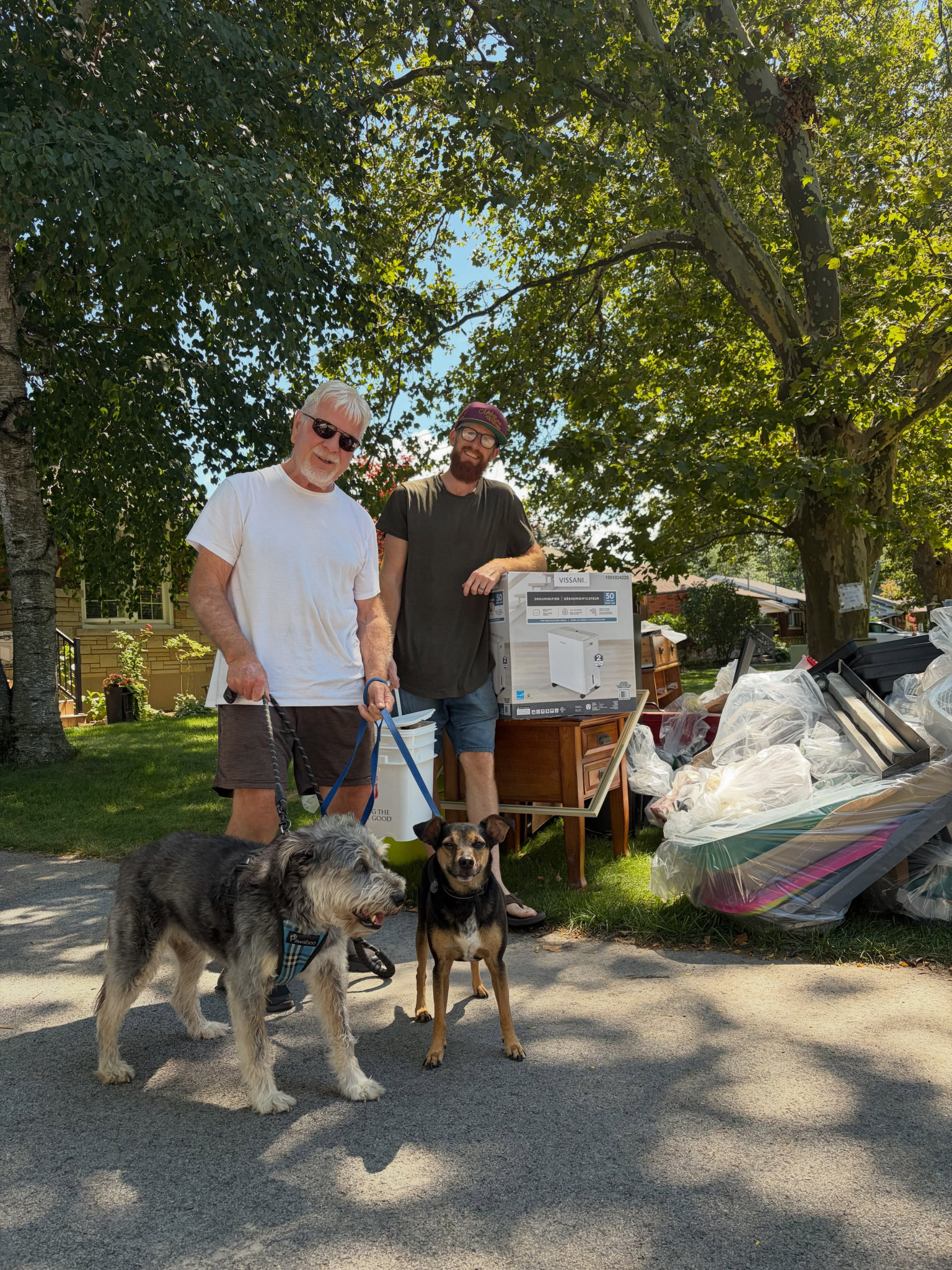
Many residents have expressed their gratitude to Mike Enns (on right) for being a valuable voice in spreading awareness of how to deal with an extraordinary flooding event that has haunted the Niagara region this summer.
(Mike Enns)
Determined to put the hardships he had witnessed his neighbourhood endure on the record, Enns went to St. Catharines council on August 24, calling for greater transparency and community involvement in the review process.
On August 10, Siscoe issued a Mayoral Direction to St. Catharines CAO David Oakes, asking staff to report back with recommendations in seven key areas: an independent flood resilience review, the identification of priority flood mitigation areas, an expanded Flood Alleviation Program (FLAP), a review of stormwater maintenance practices, improved public reporting and monitoring, expanded public education and preparedness, and continued enhanced waste collection for flood-affected households.
“While the mayor recently requested a detailed investigation that does include an evaluation of erosion risks, the City issued a tender for a watercourse erosion study earlier this year prior to the directive, and have already initiated that but it remains a work in progress,” a City of St. Catharines statement shared with The Pointer noted.
“Assessments of the Beamer Creek and Walkers Creek culverts identified are included in that study.”
While Enns supported the direction, he urged council to involve residents more directly in understanding what happened and shaping the city’s response accordingly.
He made three requests: the city makes the independent review’s process and findings public; releases relevant infrastructure information including sewer, stormwater and drainage records, historical studies and previous flood reports (also the 2019-20 floodplain mapping study, its recommendations and call for updated mapping every five years); and work with community groups and the NPCA to develop a credible resident flood survey while memories of the recent flooding are “still fresh”.
“Would you agree that the emphasis needs to be more on upstream solutions that we don’t have to be dealing with raw sewage entering our homes?” Williamson asked while describing backwater valves as a “last resort” measure.
Enns agreed that longer-term infrastructure improvements were necessary; he assumed the City was behind on infrastructure upgrades but did not know whether Hanson Drive had yet received the necessary improvements.
Ward 4 Councillor Caleb Ratzlaff questioned whether the City proactively inspects culverts and drainage features located behind homes, to which staff responded it generally responds to reported problems and does not routinely inspect privately located culverts without a specific issue being reported.
“We’ve tripled the amount in sanitary and storm over the last decade,” Siscoe reiterated.
“We have made this a priority at our council table. But we need the province and the Feds to start spending dollars on this.”
Council also unanimously voted in favour of a motion asking the province to activate its Municipal Disaster Recovery Assistance Program to help cover incremental operating and capital costs stemming from the July 21, July 28 and August 2 flooding events. Staff is now working with provincial officials to document costs associated with the storms.
Provincial assessment staff have also visited affected areas as the City waits to learn what homes and geographic areas could qualify for the Disaster Recovery Assistance for Ontarians (DRAO) program.
An Independent Review of the 2019 Flood Events in Ontario highlighted that during municipal engagement sessions, some homeowners who repaired their properties after the 2017 flood were flooded again in 2019.
Those residents told the reviewer they believed their damages in the second flood could have been eliminated or reduced if they had been able to “build back better” (an initiative that provided municipalities additional funds to rebuild damaged public infrastructure to higher, more resilient standards against extreme weather) after the first event.
The report warned that urban drainage systems, particularly in older neighbourhoods, can be overwhelmed by intense rainfall.
Among the 66 recommendations, the reviewer suggested making changes to drainage standards, private flood protection, infrastructure investment and turning the “build back better” pilot into a full program under the Municipal Disaster Recovery Assistance, as well as considering adding it to the DRAO program.
“The Province should consider raising the 15 percent cap where it makes economic sense. The program should be tied to legislated flood protection levels and floodproofing criteria. For example, a bridge damaged by a flood can only be replaced if it is raised to the design flood,” the report suggested.
As of 2024-25, provincial reports indicate the province continues to assess the program as a pilot, instead relying on Municipal Disaster Recovery Assistance allocations and newer joint federal-provincial streams such as the Canada-Ontario Partnership to Build and the Development Charge Reduction Program.
On August 27, Ontario NDP Leader Marit Stiles called on the province to increase DRAO funding and “recall the legislature” as multiple regions in the province endure the aftermath of recent flooding.
“Neighbours are stepping up for one another but charity cannot replace what the government is supposed to do,” she said.
NDP MPP for St. Catharines, Jennie Stevens, doubled down on Stiles’ point by noting that “cleaning buckets and dehumidifiers were helpful in the first few days” but they are “no longer a strategy”.
“This wasn't just Hanson Drive; Across Niagara, families and communities are still trying to recover from widespread flooding,” Enns restated during the press conference.
The City of Niagara Falls has been under a state of emergency for over a month now. NDP MPP for Niagara Falls Wayne Gates shared that farmers say they are expecting to lose “20 to 40 percent” of their crop; many grape growers won’t know the full extent of damage until early next year.
“We are doing everything we can as homeowners and neighbours to recover and protect ourselves but what is happening to us is bigger than what individual homeowners can fix,” Enns added.
The City of St. Catharines has also been in discussions with the federal government about additional programs and expects to provide council with an update on September 14.
What actions Ottawa will take remains to be seen. On August 13, a Canadian Climate Institute report highlighted that Canada is not adequately prepared for growing climate risks, with up to 1.5 million households facing severe flood risk and only a third of Canadians having taken steps to prepare for climate-related hazards — well below the federal government’s 50 percent target for 2025.
Council later approved the funding mechanism for the emergency FLAP with $20 million to expand and fund the flood relief efforts, allowing eligible residents to proceed with work once they meet the program’s requirements.
Homeowners who had already begun work following the flooding could still be eligible to retroactively obtain the necessary plumbing permit and use a licensed plumber—provided they meet the eligibility requirements including owning a single-detached or semi-detached residential property built before 2012 that is connected to the City’s sanitary sewer system.
The emergency program does not require residents to obtain three quotes or choose from a city-approved list of plumbers, staff confirmed.
However, Enns stressed that there are many residents on his street who either cannot afford or don’t qualify for FLAP—leaving many families helpless.
On August 25, the City organized a telephone town hall to answer residents’ questions and help them navigate this difficult time—nearly 29,500 people called and 4,477 participated.
While The Pointer’s Niagara reporter did not receive a call despite signing up through the City’s website, several residents who did receive calls complained about being disconnected.
City officials acknowledged that “no single format will work for everyone”, understood the frustration of residents who did not receive a call or were disconnected, and will continue to review questions and comments to inform its ongoing flood recovery work since they were aware that they “would not be able to get to every question” during the one-hour event.
“We recognize that providing an additional way to listen or participate – such as a public audio livestream – creates an opportunity to make the discussion even more accessible to more people, and that is something we will look into when planning similar events in the future,” the statement said.
The City has since uploaded a video of the one-hour session.
It brings one central question to the surface: what happens to people who cannot navigate the systems themselves during climate change?
The answer, at least on Hanson Drive, has increasingly been the neighbours.
Since the flooding events, Enns has opened his front porch and lawn to his neighbours, where they cook together at barbecues, exchange information about insurance, help each other clean and check in on residents who may not have the same ability to navigate a disaster on their own.
“That’s been a silver lining—we’ve been able to share stories and build the most unlikely of friendships which for our mental health has been life-giving,” Enns shared candidly with a smile.
“It means something to feel like we’re not alone.”
With the hope that when the next emergency happens, neighbours will be able to organize and respond to one another even faster, a core group of North End neighbours is organizing to understand residents’ needs, collect their own data on who flooded and how badly, and advocate for change with a united front alongside the City and the NPCA.
“NPCA staff met with residents to learn more about their information-gathering initiative, clarify our role, and provide additional resources to support their effort,” the agency confirmed.
Email: [email protected]
At a time when vital public information is needed by everyone, The Pointer has taken down our paywall on all stories to ensure every resident of Brampton, Mississauga and Niagara has access to the facts. For those who are able, we encourage you to consider a subscription. This will help us report on important public interest issues the community needs to know about now more than ever. You can register for a 30-day free trial HERE. Thereafter, The Pointer will charge $10 a month and you can cancel any time right on the website. Thank you
Submit a correction about this story

