
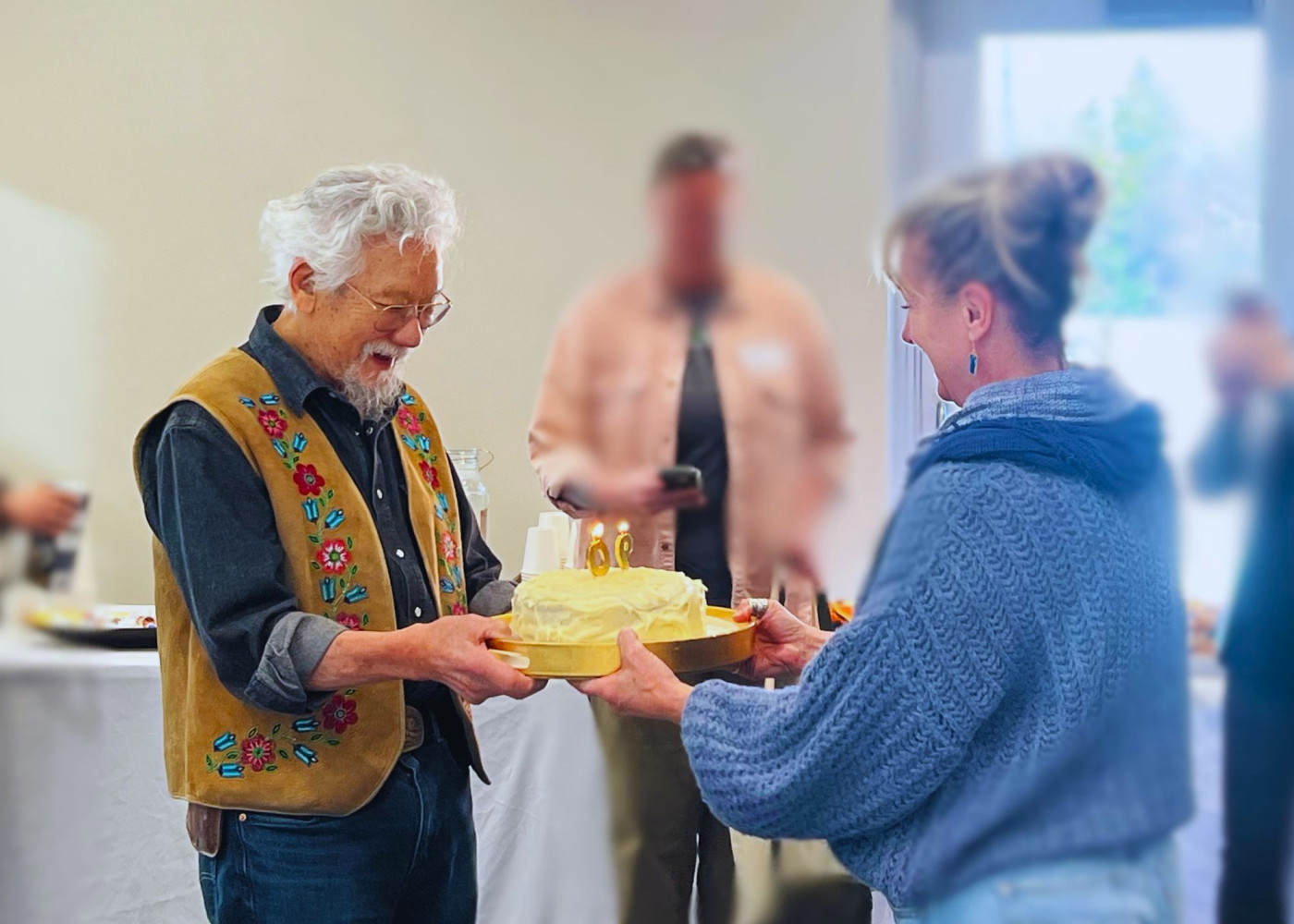
What David Suzuki wished for Ontarians on his 90th birthday
A man of humble character carrying a curious mix of optimism and quiet disappointment in his eyes, clad in dark-washed jeans, a coal grey shirt and an Indigenous-made brown vest adorned with intricate beadwork, David Suzuki walked in the room and made it brighter…eight months after he solemnly admitted it was “too late” to stop the worst of the climate crisis.
New faces turned toward him with awe, familiar ones with affection. Then, connected by their admiration for the man, they gathered together for an impromptu singing of “Happy Birthday”.
He paused, caught off guard.
For a brief moment, someone who has spent decades speaking to the world about hope, looked surprised by this simple act of tenderness.
His eyes lit up, widening with a child-like wonder. A broad, unguarded smile grew as he gazed at the carrot cake, lovingly baked by one of his colleagues from the David Suzuki Foundation. It was crowned with golden candles forming the number 90.
Watching the energy he infused into the room, on minimal sleep, it was impossible to imagine the renowned environmentalist was turning 90.
The night before, on March 23, he had been on stage at The Rose Theatre in Brampton performing in a play titled ‘What You Won't Do For Love’ alongside fellow environmentalist and the love of his life over five decades, Tara Cullis — a different kind of stage for someone whose life has played out behind podiums and in front of news cameras.
For decades, the former CBC broadcaster and geneticist has been a constant moral voice. His documentary series, The Nature of Things, translated science into messages that are urgent, simple, yet human.
On stage, with Cullis’s calming demeanour helping him along, that message isn’t driven by data or debate. The personal and vulnerable side of his story unfolds, a reflection on climate change, partnership, endurance and the quiet, daily acts of resilience even when the weight of what lies ahead feels overwhelming.
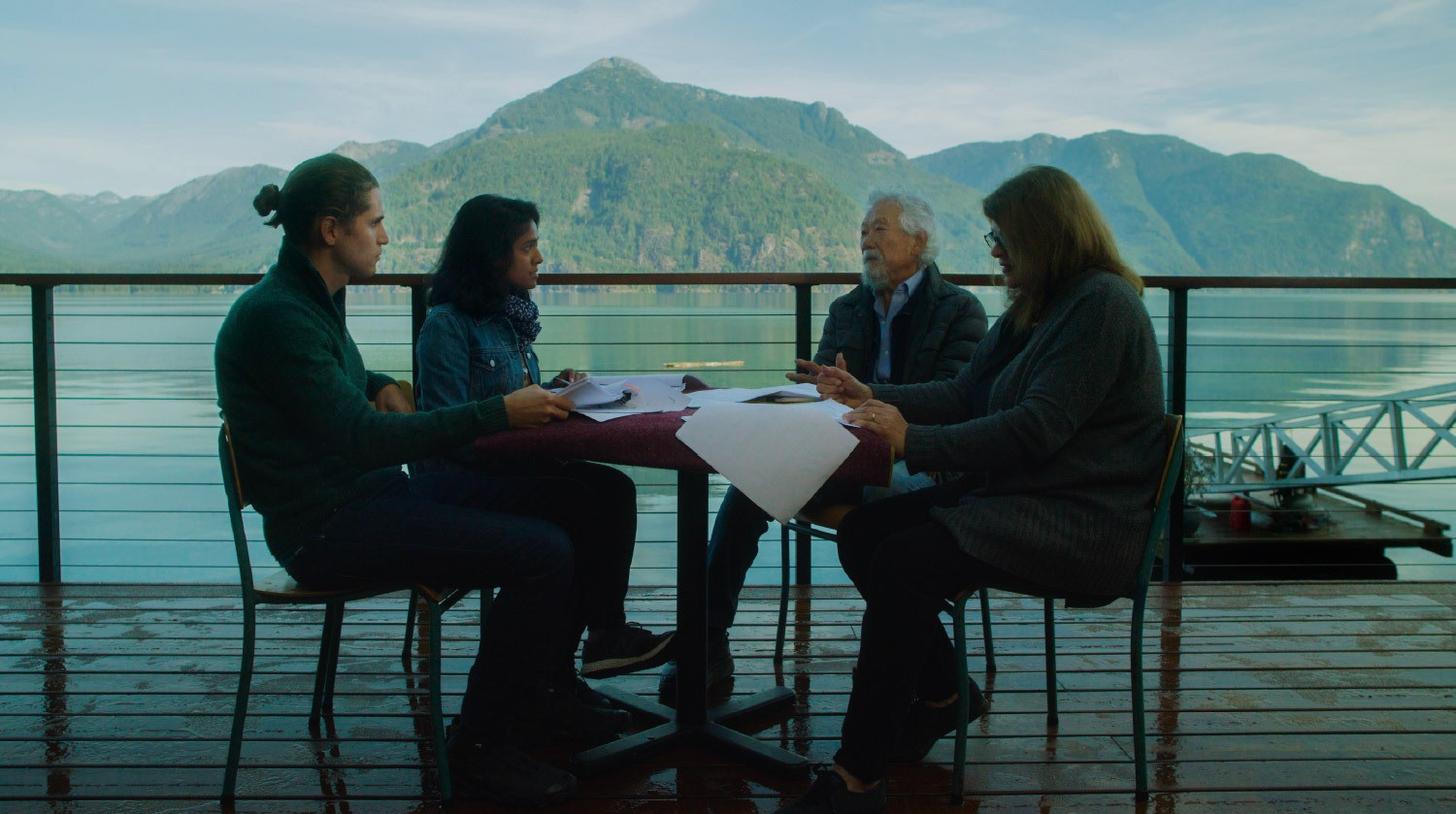
Directed by Ravi Jain, What You Won’t Do For Love is an intimate 90-minute stage performance by David Suzuki and Tara Cullis that weaves together climate advocacy, personal tales and their 50-year partnership.
Suzuki left Brampton late in the evening following a successful performance and was on the move again early the next morning to the Carmen Corbasson Community Centre in Mississauga — the fifth and final stop of the David & Tara’s Stronger Together Tour in Ontario.
The three-hour event is part of a series taking the duo across southern Ontario, sparking conversations with local activists, changemakers and municipal leaders about community care, connection and preparedness in an era of escalating climate emergencies. It’s a meditation on how to cope with the consequences of collective human actions and unnecessary wars triggered by leaders who deny climate change.
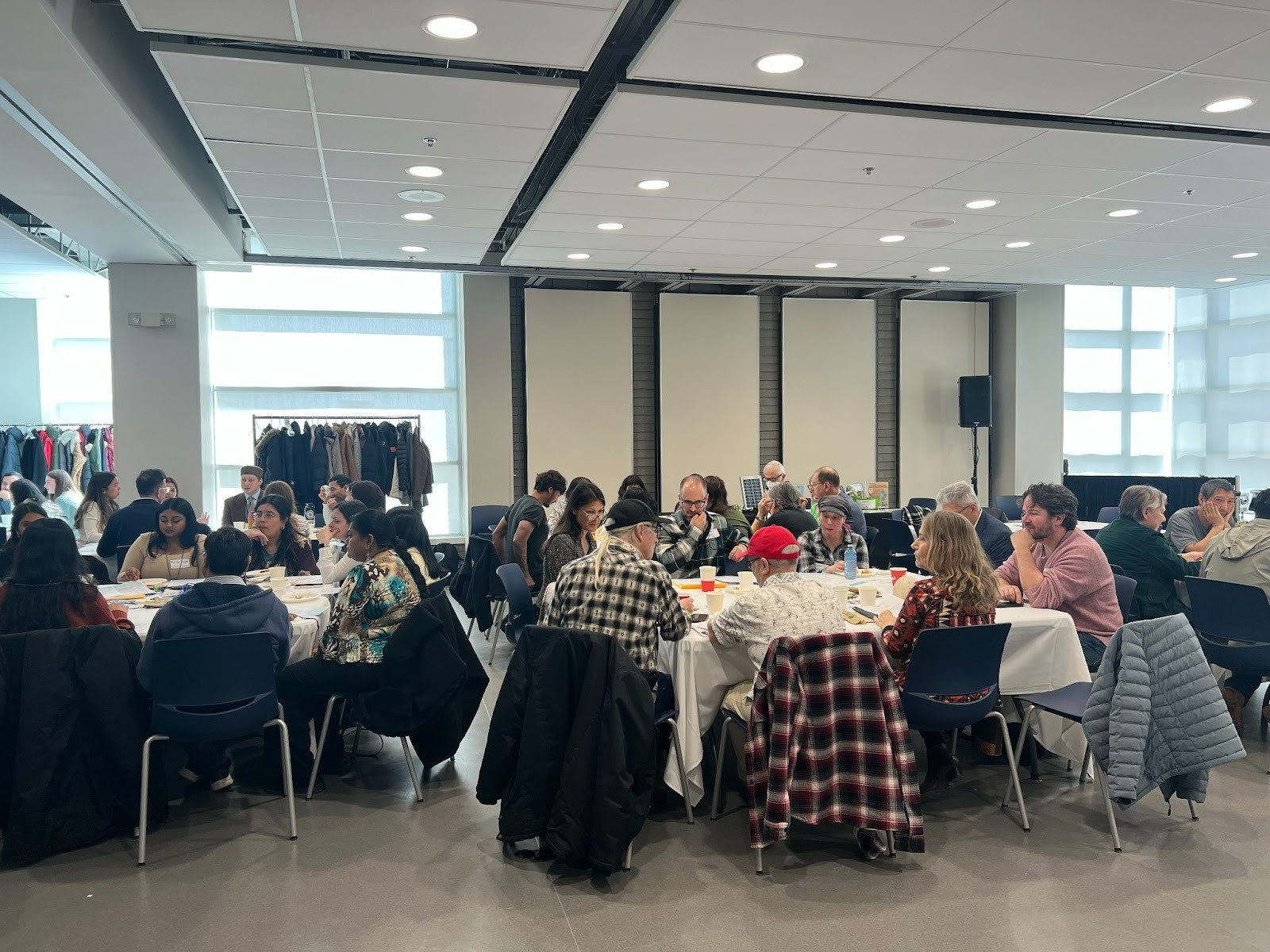
On March 24, Peel environment stewards as well as municipal leaders participated in a three-hour workshop organized by the David Suzuki Foundation. “With climate change, weather events are becoming more violent…there will be forest fires, deadly floods, massive heat waves, smoke, power breakdowns,” Tara Cullis said. “Develop communities, get to know your street, your city block, your neighbours; in a crisis, the government won’t be able to get to you with help as quickly as you might like.”
(Anushka Yadav/The Pointer)
“To have this passion and zeal to continue spreading the message, I wish I could be like that,” one of his colleagues quietly said as Suzuki gently blew the candles after making a wish.
Minutes earlier, he had been sitting in a room signing copies of his book ‘The Sacred Balance’ and chatting with journalists one-on-one.
It’s been six months since Suzuki stood in a corner quietly, deep in thought at the nation-wide Draw The Line protest in downtown Toronto last year. He seemed angry back then: “Humans are out of control, out of sync with the things that keep us alive — the planet…”.
Asked if he still felt that way, he replied: “At this point in my life, you look back and try to say, how did we succeed?,” he told The Pointer. “Well, we haven’t succeeded. We failed fundamentally.”
The rise of social media astounds him, not as a tool, but as a force that erodes trust and has undone “all of the work” that he and environmentalists had done over the past few decades.
“There’s no sense of credibility or authority anymore,” he noted, describing a world where misinformation spreads faster than evidence, where power can amplify denial louder than years of science.
“You have the president of the richest, most powerful nation in human history, saying climate change is a scam. It's a hoax. It's fake news. And nobody says, ‘this guy is crazy, toss him out, what's his evidence?’ He says it as president, and it's out there,” he said.
“He has more impact on all of the work of environmentalists and scientists.”
He paused to catch a breath, then added: “It's a very sad moment in our history.”
Then, what keeps him going? What does hope look like now?
“Everybody says, give me hope. Is there no hope?,” he asked. “But we use hope as almost an excuse.”
He likened humanity’s reliance on hope to a self-soothing illusion, saying it becomes “like opium”, a way of convincing ourselves that scientists will fix the crisis or “come up with a solution, so we don’t have to act ourselves.
“The only hope I have is that there are people still trying to make a difference.”
As a grandfather, he no longer measures his life by outcomes but by effort.
“What I’m proudest of is that I tried,” Suzuki said.
“Each of us is one person. And I've said my greatest hope at the end of my life is not that people will say: ‘Oh, he was a great man. He did this, he did that.’ No, I don't care. I'll be dead when they start saying that…
“What I hope is that when I'm still alive, I can look my children, grandchildren in the eye and say, I'm only one person, but I love you more than anything else, and I did the best I could. And I can look them in the eye and not feel that I could have done more.”
The idea of trying even in the face of failure extends to how he views politics in today’s chaotic world: the problem isn’t simply bad actors but a system built around those who vote.
“[In the system], future generations don’t even exist,” he remarked. “Why should a politician act now for something that won’t pay off for 20 years?”
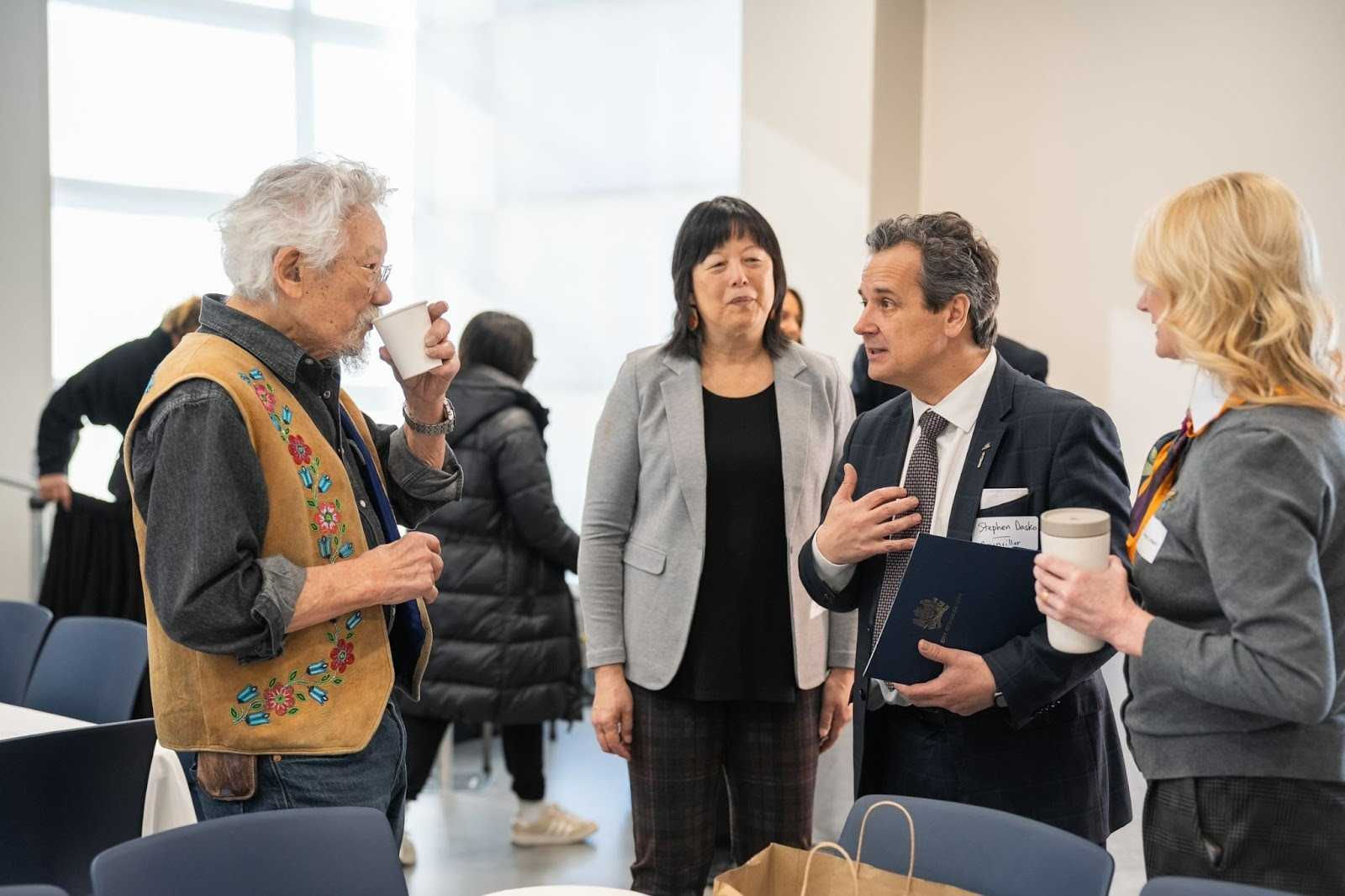
David Suzuki in conversation with Mississauga Ward 1 Councillor Stephen Dasko.
The reverberating consequences are felt everywhere: forests managed for industry, oceans treated as resources, decisions shaped by immediate pressures rather than long-term survival.
Suzuki stressed nature doesn’t vote and yet, it is Mother Earth that’s the most affected.
In 1992, a month after the UN Earth Summit (Rio Summit) in Rio de Janeiro, Brazil, Canada experienced one of its most dramatic ecological collapses on its east coast waters.
Decades of industrial-scale overfishing on the Grand Banks off Newfoundland and Labrador had driven Northern cod populations to less than one percent of their historic levels, forcing Ottawa to declare a moratorium on commercial cod fishing, the largest industrial closure in Canadian history.
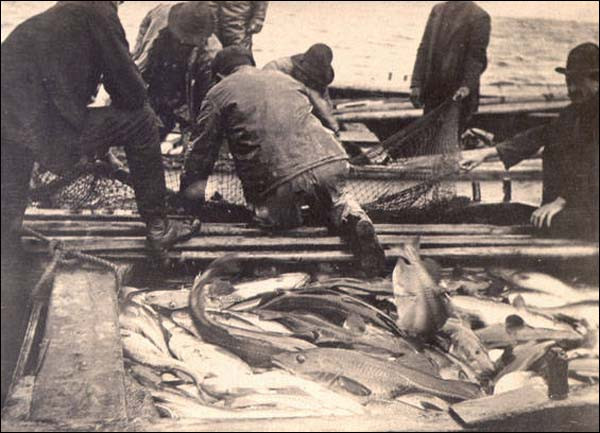
The Canadian government imposed a moratorium on the Northern cod fishery on 2 July, 1992, which ended hundreds of years of fishing activity in the province of Newfoundland and Labrador.
(Memorial University of Newfoundland, St. John's, NL)
The ban — often known as the toughest political decision of John Crosbie's career (the former minister of fisheries and oceans) — ended nearly 500 years of continuous cod harvest, put about 30,000 fishers and plant workers out of work almost overnight, shattering the economic and cultural backbone of hundreds of coastal communities that had depended on the fishery for generations.
Suzuki recalled that at the time in Newfoundland, officials recognized that cod stocks had crashed and a moratorium was necessary. But the federal government also wanted to maintain economic activity, allowing foreign fishing fleets to continue operating in Canadian waters.
“Different levels of governments are dealing with different issues,” he said.
The key to change, he believes, lies not in waiting for higher levels of government to act but in empowering communities at the grassroots level.
“Municipal governments are where you can really affect change as an activist.”
The federal government may pass responsibilities to provinces and provinces to municipalities, but local leaders are accountable to the people they directly serve. “They respond to grassroots to a much greater extent.
“The most fundamental problem with politics is that politicians have to respond to people who vote,” he pointed out. “Children don’t vote. Trees don’t vote. Oceans don’t vote. The fish don’t vote. But they’re not in the equation despite being impacted by government action.”
He explained that the Minister of Forest isn’t tasked with protecting the forest itself. Their role is to manage the competing demands of those who use it: the forestry industry, tourism operators, and Indigenous communities. The forest’s long-term health is not the highest priority because political decisions are ultimately driven by voters, not the trees.
How do we get politicians to act in favour of long-term survival then, especially at a time when the planet’s hit multiple tipping points?
Suzuki smiled and reminisced on one of his conversations with former Vice President of the United States, Al Gore.
The day after Gore was elected, he called him to ask what organizations could do to help elect more leaders like him.
Gore’s answer was simple: “Don’t look to politicians like me. I can't do anything if the public doesn't support me.
“He said, if you want to make change, you've got to convince the public there's a problem. Show them that there are solutions, and get them to care enough to demand the change.
“Then, every politician is going to jump on board.”
Three decades later, he saw this play out in Ontario when, on September 21, 2023, public pressure and outcry pushed the Doug Ford government to reverse its decision to open protected Greenbelt lands for development, apologizing for the decision and calling it a “mistake”.
“Doug Ford had to crawl on his belly and put the restrictions back up on the Greenbelt,” Suzuki said. “That was not because Ford suddenly changed his way; it’s because the public told him, ‘don’t you do that’ and that’s what we have to do everywhere.”
That is why it was important for him to be in Peel to amplify community action as the most realistic and powerful tool for change.
880 cities Project Manager Praneti Kulkarni, who was among the room full of local advocates trying to make a change in the province, felt “grateful” to be a part of a day devoted to learning and collaboration while celebrating Suzuki’s legacy.
She had seen the play the previous Friday and attending the Peel event felt like continuing the theme of “we are part of nature and nature is much bigger than us”.
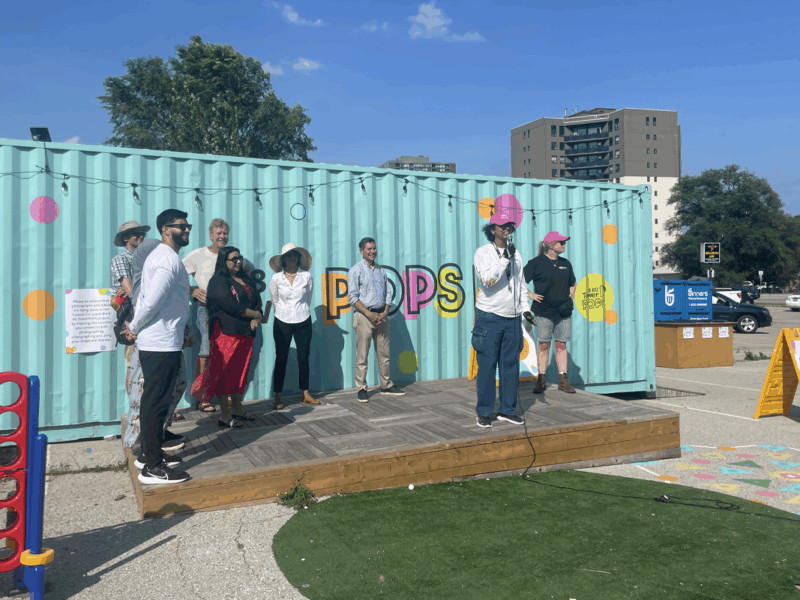
Praneti Kulkarni shared 880 cities’ latest project known as 880 Tower Pops which transforms underused spaces such as empty parking lots into vibrant public areas where nearby residents can exercise, socialize, improve their overall well-being and build community resilience alongside environmental stewardship.
(880 cities)
It is a lesson she was excited to bring to her own work with 880 cities, a nonprofit focused on making urban spaces inclusive for everyone.
At the end, as everyone sang “Happy Birthday” once again for the man of the hour, Suzuki said what he wishes is for Ontarians and for Canadians to “continue fighting” because it is never too late to “try for the planet”.
Email: [email protected]
At a time when vital public information is needed by everyone, The Pointer has taken down our paywall on all stories to ensure every resident of Brampton, Mississauga and Niagara has access to the facts. For those who are able, we encourage you to consider a subscription. This will help us report on important public interest issues the community needs to know about now more than ever. You can register for a 30-day free trial HERE. Thereafter, The Pointer will charge $10 a month and you can cancel any time right on the website. Thank you
Submit a correction about this story

