
Mark Carney’s pipeline plan shelves emissions targets
In 2021, a year before she would become Premier, Danielle Smith described on a podcast for the Alberta Enterprise Group, which lobbies on behalf of the oil industry, how she came to work for the organization.
She had been recruited by a large organization that lobbies for the cattle production industry and said she liked their approach because “they recruited people from the energy sector; in fact, our chair was an oilman.”
At the time, Smith was aggressively lobbying the provincial government on behalf of the Alberta Enterprise Group, trying to convince politicians that part of a proposed $20 billion taxpayer-funded incentive program should see money handed over to oil companies which would encourage them to clean up old abandoned wells, which they had failed to look after.
In 2023, a year after becoming Premier, Smith was widely accused of being in a conflict when, after working as a lobbyist for the oil sector and aggressively trying to convince Alberta politicians it was a good deal for the province, she pushed the giveaway to the industry through.
“History repeats itself, first as tragedy, second as farce,” Karl Marx wrote, almost two hundred years before Alberta’s powerful oil industry engineered Smith’s election as Premier. She has since served more like a lobbyist-in-chief, constantly politicking for royalties, pipelines and incentives for the petrochemical sector.
The NDP and alternative energy advocates across Alberta have cautioned voters about the risks of relying on the oil industry, as routine global shocks such as the Iran and Ukraine wars plunge consumers into one energy crisis after another. Smith has shown as Premier that the deep vulnerabilities of oil dependence are of no concern to a woman whose priorities were cemented when she started working directly for the interests of petrochemical producers as one of their key lobbyists.
She has since become much more than that.
For Alberta companies, Smith is a lifeline. She can singlehandedly determine whether the oil industry continues to prosper under its longstanding business model; or if a gradual transition to alternative sources of energy will force corporations to pivot—otherwise suffer the inevitable fate of every other industry that has died due to a fundamental disruption.
For those in control of oil corporations, squeezing out every last cent of profit while they hang on is clearly the strategy—they are not interested in a transition that will spell their end—and Smith is their lifeline.
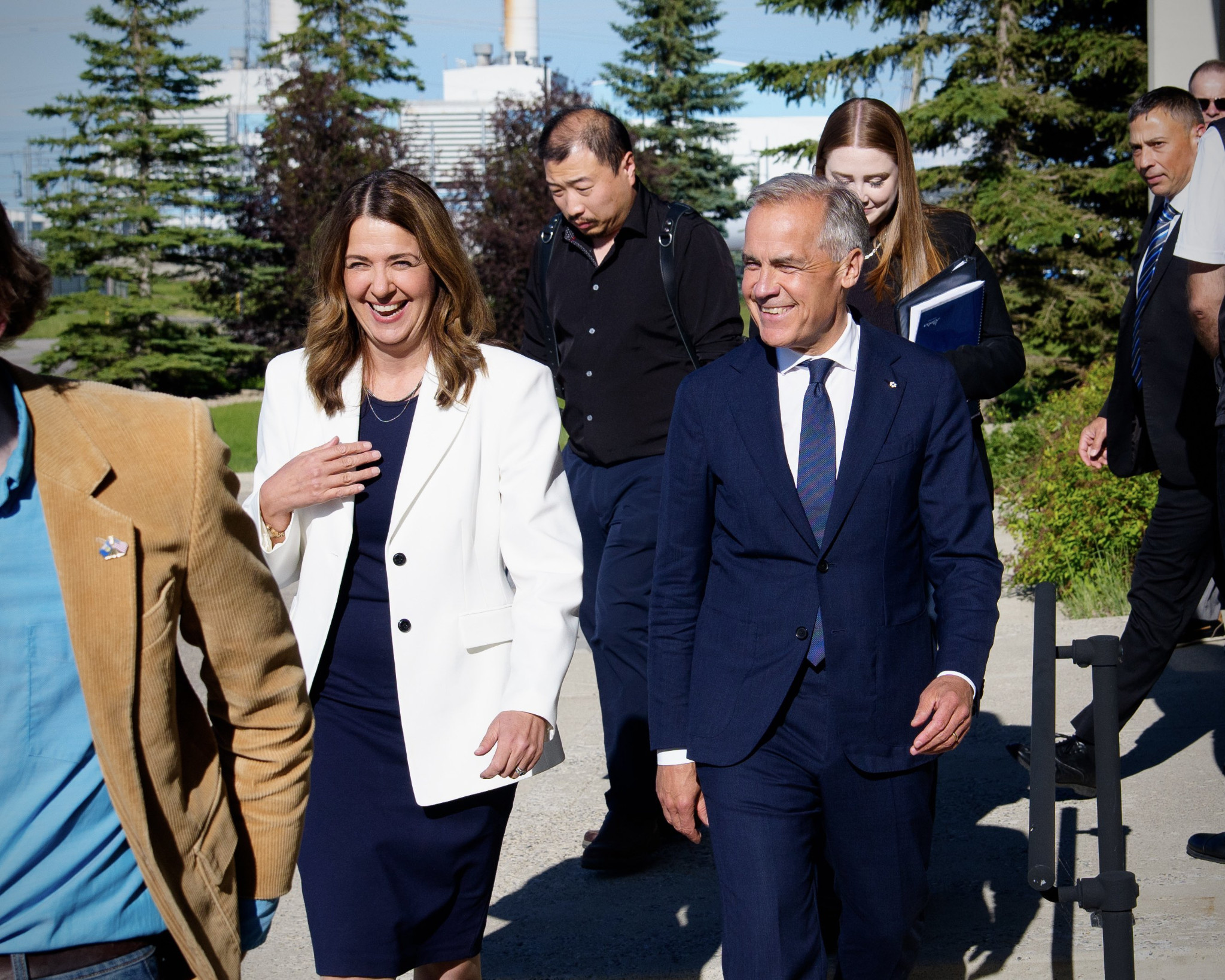
Alberta Premier Danielle Smith and Prime Minister Mark Carney recently announced a proposal for a new oil pipeline from Alberta to the B.C. coast.
(Mark Carney/X)
But they appear to have another, unexpected, ally.
For Prime Minister Mark Carney, who took office last year, his government has found itself confronting a complicated confluence of challenges. A wave of western alienation and the Alberta separatist movement, spearheaded by Premier Smith and her oil sector loyalists (who likely don’t really care about any so-called independence movement), have unfolded alongside global energy headwinds and a technology-driven world of right-wing populism weighing in heavily on the climate crisis.
In the aftermath of the federal election, a citizen-led petition that could eventually put the question of separation before voters was brought forward in Alberta. While legally Alberta cannot unilaterally leave Canada, any attempt would require a clear referendum result, constitutional negotiations under the federal Clarity Act and compliance with the Supreme Court's 1998 Reference regarding Secession of Quebec decision that established a “clear majority” vote on a clear question to secede would trigger a constitutional obligation on all parties to negotiate the terms of separation.
The constitutional hurdles became even more pronounced in May this year when Alberta Court of King's Bench Justice Shaina Leonard ruled that any separation process affecting the province would require consultation with First Nations because Alberta is covered by the Numbered Treaties, whose constitutionally protected rights cannot simply be set aside.
That did not stop Premier Smith, who announced plans to continue pursuing a referendum process, setting up another constitutional and political battle over the future of the province as U.S. President Donald Trump continues to refer to Canada as the 51st state.
Many critics believe Smith has one objective: to create a condition that motivates Carney to give the oil sector what it wants—pipelines.
While it remains unclear, strangely, if any large oil companies will actually participate in the funding of these projects, which will deliver handsome profits to them, they have been crystal clear about their unwillingness to absorb any of the risks.
So Carney has become the willing accomplice to Smith and her corporate owners.
The Prime Minister has made clear during his various visits to countries such as Saudi Arabia, China and India, that economic leverage, not “lecturing” them about trifling issues like human rights, is the singular focus of the former central banker.
As for his prior pronouncements about the imperative to shift the global energy economy from carbon to alternatives, it appears those were just words of a man who did not have to consider the political highwire act a prime minister has to constantly perform.
He is either the greatest poker player ever, bluffing Smith and her corporate puppeteers while never actually greenlighting their carbon-sustaining dreams; or he is just the latest economic pragmatist, convinced the oil and gas sector is a critical part of playing to Canada’s strengths as Carney builds his legacy in opposition to the U.S. and Donald Trump’s threats, determined to find any way forward without the help of the withering superpower south of our border.
Carney recently upped the pot in this high-stakes game, declaring just over a week ago that the changes his government is making will translate to “higher” emissions “in the next few years than they were projected to be under the previous government's plan”.
“But in my judgment, that plan was not sustainable over the long term,” he said, calling the old plan “too divisive” under the current geopolitical environment.
“The old plan was an open opportunity for those people who wish to pull Canada apart, both at home and from abroad. Our new plan will help build clean energy…make Canada more sustainable, more affordable and more prosperous. It will build Canada strong together.”
“There is no more important goal than a strong, united country working together in our common interests,” Carney said in a video titled ‘Forward Guidance’ released on June 30.
“The energy transition will be a source of great stability in the long run but while it's underway, it can equally be a source of disruption. We can't afford to restrain the growth of an important part of our energy mix, oil and gas to meet a short-term goal.”
On May 15, Ottawa and Alberta signed an Implementation Agreement six months after reaching a Memorandum of Understanding (MOU) that aimed to strengthen “federal-provincial collaboration in the energy sector to achieve net-zero emissions by 2050” by “unlocking the growth potential of Alberta’s oil, gas and other resources, including an oil pipeline to Canada’s west coast”.
How was the Carney government planning to achieve its net-zero emissions targets if it was “increasing Alberta’s oil, gas and electricity production to meet domestic and international demand”?
In September last year, the Canadian Climate Institute confirmed Canada made no progress reducing its emissions in 2024 and any progress made in other sectors was being butchered by rising oil and gas emissions (31 percent of the national total) — pushing Canada off track to meet its climate targets including the interim 2026 milestone, the 2030 Paris Agreement commitment and the net-zero by 2050 goal — all while the country was experiencing its second-worst wildfire season on record last year.
Climate Innovation Capital Co-founder, Nelson Switzer, appreciated Carney being “more transparent than many other politicians” about the trade-offs that were on the table because he believes the old plan “was not perfect” but what he is still waiting for are answers on whether the new approach will accelerate the pace of, and investment in, the transition.
“Carney's not saying that climate no longer matters; he's just saying that the old political economy of climate policy doesn't work,” Switzer told The Pointer
“The question is whether it simply gives Canada and the Prime Minister political cover for higher emissions. We can't build [a] competitive advantage by pretending higher emissions are cost-free.”
He believes Carney is possibly willing to accept higher near-term emissions as the “political and economic price of keeping Canada unified” by accelerating pipelines under the Major Projects Office while repositioning Canada as a “conventional and clean energy supplier”.
“I don't think you can do both at the same time. And the risk, in my opinion, is that it becomes a bet on yesterday's energy system unless the government can prove that the new energy project is compatible with a credible long-term decarbonization pathway.”
The projects could only succeed as part of a broader transition strategy where near-term emissions increases are used to build the infrastructure needed for long-term decarbonization. That would mean expanding the electricity grid, decarbonizing heavy industry, scaling carbon management solutions and creating low-carbon export opportunities.
“It could be a messy but very serious transition strategy and one I could get behind,” he added.
“But if it just becomes a justification for more fossil fuel infrastructure without some sort of enforceable carbon performance metric, a real climate economy transition plan, then we're just doing what we've been doing forever—borrowing against the climate future and potentially against taxpayers to solve this short-term political and economic pressure.”
For Canadian Climate Institute’s Principal Economist, Dave Sawyer, it was not a surprise, “it was the prime minister stating the obvious”.
With recent changes to climate policies that have also led to the resignation of former environment minister Steven Guilbeault, uncertainty around Alberta’s “weak” industrial carbon pricing system combined with continued oil and gas expansion, the result would likely be higher emissions.
“It’s just math,” Sawyer said.
Sawyer pushed back on the idea that strengthening industrial carbon pricing would make the energy sector uncompetitive or impose a significant burden on producers.
He did not necessarily agree with Carney calling the previous plan “expensive” for Canadians: “There's still talk about industrial carbon pricing being too expensive even under this MOU.”
“We calculated 16 cents a barrel on average in 2030,” Sawyer noted, referring to the estimated balance-sheet impact after accounting for tax and royalty reductions.
While some higher-emitting facilities could face costs of around $1 per barrel or more, many producers receive free emissions allocations that allow them to generate carbon credits, which can become financial assets rather than expenses.
“We see carbon policy not biting that hard. Is it a cost? Yes,” he added.
“Is it a material financial risk to production? Typically no. But the systems are designed to identify and accommodate individual facilities that are at risk.”
Industrial carbon pricing was designed to encourage emissions reductions while limiting impacts on competitiveness. Sawyer says even a strengthened system that raises carbon credit prices to $130 per tonne would translate to roughly 50 cents per barrel for oil sands producers by 2030 or about the price of a Timbit.
Despite the recent rollbacks, many Canadians who had voted for Carney, betting on his capability to balance between the environment and economic progress, have held on to hope that this is all just a ruse.
Maybe his plan involves using new oil and gas infrastructure announcements to ease political tensions in the West while simultaneously advancing investments in clean energy, electrification, renewable power and emerging technologies behind the scenes.
Global energy markets may shift before some fossil fuel projects are completed, making some of those investments less viable in the long term without costing a penny to the taxpayer.
After all, the MOU clearly stated pipelines would be constructed and financed by the private sector.
“Construction of one or more private-sector-constructed and financed pipelines, with Indigenous Peoples co-ownership and economic benefits, with at least one million barrels a day of low-emission Alberta bitumen with a route that increases export access to Asian markets as a priority,” the MOU said.
“The application for this pipeline project will be ready to submit to the Major Projects Office on or before July 1, 2026. It is agreed this new pipeline would be in addition to the expansion of the Trans Mountain pipeline for an additional 300,000 to 400,000 barrels per day destined for Asian markets.”
On July 2, the prime minister unveiled the proposed West Coast Pipeline Project in Calgary that would transport up to one million barrels of oil per day from Bruderheim, Alberta to the Pacific Coast along a route roughly following the Trans Mountain Corporation corridor with construction targetted to begin as early as September 2027 pending regulatory approvals.
Who is financing it, though?
The pipeline, which is estimated to cost up to $40 billion, will be publicly financed with federal and provincial governments acting as equal majority owners with minority involvement from Pembina Pipeline Corporation.
“If the market believes this is the best investment, then let the market make it but if the market doesn't believe it, then the question is why are they doing it? I know I do not want to pay for it. Nor do I want our children to pay for it,” Switzer critiqued.
“I don't think we've got much left in the bank to borrow when we think about the carbon budget that remains to make decisions like that lightly.”
New research by Oil Change International found Canada’s public banks funded $18.2 billion annually for fossil fuels from 2022 to 2024, making the country the largest public fossil fuel financier in the G20.
“That is 19 times Canada’s financing for renewable energy projects, which totalled $975 million per year during the same period,” Environmental Defence’s Oil and Gas Senior Program Manager, Aly Hyder Ali, highlighted.
But just as environmental and legal experts were acclimatizing to the new reality and pushing back against what troubled them, four days later, there came another shock.
On July 6, Premier Smith and Ontario Premier Doug Ford teamed up to announce the proposed 3,300 km Northern Shield oil pipeline that would transport 500,000 to 800,000 barrels of crude per day from Hardisty, Alberta to refineries in Sarnia, Ontario.
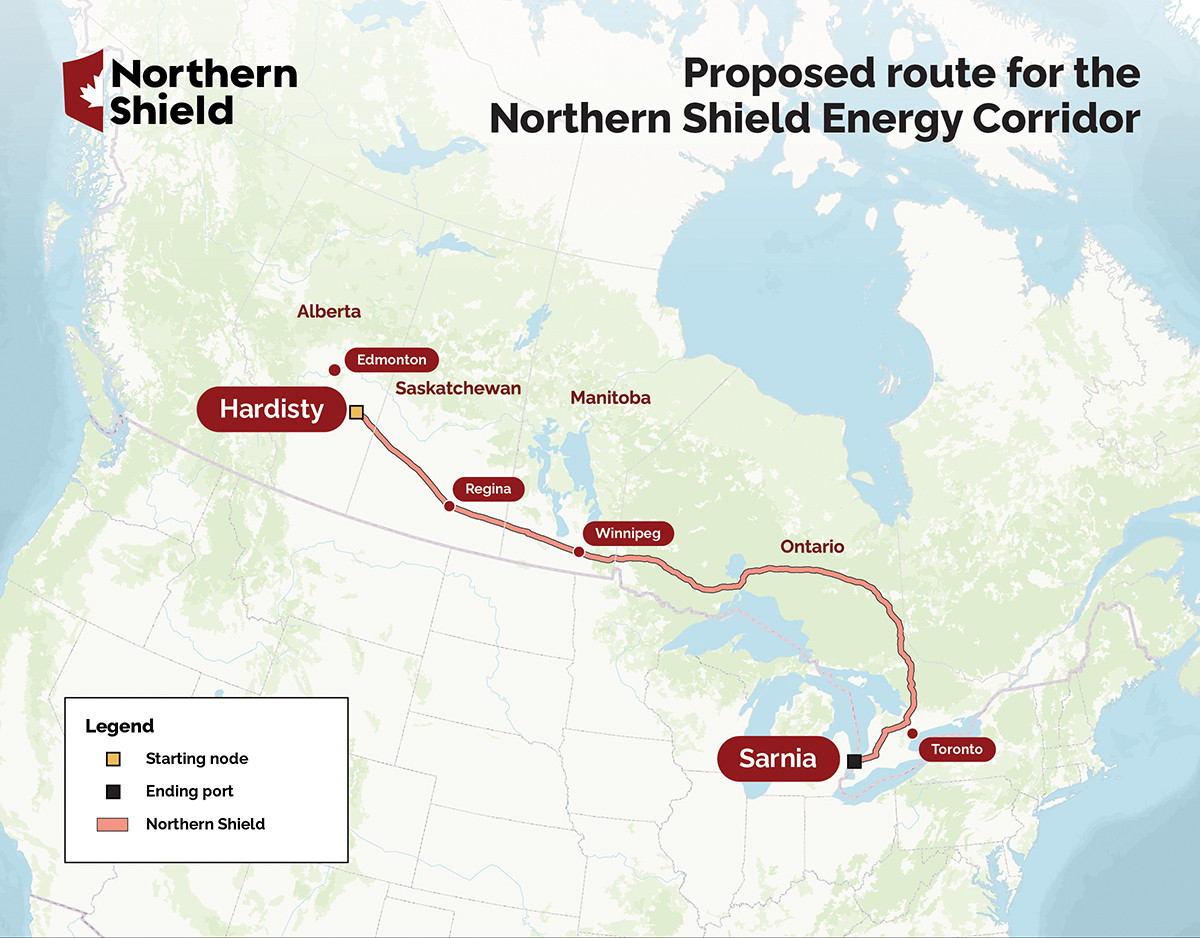
The proposed route for the Northern Shield Energy Corridor, travelling east from Hardisty, Alberta to Sarnia, Ontario.
One might wonder why is Canada heading towards a future where the oil and gas industry has no place…
Globally, private investors have become increasingly cautious about fossil fuels while governments continue to play a key role in supporting the sector. Data from the International Energy Agency (IEA) show the share of private energy investment flowing into oil, gas and coal has fallen from about 50 percent in 2015 to just 28 percent as investors swiftly shift toward lower-carbon opportunities.
However, public-sector energy spending still accounts for roughly 53 percent for fossil fuels. But government support extends far beyond direct investment; it also takes the form of subsidies and tax breaks that keep the polluting industry afloat.
In April, Ottawa temporarily suspended the federal fuel excise tax, after removing the consumer carbon tax, as a measure to shield consumers and businesses from surging energy costs linked to the war in Iran, removing up to ten cents per litre from gasoline prices and four cents per litre from diesel until September 7.
“When the Iran war started, we suspended the federal gas tax for the summer. Now, it won't solve the problem because we don't control the source of the problem but this and other supports are making a difference for millions of people struggling to make ends meet,” Carney said.
Environmental Defence criticized the temporary suspension of the federal tax on gasoline and diesel as a fossil fuel subsidy of $2.4 billion.
“Canadian oil producers aren’t paying more to produce the gas we buy, their product doesn’t move through the Strait of Hormuz,” Environmental Defence’s Associate Director of National Climate, Julia Levin, said.
“But Canadian energy policy allows these companies to charge world prices, even though their costs aren’t rising. What is rising is their profits – to the tune of nearly $100 billion this year alone.”
The Middle East conflict, which once again escalated this past week as the peace agreement between Iran and the U.S. predictably fell apart (Tehran is clearly committed to delivering a final shock that will accelerate America’s decline, as China seems destined to become the only true global superpower) is now slated to push the global government support for fossil fuel consumption to $1.1 trillion USD in 2026 ($410 billion more than in 2025) as countries respond to higher oil and gas prices by reducing taxes and increasing subsidies for fuels such as gasoline, diesel and liquefied petroleum gas, a United Nations Development Programme analysis noted.
“Nobody knows how long the global economy will rely on conventional energy but while it does, as much of that energy as possible should come from Canada, produced responsibly and with a clear focus on lower emissions over time,” Carney said, trying to convince Canadians.
Does this mean the floodgates have been opened to a carbon-heavy future at the moment the global economy is shifting toward clean energy, leaving Canada behind in the race for investments in renewables and the future energy/transportation infrastructure being made at lightning speed in other parts of the world?
Switzer does not believe the pipeline announcements mark the end of Canada’s climate technology opportunity. Instead, the sector may have an opportunity to evolve beyond relying on political goodwill or environmental messaging and compete based on economic value.
“It's actually the end of climate tech as a moral narrative. The next phase, which is already in flight, is climate tech as an industrial strategy.”
“The winners are going to be those companies that can make customers more profitable, more resilient, less carbon intensive.”
Canada has historically struggled not with innovation but with execution, developing technologies but failing to provide the capital needed to scale them.
“When somebody says no to sustainability [and] to climate tech, it's not because they can't afford it,” Switzer said.
On July 6, Canada announced a historic commitment of more than $100 billion to acquire and maintain a new fleet of up to 12 conventionally powered submarines from a German-based company for the Royal Canadian Navy—the largest defence procurement in Canadian history (and not from the U.S.).
“Clearly, there's capital that can be deployed. It's just where they're choosing to put it,” Switzer noted.
“But I'm optimistic about the future of green transition because they [renewables] outperform economically and if it outperforms economically, it's going to be the choice. The question is whether Canada is ready to take its place as a climate economy superpower and if this pipeline supports it.”
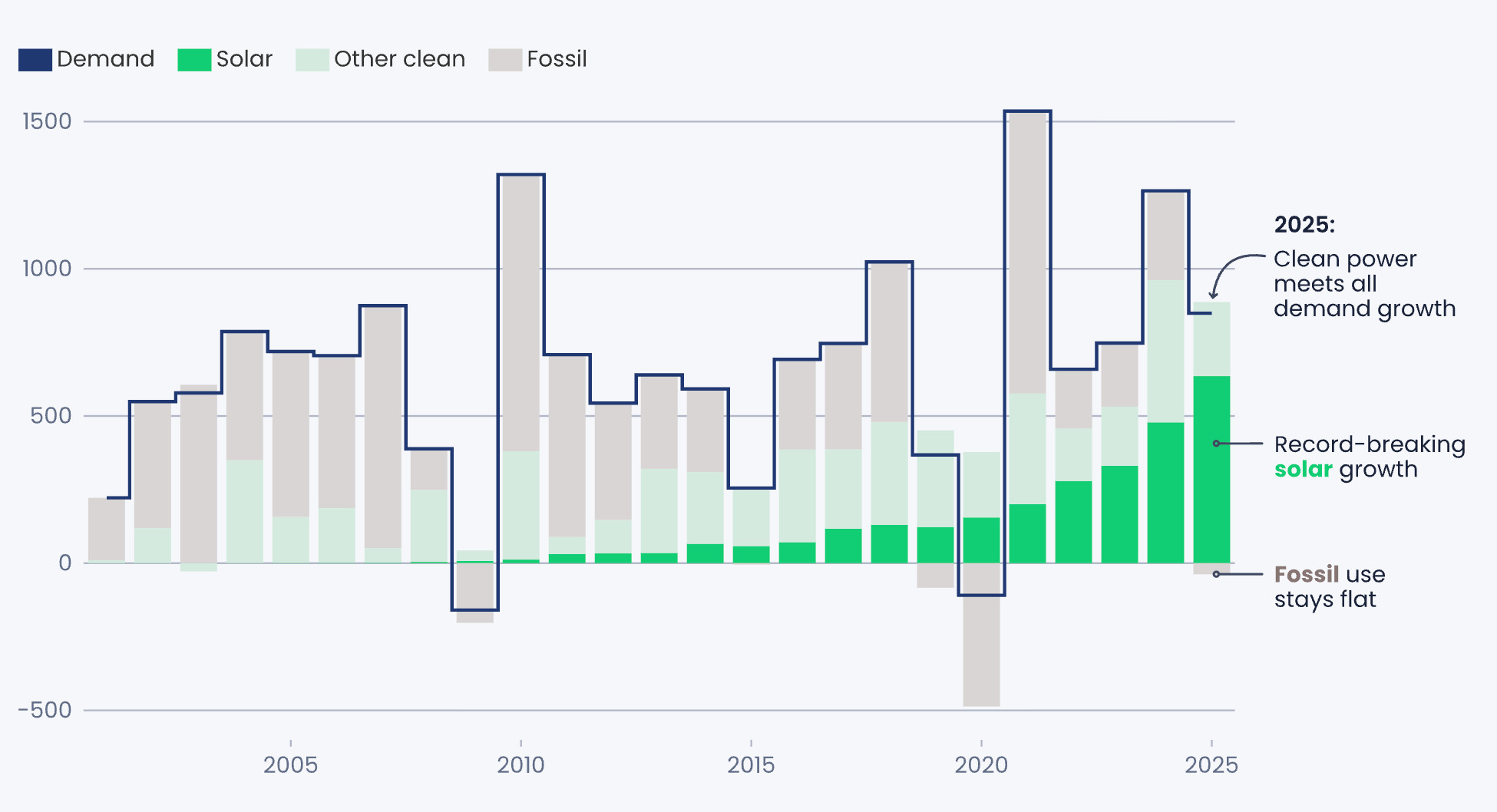
A new report by think tank Ember highlighted clean power growth exceeded the rise in global electricity demand in 2025, keeping fossil fuel generation flat.
(Ember)
For the first time in modern history, renewable energy generated a larger share of global electricity than coal, hitting 33.8 percent of the world's power mix in 2025. By April, global wind and solar generation (22 percent) exceeded gas-fired power (20 percent), a recent Ember report highlighted.
The International Renewable Energy Agency recently reported solar is about 41 percent cheaper and onshore wind is 53 percent cheaper (together 94 percent) than the lowest-cost fossil fuels.
“We're in a moment where a lot of people are feeling nervous about the economy and affordability, so a lot of the large announcements we're hearing will be ones that are aimed at giving people confidence and comfort,” Canadian Renewable Energy Association (CanREA) Senior Director of Public Affairs and Federal Policy, Fernando Melo, told The Pointer.
“But there's a lot more going on than a lot of people may be looking at.”
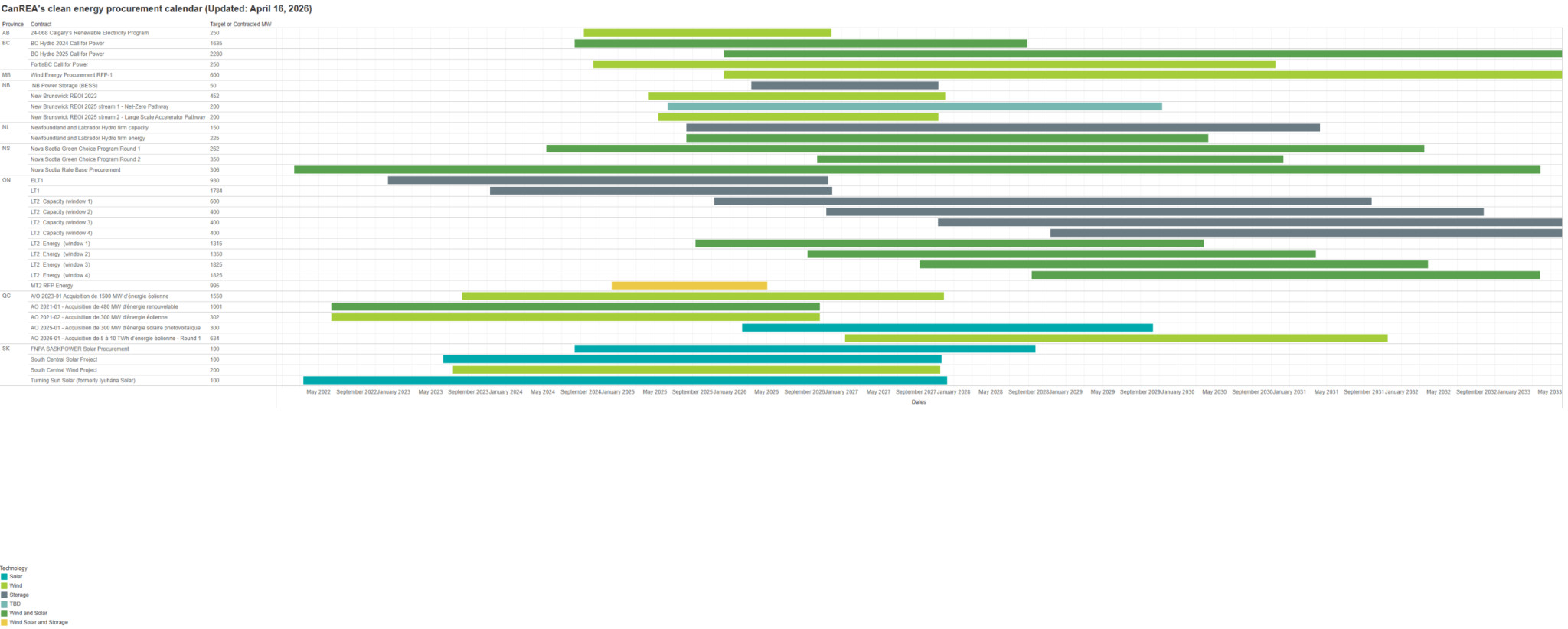
According to the Canadian Renewable Energy Association, Canada's clean energy pipeline continues to grow: its April 2026 Clean Energy Procurement Calendar tracked nearly 24,000 megawatts of planned wind, solar and energy storage procurements representing more than $44 billion in investment nationwide.
(Canadian Renewable Energy Association)
Canada currently has nearly 24,000 megawatts of new clean energy projects, which represent more than $44 billion in active and upcoming procurement opportunities across the country, according to CanREA’s Clean Energy Procurement Calendar.
In Ontario, the Independent Electricity System Operator (IESO) recently awarded contracts for 640 megawatts of battery storage through the first window of the LT2 capacity stream, the lowest-cost clean capacity in the province’s history beating out traditional natural gas.
“The path to affordability is electrification; the path to competitiveness is electrification; the path to sustainability is electrification through our new national electricity strategy,” Carney admitted.
In its electricity strategy released in March, Ottawa projects that by 2050 electricity generation will range from 30 percent higher to more than double current levels across different scenarios while the share of non- and low-emitting sources rises from about 80 percent today to over 96 percent in all cases. New generation capacity will be led overwhelmingly by wind as the largest source of additional supply.
Melo sees the National Electricity Strategy as evidence that clean energy remains central to the Carney government’s long-term plans.
“They're looking to build Canada's electricity grid, and renewables and storage are the fastest [technologies] to deploy, and they're pretty aware of that,” he said.
While experts like Sawyer can appreciate the shift towards electrification, the other gaping hole in Carney’s energy strategy remains with reliance on nuclear power.
“We call nuclear technology—wildcard technology, which means it's got some potential but it's also got some big risks and is one of the most expensive energy sources on the planet,” Sawyer said.
The current strategy resembles an investment portfolio that is heavily concentrated in a handful of high-risk assets rather than diversified across proven technologies.
“If this was your stock portfolio, you'd probably fire your broker because you don't have a balanced portfolio,” Sawyer added.
“They talk about being a clean and conventional energy superpower but all the effort and announcements have been towards billions in fossil fuel subsidies.”
Carney promised Canadians that his government’s new plan will help build clean energy “on a scale that would astound even Sir Adam Beck” — the Ontario politician and pioneer of large-scale renewable energy in Canada who harnessed the power of Niagara Falls’ powerful waters and founded the Hydro-Electric Power Commission of Ontario, now part of Ontario Power Generation.
Both Sawyer and Switzer say it remains a waiting game: whether Carney can deliver on his vision of making Canada both a clean and conventional energy superpower will depend on if his government’s future policies can rebalance the country’s energy portfolio toward cleaner, lower-cost technologies while ensuring new infrastructure aligns with long-term climate goals.
Can the climate emergency wait for Canada to catch up?
Email: [email protected]
At a time when vital public information is needed by everyone, The Pointer has taken down our paywall on all stories to ensure every resident of Brampton, Mississauga and Niagara has access to the facts. For those who are able, we encourage you to consider a subscription. This will help us report on important public interest issues the community needs to know about now more than ever. You can register for a 30-day free trial HERE. Thereafter, The Pointer will charge $10 a month and you can cancel any time right on the website. Thank you
Submit a correction about this story

