
‘If climate plan is credible, defend it’: Youth push back against Carney government’s bid to strike lawsuit
Three young Canadians are fighting to keep their climate lawsuit alive after the Mark Carney government made attempts to toss it out without a full hearing, contending that Ottawa cannot simply leave a five-year-old climate plan on the shelf after removing some of the measures it once said would help Canada meet its emissions target.
“Across the country, Canadians are living through the devastating reality of not having a meaningful plan to address climate change,” youth applicant Marie Maltais said.
“Yet, at this critical moment, the government is fighting to throw our case out of court, while simultaneously moving ahead with fossil fuel expansion and rolling back key climate protections.”
On June 15, Ecojustice, on behalf of the three young activists, Environmental Defence and the Canadian Association of Physicians for the Environment (CAPE), filed an application at the Federal Court for judicial review, suing Prime Minister Mark Carney for “dangerous” and allegedly illegal rollbacks that undo decades of progress.
“This is not where I saw myself in 12 years,” applicant and Greater Sudbury resident Sophia Mathur said at a press conference in Ottawa on June 16.
“I was hoping by this time that we would have stricter climate policies and plans, but it feels like it is an endless amount of promises with no effective plan and it was disappointing to hear when I was 11 and it’s disappointing to hear when I am 19 now.”
Fifteen days later, Carney admitted Canada’s greenhouse gas (GHG) emissions would be higher “in the next few years than they were projected to be under the previous government’s plan” as he greenlit pipeline projects alongside Alberta Premier Danielle Smith.
While criticizing the Trudeau-era climate framework — already considered weak — he claimed it would have been too expensive and divisive for Canadians dealing with affordability concerns. Days later, Smith said she planned to forge ahead with a binding referendum on Alberta separation.
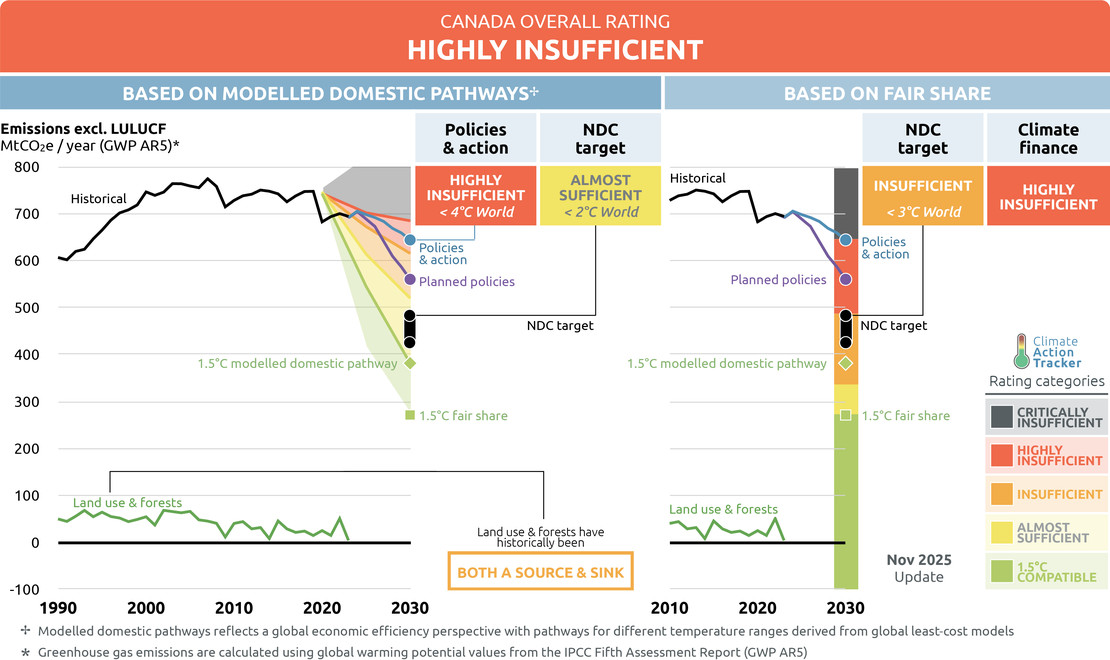
According to the Climate Action Tracker, “Canada’s climate action appears to be stalling, even as the country faces intensifying impacts”.
(Climate Action Tracker)
When Canada passed the Canadian Net-Zero Emissions Accountability Act (Bill C-12) in 2021, it created a legal framework requiring the government to set binding greenhouse gas reduction targets including five-year milestone targets and publish detailed, science-based plans and progress reports aimed at achieving net-zero emissions by 2050; part of that plan is achieving the 2030 target to cut emissions by 40 to 45 percent or approximately 440 megatonnes (Mt) below 2005 levels under the Paris Agreement.
Ecojustice lawyer Fraser Thomson explained the case argues the federal government’s abandonment and weakening of key measures in its 2030 emissions reduction plan has rendered it unlawful under the Canadian Net-Zero Emissions Accountability Act (CNZEAA), which requires the environment minister to maintain a climate plan capable of meeting the 2030 target.
“We know that key pillars of that plan have been weakened and scrapped entirely, and targets without a plan are simply empty promises,” Thomson told The Pointer.
In February, an independent review of the federal government’s progress report on its climate plan revealed the country is not on track to meet any of its climate goals, including its 2035 target and net zero emissions by 2050.
“Instead, national emissions are on course to be roughly half way to the 2030 emissions goal,” a Canadian Climate Institute report noted.
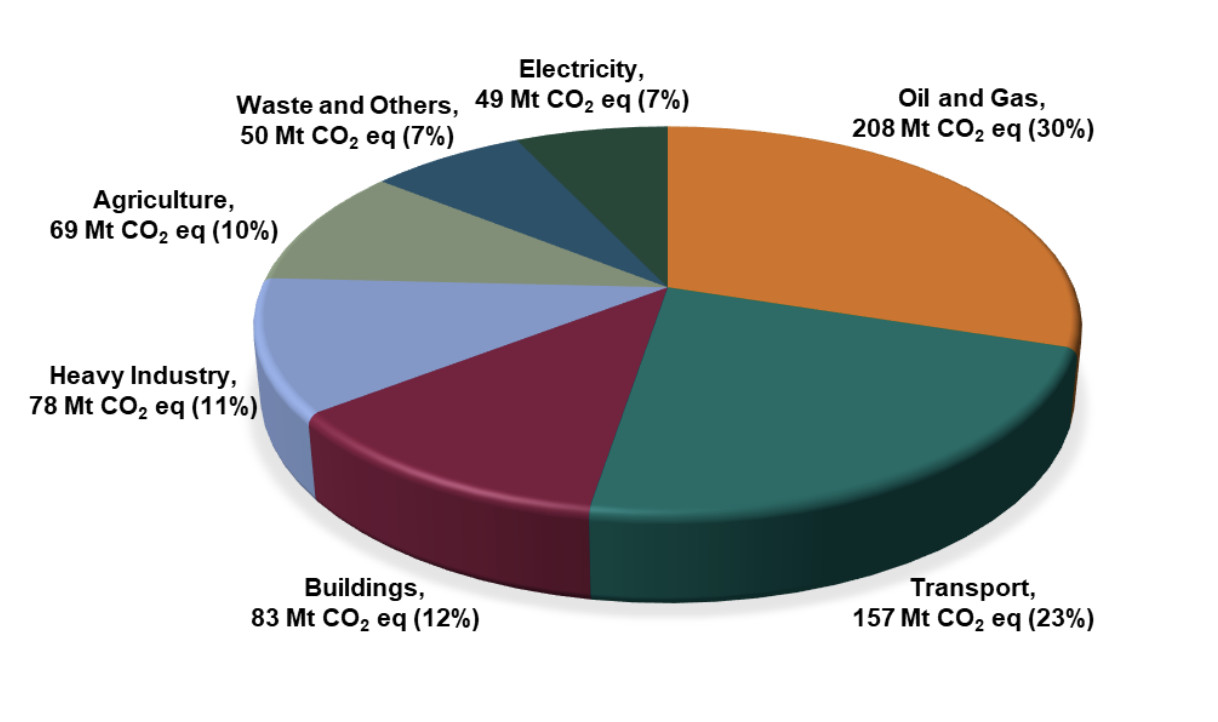
Ottawa’s 2025 Progress Report on the 2030 Emissions Reduction Plan clearly demonstrates that the oil and gas industry accounts for the highest emissions in the country, sitting at 30 percent.
(Government of Canada)
National emissions were estimated at 694 Mt in 2024, just 8.5 percent below 2005 levels, while emissions from the oil and gas industry had risen nine percent since 2005.
“The further Canada veers away from its climate targets, the steeper the path forward. That puts critical economic opportunities at risk—especially as our non-U.S. trading partners are rapidly decarbonizing their economies and looking for solutions,” Canadian Climate Institute President Rick Smith said.
On August 14, just a month before the first-ever Canada Investment Summit where the Carney government is set to showcase the country as a destination for investment and economic growth, Ottawa filed a motion asking the court to strike the lawsuit before it proceeds to a full hearing.
While federal lawyers argued that climate policy falls “beyond the Court’s institutional capacity to address”, the government’s position rested largely on discretionary language that is often used by policymakers at all three levels of government while drafting legislation frequently criticized by environment and public advocacy groups alike.
Section 11 of the Canadian Net-Zero Emissions Accountability Act states: “the Minister of the Environment may amend an emissions target or an emissions reduction plan as long as the changes being made are consistent with the purposes of the Act”.
“Read in its ordinary and grammatical sense, the use of the word ‘may’ clearly does not impose any obligation to amend,” the motion submitted to the court emphasized.
Thomson noted judicial review applications are required by law to proceed “expeditiously and without delay” under the Federal Courts Act and Federal Courts Rules.
“These kinds of motions are rare, and they're even more rarely granted,” he added.
On August 27, the youth and advocacy groups pushed back against the federal government’s attempt to have the case dismissed by filing legal submissions opposing the motion and asking the Federal Court to order an expedited hearing on the merits.
The applicants argue the minister’s “public legal duties” under sections 9(1) and 10(1)(b) of the CNZEAA are mandatory, meaning the government must maintain an emissions reduction plan “for achieving” the 2030 target and one that describes the key measures it intends to take to achieve it.
The government’s focus on section 11 mischaracterizes the case because that provision is not the source of the underlying legal duties.
The groups pointed to Ottawa’s own reporting as evidence of the existing plan no longer being capable of achieving the emissions target: even with additional measures, the reduction was projected at only 28 percent — well short of the 40 to 45 percent target. A House of Commons Standing Committee also found Canada was “not on track to meet its greenhouse gas reduction targets and has no plan to meet them”.
These admissions make the 2030 Emissions Reduction Plan effectively “obsolete” which further blocks “any ability to transparently understand the government’s climate plans or to hold the government to account”.
In holding the government accountable, the applicants are using the writ of mandamus — “a remedy that judges have available to them to order a government actor to take action when they have a public duty, and that actor is failing to fulfill that public duty”.
In this case, Thomson argues it is appropriate for judges to “order the [environment] minister to set a 2030 target that complies with the law, and specifically that sets out how the government can achieve the 2030 target”.
While acknowledging Canada’s conundrum of facing “an extraordinarily difficult economic moment” with U.S. President Donald Trump changing policies at a whim, he believes it still does not justify “the government's actions over the last year” that attribute to a “short-sighted push to weaken climate action and to expand fossil fuel production in the country”.
“Doubling down on fossil fuels at this moment doesn't diversify us from the U.S. — it ties us closer to the U.S.,” Thomson added.
A 2025 report unveiled that even as oil prices fluctuate due to a shaky geopolitical climate, American investors are increasingly buying stakes in Canada’s fossil fuel sector, owning about 59 percent of Canadian oil and gas companies.
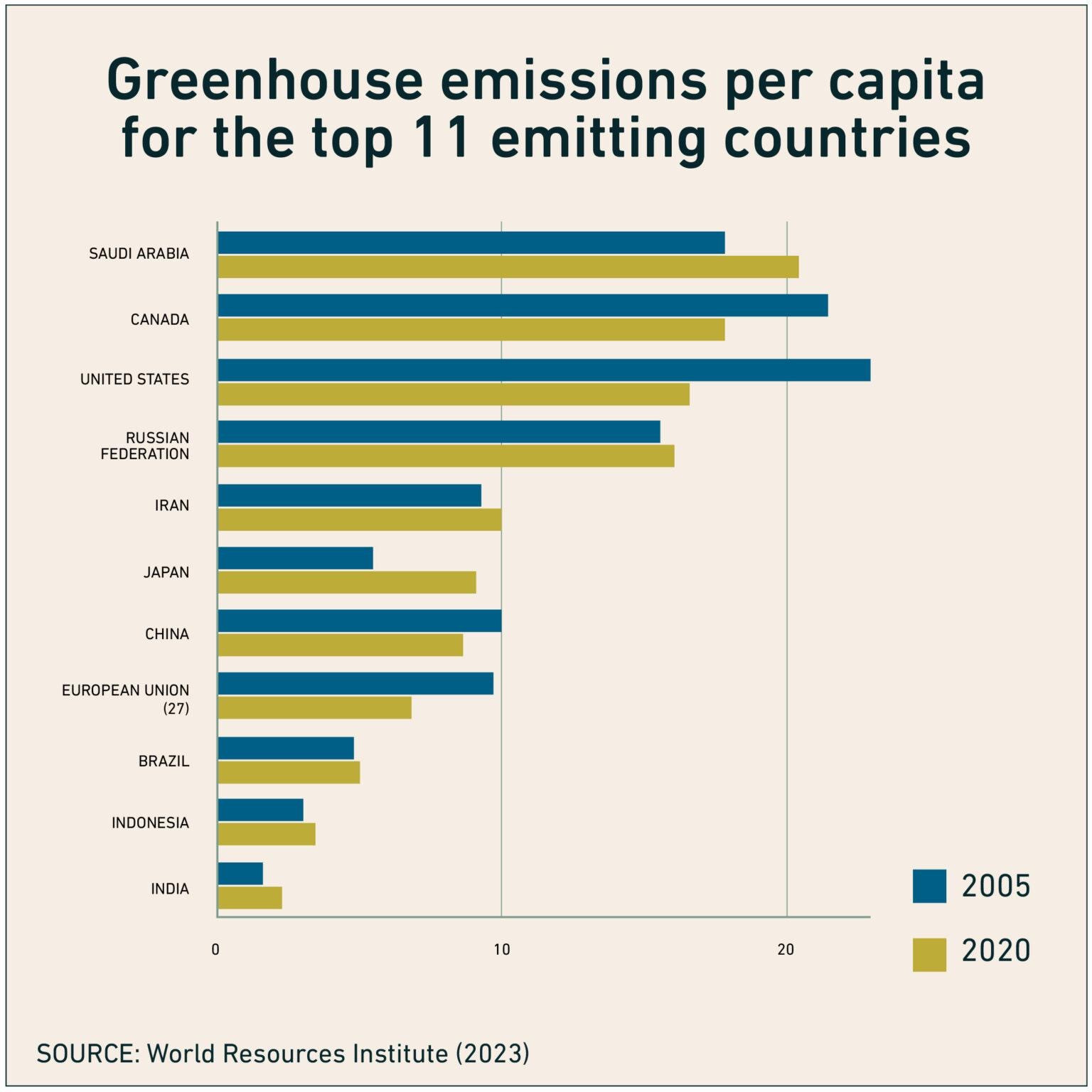
Canada has one of the highest per capita carbon footprints in the world, second only to Saudi Arabia, and emits twice as much per person as China. In 2023, it produced 5.76 million barrels of oil daily, about six percent of global output with most reserves located in Alberta’s oil sands.
(David Suzuki Foundation)
“In this moment, supporting Canada and holding our government accountable for its legal obligations to follow the law and to protect us from the climate crisis; those two things aren’t contradictory,” Thomson stressed.
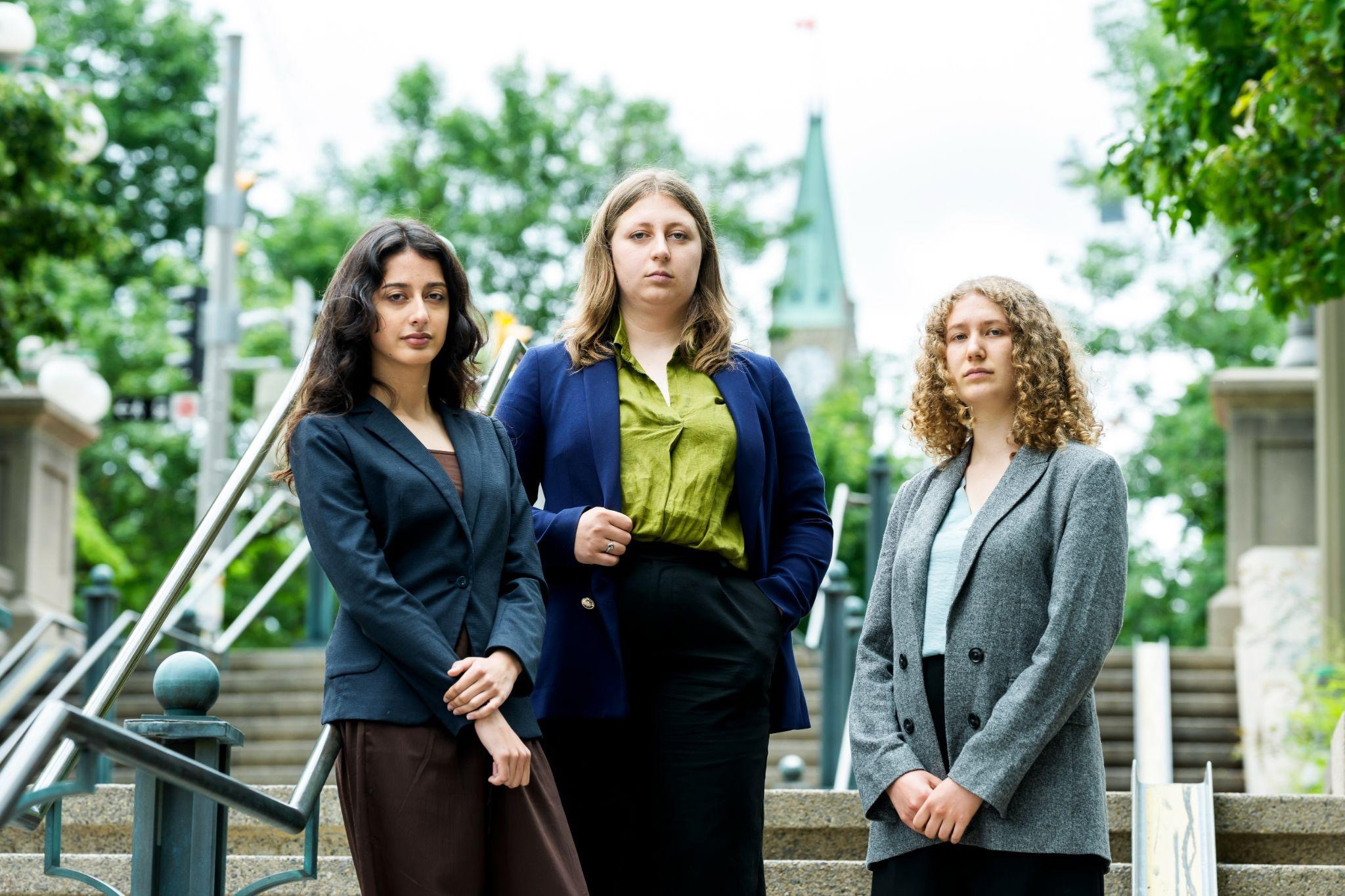
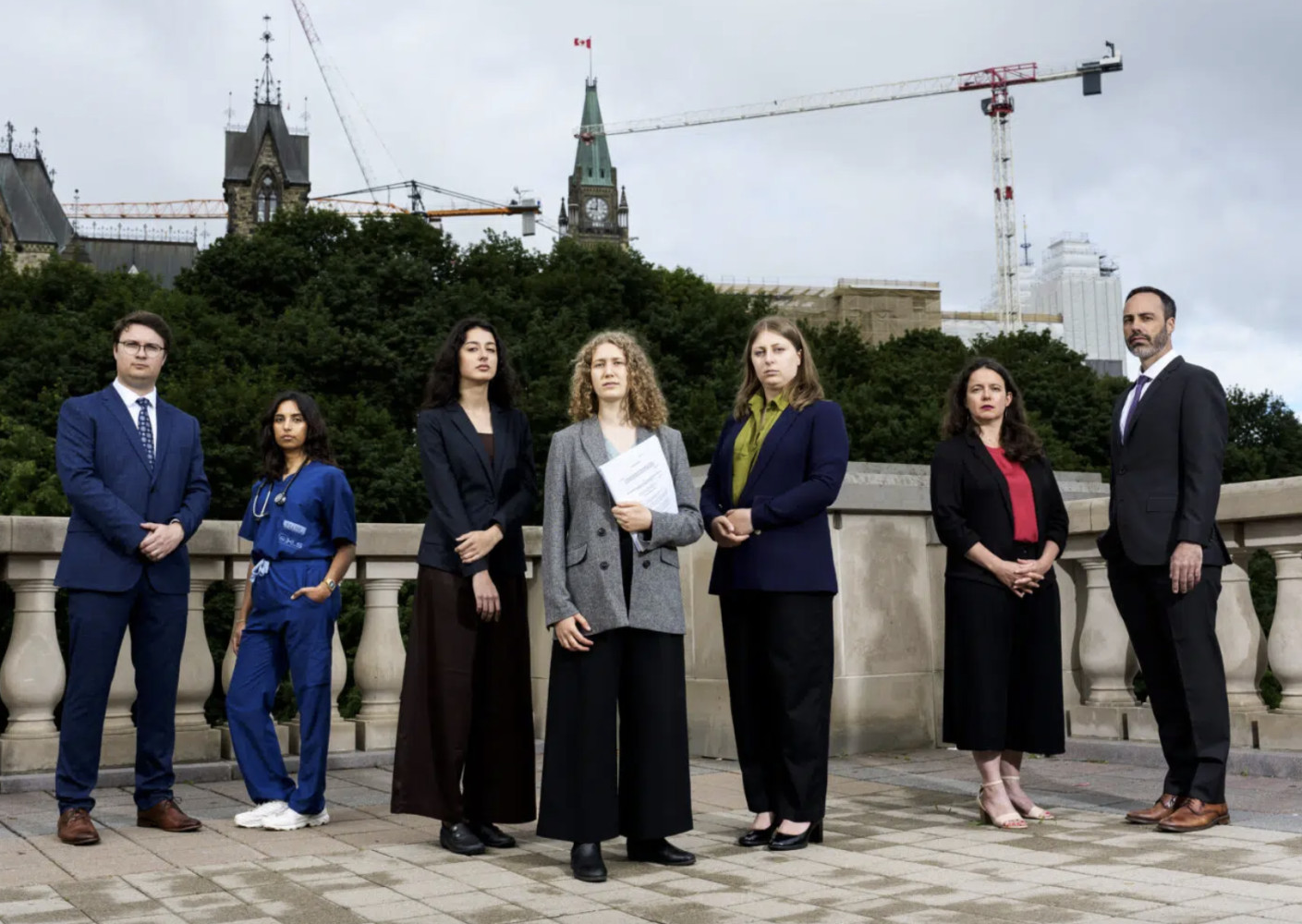
Sophia Mathur (left), Marie Maltais (center) and Shirley Barnea are taking the Mark Carney government to federal court over recent climate rollbacks and a failure to follow its legal mandate of meeting climate targets.
(Justin Tang/Ecojustice)
The federal government now has until September 4 to file its reply to the applicants’ August 27 submissions. After that, the legal submissions will go before the Federal Court for a decision on whether to grant Ottawa’s motion to strike.
“The bulk of their argument, the basis on which they're bringing this motion, is already set out in their main argument,” Thomson added.
In their latest legal submissions, the applicants have also asked for an expedited process, disputing that the government’s request for additional time would cause “unnecessary delay” in a case that turns primarily on whether the minister has complied with mandatory statutory duties.
“This is not a question of asking the court to decide what climate policies the government should adopt,” Thomson clarified.
“It’s a question of statutory compliance.”
If the government’s motion is dismissed, the underlying judicial review would then proceed toward a hearing on the merits.
“If the Carney government believes its climate plan is credible, it should be willing to defend it in court,” Mathur said.
Email: [email protected]
At a time when vital public information is needed by everyone, The Pointer has taken down our paywall on all stories to ensure every resident of Brampton, Mississauga and Niagara has access to the facts. For those who are able, we encourage you to consider a subscription. This will help us report on important public interest issues the community needs to know about now more than ever. You can register for a 30-day free trial HERE. Thereafter, The Pointer will charge $10 a month and you can cancel any time right on the website. Thank you
Submit a correction about this story

