
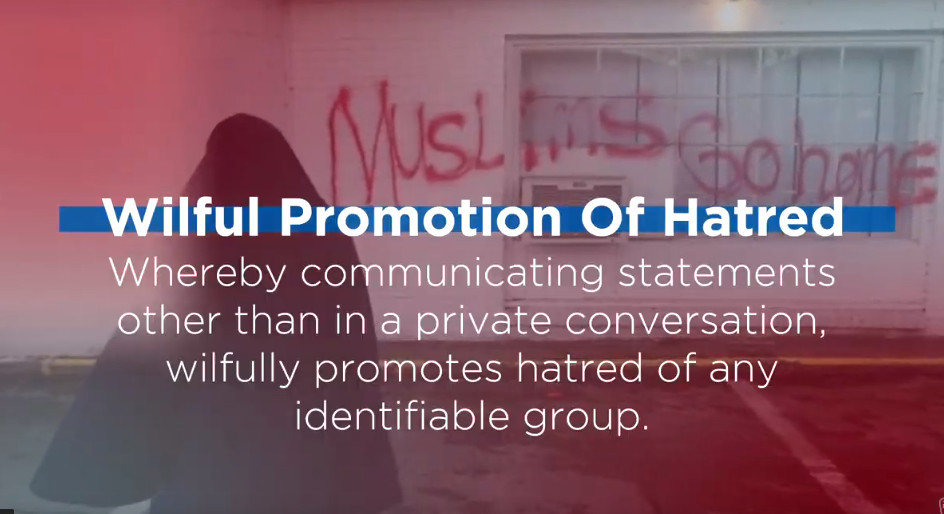
Hate crimes in Peel increase alongside tensions between minority communities
Hate-motivated crimes reported to Peel Regional Police rose 17 per cent in 2025, climbing to 195 incidents from 166 in 2024. Within this total, incidents involving the large South Asian community, which makes up about 40 percent of the population in Brampton and Mississauga, jumped 115 per cent, according to a report presented to the Peel Police Service Board.
In 2020, there were 93 police reported hate-motivated incidents in Brampton and Mississauga; the number spiked to 162 in 2023, levelled off in 2024 with 166 reported incidents, then jumped again to 195 police reported hate-motivated cases last year.
Of the 195 hate-motivated crimes reported last year, only 46 resulted in charges, 24 percent of the total.
Race, ethnicity or nationality were identified as a motivating factor in 146 of the crimes, or 75 per cent of the total.
The sharp increase of police reported hate-motivated incidents in Brampton and Mississauga last year, did not reflect the slight decrease across the whole country in 2025. According to a recently released report by Statistics Canada, total police reported hate-motivated crime numbers dropped from 4,841 incidents in 2024 to 4,708 in 2025. The overall trend over the past half decade, however, is still dramatically higher than the number of reported hate crimes in Canada prior to 2020.
From 2018 to 2024, the number of police reported hate crimes in Canada increased by 169 percent.
The rising number of incidents in Brampton and Mississauga (Caledon is policed by the OPP) are taking place within a complex cultural landscape that has seen tension between ethno-religious minority groups in recent years. Historic differences situated in other parts of the world have increasingly resulted in problems boiling over in Brampton and Mississauga, two of the most diverse cities in Canada where about 70 percent of residents identify as a visible minority.
To address the rising instances of hate crime in the region, Peel Police established a new Hate Crimes Unit in October 2025.
(The Pointer/Alexis Wright)
The ongoing tension in the Middle East was the backdrop for controversial gatherings in Mississauga as peaceful pro-Palestine demonstrations were overshadowed by groups of supporters who publicly expressed hate against Jewish people and advocated for violence.
In 2020, a peaceful pro-Palestine rally in Mississauga’s downtown Celebration Square right next to City Hall was marred when individuals not known to the student organizers arrived and began chanting anti-Semetic slogans in Arabic that are considered to be incitements to violence against Jewish people.
In 2024, organizers of a rally that was planned to celebrate Hamas, which the Canadian government considers a terrorist organization, were forced to cancel the event which had been endorsed by Mississauga Mayor Carolyn Parrish and was set to be held at Celebration Square.
Jewish organizations were shocked and led a widespread backlash against Parrish for stoking divisions in the city, after she claimed a Hamas leader killed in the Israeli war on Gaza should be compared to Nelson Mandela.
Parrish, shortly after winning a byelection when Bonnie Crombie had stepped down to lead the Ontario Liberals, was widely condemned for fostering tensions and ignoring a City bylaw that specifically prohibits events that “have the potential to incite violence and/or hatred”.
The Centre for Israel and Jewish Affairs, told The Pointer at the time that Parrish’s support for the event was “utterly unacceptable and appalling”, adding that “It is both shocking and deeply disappointing that Mayor Parrish refuses to acknowledge the harmful and divisive nature of this event."
Reckless behaviour by politicians often seeking to win votes has contributed to tensions in Brampton and Mississauga between minority groups trying to move away from historic conflicts centred in other parts of the world.
Brampton Mayor Patrick Brown was condemned by Muslim leaders when he fomented divisions between the community and Hindu residents in the city who opposed the construction of a Mosque in 2022.
Sikh residents in the city also condemned Brown in 2024 when he inflamed tensions between the community and Hindu residents after riots broke out over evidence that the Hindu-nationalist Indian government was behind a widespread plot to intimidate and carry out violence against Sikhs in Canada.
Brown described efforts by Sikh rights groups in the city to draw attention to the issue as "nuisance demonstrations” and forced through a bylaw restricting rallies near places of worship, which constitutional experts immediately said was a violation of free speech and expression laws.
Members of the city’s large Sikh community pointed out Brown’s long history with Indian Prime Minister Narendra Modi, who the Brampton mayor has called his big brother. Modi is the leader of the country’s radical Hindu-nationalist government and has been accused of human rights violations against religious minorities.
Brown’s exploitation of minority groups, often pitting them against one another to win votes, which he has admitted to, has been widely criticized for stoking the type of divisions that can lead to hate.
In 2022, The Canadian Jewish News published a first-person piece by writer Josh Lieblein, who made the point that Brown wins over large groups of voters by stoking division between ethnic and religious communities.
In a Conservative Party of Canada leadership debate the same year when Brown ran before being disqualified for allegedly violating campaign finance rules, moderator Jamil Jivani said: “Some Canadians are concerned that Mayor Brown is sowing division in our country. He has been criticized for manipulating diaspora politics to bolster his campaign." Pierre Poilievre responded, voicing his own concern over Brown’s tactics which pit groups against each other: “The bottom line is that Patrick Brown says one thing in one room and exactly the opposite in another room.”
Brown’s dangerous political strategy has never been questioned by his colleagues on the Peel Police Board, where he has refused to acknowledge the role the force has played in contributing to tensions.
In 2024, when Brampton saw violent clashes between Sikh and Hindu residents, fuelled by ongoing concerns over foreign interference by the Indian government, Brown was asked about why he refused to call out the Indian government when Canadian prime minister Justin Trudeau said evidence showed Modi’s administration was behind attacks on Sikhs and he took a tough stance against New Delhi.
Brown refused to condemn his old friend, as trust in Peel Police and its leadership continued to erode after decades of systemic discriminatory behaviour continued to be ignored by board members including Brown.
Commenting on the most recent hate-motivated crime data, Samya Hasan, executive director of the Council of Agencies Serving South Asians (CASSA), said the sharp rise in Peel’s numbers should not be read in isolation.
“There’s a nuance in that data that has come out through Peel Police’s report,” she said, pointing out CASSA’s role as part of a newly-formed advisory committee for Peel Police.
Hasan traces some of the rise in hate-motivated crimes to a shift in political exploitation around immigration.
“There’s been a lot of rhetoric that has led to people scapegoating the South Asian communities for a lot of the social issues we’re having, a lot of economic problems, a lot of the housing crisis,” she said. “Initially, it was just international students, and now generally it’s South Asian immigrants.”
The international student population and the number of temporary foreign workers exploded by 2023, when more than a million newcomers were in the country, roughly double the target that had been set by the federal government.
An outsized number of international students settled temporarily in Brampton, especially those from India, where most of the foreign students came from. Due to the city’s huge Indo-Canadian population, many arriving students attending post-secondary institutions across southern Ontario used family and social networks in the city for support.
In 2024, the federal government announced dramatic reductions in the number of visas offered to international students to bring immigration down to manageable levels, but many working in social services say negative attitudes toward newcomers who are perceived by some as a drain on resources had already begun to spread.
Hasan said the explosion in the immigrant population has widened who get targeted in hate-motivated incidents, from young people assumed to be international students to long-settled seniors who are Canadian citizens.
Hasan described instances of seniors being harassed on the street during evening walks, or being told to “go back to your country.”
Many members of the South Asian community in Brampton, near Kennedy Square Mall were open about the growing intolerance they have experienced but were wary about disclosing their identity. Although many community members spoke candidly about witnessing increased levels of intolerance living in Brampton, they were hesitant to go on the record.
Peel’s new hate-crime unit, established in October, is attempting to rebuild trust in the South Asian community, Hasan said.
Many members of Peel’s Black communities are struggling to make similar connections with a force that for decades has discriminated against Black residents.
In November, The Pointer reported that Peel Police’s own 2024 crime report showed use-of-force incidents jumped 111 per cent year-over-year, with Black residents involved in 28 per cent of those incidents, despite making up just 9.87 per cent of the general population. Rather than confronting this, the report leaned into racist stereotypes and blamed the disparity on factors such as “unstable home life,” “addictions” and “gang involvement” among those experiencing force.
In June of 2025, The Pointer covered Justice Renu Mandhane’s Ontario Superior Court ruling on a 2023 traffic stop, when officer Anand Gandhi arrested and handcuffed a Black man before even confirming his licence was suspended. Mandhane found the officer “substituted reason for stereotype,” concluding the man “was subjected to the arrest, detention and search because he was a Black man.” Mandhane concluded “racial profiling is systemic and intractable within Peel police”.
Recently, Dr. Anjali Menezes, the only racialized member of the Hamilton Police Service Board, resigned in June, citing years of being dismissed and being called demeaning names such as “the member” or “little young lady” by her board colleagues. Menezes reported that her motions to uphold Charter rights and independent oversight were repeatedly voted down by an otherwise all-white board.
In response to the increase in hate-motivated crimes, Peel Regional Police’s centralized Hate Crime Unit, launched in October, is working with a cross-sectoral support team under the Community Safety and Well-Being Bureau. In July 2025, investigative responsibility for hate-motivated crimes formally transitioned to this unit.
In a quote provided to the media, Deputy Chief Mark Dapat said, “Our new dedicated Hate Crime Unit will relentlessly pursue and hold those who commit hate crimes accountable. Acts of hate have no place in our community.”
The unit’s stated approach includes a “Reassurance Protocol” which is an individualized follow-up with victims of hate-motivated crime. Peel Police also established the Countering Hate Committee, which delivered 67 presentations to 1,723 community members in 2025, and switched to a new online reporting platform in August of last year, which saw hate-related reports jump to 29.8 percent of all reports filed on the platform in the back half of 2025, compared to 16.1 percent earlier in the year.
On July 14, Ontario’s Inspector General of Policing, Ryan Teschner, issued the province’s first-ever Notice of Issue on policing responses to hate crime. This is a new oversight tool meant to identify and drive improvement on policing matters that could affect public safety and confidence.
However, it only addresses antisemitism specifically, not the South Asian-focused issues that Peel Region is facing. The Notice followed a June 15 meeting with 14 municipal police services, the OPP, and Jewish community organizations, as hate-motivated incidents against Jewish Canadians have increased sharply since 2023 when Israel began its war on Gaza in response to the October 7 Hamas terrorist attacks.
The Notice stated that “Jewish communities have been the most targeted group for hate crimes in Canada while representing less than 1% of Canada’s population.”
The Notice also lists seven actions for police services, which include:
- Consistent classification of antisemetic hate
- Centralized investigative functions
- Consistent bail/release conditions for hate-crime accused
- Stronger supervisory oversight
- Expanded victim/community-impact statement support
- Standardized training
- Stronger board-level public reporting.
Teschner said that whereas the Notice is focused mainly on antisemitism, the model can be “applied more broadly where communities are experiencing hate.”
The Notice does not mention the South Asian population in Peel.
The Region’s own data shows South Asian and Black communities as being victimized most often in local hate-motivated incidents, with the share involving South Asian-Canadian residents more than doubling in a single year. The Inspectorate’s first hate-crime-specific oversight Notice does not mention this pattern in Peel.
The region has been plagued by a sharp rise in hate-motivated crimes since 2020. In 2023, an increase in annual hate crime statistics since 2020 showed 2SLGBTQIA+ residents were also more frequently targeted.
Steven Zhou, spokesperson for the National Council of Canadian Muslims (NCCM) said this year has been a “crisis moment” for the Muslim population in Canada.
“We’ve never quite seen things this bad,” Zhou said. “One report of an attack, some kind of threat or vandalism, pretty much one a day, if not more. What we need is a renewed national strategy against Islamophobia in Canada.”
Zhou said that since the Israeli war on Gaza in 2023, Islamophobic incidents in Canadian cities have risen dramatically.

According to data from Peel Police, Jewish and Muslim communities across Brampton and Mississauga have experienced a sharp rise in hate-motivated crimes against their members.
(Peel Police)
Peel began to witness a rise in Islamophobic incidents after 2016, with some particularly alarming messages by leaders within the Peel District School Board. The Peel Police detective who oversaw the force’s response to hate-motivated crimes at the time attributed much of the increase to right-wing political ideologies and leaders like Donald Trump who routinely expresses his hateful attitude against Muslims and other minority groups.
In 2021, the Peel District School Board voted to launch a board-wide anti-Islamophobia strategy that included mandatory staff training, following pressure from community members and decades of systemic discrimination within the board.
In 2022, a proposed building site for a Mosque in Brampton drew a public outcry from Islamophobic elements in Peel. The planned building of a Mosque in the Meadowvale area of Mississauga also drew public outcry from Islamophobes in 2015, and only after Bonnie Crombie, the mayor at the time, aggressively pushed back against the intolerance, calling out a radical anti-Muslim public figure who was later criminally charged, did the Mosque issue subside.
Zhou referenced several incidents that have shocked the public in recent years, including an attack on a Muslim woman in a New Brunswick parking lot, a man yelling at Muslims inside a Halifax Costco, the deliberate attack on a Muslim family in London, Ontario that left four members dead, and the attack on a Mississauga Mosque in 2022 by a man using bear-spray and an axe.
“Canada has become a…kind of example of what successful violent xenophobia can look like,” Zhou said.
More action, he said, is required to combat Islamophobic incidents. He said Peel is one of the jurisdictions that NCCM regularly receives reports from.
Underreporting to police remains a persistent gap, he said, citing language barriers, distrust and the perception that “nothing happens” after a report is filed.
“We are just not as equipped to deal with this in a systematic and analytical manner,” he said. “We need this to be a kind of a problem that fixes the national social fabric of Canada overall.”
Email: [email protected]
At a time when vital public information is needed by everyone, The Pointer has taken down our paywall on all stories to ensure every resident of Brampton, Mississauga and Niagara has access to the facts. For those who are able, we encourage you to consider a subscription. This will help us report on important public interest issues the community needs to know about now more than ever. You can register for a 30-day free trial HERE. Thereafter, The Pointer will charge $10 a month and you can cancel any time right on the website. Thank you
Submit a correction about this story

