
Coalition calls on Ontario’s financial watchdog to probe true cost of ‘financially reckless’ Highway 413; Ford shuts Legislature down for 5 months
This week the Doug Ford government announced it was heading into an almost five-month summer recess after a 30-day legislative session; the same day a coalition requested the province’s financial watchdog to launch an independent investigation into the costs associated with building the controversial Highway 413.
Government House Leader Steve Clark said the Legislature will not return until October 27 and the extended break is intended to avoid interfering with this fall’s municipal election campaigns.
Premier Ford, however, has shown little hesitation about weighing into local politics: Speaking to reporters at a housing construction site in Mississauga in March, Ford said if former Ontario Liberal leader Bonnie Crombie decided to run for mayor again, he would “send an army down here” to help Carolyn Parrish win the race.
On June 2, the province also turned Bill 9, dubbed the Municipal Accountability Act, into law after first tabling it in May last year. The legislation established standardized codes of conduct for municipal council members and local boards, strengthened the powers of integrity commissioners and created a process to remove and disqualify local politicians found guilty of serious misconduct.
But who holds provincial politicians to the same standard?
Queen’s Park sat for just 30 days this spring—Ford was absent for 11 of them before the Legislature adjourned for the summer.
The shortened session ended with Ontario taxpayers still on the hook for $190,865.56 in additional fees tied to the government's brief purchase and resale of the $28.9-million Bombardier luxury private jet. Ford has made no indication he would reimburse that money from his own pocket after New Democratic Party provincial leader Marit Stiles asked the Premier to dig into his own pocket for the costs.
The RCMP’s criminal investigation into the $8.3 billion Greenbelt land swap remains unresolved after more than two years. While there has been no update on the case, the PCs have also delayed the mandatory ten-year review of the Greenbelt Plan.
On May 19, the Ontario Court of Appeal dismissed the PC government's attempt to keep Ford’s personal cellphone records hidden, reviving an order requiring officials to review government-related calls made on his private device during the Greenbelt controversy.
Ford recently pushed through a late-night vote passing changes to Ontario’s freedom-of-information laws that could retroactively prevent the records from being publicly released. The new law allows Ford to shield all of his records and those of all his cabinet members and staff from public disclosure.
This could prevent his Greenbelt records, even those on his personal devices, from being made public.
The controversial Highway 413 plan has been directly linked to Ford’s desire to open up the Greenbelt for sprawling residential construction. The highway is slated to run immediately adjacent and through parts of the Greenbelt which is protected from any such encroachment. It has been estimated the 413 Highway could increase the value of land in the Greenbelt that developers have bought by up to ten times. Ford and his government are being investigated by the RCMP for taking instruction from preferred developers who bought land in the Greenbelt and want him to greenlight their properties for future construction, which Ford tried to do in his now infamous Greenbelt swaps scandal.
Information and privacy commissioner Patricia Kosseim said the legislative move to retroactively shield Ford’s Greenbelt records shows the public that “if oversight bodies get in the way, just change the rules.”
She wrote in a statement prior to the April vote by Ford and his fellow PCs shielding the records of cabinet members from public disclosure that, “Freedom of information laws exist to provide Ontarians with vital information about how government decisions are made, on what basis, who influenced them, and whether the public interest is being served.”
Ontario’s top privacy watchdog said, “If records about government business can be shielded from scrutiny simply because they sit in a minister's office, on a staffer's device, or within a political account, public accountability is eviscerated.”
In 2024, the Canadian Association of Journalists awarded the Ford government the provincial Code of Silence Award for Outstanding Achievement in Government Secrecy—a year after Ontario’s Auditor found that government officials had used personal devices and non-governmental channels to conduct official business, a practice deemed “unacceptable” and contrary to the principles of transparency and public accountability.
For a politician who ran on the slogan “For the People”, Ontarians are left with more questions than answers in the ninth year of Ford’s leadership.
But attempts are being made to get an answer on one of the PCs’ big campaign promises: Highway 413.
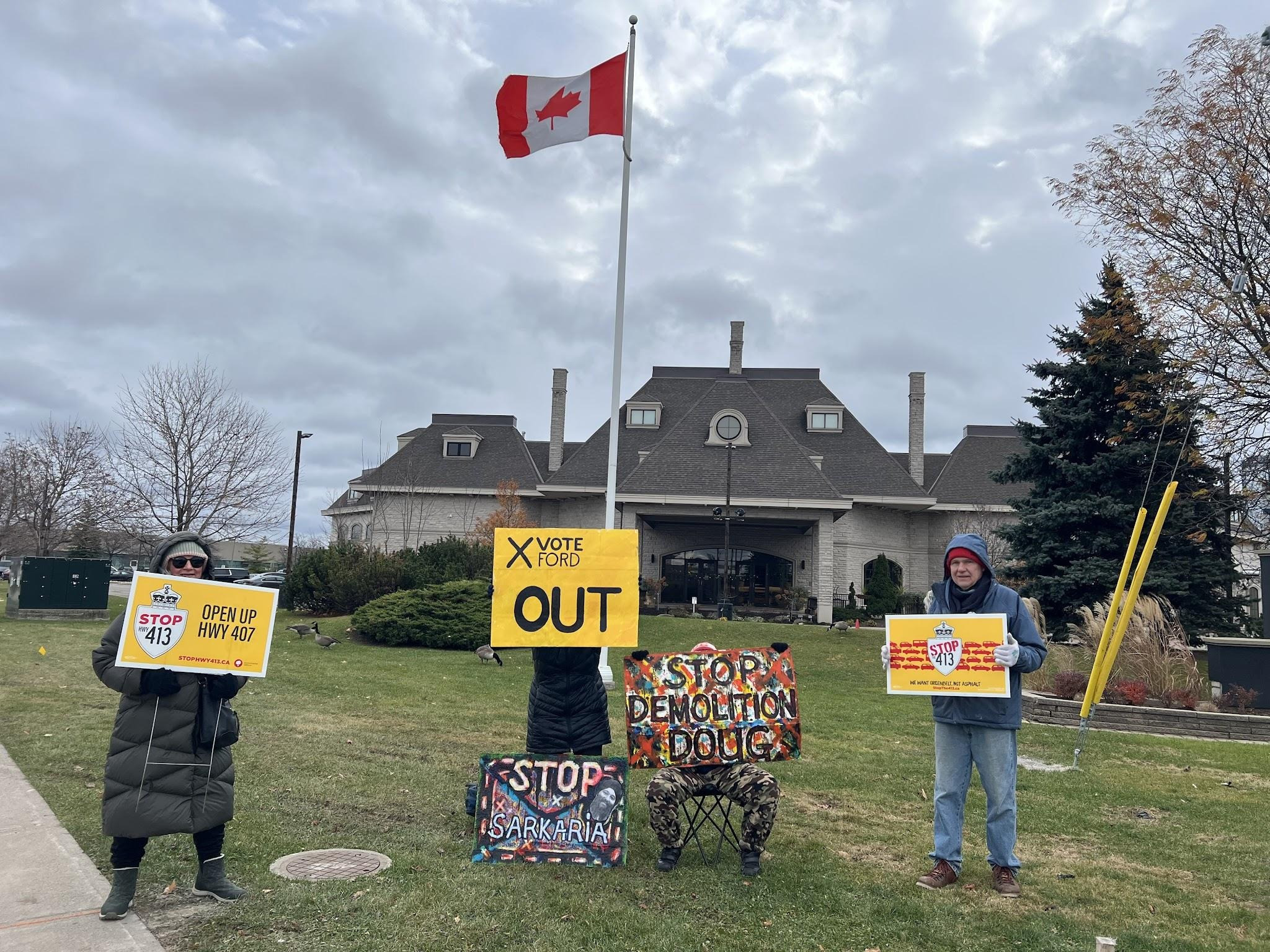
Members of STOP THE 413 NOW outside Bellevue Manor in Vaughan on November 29, 2024.
(Anushka Yadav/The Pointer)
Environmental Defence, advocacy group Open the 407 Now and representatives from all three opposition parties—the Ontario NDP, Ontario Liberals and Ontario Greens—held a joint press conference at Queen's Park on Tuesday requesting that Ontario's Financial Accountability Office (FAO) conduct an independent probe into the costs of constructing and operating what is expected to be the province’s “costliest mega-highway”.
“Highway 413 [is] a destructive highway that would cost taxpayers an estimated $16 to $18 billion, pave over protected Greenbelt land and prime farmland, fuel sprawl and worsen congestion,” Environmental Defence Associate Director, Mike Marcolongo, said.
“However, because the Ontario government has exempted this highway from an environmental assessment, proven alternatives and solutions have not been examined.”
In November 2024, the Ford government excluded the 59-kilometre highway linking Highway 401 near Milton to Highway 400 in Vaughan from the provincial Environmental Assessment Act after passing Bill 212, the Reducing Gridlock, Saving You Time Act, into law—creating the Highway 413 Act and eliminating the project's traditional environmental assessment requirements, limiting public transparency, allowing 24-hour construction despite the risks to nocturnal wildlife, and making it more difficult for landowners to contest expropriation.
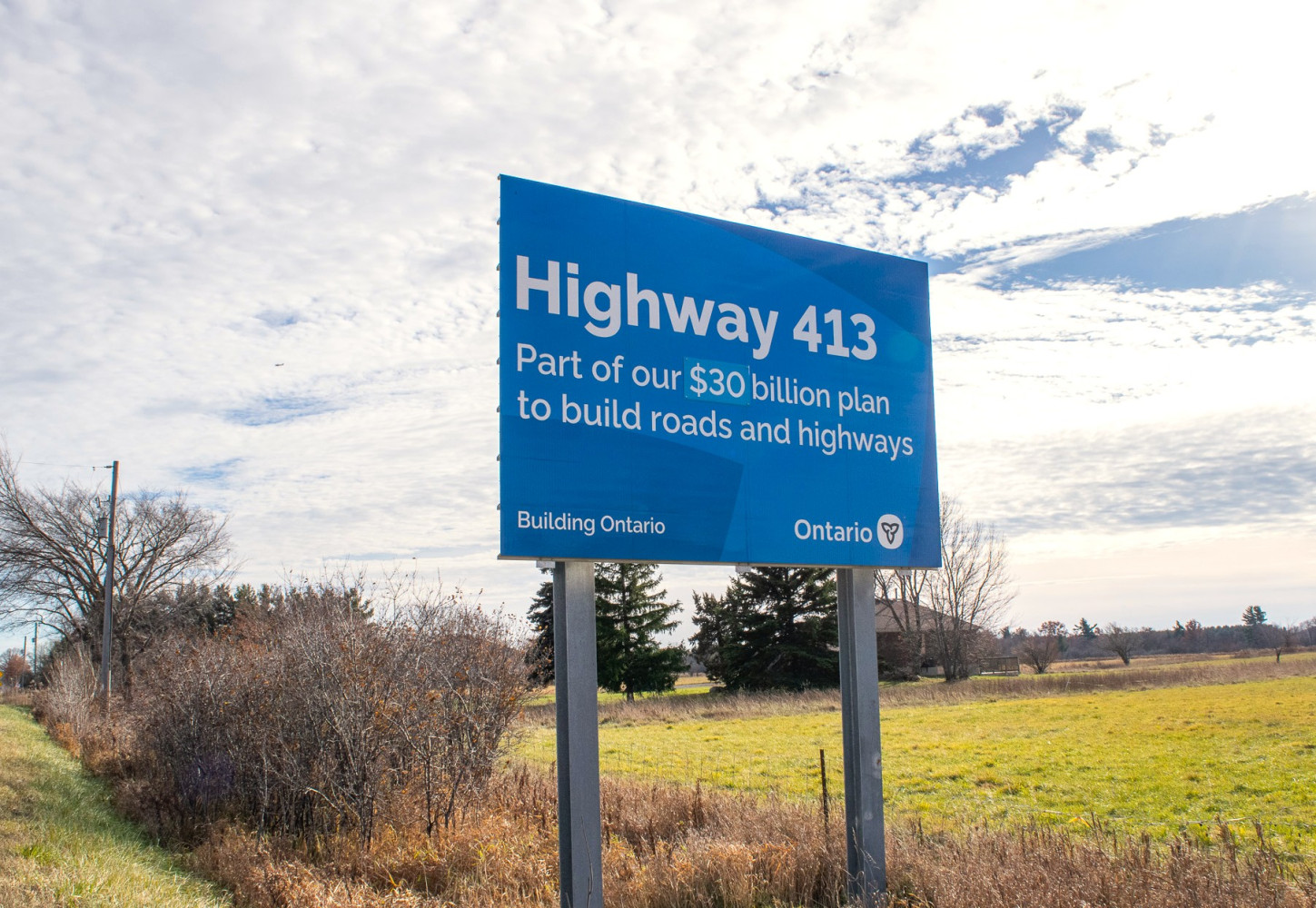
“Work is beginning to resurface Highway 10 in preparation for a new bridge over the future Highway 413,” Ford’s PC government announced in August last year. “Crews will also soon begin upgrades at the Highway 401/407 interchange, which will be the western terminus of Highway 413.”
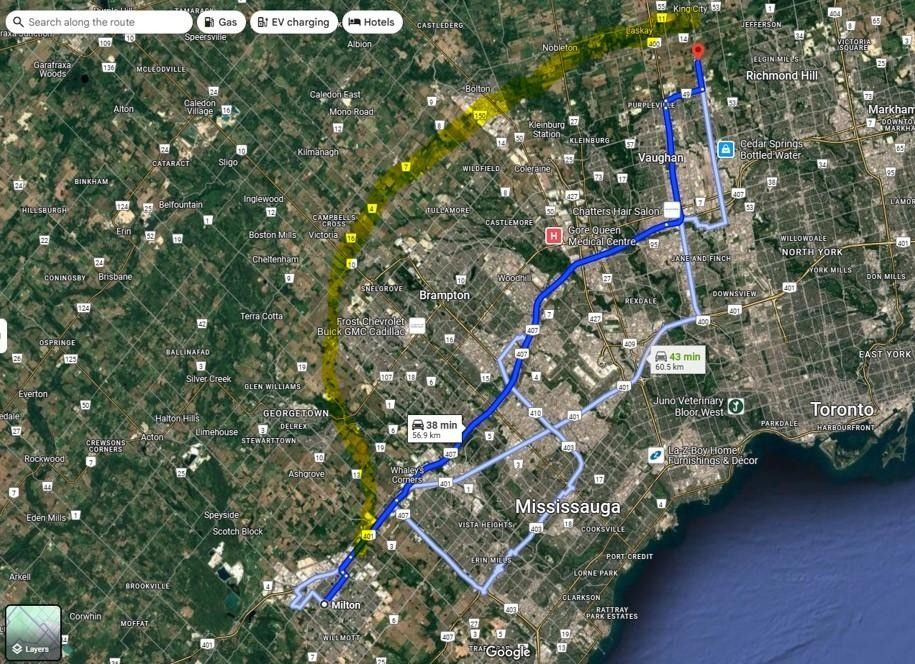
There is currently very little commuter demand for the 413 route. The highway will run roughly through the corridor highlighted in light yellow. The dark blue route uses existing highways to get commuters between the two ends where HIghway 413 would begin and end.
(Google Satellite)
The announcement suggested the long-promised highway was finally taking shape…
In 2024, when the PCs said the province would start building Highway 413 by 2025, there was no final design for the project, no finished environmental assessment and no planned opening date. The project was also being considered by the federal government for a full impact assessment due to the damage it will cause to both environmentally sensitive habitats and indigenous heritage. Ottawa dismissed the idea and created a task force to work alongside the province through a task force to mitigate the issues. The process has been opaque with little indication of any progress made to date to avoid the most damaging impacts of the highway on land inhabited by nearly 30 species at risk, according to an investigation by The Pointer.
So, when the PCs claimed Highway 413 construction was underway, it was not the highway itself, rather a series of limited infrastructure upgrades referred to as “early works.”
“There are two phases to this project. The early works, which are now under construction, and the main highway. What’s interesting is how the early works were chosen specifically to avoid triggering federal approvals,” Macpherson Law Senior Counsel, Laura Bowman, explained.
In 2020, the PCs proposed exempting the GTA West (Highway 413) project from completing a full environmental assessment before beginning “early works,” without clearly defining what those works would entail.
Regulatory agencies warned that the lack of detail made it difficult to assess potential impacts on fish habitat, migratory bird corridors and other sensitive environmental features—concerns that are now pushed under the rug with Bill 5’s watered-down definition of species habitat under the Species Conservation Act. At the time, the province indicated early works could include bridge construction and watercourse crossings but regulators underscored there had been little communication with federal fisheries officials about possible habitat disruption.
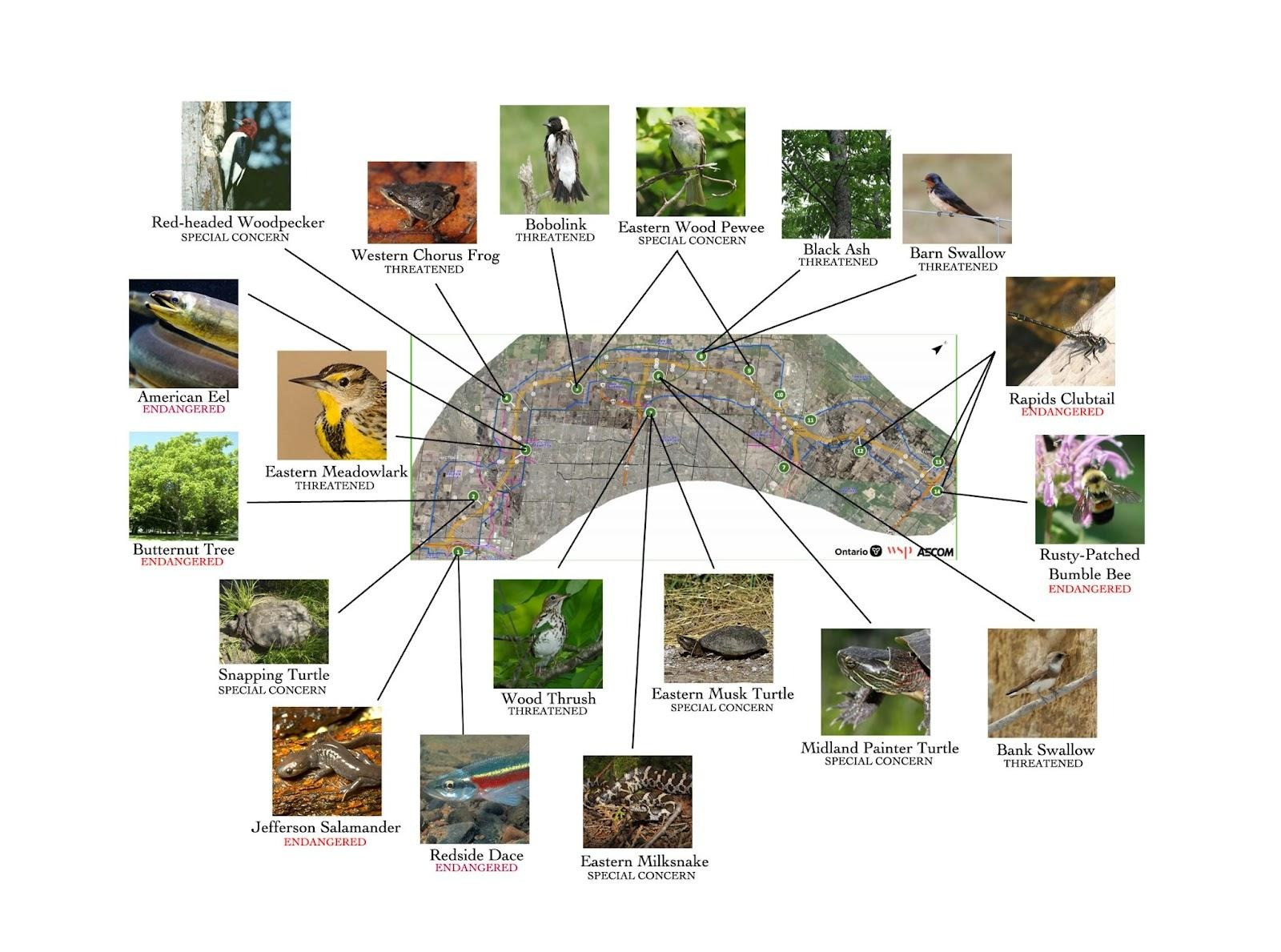
In November 2024, 121 scientists sent a letter to then–Environment and Climate Change Minister Steven Guilbeault, criticizing the “absence of federal action” on Highway 413. They warned the costly project, which cuts through and borders Ontario’s Greenbelt, could harm at least 29 species at risk protected under provincial and federal laws. The highway could also impact roughly 122 bird species covered by the Migratory Birds Convention Act and disrupt fish habitats in over 100 waterways protected by the Fisheries Act.
(The Pointer Files)
The Toronto and Region Conservation Authority warned that key protections normally applied to development in flood-prone and environmentally sensitive areas under Section 28 of the Conservation Authorities Act would not automatically apply to Highway 413, creating precariousness about how natural resources, property and public safety would be protected during the detailed design phase; thereby, failing to meet the objectives of the Environmental Assessment (EA) Act, undermining efforts to manage Ontario’s environment wisely.
The early works, therefore, were being carried out in areas that reportedly did not cross endangered species habitat or ecologically sensitive waterways, making it possible for the province to proceed without seeking federal authorization. That strategy became easier to execute after the federal government formally dropped its impact assessment of Highway 413 on April 15, 2024, following a Supreme Court of Canada ruling that limited Ottawa’s authority under the federal Impact Assessment Act, effectively ending the federal review process and leaving oversight of the project largely in the hands of the province.
Marcolongo contends construction of the highway is “many years away” and final design remains incomplete.
“Our understanding is that the MTO will be phasing the highway into four different sections, and only the final design is being completed or started at this point for one of those four sections, which will take up to two years,” he reiterated.
The group’s request is “particularly important given the Ministry of Transportation’s continued refusal to disclose the highway’s costs and the well-documented increases in construction and land acquisition costs for building infrastructure in Ontario”.
When Ford revived the project in 2019 despite recommendations of the province’s own advisory panel in 2017 that the project be cancelled, it carried an estimated price tag of just over $4 billion. Seven years later, after soaring inflation, labour shortages and escalating construction costs, the province has yet to release an updated estimate, hiding a total price tag now estimated to exceed $14 billion, according to a recent report by Enviornmental Defence.
Peter Tabuns, the Ontario NDP's critic for Environment, Conservation and Parks, believes a financial investigation could shed light on alternatives to Highway 413 and the true costs associated with a project that he argues would increase “environmental damage”, resulting in the direct loss of 2,000 acres of prime agricultural land, park land and forests next to Canada’s biggest city while increasing flooding risks for downstream communities; as reported by The Pointer previously, Peel communities will be especially vulnerable to the ecological breakdown caused by the construction of the highway, adding to the pressures that already exist due to decades of bad land use planning.
“This highway doesn't make sense environmentally, it doesn't make sense in terms of transportation, it doesn't make sense economically,” Tabuns said.
A consulting firm hired by Environmental Defence has already cautioned that Highway 413 would pump an extra 700,000 tonnes of carbon into the atmosphere every year, adding up to 17.4 million tonnes by 2050—an increase Ontarians cannot afford to bear the repurcussions of at a time when the province has already gotten rid of its duty to report on its climate change targets.
The Ontario Liberal party’s Critic for the Environment and Climate, Mary-Margaret McMahon, said the billions of dollars that the province might be projecting to use for the construction of Highway 413 could be used “for education, to improve our dilapidated schools, for transit, so we can get more people out of their cars,” for housing and healthcare.
But a January report by the FAO found that infrastructure spending over the Ford government's seven years in office is projected to be higher than during its first three years for provincial highways and transportation infrastructure. While the PCs increased focus on road-building projects continues, investments in other areas have lagged behind with projected spending on transit, justice, social services and other sectors expected to be lower “over the last seven years compared to the first three years”.

According to the FAO, the province identified 51 highway and transportation infrastructure projects with $9.8 billion in planned spending over the next decade in the 2025 budget, with the ten largest projects alone accounting for $7.5 billion, more than a quarter of the total highways capital plan.
(Financial Accountability Office)
In 2025, planned spending on provincial highways and other transportation infrastructure had climbed to $28.4 billion in real terms—an increase of $2.9 billion or 11 percent, compared to the $25.5 billion allocated in the 2019 budget. “The largest increase was in 2022, which added $2.9 billion to the spending plan, due in part to costs added for new projects, which included the new Highway 413,” the FAO revealed.
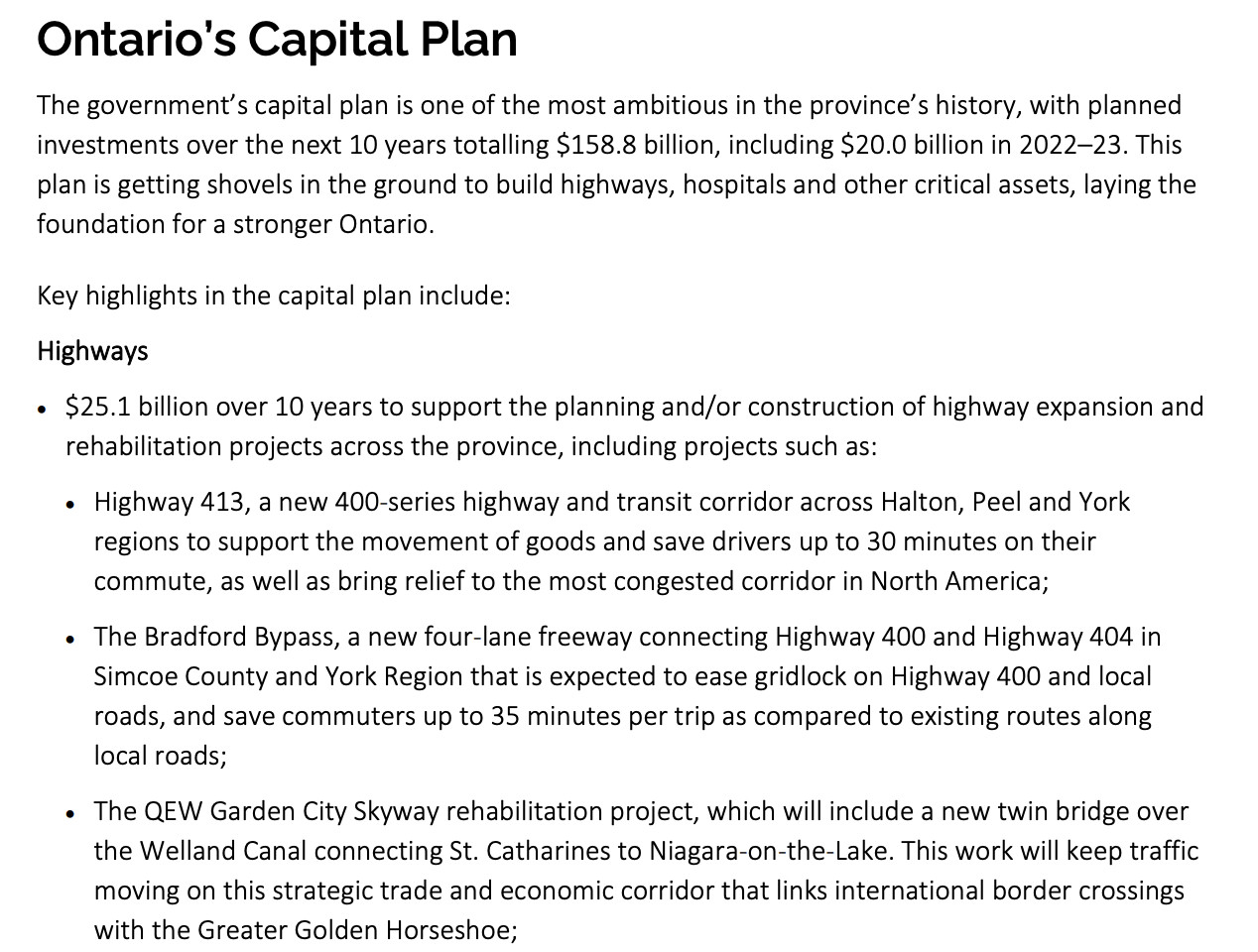
In the 2022 provincial budget, the government assigned just over $25 billion to be spent over the course of ten years on building highways.
(Government of Ontario)
In this year’s budget, the province set aside over $30 billion to be spent over ten years on construction of highway expansion and rehabilitation projects. How much of that money is slated for Highway 413 remains a mystery.
“It's not only irresponsible, it's financially reckless to proceed with a project without doing any costing,” Ontario Green party leader Mike Schreiner critiqued, calling Highway 413 a “dangerous” project.
Environmental Defence’s latest report Transit over Traffic estimates three of Ontario's proposed highway projects namely Highway 413, the Bradford Bypass and the 401 Tunnel together might cost taxpayers up to $80 billion—money that could build “enough light rail to connect Toronto to Sudbury”.
“To subsidize trucks on the 407 would cost on average $300 million a year,” Open the 407 Now Chair, Andre Willi, said.
“You can subsidize truck traffic for at least 45 years to equal the cost of this [Highway 413’s] construction.”
When the GTA West Advisory Panel, appointed by the Ontario Liberals in 2017, reviewed the potential impacts of the project, it made two important deductions: the highway would save drivers just 30 to 60 seconds per trip, a far cry from the 30-minute figure touted by the PCs.
The panel, instead, suggested using toll incentives to shift traffic, especially trucks, onto the underutilized Highway 407, which already runs parallel to the proposed 413 route, just 15 kilometres to the south, as a more cost-effective and immediate alternative.
In 1999, the Mike Harris Progressive Conservative government sold Highway 407 for $3.1 billion to a consortium that included SNC-Lavalin, Quebec's provincial pension fund, and the Spanish company Ferrovial.
The highway is currently owned by the Canadian Pension Plan Investment Board, the Crown corporation responsible for public employees retirement and Old Age Security (OAS) and Ferrovial subsidiary, Cintra, a publicly-traded Spanish toll road and parking lot company.
The Province owns a 22-kilometre stretch of Highway 407 on its eastern side, where tolls are significantly lower compared to the private section of the highway.
Last year, Ford suggested he would “never rule out” Highway 407 buyback. In 2024, a representative from Minister Sarkaria's office also told The Pointer that the PC government has “been in conversation with the 407”.
But later that year, the owners said they have had no conversations with the province about a buyback.
“We regularly meet with the Ontario government to explore opportunities to alleviate congestion across the region, though we’ve not been engaged in any conversations about a buyback,” a statement shared with The Pointer noted.
The idea of removing tolls for trucks on Highway 407 has long been floated as an alternative. It was included in the Ontario NDP 2022 election platform and resurfaced in November 2023 after Environmental Defence reported that doing so could save transport truck drivers up to 80 minutes in travel time. In February 2024, Ontario Green party also proposed subsidizing truck tolls on Highway 407 and cancelling Highway 413 construction. But the PCs voted down a motion that would have removed tolls for commercial truck traffic on the 407.
“Highway 413 has nothing to do with alleviating gridlock in the GTHA. It is all about unleashing low-density sprawl to build homes that ordinary people can't afford on thousands of acres of farmland, wetlands, greenbelt, forests, and nature, that is so vital to Ontario's $52 billion agri-food economy that creates jobs for one in nine people in this province, the largest employer in Ontario, at a time when we're facing an economic and jobs crisis,” Schreiner said at a recent press conference.
“The floods that hit the GTA two summers ago cost $1.3 billion an hour, and that will only get worse if the Ford government continues to pave over the nature that protects us.
Marcolongo estimates for the estimated cost of Highway 413, the province could build “191 km of GO/LRT/BRT that moves twice as many people”.
But Willi asserted that the highway is “another way” Ford is “helping his developer buddies” not about helping Ontarians move or reducing induced demand.
Despite Highway 413 being the subject of years of political debate between Liberal and Progressive Conservative governments, some of Ontario’s most well-connected developers were buying up farmland along the proposed route and near the Greenbelt, positioning themselves to reap enormous gains if the project moved ahead and land values surged.
“We're not saying don't build infrastructure projects, build transit for all Ontarians, and move twice the number of commuters…the government does not want to share their financial analysis with the taxpayers. This is our money,” Willi said.
“Voters wouldn't want this highway once they know the true cost and immediate alternatives available.”
Email: [email protected]
At a time when vital public information is needed by everyone, The Pointer has taken down our paywall on all stories to ensure every resident of Brampton, Mississauga and Niagara has access to the facts. For those who are able, we encourage you to consider a subscription. This will help us report on important public interest issues the community needs to know about now more than ever. You can register for a 30-day free trial HERE. Thereafter, The Pointer will charge $10 a month and you can cancel any time right on the website. Thank you
Submit a correction about this story

