

2025 in Review: Ontario’s environmental framework butchered by the Ford government
“Exploitative,” Caledon resident and artist Andie Trépanier said.
“Criminal,” Toronto resident Sean Killackey said.
“Incompetence,” Brampton resident David Laing said.
“Destructive,” Toronto resident Corbin Sparks said.
“Atrocious,” Whitchurch-Stouffville resident Mark Carroll said.
These were some of the words Ontarians used when The Pointer asked them to describe, in a single word, how the Doug Ford government treated Ontario’s environmental framework in 2025.
“Regressive,” Toronto resident Francesco Corsaro said.
“Duplicitous,” Pickering resident Mike Borie said.
“Impunity,” London resident Brendon Samuels said.
“Mockery,” Diana Sam said.
“Homicidal,” Toronto resident K Lee said.
Others, clearly looking for an avenue to vent frustration, sent only words unfit for publication.
These aren’t just individual sentiments: Ontario Premier Doug Ford’s approval rating fell sharply by seven points this fall from 41 to 34 percent, leaving him among Canada’s least-approved premiers at year’s end, according to the Angus Reid Institute’s final rankings for 2025.
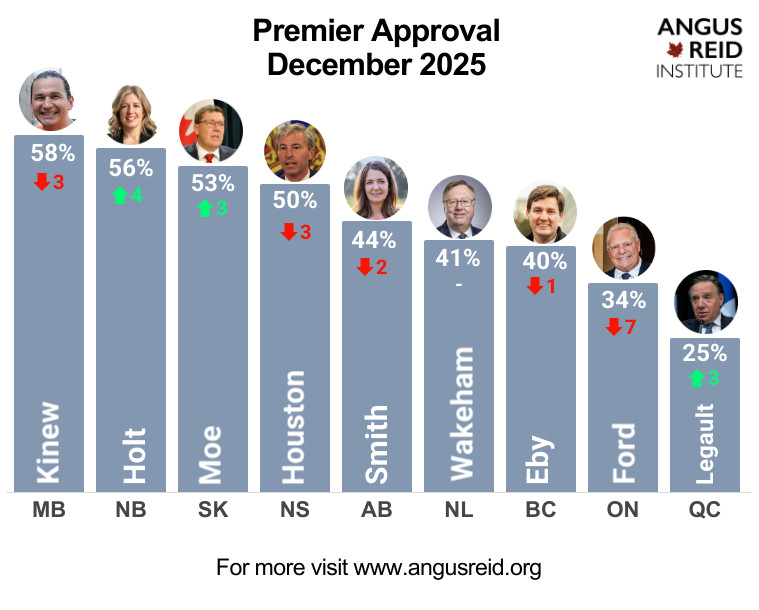

Doug Ford’s standing with Ontarians took a notable hit toward the end of 2025, according to the Angus Reid Institute’s final premier approval rankings for the year. His approval fell seven points, placing him among Canada’s least-popular premiers, alongside Quebec’s François Legault. The drop came amid growing concern over top-of-mind issues for Ontarians: weak economic growth, the Progressive Conservative government’s move to roll back emissions reduction commitments and accelerating development in the Ring of Fire region.
(Angus Reid Institute)
The reasons were plenty: a $13.5-billion deficit, the lowest housing starts on record, weak economic growth, an overburdened healthcare system and the gutting of Ontario’s environmental framework.
The following is a timeline of Doug Ford and his PC government’s 2025 performance.
January
Macbeth's reflections on falling from confidence and freedom to being trapped by fear and doubt seemed to echo the PC government’s own position in January when the looming threat of RCMP releasing results of the criminal investigation into Ford’s Greenbelt scandal led him to officially triggering an early provincial election for February 27 after Lieutenant Governor Edith Dumont agreed on January 28 to dissolve Ontario’s 43rd Parliament.
He said the election, called 16 months earlier than required, was necessary to secure a new mandate to confront U.S. President Donald Trump and roll out an “economic action plan” in response to looming tariffs.
"This is gonna be a battle for the next four years. I want to make sure I have a strong mandate to outlast President Trump," Ford said.
February
When asked about the housing crisis during the provincial debate on February 17, Ford pointed to the bustling cityscape, “all you have to do is look outside the door, there’s more cranes going up in Toronto, right in your own backyard.”
He was right…partially. Toronto was leading in North America with 83 cranes in its core in the first half of the year, 43 of which were dedicated to residential projects.
Housing starts in the province, on the other hand, have been declining for three consecutive years.
A report from the Canada Mortgage and Housing Corporation for February 2025 revealed a 29 percent drop in housing starts across the province last year with just 74,326 housing starts—25,000 fewer than in 2021.
Later, a June report from Ontario’s Financial Accountability Officer found housing starts in the province in the first quarter of the year were the lowest they had been since 2009.
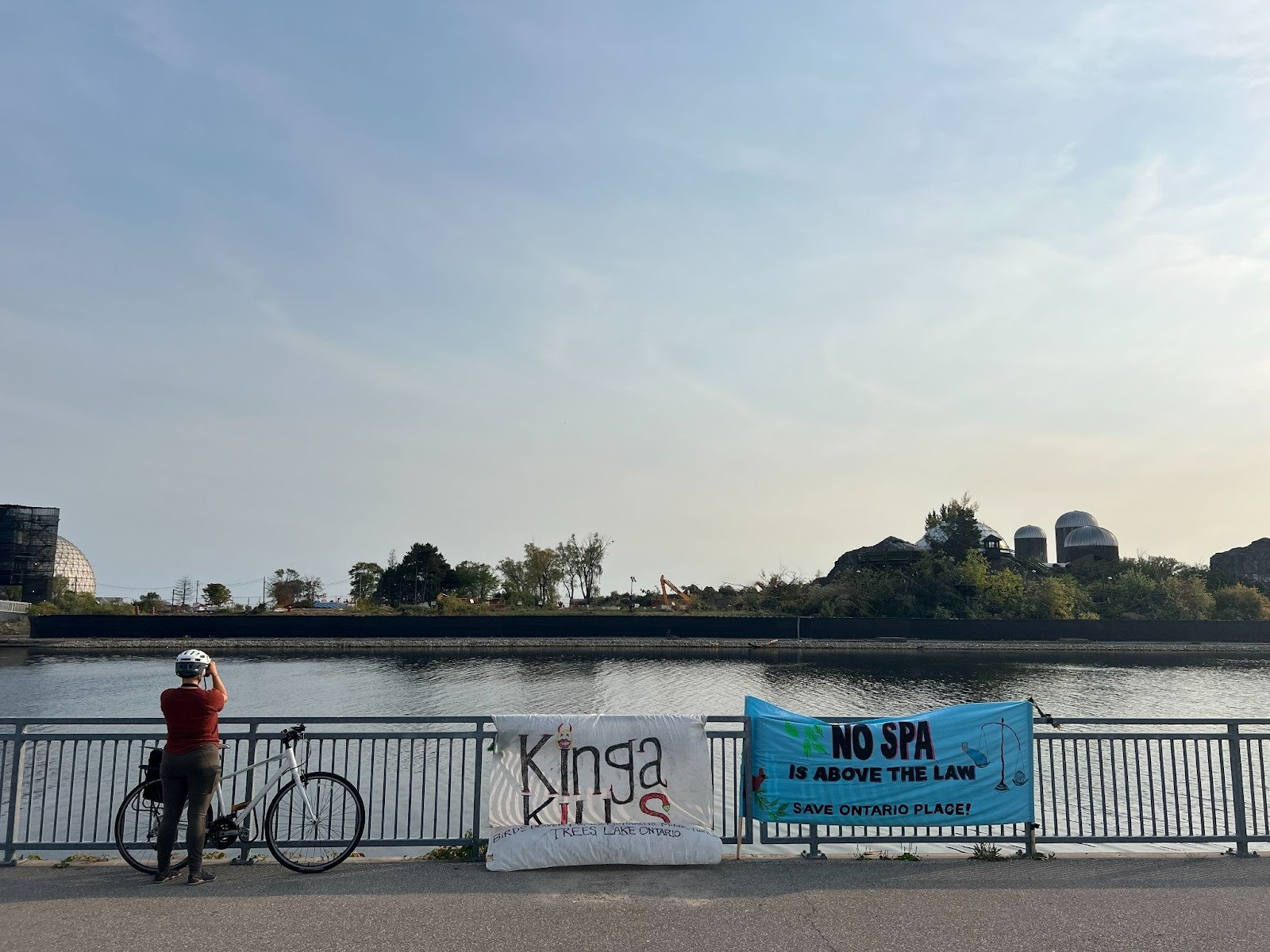
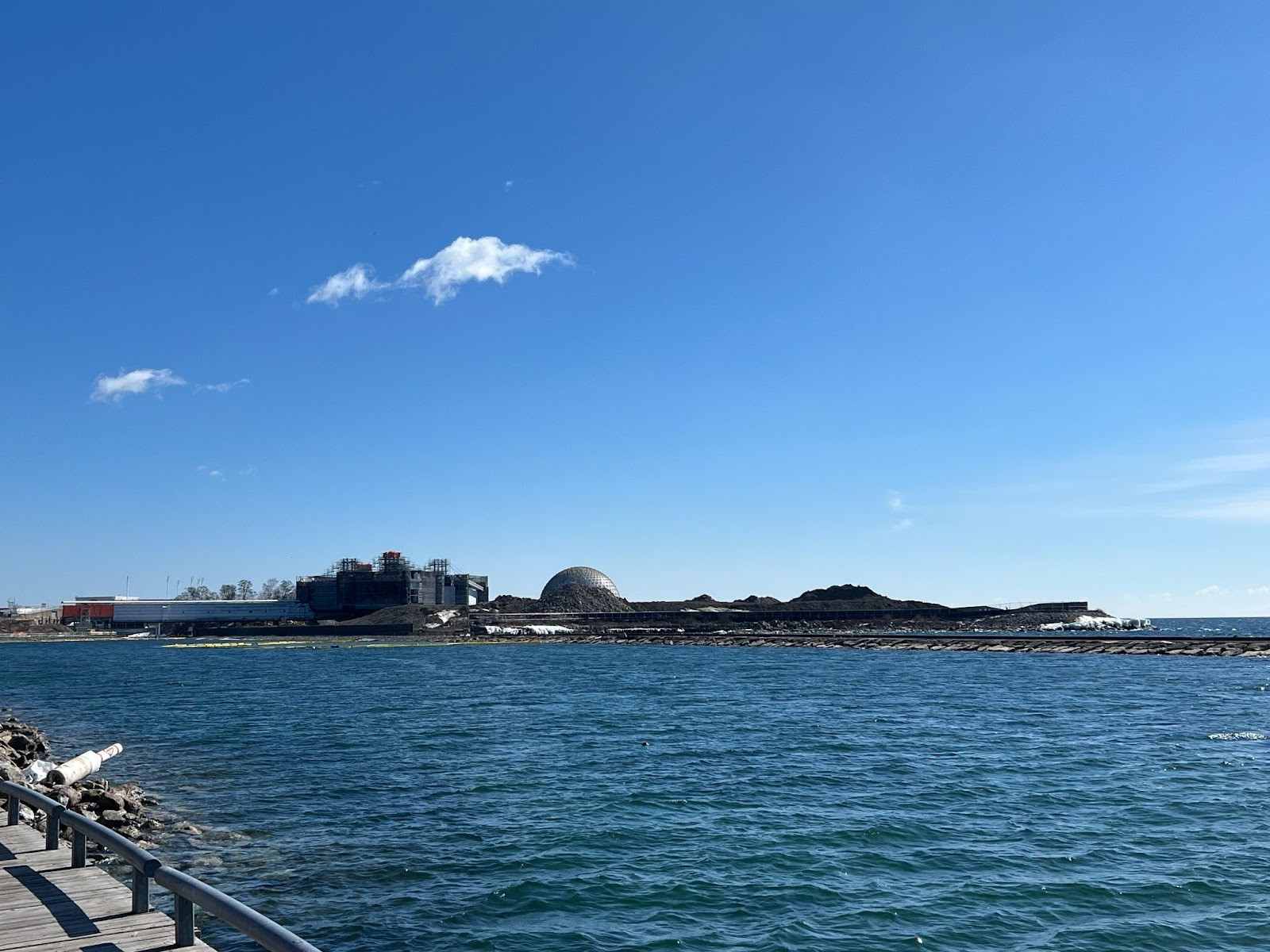
In late February, advocacy group Ontario Place for All called for a police investigation into the Ontario Place Call for Development, citing concerns that it was “not fair, accountable or transparent” after the Auditor General’s report found the province failed to comply with Ontario’s Realty Directive. [First photo is from October 3, 2024 when the trees were cut. Second photo is from March 9, 2025.]
(Anushka Yadav/The Pointer)
Ten days after Ford’s comments, with the second-lowest voter turnout in Ontario’s history, the Progressive Conservatives (PCs) secured a third consecutive term at Queen’s Park, winning 80 of 124 seats despite backing from only about one in five eligible voters, Elections Ontario reported. Just over five million Ontarians cast ballots and fewer than 2.2 million, 43 percent of votes cast, supported the Tories.
The snap elections cost the province roughly $189 million.
A day before, an International Institute for Sustainable Development (IISD) report found provincial funding policies have been blocking municipalities from strengthening their natural infrastructure.
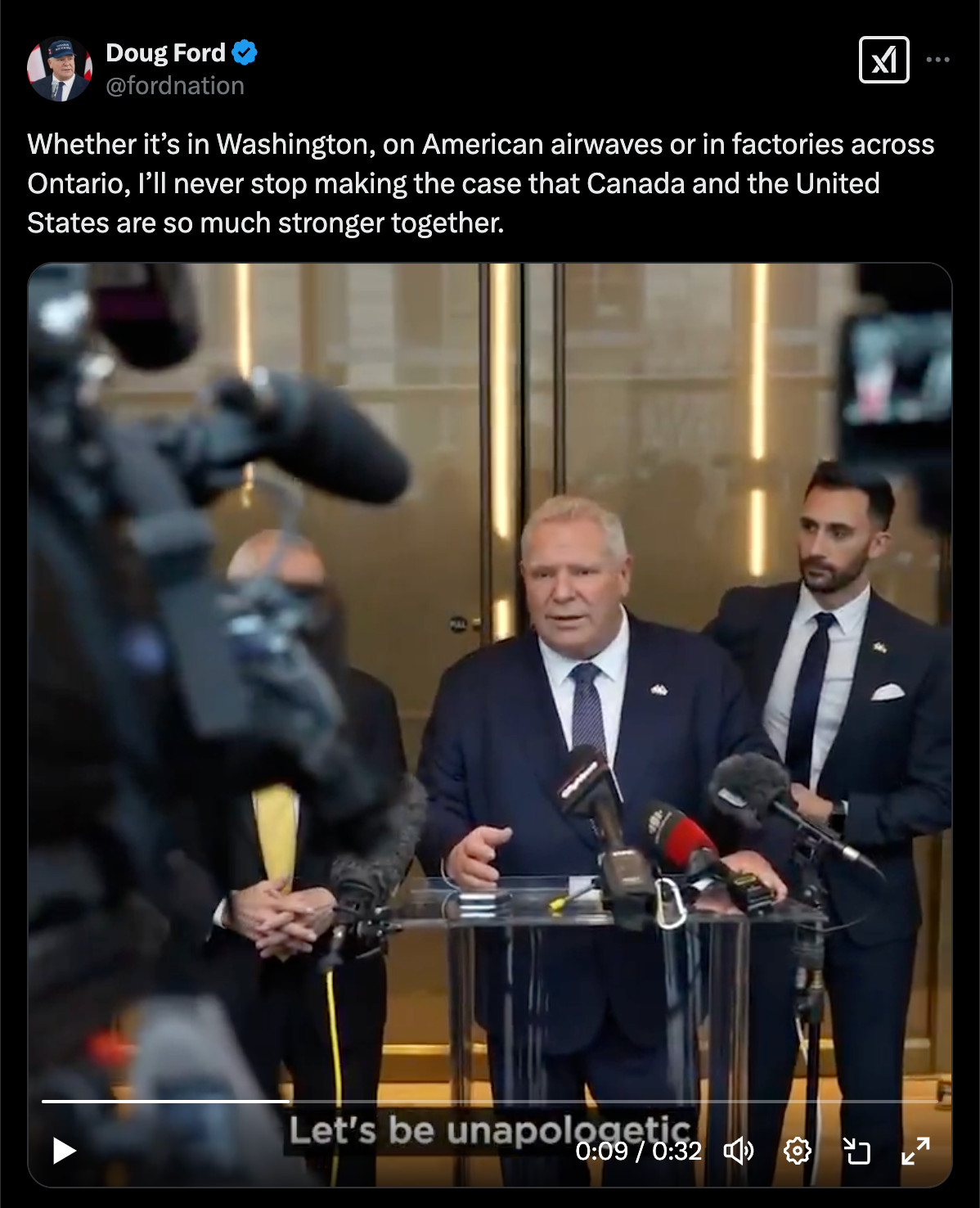

Some of the comments on Ontario Premier Doug Ford’s X post, where people share their thoughts on his latest campaign activity… in Washington DC. The trip sparked complaints that taxpayer-funded activities were used for partisan purposes, prompting the Ontario NDP to call for investigations by the integrity commissioner and Elections Ontario ahead of the provincial election.
(Doug Ford/X)
March
On March 3, right before Ford’s ratings were the highest this year, the premier leaned into his portrayal as Captain Canada by threatening to cut off electricity exports to U.S. states if President Donald Trump imposed the planned tariffs on Canadian goods, including a ten percent levy on energy.
“If they want to try to annihilate Ontario, I will do anything, including cutting off their energy — with a smile on my face,” he said at the Prospectors and Developers Association of Canada conference in Toronto while floating additional measures including surcharges on energy sales to the U.S., scrapping a $100-million deal with Starlink and encouraging retailers to prioritize Canadian-made products.
April
Ever tried walking on a day so windy that every step feels like a battle against the gusts? That’s what April felt like in Ontario as the Ford government barreled Bill 5 through the legislature amongst other changes, setting the tone for the rest of the year.
On April 9, the province proposed expanding strong mayor powers to the heads of council in 169 additional Ontario municipalities to help accelerate the delivery of provincial priorities such as housing, transit, and infrastructure, effective May 1. By August, a survey of chief administrative officers found the powers had “little to no impact” on housing and were contributing to politicization and divisions within municipal councils — a trend seen in Peel as well.
On April 17, Bill 5, Protect Ontario by Unleashing Our Economy Act, was first introduced by Minister of Energy and Mines Stephen Lecce who defended the move saying “in order to build a prosperous and united Canada, we need partnerships. It's the cornerstone of mutual prosperity,” and every time the Ford government has “built a transmission line in this province, it's been done in partnership with 50/50 equity.”
Originally framed as a mining act aimed at fighting tariffs, it quickly revealed itself as a sweeping omnibus bill that would reshape the province’s environmental, heritage and municipal laws.
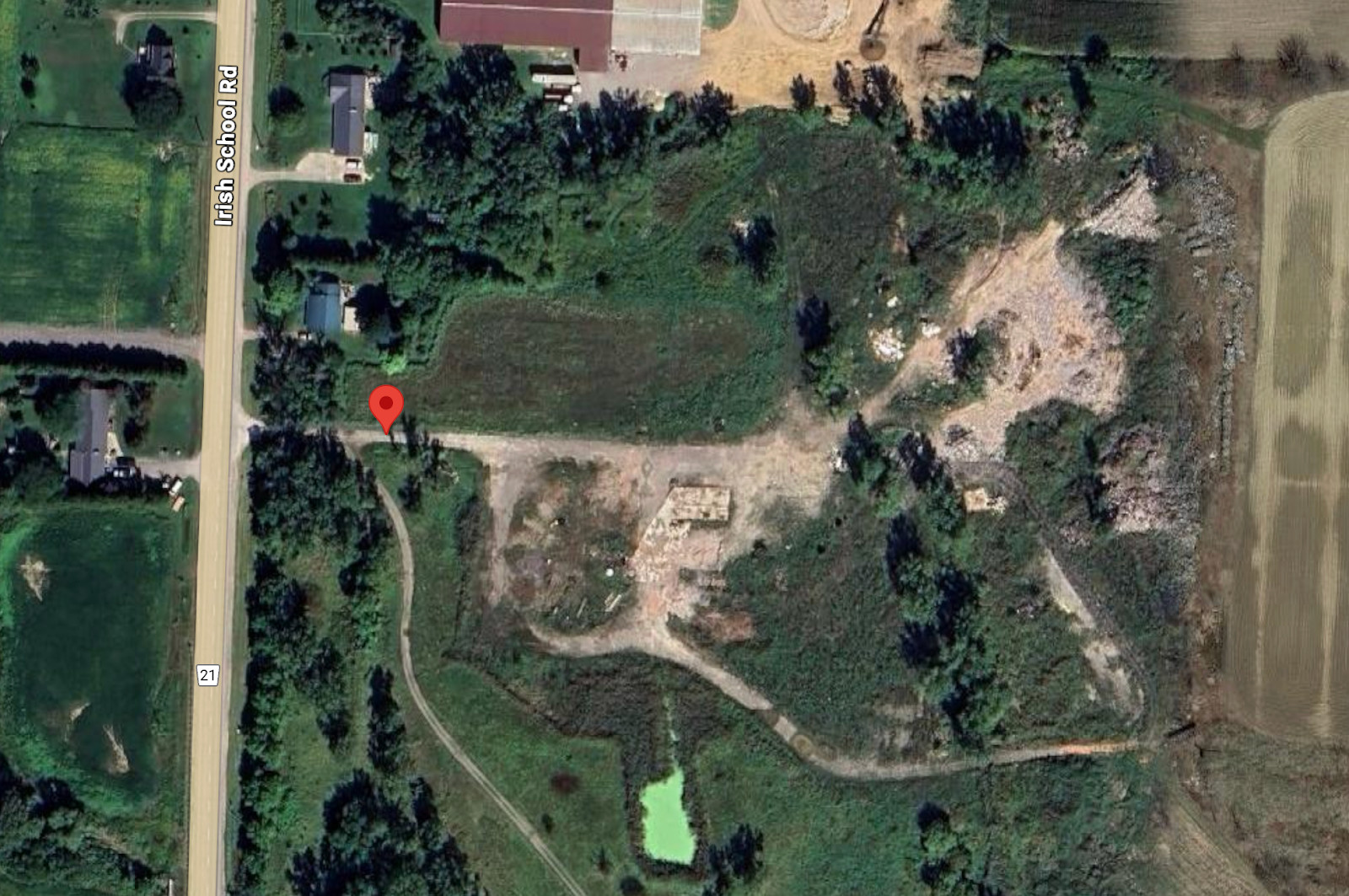
Mississauga-based waste management company, York1, purchased 87.8 acres at 29831 Irish School Road on December 15, 2022, a former tile yard and dormant fly ash landfill located less than 1 km from Dresden’s town line and 700 meters from the local high school and later acquired a 95.4-acre farm to the south and a 47.9-acre farm to the north in October 2023. When the Doug Ford government through Bill 5 proposed exempting the landfill from an environmental assessment, Liberal MPP Ted Hsu called for Ontario’s Integrity Commissioner to investigate the matter in May alleging there were reasonable and probable grounds to believe Ford, two of his cabinet ministers and a former minister were connected to the landfill. But the request was denied in August. As of December 22, Bill 5 does not mention the Dresden landfill.
(Google Maps)
Many aspects of the legislation had nothing to do with fighting tariffs such as eliminating endangered species protection, hypocritically exempting the Dresden landfill from an environmental assessment where 365,000 tonnes of garbage was proposed to be dumped, an assessment that the Ford government themselves promised and exempting projects like Ontario Place from even more guardrails.
Ontario Place was once home to more than 50 species of trees, offering vital shelter, food and habitat for a wide range of birds and animals, serving as a rare urban refuge and thriving ecosystem — all of which was wiped out in October 2024. On April 16, a New York Times investigation revealed the European spa company Therme had misrepresented its experience and finances to secure a 95-year lease for the water park that would replace Ontario Place.
However, two of Bill 5’s most controversial measures were it allowed exempting projects from archaeological assessments, putting Indigenous heritage sites at risk and replacing the Endangered Species Act with a weakened Species Conservation Act, giving politicians, not independent scientific panels, the power to decide which species receive protection while completely changing the definition of habitat.
Schedule 9 of the controversial legislation established Special Economic Zones (SEZ), letting the provincial cabinet fast-track developments and bypass more than 800 laws including municipal bylaws, the Safe Drinking Water Act and labour protections while restricting court challenges, effectively limiting public oversight and accountability. An in-depth report by The Pointer suggested SEZs haven’t worked in other economies.
May
By the first week of May, Bill 5 had reached second reading and the backlash was spreading as fast as the legislation itself: an omnibus bill pitched as economic protection was now igniting resistance across Ontario from municipal councils to Indigenous leaders and environmental advocates.
On May 12, as opposition to Bill 5 boiled over at Queen’s Park, Ontario was confronting a real emergency: a wildfire that ignited near Ingolf in the Kenora District burned out of control, spreading into Manitoba by May 15 and marking the beginning of Ontario’s second-worst wildfire season on record — one that won’t end until November 3. Between April and October alone, 643 fires scorched 597,654 hectares, well above the ten-year average, with flames reaching populated areas as far south as Kawartha Lakes, according to the Ministry of Natural Resources.
That same day, advocates from civil liberties, environmental, and Indigenous organizations including Environmental Defence, Democracy Watch, the Association of Iroquois and Allied Indians, Friends of the Attawapiskat River, and members of the Neskantaga First Nation gathered at Queen’s Park to denounce the bill while municipal opposition followed.
By mid-May, GO transit expansion, which included a 25-year operating agreement between Metrolinx and a private consortium, was quietly cancelled without a public explanation while staff working on the project were reportedly let go.
Sandwiched between that intense storm, the PC government sent another shockwave for the environment through Bill 17, dubbed the Protecting Ontario by Building Faster and Smarter Act, which was unveiled on May 12 in a bid to jumpstart home construction through changes to development charges, building codes and planning.
The province said Bill 17 “work(s) together” with measures proposed in Bill 2, the Protect Ontario through Free Trade within Canada Act, and Bill 5, “as part of the government’s plan to protect Ontario by strengthening internal trade relationships, supporting faster provincial development and supporting buying local.”
Critics, however, warned the bill followed a familiar pattern of centralizing power at Queen’s Park while sidelining local governments and environmental safeguards.
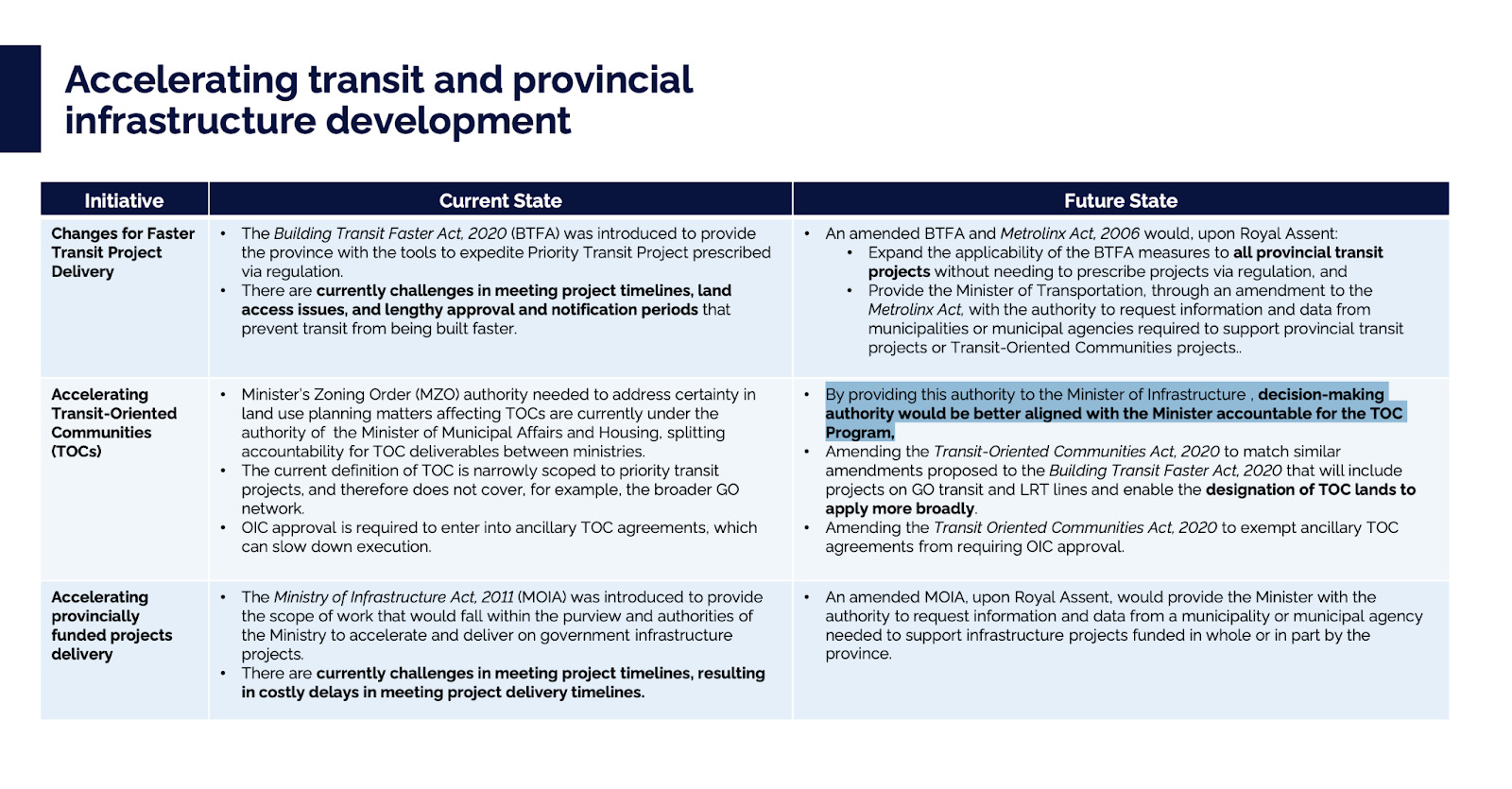
Bill 17’s technical briefing clearly stated the province’s minister of infrastructure will be provided “decision-making authority” to designate land for the Transit-Oriented Community (TOC) program.
(Government of Ontario)
Among its most controversial provisions, Bill 17 would centralize control over the Ontario Building Code, effectively stripping all 444 municipalities of the authority to set their own construction standards.
“Municipalities do not have the authority to require their own unique standards beyond the Building Code,” a provincial technical briefing on the bill noted.
The move cancelled out local green building initiatives such as Toronto’s widely-recognized Green Development Standards (GDS) alongside Mississauga’s GDS which the City spent years refining and Caledon only introduced in July 2024, despite their proven role in cutting building emissions and advancing municipal climate goals, including Mississauga’s target of a 40-percent reduction by 2030 and Caledon’s 36-percent cut from 2016 levels.
Bill 17 not only put the local targets at risk but Ontario’s ability to meet its own 2030 and 2050 climate commitments and Canada’s national goal of reducing emissions 40 to 45 percent below 2005 levels by 2030 on the path to net-zero by 2050.
On May 16, also Endangered Species Day, more than 100 environmental organizations sent a joint letter to environment minister Todd McCarthy arguing that Ontario was rapidly becoming a national outlier on biodiversity, criticizing the government’s “pay-to-slay” approach under Bill 5 allowing industry to damage habitat in exchange for fees.
Turning a deaf year, after just two days of committee hearings on May 22 and 26, Government House Leader Steve Clark moved swiftly to cut short further review, sending Bill 5 back to the Legislature for third reading followed by the Ford government shutting down debate on the bill by passing a Time Allocation motion, allowing only one 20-minute recess on May 29 despite slowdown tactics from the official opposition as well as several rallies outside Queen’s Park.

Ontario Liberal MPP Ted Hsu highlighted the sheer volume of amendments aimed at stretching out the committee process during Bill 5’s review, enough to fill the government’s scheduled 10.5 hours of meetings. The PCs made some tweaks following First Nations’ backlash, but Progressive Conservative House Leader Steve Clark remained noncommittal on whether the Liberal delay tactics would hold. The NDP, however, criticized the Liberal approach, pushing instead for a direct vote on the Bill’s most contentious elements.
(Ted Hsu/X)
June
On June 4, Clark allowed just one hour of debate before forcing a final vote. Bill 5 passed that afternoon and received royal assent the next day, cementing sweeping new powers that critics say will burn through environmental protections, Indigenous consultation and local democracy.
The next day, Queen’s Park officially adjourned for the summer with a return date of October 20, a six-week delay.
On June 5, the Ford government unleashed a climate catastrophe through its 2025 budget where critical minerals weighed heavier than the climate crisis. Bill 24, Plan to Protect Ontario Act (Budget Measures) which included a $60.6 million cut to the Ministry of Natural Resources, a minimal increase of $156.8 million to the Ministry of Environment, Conservation and Parks (MECP) compared to nearly $9 billion allocated to the Ministry of Energy and Mines.
Amongst a wide range of changes, Bill 24 also amended the Highway Traffic Act, granting the Lieutenant Governor the authority to remove or reconfigure certain bicycle lanes in Toronto to make them available for motor vehicle traffic, a move the PCs will double down on later in the year through Bill 60. The actions stood in contrast to a July Charter ruling by the Ontario Superior Court of Justice found the Ford government’s bike removals under Bill 212, “Ontario’s anti-bike lane law”, unconstitutional.
The next day the Greater Toronto Area (GTA) briefly held the unenviable title of having the worst air quality in the world due to the smoke.

In June, a Clean Energy Canada poll found that two-thirds of Canadians favour developing clean energy over fossil fuels, meaning approximately 67 percent do not want fossil fuels to be the primary focus and 85 percent wish to maintain or increase federal climate action.
(Anushka Yadav/The Pointer)
By mid-June, Ontario had 183 fires while Ford joined provincial leaders in calling on the Carney government for more national support, warning that provinces can no longer manage wildfire season alone.
"We do need that national strategy to make sure that when issues like this happen, we have the resources, we have the water bombers," Ford said during a press conference.
He noted Ontario had ordered six new water bombers but due to global backlogs, they likely won’t arrive until 2029 or 2031.
The union representing the province’s wildfire pilots, Ontario Public Service Employees Union (OPSEU/SEFPO), said the government’s promises of new planes gave the “appearance of investment with no substance” as the province failed to address staffing shortages and continued to offer low wages.
A few days after OPSEU/SEFPO's statement, the PC government slashed emergency wildfire funding by $42 million, with a $3.8 million cut from the budget for emergency preparedness and response.
And then, it got worse.
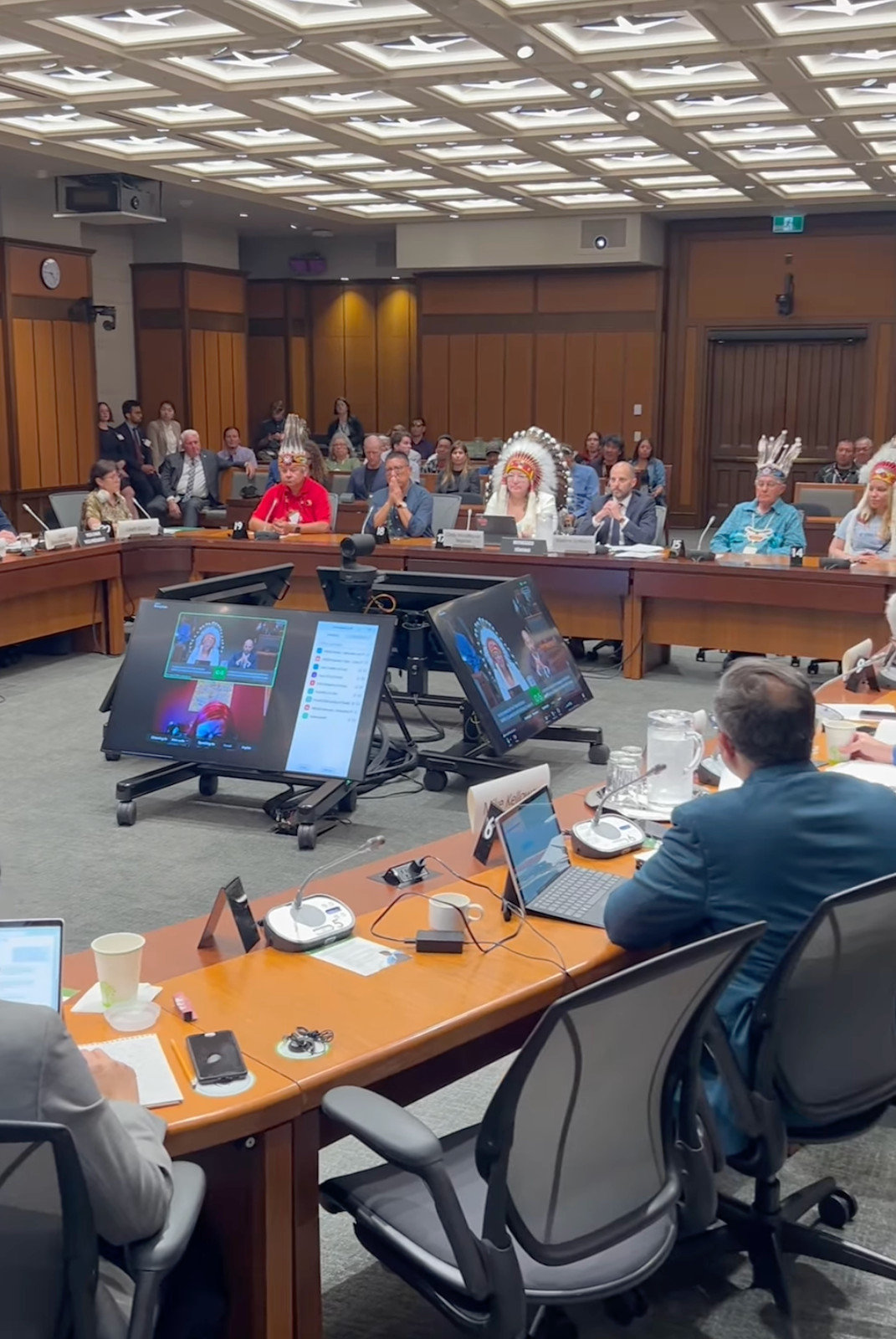
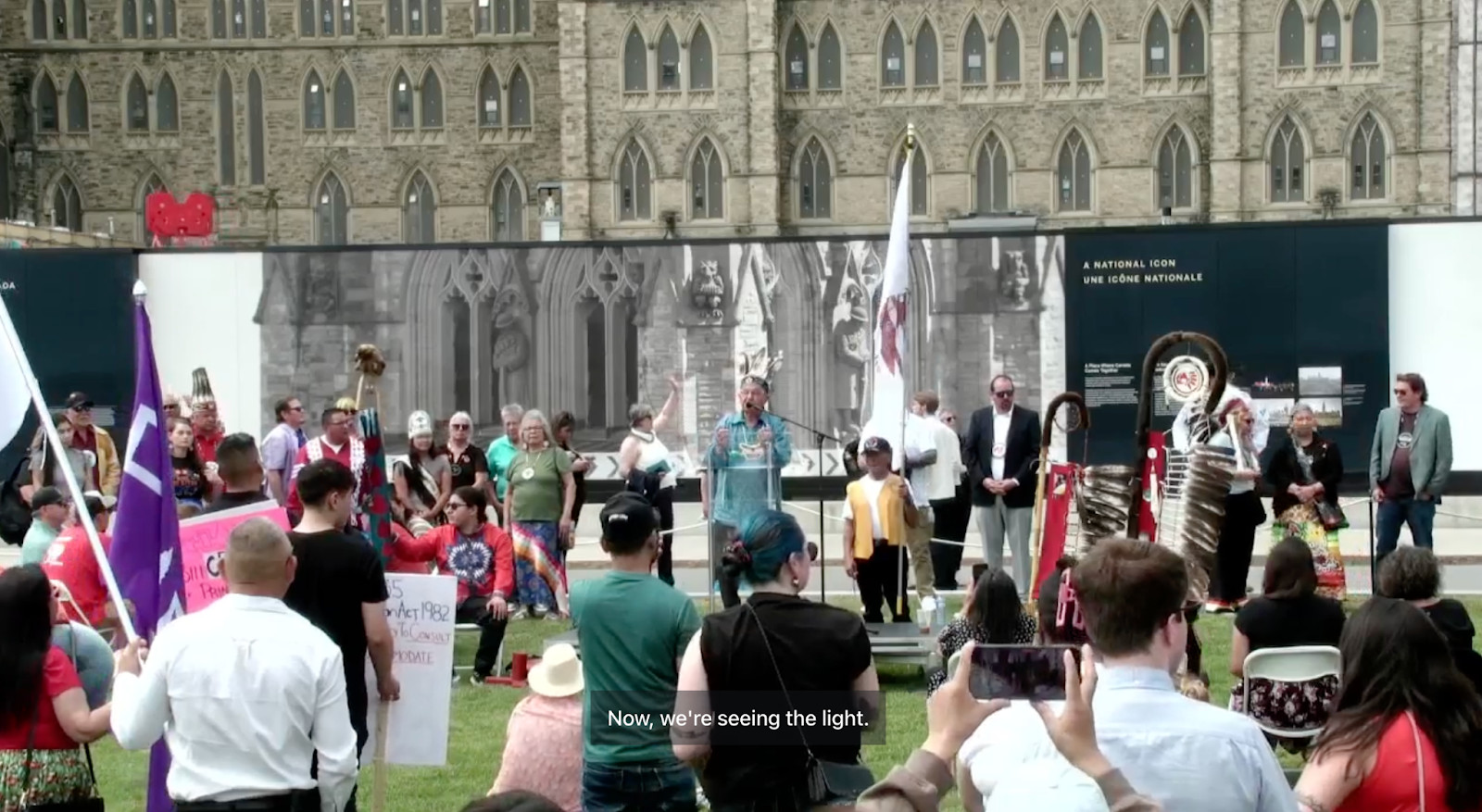
National Chief Cindy Woodhouse Nepinak presenting to the Standing Committee on Transport, Infrastructure and Communities on Bill C-5, An Act to enact the Free Trade and Labour Mobility in Canada Act and the Building Canada Act, while people from First Nations rallied outside Parliament Hill in Ottawa on June 17.
(Top: National Chief Cindy Woodhouse Nepinak, Bottom: Chiefs of Ontario/Facebook)
“When I first came into office, I told Minister (Greg) Rickford, ‘Treat them well, give them what they need, whatever they want for them to prosper.’ But there’s going to be a point that you can’t just keep coming hat in hand all the time to the government, you’ve got to be able to take care of yourselves,” Ford said during a news conference on June 18, two days after Prime Minister Mark Carney’s government rammed through Bill C-5, a bill that sparked similar concerns as Bill 5, through the parliament.
“And when you literally have gold mines, nickel mines, every type of critical mineral that the world wants, and you’re saying, ‘No, no, I don’t want to touch that, by the way, give me money’ — not going to happen.”

On June 14, protesters carrying banners reading “KILL BILL 5” gathered at Ford Fest as Doug Ford spoke about Trump, tariffs and insisted Canada would never become the “51st state”.
(HeadwatersStopsThe413)
First Nations leaders slammed the comment as “dangerous rhetoric” while NDP MPP Sol Mamakwa condemned Ford’s words as “deeply offensive and racist,” accusing Ford of disrespect and resource strong-arming.
The next day, Ford issued an apology during a meeting at Queen’s Park with dozens of chiefs from the Anishinabek Nation, which represents 39 First Nations across Ontario.
Between June 18 and 21, members of the Attawapiskat and Neskantaga First Nations launched a historic mobilization, “Here We Stand,” along the Attawapiskat River to defend their sacred waters and oppose the proposed Northern Road Link, the road that’s meant to connect future Ring of Fire mines to provincial highways.
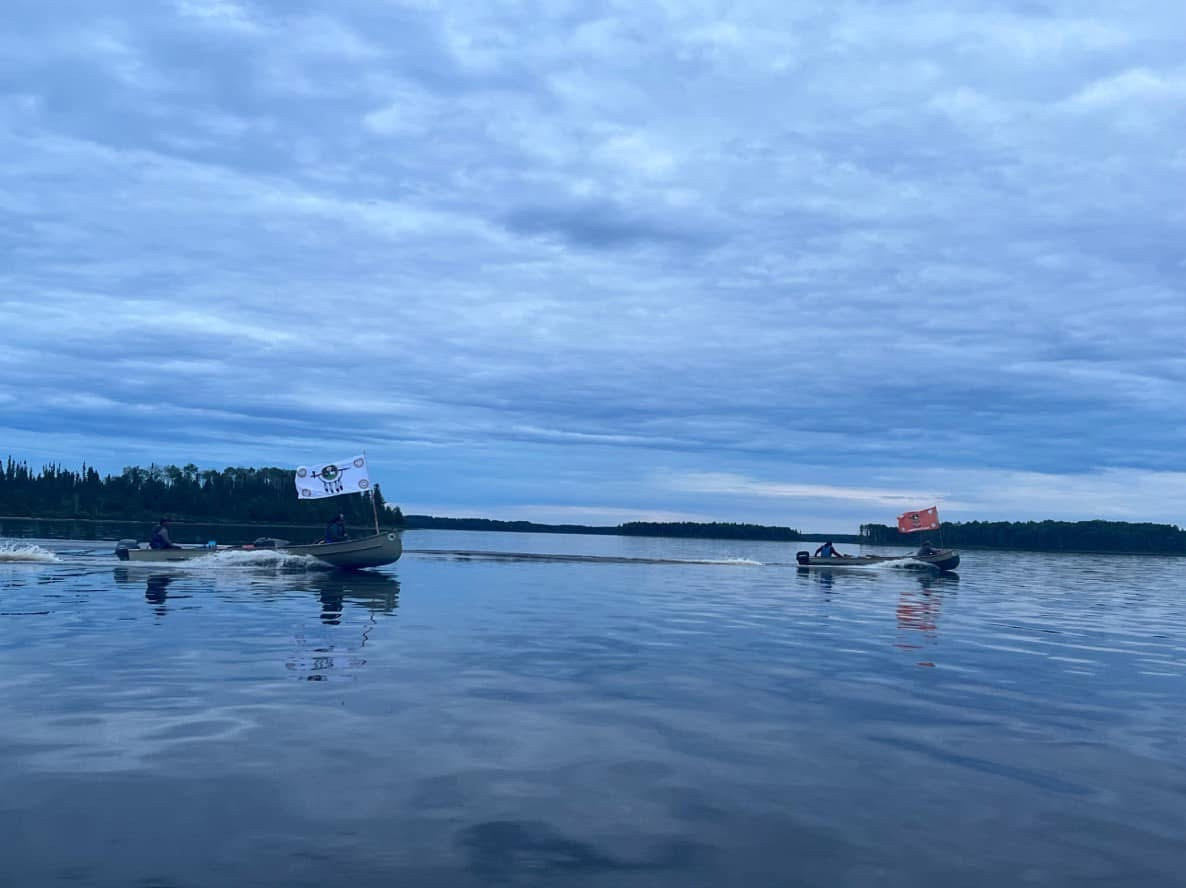
Grassroots delegations from Attawapiskat and Neskantaga First Nations surveyed the site by canoe, float plane, and air due to unusually low water levels. “The shallow river this year is yet another sign of the impacts of climate change—a direct threat to the land, water, and traditional land users throughout Treaty No. 9,” a statement shared with The Pointer claims.
(Neskantaga First Nation)
All this rush to make Ontario strong but when the Ford government unveiled its first integrated energy plan, Energy for Generations on June 12, it centred on building four small modular nuclear reactors at Darlington and designed by GE Hitachi, a project critics warn would be costly, risky and increase reliance on enriched uranium. While the province pegs the price at $20.9 billion, independent estimates put it closer to $27 billion with power far more expensive than wind or solar.
The plan assumes that by 2050, 75 percent of Ontario’s electricity will come from nuclear, while the share of renewables like wind and solar is projected to shrink.
That’s not all. Tucked into the blueprint was Brampton’s Emerald Energy from Waste incinerator, where experiments with a hydrogen electrolyzer powered by garbage to “assess how clean hydrogen produced on-site could be used for heavy-duty vehicles or to provide grid services” were being done.
Cleaner, tech-powered future? Not exactly.
Not only are there risks of hydrogen leaks involved in the process but the company in question also has plans to redevelop its incineration system in three phases, replacing the existing facility and building a new one on the same site to increase its capacity from 182,000 to up to 900,000 tonnes per year — making it Canada’s largest waste-burning facility.
By the end of June, environmental experts and advocates were sounding the alarm over a proposal made in May by Ford's government to invest nearly $38 million in building Destination Wasaga, a tourist hub featuring beaches, a revitalized downtown, and historic sites.
“The Ontario government is proposing to sell key parts of Ontario’s second most-visited Provincial Park for a development scheme. The area on the chopping block includes roughly 60 percent of the Park’s celebrated Georgian Bay shoreline lands,” Environmental Defence warned.
“The PPCRA (Provincial Parks and Conservation Reserves Act) currently requires that elected MPPs approve any significant removal of provincial park land. Rather than simply complying with that requirement and obtaining that approval for Wasaga Beach Provincial Park, the government is proposing currently unspecified “legislative amendments” to the PPCRA itself. The government notice says the amendments are “to remove” land.”
Friends of Nancy Island & Wasaga Beach Park volunteer and long-time piping plover guardian Fiona Ryner told The Pointer removing parkland from protected status and transferring it to municipal control can pave the way for commercialization, dune destruction and development in a fragile ecosystem that does not naturally regenerate.
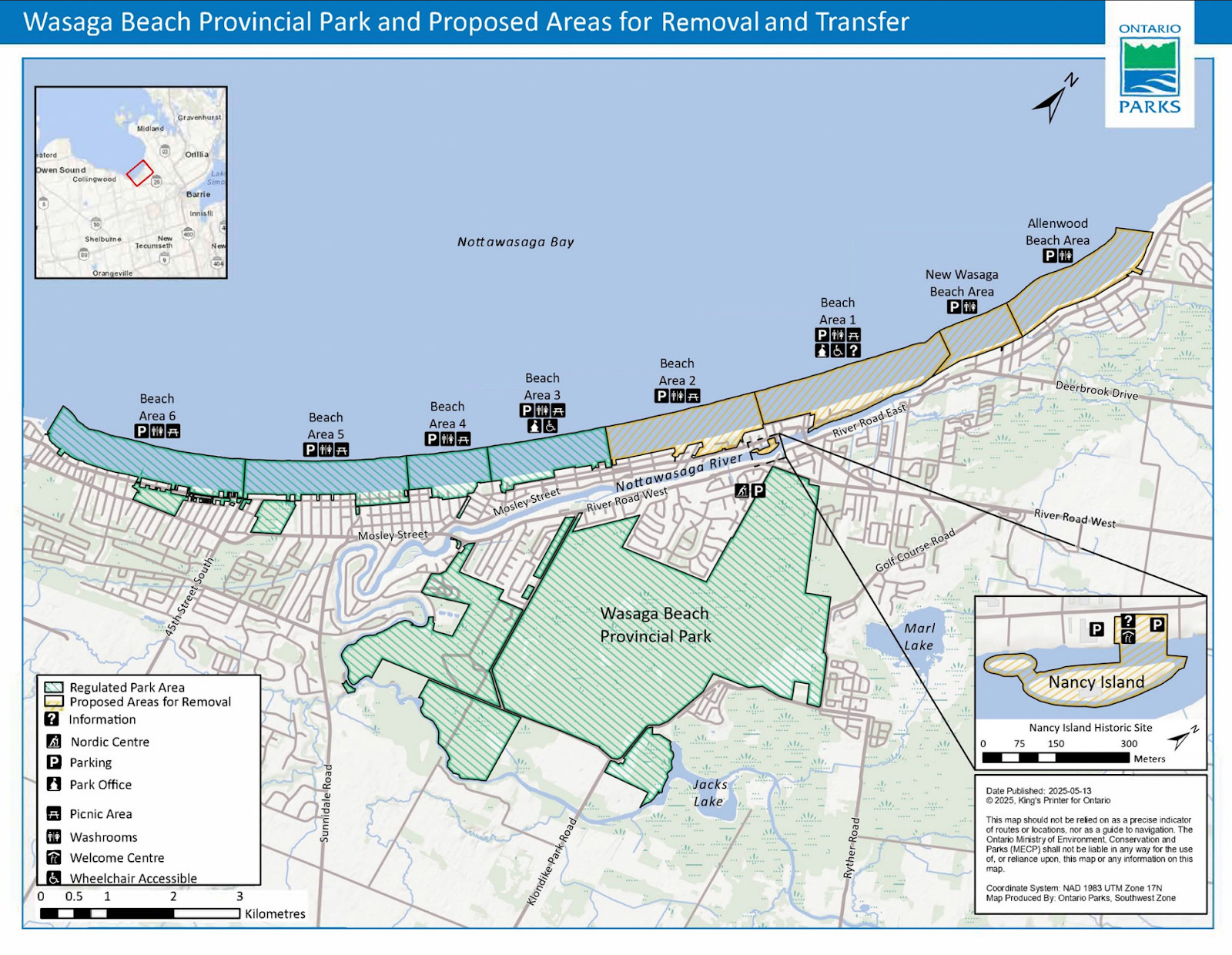
Wasaga Beach Provincial Park, established in 1959, spans 1,844 hectares and serves as a key recreational area. The proposed changes include transferring the administration of Nancy Island from the Ministry of the Environment, Conservation and Parks (MECP) to the Ministry of Tourism, Culture and Gaming (MTCG), shifting it from the Provincial Parks and Conservation Reserves Act (PPCRA) to the Heritage Property Act (HPA) to encourage tourism and economic growth. The proposal also includes removing four key areas from the park, with plans to sell Crown-owned lands to the Town of Wasaga Beach to support downtown revitalization. The public comment period for these changes closed on August 11.
(Ontario Parks/ERO)
Why did it matter? It would endanger piping plovers, wetlands and natural flood protections at a time when combating climate change is not an option while setting a dangerous precedent that could weaken safeguards for provincial parks across Ontario.
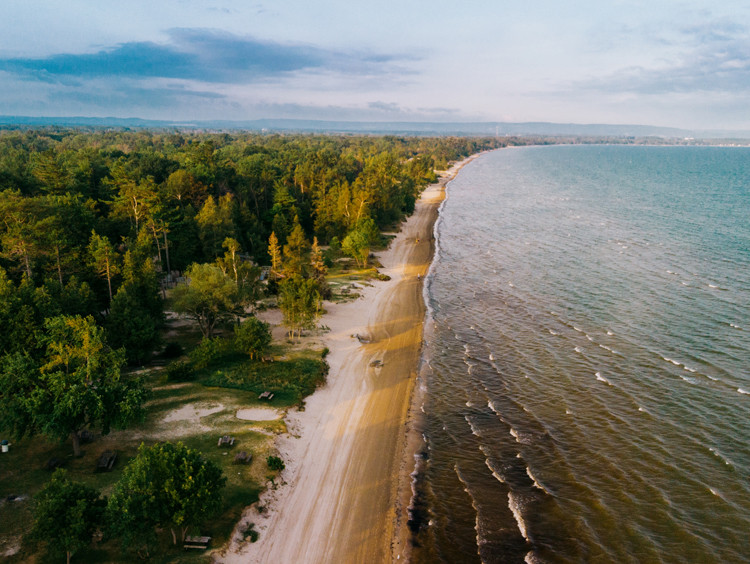
Wasaga Beach plays a crucial role in combating climate change, serving as a natural barrier against erosion, flooding, and storm surges, as well as provides essential habitat for endangered species. Its dune system stabilizes the shoreline, protects inland areas, and mitigates the increasing threat of severe weather events, making its preservation vital not only for the local ecosystem but also for the community’s resilience to climate impacts.
(Wasaga Beach)
July
On July 16, chiefs from four of the nine First Nations and senior counsel Kate Kempton of Woodward and Company announced a fast-tracked constitutional challenge on behalf of nine First Nations against Bill 5 and key sections of Bill C-5, arguing that the laws grant provincial and federal cabinets sweeping, unchecked powers to override protections for the environment, human rights and Indigenous consultation processes.
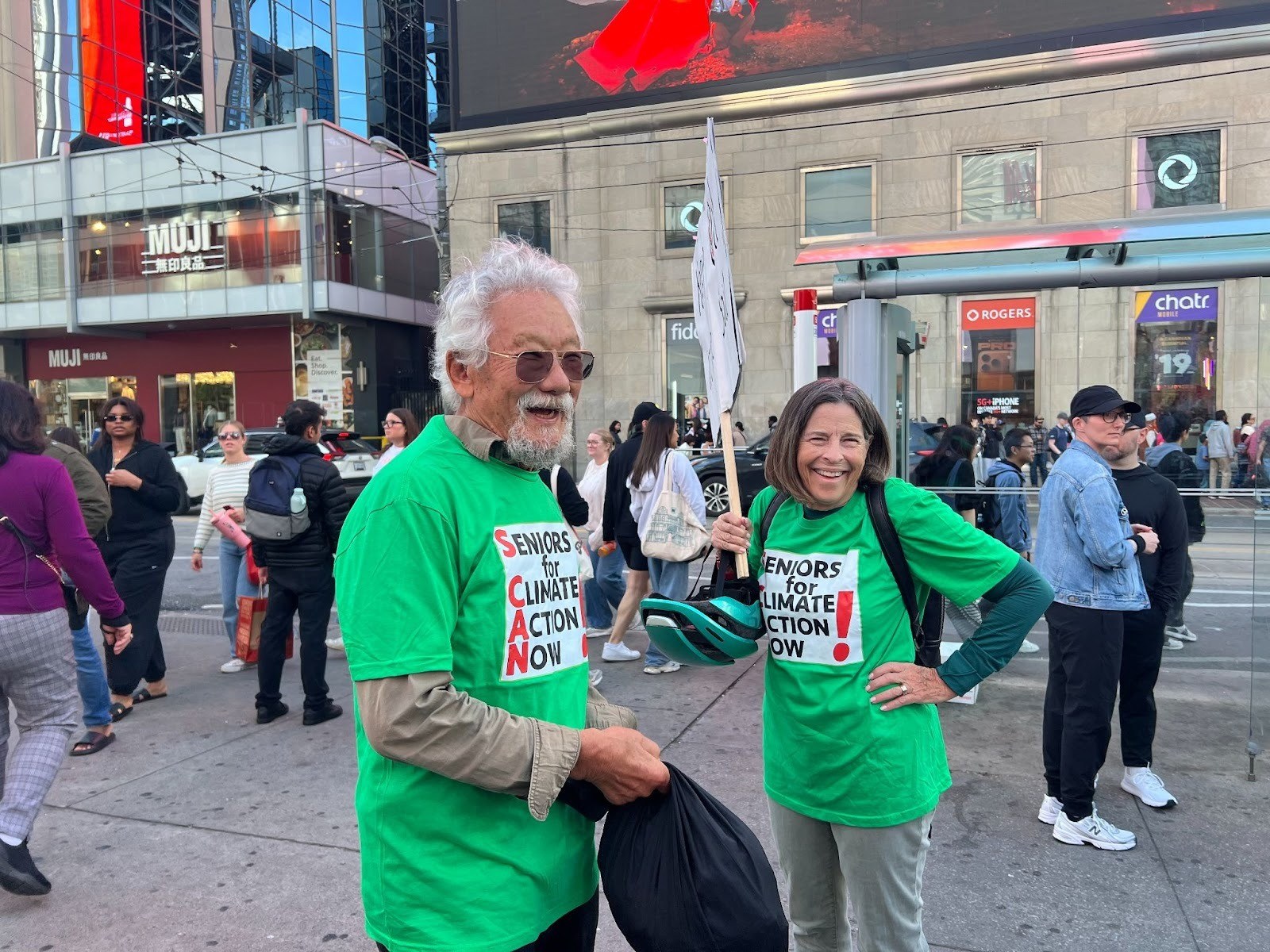
In July, David Suzuki declared that humanity has lost the fight against climate change due to decades of prioritizing economic and political interests over science, with flawed systems and widespread apathy blocking progress but he urged that we must not give up, instead refocusing our efforts to implement solutions and redefine our future. “Humans are out of control, out of sync with the things that keep us alive—the planet,” Canada’s most iconic naturalist told The Pointer during the ‘Draw The Line’ protest in September. “We’ve developed systems, legal, political, economic, that are completely out of sync with planet Earth. And planet Earth is the source of our survival and well-being.”
(Anushka Yadav/The Pointer)
August
Seven years after assuring developers he would open a “big chunk” of the Greenbelt in exchange for their support and reviving the project after securing power, Premier Ford announced construction on Highway 413, one of his key campaign promises, was “beginning” on August 27 — a claim challenged by several environmental groups.
“This is about appearing to start construction to make the project politically difficult to stop,” environmental lawyer Laura Bowman said, noting similar tactics used on the Bradford Bypass resulted in years of stalled infrastructure and mounting public costs.
The appearance Bowman’s referring to is the “early works” or a series of limited infrastructure upgrades that don’t require federal approval. They include a stretch of Highway 10 in Caledon, preliminary design work for a future bridge along with upgrades at the Highway 401/407 interchange. None of this involved building the 52-kilometre Highway 413 itself nor do the early works resolve the broader environmental and financial questions that have dogged the project for years.
Even with the provincial Species At-Risk Act replaced with a tempered-down version, a University of Guelph study by biologists Karl Heide and Ryan Norris found the highway would harm at least 29 species protected under the federal Species at Risk Act, including Blanding’s Turtle, Butternut, Redside Dace, Wood Thrush, Red-headed Woodpecker and the Rusty-Patched Bumble Bee.
September
On September 10, the PCs rolled out their first move to unlock the Ring of Fire, pouring $62 million into Geraldton’s roads to build what officials call the “gateway” to Ontario’s 5,000 square kilometres mineral treasure trove containing nickel, copper, platinum and chromite. Stretching from Highway 11 to Highway 584, the road would allow all-season access to a remote, resource-rich wilderness that’s home to one of the planet’s most valuable natural climate assets, the Hudson Bay Lowlands, a vast expanse of peatlands that stores an estimated 30 to 35 billion tonnes of carbon and provides refuge to over 50 species at risk.

The proposed Webequie Supply Road segment of the Ring of Fire access network will cut through a number of bodies of water, requiring an estimated six bridges and 25 culverts. The broader road network, composed of three connected projects, will cross major rivers, including the Attawapiskat River and the Albany River, both crucial to the local ecosystem and First Nations communities.
(Government of Ontario)
Scientists estimate between 1.6 and 2 billion tonnes of carbon equivalent greenhouse gases lie locked beneath the surface of the proposed development zone site and disturbing it could release massive emissions and undermine not only Canada’s but also global climate goals.
“The close to $40 million that they’re putting in, it’s not much…the land which we’re protecting, that’s priceless,” Neskantaga First Nation Chief Gary Quisess told The Pointer while calling out the PCs strategy as “divide and conquer”.

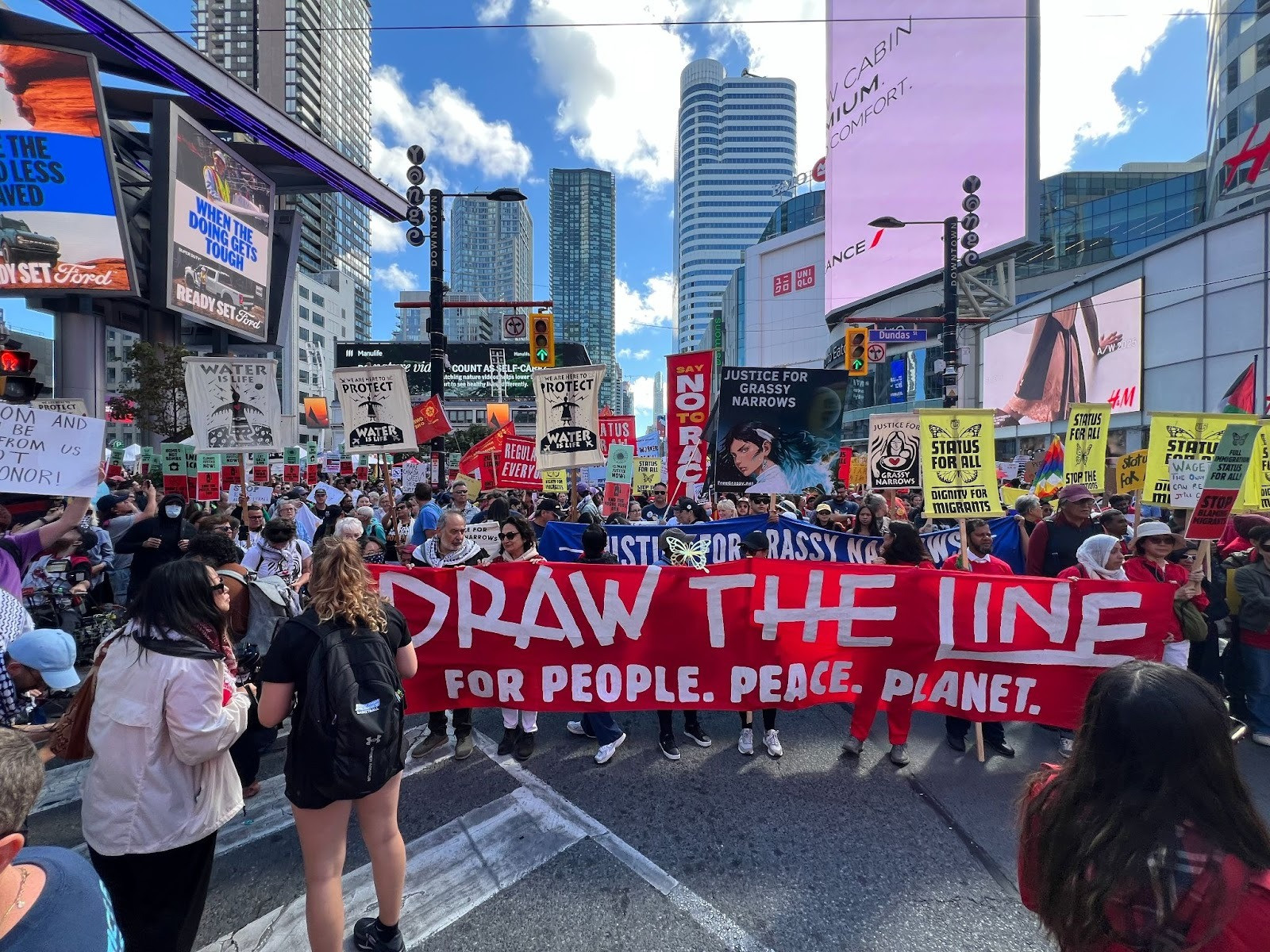
On September 19, protestors gathered outside Queen’s Park, creating a satirical scene (as seen in the first photo), declaring the provincial legislature a Special Economic Zone and pouring mysterious toxic waste into a prop water body surrounded by species at-risk. On September 20, concerned Canadians across the country took part in the ‘Draw The Line’ protest organized by a coalition of 14 partner groups against Bill C-5 and Prime Minister Mark Carney’s support for new fossil fuel projects, looming public service cuts and policies critics say sideline Indigenous voices.
(Anushka Yadav/The Pointer)
October
Within days of returning to the provincial legislature, the PCs reshaped Ontario’s water governance through three pieces of legislation: bills 56 and 60 in October and Bill 68 in November.
Bill 56, the Building a More Competitive Economy Act, which received royal assent by November 3 after being tabled on October 20, made sweeping changes to Ontario’s Clean Water Act, centralizing decision-making over drinking water protection with the province and reducing the role of locally run source protection committees established after the Walkerton tragedy, a move critics warn could weaken evidence-based safeguards under the guise of streamlining development approvals.
On June 30, Ontario Environment Minister Todd McCarthy co-signed a letter urging the federal government not to reintroduce Bill C-61, legislation aimed at ensuring clean drinking water and protecting freshwater sources on First Nations lands, and repeal the Impact Assessment Act, the Greenhouse Gas Pollution Pricing Act as well as the federal electric vehicle mandate.
McCarthy framed the request as supporting economic growth and countering U.S. trade pressures but did not explain how the bill would impede these goals.
First Nations leaders condemned the move and demanded the environment minister’s resignation, arguing the minister failed to prioritize Indigenous communities’ longstanding right to safe drinking water.
McCarthy later issued an apology for any “confusion,” claiming the goal was to balance regulatory certainty with clean water access, though many First Nations rejected it as meaningless, noting he had not withdrawn the request.
Another one of the PCs’ omnibus bills, Bill 60, Fighting Delays, Building Faster Act, tabled on October 23 and passed into law by November 27, bundled major changes across transit, planning, housing, transportation, water and municipal governance.
The Keep Water Public coalition warned that Schedule 16 (Water and Wastewater Public Corporations Act) of the legislation allows the province to create new “water corporations” to run local drinking water and wastewater systems, making water less safe and less affordable for Ontarians.
“These profit-driven corporate bodies could set rates, take on debt, and operate with less public oversight, mortgaging our water for their bottom line,” the coalition noted in a statement.

Ontario has 26 First Nation communities under active long-term drinking water advisories.
(Government of Canada)
CUPE Ontario president Fred Hahn noted that if there’s anything that the Walkerton tragedy has taught Ontarians, it is that cuts, deregulation and privatization have “deadly consequences.”
“The Ford Conservatives can call it whatever they want, but the language of Bill 60 makes it clear that they are privatizing our water. They held debate at night when people weren’t watching and made it impossible for people to comment so they could fast track a disastrous law that prioritizes their corporate agenda over the safety and affordability of water for all Ontarians,” Hahn added.
Amidst the stack of bills pushed through the provincial legislature, the pursual for a road to the Ring of Fire continued.
On October 29, Ford alongside Indigenous affairs and First Nations economic development minister Greg Rickford and Webequie First Nation Chief Cornelius Wabasse, announced a Community Partnership Agreement aimed at accelerating road construction in the ecologically sensitive, mineral-rich Ring of Fire.
November
On November 6, Ontario’s finance minister Peter Bethlenfalvy unveiled the 2025 Fall Economic Statement that brought three big and historical changes, not in a good way.
It repealed sections 3-5 of the 2018 Cap and Trade Cancellation Act, which requires the province to set emissions reduction targets, develop a climate change plan and report on progress toward those goals. On November 27, the province introduced what seemed to be a replacement for this change – Bill 81, Ontario Climate Change Adaptation and Resilience Act, which sets out a broad framework for climate adaptation and resilience but raises concerns since many measures depend on future funding with the Minister having wide discretion over planning and fund allocation, limited enforcement and reliance on voluntary compliance or delayed regulations, potentially leaving urgent climate risks under-addressed.
Bill 68 also made changes to the Provincial Parks and Conservation Reserves Act and the Historical Parks Act that paired with Provincial Parks and Conservation Reserves Amendment Act or Bill 26, which was first proposed in May and passed into law by December 11, to grant the government authority to reclassify ecologically sensitive provincial parks and create new park classes by regulation without public consultation, raising fears that the Ford government is paving the way for transferring parts of Wasaga Beach to municipal control for tourism development.
On November 17, multiple environment advocates and experts spoke at a Standing Committee of the Interior offering amendments to Bill 26, which proposes to add two new classes of provincial parks, including urban and adventure class parks.
“We support the concept [of adventure class parks] so long as 'maintenance of ecological integrity ' remains the first priority,” Ontario Nature’s executive director Andrés Jiménez Monge said.
“Ecological integrity is the sheer anchor, and recreational uses should complement, not risk that purpose.”
Jiménez Monge urged the committee to explicitly prevent any existing provincial parks from being reclassified as adventure parks, warning that such changes, made without renewed Indigenous and community engagement, could erode ecological protections, break prior commitments and create uncertainty for partners while also cautioning that making motorized recreation like snowmobiles and ATVs a core feature of these parks risks undermining ecological integrity and protected-area standards and should instead remain limited to existing land-use planning and designated trail systems.
He emphasized that provincial parks and conservation reserves must remain places for low-impact recreation and ecological and recreational needs can be balanced when management decisions stay with Ontario Parks staff supported by monitoring and enforcement.
Jiménez Monge requested the removal of a clause allowing the creation of “such other classes of parks as may be prescribed by regulation,” warning it grants overly broad power to add new park categories without legislative oversight.
Less than 11 percent of Ontario’s lands and waters remain formally protected and the province has yet to adopt the national and international “30x30” target, which aims to conserve 30 percent of lands and waters by 2030. Canada committed to the goal in 2022 as a signatory to the UN Convention on Biological Diversity and Ontario is widely regarded as a “laggard” in the national effort to safeguard its natural heritage, Wilderness Committee’s Ontario campaigner Katie Krelove reminded government officials during her presentation.
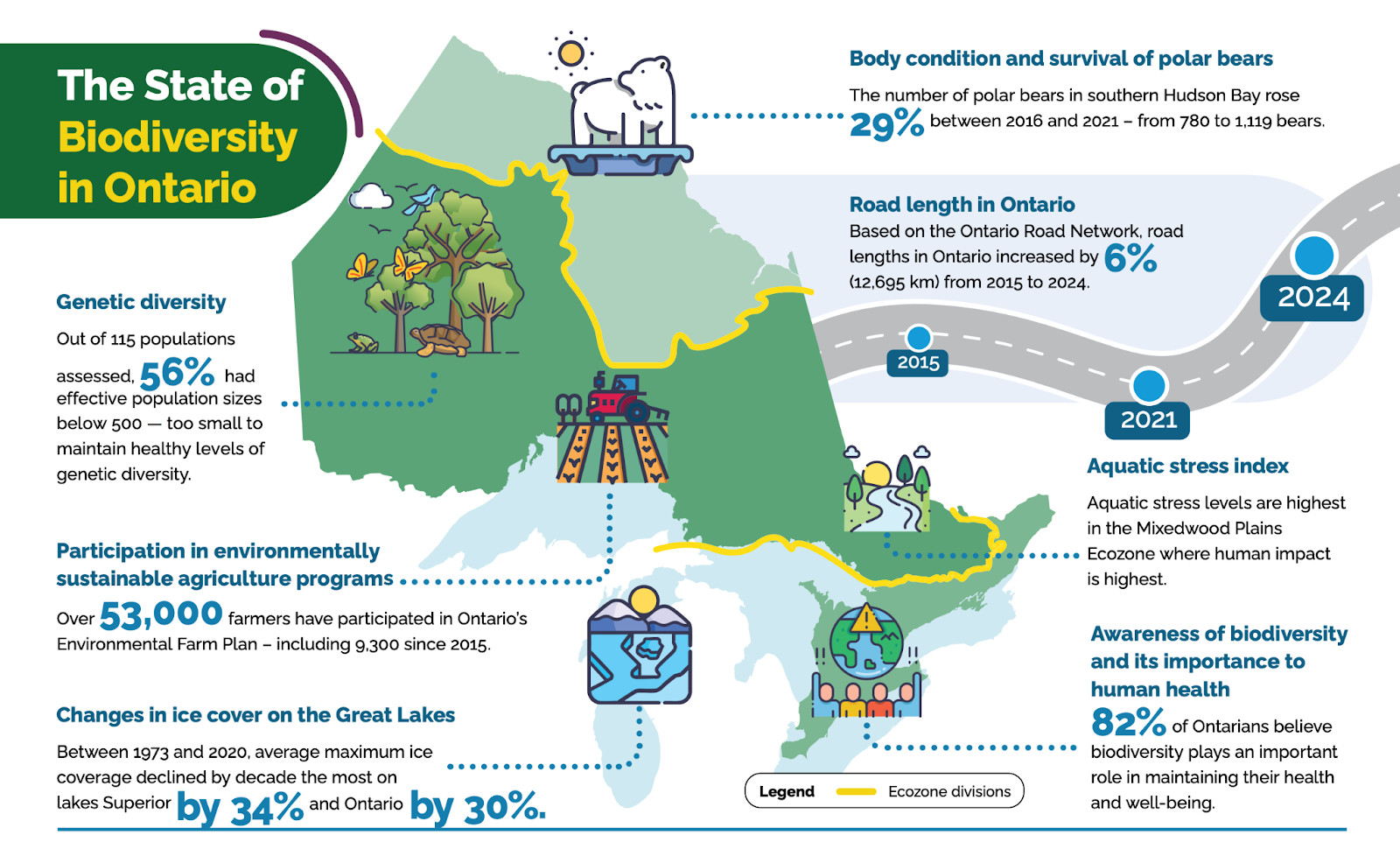
In 2025, Ontario’s biodiversity progress remained uneven: more than half of the strategy’s conservation targets (54 percent) have made little progress, 38 percent have seen some progress, none have achieved substantial results and no targets have been fully met. The report also found that 88 percent of Ontarians support investments in biodiversity protection and restoration.
(State of Ontario’s Biodiversity/Sobr)
The third major change under Bill 68 targets one of Ontario’s most effective yet chronically underfunded environmental safeguards: the province’s 36 conservation authorities, which the Ford government plans to amalgamate into seven mega-regional bodies under a new centralized Ontario Provincial Conservation Agency (OPCA).
PC officials claim the changes are aimed at speeding up housing and infrastructure approvals but critics warn it could dismantle decades of watershed-based protection, erase local scientific expertise, weaken flood prevention and environmental oversight while opening the floodgates to unchecked development.
December
Two days before, Ontario’s Auditor General Shelley Spence laid bare the PCs’ mishandling of the Environmental Bill of Rights (EBR) in her report, exposing a pattern of bypassed consultations, ignored public input and weak enforcement that puts Ontarians’ environmental rights at risk.
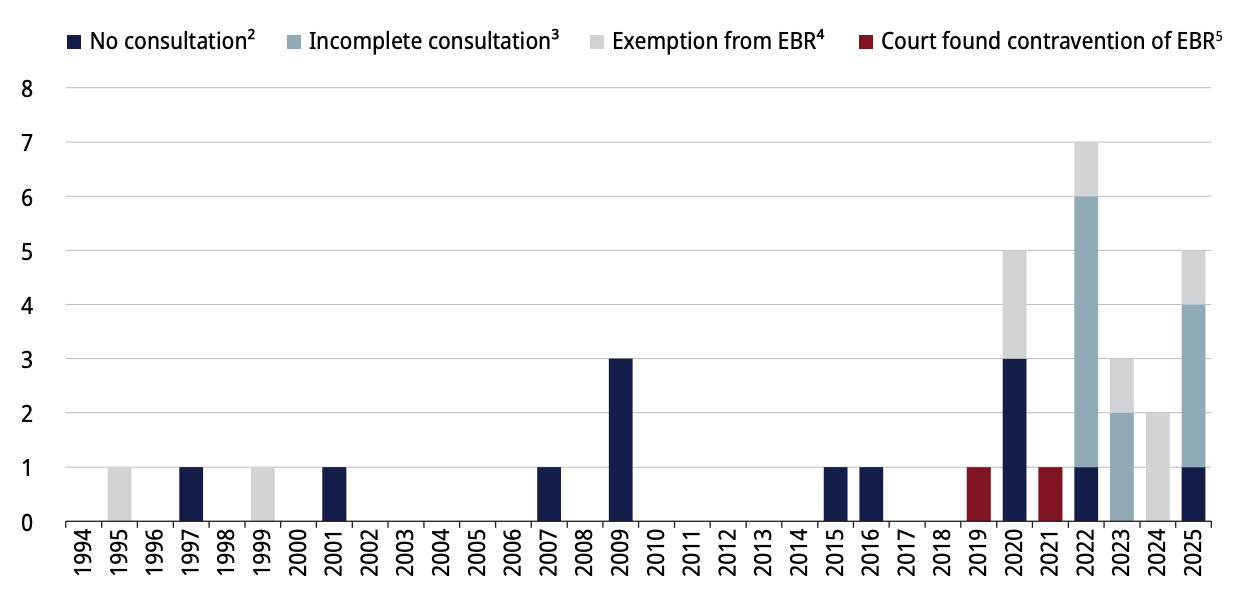
Since 2019, the province has increasingly bypassed the Environmental Bill of Rights, passing environmentally significant bills without consultation, approving projects before consultations ended, granting broad exemptions, and even being twice found by the Divisional Court to have violated the Act including in 2019 when the Court ruled Ontario broke the law by failing to consult the public on Planning Act changes that enabled rapid rezoning for fast-tracked development. The trend has only worsened, with 2025 marking the second-highest year on record for incomplete consultations after 2022.
(Auditor General of Ontario)
Spence’s report revealed ministries repeatedly failing to apply or document Statement of Environmental Values (SEVs), exempting major projects like Highway 413 and the Ontario Place redevelopment from public review and issuing vague or incomplete notices that obscure environmental impacts while public advertising campaigns continue to prioritize image over transparency.
The Ford government spent a record-breaking $111.9 million on taxpayer-funded advertising in 2024-25, the highest ever in the province’s history, with nearly 40 percent of the ads designed to leave Ontarians with a “positive impression” of the government right before calling for an early election, the audit highlighted.
“When I look at value for money for those ads we look at: is it telling me anything I didn't know as a person in Ontario?,” Spence said.
“Some of the ads are quite promotional for the governing party. They aren't really providing good, solid information to the citizens of Ontario…there's numbers that are sometimes in the ads, and we don't have support for those numbers quite often. They're future-oriented numbers as well.”

"The two largest campaigns, “US Partnerships” and “It’s Happening Here, Phases 2 & 3,” accounted for $59.3 million, or 53 percent of government advertising spending in 2024/25,” the Auditor General’s latest report noted.
(Auditor General of Ontario)
On December 18, as Ford and Carney announced an agreement to streamline environmental assessments, avoiding “ federal duplication” and fast-track the all-season Ring of Fire road, with Ottawa deferring to Ontario’s review process to speed up major infrastructure projects under a ‘One Project, One Process, One Decision’ model, the Prime Minister was seen chuckling and making animated expressions while Ford described an anti-tariff ad featuring Ronald Reagan that ran in the U.S. as the “greatest ad ever”.
Ford made the comments after U.S. President Donald Trump halted trade talks with Canada in response to the ad, threatening to slap an additional ten percent tariff on top of existing duties.
A day before the announcement, the province released its Special Economic Zones (SEZ) regulations, which ignored the concerns raised by environmental groups and First Nations after draft regulations were released in October, granting preferential rights to select “trusted proponents,” including foreign investors, bypassing provincial and municipal laws, disregarding input from Indigenous communities and civil society, leaving project approvals solely to the Minister’s discretion and shielding the government from liability for any resulting environmental or social damage.
On December 8, Legal Advocates for Nature’s Defence (LAND) submitted, on behalf of Ramon Kataquapit of Attawapiskat First Nation and the Friends of the Attawapiskat River founder Michel Koostachin, a request for leave to intervene in the Ontario Superior Court of Justice against Bill 5 which the proponents argue impact Indigenous communities, lands and waters, particularly in Treaty 9 territory and the Hudson-James Bay lowlands.
“If our leadership won't be taken seriously, if the treaties won't be taken seriously, if our past isn't taken seriously, we’ll make sure that our future will be,” Ramon told The Pointer.
“And part of that goal is equity, equality, and environmental stewardship, and strengthening Treaty rights.”
On the final day of the 2025 legislative sitting at Queen’s Park, municipal affairs minister Rob Flack also broke his silence on the mandatory 10-year review of the Greenbelt Plan, which was scheduled for February this year but was delayed due to the snap elections.
“I think everyone knows we had a winter election, as of that, we are taking time to get the framework put in place so we can do a proper review,” Flack said but failed to provide a timeline for the review.
“The Greenbelt is enshrined in legislation for generations to come.”
The review is meant to be conducted by the Greenbelt Council, which is currently inactive as its last government-appointed members’ terms expired in June.
With provincial leaders set to return back to Queen’s Park on March 23 in the new year, missing four full sitting weeks, Ontarians continue to pay the price, quite literally, through bumped-up insurance rates and skyrocketing grocery bills.
In its latest report, Canada's Food Price Report projects an average family of four could face an estimated $994.63 increase in food costs in 2026 compared with 2025 due to climate change impacts and trade pressures.
Starting November 1, Ontarians also faced a sharp 29 percent increase in residential electricity generation costs, largely driven by reliance on expensive nuclear power, with much of the rise temporarily offset by an expanded taxpayer-funded Ontario Electricity Rebate.
But it wasn’t all doom and gloom.
In Ontario, species once believed to be lost began to re-emerge. After a reassessment by the Committee on the Status of Endangered Wildlife in Canada (COSEWIC), the Canadian Wildlife Federation confirmed the rediscovery of the Illinois Tick-Trefoil in Brantford, a plant not seen in Canada since 1978 and long considered extirpated.
Beyond biodiversity, climate-positive policy moments also surfaced, including renewed momentum around high-speed rail in the Ottawa-Montreal corridor, widely viewed as a win for both emissions reduction and Canadians.
The world’s highest court delivered historic protections for communities on the frontlines of climate change.

On October 1, the world lost legendary conservationist Dr. Jane Goodall. “There is hope. We can slow down climate change, we can slow down loss of biodiversity, we can change corporations, we can change government policies but only if we get together, and it's the young people today that give me the most hope. You can stand up and make a difference,” Goodall said. ”Fighting is not a word that's associated with peace. But if we're fighting for freedom, for justice, justice to people, justice to sentient animals, then fighting is a good word.”
(Photo: Jane Goodall Institute Canada, Graphics: Anushka Yadav/The Pointer)
As we bid adieu to 2025 and welcome 2026, we at The Pointer want you, our readers, to remember that though the climate crisis can feel claustrophobic, individual actions are still critical. As the legendary primatologist Jane Goodall said: “Somehow we must keep hope alive—a hope that we can find a way to educate all, alleviate poverty, assuage anger and live in harmony with the environment, with animals and with each other.”
Email: [email protected]
At a time when vital public information is needed by everyone, The Pointer has taken down our paywall on all stories to ensure every resident of Brampton, Mississauga and Niagara has access to the facts. For those who are able, we encourage you to consider a subscription. This will help us report on important public interest issues the community needs to know about now more than ever. You can register for a 30-day free trial HERE. Thereafter, The Pointer will charge $10 a month and you can cancel any time right on the website. Thank you
Submit a correction about this story

