
Plan to allow early construction in downtown Brampton, despite flood risk, now in hands of Province, conservation authority
The City of Brampton has officially requested approval from the provincial government and the Toronto and Region Conservation Authority to advance two developments in downtown Brampton before the Riverwalk project, meant to mitigate the well-documented flood risk in the area, is completed.
Initiated in December, the City is looking to amend the Special Policy Area (SPA) framework that limits development in the downtown core to allow early phase construction of two City-led projects: the Centre for Innovation (CFI), and development of a large section of Main Street known as the Heritage Theatre Block and Southern Block, which includes a number of addresses along Main Street North (30-46, 54-60 and 70-86)
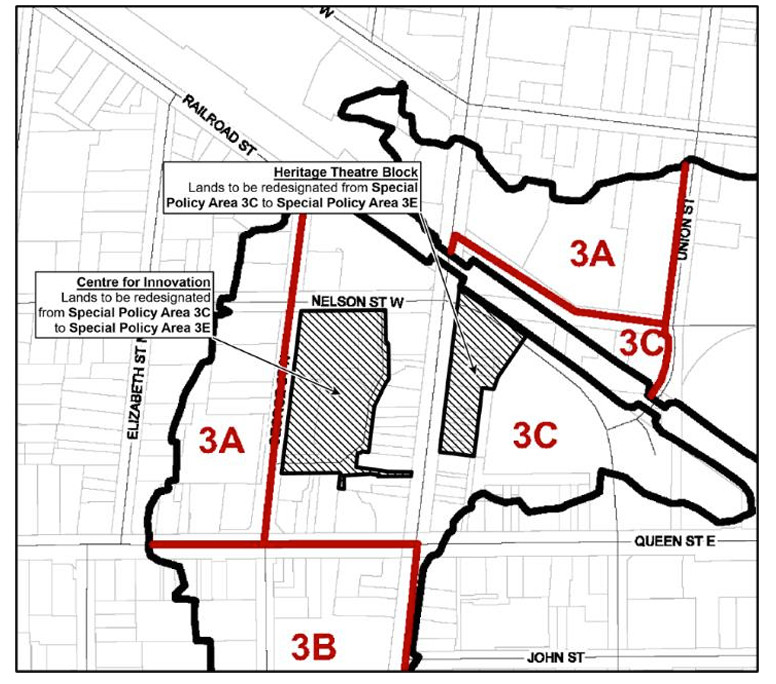
Brampton council members want to move forward with development in downtown, despite the risk of flooding. Staff claim this can be done in a safe manner. The construction of sufficient flood mitigation infrastructure is at least three years away.
(City of Brampton)
Much of downtown is part of the SPA, a provincial designation put in place to limit development in the downtown due to the existing flood risk.
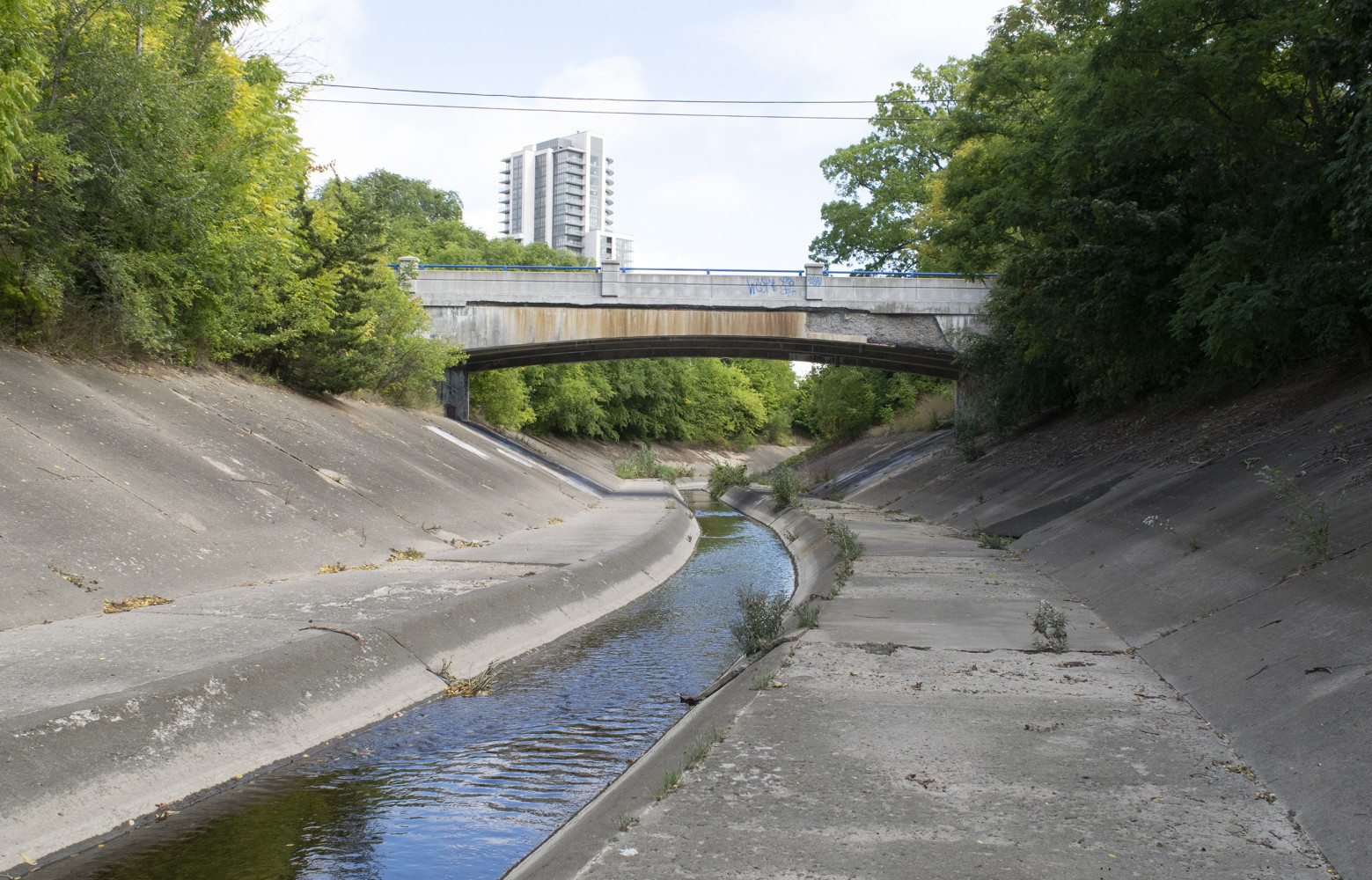
For decades, the City has been handling the risk of water rising above the banks of Etobicoke Creek by diverting it around the town through a concrete-lined bypass channel. As a result of climate change and increased rainfall, this bypass channel is no longer sufficient to handle the increased water levels projected in years to come.
To fix this problem the City of Brampton has been advancing the Riverwalk flood mitigation project to eliminate the potential for flooding. This would allow the SPA to be lifted and large-scale development to commence.
In a surprise move in December, the City released a public report indicating its intention to allow development to move forward prior to this flood mitigation being completed.
On February 2, a report before the Planning and Development Committee provided further details on this initiative, making it clear the requested change to the SPA would not allow large-scale development or residential occupancy before the flood risk is completely eliminated.
The Provincial Policy Statement allows construction within SPAs, but requires joint approval from the Ministry of Municipal Affairs and Housing (MMAH) and the Ministry of Natural Resources (MNR), and must include the appropriate “risk-mitigation measures.”
According to the report from City staff, the Official Plan amendment would allow for planning approvals, “design development” and permitting; site preparation including demolition, shoring excavation and grading; “construction-phase activities associated with approved development”; and “limited, temporary, non-residential site activation”. This includes temporary and removable structures, like modular units or shipping container–type structures used during construction.
The report makes it clear residential occupancy or “sleeping accommodation, whether temporary or permanent” will not be permitted prior to the Riverwalk’s completion. Occupancy of any “permanent buildings or structures” is also not permitted.
The amended SPA will only apply to the Centre for Innovation and Main Street North properties.
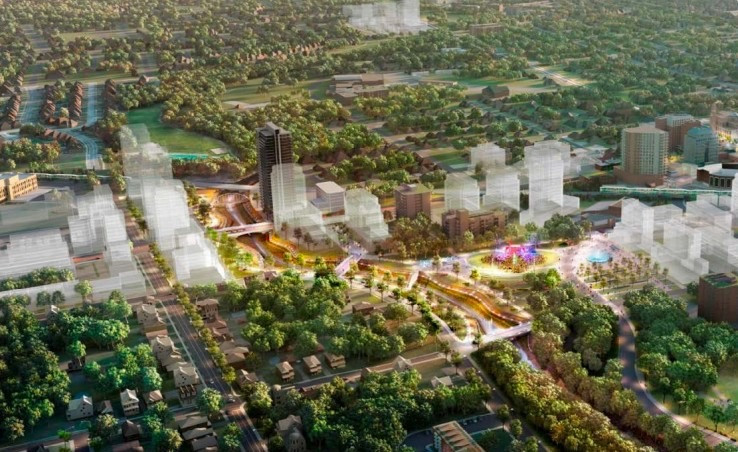
The long-delayed Riverwalk project is meant to mitigate the flood risk in Brampton’s downtown.
(City of Brampton)
According to the report, City staff will ensure the framework “remains consistent with provincial requirements, supports joint-Ministerial review and allows for any required technical or policy refinements to be incorporated prior to final adoption by Council”.
Two studies conducted by Montrose Environmental Inc. for the City, a “Flood Hazard Assessment” and “Flood Risk Assessment,” concluded the SPA amendment, and the work it allows, “will not represent an increase in risk to life and property”.
While the risk may be minimal, the City has maintained that any development partners that work with the municipality on either of these two projects, will be required to sign agreements that fully indemnifies the City of Brampton.
“The applicant shall acknowledge in writing the risks that the applicant is assuming associated with the construction of buildings and/or structures in advance of the Riverwalk flood protection infrastructure works being complete and functional,” the draft Official Plan Amendment details.
This agreement must also include a “complete indemnification of any public authorities” from any damages from “property damage, injury or loss of life due to flooding during and after construction until Toronto and Region Conservation Authority confirms in writing that the Riverwalk flood protection infrastructure works are complete and functional” and “any losses attributable to delays in the completion of the Riverwalk flood protection infrastructure works or caused by a failure of the flood protection infrastructure works to be completed or to be completed within the anticipated time frame.”
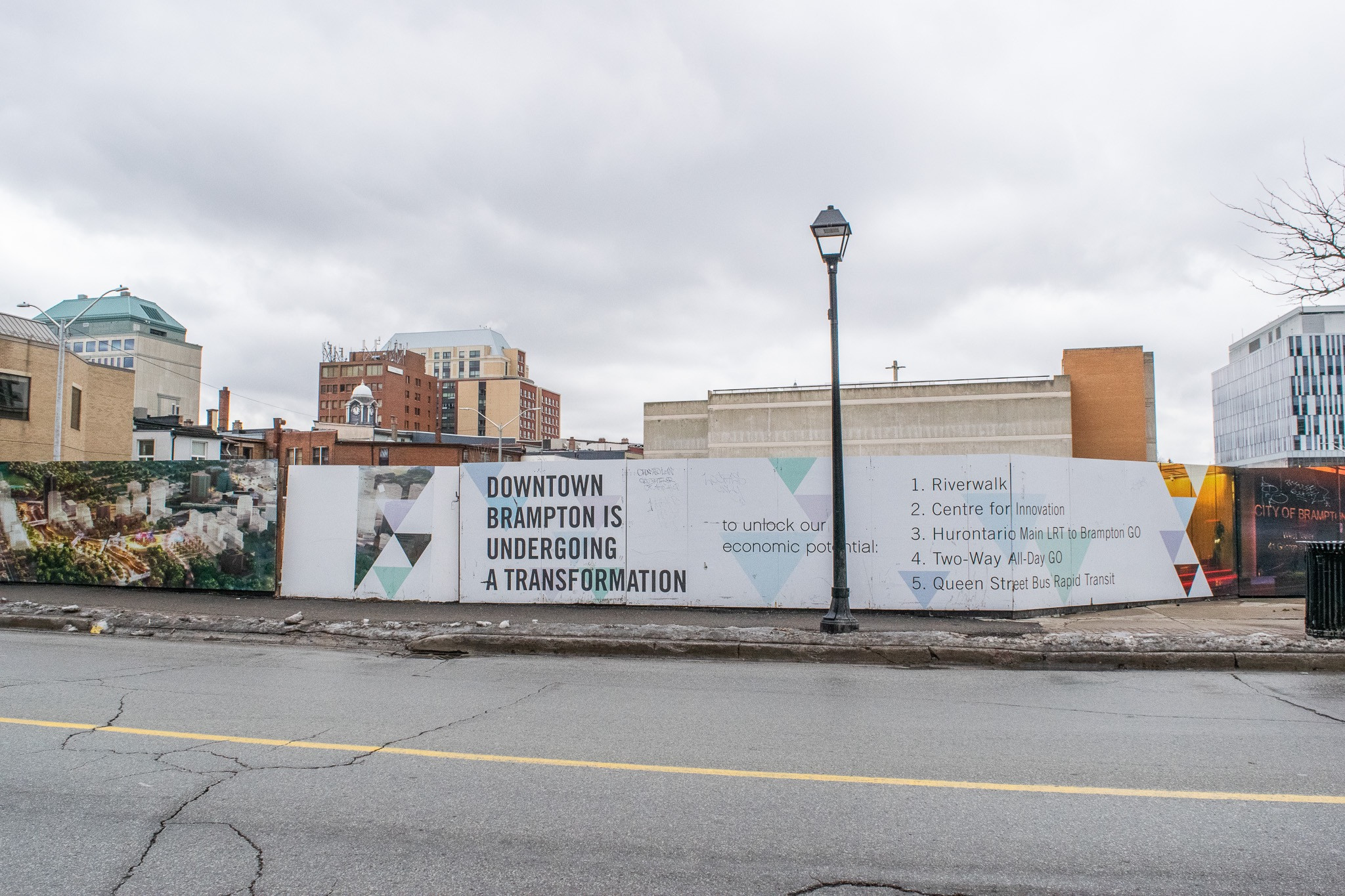
The City of Brampton is seeking provincial government approval to move forward with its Centre for Innovation project prior to eliminating the flood risk in the downtown.
(Alexis Wright/The Pointer)
According to City officials, construction on the Riverwalk project has commenced, with further work expected to advance “over the next several years”. The City is aiming to complete the project in 2028 “subject to detailed design, permitting, funding, and agency approvals.”
It is unclear where construction on the project currently stands, and whether the lack of new investment into the Riverwalk in the 2026 budget will impact this timeline.
City staff began working on land acquisition for the project three years ago, but very little information has since been provided by the council.
The Pointer asked the City of Brampton media relations department for confirmation on the completion timeline of 2028 for the Riverwalk Flood Protection Project, given that no new money has been allocated this year. City staff acknowledged the request, then requested an extension to gather the necessary information, which was granted. A response has yet to be received.
The Pointer also sent questions to MMAH and MNR, asking whether it would permit development to move forward within flood-risk areas while the underlying flood hazard has not yet been fully mitigated. Neither responded.
Underinvestment into the City’s downtown has become a pattern under Mayor Patrick Brown. He has repeatedly refused to budget sufficiently for badly needed infrastructure in the downtown, including the Riverwalk. Despite federal funding assistance for the project (which could cost more than half a billion dollars), Brown has failed to provide matching dollars to unlock the $38 million Ottawa offered five years ago and has ignored a range of spending priorities to rehabilitate Brampton’s struggling downtown.
After being elected mayor in 2018, Brown immediately cancelled the Downtown Reimagined revitalization plan, which involved a number of structural improvements in the city centre. This has further exacerbated issues in downtown Brampton, which has been on a steep decline for years. Boarded up buildings, shuttered storefronts and cracked roads and sidewalks have become a common sight.
Email: [email protected]
At a time when vital public information is needed by everyone, The Pointer has taken down our paywall on all stories to ensure every resident of Brampton, Mississauga and Niagara has access to the facts. For those who are able, we encourage you to consider a subscription. This will help us report on important public interest issues the community needs to know about now more than ever. You can register for a 30-day free trial HERE. Thereafter, The Pointer will charge $10 a month and you can cancel any time right on the website. Thank you
Submit a correction about this story

