
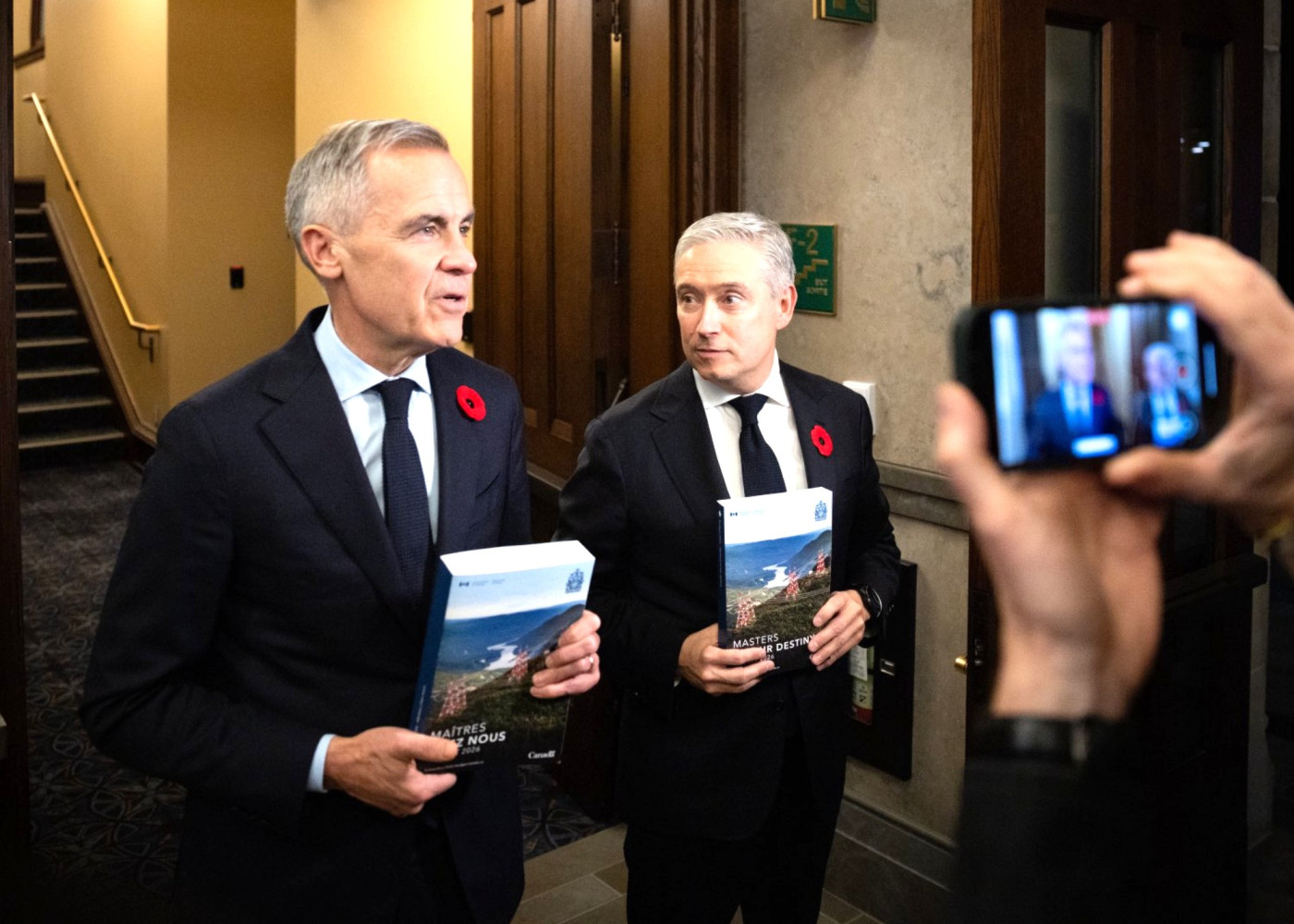
Carney’s second budget bets on oil, gas and AI as ‘Masters of Canada’s Destiny’ while climate costs soar
“Our country is more united than ever… [and] our greatest strength, as the Prime Minister said, is something that cannot be found on [a] balance sheet: trust. Trust is what defines Canada in an uncertain world,” Minister of Finance and National Revenue, François-Philippe Champagne, said as he unveiled this year’s federal budget, titled ‘Masters of Our Destiny’, on November 5.
Champagne was referring to Prime Minister Mark Carney’s Canada Investment Summit address, where he framed “trust” as Canada’s strongest asset to market the country as a reliable, predictable and rules-based alternative — unlike erratic “hegemons” like the U.S. — for global capital.
For many Canadians, trust in Carney is fading away. The honeymoon is over, as the Prime Minister continues to show us who he really is.
Trust was the foundation of a governing mandate they gave to Carney when he was resoundingly chosen to lead the country through a period of economic, political and environmental uncertainty.
We collectively wanted a centrist’s hand to steer our nation through these churning waters, crashing together violently from opposing shores, as many of us were caught in the middle.
In January 2025, following months of plummeting public support, growing discontent over the cost-of-living crisis, inflation and housing affordability, and mounting pressure from within his own party, an emotional Justin Trudeau announced his resignation as Liberal leader and Prime Minister outside Rideau Cottage.
He had come to be seen as a dying remnant of the too woke, too left, not sunny enough ways of the Liberal Party under his leadership. Immigration had spiralled out of control, two of the world’s major economic powers, China and India, had been alienated by what cynics saw as Trudeau’s pandering to voting blocs and many of his climate change policies were effectively framed by opponents as drivers of the affordability crisis.
The Liberals knew, if they were to stand a chance of preventing Conservative Leader Pierre Poilievre from becoming prime minister, they needed someone who could restore confidence in the party’s economic agenda.
Canadians, like so many around the world, were fatigued by cruel Trump-style politics on one side, and out-of-touch limousine liberals on the other.
We desperately wanted someone to bring the country together, to put money back in our pockets and to govern from the middle.
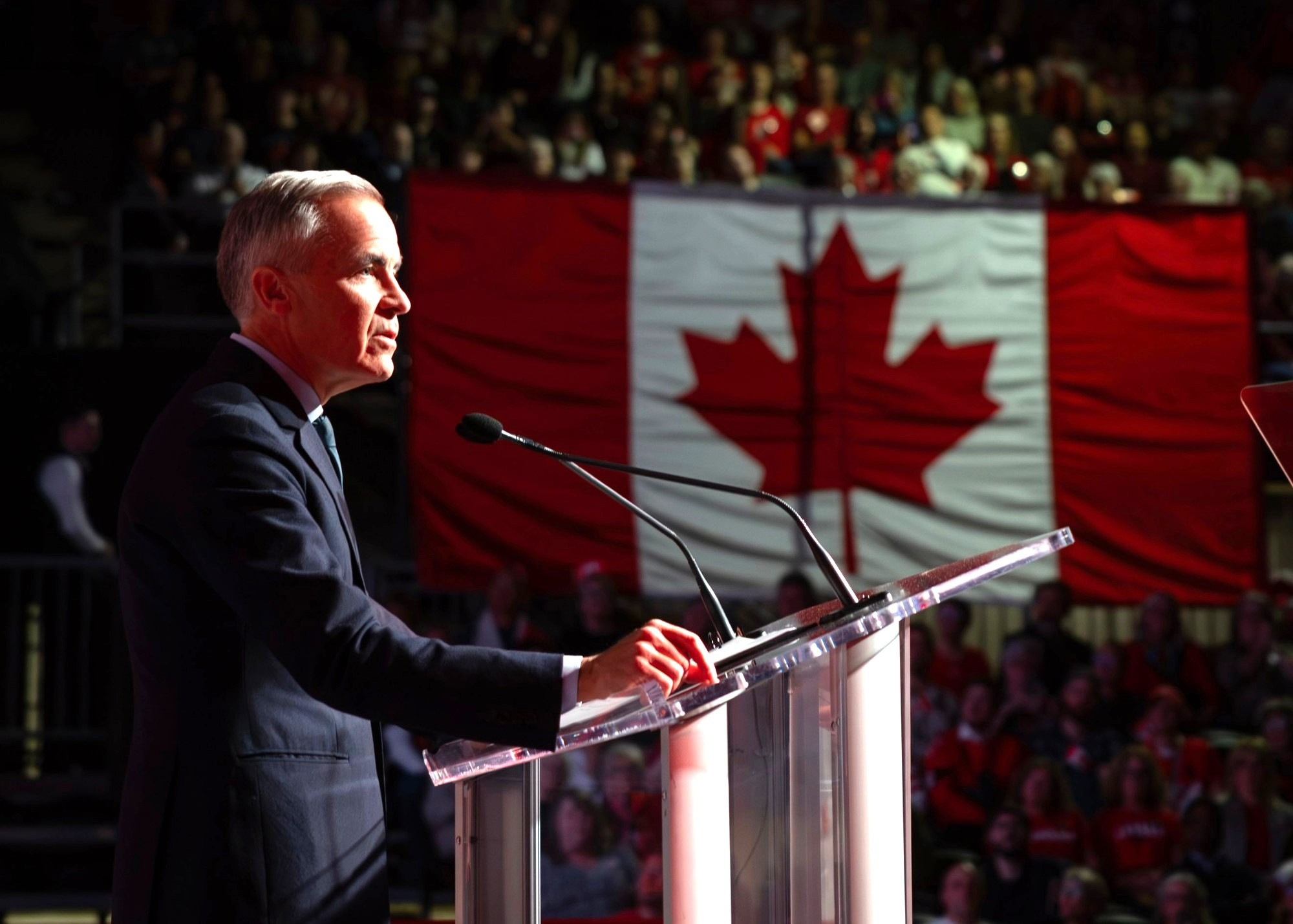
Prime Minister Mark Carney has in recent months alienated Canadians concerned about the environment and human rights. (Government of Canada)
Carney exploded into the global consciousness as the leader for everyone who felt the same way, ground down after a decade of scape-goating on one side and empty idealism from the other.
At Davos, he ignited a sense of Canada that is uniquely ours—tough-minded, resilient and fair. Like the land itself, he reminded us of a nation with a rugged, remarkable history. Without apology he told the world we have always forged our own destiny, away from the Europeans who for centuries tried to frame us in their own likeness, and those Americans who think of us as a satellite state orbiting their universe.
Carney had served as an informal economic adviser to Trudeau during the COVID-19 pandemic before becoming chair of the Liberal Party’s Leader’s Task Force on Economic Growth in September of 2024. He brought a unique combination of financial and environmental credentials the party faithful hoped would appeal to voters across the middle of our polarizing political spectrum, as those on the far ends kept walking off a narrowing plank.
Economic environmentalists saw an ally in someone who did not use self-righteous grievances and guilt to garner support (which has increasingly turned many off); they had been waiting for a leader who could convince capital markets that alternative energy and sustainable investments are the only responsible financial strategy for a carbon-free future that global heavyweights like China are already all-in on.
After he became Canada’s 24th Prime Minister, he said, “I pledge to you, and to all Canadians, that I will work day and night with one purpose: to build a stronger Canada for everyone,” during his victory speech.
“To be clear, this will require change. Big change. But I know Canadians are ready.”
Many were not ready.
He quickly made it clear that human rights issues would no longer dictate our policy toward China and India and other bad actors—trade would.
He has gambled that Canadians, on balance, care more about their bank account than any other competing ideological priorities. This is the way to bring the country together.
And that is the way the former central banker is running the nation. The only way he knows how.
During his first year in office, Carney repealed the consumer carbon tax, paused the federal electric vehicle (EV) sales mandate and weakened zero-emission vehicle (ZEV) targets, reversed the oil and gas emissions cap, watered down methane regulations, scaled back anti-greenwashing rules, reduced public accountability, rewrote the rules surrounding environmental impact assessments and greenlit numerous new fossil fuel infrastructure projects.
In November 2025, Carney’s first budget failed to connect the climate crisis with Canada’s economic ambitions; fiscal tightening was reasoned for the deep cuts to environmental programs as well as Environment and Climate Change Canada (ECCC), which is set to shrink by $1.3 billion as of 2030.
But some supporters continued to cling to hope—they trust(ed) Carney to play a masterful gambit, showing capitulation to Alberta to secure a conclusive referendum commitment to Canada, and drawing the U.S. administration into a trade war stand-off that might have helped doom the Republicans.
While he appears to have greatly weakened the radical right in this country, and aided in the return to normalcy south of the border; on the environment, Carney’s chess strategy seems to be moving his pieces toward a check mate not against the oil and gas industry, as many had miscalculated, but a victory over those who ideologically pushed our country toward a greener future.
In June, he stated Canada will not meet its near-term emissions targets and characterized the previous strategy as too divisive. By leaning too far to the left on climate policy, Trudeau, according to his successor, had only pushed Alberta and others deeper into the radical right tent. The hope was that Carney was drawing them back out by fooling them with a gambit that was just a trap, signing oil and gas deals he knew could never be met.
Four months later, he designated the proposed West Coast oil pipeline (now named the Pacific Link pipeline) as Canada’s first project of national interest under Bill C-5, the Building Canada Act. The pipeline is estimated to add 170 megatonnes, a quarter of Canada’s current emissions—amounting to roughly $47 billion in climate damage for every year the pipeline operates.
On October 19, Alberta voters overwhelmingly chose “remain in Canada” as their referendum outcome.
Carney had kept his promise of saving the country from being divided.
But what has he sewn?
In September, when he addressed investors at Canada’s Investment Summit, outside the venue hundreds of protesters expressed their dissent over Ottawa’s openness to leasing or selling existing public infrastructure, particularly major airports, to private investors to help finance new infrastructure projects, including expensive oil and natural gas pipelines, and seed a new sovereign wealth fund.

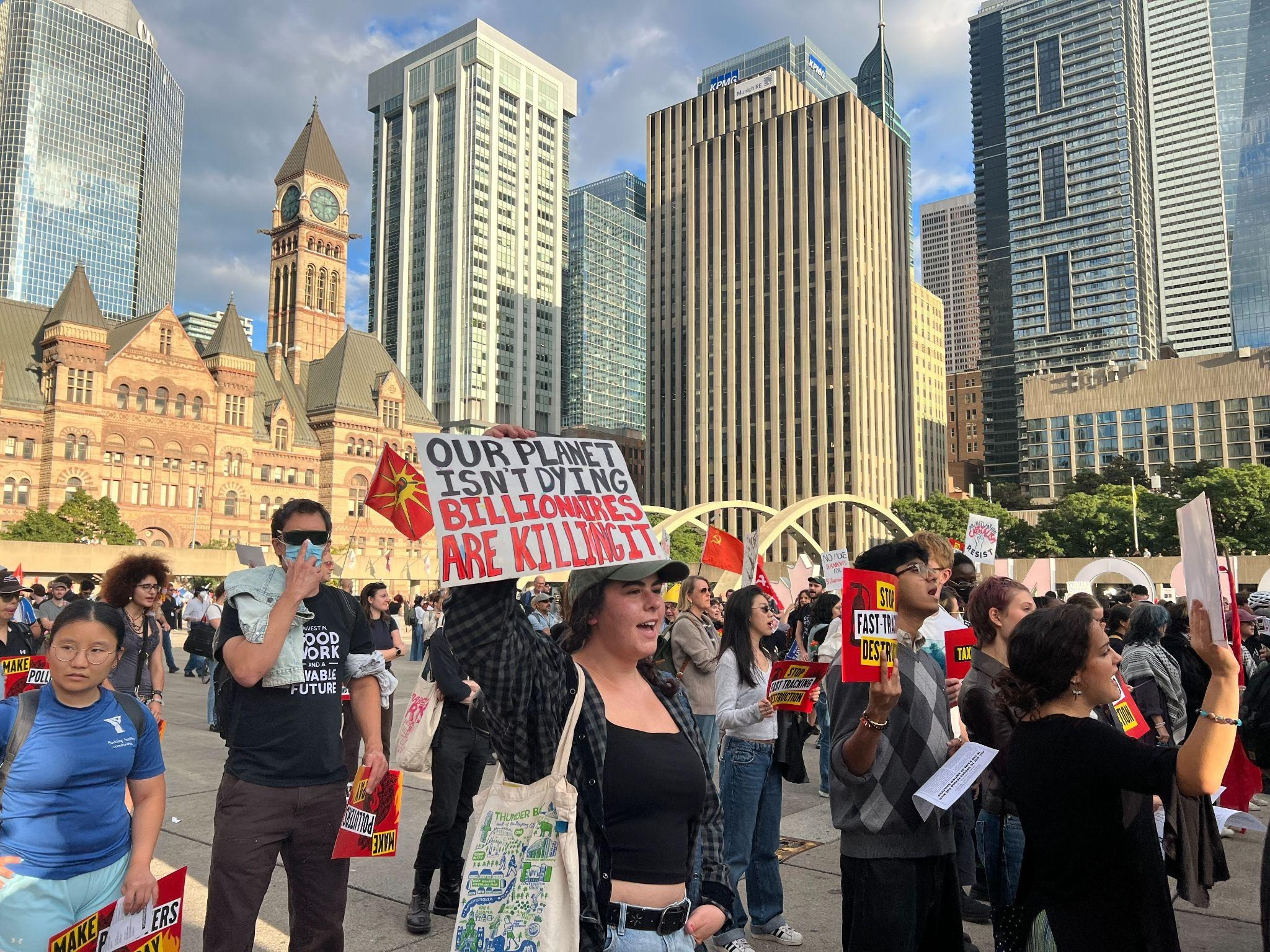

Thousands of protesters marched from Nathan Phillips Square to the Art Gallery of Ontario to express opposition to the Canada Investment Summit. (Anushka Yadav/The Pointer)
On November 4, Carney was ranked second on Newsweek magazine’s list titled, “Revenge of the Climate Heretics: The 50 Leading Eco-Policy Dissenters”, placing him behind Microsoft co-founder Bill Gates and ahead of U.S. President Donald Trump—for his climate rollbacks, in opposition to where most of the world is headed.
“Climate policies worldwide continue to expand, with Asia, Latin America, and Africa increasingly setting the pace on policy innovation”, according to data released by the Oxford Climate Policy Monitor, which is now used by the UN’s Taskforce on Net Zero Policy.
The next day, Ottawa unveiled its second federal budget, late in the afternoon last Thursday, committing $142 billion in new spending measures. Initial reports heralded the government for projecting a $62.3-billion deficit for 2026-27, nearly $3 billion lower than Ottawa’s forecast in its spring economic update.
The more than 500-page fiscal blueprint promised to “lower costs” and trigger an “investment supercycle” while attempting to balance climate action and affordability with economic growth, at least on the surface: $50 billion to expand Canada’s electricity grid and double the country’s power production by 2050; $587 million over five years, starting in 2027-28, to renew Environment and Climate Change Canada’s Zero-Emission Vehicle Infrastructure Program and support the installation of more than 55,000 additional EV chargers; and $2 billion investment in national heat pump Pump Rebate to help up to 820,000 households install heat pumps.
It didn’t end there. Ottawa earmarked $3.7 billion for a nature strategy, $1.2 billion over four years for ocean protection, $3.6 billion over 10 years for Parks Canada infrastructure and $400 million over seven years for industrial decarbonization.
“A lot of positives,” Hadrian Mertins-Kirkwood, a political economist and Senior Researcher with the Canadian Centre for Policy Alternatives (CCPA), said.
But there was little left to cut after the government dismantled several of Canada’s climate policies in last year’s budget.
Sierra Club Canada Director of Communications Conor Curtis wanted to “celebrate” the green investments but that is difficult when “this budget ties Canadian finances and the Canadian economy to the fate of the oil and gas and AI industries”.
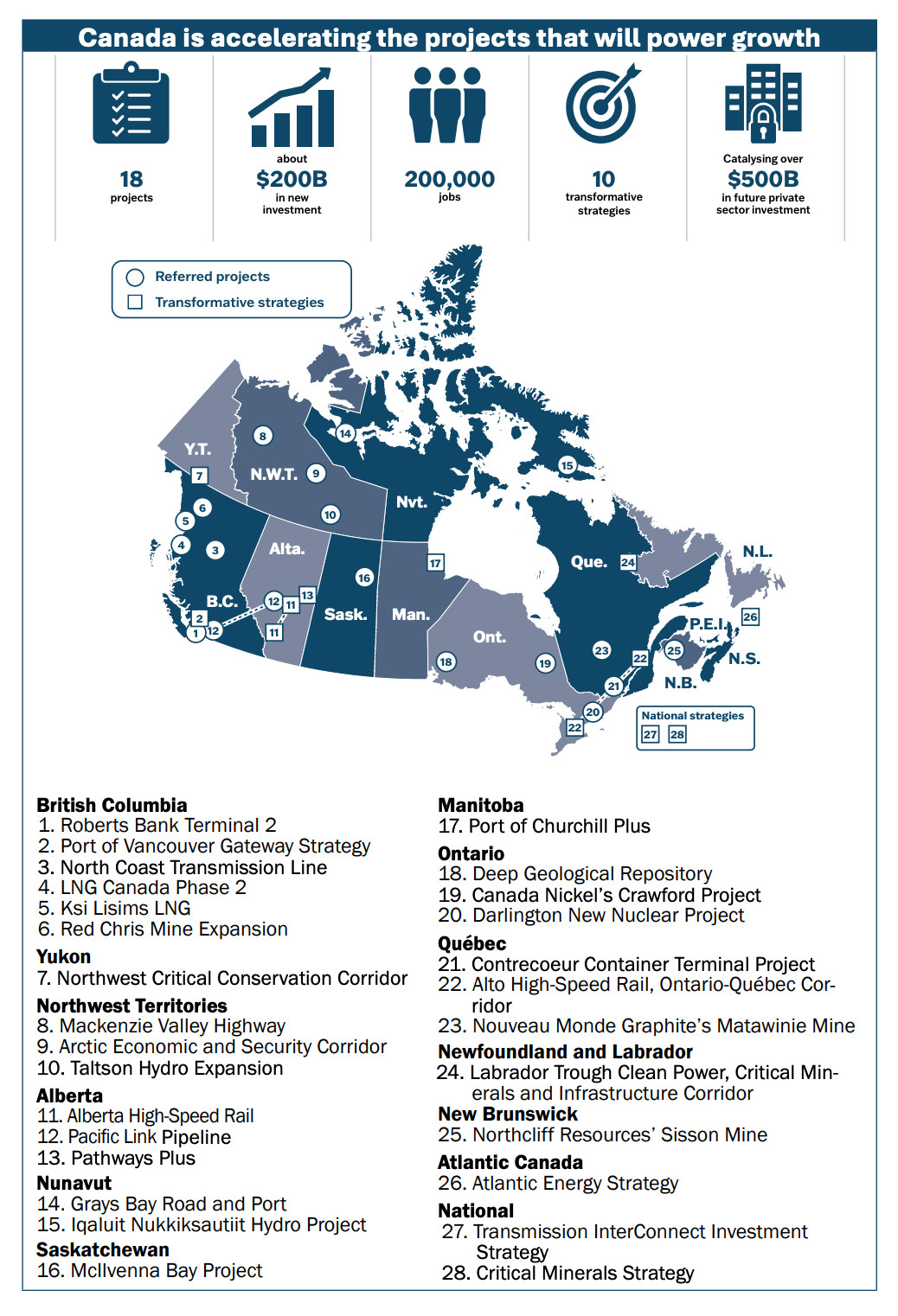
The 2026 federal budget includes funding for several oil and gas projects alongside plans for moving Canada’s energy systems towards electrification. (2026 Budget/Government of Canada)
Drawing on lessons from his master’s studies in environmental policy, he analyses “big promises”, policy announcements and headline funding commitments through the lens of “implementation”: is there a clear plan for how the money will be spent and do the investments represent a meaningful shift in government priorities?
But he did not see any specificity or attention to detail that was required to inspire confidence, particularly after repeated instances in which implementation flaws, added caveats or weakened policies have allowed more polluting energy projects to move forward.
“Fool me once, shame on you. Fool me twice, shame on me,” Curtis said cautiously.
Critics argue the fiscal plan inherently serves corporate interests, specifically Canada’s oil and gas giants that have already banked profits from the U.S., Israel and Iran war—despite the government admitting that oil prices are expected to stay “elevated” until next year. To continue public reliance on oil, Ottawa has committed another $2.9 billion to extend the gasoline tax cut first introduced this summer to lower costs at “the pump”.
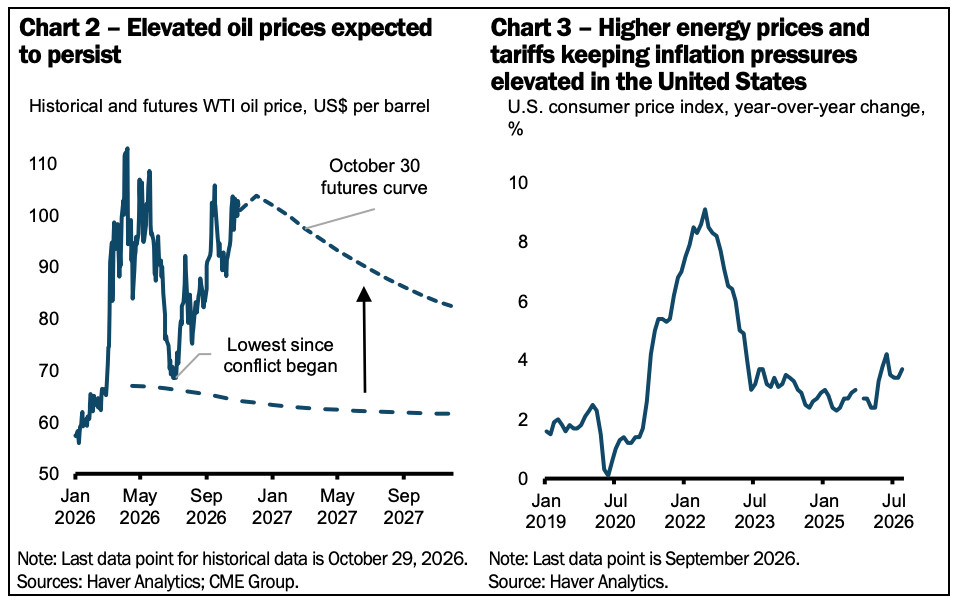
“Tensions in the Middle East and the intensification of Russia’s war in Ukraine have renewed pressures in global energy markets following a brief period of relative calm earlier in the summer,” the budget noted. “While the upward pressure from these disruptions has been partly offset by weaker global oil demand, increased production outside the Gulf, and releases from strategic petroleum reserves, futures markets suggest oil prices will remain well above pre-conflict expectations through 2027.” (2026 Budget/Government of Canada)
“It’s one step forward, two steps back with this government,” Mertins-Kirkwood told The Pointer.
Despite championing its funding for EVs, heat pumps and clean electricity and the emissions the initiatives will cut down, the budget maintains Ottawa’s support for costly projects that will result in high emissions including the Ksi Lisims LNG, LNG Canada Phase 2, Roberts Bank Terminal 2, Pathways Plus and Pacific Link Pipeline. Not once does the document mention how much emissions the project will contribute.
Green Party leader Elizabeth May, who was hesitant to vote in favour of Carney’s first budget but did so after securing assurances regarding climate and reconciliation targets, said she was a “fool” for trusting Carney’s approach towards climate change parallel to his plans for expanding oil and gas infrastructure.
The budget “proposes to provide $22.9 million over five years to Environment and Climate Change Canada to update the Clean Electricity Regulations and to develop equivalency agreements with provinces and territories where appropriate”.
“Any changes would maintain the net-zero by 2050 goal and continue to protect the environment and human health from climate change. The proposed changes will be subject to consultation,” the budget states.
In theory, that seems like a large sum of money but there is no date for when the regulations would be enforced. In November last year, when Alberta and Canada signed a Memorandum of Understanding (MOU), the federal government committed to immediately suspending and placing the Clean Electricity Regulations in Alberta into abeyance, pending a new carbon pricing agreement.
The revisions proposed in the budget would give electricity producers greater flexibility to keep existing facilities operating for longer including where needed to maintain grid reliability, while providing more room for natural gas generation in the near term to support industrial expansion and data centres.
They would also allow producers to offset a greater share of their emissions through verified reductions elsewhere in the electricity sector and the economy.
The government contends natural gas provides “baseload and operational flexibility” and complements renewables like wind and solar.
But Mertins-Kirkwood observed two key issues with that statement: the weakening of the Clean Electricity Regulations could allow natural gas to capture a significant share of new investment, even as Ottawa promotes its support for renewables while solar power, the fastest-growing source of new electricity generation worldwide, is not mentioned once in the budget.
The budget also sets aside $6 billion for “emerging” electricity technologies that will include a new type of fuel cell that burns natural gas to power data centres.
As reported by The Pointer previously, natural gas is not clean energy; it is primarily methane, a potent greenhouse gas, that carries significant climate consequences — particularly as Ottawa has already weakened its methane regulations through its agreement with Alberta.
“Methane is a powerful and short-lived greenhouse gas, with a lifetime of about a decade and Global Warming Potential about 80 times greater than that of carbon dioxide (CO2) during the 20 years after it is released into the atmosphere,” an Intergovernmental Panel on Climate Change report warned.
Mertins-Kirkwood criticized Ottawa’s “all-of-the-above” approach on energy policy, arguing that the Carney government cannot simultaneously pursue leadership in conventional and clean energy and meet its climate commitments.
“This is great news that we have a government that does seem to be genuinely committed to expanding the electricity grid and electrifying a lot of the economy. That is necessary,” he added.
“It’s just not sufficient. And our emissions are not going down because we’re not actually grappling with the root of the problem, which is fossil fuel production and consumption.”
One of the biggest corporate giveaways comes in the form of the $36-billion Productivity Mega-Deduction, a tax break that allows companies to immediately write off capital investments such as machinery and equipment.
While Ottawa has promoted the measure as a way to spur investment, an analysis by CCPA found that oil and gas extraction and refining stand to receive 29 percent of its benefits, with another 10 percent flowing to mining. Mertins-Kirkwood noted it will also benefit the clean industry in electricity generation, manufacturing and/or transportation.
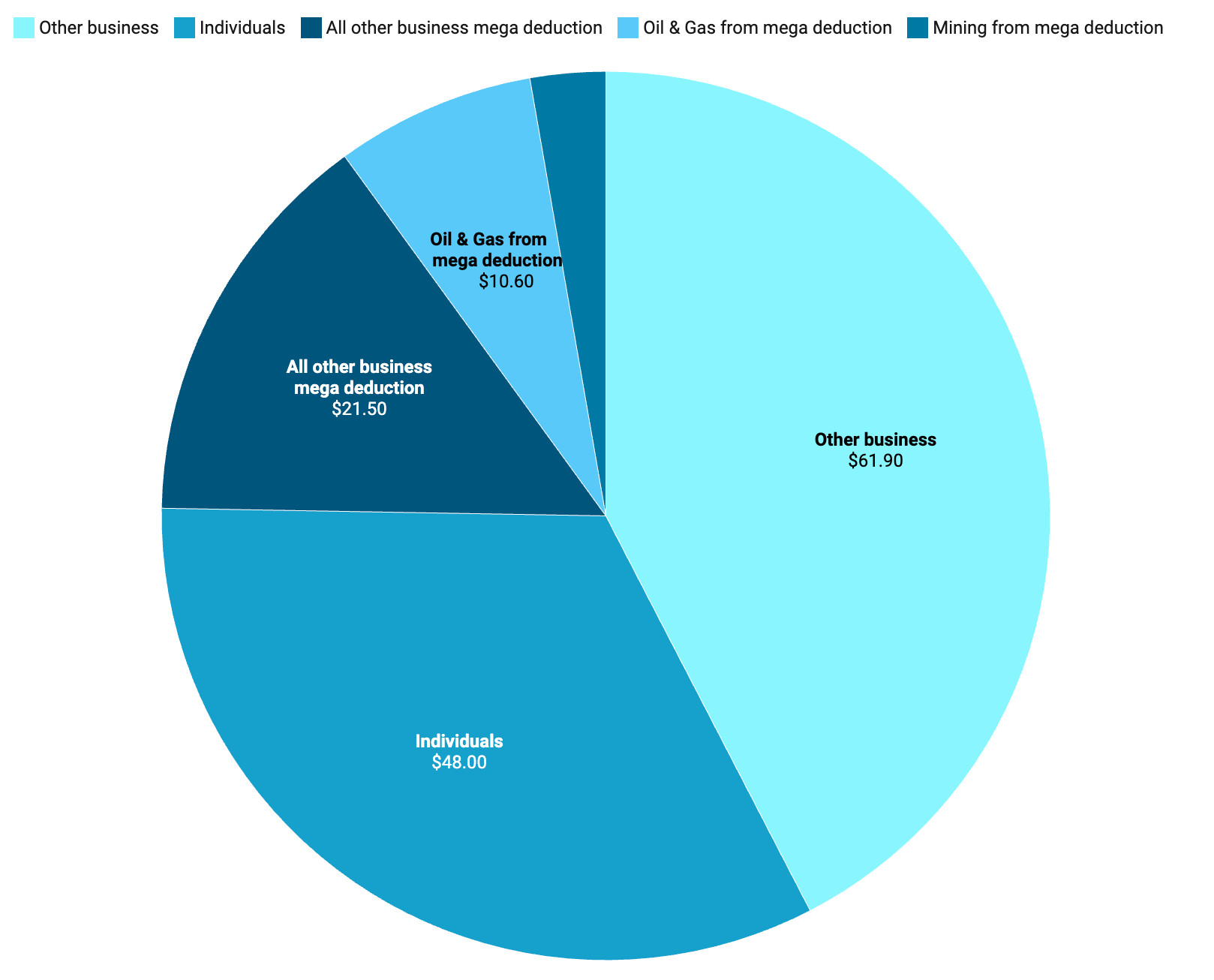
“The budget reveals exactly how much the federal government will lose in tax revenue by year—and fully 14 percent of the deficit in coming years will be due to this new deduction,” a recent analysis by the Canadian Centre for Policy Alternatives revealed. (Canadian Centre for Policy Alternatives)
These capital-intensive industries would likely have made many of the investments anyway, meaning taxpayers could be subsidizing spending that would have happened without the tax break. The report warns any additional investment the measure does generate is likely to flow into extractive industries rather than sectors that need to be developed as part of a transition away from fossil fuels.
The Productivity Mega-Deduction accounts for roughly a quarter of the entire budget while the tax write-offs for extractive industries alone amount to 10 percent of new spending.
Meanwhile, measures that could help make life affordable for Canadians (including the gas tax cut, the groceries and essentials benefit and child-care spending) make up only a third of the budget.
Mertins-Kirkwood says the common misconception is that the oil and gas industry accounts for more than 25 percent of Canada’s GDP (Gross Domestic Product) — which isn’t true.
Direct oil and gas extraction accounts for only five percent of the national GDP, according to government data.
“Our prime minister talks about the economy as if the goal is private capital investment, the goal is productivity growth, the goal is foreign direct investment and it’s not that those things are bad inherently, it’s that they should be a means to an end — people’s lives getting better,” Mertins-Kirkwood said.
“That’s one of the challenges with this government; they’re treating things like investment as a goal in itself without any real consideration for how that makes lives better.”
He added that doubling down on oil and gas would deepen Canada’s dependence on the industry and volatile international markets, while doing little to strengthen the economy or create jobs — challenging the “myth” that fossil fuel development is a major source of employment.
That same promise of economic prosperity and job creation featured prominently when Prime Minister Mark Carney shook hands with Alberta Premier Danielle Smith for the proposed Pacific Link pipeline that will supposedly create roughly 140,000 jobs nationwide, add more than $20 billion annually to GDP and generate over $100 billion in government revenues by 2060.
By contrast, a 2019 Clean Energy Canada study estimated “Canada will see 700,000 more energy jobs in 2050 than exist today if Canada (and the world) reaches net zero, with growth in clean energy jobs outpacing the decline in fossil fuels”.
“Canada’s battery supply chain alone could create between 60,000 and 250,000 jobs by 2030,” the federal government’s Sustainable Jobs Plan cited.
The budget is filled with cautionary language that tries to balance environmental protection with money for extraction.
While Ottawa acknowledged “Canada is shaped by water” and committed new funding to expand marine conservation, it simultaneously set aside $11 million over four years to advance Arctic offshore oil and gas governance that has since raised concerns about the future of the region’s long-standing drilling moratorium that was imposed in 2016 by both Canada and the U.S.
“It is absolutely not in any way, shape or form a decision about lifting the moratorium. It is a respectful engagement,” Carney tried to reassure during a press conference.
“It’s respecting self-government. But it’s also, rest assured, respecting the environment.”
Curtis says the funding for Arctic offshore oil and gas governance will serve as a “test” for the government's intentions.
“You don’t waste $11 million on something that’s just outlandish from an economic perspective, but also fundamentally extremely bad for the environment,” he said, arguing the funding undermines any suggestion that oil expansion is merely a strategic move Ottawa has no serious intention of pursuing.
Some critics also question how Ottawa can claim to respect Indigenous rights when it is backing the Pacific Link pipeline, opposed by Indigenous communities whose territories it would cross, including Cold Lake First Nations, Sturgeon Lake Cree Nation and Fort McMurray and Wood Buffalo Region Métis peoples?
“The Pacific Link pipeline is unique in that it has tossed aside the fundamental pillars of our relationship in terms of respect, in terms of shared communication, and taking up lands in our territories without any form of credible consultation,” Union of B.C. Indian Chiefs President Grand Chief Stewart Phillip said in a statement.
“We all know that this is a template approach for many other projects to come if it goes as smoothly as Canada hopes.
“We have a duty and an obligation to protect our rights to the fullest extent of the law and we have every intention of doing that. This is not a cake walk, this is not a ‘gimme’, this will be hard-fought in the court rooms, and if necessary, with boots on the ground.”
Initially proposed as a privately built and financed project to transport Alberta bitumen to British Columbia’s West Coast, the Pacific Link pipeline has since received backing from public funds by the government.
Mertins-Kirkwood found the move difficult to reconcile with the Carney government’s “coherent” economic agenda, which emphasizes tax cuts, deregulation and creating conditions for private investment.
“It doesn’t really make any sense,” he said.
For anyone who thinks this is Ottawa “playing chicken with Alberta”, he is “not so sure about that” as the Trudeau government also purchased the Trans Mountain pipeline as part of its “grand bargain” — a deal that ultimately saw billions in public money committed to a project the government had initially suggested would be privately financed.
“And then the thing you got in exchange for that, which was carbon pricing, is now dead,” he added.
“So I worry that our government would be willing to go all in on this to buy another pipeline, even if it's a money loser, because they’re so ideologically committed to oil and gas expansion that they’ll do it at any cost.”
Those concerns come as Ottawa faces growing criticism over its retreat from federal environmental oversight, whether it is revamping the Species at Risk Act or speeding up permits for “national interest projects” by changing the rules around the Impact Assessment Act.
In 2019, Alberta launched a legal challenge against the original Impact Assessment Act, arguing that it improperly allowed Ottawa to interfere with local economic activities, energy projects, and provincial regulatory processes under the guise of environmental assessment.
Four years later, the Supreme Court of Canada ruled that key parts of the legislation governing the assessment of designated projects exceeded Parliament’s constitutional authority, while affirming federal jurisdiction over certain aspects of environmental assessment, including projects on federal lands.
Following the ruling, Parliament then amended the legislation in 2024. But Alberta subsequently referred questions about the amended law to its Court of Appeal, which again found the legislation unconstitutional.
In November, the federal government decided not to appeal the Alberta Court of Appeal ruling, leaving the future of federal environmental assessment legislation uncertain.
“Canadians deserve a federal government that is prepared to defend its jurisdiction to assess the environmental consequences of major projects and ensure decisions are made in the public interest,” Ecojustice Climate Director, Charlie Hatt, said in a statement.
“We urge the government to engage with Indigenous peoples, environmental experts, and the public about establishing a strong, constitutionally sound federal impact assessment law.”
The decision was taken just months after the federal government signed a cooperation agreement that allows Alberta to take a larger role in environmental impact assessments and treat UNDRIP as non-binding despite Indigenous opposition.
With the referendum behind Canadians and a Democratic majority in the south, how will the Carney government now rationalize bad policy that favours oil and gas production?
Mertins-Kirkwood does not believe the threat posed by the U.S. ever provided a strong economic justification for investing heavily in new fossil fuel infrastructure.
But he is wary that “nothing has changed” since the midterm results and Canadians still “have to be cautious” as U.S. tariffs remain in place and the Trump administration’s efforts to obstruct renewable energy while doubling down on fossil fuels are still ongoing.
“The federal government talks about diversifying, but I think when people hear diversify, they think new industries and what the federal government meant when they said diversify was the exact same industries, just new markets for it,” he said.
But there is no strength to the business case as the U.S. remains the only market with significant demand for Canadian oil—not “Europe, China or India”.
“The best argument really for it was the sovereignty argument: the idea that we need to just get away from the U.S.,” he added.
“But I’m not sure that the midterms changed that that much because already the federal government was not really looking at the evidence and making those decisions.”
That same argument extends to the federal government’s support of the AI industry: Ottawa is committing nearly $5 billion towards artificial intelligence at a time when the odds of an AI bubble-bursting event appear to be rising by the day.
While concerns about the industry have been growing for some time due to the cost of capital against a backdrop of rising interest rates and inflation, the recent Democratic sweep of Congress in the November U.S. midterm elections triggered a stock market sell-off, with prices of hyperscaler stocks down nearly 30 percent since their peak.
Mertins-Kirkwood said the federal government’s push to build data centres and accelerate AI adoption risks exposing taxpayers to an industry whose long-term economic returns remain uncertain.
Even when the scary environmental impacts of large-scale data centres are set aside, Canada has so far avoided the level of exposure seen in the U.S., where hyperscale facilities have been built on a much larger scale.
“We haven’t actually built these things yet, and we haven’t seen the private sector adopt AI at the pace that the federal government wants,” he noted.
“So, Canada is ironically actually very insulated from the AI bubble.”
Additionally, despite the promise of AI to boost productivity and create economic prosperity, a recent Statistics Canada report found “there is no statistically significant direct association between AI adoption and productivity” — in line with global studies.
For Shion Guha, a University of Toronto professor and public-interest technologist who studies AI governance, the biggest gap is the federal government treating AI infrastructure as critical to national sovereignty, but offering little transparency about how the money will be spent or how its own use of the technology will be monitored.
Among the largest commitments are $2.7 billion for the AI for All strategy, up to $1.6 billion in equity in Toronto-based Cohere, and roughly $1 billion over five years for Digital Transformation Canada’s IT projects.
“Cohere is not a public company; it’s a private company, and why is the federal government essentially picking winners and losers?” Guha told The Pointer.
“Why is there not a more open process where a lot of other companies can compete to provide said tools for the public service?”
While Budget 2026 allocates $176.3 million to a commission tasked with overseeing social media and AI chatbots, and proposes new oversight of private companies, Guha did not see new funding to scrutinize AI systems used by federal institutions.
“It’s nice to see that there’s money in AI. But where, how? How is the government going to police itself?,” he said while identifying the absence of new mechanisms to challenge automated government decisions.
“That is the double standard!”
Strikingly, Ottawa’s own Impacts Report found that the AI for All benefits predominantly men and the majority of high-income people.
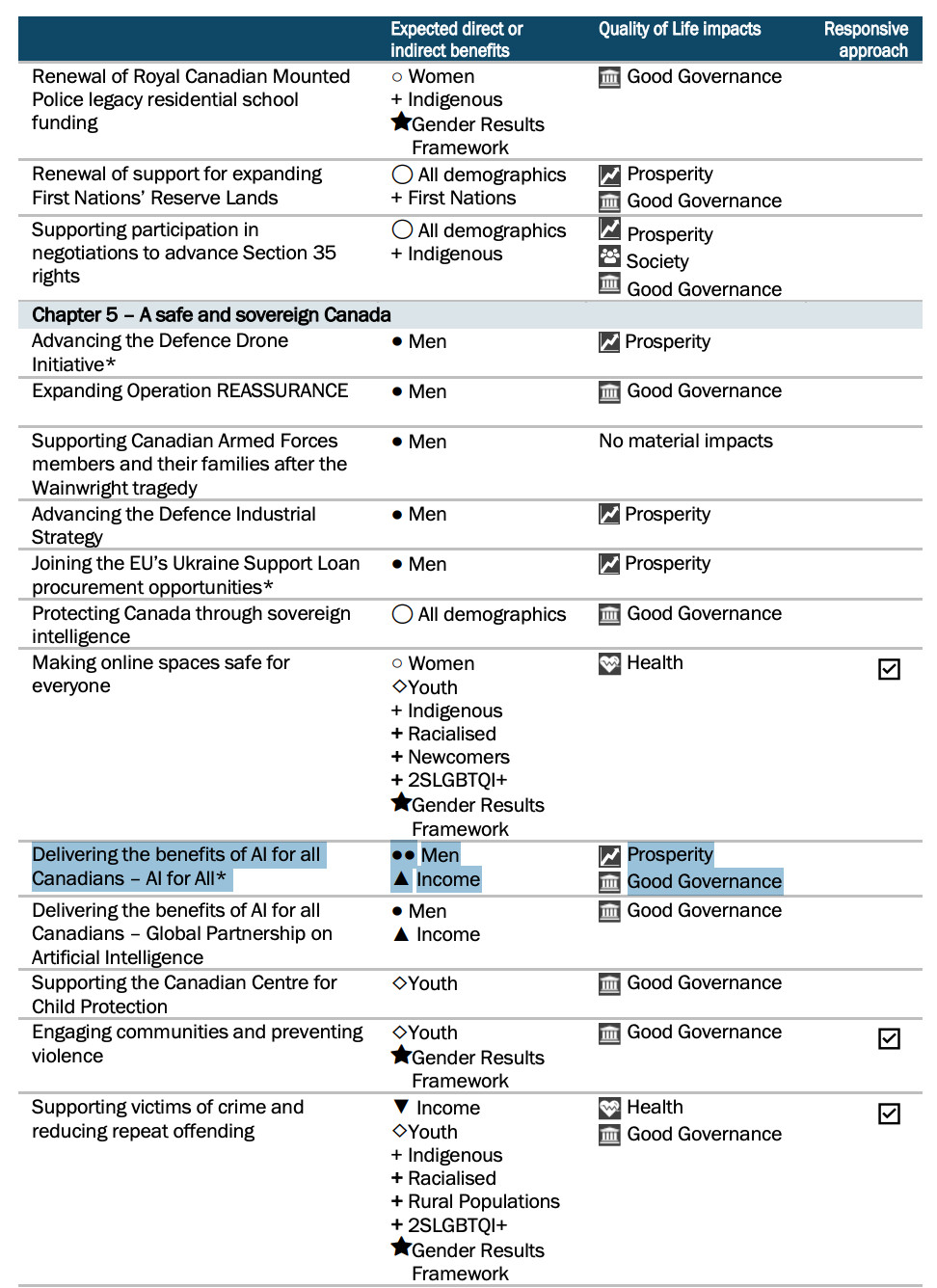
The direct benefits of Ottawa’s AI for All strategy will go to men and those with a high income. (Budget 2026: Annex 4 - Impacts Report)
And of course, there is nothing in the budget that outlines how the Carney government aims to protect the country’s natural resources including its water bodies, if large-scale data centres are constructed.
This year’s budget offers a revealing picture of the Carney government’s priorities, exposing how little urgency it appears to attach to the climate crisis while doubling down on policies that risk worsening environmental damage.
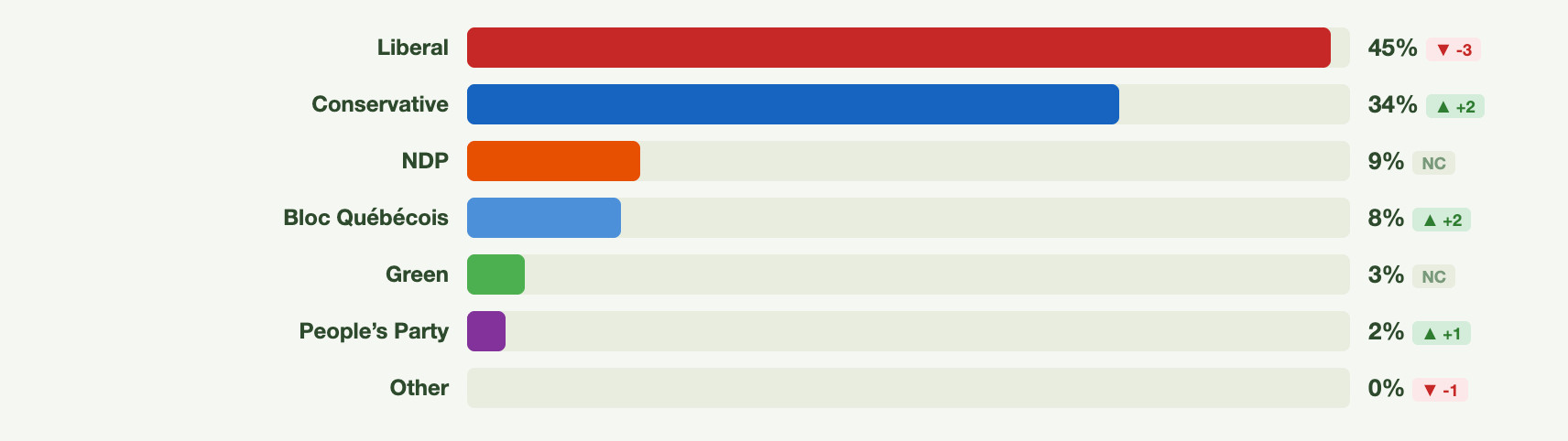
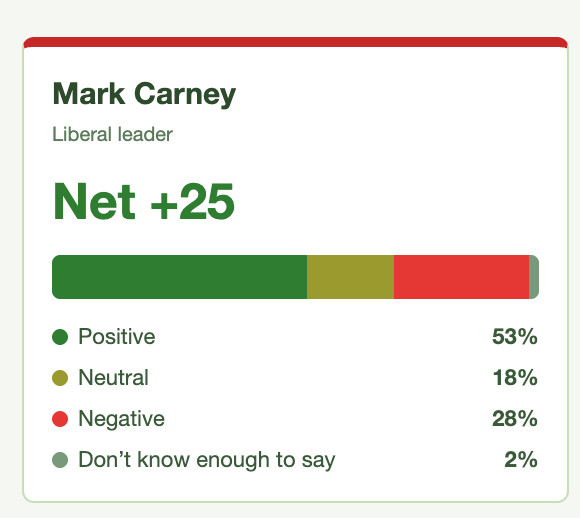
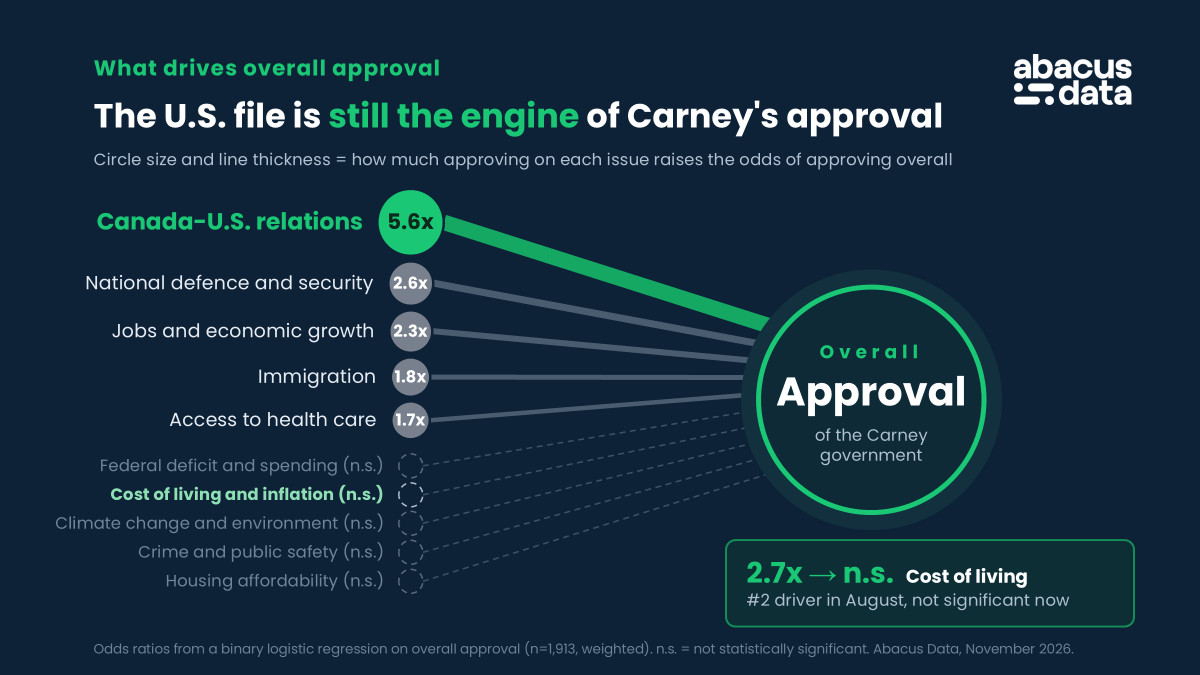
“Since October 21, Liberal support is down 3 points,” according to the latest Abacus Data report. (Abacus Data)
“It’s amazing to me how this hasn’t affected Carney’s popularity yet. But I do think it’s coming. You can only ride the high for so long,” Mertins-Kirkwood said.
“With the change in government to the south, I do wonder how much longer Carney’s going to be able to get away with things that voters say they don’t like but accept it because of his sovereignty argument.”
Despite Ottawa’s own scientists — as well as United Nations experts — urging Canada to prepare for a 5°C hotter future and act urgently to avoid the worst impacts, the budget had little to nothing for climate adaptation and mitigation.
Canadian Climate Institute’s Adaptation Research Director Ryan Ness thought it was “obvious enough to expect more in this budget” given “there were lots of signals that would have pointed the federal government in this direction at this time”.
Severe weather caused more than $3.7 billion in insured losses this year, making 2026 the third-costliest summer in Canadian history, according to estimates from Catastrophe Indices and Quantification Inc. (CatIQ). “Four of the five costliest summers in Canadian history have occurred within the last six years,” a recent report found.
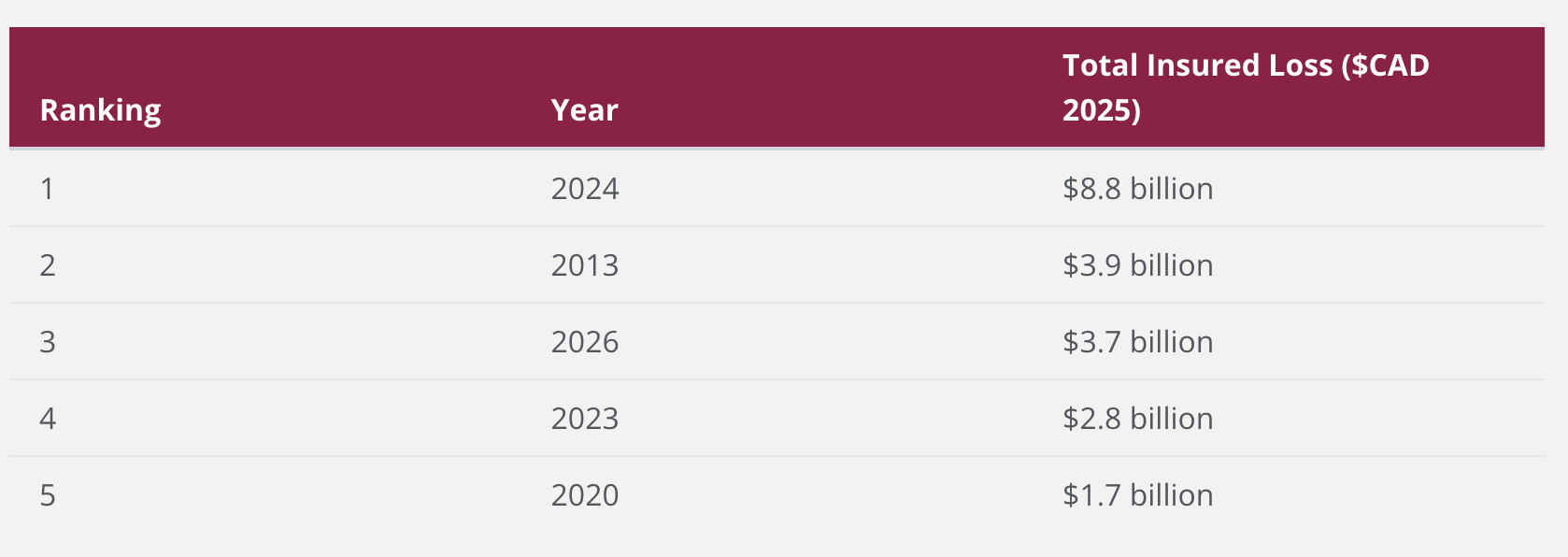
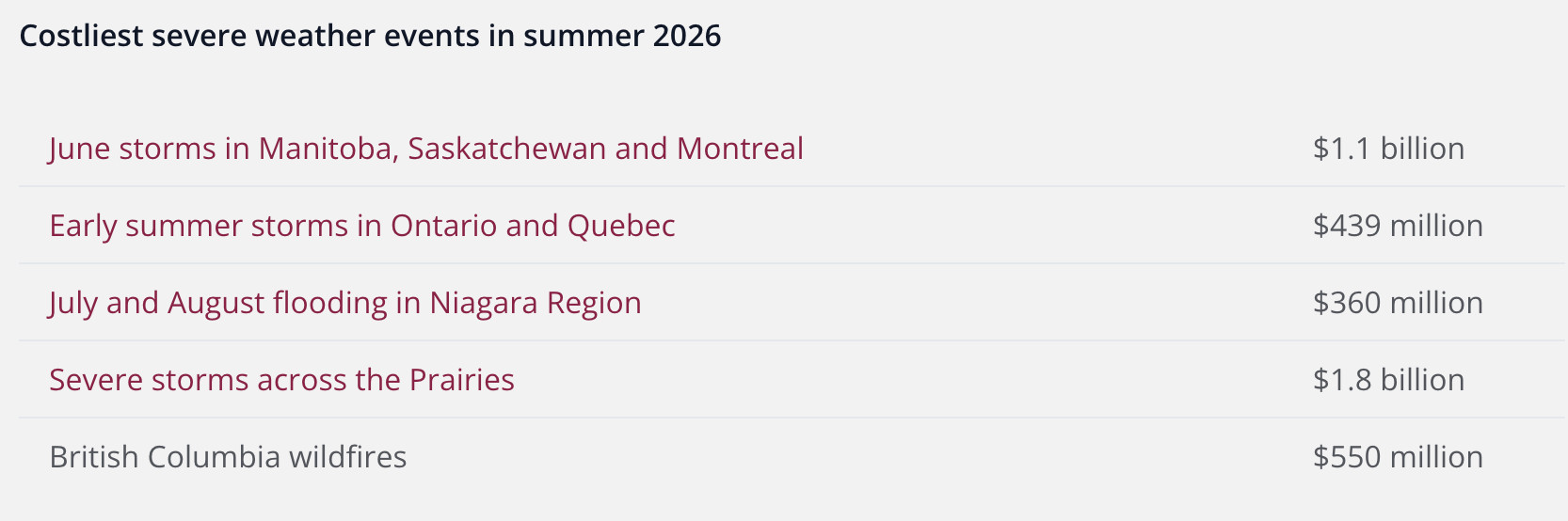
2026 is among the top five costliest summers on record for extreme weather in Canada. (Insurance Bureau of Canada)
“The fact that climate change continues to cost us more, and we’re not doing anything to get ahead of it, we thought was obvious enough to expect more in this budget, but there was virtually nothing about proactively preparing for or adapting to climate change in budget 2026,” Ness told The Pointer.
The federal government acknowledged in its budget that Canada experienced “among the most severe” wildfire seasons this year with more than 5,400 wildfires burning approximately 4.5 million hectares of land and forcing more than 33,750 people from their homes including over 8,800 people from Indigenous communities.
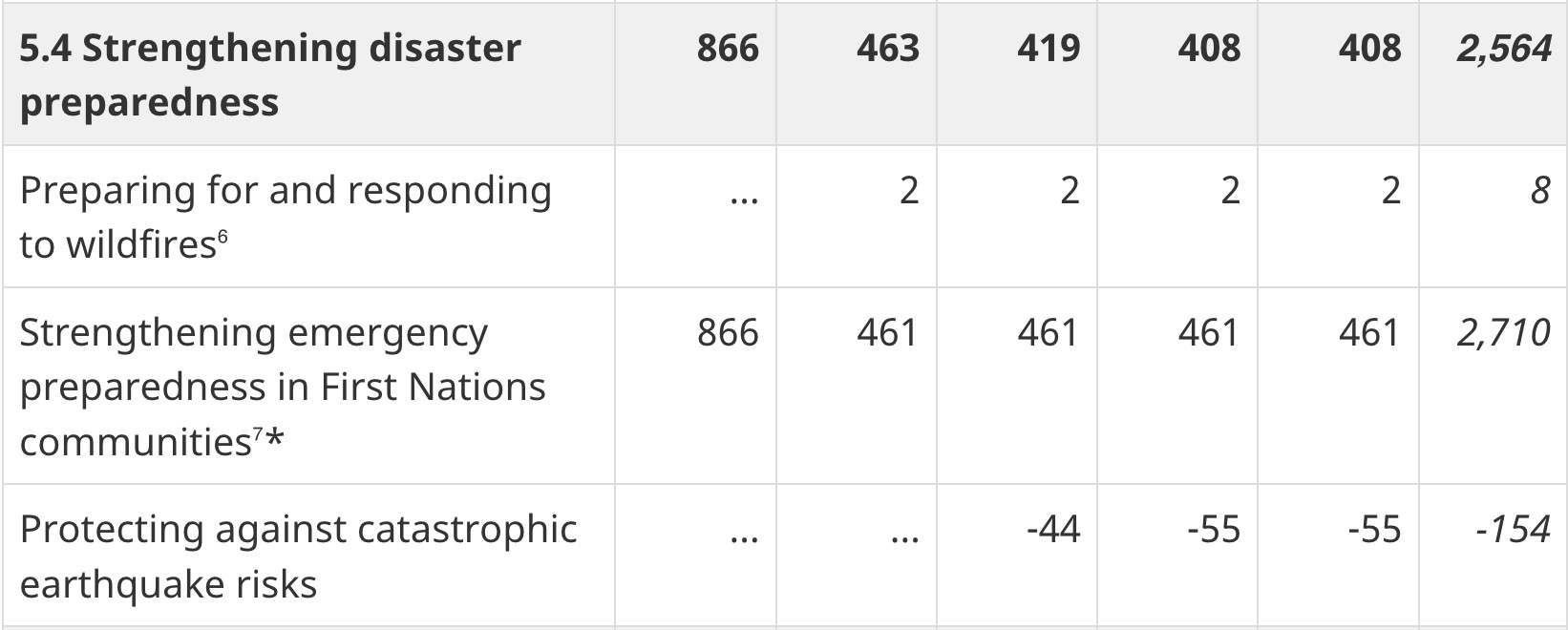
The federal government has announced $2.5 billion for disaster preparedness while $7.7 billion was earmarked for “defence industrial strategy”. (2026 Budget/Government of Canada)
Ottawa has earmarked $8 million over four years, beginning in 2027-28, to prepare for and respond to wildfires. No funding is allocated for the 2026-27 fiscal year under this commitment.
The budget also includes approximately $2.7 billion to strengthen emergency preparedness in First Nations communities. The federal government noted it announced $865.6 million to address emergencies that have already occurred on reserve, $446.2 million in ongoing funding for future disaster response and recovery and $14.8 million in annual funding towards wildfire protection and fire safety initiatives in First Nations communities in October.
“The government is very focused on responding to emergencies and disasters once they happen,” Ness noted.
He observed that of the approximately $2.7 billion committed to emergency management in First Nations communities over five years, $866 million is intended to address emergencies from the past year with the remainder directed towards future disaster recovery.
The budget also makes no investment in preventative measures such as retrofitting homes with fire-resistant materials and creating firebreaks around communities to limit the spread of flames and reduce damage when fires occur.
Ottawa has also put up to $2.5 billion in financing through Export Development Canada to support De Havilland Canada in expanding production of waterbombers at its Alberta facilities, with the aim of shortening delivery times as wildfires become more frequent and severe.
While both commitments may strengthen Canada's ability to respond to wildfires and other emergencies, Ness argues they do little to address the conditions that allow such disasters to become increasingly destructive in the first place.
Canada also does not have a national wildfire strategy, primarily because forest and wildfire management is a provincial and territorial responsibility. In Ontario, many First Nation communities including Neskantaga criticized the provincial government for a slow response during wildfire evacuations, with delayed communication and underfunded local airports, which left vulnerable evacuees confused and panicked this summer.
The federal government is setting aside “up to $2.5 billion” to finance De Havilland Canada to help increase waterbomber production capacity following months of lobbying by the manufacturer. The funds will help to build a second assembly line in Alberta, eventually doubling production capacity to 20 water-scooping aircraft per year. However, new assembly slots won’t open until 2030.
“[That money] is in financing, not in funding,” Ness stressed.
“What it really means is that the government is going to give low-interest loans or no-interest loans to the manufacturers of those water bombers—but it’s not actually going to buy them.”
This year, firefighters and equipment in every Canadian jurisdiction were maxed out for 23 days during the wildfire season.
Similarly, despite record flooding in several parts of Canada including in Ontario where communities from St. Catharines to Ottawa struggled to get water out of their basements following multiple once-in-a-century storms, the federal government “missed its deadline to release Canada-wide flood risk ratings through a flood risk awareness portal by the end of 2025”, according to the Auditor General of Canada.
“Many maps had not yet been completed, and most of the existing flood hazard information is not practical or actionable for users,” the report released in May noted.
“Delays could also put investments in housing, infrastructure, and other physical assets at risk, including the $140 billion planned to be invested by the federal government as detailed in Budget 2025.”
More than 1.5 million homes across the country are still located in high-risk flood areas. Without local flood maps, it is difficult for homebuyers to assess whether their property would be vulnerable to flooding.
Ness added that rather than investing in measures such as basement floodproofing, community flood barriers or upgrades to stormwater infrastructure, federal and provincial governments are leaving much of the responsibility to homeowners and municipalities, many of whom lack the financial resources to act.
Over the past decade, floods have averaged nearly $800 million in insured losses annually but the federal government has only spent an average of “about $230 million annually from 2016 to 2025 in post flood relief.”
In this year’s budget, the federal government has set aside merely $3 million for “strengthening flood resilience” for 2027-28. Ness sees this as Ottawa failing to adequately invest in updating the country’s “outdated” and incomplete flood maps and expanding wildfire hazard mapping.
“Ottawa’s budgeting to pay for climate change but not to get ahead of it and prevent those costs,” Ness said.
Under the current approach, federal and provincial governments spend billions of dollars providing emergency assistance to communities devastated by floods and wildfires, with the costs spread across the broader tax base.
“That’s where that funding originates from,” he said.
“We are all paying for climate damage, even if it doesn’t happen to our communities or our neighbourhoods.”
He believes governments could instead make smaller, proactive investments in communities most vulnerable to wildfires, such as building firebreaks and ensuring homes have fire-resistant roofs, because “it’s much cheaper to try to prevent disasters than to deal with them after they occur.”
A 2022 Canadian Climate Institute report highlighted the return on investment for adaptation is massive: every dollar spent on adaptation avoids up to $15 in losses.
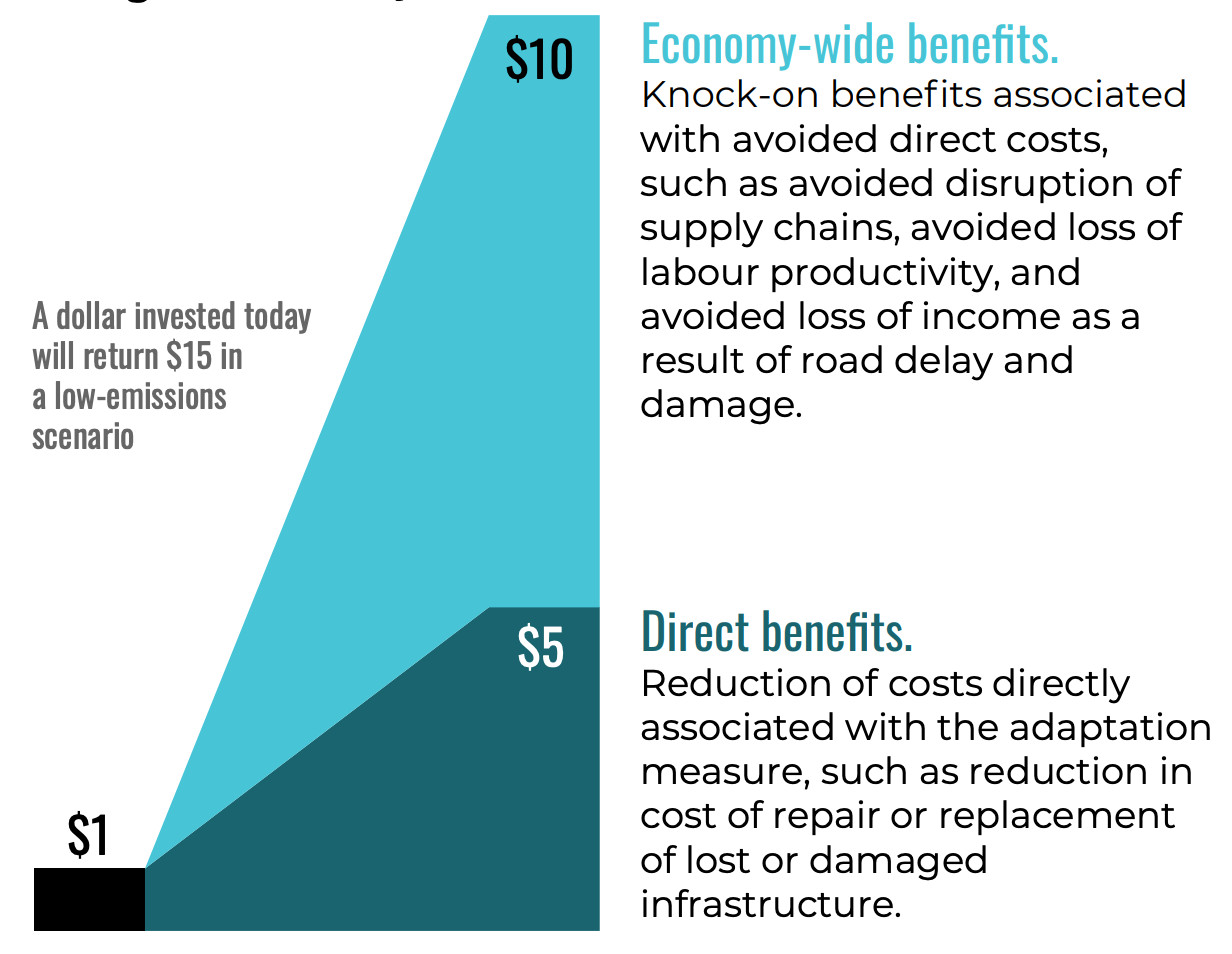
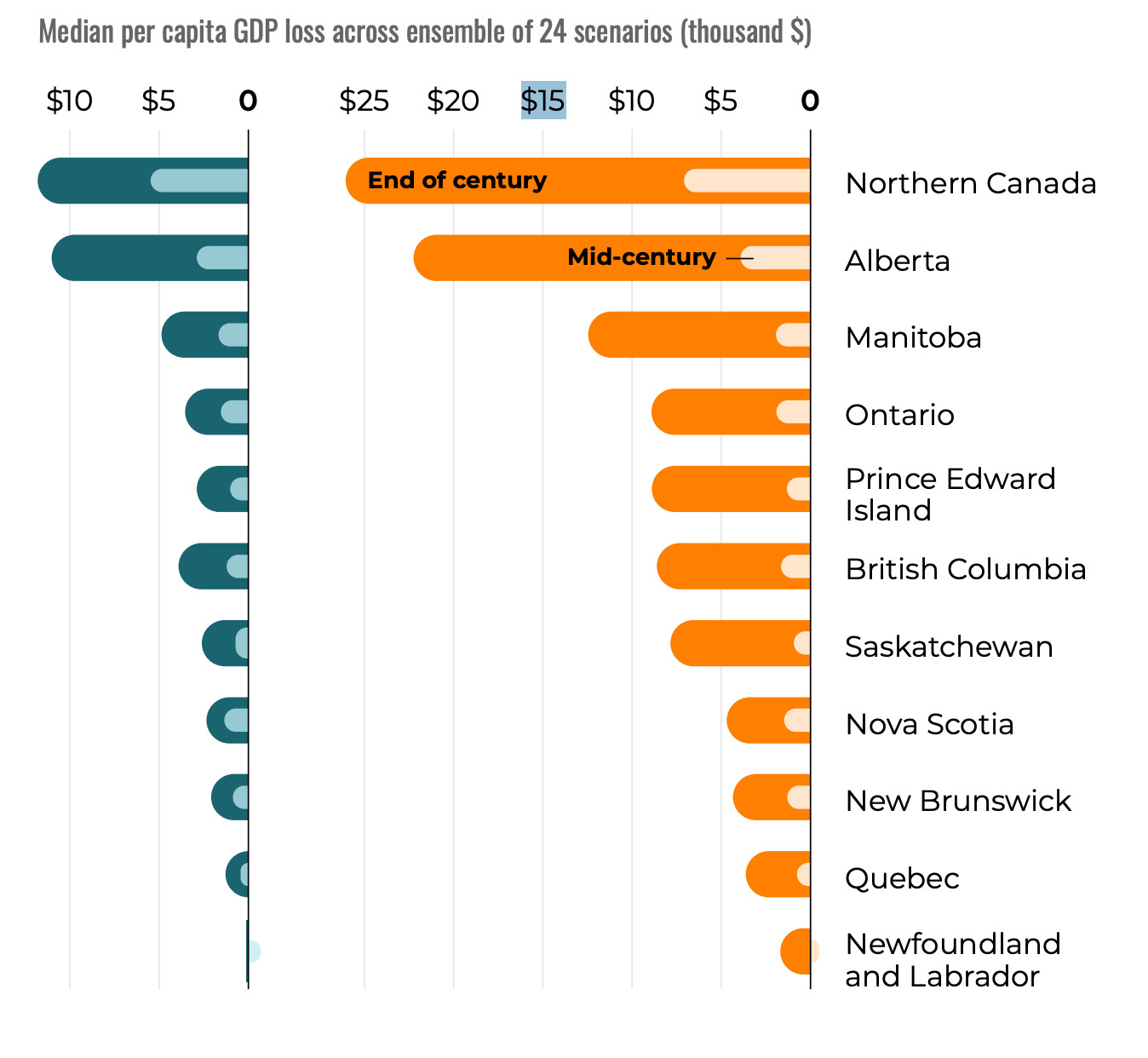
“No region is immune from the impacts of climate change, as losses take hold across the country, both in the low-emissions and high-emissions scenarios,” a 2022 Canadian Climate Institute report noted. “Proactive adaptation is a strong investment that generates major economic returns.” (Canadian Climate Institute)
Ness says federal housing programs including the Build Communities Strong Fund and Build Canada Homes Fund currently lack safeguards to prevent public money from supporting developments in high-risk flood and wildfire zones, potentially turning new homes into future financial liabilities.
There is also no dedicated new funding to help climate-vulnerable communities protect their homes and infrastructure, with adaptation projects now competing against other municipal priorities for funding ranging from roads to ice rinks.
“The government’s made it clear that we have to find ways to cut costs and to make room for priorities like nation-building projects and our NATO defence commitments,” Ness said.
“But these [climate resilience measures] aren’t budget-breaking asks.
“It's surprising that this would be the place where the government would try to cut costs, given that in the long term it saves us all money and makes our country more resilient and ultimately more prosperous and competitive, which is what the current Build Canada Strong agenda is all about.”
Email: [email protected]
At a time when vital public information is needed by everyone, The Pointer has taken down our paywall on all stories to ensure every resident of Brampton, Mississauga and Niagara has access to the facts. For those who are able, we encourage you to consider a subscription. This will help us report on important public interest issues the community needs to know about now more than ever. You can register for a 30-day free trial HERE. Thereafter, The Pointer will charge $10 a month and you can cancel any time right on the website. Thank you
Submit a correction about this story

