
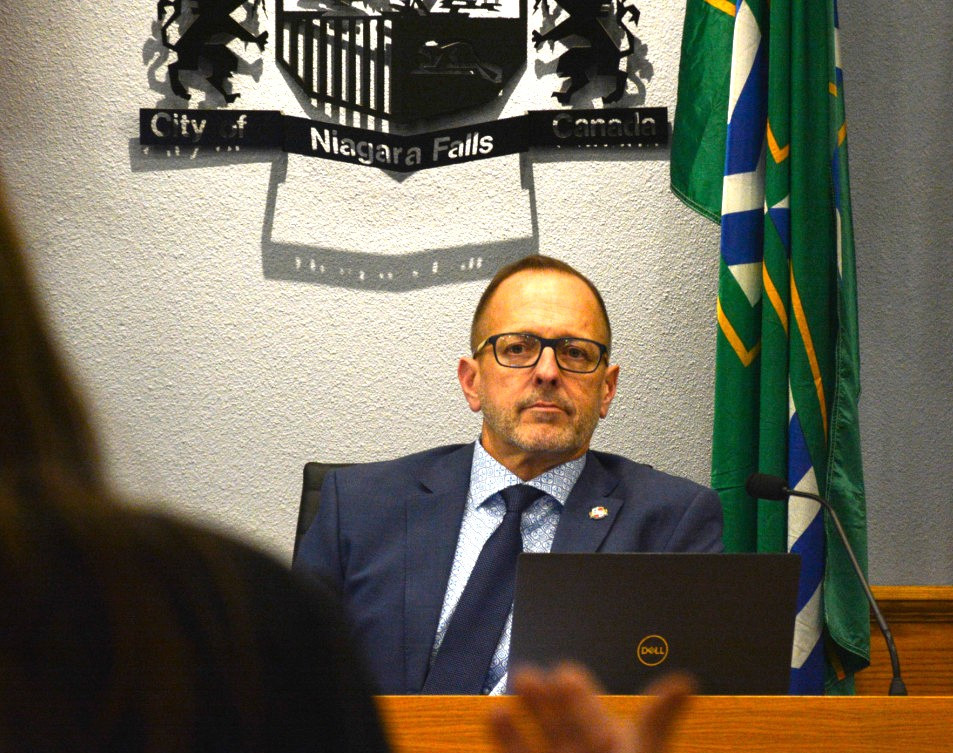
Jim Diodati claimed councillors routinely overpowered mayors at Niagara Region; the facts tell a different story
At the April 28 hearing of the provincial Legislative Assembly’s Standing Committee on Heritage, Infrastructure and Cultural Policy, Jim Diodati, the Mayor of the City of Niagara Falls, appeared in support of Bill 100, the Better Regional Governance Act.
The provincial legislation, which received Royal Assent less than ten days later on a vote along party lines, allows the ruling PCs to appoint unelected individuals, unanswerable to the electorate, to chair various regional governments in Ontario, including in Niagara. The legislation also significantly alters the composition of Niagara Regional Council, eliminating all members other than Niagara Region’s mayors and a chair appointed by the Province.
Diodati, who has been on Regional Council since 2010 by virtue of his position as Mayor of Niagara Falls, thinks the change is warranted. He has been a staunch supporter of the possible amalgamation of Niagara’s municipalities and endorsed Doug Ford in the 2025 provincial election.
Diodati’s comments at the Standing Committee made clear his frustration with having to deal with directly elected councillors.
“So, if the (directly elected) regional councillors are going in a different direction, we (the mayors) lose every time,” he bemoaned.
He also alluded to the source of the friction between mayors and “some people” on council: developer incentives.
“It's frustrating when they refer to it as “corporate welfare” when they don’t understand we’re going to get more money back than we put into it,” Diodati lamented.
He also dismissed certain councillors who prioritize social services funding, at the expense of development incentives: “Some people maybe don’t have a business background or don’t understand the process of why a company would want to locate in your community. They don’t understand, when you have incentives, it’s bait on the hook to bring these companies to create jobs for investment and economic development. But then you’ve got other people who say, ‘No, no, there shouldn’t be any money to incentivize companies to come. Just give it to social services.’ We’re trying to say, ‘You’re going to get it for social services if you get the jobs and investment'," Diodati argued, ignoring decades of research that has shown developer incentives only benefit developers—the same companies that provide the vast majority of the campaign funding to Diodati and the other Niagara mayors. He provided no evidence that taxpayer-funded incentives to developers create more revenue for social services.
It’s unclear why Diodati even made the claims about developer incentives when he should have known that studies for Niagara Region done by KPMG found that the incentives he lobbied for, to benefit developers, do not accomplish what he claimed.
Is Diodati’s broader claim correct, that Niagara’s twelve mayors are being outvoted and regularly overruled by the nineteen independently elected regional councillors? Also, would there have been different results had only mayors constituted Regional Council?
The Pointer decided to investigate.
Our analysis is restricted to votes during this current Council term (November 2022 to the end of July 2026). The vote had to have occurred at a Regional Council meeting or a Committee of the Whole meeting, which consists of all members of Regional Council. Votes at Standing Committees, where a full complement of members does not exist, were not considered. Also, votes at the Standing Committees are recommendations subject to approval by the Regional Council.
In order to ensure accuracy, only votes reflected in the official minutes were considered. While the Regional Council will often vote on matters electronically, the Region’s minutes only indicate whether the vote is carried or defeated and do not detail the votes of the individual councillors; therefore, the investigation looked at the results of only the “recorded votes”, as reflected in the Region’s official minutes.
The Region’s procedural by-law defines a recorded vote as “a written record of the name and vote of each Member who votes on a question and of each Member present who does not vote.” For a recorded vote to occur, a member has to request it. The Clerk of the meeting will call out the roll of the members, in alphabetical order, with the member stating out loud their vote, for or against the motion on the floor.
As a recorded vote identifies the position of each member on a particular issue, those conducted over the Region’s term should give a good indication if Councillor Diodati’s hypothesis is accurate - that the majority of independently elected regional councillors are outvoting Niagara’s mayors, who are “losing every time”, in Diodati’s words.
Recorded Votes
Over the course of the Council term, which commenced with the inaugural meeting of November 24, 2022, there have been thirty-eight calls for a recorded vote, as of the end of July. The subject matter of the recorded votes varies including a number of procedural matters, a handful of resolutions to the Province, instances of tender and Official Plan approvals, decisions related to formal complaints under the Development Charges Act and other developer requests for financial relief.
For a spreadsheet of The Pointer’s voting analysis, click here.
How many times did the mayors vote differently than the directly elected Regional council members?
Councillor Diodati’s contention is that the councillors have often voted in a bloc against the interests of the bloc of mayors.
The Pointer found only a single instance that comes close to Diodati’s hypothesis.
On November 20, 2025, Council considered a request from the Two Sisters Resorts Corporation to receive relief from the Region’s Development Charges (DC) By-law for a charge related to the second level of underground parking for the proposed hotel development at the former Parliament Oak school site in Niagara-on-the-Lake.
The developer’s legal counsel argued that had the additional parking requirement been accommodated as (outdoor) surface parking, there would have been no charge under the Region’s DC By-law; that the additional floor of underground parking was not generating any additional infrastructure-related costs to the municipality, as per the notion that development should be paying for development, and that ten of twelve of Niagara’s lower area municipalities, including Niagara-on-the-Lake, do not charge DCs for underground parking. The legal counsel also noted that despite the request for relief in the amount of approximately $905,000, the developer would still be paying development charges of approximately $4.4 million to the Region, including charges related to the first floor of underground parking.
The Region’s Corporate Services Committee had accepted the argument of the developer, so the decision at Regional Council was whether to ratify the Committee’s recommendation to grant the relief of $904,819.
All eleven Niagara mayors at the meeting voted in favour of granting the relief to Two Sisters. Lincoln Mayor Sandra Easton was filling in as Acting Regional Chair for the meeting, so she did not cast a vote.
While all the opposition to the granting of relief did come solely from the directly elected Regional Councillors, they were not unanimous in their opposition to the request. Four Regional Councillors voted alongside the eleven mayors in favour of granting the development charge relief; therefore, Councillor Diodati’s contention that Niagara’s mayors were being out-voted and found themselves in a “losing” position is not borne out by the vote related to the granting of development charge relief to Two Sisters, as the directly elected regional councillors did not vote as a bloc and, therefore, did not outvote the mayors.
How often did Niagara mayors vote as a bloc?
In addition to the Two Sisters request, there were only four other recorded votes where there was unanimity in the position of Niagara’s mayors but almost all of the regional councillors were in agreement with the mayors, with only one or two councillors in opposition on the votes.
What if only the mayors voted, would it have changed the result of any of the Region’s votes?
Come November, it will only be Niagara’s twelve mayors at Regional Council. Had that been the case during this council term, only four of the recorded votes out of the thirty-eight would have had a different result.
At their October 19, 2023 meeting, Regional Council considered a motion proposed by Councillor Haley Bateman (St. Catharines) calling on the Province to implement all fifteen recommendations from the Auditor General’s August 2023 Special Report on the Greenbelt and for the government to re-evaluate the 2022 changes to the Greenbelt boundaries. The Auditor General had described the process as “seriously flawed and dismissive of effective land-use planning.” The resulting “Greenbelt scandal” would lead to a still pending RCMP investigation.
Just days prior to the Regional Council meeting, the Minister of Municipal Affairs & Housing introduced legislation to restore the Greenbelt lands that had been removed in 2022. As a result, some of the councillors declared the resolution redundant and unnecessary, while others felt that the Region should go on record to reiterate their support for preservation of Greenbelt lands.
Two of the Region’s mayors, Jeff Jordan (Grimsby) and Brian Grant (Wainfleet), were supportive of Councillor Bateman’s motion. Six mayors, Frank Campion (Welland), Diodati, Sandra Easton (Lincoln), Marvin Junkin (Pelham), Wayne Redekop (Fort Erie) and Matt Siscoe (St. Catharines), were opposed.
The council vote to approve the motion was tied 13-13. Chair Jim Bradley cast the deciding vote to support the motion going to the Province. Had it just been a vote of the mayors, the motion would have been defeated. An earlier recorded vote to “call the question”, a procedural move to end debate on the motion, had been defeated 15-12. Six mayors supported halting debate and proceeding with the vote, while three mayors were opposed.
In explaining his vote, Councillor Redekop stressed that his opposition was not a sign that he did not support natural heritage and the Greenbelt but that the motion was “exactly what the Province was planning”. Had the motion preceded the Minister’s introduction of legislation, a few of the mayors intimated that their votes would have been different; therefore, a mayors-only vote opposed to the motion was, arguably, more related to the timing of the motion, as opposed to the content. The vote on “calling the question”, though, could be a sign that a mayors-only council may be more interested in dispensing with business expeditiously than engaging in protracted debate.
The next example of a result of a vote that would have been different if decided solely by the mayors came at one of the periodic special meetings where Council sits as a quasi-judicial tribunal to hear formal complaints under section 20 of the Development Charges Act.
Property owners may file a complaint to Regional Council if they feel that staff has incorrectly determined the amount payable under the Region’s DC by-law, a credit was not applied or incorrectly calculated, or there was an error in the application of the by-law.
On January 16, 2025, the Council considered three appeals in which the applicants felt their properties were being wrongly assessed at the higher commercial DC charge, when they should have been assessed as an industrial use. In all the cases, staff and external legal counsel recommended the appeals be dismissed.
The subject lands of one of the appeals pertained to 399 Vansickle Road in St. Catharines. The property in question was to be leased by Goodwill Niagara. Under the commercial DC charge, the rate would have been $379,295.84. If assessed as an industrial use, the rate was significantly less at $141,213.44.
There was much discussion on what defined industrial, commercial and manufacturing uses. The complainant argued that processing activities conducted by the tenant would fit under the Industrial definition of the Region’s by-law and noted that the St. Catharines DC by-law recognized the use as industrial.
A recorded vote upholding staff’s recommendation to dismiss the complaint passed on a 13 to 10 vote. Three mayors, Cheryl Ganann (West Lincoln), Grant and Junkin, voted to dismiss. The other mayors present at the meeting were Diodati, Easton, Jordan, Junkin, Siscoe and Terry Ugulini (Thorold), who voted against the dismissal.
It should be noted that five of the Region’s thirty-eight recorded votes have been related to complaints under section 20 of the DC Act. Although there has never been total unanimity of the mayors, in all five of those cases the majority of mayors voted against the staff recommendation to dismiss the complaint, supporting the complainant’s position that staff had incorrectly applied the Region’s by-law. Other than the Vansickle Road property, all other DC complaints have been upheld, leading to applicants paying less than staff’s recommended position.
In speaking to the Vansickle Road complaint, Diodati has possibly signalled what may be expected from an all-mayor council dealing with future complaints under section 20 of the DC Act, when he expressed he had no qualms about supporting the developer complainants.
“The intent of industrial designations and DC bylaws are to encourage and incentivize industrial investment and jobs. I think that's what this comes down to. I don't want to debate wordsmithing on manufacturing versus processing. The Regional Municipal DC bylaws should be more aligned with the municipal by-laws instead of splitting the hairs on certain words,” argued Diodati.
The issue of developer incentives was related to the most recent example of a decision that would have been different if solely voted on by Niagara’s mayors, though the matter was more procedural in nature.
At the August 28, 2025 Regional Council meeting, Welland Mayor and Regional Councillor Frank Campion requested a recorded vote to refer to staff a revised proposal related to an application under the Region’s Smarter Niagara Incentive Program. The application was related to the Lock & Quay project by L!V Developments, a proposed four-neighbourhood development at 1 Quaker Road in Welland.
At a Committee of the Whole meeting the week prior, Council had rejected two motions for Regional funding for the project in the tune of $40 million and $5 million. In both cases, four of the seven mayors present were opposed to the funding motion.
The referral of the revised application to staff was defeated by a 15 to 12 vote. Mayors Easton, Ganann, Ugulini and Lord Mayor Gary Zalepa (Niagara-on-the-Lake) voted against the referral. The mayors in favour of the referral were Campion, Diodati, Grant, Redekop, Siscoe and Bill Steele (Port Colborne).
Conclusion
While it was theoretically possible, based solely on the composition of Niagara Region Council, that Diodati’s claim “that if the (directly elected) regional councillors are going in a different direction, we (the mayors) lose every time”, it has not been borne out at Regional Council during the current council term.
There were limited instances where all the mayors present voted the same way and in most of those cases there was near unanimity in the voting of the entire council.
In only one instance, where all mayors voted the same, did the majority of councillors vote differently. In that case, the Two Sisters Resort’s request for relief from development charges, the mayors alone did not “lose” the vote, as four directly elected councillors sided with them in granting the relief.
Despite his claim, Diodati was rarely on the losing side of votes.
At the end of 2025, with twenty-eight recorded votes called at the Region, he was only on the minority side of five votes; in the majority on seventeen occasions; and absent for six votes.
In 2026, Diodati’s standing on the “losing” side of issues more than doubled based on a series of votes on Regional governance, former Chair Bob Gale’s unilateral actions on amalgamating Niagara and Bill 100.
Diodati did not side with the majority of Regional Council, and the majority of his fellow mayors, who called for any governance review of Niagara to be based on data, a business case and public consultation; that Gale, at the time, refrain from further unilateral action on governance and that Council oppose Bill 100.
With regard to whether a mayors-only Regional would have led to different decisions, of the thirty-eight recorded votes, as of the end of July 2026, only four would have resulted in a different outcome had Regional Council been composed of only the mayors.
If the recent past is an indication of the future, appeals under section 20 of the Development Charges Act, and developer relief, in general, are more likely to be granted by a mayors-only Council, and official communications to the Province may be less forceful.
In the October 2023 debate on whether to send a resolution to the Province related to the Greenbelt, the different considerations of mayors versus directly elected councillors were articulated.
“The path of trusting the (Provincial) government is great if you are in a mayoral position, I would imagine it is the best path to take but as a councillor it is important to reiterate our support for the Greenbelt,” offered Councillor Leanna Villella (Welland).
Mayor Diodati made clear what path he was taking: “You have to look at the big picture. The motion’s not going to change any outcomes regarding the Greenbelt, but it certainly may negatively impact future requests (to the Province). It's difficult to scold someone and then need to go back to them and ask for something later.”
Email: [email protected]
At a time when vital public information is needed by everyone, The Pointer has taken down our paywall on all stories to ensure every resident of Brampton, Mississauga and Niagara has access to the facts. For those who are able, we encourage you to consider a subscription. This will help us report on important public interest issues the community needs to know about now more than ever. You can register for a 30-day free trial HERE. Thereafter, The Pointer will charge $10 a month and you can cancel any time right on the website. Thank you
Submit a correction about this story

