
‘Waste, abuse and a culture of casualness with taxpayer dollars’: Has Doug Ford already decided on a 4-city or even 1-city future for Niagara?
The word “amalgamation” has been a contentious one in Niagara Region for years, consistently triggering political spats and community concern whenever it is tossed around.
That didn’t stop Bob Gale, the new Regional Chair, from raising the spectre of a municipal mash-up almost immediately after being appointed to the role by Premier Doug Ford. Ford has made his position clear that municipal restructuring is necessary in the region which has 13 municipalities (including the upper-tier Niagara Region), 126 municipal politicians and a population of about 540,000. It was a stance he reiterated during a press conference in Niagara Falls on Wednesday, scoffing at the number of elected officials in the region and criticizing the tax increases they are levying on residents.
“I think people are sick and tired of, over a term, double-digit tax increase in one term,” Ford said. “For anyone to sit back and say well they aren't going to save money, come on—there’s 126 (municipal politicians). I don't know who you’re trying to kid.”
Despite his words, and concerns raised by some council members across Niagara Region, that the Premier has already made up his mind, Ford claimed that is not the case when he made his bombshell comments in the region yesterday.
“I’m going to look at their proposal—it has to be led by Niagara, simple as that. If it’s not led by Niagara then we move on, and I guess the people of Niagara are going to have to pay double-digit tax increases for quite some time.”
The idea of a “proposal” and what has driven the need for such a proposal is a mystery to many. Ford is now waiting for a proposal from Niagara, and claiming he is not driving the process, while simultaneously making it clear that Niagara’s current governance model is not working. Now, the man he recently appointed to the role of Chair in Niagara, is suddenly calling for amalgamation.
While Ford was in the region for a press conference celebrating the raising of the final structural beam on the new South Niagara Hospital, it was not the topic of the day, thanks to Gale’s sudden fixation with amalgamation, and his stunning claims of mismanagement under the system he now oversees.
On February 19, two letters signed by Gale, who was installed by Ford’s government in December to replace the late Jim Bradley, were shared with selected local media outlets.
One letter was directed to the Minister of Municipal Affairs & Housing, Rob Flack. Within it, Gale declared that municipal reform was needed in Niagara to combat tax increases that had been passed by Regional Council over the previous three years, which together amounted to a nearly 25 percent increase to the Regional tax. He alleged that “several patterns had emerged” during the recent budget process that “taken together, raise serious concerns regarding waste, abuse and a culture of casualness with taxpayer dollars”. He did not elaborate on his claims in the correspondence.
His words were described as “outrageous and (a) wildly insulting thing to say”, by Regional Councillor Laura Ip (St. Catharines) in a recent blog post.
The second letter—dated February 5—was addressed to Niagara’s 12 lower-tier mayors. It was even more emphatic in its conclusions that some form of municipal amalgamation was necessary.
“I am deeply contemplating a 4-city or 1-city model”, Gale informed the local mayors. He claimed this would “maximize efficiencies and benefits to the communities we serve.”
The implication of Gale’s letter is that Niagara’s two-tier system of municipal government, in place since 1970, would cease, with the future of hundreds of municipal employees across Niagara uncertain. Premier Ford, during his comments yesterday in Niagara Falls, openly questioned the efficacy of the upper-tier municipality, Niagara Region.
“I can tell you firsthand, people call their mayor, or they'll call their city councillor or their MPP or their MP. They don't call their region representatives,” Ford said Wednesday, signalling his desire for change.
Gale admitted this week, under intense questioning by Fort Erie Mayor Wayne Redekop, that key concerns around amalgamation, and the financial claims he has made, are not supported by any data. It’s unclear how municipal politicians across the region will be able to address in less than two weeks, the advantages or disadvantages of a “1-city or 4-city” model, without any deep analysis of complex municipal structures and services currently overseen by either the upper-tier regional municipality or the lower-tier towns and cities, such as policing, fire and EMS delivery, utilities, roads, waste management, social services, parks and recreation and public health.
Despite suggesting that his mind is already made up, Gale offered the mayors an opportunity for their feedback by March 3, 12 days from the date of his letter. Gale then plans to submit recommendations to Minister Flack in the first week of March.
The letters immediately triggered alarm among local politicians who have raised serious questions about the lack of time they have to respond to Gale’s request for feedback, the lack of public engagement on such a serious change across 13 municipalities and how the entire process was launched without any warning.
On February 9, just over a week before he sent his letter to local mayors, Gale appeared before Grimsby Council. Councillor Jacob Baradziej asked him if, “there had been any more from the province on condensing the amount of lower-tier municipalities in Niagara and reducing the number of politicians.” The Chair replied, “Uh, no. You’ve read in the media what I have read on this. So, it's in the hands of the Province.”
Despite firing off his controversial letters on February 19, just ten days earlier in Grimsby, Gale gave no indication that he had any plans to wade into the issue. He did make one position clear, that he felt there are too many municipal politicians in Niagara.
A question Gale and Ford have failed to answer is why the entire process suddenly unfolding in Niagara is even necessary, after the PCs already ordered an extensive review of regional governments in 2019, including Niagara’s. Long-time Waterloo Region Chair Ken Seiling and Michael Fenn, a former deputy minister, were appointed as special advisors to assist with the regional government review. Between March and May of that year more than 8,500 written submissions were received and nine in-person sessions that heard from almost 100 individuals and organizations were conducted. Late in the year, Ford decided not to act on the so-called Fenn-Seiling report, which has never been released publicly.
After an exhaustive process that included public consultations, external and internal accounting analyses and a review of all potential financial implications by two widely respected municipal governance experts, Ford received a comprehensive report which was never shared, then promptly pulled the plug on making sweeping changes after the work was submitted.
Now, Ford and Gale have made no mention of dusting off the completed review, or sharing it with the public to show if amalgamation would indeed save money for Niagara taxpayers.
During last year’s provincial election, local Niagara NDP incumbent candidates Wayne Gates (Niagara Falls) and Jeff Burch (Niagara Centre) warned of the possibility that, if reelected, a Ford government would impose amalgamation on Niagara municipalities. The Premier first called for a review of regional governments across the province in 2019, claiming the structure was “bloated” and in 2023 he reiterated his position on Niagara specifically: “I had Chair (Jim) Bradley (he passed away last year) over, with the mayors, and I’ll be very transparent, I said: ‘hey, you have too many politicians’.”
On Wednesday, Ford claimed any decision made by his government would be “regionally led”. He did not directly answer when asked if he had given direction to Gale to initiate amalgamation discussions, instead repeating any decision by his PC government will be informed by Niagara.
“It has to be from Niagara, by Niagara, it has to have the approval from the majority of mayors,” he said, adding he would also like to see 70 to 80 percent of local politicians agree on a solution.
It could be a tough number to achieve.
The reaction of Niagara mayors, especially of the smaller and medium-sized municipalities, has been swift. Niagara-on–the-Lake Lord Mayor Gary Zalepa issued a statement quickly after Chair Gale’s letters became public, in which he declared his municipality was strongly opposed to any proposal that would see the town absorbed through amalgamation.
“Any proposal that would fundamentally change our municipality must have a clear legislative foundation, a transparent process, and meaningful public consultation. None of that has occurred,” Zelepa said.
Mayor Redekop in Fort Erie has questioned what legislative authority Gale was relying upon to undertake his review, while pointing out that Gale had been appointed by Premier Doug Ford, and not elected to the Regional Chair’s position, inferring he had no mandate to pursue such changes. Redekop indicated he would be writing to Minister Flack to express concern for any forced amalgamation and requesting a “business case be provided that is based on data-driven evidence to prove that a new structure will actually improve quality of life in this region.” The Mayor argued that it was unreasonable “to expect a careful and informed response to major and disruptive changes like governance reform or municipal amalgamation within 12 days.”
In public statements, Mayors Cheryl Gannon (West Lincoln), Bill Steele (Port Colborne) and Jeff Jordan (Grimsby) have expressed their belief that reviewing the current two-tier government model has value, especially issues at the upper-tier level (Niagara Region) but they were disappointed with how Gale has brought the issue forward and the lack of meaningful public consultation.
“Any and all discussions that could potentially change the manner in which Niagara communities are governed should not be quick, knee-jerk reactions to numbers and circumstances, but rather should be advanced using careful analysis of all pros and cons,” Mayor Gannon said.
Mayor Jordan also questioned the timing of the review in light of the municipal election slated for October. Filing to be a candidate commences on May 1. Chair Gale has speculated that the Province could make a decision on amalgamation in sixty days.
Local mayors were also upset that the letter addressed to them was dated February 5, but not sent to them until two weeks later. When addressing Fort Erie Council earlier this week, Chair Gale claimed the date was an error. Mayor Redekop suggested that perhaps the letter was originally drafted on the 5th. Gale responded that “he did not think so”. The Mayor responded: “so February 5th just kind of popped out of nowhere?”
Gale’s unilateral action has raised eyebrows and concerns of some of his Regional Council colleagues. In an email to The Pointer and other media outlets, St. Catharines Councillor Haley Bateman was critical of the Chair’s actions.
“He has taken it upon himself, with no consultation or direction from Council or members of the public to discuss the dissolution of Niagara's municipal governments. Bob Gale does not have the authority to do so.”
Councillor Ip pointed out that unlike lower-tier mayors that have been afforded certain “strong mayor powers”, the Regional Chair has not.
“Gale’s job is to act at the direction of Council. His job is not to sidestep or circumvent Council in any way,” Ip said.
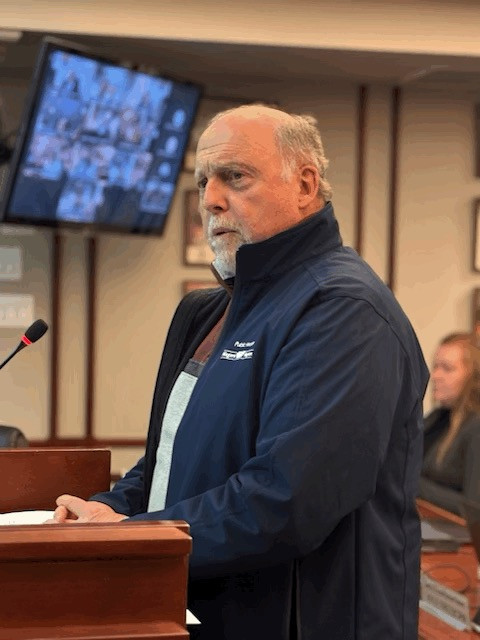
Regional Chair Bob Gale speaks at Niagara-on-the-Lake Council on February 24.
(Carolynn Ioannoni/The Pointer)
Earlier this week, Gale attempted to justify his actions when speaking with local councils in Fort Erie and Niagara-on-the-Lake.
On Monday evening at Fort Erie Council, Gale argued that he had “a duty to raise structural options with the province when current arrangements appear inefficient.”
Mayor Redekop asked him whether the Premier had issued a mandate letter to him to pursue governance reform and amalgamation. Gale responded that it was “totally” his idea to send his letter to the minister.
Councillor Ip has publicly expressed skepticism that changes were not pre-ordained.
“I think the amalgamation decision has already been made and that these letters and any meetings (there’s a Committee of the Whole meeting on February 26 ahead of our regular Council meeting) are just smoke and mirrors to give some semblance of an impression that there was consultation with Council and the local area municipalities,” Ip wrote in a blog post.
Provinces have the constitutional authority to enact laws related to municipal institutions—municipalities are often referred to as “creatures of the province”— and Premier Ford has shown no hesitancy to impose decisions on municipalities. In 2018 he unilaterally slashed the size of Toronto City Council from 47 members to 25 and cancelled Regional chair elections in Niagara while municipalities were in the midst of local election campaigns. More recently he has tried to dictate how municipalities handle issues they have traditionally controlled, such as the use of automated speed cameras and bike lanes (the courts struck down his move to dictate bike lane policy for cities).
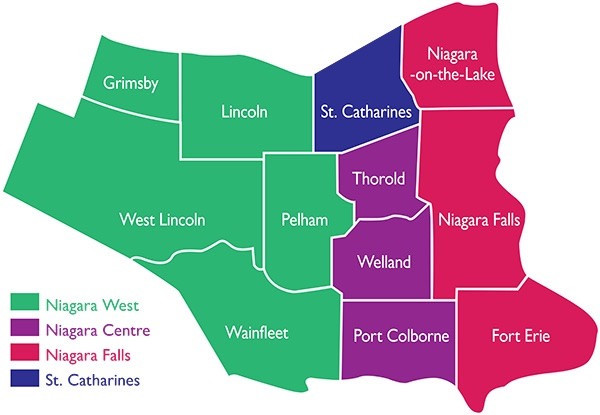
The 12 municipalities that comprise Niagara Region. All of them make up the upper-tier municipality of Niagara Region.
(Niagara Region)
Of Niagara’s three biggest municipalities only Welland’s mayor Frank Campion has issued a public statement indicating a preferred outcome. Campion claims he “firmly” supports a four-city model.
“A four-city structure would better align municipalities by population and shared interests, create stronger and more balanced municipal partners, reduce duplication and streamline decision making, while preserving meaningful local representation.”
Niagara Falls Mayor Jim Diodati has not staked out a position, but during Wednesday’s press conference alongside Ford, he echoed Gale’s comments that the “current system is not working”.
“I think we all agree, we have too many politicians in Niagara,” he said. “We have too many cooks in the kitchen and it's too expensive to do business in Niagara.”
The issue of municipal governance reform never seems to go away in Niagara. A 28-page report before the Regional Council in 2020 outlined the numerous motions and efforts toward reform since 2005. There has never been a local consensus on what municipal reform should look like in Niagara, whether it be the status quo; one Niagara; the elimination of the regional level of government; or a 3 or 4-city model centred on Niagara’s largest lower-tier municipalities: St. Catharines, Niagara Falls and Welland.
Since the institution of regional government in 1970, Niagara has remained a two-tier system with the upper-tier Niagara Region and twelve lower area municipalities. Although there have been minor tweaks in representation over the years, there are currently 126 municipal elected representatives in Niagara, a number and cost that has been a source of criticism by Premier Ford. The vast majority of local representatives are part-time and have minimal impact on municipal budgets.
“When you use the hyperbole that 126 elected representatives are too much for Niagara, and I would say, if they were full-time equivalents, then you would have a point, but you are probably dealing with 30 to 35, full-time equivalents, which would be comparable with Peel or Toronto,” Mayor Zalepa said.
Ford doubled-down on that criticism Wednesday, hurling barbs at the number of officials and their inability to keep taxes low for residents.
“I’d be the mayor of every single region in here and balance the books,” Ford claimed.
According to Thursday’s Committee of the Whole agenda at the Region, documents to be addressed consist solely of Gale’s two letters, without any supporting report or other information justifying his conclusions that the need for municipal reform is urgent or that amalgamation will lead to cost savings and efficiencies.
Several reports have concluded that municipal amalgamations do not achieve cost savings. A report by the Fraser Institute, the conservative Canadian public policy think tank, from 2015 found there was no tangible financial benefit from amalgamation.
Premier Ford scoffed at the notion.
“I’ve never seen that,” grumbled Ford about the numerous reports written on municipal amalgamation. When he was in Niagara Falls on Wednesday the Premier pointed to his business experience as proof to the contrary.
In an email to Regional Council members calling for Thursday’s meeting, Gale declared that “the overwhelming feedback from the public has been clear, people want change, and they want it now.”
He indicated the meeting would allow council members “the opportunity to discuss the governance issue openly”, though he is suggesting that members’ comments be limited to five minutes—despite the Region’s Procedural By-law allowing members to speak for up to 10 minutes on a matter.
Gale declared that delegations from members of the public “will not be feasible” due to the Region’s regularly scheduled Council meeting at 6:30 p.m. Thursday, immediately after the committee meeting.
“The Chair has changed the rules of order to suit his needs by prohibiting members of the public from delegating and capping Councillors’ input to under 5 minutes,” Councillor Bateman said. “This direction contravenes our bylaws, as does the omission of members of the public from delegating at this meeting.”
During his appearance in Fort Erie earlier this week, Gale conceded that Regional Council members could extend the speaking limit on Thursday, but it would mean “we'll be there for a long time”. He also said that if the mayors wanted public delegations, it could be accommodated. It is unclear if he meant for Thursday’s meeting or for some time in the future, but there is only a matter of days before Gale’s self-imposed deadline of March 3.
The Chair’s comments on public consultation in Fort Erie were often contradictory. Early in his delegation he declared “there is no advantage to go to more consultation.”
When challenged by Mayor Redekop on the statement, Gale backtracked slightly.
“We've had enough consultation on it, but there will be more. That's why I have asked the mayors to submit their opinions, and as well as any other citizens, can send emails to us.”
There is currently nothing on the Region’s website directing residents to provide their opinion on the issue.
When Mayor Redekop further pressed Gale on any public consultation, the Chair gave the opinion that the Province might have public hearings after he makes his submissions to the Minister.
Mayor Diodati echoed some of Gale’s talking points during the press conference Wednesday.
“For anyone saying there hasn't been meaningful public debate, that's absolutely factually incorrect. It started in 2000 with the Berkeley Report, commissioned by the Region of Niagara and conveniently put on the shelf. We had Ken Seiling and Michael Fenn come here and do public meetings. They interviewed everybody that had an opinion in Niagara, and then we had the standing committees of the province in 2024. There's been all sorts of opportunities. There’s been all sorts of data.”
What the Mayor failed to mention was that the Ford government has never produced a public report on amalgamation, let alone one that justifies such action. The Fenn-Seiling report has never been publicly released and a promised second tranche of hearings before the standing committee did not occur with the dissolution of the legislature in early 2025 ahead of last year’s provincial election.
The issue of whether Gale has “data” to support his assertions that amalgamation in Niagara will lead to cost savings and efficiencies came up at his delegations this week in Niagara-on-the-Lake and Fort Erie.
The following transpired at the Fort Erie meeting:
Mayor Redekop: Do you have any data to support your views with respect to what you're proposing in terms of potential changes to governance in Niagara?
Gale: Only from talking to citizens and businesses and proposals in the consultations that have happened over the last 20, 27 years.
Mayor Redekop: Okay, do you understand what data is?
Gale: Facts.
Mayor Redekop: So, you have nothing currently?
Gale: Nothing in the last year. That's why I'm submitting it to the government for their decisions.
Mayor Redekop: Do you have any data as to whether there will be any benefits that the taxpayers of Niagara can expect from governance changes? Not your belief. Data.
Gale: I have no data on it at this time.
Mayor Redekop: When would you expect to be putting forward that type of data, or do you plan to do that before you ask the government to impose changes on government structures in Niagara?
Gale: I'm going to submit all the information from the mayors that come in to me, and from any citizens. I'm going to submit that to the province, and they will study it from there.
Mayor Redekop: I don't call that data. I call that information coming in from citizens and mayors. Do you have any data that supports your deep contemplation that only one city or four cities models will maximize efficiencies and benefits in Niagara?
Gale: I only have the common sense data that taxpayers can't afford 25 percent tax increases. We can't survive with $2.7 billion worth of infrastructure deferrals. We can't put up with red tape on applications from people.
Mayor Redekop: I don’t want to be disrespectful but so far, the way you are categorizing this, it looks like a Bob Gale flyer.
At the two councils this week, Gale was also criticized for attributing budget increases to Niagara’s governance structure while omitting such impacts on the Region’s budget as rapidly rising policing costs, provincial downloading and past fiscal decision making.
Mayor Redekop asked why Gale had not mentioned the impact of police budgets in his letter to the Minister. Policing accounts for more than two-thirds of the Region’s 6.3 percent property tax increase for 2026. The Chair responded to Mayor Redekop that he would be “getting too much into the weeds” to disclose that in his letter to the Minister.
Gale eventually conceded that amalgamation was unlikely to realize any cost savings related to the existing Niagara Police budget. And he did not address how, for example, policing would be structured in a 4-city model; would four separate police departments with four budgets and four chiefs be needed to replace the one that currently serves all of Niagara? Redekop also noted that amalgamated municipalities would see pressure to eliminate volunteer fire departments that serve most of Niagara’s smaller municipalities, adding additional costs as the result of amalgamation.
On provincial downloading, Mayor Redekop, who has chaired the Region’s budget committee this Council term, informed Gale of the impacts.
“Do you have any idea how much money regional taxpayers are paying in order to reach provincial mandates for those various services? It’s over $100 million, 21 percent of the region's budget. So, that means that the taxpayers of Niagara are paying for things that the Province has mandated, that the Province is not sending money to Niagara for.”
Premier Ford rejected the notion that downloading is the reason municipalities are cash strapped.
“That’s passing the buck,” Ford said Wednesday, failing to explain how his government has helped municipalities with costly downloaded services such as public housing.
At Niagara-on-the-Lake on Tuesday, after Chair Gale had admitted that he had been at fault in the past for his votes against putting more funding into infrastructure, Councillor Tim Balasiuk asked him if part of the financial issues at the Region were due to taxes being kept artificially low in the past. Gale declined to comment; however, it has been a common refrain during budget deliberations at the Region this term that the current council is paying for the inadequate funding decisions of past councils.
Gale took little responsibility for the heavy lifting that might be required to move forward with amalgamation or a thorough governance review, but claimed he had no plan to provide a business case supporting amalgamation to the Province, while repeating his refrain that he would be providing all the feedback he receives to the Province for Queen’s Park decision makers to make a call.
Niagara-on-the-Lake Council was not swayed by his arguments. Lord Mayor Zalepa stated in a news release on Wednesday that “what is increasingly clear is that the assertions lack supporting facts and evidence. Rather than continuing down a flawed path or promising potential tax reductions without a documented financial analysis, it would be far more productive for the Region and local area municipalities to engage in an evidence-based review of how services can be delivered most effectively to Niagara residents. Forced amalgamation is not something our communities have asked for.”
Chair Bob Gale’s Letters to Minister Rob Flack and Niagara’s mayors can be read here.
Email: [email protected]
At a time when vital public information is needed by everyone, The Pointer has taken down our paywall on all stories to ensure every resident of Brampton, Mississauga and Niagara has access to the facts. For those who are able, we encourage you to consider a subscription. This will help us report on important public interest issues the community needs to know about now more than ever. You can register for a 30-day free trial HERE. Thereafter, The Pointer will charge $10 a month and you can cancel any time right on the website. Thank you
Submit a correction about this story

