
Niagara police services board rejects cuts to 11.5% budget increase, setting up contentious final vote at regional council
Niagara Democracy Watch is The Pointer’s feature aimed at increasing the public’s awareness and political involvement in the Niagara Region by highlighting key agenda items, motions and decisions.

Date: January 8 - 4:30 p.m. | Full agenda | Watch live
While the calendar has rolled over into 2026 and many are now back to work following the holiday season, most municipal councils won’t begin meeting, in earnest, until the second or third weeks of January.
Not Niagara Regional Council.
The upper-tier municipality has called a Special Council Meeting for Thursday, January 8th to consider approval of the 2026 budget.
On December 11th, at its previous Budget Committee of the Whole meeting, Niagara Regional Council was unable to finalize its budget with some councillors still unhappy with the impact it could have on taxpayers, particularly the increase being asked for by the Niagara Police. Council approved a motion demanding the NRPS and the police services board, scale back the requested budget by $2.7 million.
This marks the third consecutive budget Regional Council has “sent back” to the Police Services Board for trimming. The Region’s hoped-for reduction of $2.7 million in 2026 would only shave off half a percentage point from the Region’s provisional general tax levy operating budget increase that sat at 6.98 percent at the end of the December 11th meeting.
The Niagara Regional Police Services Board was able to consider Regional Council’s request before the holidays, having already had a board meeting scheduled for December 18th. A report added in response to the request from council recommended the Board approve mitigation options that would remove $1,350,000 from the budget, or half of the amount requested by the Region. The amount would represent a 0.6 percent reduction to the Police budget, making the increase over the Police’s 2025 operating budget 10.9 percent, a total of $235,551,521 for the year. The impact on the Region’s General Tax Levy would be a quarter of a percent.
Niagara Police staff proposed eight mitigation options, half of which were deferral of position start times from January 1st to July 1st. In addition, two Sergeants proposed for a Modified Work Accommodation Program were recommended to be removed, with the hiring of the program’s occupational therapists being staggered. The elimination of a $200,000 transfer from the operating budget to an Employee Future Benefit Reserve was advanced with the hope that it could be made up by any annual surplus. The administrative supplies line item was reduced by $23,000. Finally, the related report was optimistic on the possibility of an increase in provincial funding for Court Security and Prisoner Transportation revenue in the amount of approximately $303,000, accommodating such an increase in the mitigation measures.
At the December 18th Board meeting, two of the members, who also sit as Regional Councillors, questioned a couple of the proposed mitigation measures. Member Bill Steele, Mayor of Port Colborne and Regional Councillor, indicated that he was uncomfortable with the elimination of the transfer to the Employee Future Benefit Reserve, as it would increase “unfunded liability” for the NRPS. Member Laura Ip, St. Catharines Regional Councillor, questioned the efficacy of adding the hoped-for provincial funding for Court Security and Prisoner Transportation, describing the move as spending money the NRPS did not have yet, with no firm guarantees that they would receive it. Chief Bill Fordy admitted that there was some risk in expecting the increase in provincial funding.
Steele and Ip’s concerns lead to amendments to the staff recommendation reducing the mitigation measures further from the proposed $1,350,000 to $847,259, meaning an 11.1 percent budget increase, down slightly from the Police’s 11.5 percent increase. Despite staff’s efforts at reductions, Member Kevin Gibson was opposed to any cuts.
“I suspect that in future years our budget is going to be under a much broader attack for reduction. I hate to use the word attack, but I have a feeling that we're going to have a harder time in the future with our budget. I don't support any of this and I'm going to vote to not accept this entire thing,” argued the former Wainfleet Mayor and Regional Councillor.
When the final vote was taken to consider the reduced cuts to the Police budget, it failed on a 4-2 vote. As a result, the NRPS formally sent the Region a correspondence, which is on Thursday’s agenda, indicating that the Board “supports and reaffirms the original 2026 Proposed Operating Budget submission for the Niagara Regional Police Service…and Police Service Board as previously presented to the Region’s Budget Review Committee of the Whole.”
How the Regional Council will react to the Police Board’s rejection of $2.7 million in budget cuts remains to be seen. With this 2026 budget process, the Council has been inconsistent, rejecting a motion asking that the Niagara Police consider a two percent reduction to the proposed budget increase, but passing the motion that the Board consider $2.7 million in cuts, by a 15-12 vote, two weeks later. Similarly, during the 2025 budget deliberations, while the Board had rejected any cuts, Regional Council passed a motion reducing the allocation to the NRPS based on the staggered hiring that had been proposed by Chief Fordy and rejected by the Police Services Board.
Councillor Ip, at the Police Services Board meeting, was assertive in her defence of the proposed budget increase and rejection of any further cuts.
“First of all, a few of our colleagues at council commented that they did not feel that the police service board had worked hard enough to bring in a budget that they could accept, which is indicative of them not watching the (Police Board) meetings or discussing the process that we go through with any of us (the Regional Councillors that sit on the Police Services Board). The $2.7 million is arbitrary. There was no thought to what the cut does to the budget other than an attempt to make the council look good in the last budget before an election.”
While it is not an uncommon goal for a council to come in with an operating budget with a smaller increase in the last year of their term, prior to the next municipal election, whether the Regional Council has been successful is debatable, especially considering a motion in May 2025 that directed the Region’s departments and agencies, boards and commissions “to adhere to a “guidance rate” limiting increases of operating budgets to 3.5 percent. Chief Fordy had described the 3.5 percent guidance as akin to “defunding the police”, a claim that represented a significant exaggeration, considering the current rate of inflation in Ontario and what municipal departments including fire and paramedic services have had to limit increases to.
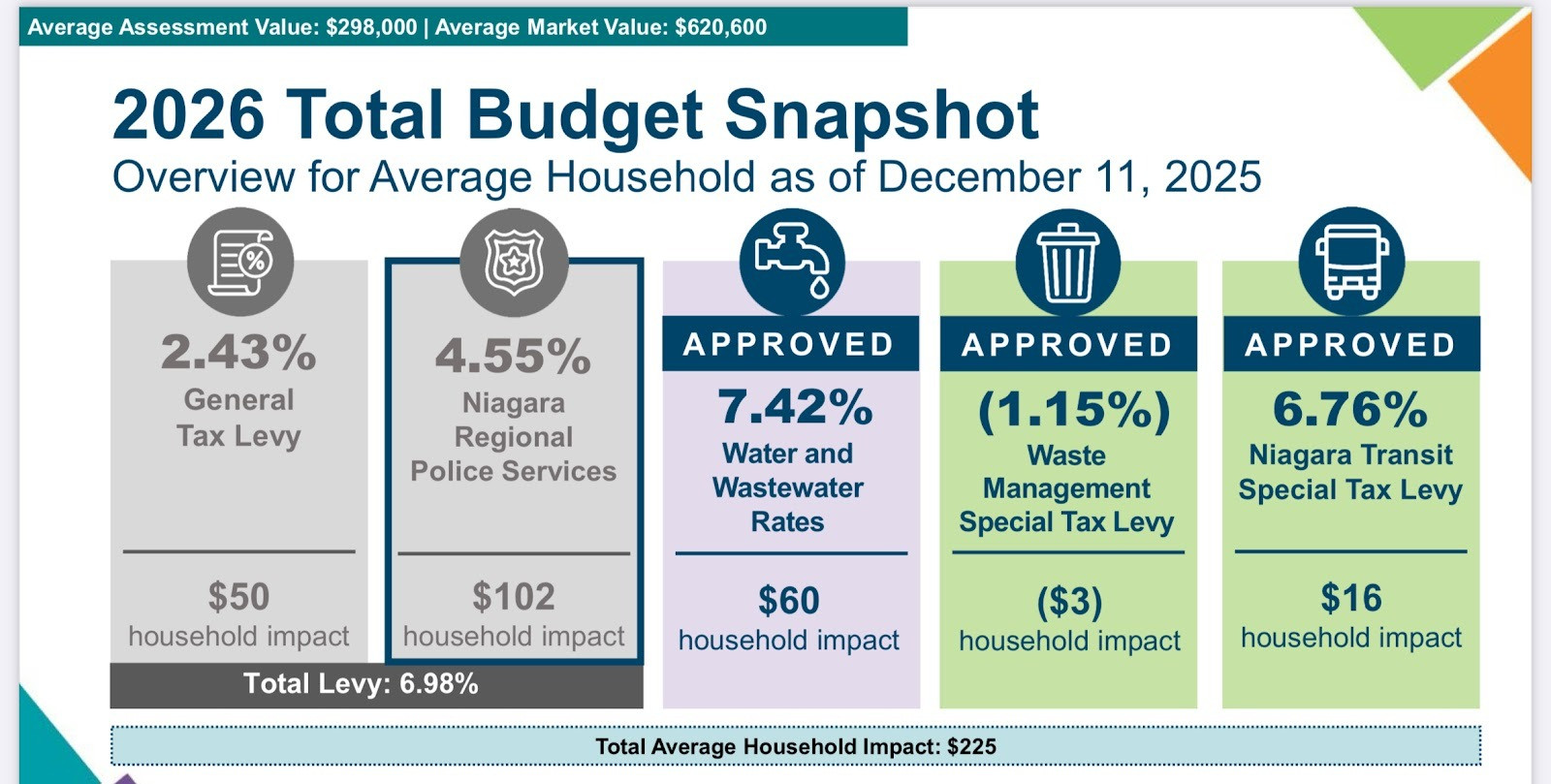
If the Niagara Police budget increase remains at 11.5 percent, the Region’s general tax levy operating budget will increase 6.98 percent for 2026, just nominally below previous years during this council term; they have ranged from 7.02 to 9.8 percent. The Niagara Police budget will account for two-thirds of the 6.98 percent increase.
(Niagara Region)
The impact on the “average” household would be a $152 increase on the Regional portion of the property tax bill based on the operating levy. In addition, the average household will also see a net $73 increase between water and wastewater rates and the Niagara Transit Special Tax Levy.
The spectre that hangs over any dispute regarding the police budget is an appeal to the Ontario Civilian Police Commission. The Community Safety and Policing Act mandates that “in establishing an overall budget for the municipal board, the municipality does not have the authority to approve or disapprove specific items in the estimates.”
The requirement is often translated to say that the Council provides an allocation or “funding envelope” but cannot dictate how the Police service spends (or cuts) from its budget. If the council or the board is dissatisfied with the budget a mediation or arbitration can be requested.
It is doubtful that it will come to such an appeal considering the parties would have to share equally the costs and expenses if the matter went to arbitration, and the “disputed” amount of $2.7 million represents only a 0.6-point reduction to the proposed 11.5 percent police budget increase, to 10.9 percent.
A review of appeals before the Commission indicates that the only time an appeal occurred related to the NRPS budget was in 1981, when the Commission upheld the Police request for a $4.6 million increase, which represented a 21.6 percent jump in the Service’s budget from the previous year.
The Niagara Region’s report and related powerpoint on the 2026 General Tax Levy Budget can be read here and here.
Email: [email protected]
At a time when vital public information is needed by everyone, The Pointer has taken down our paywall on all stories to ensure every resident of Brampton, Mississauga and Niagara has access to the facts. For those who are able, we encourage you to consider a subscription. This will help us report on important public interest issues the community needs to know about now more than ever. You can register for a 30-day free trial HERE. Thereafter, The Pointer will charge $10 a month and you can cancel any time right on the website. Thank you
Submit a correction about this story

