
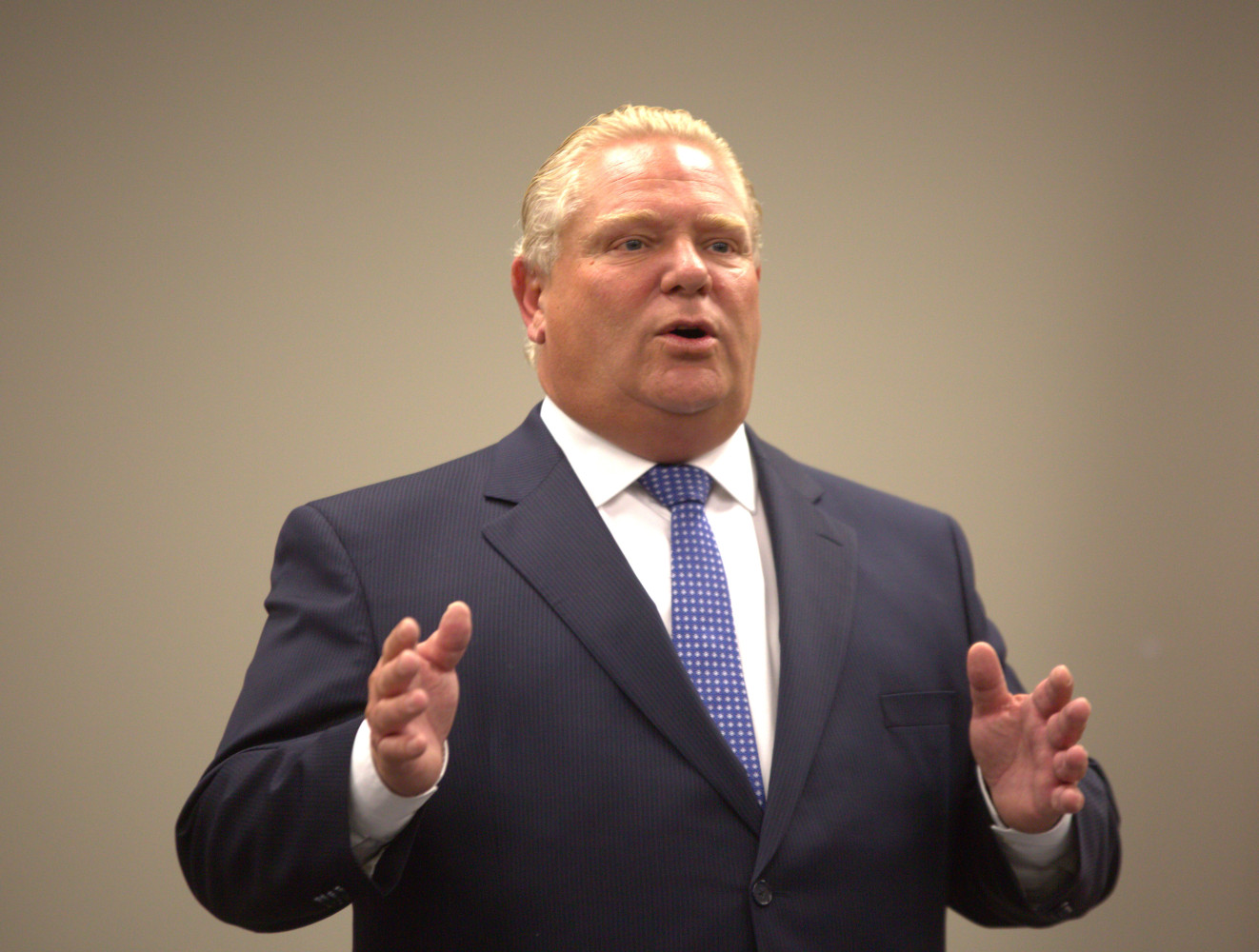
‘A top-down political experiment written on the back of a napkin’: Doug Ford will appoint chairs to lead regional governments across Ontario
“We are being asked to get on a boat that's heading into undemocratic waters. We should not be embarking on it, and we should be pushing back,” warned Fort Erie Mayor Wayne Redekop at the April 30 Niagara Regional Council meeting.
Redekop was speaking to a motion he had crafted and that his council in Fort Erie had approved at their April 13 meeting in opposition to Bill 100, the Better Regional Governance Act. The motion opposed provisions of the Bill, specifically, the appointment by the provincial government of the future regional chair, the provision of “strong chair” powers to that unelected position, and a system of weighted voting, not currently detailed in the legislation.
The motion passed on an 18-9 vote, however, Redekop’s effort appears to have been for naught. The week after the Regional Council meeting, after limited public hearings and out-of-the-ordinary evening sessions of the Legislature that, in one case, stretched to midnight, the majority PCs passed the legislation inside Queen’s Park early last month, and Bill 100 will now dramatically affect Niagara governance after October’s municipal elections.
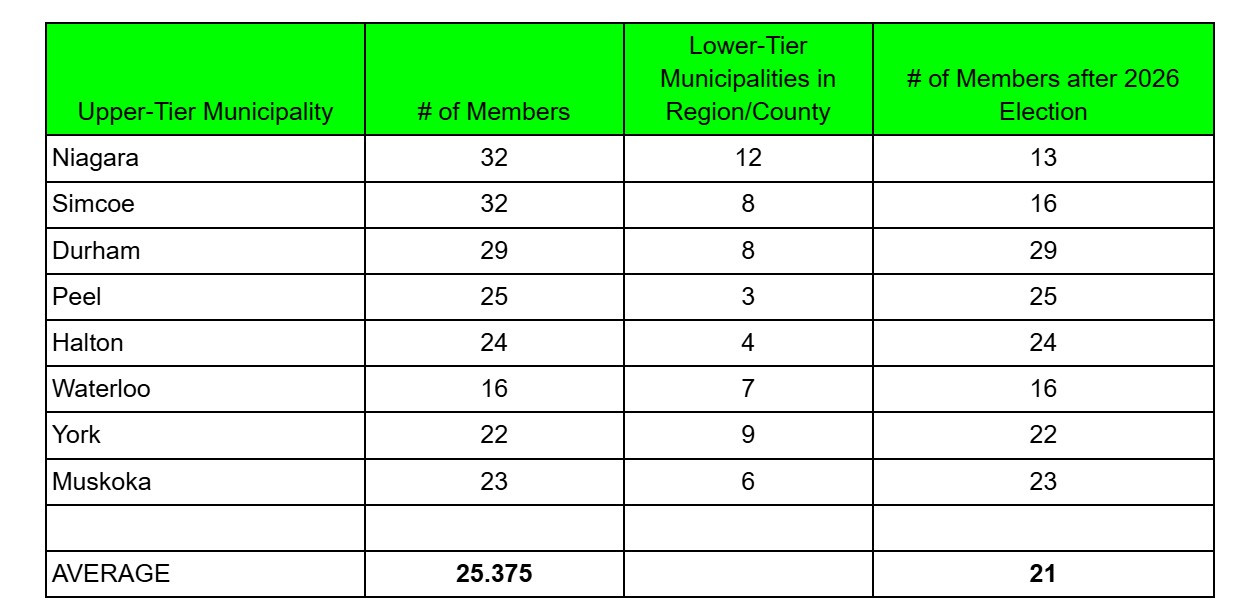
Upcoming changes under Bill 100. Critics have questioned why Doug Ford has targeted some regions slated for significant reductions in representation, but not others.
(Dean Iorfida)
Critics have said the changes to council composition are not consistent. While Niagara Region will go down to 13 from 32 council members currently representing 12 municipalities, Muskoka’s 23 members representing only 6 municipalities will remain untouched. Ford’s close ties to the area where he has a large family cottage have been linked to his preferential treatment. He has been calling for Niagara to be amalgamated since he became Premier. Cutting council down and appointing his own “strong chair” will allow him to get some of the same results that amalgamation would achieve, reducing local representation and dramatically curtailing the power of those advocating for their specific community.
Some of the impacts of the Better Regional Governance Act are known: The size of Niagara Regional Council will shrink from thirty-two members to thirteen. The nineteen directly elected Regional Councillors representing eleven of Niagara’s twelve lower-tier municipalities have been eliminated. Come November 2026, Regional Council will be just Niagara’s 12 mayors and an unelected Regional Chair, giving Ford significant authority over compliant mayors beholden to his appointed boss.
Municipal law experts have suggested the legislation could be challenged on constitutional grounds, as it strips local democracy and control of decision making by residents to the bone. Ford will be the unofficial mayor of every municipality under the regional system, critics have warned.
What is not known is who the Regional chair will be in November with unilateral powers to set budgets, hire and fire the Region’s chief administrative officer and quash by-laws, subject to a two-thirds of council override. Because the selection of the future chair will be made by the Minister, the fear is that the unelected chair will be beholden to the PC government, not the local electorate.
Planning and housing advocates have warned that the province’s regions are where Ford’s developer friends want to build, free from the constraints that local municipal governments place on builders who want ultimate control of planning, removing residents from the process to shape their own communities.
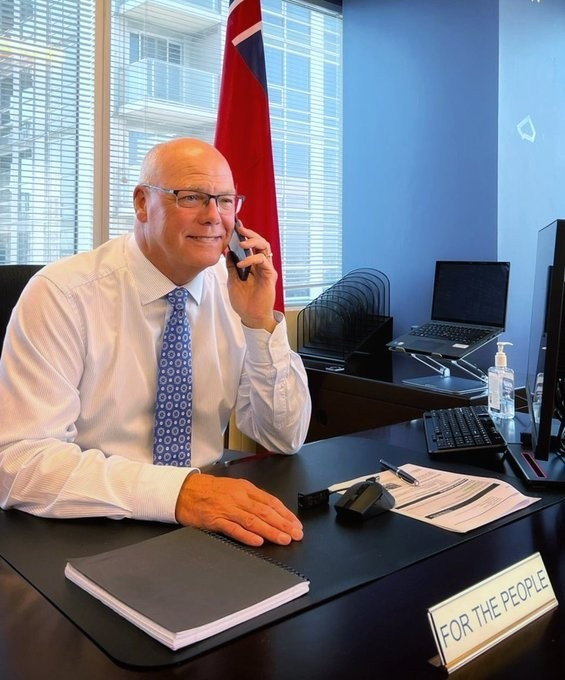
Municipal Affairs and Housing Minister Rob Flack says there was plenty of opportunity for input into Bill 100 and that the legislation will streamline decision making at the municipal government level. Critics say the Bill gives Doug Ford unprecedented and undemocratic control over local decision making and residents who will no longer get to shape their own community.
(X)
For Redekop, provisions of the legislation are an affront to long-standing democratic principles: “I wouldn't have thought when I started my political career, that during my lifetime I would ever be involved in a debate about whether or not the representatives of a local government would be appointed, as opposed to elected by the residents. I wouldn't have thought that I would be involved in a discussion about whether or not majority rules, which is something that is traditional and historic in all of the democracies, beginning with the English Parliament. But, here we are today, and it seems to me that we're being asked to do things that are completely contrary,” Redekop lamented.
“We're not being asked. Actually, we're being told this is how things are going to be done. Completely contrary to the history of our country.”
The PCs have claimed the purpose of the legislation is to speed up government processes and create conditions for faster decision making to ultimately deliver housing and critical infrastructure.
Niagara Centre NDP MPP Jeff Burch sees different motives behind the legislation: “What the Bill actually does is it gives the government and its unelected, hand-picked chairs unprecedented power over regional municipal budgets and operations. It takes power away from municipal taxpayers and their elected representatives. The effort to make this sound as if it’s more democratic quite frankly flies in the face of what the Bill actually does.”
Lindsay Jones, Executive Director of the Association of Municipalities of Ontario, which represents Ontario’s 444 municipalities, advocated for local decision making in the composition of councils, the provision of weighted voting and the selection of chairs. She characterized the combination of provincially appointed heads of council, with strong-chair powers, as “fundamentally undemocratic”.
Welland Mayor Frank Campion has indicated he has not made a decision on whether to seek re-election in Niagara’s third largest lower-tier municipality, but if called upon to be Ford’s regional chair, he would do it. Campion has stressed he is not lobbying for the position and has not spoken to anyone about it. Tony Joosee, a former Grimsby city councillor, co-chair of the Save West Lincoln Memorial Hospital initiative and a current member of the PC Party of Ontario executive, indicated that “some have suggested” he be Niagara regional chair but did not commit to the possibility based on his current work with “a publicly traded company”. Fears of PC insiders like him getting the chair job and doing Ford’s bidding have been widely raised.
Campion and Niagara Falls Mayor Jim Diodati (both endorsed Ford during the 2025 provincial election campaign) spoke to the structure of the current Regional Council as being “too large” to get things accomplished. Diodati bemoaned that mayors are outnumbered “so if the regional councillors are going in a different direction, we lose every time.”
St. Catharines Regional Councillors Peter Secord and Sal Sorrento have also addressed the chair issue. Secord indicated that even though his own position was being eliminated he was prepared to support a “more focused” Regional Council with Niagara's mayors and a “strong” regional chair. Sorrento, who unsuccessfully ran for the PC party in the 2025 Provincial election, has criticized Niagara Region’s current decision-making process, suggesting a chair with unique powers makes sense.
There is no shortage of PC loyalists who seem to either be lining up for the job, or clearly expressing their support for Ford’s unpopular move.
St. Catharines NDP MPP Jennie Stevens has made the position of the Official Opposition clear. “We’re sending a very strong message to you: We disagree with this whole Bill.” Stevens described it as a “top-down political experiment written on the back of a napkin”.
Liberal MPP Tyler Watt (Nepean) attempted to get the name of the legislation, Better Regional Governance Act, 2026, replaced with the “Power Without Accountability Act” 2026 and the appointed chairs referred to as “super mayors”. He was ruled out of order inside the provincial Legislature for “being tendered in the spirit of mockery”.
The Minister of Municipal Affairs and Housing, Rob Flack, claimed that appointed chairs had “already demonstrated good results”, conveniently ignoring the controversy surrounding his government’s previous selection of Bob Gale as Niagara Region’s chair in December. Gale resigned after three contentious months on the job, when it came to light that he possessed a signed copy of Adolf Hitler’s Mein Kampf. He had tried to ram Niagara amalgamation down the throats of municipal leaders, many of whom roundly rejected his heavy-handed tactics, as Gale attempted to carry out the goal Ford has long openly talked about.
On May 5, after Minister Flack introduced the third reading of Bill 100, Niagara Falls NDP MPP Wayne Gates was finally able to address the proposed legislation at 10:55 p.m. He described the proceedings as akin to the government’s passage of Bill 97, the Plan to Protect Ontario Act (Budget Measures), 2026, which saw, among other provisions, changes in legislation to exclude Minister or Minister’s office records from disclosure under freedom of information legislation: “In the dark of night, pushed it through,” Gates said.
The opposition MPP, who also represents Niagara-on-the-Lake and Fort Erie, declared, “nobody in Niagara wants an appointed chair, and in particular somebody with strong-chair powers.” Gates proceeded to read Mayor Redekop’s motion verbatim. He also alleged that Premier Ford approached him during the cordiality of the holiday season in 2025 and announced, “Gatesy, you’ve got too many elected officials in Niagara, and you’re going to four cities or you’re going to one.”
While Ford’s desire for an amalgamated Niagara fell short due to public and political opposition, the provisions of Bill 100 will achieve much of the same. A point not lost on Regional Councillor Andrea Kaiser (Niagara-on-the-Lake).
“I have been shocked by the fact that this is not in the headlines and that people are not outraged. People were outraged about a jet, and rightly so, I understand that. I just cannot believe that people in Ontario do not understand the implications (of Bill 100),” she said at the Regional Council meeting where Redekop brought up his motion.
On May 7, Bill 100, Better Regional Governance Act, 2026, received Royal Assent thanks to the powerful majority Ford’s PCs enjoy. Soon, his appointed chairs will have the same kind of power in Niagara, and beyond.
Email: [email protected]
At a time when vital public information is needed by everyone, The Pointer has taken down our paywall on all stories to ensure every resident of Brampton, Mississauga and Niagara has access to the facts. For those who are able, we encourage you to consider a subscription. This will help us report on important public interest issues the community needs to know about now more than ever. You can register for a 30-day free trial HERE. Thereafter, The Pointer will charge $10 a month and you can cancel any time right on the website. Thank you
Submit a correction about this story

