
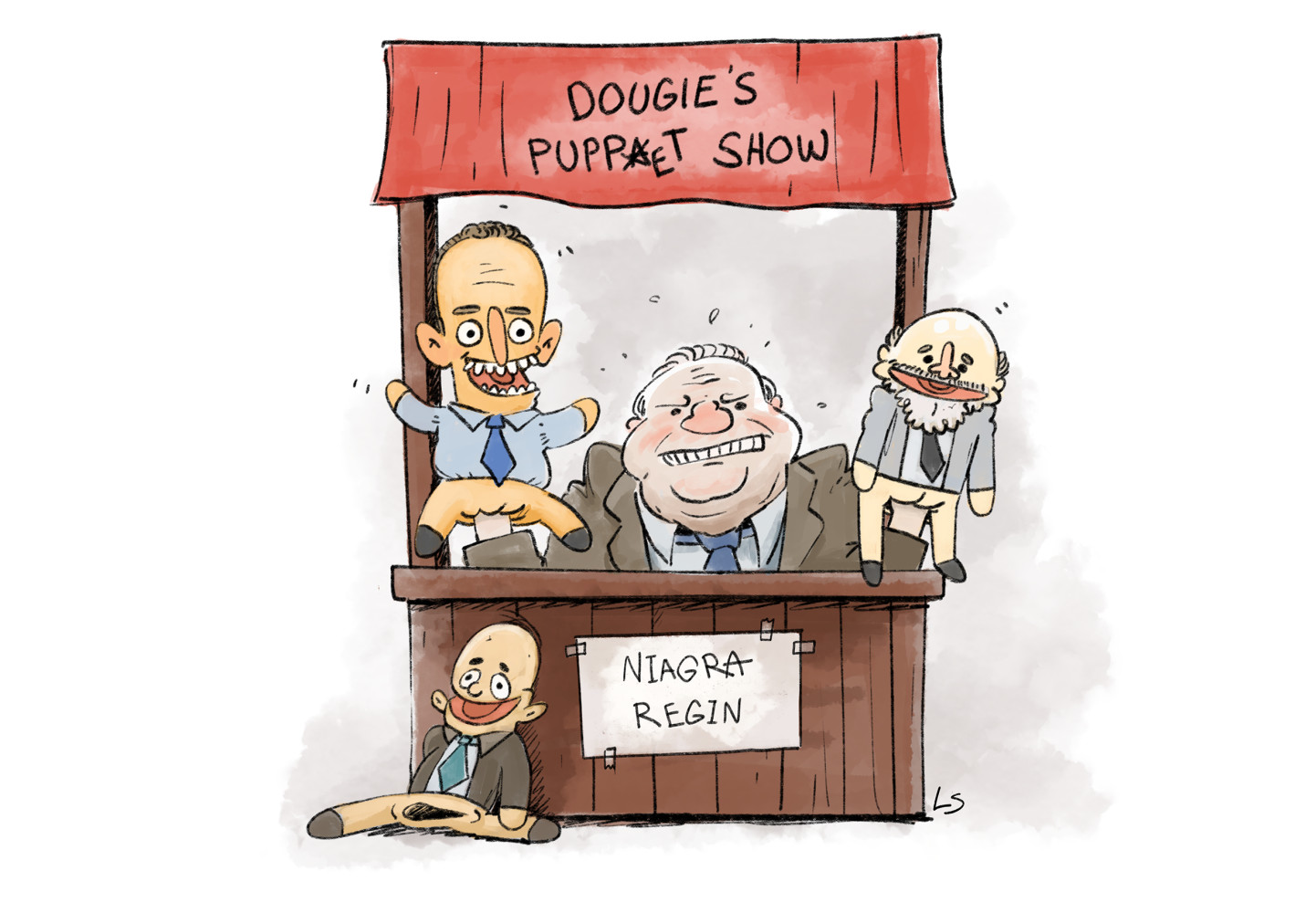
Ford’s push to slash councils, appoint regional chair ‘puppets’ raises questions about governance in Niagara
On April 2, just prior to the Easter long weekend, Municipal Affairs Minister Rob Flack introduced the Better Regional Governance Act, 2026, a piece of legislation that will drastically cut the size of Niagara Regional Council in time for October’s 2026 municipal election. It allows the PCs to continue their recent practice of handpicking regional chairs and inserting themselves into municipal decision-making.
The direct election of regional councillors from Niagara’s largest lower-tier municipalities, which has been in place since 1970, currently sends nineteen members to represent their communities at the upper-tier, alongside each of the 12 mayors and the chair. This will be eliminated, limiting the next council to a directly appointed regional chair and the mayors of the lower-tier municipalities. The move will reduce Niagara Regional Council from the current 32 members to 13.
Under the proposed legislation, the appointed Regional Chair will be given “strong chair powers”, akin to the strong mayor powers the Province has handed to almost half of Ontario’s heads of council since November 2022.
Despite the power to wield unilateral authority, the Queen’s Park appointee will not be democratically elected, raising questions about who the chair, with sweeping power over the electorate, will actually be representing.
Minister Flack was questioned at the April 2 press conference inside Queen’s Park on the direct appointment of regional chairs being anti-democratic and the possibility that the result of the legislative changes would be eight PC party members installed to do the bidding of the Ford government.
“The chairs don't do the bidding. The council does the work. They (the Regional council members) are still elected officials, representing each of the municipalities on the regional government council. Full stop. We’re not handpicking, we are going to carefully look at resumes to see who has the skill sets,” Flack said.
That’s not how many councillors across Niagara saw the recent appointment of Bob Gale as the regional chair in December, following the passing of former chair Jim Bradley last year.
Gale, before his quick resignation after it was revealed he possessed a signed copy of Adolf Hitler’s Mein Kampf, had immediately pushed for amalgamation once handed the job he only held for 84 days, exactly what Ford has for years publicly said is his own desire.
The press gallery challenged the Minister on the efficacy of prior appointments. One reporter asked: “You hand-picked Bob Gale and that didn’t seem to work particularly well. How will you vet chairs to avoid another Hitler debacle?”
Flack did not specifically address the circumstances surrounding Gale and his resignation. He indicated that any future appointees would be fully vetted by the provincial integrity commissioner. The Minister also contended that direct appointments in York and Peel had “worked” and that he was not thinking of replacing the current Chairs of Peel and York, who he described as “hand-picked”.
“The government appointed a chair who had to resign after two months, after throwing the Region into chaos with plans for a four-city model forced amalgamation that was pushed by conservative mayors and Doug Ford. That's what happens when you tramp on a democracy and you start making plum appointments to people that are connected to serving a (political) party to run the Region,” Niagara Centre NDP MPP Jeff Burch said at Queen’s Park.
Minister Flack made no mention at the press conference about Gale’s replacement. A letter from the Minister to the acting regional chair, for the month of March, Rob Foster indicated Flack intends to appoint a new chair to serve for the remainder of the current term of council and details would be shared “in the coming weeks”.
The provincially appointed heads of regional council after the 2026 election will have more authority at their disposal, as the government announced regional chairs will receive “strong chair” powers, which would mirror the “strong mayor” powers that have been afforded to the heads of 215 of Ontario’s 444 municipalities.
The powers include the authority to appoint the municipality’s chief administrative officer and certain division heads, the ability to re-organize the structure of the municipality, veto power over certain bylaws, subject to a two-thirds of council override, and the unilateral authority to bring forward matters of provincial priority connected to housing and related infrastructure.
Previously, heads of council had to rely on the support of the majority of their council peers to advance any priorities.
Much criticism was levelled at Gale during his brief tenure for taking unilateral actions that he arguably did not have the legislative authority to do.
Now, the provincial government is justifying additional powers for the chairs as necessary to create “more efficient, streamlined local decision-making, enabling them to deliver faster results for residents and support efforts to advance shared provincial-municipal priorities.”
For Green Party Leader Mike Schreiner, the extension of the powers to chairs, who are not accountable to the electorate, is another anti-democratic attack on local decision making by the Ford government that will not have the intended impact.
“They already tried this with strong mayor powers and just look at how that worked out: housing starts are still at historic lows and housing prices remain at historic highs. Doug Ford is going to use these powers to force urban boundary expansions onto municipalities so that wealthy, well-connected insiders can cash in billions while everyday Ontarians pay the price,” Schreiner said in a press release.
The reaction to the Minister’s announcement was better received amongst Niagara’s politicians. Not surprisingly mayors Jim Diodati (Niagara Falls), Frank Campion (Welland) and Sandra Easton (Lincoln), who have been supportive of governance changes in Niagara including the possibility of amalgamations, were quoted in the Province’s news release with positive comments.
While St. Catharines Mayor Mat Siscoe was not included in the news release, he was name checked at the related press conference as a Head of Council who has used his strong mayor powers to prioritize housing development, though his use of the powers has not been without criticism.
The mayors of Niagara’s remaining municipalities, save for Fort Erie, sent out a joint news release after the announcement, welcoming the proposed legislation. The group also reiterated their requests to remove two councillors on their respective councils ahead of October’s election.
Standing on his own was Fort Erie Mayor Wayne Redekop. He has arguably been the lead politician at regional council in addressing the unilateral actions taken by Gale and authored motions that have called for a governance review in Niagara to be based on data, a business case with financial analysis and public consultation.
Redekop was critical of the provisions of the legislation that allow for unelected chairs “dependent on the Premier for their positions” to have veto powers over duly elected council members, he detailed in a statement.
He also argued that a lack of public consultation on fundamental democratic changes should be “challenged”.
“I hope the Premier will reconsider prior to finalizing the legislation and ensure it is properly evaluated based on evidence, financial analysis or business case justification, and local input that includes public consultation,” Redekop said.
Flack’s announcement at least provides clarity on the future of governance in Niagara going into the fall municipal election.
The decision follows two tumultuous months in Niagara that saw Gale, pursue a series of controversial unilateral moves, including the possibility of forced municipal amalgamations, only to resign after it was revealed that he had purchased a signed copy of Hitler’s infamous hate-filled screed.
According to a PC news release, the proposed legislative changes for regional governments “would help local leaders speed up decision making, reduce costs and expedite housing and infrastructure.” Minister Flack said, “now more than ever” all government officials need to be “laser focused” on matters of importance, such as investing in infrastructure, supporting economic growth, creating new jobs and building homes.
The housing supply shortage has been used by Ford and his PCs since his election in 2018 as the justification for controversial legislation. His determination to open up the Greenbelt for residential construction, at the behest of powerful developers, is currently under investigation by the RCMP. Municipal leaders across the province have expressed frustration over Ford’s developer-driven economic focus, which has sidelined the traditional role of local councils and residents in the shaping of their communities.
Instead of the chosen approach of the last two federal governments, which have incentivized municipalities that approve density aligned with affordable housing strategies in small, medium and large communities, Ford has forced through a series of legislation that favours developer control over the type of housing stock that is created. This has led to a mismatch between the market and what is being built, with many small highrise units squeezing families out of projects, while large single-family houses are either unaffordable or not what younger buyers are looking for.
Ford’s housing legislation has perplexed many municipalities that could be forced to cover the costs for growth-related infrastructure, which has traditionally been paid for by developers (most of these costs are passed onto the buyer).
Even the conservative Fraser Institute has questioned the PC strategy, reporting the slow rate of housing starts under Ford’s leadership: “In 2024…Ontario fell 30,092 homes short of the government’s target of 125,000,” while the gap will grow even wider as starts will “fall again in 2026 to 64,800 while the target this year rises to 175,000 new homes. In other words, the number of new homes is expected to fall again this year while the annual target reaches a new high.”
Canada Mortgage and Housing Corporation data show how Ontario’s failing record under Ford is pulling the entire country down. New housing starts in the province have fallen each year since 2021, from 99,566 to 65,376 in 2025. Meanwhile, the unrealistic targets put forward by developers and adopted by the PCs, keep going up.
Facing questions from reporters inside Queen’s Park on April 2, Flack was asked how the changes under the legislation could truly impact housing starts when the government had previously stripped Planning Act power from the regional level of municipal government, while the building permit process under the purview of lower-tier municipalities is made more dysfunctional by Ford’s rapid takeover of planning decisions.
Flack evaded the question.
He later conceded that “accelerated” housing starts in the future were more likely to happen due to the temporary elimination of the provincial portion of the Harmonized Sales Tax (HST) and reductions in municipal development charges, rather than the effects of “this initiative”, a reference to the Better Regional Governance Act.
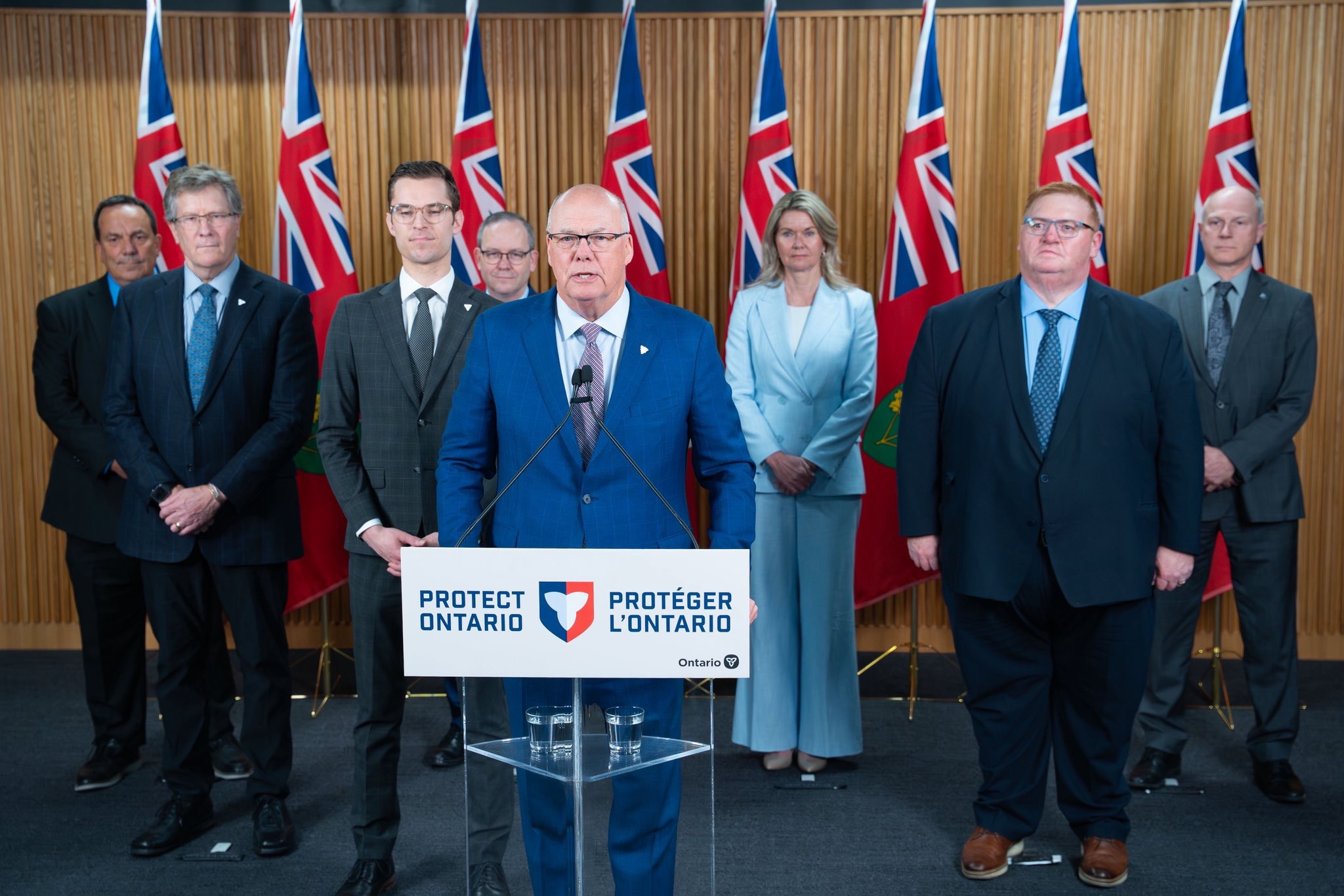
While answering questions from reporters on April 2, Minister of Municipal Affairs & Housing, Rob Flack evaded criticisms that the PCs would be hand-picking party loyalists to serve as appointed regional chairs.
(Government of Ontario)
The proposed legislation takes aim at the number of politicians in Niagara (and Simcoe County), which Flack described as “inflated”. It’s a narrative that comes directly from Premier Ford. In 2019, while being interviewed at an event in Burlington, Ford described the number of municipal politicians in Niagara as “ridiculous”, a comment the Premier has reiterated since, most recently during a visit to Niagara for an unrelated announcement in February.
As written, the legislation eliminates all directly elected regional councillors in Niagara and county councillors in Simcoe County. After October’s municipal election, the two councils will be populated solely by the mayors from the lower-tier municipalities in the area and the chair appointed by the Minister.
The government’s news release compared Niagara’s 126 politicians to Toronto City Council’s 26 members and the 124 MPPs at Queen’s Park, questioning how such a relatively small population needs so many elected representatives (Niagara Region’s population as of early 2026 was approximately 535,000; Toronto’s was an estimated 3,350,000; and Ontario’s was 16,000,000).
The release argued that the disproportionate number of Niagara Region’s elected officials “increase the cost of government for local taxpayers and create dysfunction at council.”
The Minister, during his remarks admitted, however, that the changes were “not about saving money”.
“It will save some money. It is about efficiency, it’s about decision making and having effective government,” Flack claimed. Based on the 2025 Statement of Councillor Remuneration, the elimination of 19 Niagara regional councillors would equal a little over $1 million in wages and benefits, less than a quarter percent of the Region’s 2026 budget. Niagara’s 126 politicians are mostly part-time and are more comparable to 30 to 35 full-time politicians.
Only Niagara Region and Simcoe County are being subjected to the removal of their directly elected representatives at the upper-tier council level. No councillors are being removed from the other municipalities covered by the legislation (Durham, Peel, York, Halton, Waterloo and Muskoka). While Niagara Regional Council will be reduced from 32 members to 13, Simcoe County will be reduced to 17 members from 32. The comparably sized Durham Region Council remains untouched at 29 members.
The notion of a mayors-only Regional Council was floated in a March 4 letter by Gale, before he resigned over the book controversy. Niagara Regional Councillor Laura Ip, who had previously declared she would not be seeking re-election in 2026, took to her blog at the time questioning the efficiency of such a proposal:
“Who’s going to do all the work?” Ip pointed out the various committees, agencies and boards that Regional Councillors sit on. “There’s no possible way that people who are also mayors, many of whom also have small businesses, can find the time to take on this much more work.”
With the cuts to Regional Council, the number of Niagara politicians will fall to 107.
Further efforts by Niagara lower-tier municipalities to pare their own numbers were not accommodated in the Minister’s legislation.
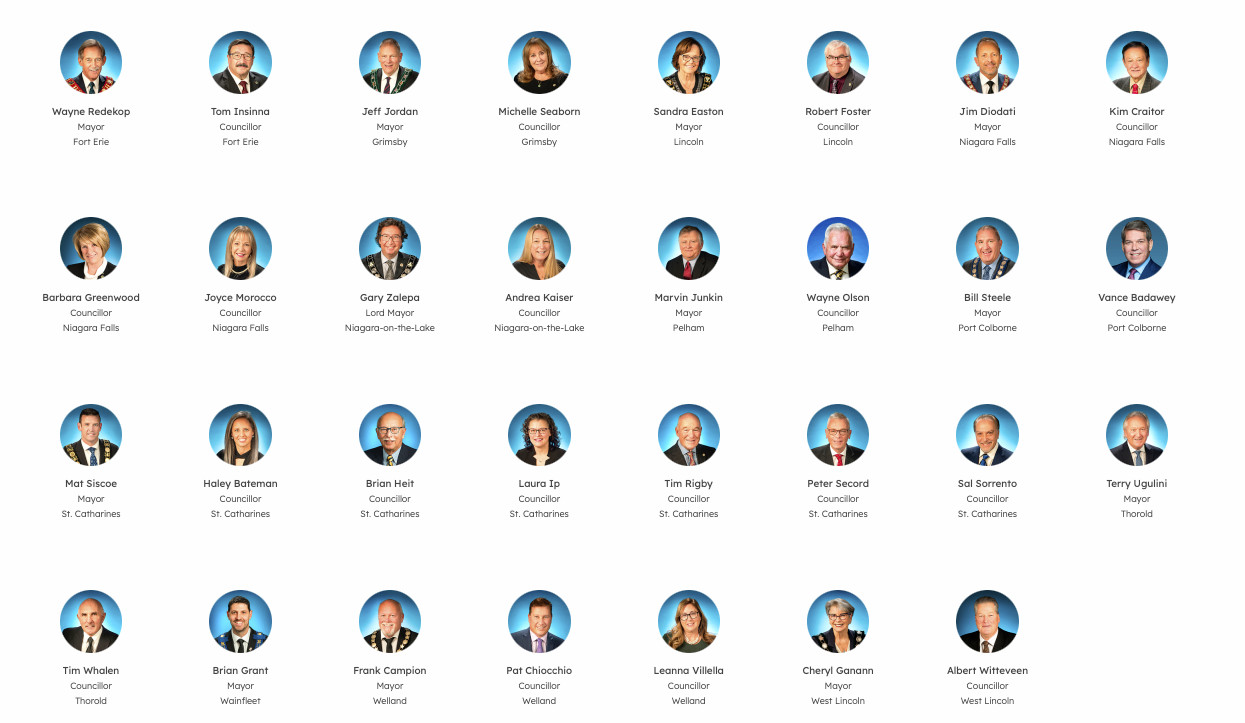
The proposed legislative changes by the PC government would cut the size of Niagara Region Council from its current 32 members, to 13—12 mayors and the regional chair.
(Niagara Region)
In the two weeks preceding Minister Flack’s announcement, Grimsby, Thorold, Port Colborne and Niagara-on-the-Lake councils all considered similarly worded motions to reduce their respective councils by two members, from a mayor and eight councillors, to a mayor and six councillors. The rationale for the reductions, as noted in the related news release from NOTL, was to “demonstrate that Niagara's communities are ready to lead reform without waiting for direction from above.”
The discussion at the respective council meetings were a little more pointed, indicating that it would be wise for the councils to make any cuts before the Province imposed council reductions on them.
Lower-tier municipal councils have the authority to change their council composition, however, because the proposed changes were approved in a municipal election year, they would not be applicable until the 2030 municipal election. As a result, each of the four councils formally requested the Province provide the legislative authority needed to make the reductions take effect for the 2026 municipal election, with a deadline of May 1st, 2026, when municipal candidates can file for office.
The Better Regional Governance Act does not address any of these requested changes.
Minister Flack did acknowledge receiving the letter from the Niagara municipalities the day before the April 2 news conference at Queen’s Park but he and Niagara West MPP Sam Oosterhoff, who also attended the news conference, appeared unclear on which municipalities the letter pertained to. They erroneously stated it may have been Welland and Pelham, in addition to Grimsby and Niagara-on-the-Lake, who were requesting the council reductions.
When asked if the request would be accommodated for the 2026 election, Flack was non-committal.
“No promises but we’re going to consider it,” he said.
In addition to the reduced council sizes, Niagara Region Council will likely see a form of weighted voting after the 2026 election (weighted voting is already in force in Simcoe County).
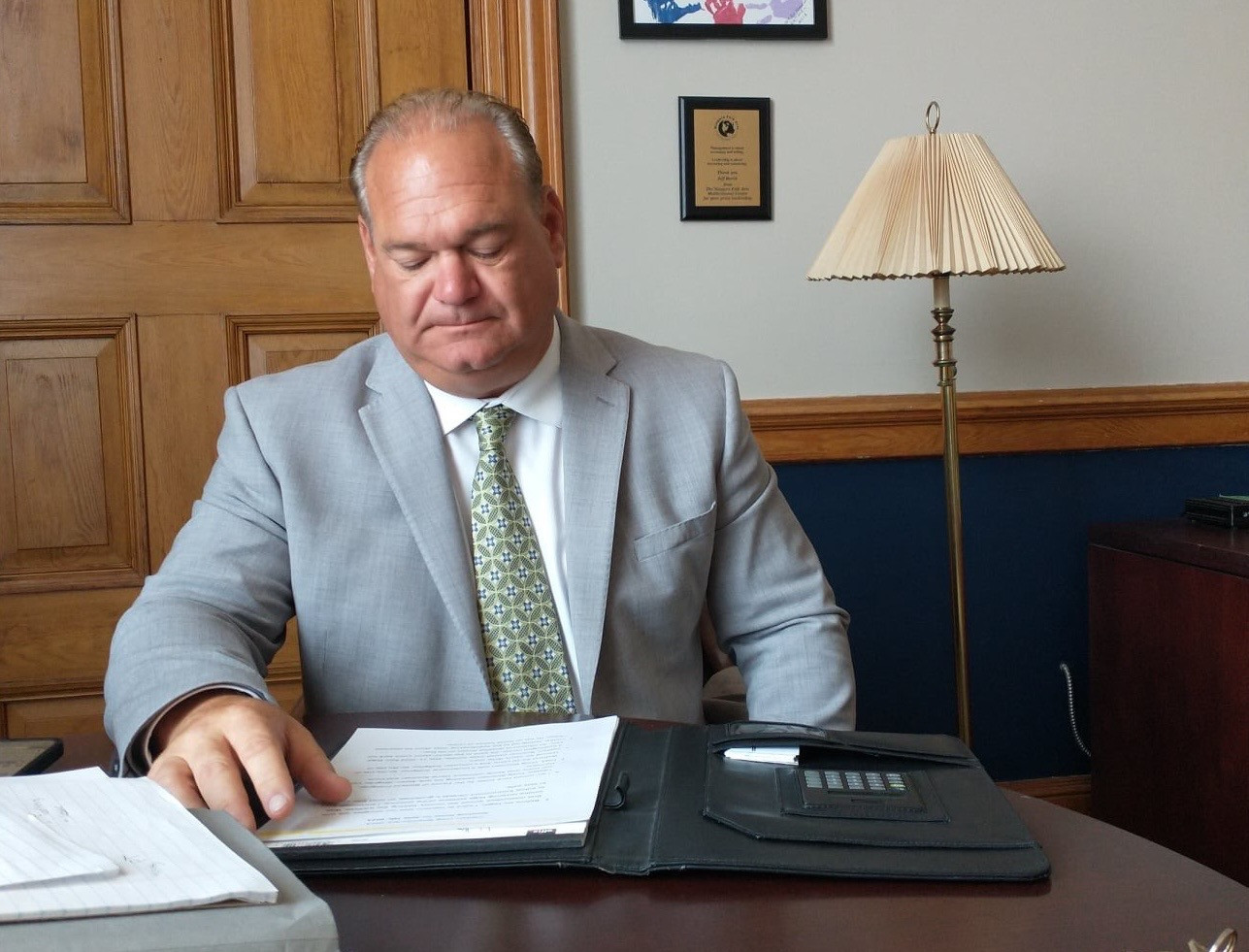
Niagara Centre MPP Jeff Burch said any changes to Niagara Region governance should be made at the local level, not unilaterally imposed by the Province.
(Jeff Burch/X)
The Province’s news release indicates the government would work with local municipal leadership in Niagara in developing the weighted voting framework, potentially based on population size, “to facilitate the transition to the new council structure and ensure appropriate and effective representation.”
The idea of a Niagara Regional Council populated solely by mayors with a system of weighted voting in place also appeared in Gale’s March 4 letter to the PCs.
Minister Flack was less specific regarding weighted voting in Niagara. He indicated that it would “be considered”.
Burch, the NDP’s Municipal Affairs & Housing critic, took to his social media, criticizing the proposed changes:
“Changes to the composition of regional government should be decided as part of the regional governance review through a public and evidence-based process. Having only mayors sitting on Regional Council with weighted voting is an untested idea that should be one of many options considered…Changes of this magnitude that have not been fully thought out or explained should never be decided on the fly a few months before an election.”
Email: [email protected]
At a time when vital public information is needed by everyone, The Pointer has taken down our paywall on all stories to ensure every resident of Brampton, Mississauga and Niagara has access to the facts. For those who are able, we encourage you to consider a subscription. This will help us report on important public interest issues the community needs to know about now more than ever. You can register for a 30-day free trial HERE. Thereafter, The Pointer will charge $10 a month and you can cancel any time right on the website. Thank you
Submit a correction about this story

