
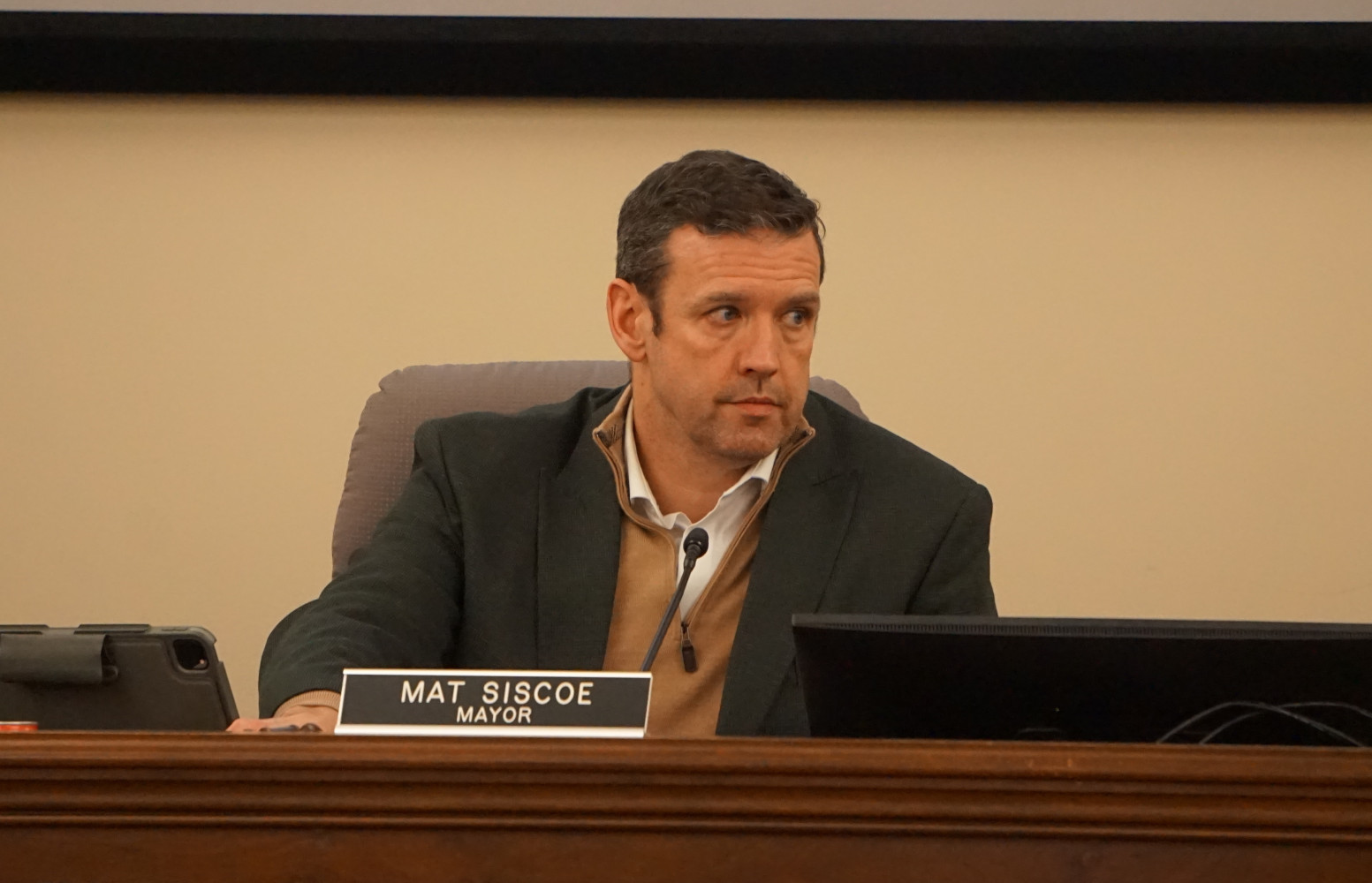
Provincial analysis casts further doubt on Mat Siscoe’s use of strong mayor powers
An analysis from the Queen’s Park Legislative Research branch is shedding more light on how the PC government’s strong mayor powers are meant to be used, and is raising concerns about how St. Catharines Mayor Mat Siscoe has been implementing them to push through projects, including at least one single-sourced contract.
The research opinion, prepared by Ontario’s Legislative Research and Information Service for Niagara Centre MPP Jeff Burch, was requested following reporting by The Pointer that detailed how Siscoe used strong mayor powers to circumvent the City’s standard procurement process to initiate a single-source contract for a planning study on Ontario Street. Siscoe also used them to move forward a number of projects that do not appear to qualify as “provincial priorities”—the key stipulation in the PC legislation for when mayors are allowed to use the strong mayor powers to circumvent democratic procedures.
The Pointer’s reporting revealed that the mayor inserted himself directly into the procurement of a contract tied to secondary planning work for the lands around the former General Motors site on Ontario Street, directing a non-competitive, single-source agreement for up to $250,000 be issued.
Single sourcing is the procurement of goods or services from a pre-selected supplier without a competitive bidding process. Its use is tightly controlled, permitted only in limited circumstances, and is not intended to involve political influence.
The City’s procurement policy requires that all purchases be handled through its procurement division, with strict justification for any single-source contract, and council approval for amounts exceeding $150,000. None of these requirements were followed in awarding the contract, which was lumped into Mayor Siscoe’s 2026 budget and received little attention from other councillors who most likely missed its presence buried in the lengthy budget document.
MPP Burch told The Pointer he requested guidance from Ontario’s Legislative Research and Information Service, a non-partisan office that conducts legal and policy research for members of the Legislature, after receiving questions and complaints from constituents. The analysis was sought to determine whether such a use of strong mayor powers is permitted under Ontario law.
The response provided outlined how, theoretically, such an action may be possible, but only if specific procedures set out in legislation are followed.
At the centre of the analysis is the mayor’s veto authority, which allows heads of council in designated municipalities to override certain bylaws if they believe it interferes with provincial priorities, including housing development and supporting infrastructure.
The legislative analysis confirms municipal procurement policies can be vetoed using strong mayor powers, as there was no exemption created in the legislation.
In theory, that means a mayor could override a procurement policy and enable a single-source contract—but the analysis concludes this power is not absolute, and when making such a decision, certain conditions must be met.
It states that the use of veto power depends on “proper procedures” being followed, including providing notice to council of the intention to veto, and requires the mayor to determine that the bylaw in question could interfere with a prescribed provincial priority.
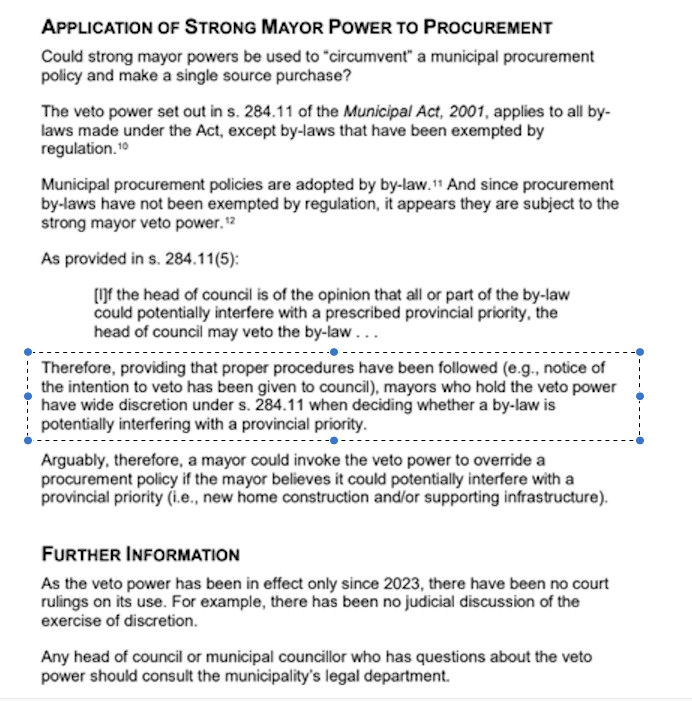
An analysis completed by Ontario’s Legislative Research and Information Service concludes that only when proper procedures are followed, can a mayor invoke strong mayor powers to override existing municipal procedures and bylaws.
(Ontario Legislative Research and Information Service)
There is no public record of Mayor Siscoe providing his intention to veto the procurement policy to push forward the single source contract—which appears to place him in contravention of the strong mayor rules.
A review of the minutes and agenda of the mayor’s budget meeting, as well as a review of the recording of the meeting, show that Council was not given notice of any intention to veto a procurement by-law, and no explanation was publicly provided linking the decision to a provincial priority.
The legislative memo makes clear that while mayors have “wide discretion” in determining whether a bylaw interferes with a provincial priority, that discretion only applies once the proper process has been followed.
The provincial interpretation is amplified by an earlier legal opinion from prominent municipal lawyer John Mascarin.
Mascarin’s firm, Aird & Berlis LLP, was retained to review the use of strong mayor powers in the Township of Killaloe, a small municipality west of Ottawa, after councillors raised concerns about their mayor’s actions and requested an independent legal assessment.
In that opinion, Mascarin concluded the powers are tightly constrained by the legislation that created them and cannot be used to bypass standard municipal governance processes.
Mascarin notes that strong mayor powers “do not, and cannot, circumvent the ordinary decision-making structure of a municipality,” warning that actions taken outside the scope of the legislation would be invalid.
The opinion also makes clear that strong mayor powers are not interchangeable tools that can be broadly applied. Each authority, whether directing staff, proposing bylaws or issuing a veto, is tied to a specific section of the Municipal Act and must be exercised in accordance with the requirements of that section.
In practical terms, that means a mayor cannot simply take an action and characterize it as falling under “strong mayor powers.” The legal authority only applies if the correct mechanisms are used, and if the required procedural steps are followed, and if the use of them falls within their prescribed purpose.
Taken together, this latest provincial analysis and the Mascarin legal opinion point to the same conclusion: while Ontario’s strong mayor framework grants significant authority, it also imposes clear legal limits.
Those limits are not optional.
They include both procedural requirements, such as notice to council, and a defined connection to provincial priorities.
Strong mayor powers were introduced in 2023 as part of the province’s effort to accelerate housing development, giving heads of council in designated municipalities expanded authority to advance provincial goals. The PCs are now considering extending these powers to regional chairs.
But the legislation also built in safeguards intended to ensure those powers are used transparently and within a structured decision-making process.
In St. Catharines, those safeguards were not observed. The situation raises a fundamental question: if the required procedures were not followed, was the power used in a manner consistent with the law at all?
That question has not been publicly addressed by members of council. Under the legislation, council holds one of the only formal checks on a mayor’s use of strong power, the ability to override it with a two-thirds majority vote.
With strong mayor powers still largely untested in the courts, adherence to the procedures set out in the legislation remains one of the only safeguards ensuring they are used properly. The provincial memo now provides a clearer understanding of what those procedures are.
Email: [email protected]
At a time when vital public information is needed by everyone, The Pointer has taken down our paywall on all stories to ensure every resident of Brampton, Mississauga and Niagara has access to the facts. For those who are able, we encourage you to consider a subscription. This will help us report on important public interest issues the community needs to know about now more than ever. You can register for a 30-day free trial HERE. Thereafter, The Pointer will charge $10 a month and you can cancel any time right on the website. Thank you
Submit a correction about this story

