
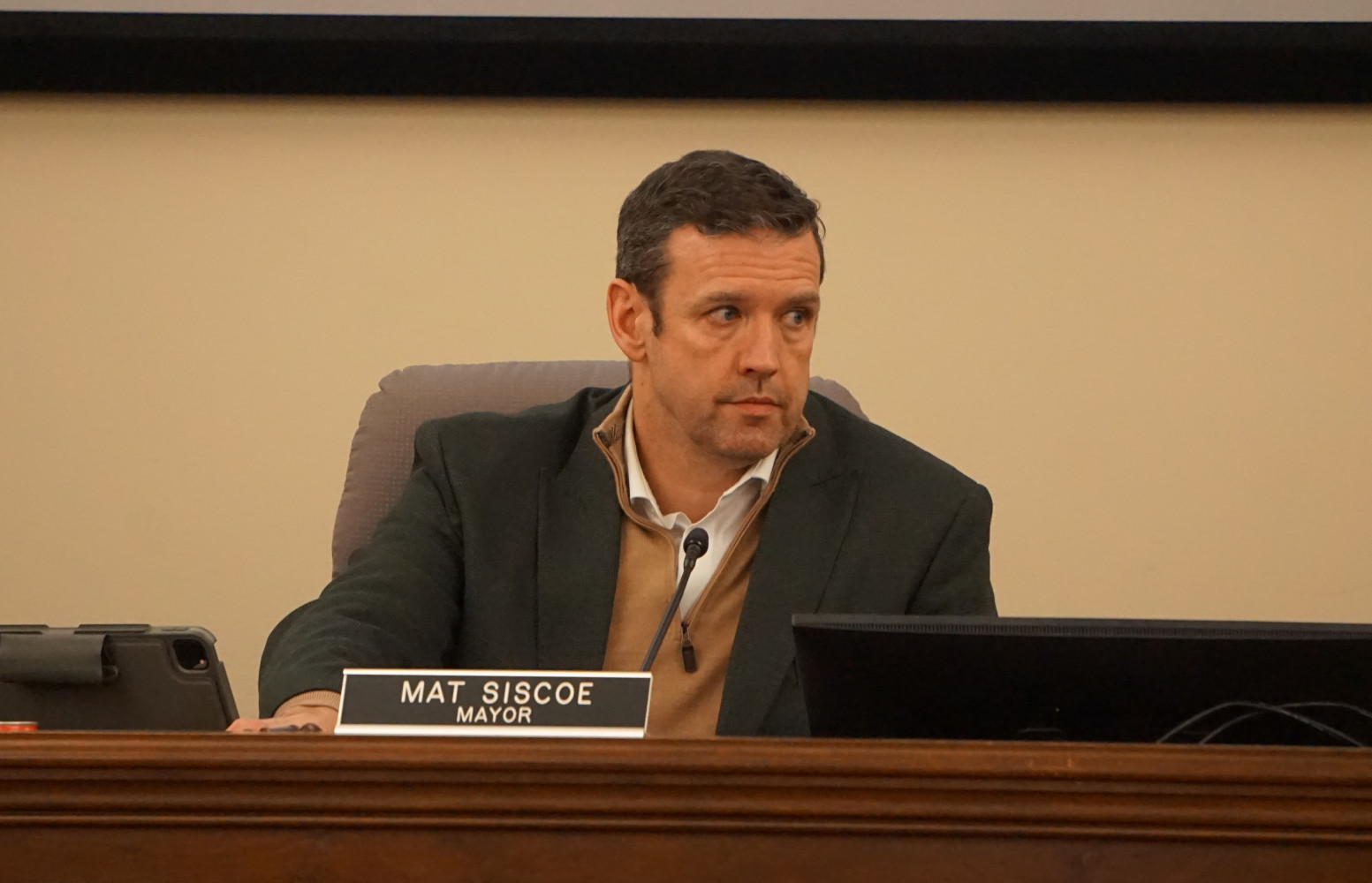
St. Catharines Mayor Mat Siscoe’s single-sourced contract for Ontario Street study appears to violate rules
On November 6, St. Catharines Mayor Mat Siscoe used powers granted under provincial strong mayor legislation, when he directed City staff to carry out a planning exercise.
He instructed them to bypass the City’s standard procurement safeguards and proceed with a single-source contract with an upside value of $250,000. There was no bidding process and the contract was handed to a preferred vendor.
It’s just one of several actions Mayor Siscoe has carried out under the guise of strong mayor powers that have raised concerns.
When strong mayor powers were introduced, Premier Doug Ford and the PC government claimed that by handing over such power to override certain council decision-making at the local level, getting motions approved with only a third of council’s support, it would accelerate housing development, streamline approvals and remove bureaucratic barriers. First implemented in November 2022 in Toronto and Ottawa, the powers came into effect in St. Catharines in July 2023.
The legislation is deliberately narrow: mayors may issue formal directives to staff, but only to advance “provincial priorities”, primarily housing, and without overriding council or administrative authority.
Siscoe’s mayoral direction (2025-29) on November 6 , directed the City’s Chief Administrative Officer to:
“Commence a single source procurement process to retain a land use planning consultant and any necessary sub-consultants… to a maximum upset limit of $250,000.”
The City has since announced that NPG Planning Solutions of Niagara Falls was awarded the contract to “reinitiate the Ontario Street Corridor Secondary Plan policy exercise”. The planning for the area initially began in 2022 but was paused indefinitely in April 2024 when the owners of the former GM site announced they were not prepared to undertake the required studies for financial reasons.
After the owners withdrew from the process, Director of Planning and Building Services Tami Kitay advised council that the work would be halted, stating:
“Before meaningful work on visioning and the creation of alternatives can proceed, the background studies must first be completed to identify development constraints within the study area.”
Those background studies have not yet been initiated and the owners have not announced their intentions to undertake them. This raises questions about Siscoe’s decision to restart the municipal planning process and the rationale for proceeding on an expedited basis through a single-source contract.
Because the mayor directed a single-source process, residents have no way of knowing if the best consultant was chosen for the job. This is not the first study to be conducted of the area, which includes the contaminated GM site. It’s unclear why other consultants who have experience in the area were not considered for the contract, or why an open process was not carried out to invite them to bid.
Single sourcing is a decision to procure goods or services from one specific supplier, without the normal competitive process. While the City’s procurement policy allows single-source contracts, it is only permissible under highly restrictive exemptions, including:
- only one supplier is capable of delivering the service,
- no bids were received in response to a bid solicitation,
- specialized expertise is unavailable elsewhere, or
- urgent or unforeseen circumstances arise.
The responsibility for determining if these conditions are met lies with staff, not the mayor. The City’s Procurement Division, operating within its financial management framework, is solely responsible for overseeing the acquisition of goods and services across all departments. Elected officials are not to have a role in this process.

Following a motion from Mayor Mat Siscoe using strong mayor powers, a consultant has been chosen to initiate a secondary plan study for the Ontario Street corridor. The inclusion of the sprawling former GM property in the study, and its significance remains unclear.
(Joel Wittnebel/The Pointer files)
For comparison, a single-source procurement valued at $162,474.02 was completed on December 8, 2025. The contract was to procure an upgrade to the fire department’s automated dispatch system. Staff prepared a detailed three-page report for council explaining the project requirements and the rationale for recommending a single-source approach. The report included the following:
“Under Part VI 18(e) of the Procurement By-law No. 2023-178, a sole or single source contract where the total cost exceeds $150,000 requires Council approval to proceed with an award, and there is an absence of competition for technical reasons, and the Goods and/or Services can only be supplied by a particular vendor.”
The report was placed on the consent agenda for council approval, with the option for discussion if requested, and was approved unanimously.
No comparable report was prepared for council regarding the Ontario Street Secondary Plan. Questions submitted to Mayor Siscoe on the matter remained unanswered at the time of publication.
According to a spokesperson for the City of St. Catharines, Mayor Siscoe did not break any rules.
“The City’s procurement policy permits single-source contracts and was followed. The project was identified as such in the mayor’s budget report and presentation for the 2026 budget and was supported by Council.”
A review of the council meeting at which the single-sourcing issue appeared on the agenda shows it was raised during the special meeting held on November 5, 2025, for the presentation of the mayor’s budget. At this meeting, the mayor presents the budget, but council does not vote to approve it. Under strong mayor powers, councillors are allowed to introduce amendments to make changes, but after this process, there is no vote, the mayor’s budget is simply approved. Although council was permitted to ask questions during the meeting, no effort was made, by either staff or the mayor, to draw attention to the highly unusual use of strong mayor powers to direct a single-source procurement.
The $250,000 allocation was added to the budget directly by the mayor under his strong mayor powers, meaning council had no authority to approve or reject it and merely voted to “receive” his presentation. There was no discussion of the highly unusual single-source procurement, nor was council’s attention drawn to it, raising questions about the City’s claim that the decision was “supported by Council.”
Questions about the legal use of strong mayor powers have also been examined closely in other Ontario municipalities. In the Township of Killaloe, Hagarty and Richards (KHR), councillors grew concerned about a series of directives issued by their mayor and commissioned an independent legal opinion from Aird Berlis.
The KHR report was authored by John Mascarin, a specialist certified by the Law Society of Ontario in Municipal Law and an adjunct professor at Osgoode Hall Law School. Coincidentally, Mascarin was the Integrity Commissioner for St. Catharines until February 2023 when under the leadership of the new mayor, Mat Siscoe, council replaced him with Michael Maynard.
Mascarin makes it clear in his report that strong mayor powers are very narrow in scope. Directives must advance provincial priorities, primarily housing, and cannot override the roles of council or staff. He warns that these powers do not give a mayor general control over municipal operations.
“The power of a strong mayor to give direction to municipal staff is quite limited…. it is an ancillary tool to help the strong mayor exercise or implement their other Strong Mayor Powers,” Mascarin explains.
The legislation “does not, and cannot, circumvent the ordinary decision-making structure of a municipality by allowing a strong mayor to issue broad-ranging edicts that municipal employees are bound to implement.”
Applying this framework to Siscoe’s Ontario Street Corridor directive raises fundamental questions about governance. Under the City’s procurement bylaw, it is staff, not elected officials, who are responsible for determining whether a contract should be single-sourced, based on clearly defined criteria. The concern is not simply that the contract was single-sourced, but that the procurement method itself was directed by the mayor, rather than determined independently through the administrative processes designed to ensure fairness, transparency, and accountability.
Asked for an explanation City officials only said that, “Regarding the sole-source contract, the City’s procurement outlines (sic) our policies and procedures and can be read in its entirety at the following link”.
The City’s policy has nothing that allows the mayor to unilaterally direct sole sourcing; it is unclear why staff referred to it.
Al McKay, a longtime St. Catharines resident and former Manager of the Niagara Region branch of the Property Taxpayer Alliance, said the move raises serious fiscal concerns as well as issues around public trust.
“From a taxpayer perspective, the concern is not simply the dollar value, it is the bypassing of competitive procurement safeguards designed to protect public funds.”
McKay says municipal procurement rules exist to ensure transparency, competition and accountability, as they require council approval on high value contracts, to protect taxpayers against high-priced deals and cost over-runs.
“In this case, the procurement policy clearly anticipates that sole-source contracts above $150,000 must go to Council,” he explained. “That safeguard exists precisely because non-competitive contracts carry a higher risk of overpayment or perceived favoritism.”
Directive 2025-29 is not an isolated case. Since receiving strong mayor powers Siscoe has signed 91 directives under that authority, while many of them appear to fall well within the scope of the legislation, there is a marked pattern in the past year of examples that do not appear to fall under the category of “provincial priorities”.
- Kiwanis Field Dome (April. 2025): Staff were instructed to report on the feasibility of installing a year-round dome for recreational purposes.
- Traffic Calming in School Zones (October 2025): Staff were asked to prepare options for speed humps, lane narrowing, and pedestrian crossovers.
- New Hope Church Fire Suppression (November 2025): Staff were directed to report on fire suppression and water service connections for a church property.
All of these directives require staff to undertake work that appears unrelated to provincial priorities and therefore, in theory, should not fall under strong mayor powers. According to the Mascarin legal framework, these powers are intended for a narrow, housing-focused purpose. Their repeated use for routine municipal matters shows a gradual expansion of authority beyond the original intent.
Taken together, these directives reflect a gradual normalization of using strong mayor powers for matters that are beyond the scope of the legislation.
Supporters of strong mayor powers argue that they are necessary to accelerate projects tied to housing, cutting through bureaucratic delays. However, critics emphasize that speed cannot come at the cost of governance safeguards.
As McKay notes, bypassing council oversight and competitive procurement undermines the very accountability the rules are meant to protect.
“These powers are designed to be used sparingly and for housing-related initiatives,” McKay said. “Directing staff on procurement for a $250,000 contract, while bypassing council approval, stretches the authority far beyond its intended purpose.”
Mascarin’s KHR report makes it clear that strong mayor powers do not “vest in a strong mayor the power to exercise general control over municipal operations.” In the KHR opinion, he found that directives issued outside the narrow statutory purpose were not validly issued, as they intruded on the roles of council and staff and were therefore not legally binding. According to Mascarin:
"The power to direct municipal employees…is highly circumscribed; a strong mayor does not ‘step into the shoes’ of their council in their ability to direct staff in respect of any matter."
The report also concluded that the mayor deliberately misused the legislation to bypass council. The town council later approved recommendations from an Integrity Commissioner, resulting in the forfeiture of 180 days’ pay.
Public-sector procurement is grounded in the principle of separation of duties, a system in which responsibilities are deliberately divided to ensure that no single individual controls the entire process. In practice, this means council approves budgets and sets overall policy, staff determine the appropriate procurement method, procurement professionals manage the process, and evaluation committees assess submissions independently. This structure is intentional, designed to safeguard fairness, ensure transparency, and protect public funds from undue influence or misuse.
Strong mayor powers are clearly and narrowly defined.
In St. Catharines they are being used beyond the safeguards designed to protect taxpayers and local democratic decision making.
Email: [email protected]
At a time when vital public information is needed by everyone, The Pointer has taken down our paywall on all stories to ensure every resident of Brampton, Mississauga and Niagara has access to the facts. For those who are able, we encourage you to consider a subscription. This will help us report on important public interest issues the community needs to know about now more than ever. You can register for a 30-day free trial HERE. Thereafter, The Pointer will charge $10 a month and you can cancel any time right on the website. Thank you
Submit a correction about this story

