
Four candidates, four visions: How Mississauga’s mayoral hopefuls would tackle affordability, housing, crime and transit
With the increased powers mayors across Ontario hold, the decision to elect a new one carries immense weight for each of Mississauga’s 800,000-plus residents.
Mississauga’s next mayor will inherit a city at a crossroads, where the cost of living is climbing, housing remains out of reach for the vast majority and growing congestion is testing the limits of local infrastructure.
Unique, complex dynamics have also forced crime to the top of the City Hall agenda.
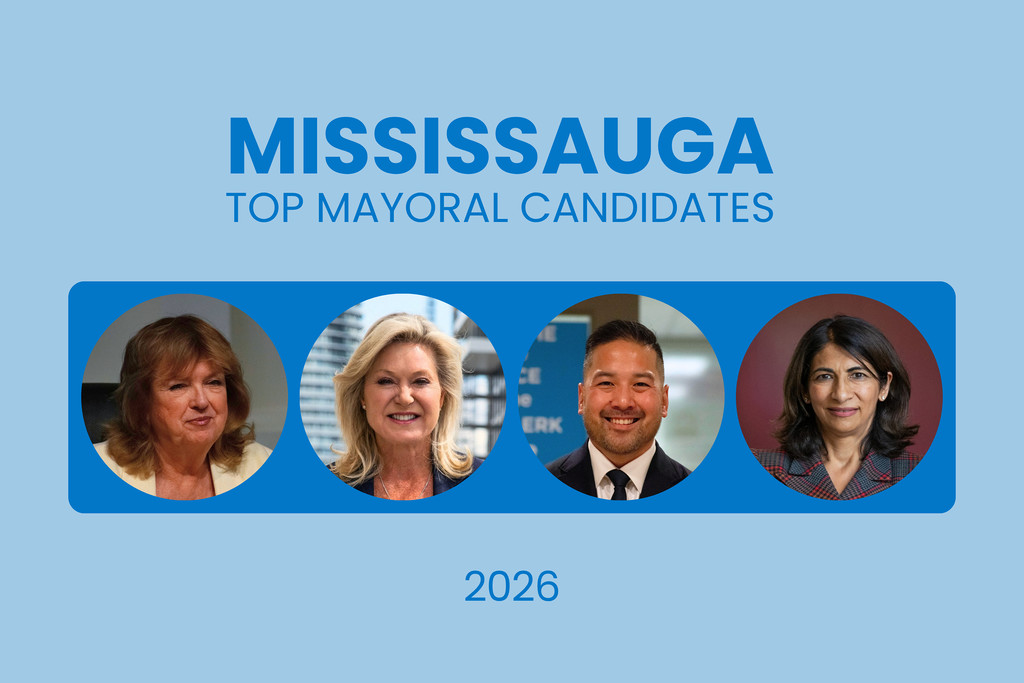
Four front-running candidates, each with varying amounts of political experience, believe they can take on the challenge of leading one of Canada’s largest, fastest-growing cities.
Alvin Tedjo has served Ward 2 as a councillor during the council term now drawing to a close, and was joined by Dipika Damerla who has represented Ward 7. Both ran in the 2024 mayoral by-election against Carolyn Parrish, who was victorious and is now seeking re-election after serving as mayor for two years.
The three current members of council are joined by Bonnie Crombie, who is running again after taking over the leadership of the Ontario Liberals following just over nine years as Mississauga’s mayor.
Tedjo has almost four years of experience representing constituents as an elected official, all at the council level; Damerla has been on council for almost eight years and served as an MPP representing Mississauga for seven years prior to that. Both Parrish and Crombie were Mississauga MPs; they both served as the Ward 5 councillor and both have been mayor.
All four of the front-running candidates (The Pointer is not featuring other mayoral candidates who are far behind in the race according to public polling) are prioritizing affordability, crime and transportation (moving residents across the city and the GTA). In addition, Damerla has also made accountability inside City Hall a main focus of her campaign.
Their proposed solutions to the challenges Mississauga residents face offer voters contrasting visions, from how they would control crippling property taxes and create badly needed affordable housing in the booming city, to how certain types of crime plaguing communities should be confronted while not allowing police spending to break the backs of homeowners, and managing major transit and transportation projects to ease the city’s rapidly worsening congestion.
While all four candidates recognize that affordability, housing, crime and transportation are critical issues—the priorities voters are focused on as they decide who will get their vote on October 26—the candidates are proposing different solutions to confront the most pressing problems.
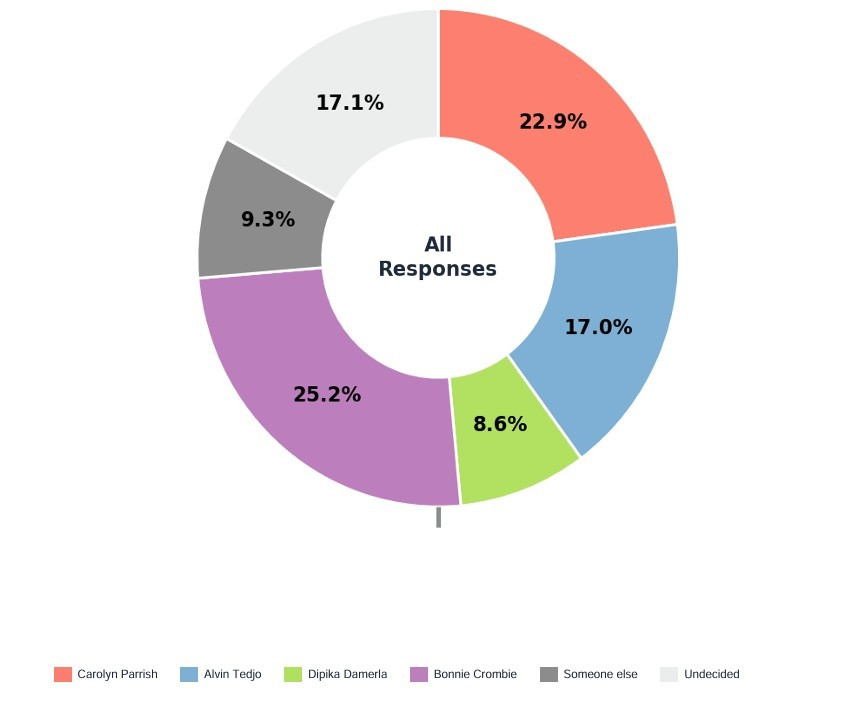

A Mainstreet Research poll, commissioned by Y Media, conducted at the end of September showed Bonnie Crombie was the top choice of voters for Mississauga mayor, but other candidates are only slightly behind her. (Mainstreet Research)
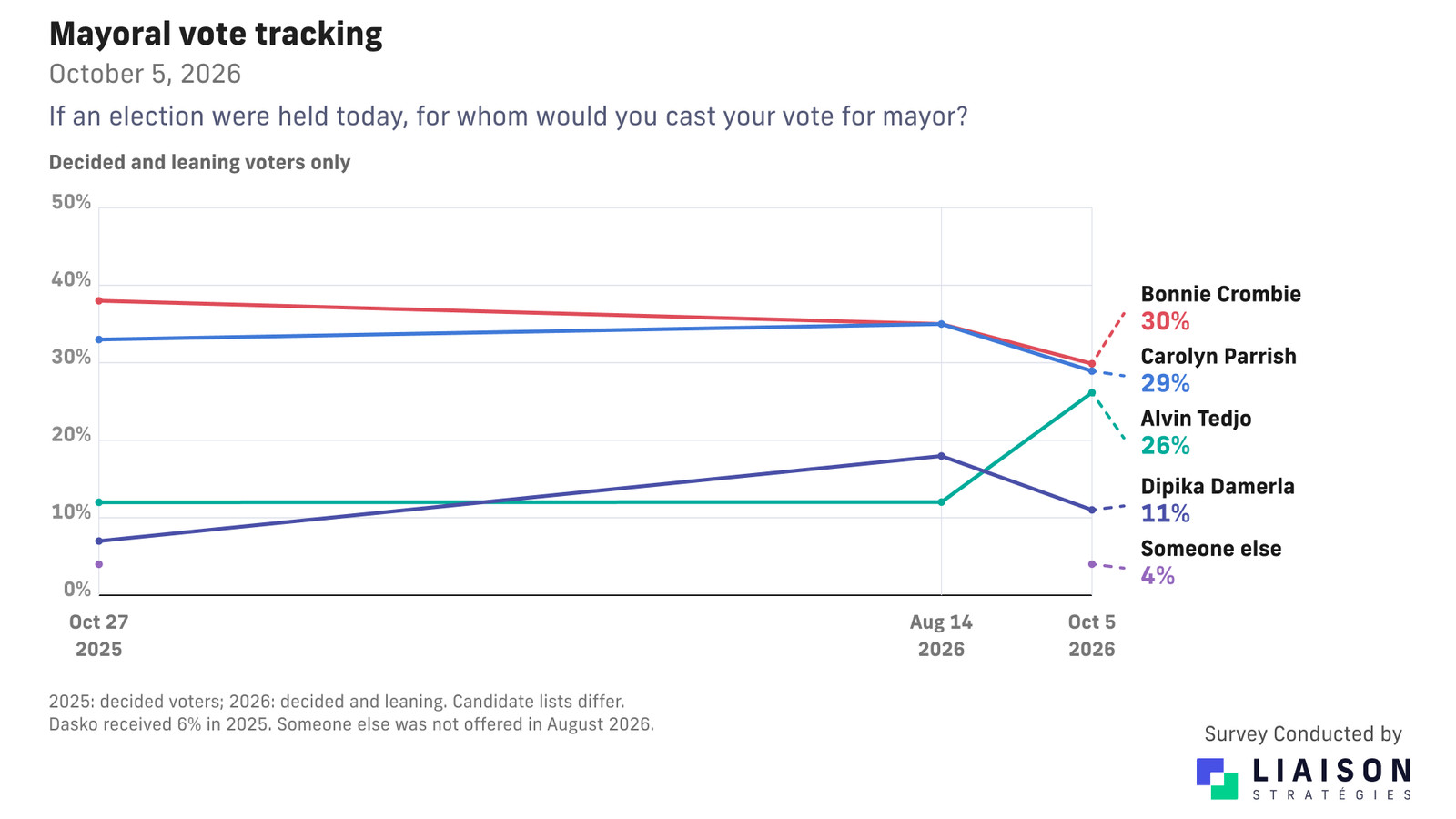
A poll conducted by Liaison Strategies at around the same time also found Bonnie Crombie is leading Carolyn Parrish by a narrow margin with Alvin Tedjo not far behind. (Liaison Strategies)
Property taxes emerged as one of the defining issues in recent debates over the past two weeks, with candidates pitching their promises to freeze taxes for differing periods, limit increases to the inflation rate, or find more creative ways to expand the budget at an affordable rate by finding significant savings through external financial oversight—Damerla has been pushing for this during the council term, but Parrish and Tedjo shot down her motion for an independent Mississauga auditor general role earlier in the year.
Tedjo wants to freeze the City portion of property taxes (Mississauga’s amount gets blended with the Region of Peel property tax increase to establish the total amount) for two years.
“I’m committed to freezing property taxes for every single family in this city for the next two years to make sure that people have the ability to live in their homes with dignity and not have to make the choice between groceries or taxes,” he said during the Food Banks debate.
“This is the single biggest tool that the City of Mississauga has at its disposal. It’s the property tax rate.”
His promised freeze typically ends up badly for taxpayers, who still see large increases from spending that is shifted to the Region, onto utility bills or, in some cases, to a range of user fees. Debt financing or clawing funds from reserve accounts meant for emergencies and critical needs are options to offset tax freezes, but also have dire consequences for taxpayers immediately after budget cuts are made to achieve a freeze.
North of Mississauga, Brampton Mayor Patrick Brown, when campaigning in 2018, championed freezing property taxes. The end result of years of successive tax freezes has seen some of the City’s most critical projects left behind, as projects like the Riverwalk flood mitigation plan, the downtown redevelopment project, a promised stadium Brown vowed to build, a tunnelled LRT into Brampton’s city centre, its first standalone university, a second hospital which requires a City Hall funding contribution, fire facility upgrades, transit infrastructure needs bottlenecking the system, have been shelved, delayed, or continuously underfunded. City Hall’s costs to homeowners, meanwhile, pushed a record amount of properties into tax arrears due to Brown’s failed fiscal planning.
Freezing property taxes typically causes a “pay-for-it-later” crisis, when the price to catch up with delayed costs to run and maintain a city ends up being far greater in the immediate future.
Tedjo is promising to allow eligible senior homeowners to defer property tax payments altogether until they sell their homes, when the amount owing would be recouped.
He stumbled badly when peppered with questions and suggestions that his pitch is nothing more than an election stunt that would never get approved, and he could not explain how the deferral would work or how a range of practical problems with his idea would be addressed.
Residents and candidates quickly called him out, with many seniors who rely solely on CPP and old age security questioning how they would eventually be able to pay for costs that would catch up to them, when they are on a fixed income.
“The problem, Alvin, is that your plan still has no details,” Damerla said during one of the debates, questioning how the proposed program would work, who would qualify, how it would be managed and how City Hall would pay for millions of dollars of services and infrastructure without the lost tax revenue, pointing out other homeowners would end up subsidizing his election gimmick. The comment received thunderous applause from senior residents in attendance at the debate who had similar concerns.
While Tedjo did not provide further clarity during the debate, his campaign website states eligibility for a tax freeze would be tied to residents who are 65 or older, own only one property and have lived in the residence for at least 20 years.
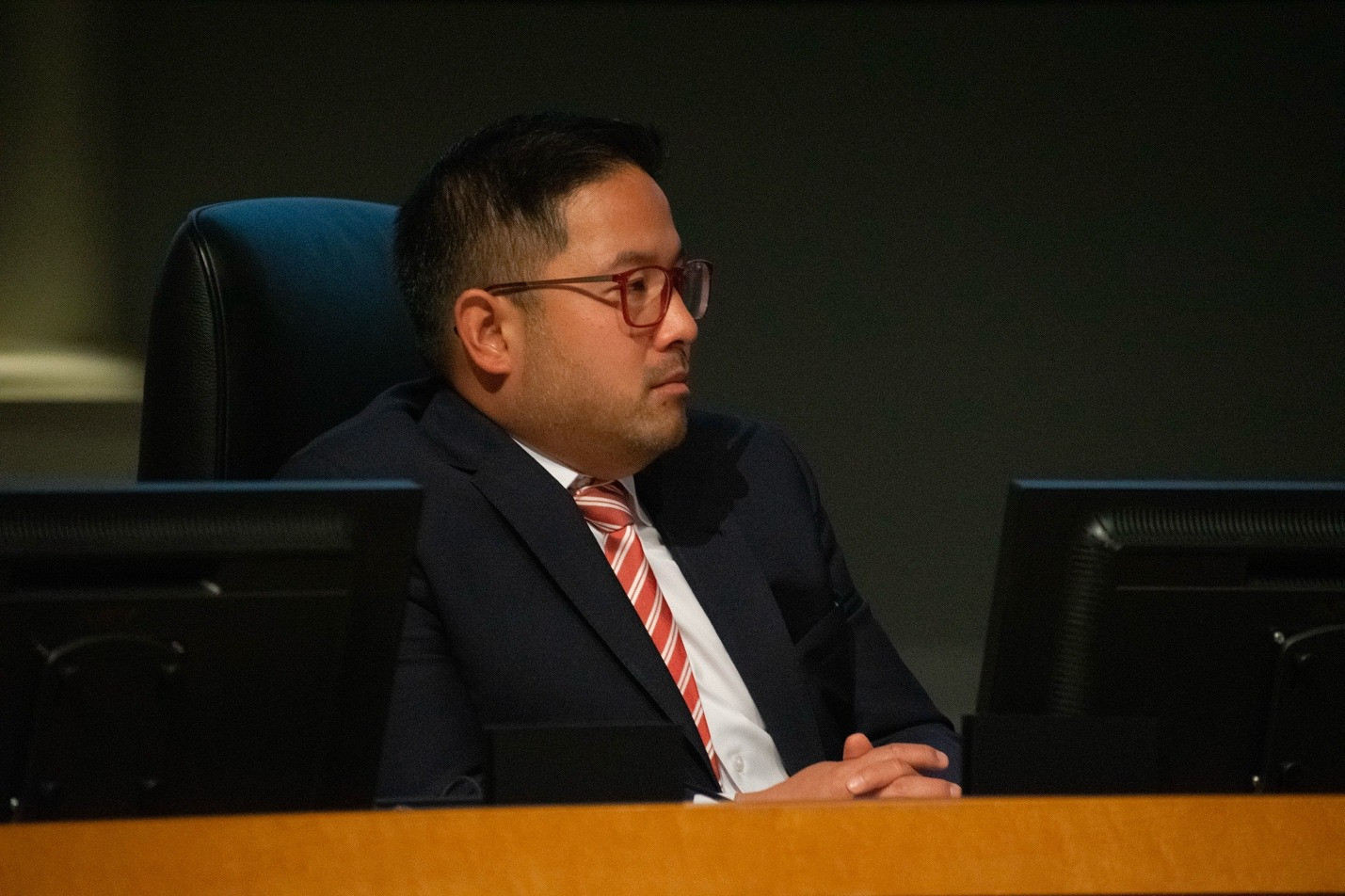
Alvin Tedjo is promising a two-year property tax freeze for all residents and eliminating taxes altogether for some seniors until they sell their home. His plan has been widely panned as an unsustainable election stunt that will force seniors and other residents out of their homes. (Alexis Wright/The Pointer)
Damerla’s campaign alternative focuses on freezing the City-controlled portion of property taxes in 2027 while examining how municipal spending can be reduced without cutting services. She has argued that residents need more than temporary relief and the City must address the financial pressures that contribute to increases in the first place.
“The single most important thing that council can do when it comes to affordability is keep those taxes low,” Damerla said during the Food Banks debate, emphasizing that the objective should be to manage costs while maintaining municipal services.
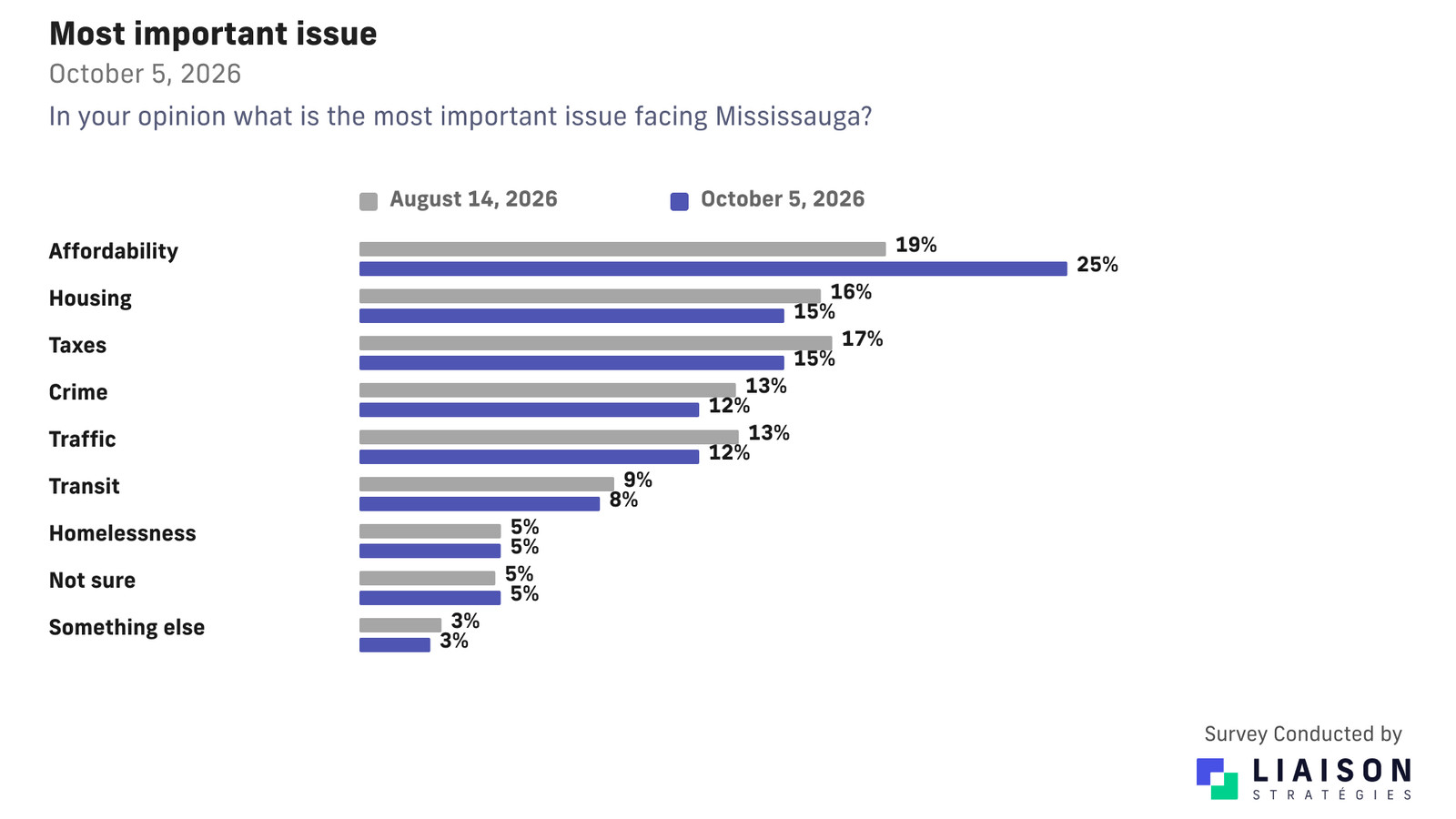
Affordability and housing continue to be the top issues among Mississauga voters. (Liaison Strategies)
Damerla has also identified the Peel Regional Police funding formula as a major concern. Because policing is funded at the regional level, she argues that Mississauga’s tax burden cannot be addressed by looking only at City Hall’s budget; instead, she wants to examine every avenue available to reduce spending. All 12 Mississauga council members also sit on the Region of Peel council.
“My commitment is to freeze taxes in 2027. But everybody here is talking about freezing taxes at the City. But the elephant in the room is the Region of Peel,” she said during the Food Banks Debate.
“That’s where our taxes are really going up. And so my other commitment is to fix the policing formula. That's the single most important thing we can do to help Mississauga residents and keep property taxes low.”
Currently, Peel Police funding is split between Mississauga, which covers 62 percent of the costs, and Brampton which pays for the remaining 38 percent (Caledon is policed by the OPP). All four of the top candidates have criticized the formula and called for the province to re-evaluate it.
Crombie has taken a different position on tax freezes, arguing that long-term affordability depends on sustainable budgets rather than postponing the financial consequences of municipal spending which would cripple residents in the short-and-long-term. She has warned that tax freezes do more harm than good.
“I have a track record of delivering your taxes in and around the rate of inflation,” she said, defending her record on tax increases. She criticized Parrish for allowing increases to get out of control in her two years as mayor, when they went up a combined 15 percent.
Crombie wants an independent examination of the City’s expenditures, to find savings.
“We need to do a line-by-line audit to find out where the spending is because we don't have a revenue problem in Mississauga,” Crombie said during the debate, “we have a spending problem.”
She has also proposed increasing the annual property-tax rebate for eligible low-income seniors to $1,000 and offering an interest-free, one-year deferral of annual increases for qualifying homeowners aged 65 and older.
Crombie has argued that tax relief must be paired with financial discipline and an ability to maintain essential services, as her approach also includes targeted assistance for businesses affected by U.S. tariffs with the aim of helping them preserve cash and protect jobs.
Parrish, meanwhile, has defended her high taxes.
During the Food Banks debate, she pointed to the financial pressures facing municipal operations and the difficulty of freezing taxes while expenses continue to rise.
“80 percent of our budgets are going to wages; they're going to unions who are also hungry and also required pay increases every time they do their settlement,” Parrish said.
She argued the City has already sought savings from its departments and highlighted the difficulty of making further reductions without affecting services. Parrish refused to bring in an external auditor, though, voting down Damerla’s motion for an independent Mississauga auditor general earlier in the year. Tedjo also voted the idea down. Both Damerla and Crombie have promised to create an auditor general position if elected.
“This year, we asked every department to cut two percent of their budgets, and they did. And we got the City portion of the taxes down to 1.61 percent, which is below the cost of living,” she said during the debate. The overall tax increase was still over 5 percent.
Parrish’s argument is that municipal leaders must balance residents’ demand for lower taxes while still maintaining and delivering key services.
Her challengers, however, contend the City needs a different approach to spending.
The candidates also differ on how Mississauga should respond to housing costs and whether the City should take a more direct role in delivering homes within residents’ financial reach.
“I was really proud to announce our housing platform that will create a Mississauga Housing Corporation, where the public land will be used to work in public-private partnerships with the not-for-profit sector, with the for-profit sector, to build the housing that we need,” Tedjo said.
The proposed corporation would give the City a more active role in bringing partners together to build affordable homes, rather than relying exclusively on private-market construction.
Tedjo also advocated for making affordable rental incentives permanent and simplifying the municipal approval process.
Damerla is emphasizing housing approvals that match the needs of residents and can be constructed at lower costs.
During the October 5 POLICORNER debate, she argued the City should not focus exclusively on high-rise condominiums when other housing forms could provide more attainable options.
“One of the things I've always said is we need to build the homes that people actually want to live in,” Damerla said.
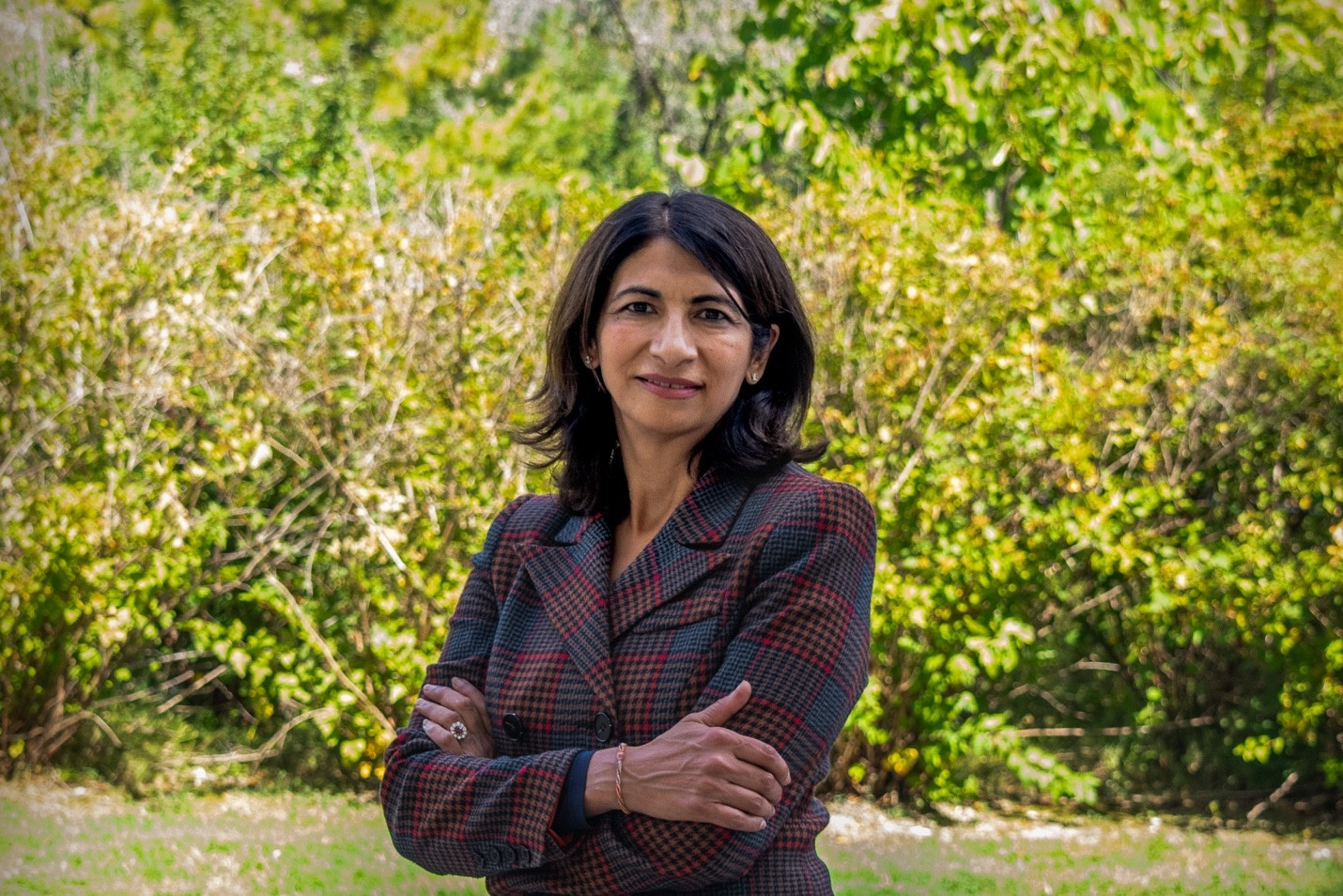
Dipika Damerla is promising to bring more accountability and transparency back to City Hall by hiring an independent auditor general and calling on the province to re-evaluate the Peel Police funding split between Mississauga and Brampton. (Alexis Wright/The Pointer)
She pointed to townhouses and smaller multi-unit buildings as alternatives that could provide more space without the costs associated with large condominium developments.
“On a square footage basis, it is cheaper per square foot to build a townhouse than to build a 40-storey condo,” she said.
Her proposal would permit six-plexes as of right on certain arterial roads, while expanding housing options for seniors looking to downsize. The goal is to provide homes that meet different needs at different stages of life while making better use of existing neighbourhoods.
Crombie has also emphasized the need for a broader range of housing, including purpose-built rentals, co-operative housing and supportive housing.
During the POLICORNER debate, she said the City needs to provide options for residents of different ages—from young families seeking smaller homes to seniors who no longer need large houses, and Crombie identified municipal land as an opportunity to expand housing options.
“The federal government used to build co-ops. We can build on City land or that of religious organizations,” she said.
Crombie proposed working with non-profit providers and other levels of government to secure funding and land for housing that remains affordable over the long term. Her platform also includes measures to help residents facing eviction, preserve existing affordable rental units and improve access to supportive housing.
She has argued the City should use partnerships to deliver housing while ensuring that public land and financial assistance produce lasting benefits for residents.
Parrish’s approach has largely focused on working with developers to identify barriers to construction and encourage more housing projects.
“The first thing I did the first week after I was elected was put together 25 of our top developers to do a housing task force,” she said.
“Their first job was to tell our staff everything we were doing wrong that would take time and money to get their plans approved. It worked extremely well.”
Residents in the audience took issue with Parrish’s developer task force, shouting “no more monopolies.”
Parrish also pointed to development-charge reductions, the fees developers pay to have infrastructure installed for the homes they build, as a way to encourage rental construction, noting Mississauga has lowered fees for the building of rental units, including previously waiving them for qualifying two-and three-bedroom units.
The measures were meant to make it cheaper for developers; however, there is no guarantee they will pass their savings on to buyers or renters, instead pocketing the incentives as additional profits.
The way crime and public safety are dealt with has been a point of contention.
“When people's cars get broken into, when people's homes get broken into, everyone's insurance goes up,” Tedjo said.
He argued that crime prevention should be part of a wider effort to reduce living costs, since insurance bills can add another expense for families.
“The police budget is the largest budget we have,” Damerla stressed while questioning whether the City and Region are getting value for all the money pumped into the police department.
Peel Police’s budget has skyrocketed in recent years, doubling in less than a decade. This year alone, Mississauga paid about $520 million for policing.
Damerla wants to implement value-for-money audits that would examine the police budget and identify opportunities to improve efficiency, emphasizing that financial oversight and public safety should not be treated as competing priorities. She believes correcting that arrangement could help reduce financial pressure while preserving the City’s ability to support policing.
Damerla has tried to bring in external audits of Peel Police but her efforts have been shot down, including a motion in April she brought forward for an external audit of Peel Police. Parrish, who has repeatedly claimed the skyrocketing police budget is a major concern of hers, voted against Damerla’s motion to conduct a thorough external audit of Peel Police spending, prompting critics to question if Parrish actually wants to challenge runaway police spending.
After hearing from residents about break-ins, home invasions and vehicle thefts, Crombie emphasized the importance of police visibility, neighbourhood-level responses and adequate resources for frontline officers.
“I will say that people don't feel as safe as they once did,” she said, arguing the mayor should be involved in police governance and negotiations over the service’s budget, repeatedly emphasizing the need to maintain a strong police presence while questioning spending increases that do not focus on frontline policing and could undermine the City’s ability to fund other priorities.
Crombie hammered Parrish for quitting the Peel Police board shortly after joining it when she became mayor. Crombie said the only way Mississauga policing priorities and community-based solutions for specific neighbourhoods with unique needs can be championed, is if the mayor is on the police board.
“She quit the board. She quit on all of us,” Crombie said of Parrish during the POLICORNER debate, which Parrish did not attend.
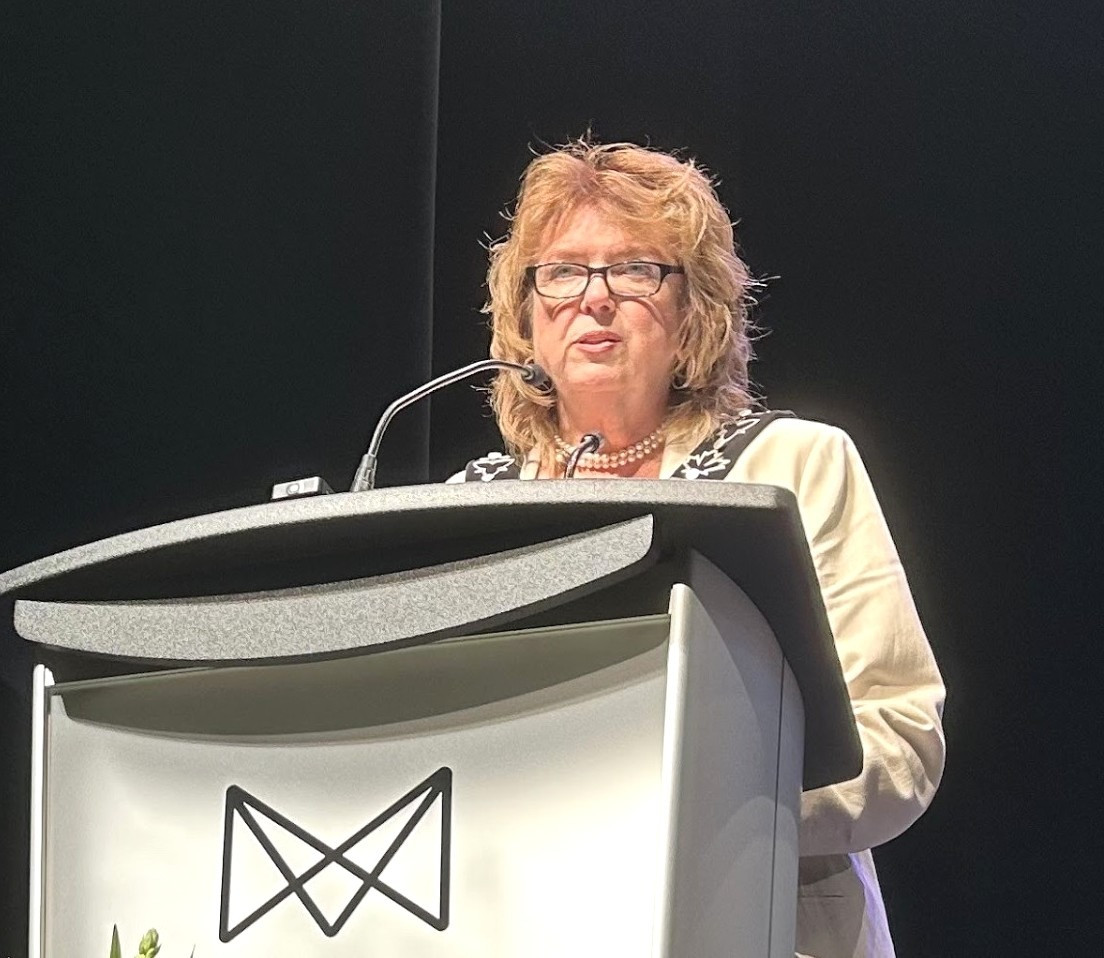
Carolyn Parrish said her campaign is largely focused on continuing her previous accomplishments as mayor, building on work with her housing task force. Parrish stated she would remain on the sidelines instead of taking a seat on the Peel Police board if re-elected. (Alexis Wright/The Pointer)
During the Food Banks debate, Parrish defended her approach during her two years as mayor, while challengers questioned whether the City’s current spending is sustainable.
Parrish, who resigned her seat on the police services board in November of 2024, months after being elected, said she would name a “trusted appointee” to serve in her place if she is re-elected.
“Carolyn Parrish has not been doing her job. She has not worked for the people of Mississauga,” Crombie said at the POLICORNER debate.
“She went to a single meeting at the Peel Regional Police board, and then she quit.
“I think it's the responsibility of the mayor to sit on the police board. That's where you learn about community safety: What are the hotspots in the city, what are the police doing about it…But the mayor abdicated, so she learned none of that. When it came time for the chief to present the budget to the board for approval, she didn't like it, so she quit.”
Crombie brought the same energy while detailing her proposal for extending Toronto’s Line 2 subway from Kipling Station into downtown Mississauga, a major project she says would be a game-changer, connecting with regional transportation and sparking a huge injection of investment along the entire subway corridor.
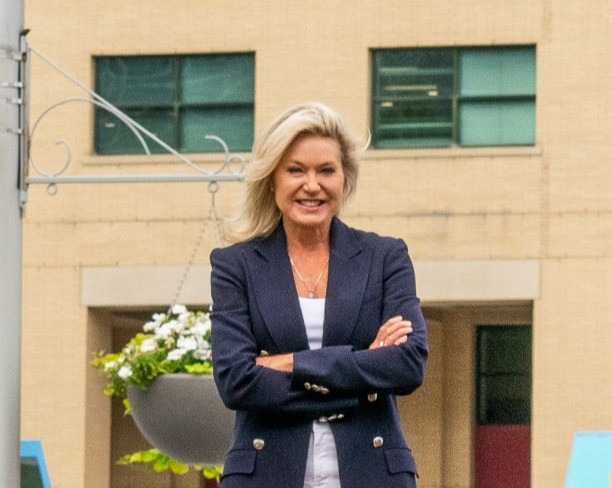
Bonnie Crombie is promising a subway line for Mississauga and reduced taxes. (Alexis Wright/The Pointer File Photo)
Crombie said she will launch the studies needed to bring a subway line to the city.
“We are Mississauga. We're going to do our homework. And we're going to show them (the provincial and federal governments) how feasible it is.”
She said the City should pursue the subway line while continuing to improve existing transit connections, including the future Hazel McCallion LRT Line on Hurontario Street and GO services.
Crombie also highlighted the need to improve traffic flow, stating, “We need better signal coordination, fewer bottlenecks, and better coordination of construction.”
Tedjo said, “Traffic is awful,” while describing the daily frustrations people experience while travelling across the city.
“We need to invest in transit that makes a difference today, not 10, 15, 20 years from now.”
His approach includes improving bus movement through traffic, using technology to make the road network operate more efficiently and pursuing projects that can be delivered sooner. He has also supported two-way, all-day GO train service on the Milton line, which would improve connections for residents in northern Mississauga.
Damerla has emphasized the need to coordinate housing growth with transportation investment, arguing that new development can worsen congestion when transit infrastructure fails to keep up.
During the POLICORNER debate, she described the problem as “purpose-built congestion,” saying that City Hall has approved high-rise buildings without providing the transit needed to support the growing population.
She has advocated for practical transit improvements and stronger regional connections, including changes to GO service along the Milton Line, and better transit planning for neighbourhoods experiencing growth.
Parrish has defended her efforts to improve transit and expand services while managing the costs of major infrastructure projects, emphasizing the need to make public transportation increasingly useful and accessible to residents who currently depend on cars.
The four candidates are set to debate again on October 15 at Christ First United Church, hosted by the Town Of Port Credit Association (TOPCA) and the Lakeview Ratepayer Association.
Email: [email protected]
At a time when vital public information is needed by everyone, The Pointer has taken down our paywall on all stories to ensure every resident of Brampton, Mississauga and Niagara has access to the facts. For those who are able, we encourage you to consider a subscription. This will help us report on important public interest issues the community needs to know about now more than ever. You can register for a 30-day free trial HERE. Thereafter, The Pointer will charge $10 a month and you can cancel any time right on the website. Thank you.
Submit a correction about this story

