
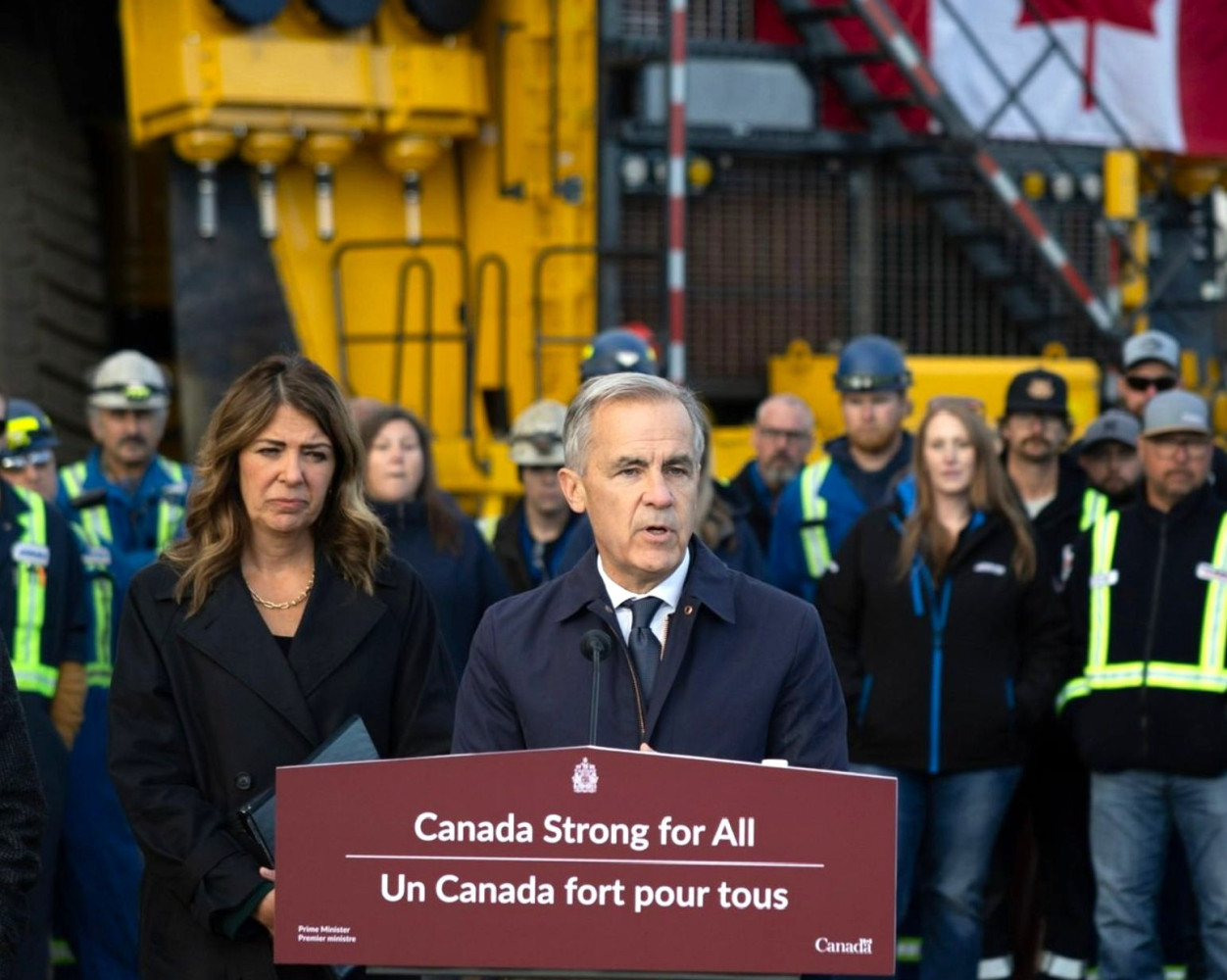
‘Building Canada Wrong’: Carney picks oil pipeline as first national interest project days after tabling ‘draconian’ Bill C-39
Ten years after the Fort McMurray wildfires scorched more than 1.4 million acres amid severe drought conditions, Prime Minister Mark Carney returned to the city to announce the West Coast Pacific Link oil pipeline as the first project designated in the national interest, less than a month after federal scientists warned Canada’s climate impacts are irreversible.
“We have to do this because the world’s facing an energy crisis on three dimensions: there’s an immediate challenge of affordability, and in some countries, the very availability of hydrocarbons; there’s a structural challenge of energy security, and the existential challenge of climate change,” Carney said during a press conference on October 1.
“And these challenges are forcing countries to think differently about where their energy comes from, and on who they can rely on to supply it.”
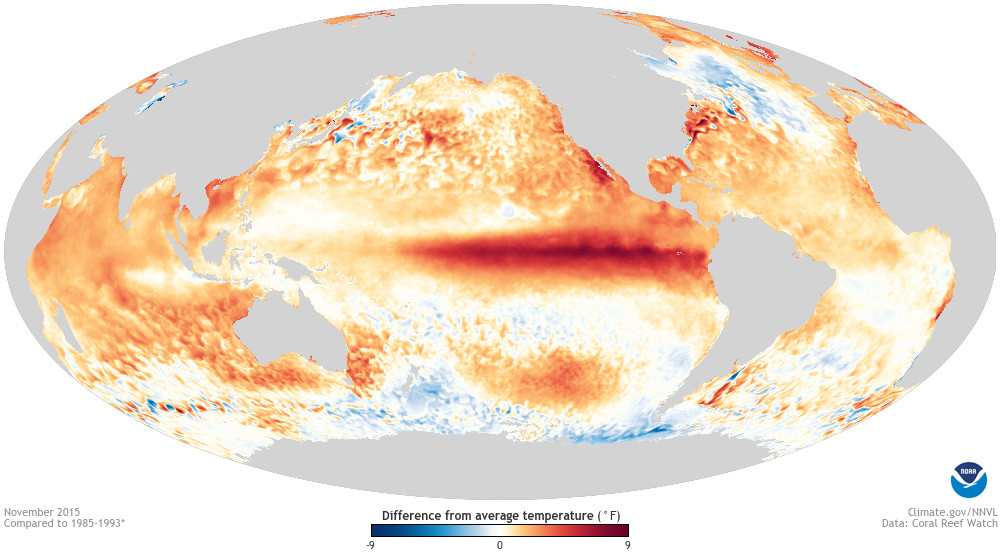
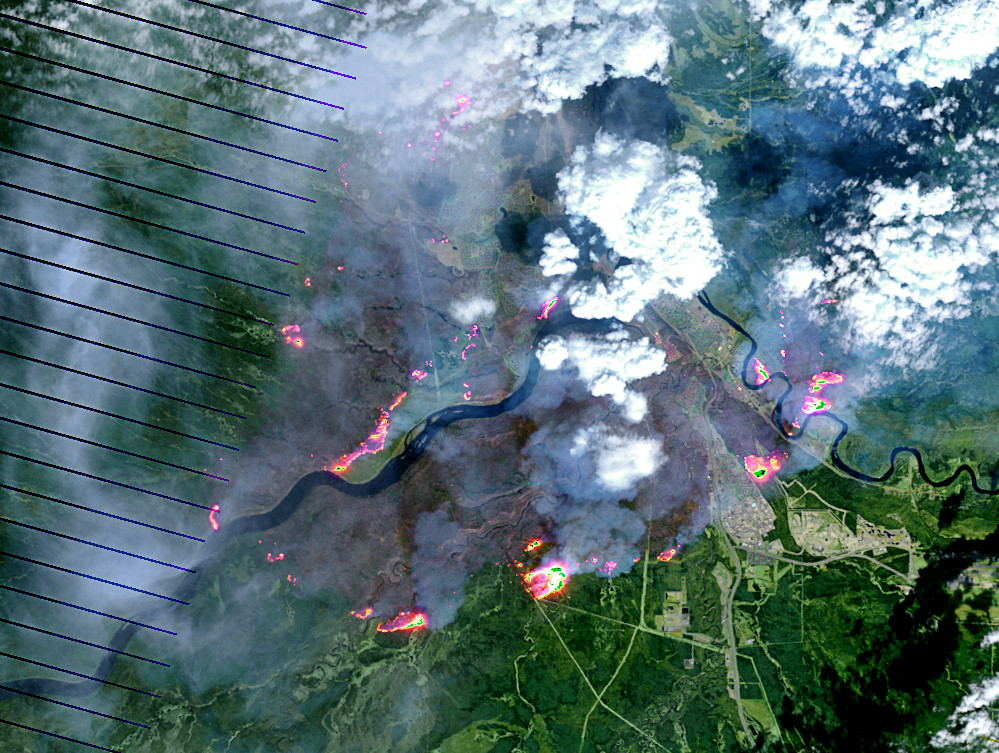
The 2014-2016 El Niño was one of the strongest El Niño events on record, with unusually warm waters developing between the coast of South America and the International Date Line that also fuelled the raging wildfires in Fort McMurray, Alberta—a human-caused event made worse by unusually high temperatures. (First Image: National Oceanic and Atmospheric Administration, Second Image: NASA)
The announcement drew swift criticism from Indigenous and environmental groups alike, especially given its ominous timing—ten days after Bill C-39, titled Building Canada Strong Act, was introduced in Parliament.
Bill C-39 builds upon and expands the fast-tracking framework established by Bill C-5, the One Canadian Economy Act (which passed in June 2025) and proposes changes to labour and environmental laws including one-year approval timelines for major projects, expanded powers to intervene in strikes and new “regions of national interest” with potentially reduced regulatory scrutiny.
“If we’re going to say no, say no quickly. If we are going to say yes, say yes on time,” Carney said while stressing that predictability is vital.
Much like Bill 5’s Special Economic Zones, regions of national interest may be designated in areas such as energy and transportation corridors and industrial regions, following a regional assessment under the Impact Assessment Act (IAA) that identifies the geographic area, activities and standard conditions, allowing certain developments to be considered “pre-approved” if they meet specified conditions and mitigation measures.
Sean Mullin, a former special adviser to the Prime Minister’s Office for Economic Affairs from 2023 till 2025, said the changes were not entirely new with concerns about Canada’s complex regulatory process having been building for years.
“It was certainly on the radar. The previous government was trying to make some moves along that front, but relative to what the Carney government has done, was more cautious,” Mullin, Senior Fellow at the University of Toronto’s Munk School of Global Affairs & Public Policy, told The Pointer.
However, Environmental Defence Associate Director of national climate Julia Levin criticized Bill C-39 as a move to fast-track megaprojects by weakening federal project reviews, warning it could leave communities, wildlife and nature exposed to irreversible ecological harm.
Macpherson Law Senior Counsel Laura Bowman observed that the legislation has shifted “much more in the direction of Ontario’s Bill 5, which is deeply troubling”.
“I was quite shocked that they would get rid of some of the features in the Building Canada Act that Parliament very deliberately put in to try and keep a lid on some of the more draconian aspects of the bill,” she told the Pointer.
Jeronimo Kataquapit, an Indigenous youth leader and founder of the grassroots movement Here We Stand, is particularly concerned about the potential implications of Bill C-39 for the Ring of Fire and its ongoing regional assessment due to the federal legislation possibly weakening environmental protections and Indigenous rights by creating mechanisms to accelerate development in designated regions—much like Ontario’s “dangerous” Special Economic Zones under Bill 5.
“Bill C-39 weaponizes regional assessments,” he said.
“Much like Ontario’s Special Economic Zones, they [regions of national interest] can conduct whatever they want. It fast-tracks development within the region. This is a great violation of not only the environment but First Nations' rights as a whole.
Kataquapit also criticized Bill C-39 for lacking the five-year sunset clause included previously in Bill C-5, arguing that its expanded powers could become permanently embedded in federal law.
“The special powers granted to the federal government will be ingrained in Canadian law forever; this just isn’t about the Ring of Fire, it’s about the environment as a whole,” he added.
“We need a firm promise from the federal government that the Ring of Fire will not be deemed a region of national interest.”
While there is no word from the federal government on whether the Ring of Fire will be deemed a project of “national interest”, for many critics, the first project, the West Coast Pipeline, was not news—it was months in the making, driven by erratic national and geopolitical winds.
On January 20, while delivering an address at the 56th World Economic Forum Annual Meeting in Switzerland, PM Carney warned that the post-Cold War rules-based international order was facing a permanent “rupture”, driven by superpowers and “hegemons” weaponizing economic integration.
Trade negotiations that began between Carney and U.S. President Donald Trump in late March 2025 collapsed by August this year following late-stage disagreements over auto terms and third-party trade restrictions.
Sandwiched in between, on May 8, the federal government released a discussion paper outlining a planned regulatory overhaul to slash project approval times to under a year to boost exports and attract global investment.
A nationwide engagement process was conducted from May 8 to July 22, during which the Major Projects Office received over 26,000 submissions — including support from industry stakeholders and opposition from Indigenous groups and members of the public.
On June 1, the Canadian Society for Ecology and Evolution (CSEE), representing 930 scientists, pushed back, warning that exempting projects from current levels of review could have “serious consequences for Canada’s threatened species, biodiversity, and ecosystems”.
The federal government later said it had heard Canadians’ concerns loud and clear and dropped plans to exempt major projects from the Species at Risk Act—a move that seemed like a win but would later turn out to be a dud when Bill C-39 would be put on the table.
On May 21, Alberta Premier Danielle Smith had announced the referendum question on Alberta’s separation—six months after Canada and Alberta signed an energy and economic Memorandum of Understanding (MOU) outlining cooperation on resource development, carbon capture and the proposed West Coast oil pipeline, leading to the resignation of former environment minister Steven Guilbeault and Canada’s top climate advisors.
“When someone tells you who they are, you have to believe them,” one of two founding members of the federal government’s Net-Zero Advisory Body (NZAB), Catherine Abreu, told The Pointer previously.
“And Mark Carney has been telling us who he is and what he wants since (his) election, and what he wants is to build a new oil and gas pipeline that is very obvious and clear to me.”
“The old plan was an open opportunity for those people who wish to pull Canada apart, both at home and from abroad. Our new plan will help build clean energy…make Canada more sustainable, more affordable and more prosperous. It will build Canada strong together,” he said.
“The energy transition will be a source of great stability in the long run but while it's underway, it can equally be a source of disruption. We can't afford to restrain the growth of an important part of our energy mix, oil and gas to meet a short-term goal.”
In July, the Major Projects Office, which was established in August last year, announced it was ‘initiating’ the process of assessing the 1,250-kilometre pipeline for potential designation as a project of national interest under the Building Canada Act to expand Canada’s access to international markets, particularly in Asia—reducing reliance on the United States.
Supported through a partnership between Ottawa and Alberta, the proposed pipeline that could cost taxpayers up to $44 billion would begin near Bruderheim, Alberta, follow the existing Trans Mountain corridor toward British Columbia’s south coast and transport up to one million barrels of crude oil per day to a proposed marine export terminal.
While a recent Angus Reid poll shows 63 percent of Canadians approve of the proposed Alberta-to-B.C. pipeline project, another poll makes it clear that 68 percent oppose using federal public dollars for new oil pipelines or fossil fuel expansion projects.
“To ensure Alberta will export some of the lowest-carbon intensity oil in the world, the Government of Canada, the Government of Alberta, and the Oil Sands Alliance have reached an agreement to advance construction of the Pathways Project,” a statement from the Prime Minister’s Office noted.
“Pathways will be one of the world’s largest carbon capture and storage projects, and alongside other emissions reductions commitments in this agreement, it will achieve 16 million tonnes of emissions reductions per year.”
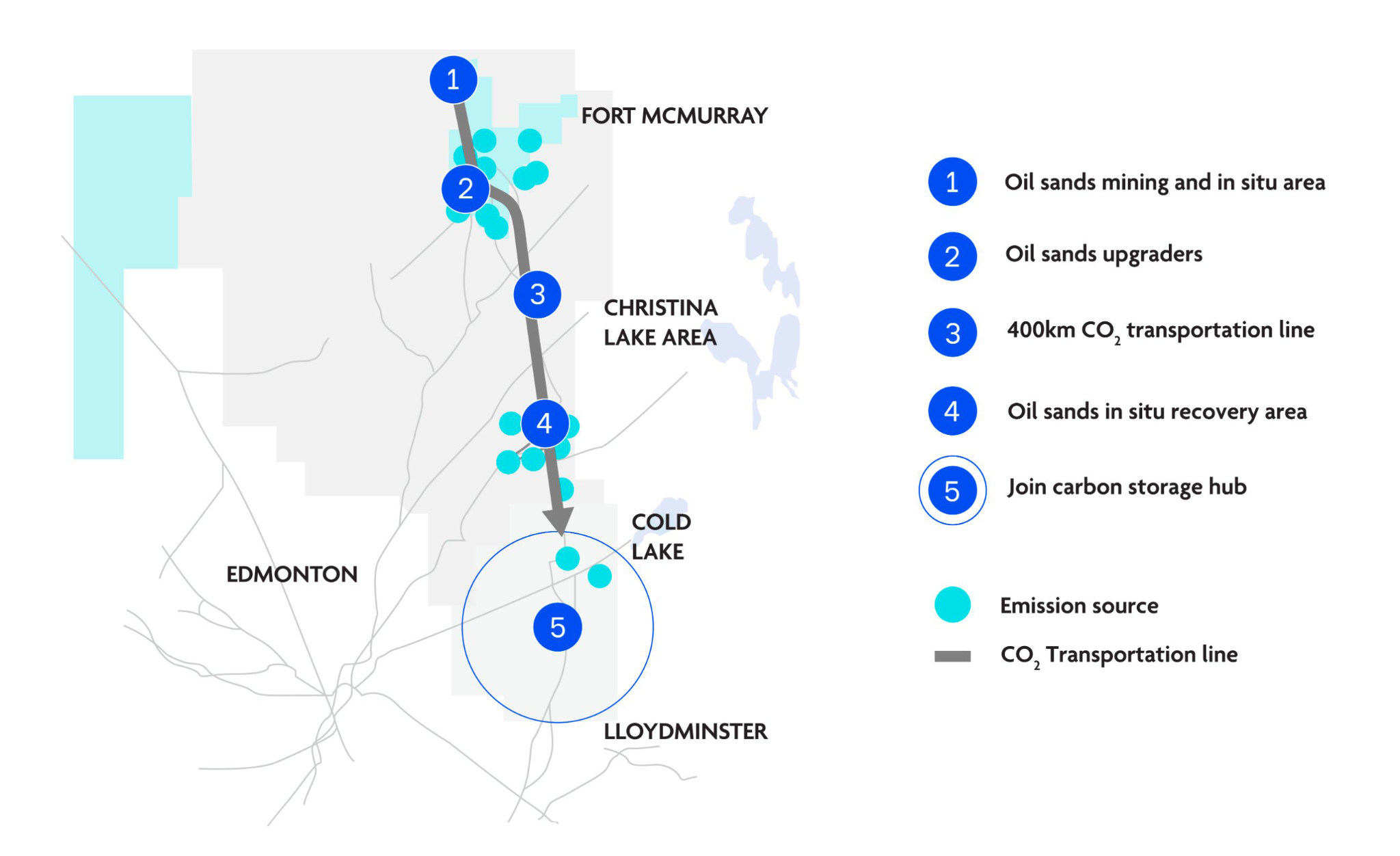
The Pathways Alliance carbon capture and storage project, proposed under Ottawa’s Major Projects list, would run roughly 400 kilometres from over 13 Alberta oilsands facilities in the Fort McMurray, Christina Lake, and Cold Lake regions to a storage site just outside St. Paul, where carbon dioxide would be buried deep underground. Over the years, rural residents along the pipeline’s path have raised concerns about safety, environmental risks, and a lack of meaningful consultation including potential pipeline ruptures, groundwater contamination, threats to Indigenous Treaty Rights, and the discrepancy between ambitious capture goals and historically lower real‑world carbon capture rates. (Canadian Energy Centre)
The Oil Sands Alliance, formerly the Pathways Alliance, is a consortium of Canada’s largest oil sands producers, representing the vast majority of the country’s oil sands production.
Under its original Pathways plan, the companies pledged to achieve net-zero production emissions by 2050 with carbon capture forming the centrepiece of the strategy.
Since then, however, oil sands emissions have risen to 92 million tonnes, according to the latest federal inventory, while the alliance’s stated ambitions have shifted from its original plan.
“And the ambition of Pathways has decreased,” Former NZAB co-founder and University of British Columbia professor Simon Donner observed.
Donner did the math.
The agreement between the federal government, Alberta and the five oil sands companies suggests Pathways is now targeting six million tonnes of emissions reductions by 2035 with a further 10 million tonnes being pursued by 2045.
“All of this, however, is tied to the new pipeline,” he noted, as these reductions could be outweighed by the emissions associated with producing the additional bitumen the proposed pipeline would carry.
Based on a pipeline capacity of one million barrels per day, operating at 80 percent capacity and assuming a continued annual decline in emissions intensity, Donner estimates the additional production could generate roughly 18 million tonnes of emissions by 2035 — “meaning that oil sands emissions would continue to increase”.
While companies could pursue further measures such as electrification to reduce emissions, Donner argues that the agreement’s changes to industrial carbon-pricing benchmarks could reduce the incentive to go beyond the emissions reductions outlined in the deal.
The additional 10 million tonnes is also framed as something the companies will “pursue” rather than a firm commitment to achieve.
“It is still unclear who will be paying for Pathways, or for the pipeline,” he added.
On October 31 last year, more than 50 environmental, health, and Indigenous organizations sent a letter to the Carney government opposing the use of public funds for the Pathways Alliance Carbon Capture and Storage project, arguing the $16.5-billion proposal has a poor record of cutting emissions, serves mainly to prolong oil sands production, and lacks consent from affected Treaty 6 and Treaty 8 Nations.
The government now claims that the Pacific Link proposal, led by the Trans Mountain Corporation and Pembina Pipeline Corporation, will provide opportunities for Indigenous communities along the route to acquire equity stakes and participate in the project’s economic benefits.
“It seems that they’re checking off the box of this will advance the interests of indigenous people with no discussion of what the adverse project impacts might be, no investment disclosure—just bare speculation that there might be project benefits,” Bowman noted.
The Union of B.C. Indian Chiefs (UBCIC) criticized the federal government for designating the pipeline despite an incomplete consultation process and failing to adequately account for First Nations’ constitutionally protected title and rights and the potential impacts of increased fossil fuel extraction and transportation.
“At the heart of our fight is keeping our coast super tanker free and protected from jeopardizing our way of life, economy and future,” UBCIC Secretary-Treasurer Káwázil Chief Marilyn Slett said in a statement.
“Whether the tankers travel south or north it’s all the same. They threaten the health of our ocean and an oil spill is devastating to our communities. Heiltsuk knows this first hand - 10 years after the Nathan E Stewart fuel spill that impacted our marine bread-basket, Heiltsuk is still fighting for justice.”
Analysts at the Institute for Energy Economics and Financial Analysis (IEEFA) also questioned whether the proposed pipeline makes economic sense and found the 1-million-barrel-per-day West Coast Oil Pipeline is unlikely to be needed and could be a net negative for the value of Alberta’s oil industry.
The report estimates the project could cost between C$35.2 billion and C$43.7 billion with tolls of $18.70 to $23.72 per barrel, tremendously higher than existing routes. Even a potential price premium for exports to Asia may not be enough to offset those costs, potentially leaving shippers with lower returns.
“The proposed ownership structure would place close to 90 percent of the capital at risk with government-owned entities, with a minority private partner,” Pembina Institute Senior Analyst Ian Sanderson noted in his recent report.
“If commercially competitive tolls cannot recover the full cost of the project, the gap would likely be absorbed through lower returns, longer payback periods or direct public cost.”
More than 90 percent of Canadian bitumen exports currently go to the U.S. while China is the only other country with significant refining capacity for Canada’s heavy crude.
If the recent U.S.-Iran war adding downward pressure is not enough signal of market trends, China’s state-owned oil company Sinopec clarified that oil demand in the country “very likely” peaked last year. The International Energy Agency (IES) also projects global oil demand will peak by 2030, before the proposed pipeline could be completed.
To add another layer of uncertainty, Ottawa acknowledged that the project’s success will depend on other, associated investments and initiatives.
“Pacific Link is a transformative project, but its full potential will only be unlocked by the initiatives the Government of Canada is leading across the country,” the statement said.
“We are working with the Government of British Columbia to expand the container terminal at Roberts Bank and the future marine terminal to export crude from Pacific Link.”
On September 29, two weeks after Carney’s wife Diana Fox Carney was appointed Canada’s first Ocean Envoy, the federal government announced more than $1 billion over four years for ocean conservation, marine safety, marine-life protection and Indigenous-led stewardship, along with funding for spill preparedness, marine-traffic monitoring, underwater-noise research, marine mammal response and habitat restoration.
“The timing of the funding feels like it’s meant to mollify concerns for the Salish Sea and the endangered southern resident killer whales if this pipeline and its tankers become reality,” David Suzuki Foundation Nature Director Erin Roger said.
“The amount committed to marine protection is a drop in the ocean compared to the tens of billions of public funds that will be spent on the new pipeline and expanding the Port of Vancouver. It’s good to see Ottawa acknowledge the importance of oceans conservation, but its respective investments contradict its stated priorities.”
The announcement acknowledged concerns “consistently” raised by First Nations in B.C. about the cumulative impacts of vessel traffic on southern resident killer whales, wild Pacific salmon, marine ecosystems, fisheries access and spill risk.
In 2001, the majestic Southern Resident killer whales (SRKW) were designated endangered by COSEWIC (Committee on the Status of Endangered Wildlife in Canada) under the Species at Risk Act—a direct result of declining Chinook salmon stocks, vessel disturbance and underwater noise, environmental contaminants and the population’s small size among the threats facing their recovery.
In 2020, a federal review of the proposed Roberts Bank Terminal 2 expansion near Vancouver found that the project would add pressure on the population through increased underwater noise, ship-strike risk and impacts on Fraser River salmon.
“If a worst-case oil spill were to occur in the marine shipping area, it could result in potentially significant adverse residual effects for vulnerable species such as SRKW and marine birds, marine commercial and recreational activities, current use, cultural heritage and health of Indigenous groups,” the federal report highlighted.
With an oil tanker terminal now also proposed for Roberts Bank, conservation advocates argue that the cumulative effects of additional industrial and marine traffic could further complicate recovery efforts.
This is “building Canada wrong” instead of “strong,” Rogers noted.
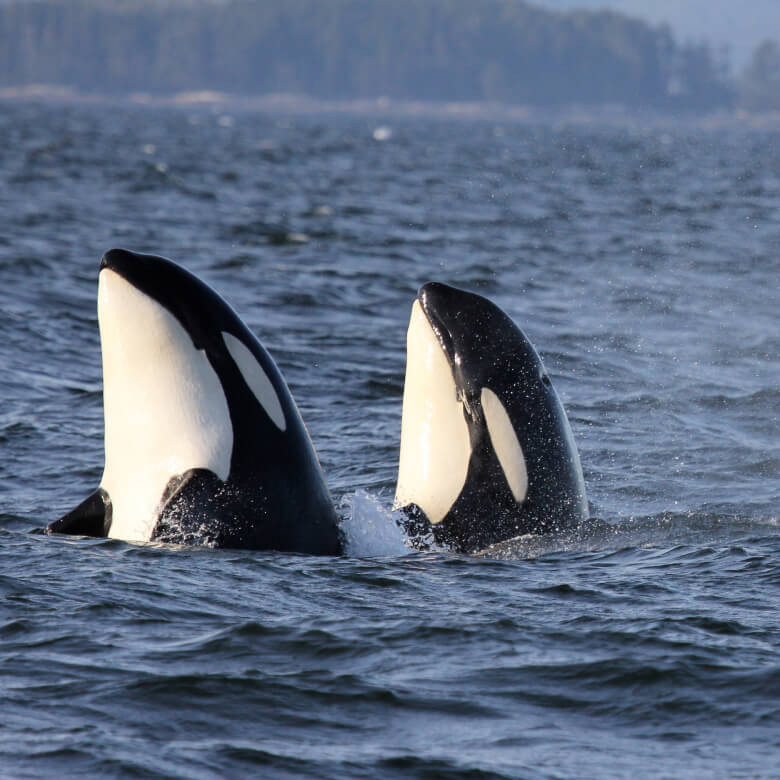
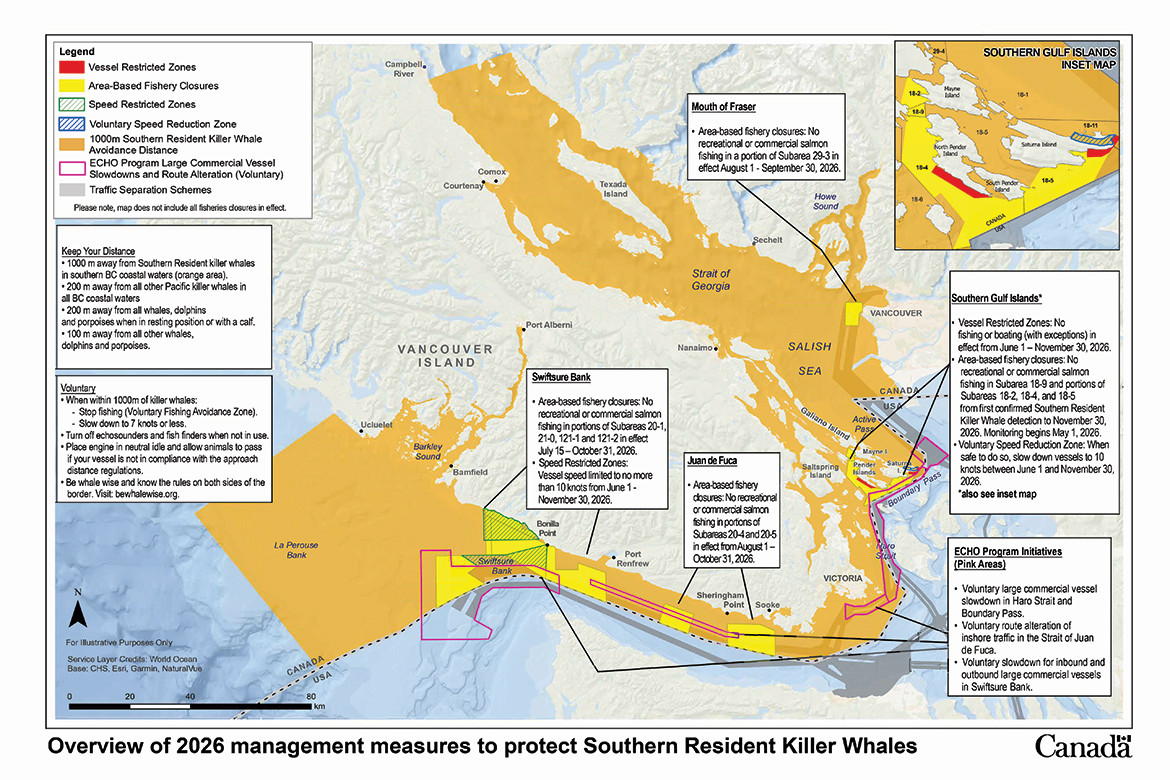
To protect the endangered Southern Resident killer whales, the federal government introduced measures this year to protect them including seasonal fishing closures, vessel-restricted zones, mandatory speed limits in key areas and a 1,000-metre approach distance for vessels, alongside efforts to reduce toxic contaminants affecting the whales and their prey. (First Image: World Wildlife Fund, Second Image: Government of Canada)
During the Canada Investment Summit on September 14 and 14 when Ontarians protested the attack of environment, Carney said the approach for major projects will be spread to other projects across the board through new legislation once Parliament is back.
On September 21, Bill C-39, also called An Act respecting certain measures to strengthen the economy, was introduced for its first reading in the House of Commons by House leader Steven MacKinnon, who called the “significant economic” legislation a “centrepiece” of the fall sitting that follows “one project, one decision, in one year” model.
Beneath the bill’s sweeping promise of building faster lies a dense web of more than 300 clauses in 246 pages that would rewrite provisions across federal laws protecting species, water and fisheries while reshaping parts of the Labour Code.
Under revised Section 107 of the Canada Labour Code, the labour minister could direct the Canada Industrial Relations Board in the case of a “strike or lockout” to order the resumption of operations, extend a collective agreement or impose binding arbitration if they believe a work stoppage is adversely affecting or may adversely affect the national interest.
While the bill requires the minister to consider a special mediator’s report, the listed factors including impacts on the economy, social disruption and freedom of association remain discretionary, meaning the final decision would rest with the minister.
“Government needs to understand that there will be intended and unintended consequences from these proposed changes, on collective bargaining, on workers’ ability to make positive changes in their workplaces and on how employers will now behave at bargaining tables,” Unifor National President Lana Payne said.
The International Court of Justice (ICJ) recently affirmed that the right to strike is a “protected” activity of trade unions under international law.
While Canada remains 20 years behind reaching its 2030 emissions target, Bill C-39’s changes to the IAA, Canada Energy Regulator Act, Building Canada Act, Species at Risk Act, Fisheries Act and Canadian Navigable Waters Act have made many critics “skeptical” of what lies ahead if the bill passes.
One major proposed change would let Ottawa authorize preliminary construction on some designated projects before a federal impact assessment is complete, if the environment minister deems the work “enabling activities” in the “public interest” and imposes conditions to mitigate federal effects.
While the government could still stop a project after the assessment, critics question the order of operations.
“The purpose of impact assessment is to decide whether or not to do a project,” Bowman said.
“An impact assessment that happens after you've made that decision is not an impact assessment.”
The bill would also overhaul how assessments are conducted, with federal reviews, permits and consultations running concurrently rather than sequentially: For projects overseen by the Canada Energy Regulator or Canadian Nuclear Safety Commission, those agencies would take the lead on the federal assessment while the environment minister would issue a single decision document for other IAA projects, incorporating approvals, conditions and mitigation measures.
The 365 days assessment clock, however, will not start until a proponent submits a complete application with all required information. If a decision is delayed, the minister will be required to provide an explanation and a proposed timeline.
Ottawa claims the approach will reduce duplication and provide greater certainty without removing environmental assessments, permitting or consultation requirements.
But Bowman disputes the characterization of the existing system as simply duplicative, and insists that the different stages addressed different issues and relied on different areas of expertise.
“Impact assessment versus pipeline safety versus nuclear safety standards versus fisheries—these were different regulatory bodies with different sets of expertise,” she explained.
The existing process places the broader impact assessment first with subsequent permits informed by its findings.
“Now we’re just acting like no expertise is needed, and there’s no iterative process required, and we can just do them all at once,” she said.
The question of whether a project should proceed is also fundamental to the duty to consult and accommodate Indigenous Peoples, because a meaningful process should leave alternatives including whether a project moves forward at all on the table.
“Or maybe we find a different solution that is less infringing of Indigenous rights,” she added.
Bill C-39 would formalize the Canada Energy Regulator’s (CER) role as the sole federal assessor for pipelines, transmission lines and certain offshore renewable-energy projects regulated by the CER.
The change follows amendments that removed those project categories among others including “in situ oil sands extraction facilities” and “fossil fuel-fired power generating facilities” from the IAA’s designated-project list on September 3.
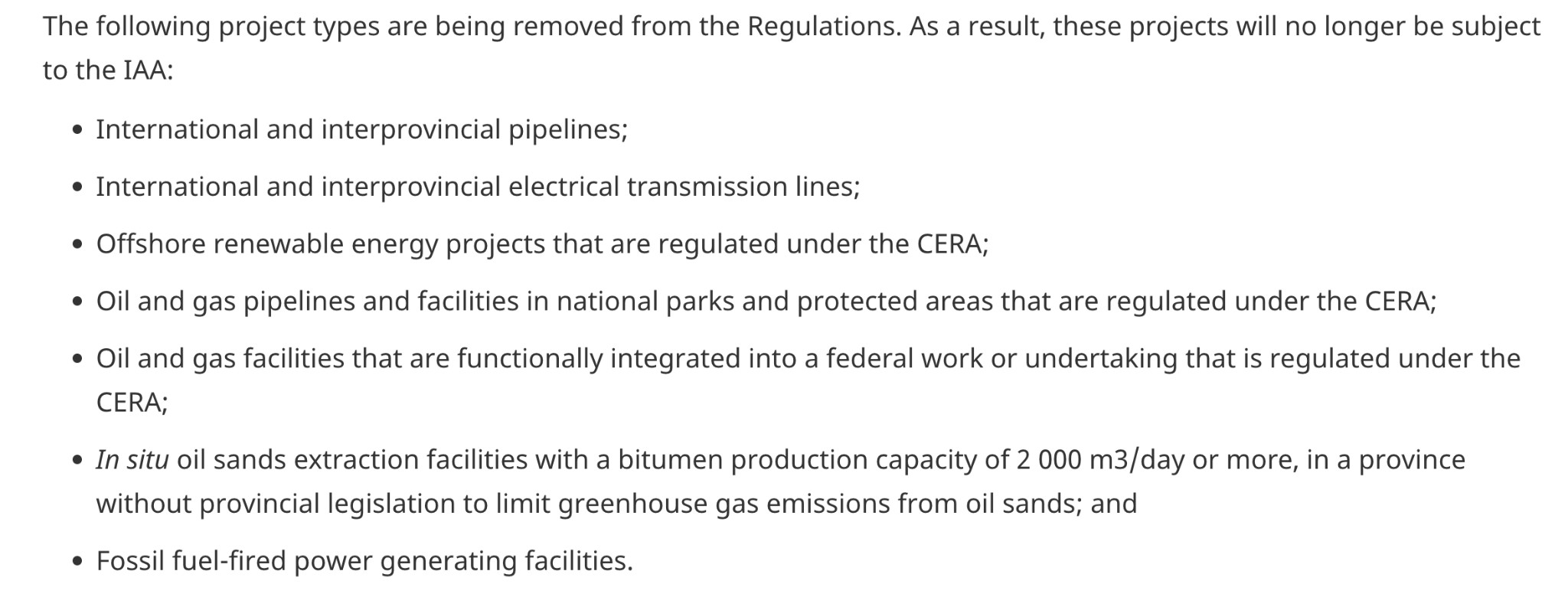
Recent amendments to Canada's Physical Activities Regulations came into force on September 3 to eliminate overlapping federal review processes and streamline major project approvals for a number of fossil fuel infrastructure. (Government of Canada)
For nuclear and uranium projects subject to the IAA, the Canadian Nuclear Safety Commission would similarly become the federal impact assessor rather than an integrated review panel involving the Impact Assessment Agency.
“This risks undermining informed decision-making concerning project approval for projects with extremely high inherent costs and risks,” Levin fears.
Bowman suspects Ottawa is “deliberately creating confusion” around which major projects would actually undergo federal impact assessment while some of “the biggest projects are being carved out”.
“What we’re left with is, for some unknown reason, medium projects will be assessed and everything else won’t,” she added.
“There’s no logic to that.”
Bill C-39 would also alter how environmental conditions can be modified as under the IAA, the environment minister would be able to add, remove or amend conditions where the minister determines the change is in the public interest.
Levin pointed out “the Roberts Bank Terminal 2 went through federal review and was approved on conditions that are meant to mitigate harms to the Southern Resident Killer Whale”. Under the new changes, “those conditions can be removed”.
The minister responsible for the Building Canada Act would also gain authority to adjust environmental conditions for projects including in response to technical changes, construction timelines or additional Indigenous consultation.
“They don’t seem to believe that environmental assessment is a thing anymore,” Bowman remarked.
Under the proposed framework, decision-makers would have to consider technical, economic and practical feasibility when establishing certain conditions under the Fisheries Act and Species at Risk Act.
Bill C-39 would also expand the habitat-credits framework, ranging from their creation, allocation, transfer, use, tracking and management. Certified credits could be used to offset harmful effects on fish or fish habitat from authorized activities within a service area.
“In practice, this would allow companies to destroy critical fish habitat to buy dubious ‘habitat credits’ or pay a fee to offset the damages,” Levin predicts.
Environmental policy expert and University of Toronto Mississauga professor Andrea Olive cautions “Earth’s accounting balance” does not even out that way.
“You can't trade one ecosystem for another. You can't say we're going to sacrifice this one and save another one,” Olive told The Pointer.
“It’s like paying for your sins.”
Ministers will also have new authority over conditions attached to environmental approvals; it includes amendments made to the Canadian Navigable Waters Act that would provide authority for the minister to exempt certain bodies of water from specified provisions of the Act—change critics worry could further weaken protections for species and habitat.
Currently, the federal Species at Risk Act is already not strong enough: there is no mandatory deadline between a species being assessed as “at risk” and receiving legal protection. Despite recommended timelines introduced in 2017, only six percent of the 288 species assessed since then moved to the next stage on time—not a single marine fish or mammal did so.
The federal government says it wants to create a Crown Consultation Hub within the Impact Assessment Agency to provide one coordinated consultation process per project and per Indigenous community while the legislation would retain the Crown’s duty to consult.
But Levin argues the accelerated process could make meaningful consultation more difficult if communities do not receive sufficient information about projects and their impacts.
“If nobody ever asks or answers that question, the duty to consult is inherently frustrated,” Bowman added.
She observed that even the West Coast oil pipeline’s announcement lacks any real details: “It just looks like a PR piece. There’s no information about the project in there.”
The federal government maintains that Bill C-39 does not eliminate environmental assessment, permitting or consultation requirements.
Instead, it says the bill changes who leads the assessment and how federal processes are coordinated, while maintaining environmental, health, social, economic and Indigenous considerations.
The government says the existing system can involve multiple federal decisions and reviews and that projects have sometimes taken more than five years to receive federal decisions.
Olive believes it would be worthy to ask: “What are the alternatives that we’re comparing the first national interest project to?”
“From an environmental standpoint, the best option would be to leave the bitumen in the ground,” she said.
“Obviously not from an economic one…I think we should agree that moving it on trains or trucks would be an awful idea.”
The environmental trade-offs could be discussed, but that may no longer be the central question now that the project has been designated as being in the national interest; the focus then shifts to mitigating the environmental damage.
“That’s what an impact assessment does: It’s not saying the environmental costs are too high; you can’t do it. It’s saying this is what the environmental costs are, and here’s how we can minimize them,” she said.
The proposed pipeline is expected to follow the existing Trans Mountain Pipeline corridor, which could limit additional disturbance by concentrating new infrastructure in an area that has already been affected.
But that does not eliminate the total environmental costs: the bitumen would still be transported by tanker and shipped overseas.
“I'm a political scientist but we need the time to ask scientists these questions, and they'd be able to best tell us what the potential impacts are going to be, and on what species and ecosystems, and then how one might mitigate that. Can you do that in six months? I don’t know,” Olive said.
“I guess we’re going to try it…unless it’s some other political maneuver where he [Carney] is trying to work out and negotiate different deals with Donald Trump or with Alberta—he’s not transparent about that.
“Mark Carney’s trying to have his cake and eat it too.”
In December last year, owners of the Trans Mountain pipeline paid $196,000, the largest cumulative penalty issued by the CER, for environmental non-compliance and inadequate protection measures during severe rainstorms and flooding in the Lower Mainland of British Columbia in 2024.
“I don’t think this is really about duplication. This is about walking away from basic environmental standards. One of the ways that you do that is you get rid of the experts who ask the questions,” Bowman said.
“They [the federal government] may actually truly believe that they're doing something good and useful here, but it’s because they have stopped listening to anybody but their own proponent echo chamber, and they don’t know what happens in the real world on the real ground to real people when you don’t have the expertise to manage projects effectively.”
Email: [email protected]
At a time when vital public information is needed by everyone, The Pointer has taken down our paywall on all stories to ensure every resident of Brampton, Mississauga and Niagara has access to the facts. For those who are able, we encourage you to consider a subscription. This will help us report on important public interest issues the community needs to know about now more than ever. You can register for a 30-day free trial HERE. Thereafter, The Pointer will charge $10 a month and you can cancel any time right on the website. Thank you
Submit a correction about this story

