
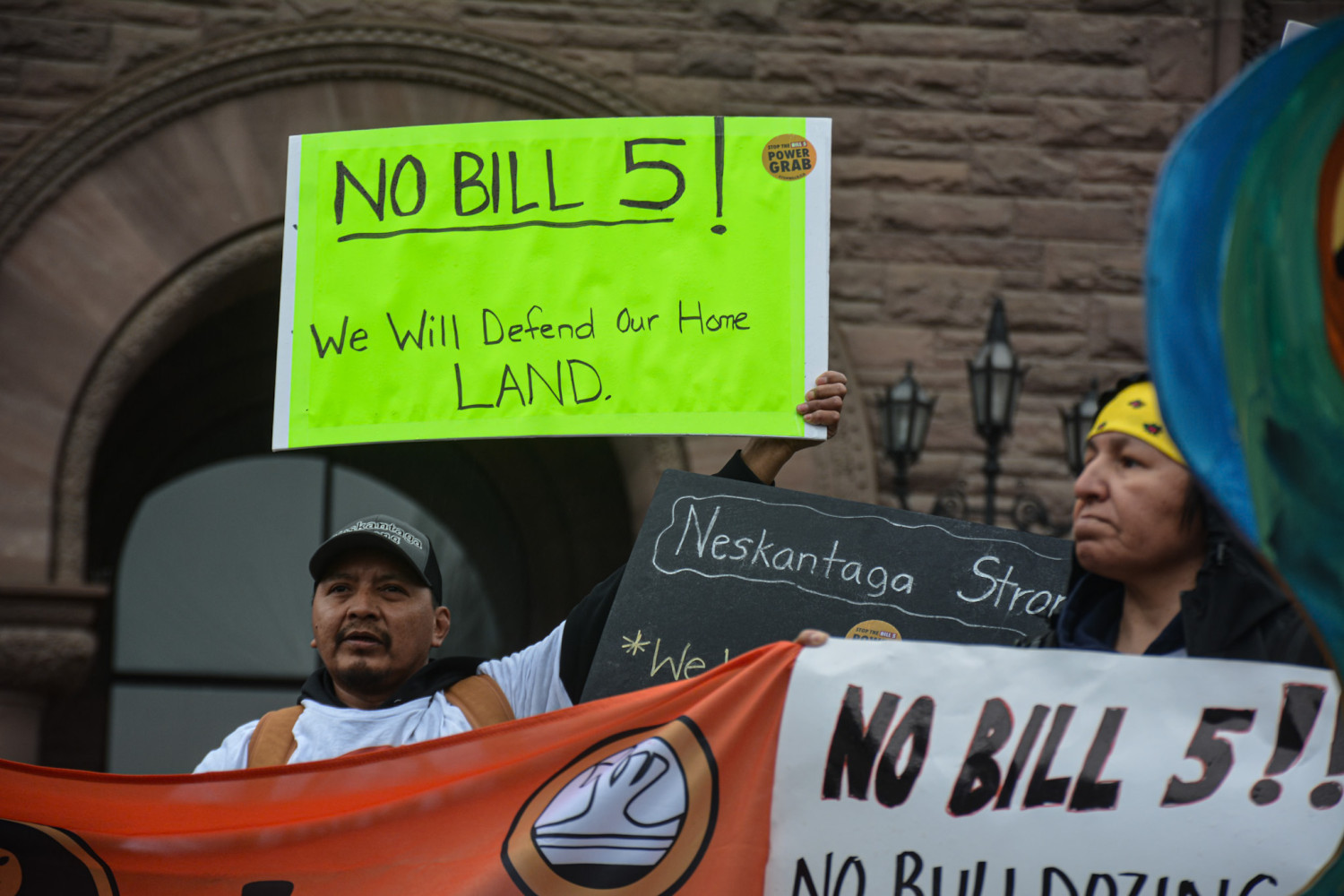
Four environmental groups taking Ford PCs to court over ‘dangerous’ Special Economic Zones Act
The Ontario PC government is now facing more legal challenges than any other province in Canada. The latest is a constitutional fight targetting the Special Economic Zones Act under the controversial Bill 5, which passed last summer, despite enormous public backlash.
“It is a mad grab for unaccountable power by Ford’s Progressive Conservatives,” Democracy Watch Co-founder, Duff Conacher, told The Pointer.
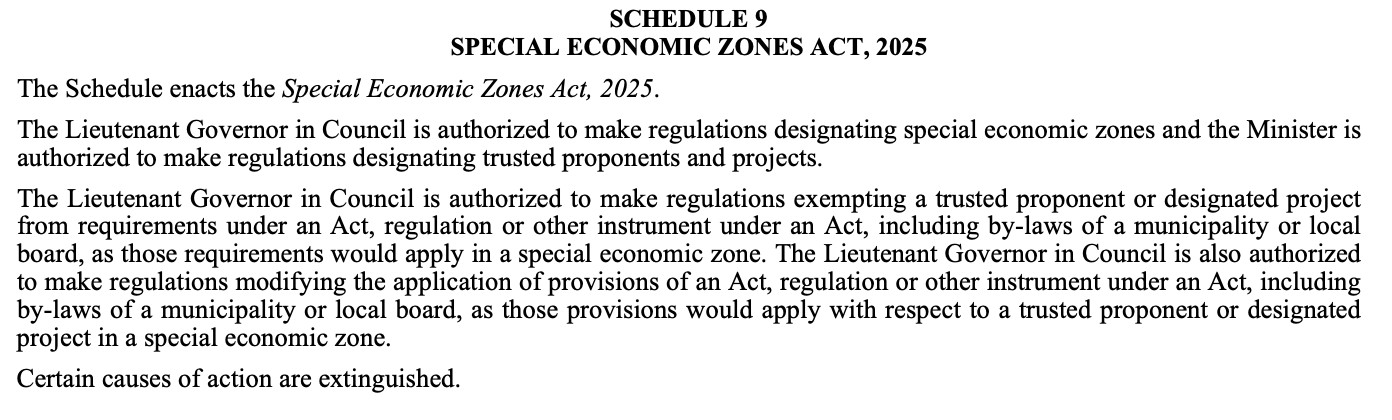
The legislation’s provision that "certain causes of action are extinguished" raises concerns that affected individuals or communities would be prevented from seeking legal recourse, which would weaken local control while prioritizing economic interests over community needs and environmental protection.
(Bill 5)
On April 7, a coalition of environmental and public interest groups led by Ecojustice served the PC government with a court application challenging the Special Economic Zones Act, arguing the controversial law lets Ontario’s Cabinet rewrite or suspend laws at will, bypassing legislative debate, public scrutiny and meaningful limits — a claim rarely seen in Canadian constitutional challenges.
“We’ve been concerned about the act from the time Bill 5 was tabled,” Ecojustice lawyer Lindsay Beck told The Pointer.
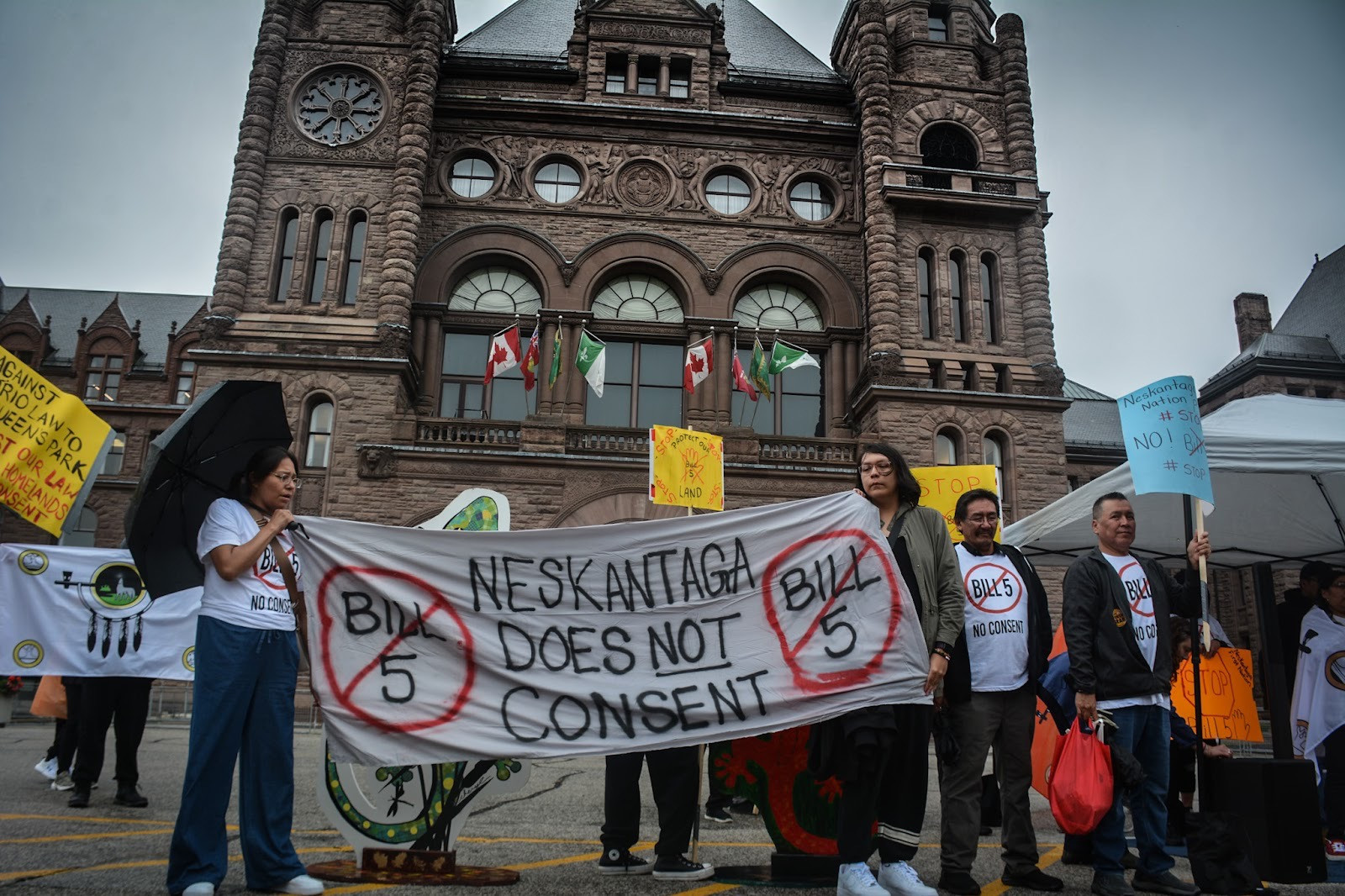
Bill 5 dismantled core environmental safeguards, bypassing Indigenous consultation and gave the provincial cabinet broad authority to fast-track development in designated zones, free from the constraints of local laws.
(Joel Wittnebel/The Pointer files)
The challenge, filed in Ontario’s Superior Court of Justice, is backed by Democracy Watch, Environmental Defence, Friends of the Earth and Wildlands League — who say multiple sections under the SEZA result in “an alarming bypassing of Ontario's democratic system”.
Conacher explained that under the constitution, the provincial legislature is the body that makes and changes laws while the cabinet’s role is limited to setting regulations within the framework of those laws. Historically, regulations have provided details and flexibility without exceeding the law’s scope. But the SEZA provides the cabinet sweeping authority to decide that entire laws don’t apply in certain areas, far beyond standard regulatory powers.
“The powers extended to the executive branch of government in the Special Economic Zones Act are quite unprecedented,” Beck added. “It's really hanging like a threat over all of Ontario. We don't know what protections the cabinet might choose to exempt Ontarians from in the name of getting building going.”

On May 12, environmental groups and Indigenous leaders, council members and youth gathered at Queen’s Park calling on the provincial government to stop Bill 5. The same groups are now taking the PCs to court.
(Environmental Defence/X)
Under the law, the Province can designate special economic zones—what critics are labelling as “lawless zones”—where legal protections, oversight and accountability can be swept aside at the discretion of Cabinet, identify trusted proponents and approve designated projects, which can then be exempted from provincial laws, regulations and even municipal bylaws — making it a “Henry VIII clause”.
“The government can pick winners, draw a boundary on a map, and decide that inside it, the rules no longer apply. Safeguards people rely on — for clean air, safe water, and a say in decisions — simply disappear,” the coalition said in a statement.
Bill 5 also included broad provisions intended to block any court challenges arising from this power but that has not stopped three separate lawsuits from emerging against the legislation.
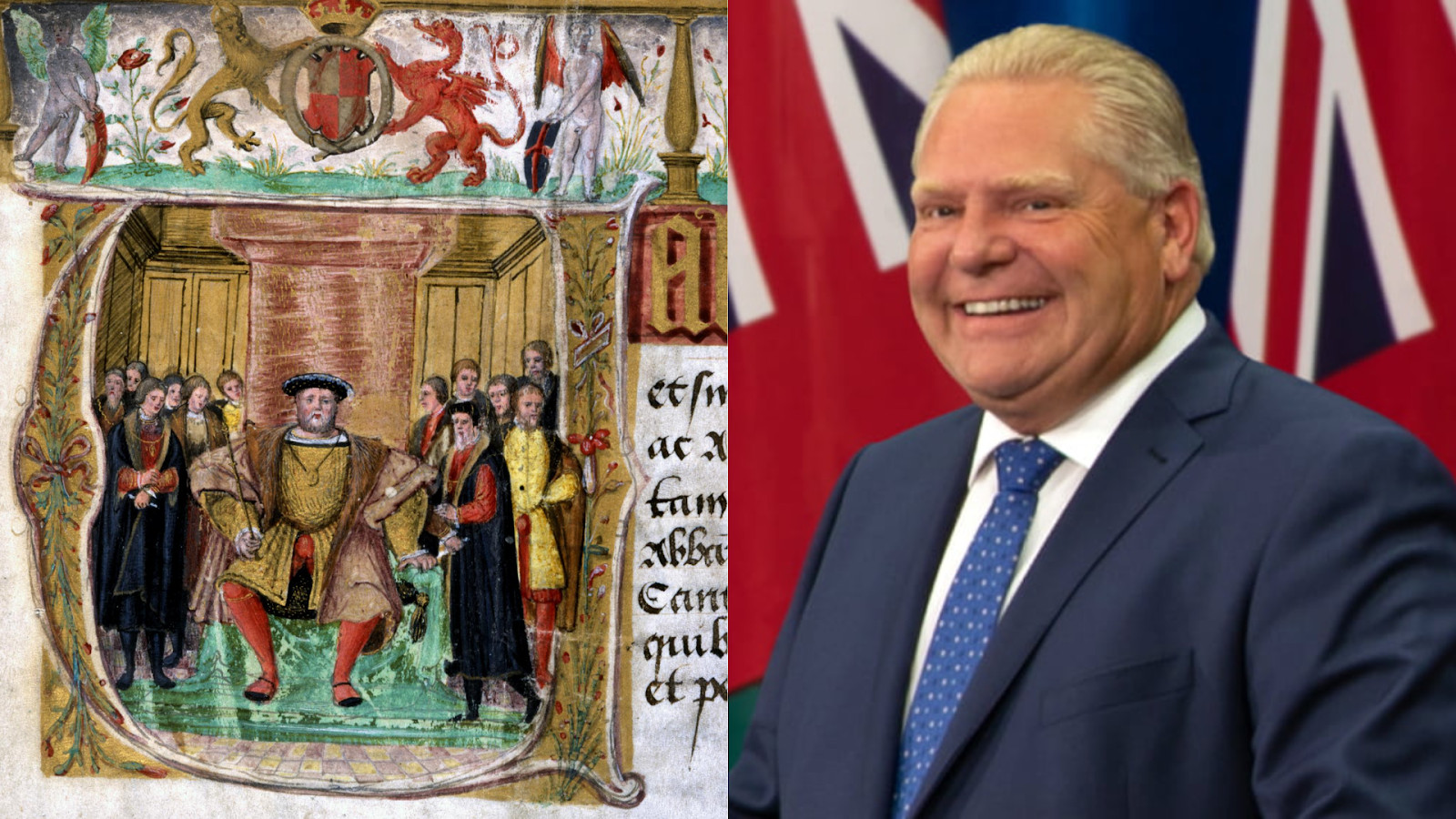
A "Henry VIII clause" in law refers to a provision that grants the executive branch (such as a cabinet or government) the authority to amend or repeal primary legislation (laws passed by Parliament) through secondary legislation (regulations or orders). The term is named after King Henry VIII, who used royal proclamations to bypass Parliament and create laws on his own.
(The National Archives/Ontario.ca)
“The law is dangerously undemocratic as it gives the Doug Ford cabinet unconstitutional, king-like powers to change any law without a review or vote of approval by Ontario’s legislature,” Conacher noted.
“These excessive powers are a recipe for corruption, trading of favours and preferential treatment by the Ford Cabinet of lobbyists, businesses, unions and other organizations that they favour, waste of the public’s money on boondoggles and pie-in-the-sky pet projects, and other abuses of power that benefit friends of Premier Ford and his Cabinet ministers.”
Ford has previously claimed special economic zones are necessary to protect Ontario from economic instability. The U.S. tariffs and an uncertain geopolitical climate was forcing the government to fast-track mining, energy and infrastructure projects including the tunnel under Highway 401 that critics have already deemed as unrealistic and disconnected from today’s environmental realities, expand mining in northern Ontario, build new nuclear generating stations, a deep-sea port in James Bay, the Billy Bishop Airport expansion and roads to the Ring of Fire.
“We’re being held back by our own processes. We’re being held back by red tape and endless delays,” the Premier said at a press conference in April last year while announcing the bill.
But many in the province question if it’s red tape that has led to Ontario’s economic issues. A recent report by the Fraser Institute revealed the province’s Gross Domestic Product (GDP) per person was approximately CA$74,143, the second-lowest among Canadian provinces and neighbouring U.S. states. This translates to a stagnant standard of living, which has fallen 27.5 percent below the regional average of $94,523 which is below pre-pandemic levels. This has created a widening prosperity gap with the latest budget, that fails to accept climate change as a problem, projecting a deficit of $13.8 billion for 2026-27 and $6.1 billion the year after.
“Although Canada’s national growth story has also been dismal for an extended period, Ontario’s performance has been so poor that we are falling behind the rest of the country,” the report concluded.
The PCs’ environmental and climate record fared even worse. In September last year, the Auditor General revealed the province was not on track to meet its 2030 greenhouse gas reduction targets. Two months later, rather than strengthening its climate action, the Ford government removed the legal requirement to report on climate progress, set emission targets and prepare a climate plan entirely as part of the 2025 Fall Economic Statement.
Critics note when Ontarians zoom out and inspect the PCs track record, the Special Economic Zones Act turns out to be a part of a “broader trend”, where democratic processes are weakened, environmental safeguards and Indigenous consultation processes are “treated as obstacles rather than protections” — which was exemplified in the draft regulations for SEZs that failed to adequately incorporate feedback from Indigenous communities and environmental groups despite receiving feedback.
“When vital safeguards are recklessly sacrificed to create private profits for proponents, we all pay the price,” Anna Baggio, Conservation Director of Wildlands League, said. “This new law is the culmination of years of attacks on threatened wildlife, our natural world and treating the environment, Indigenous rights and public consultation as red tape.”
In the draft regulations, Ontario reaffirmed its “commitment to meeting the Duty to Consult,” but offered no concrete mechanism to uphold Indigenous rights or consultation requirements as part of the draft regulations, and said it is “considering other mechanisms” to make information public, that potential appeals “would be considered” later, and that existing programs already support Indigenous businesses.
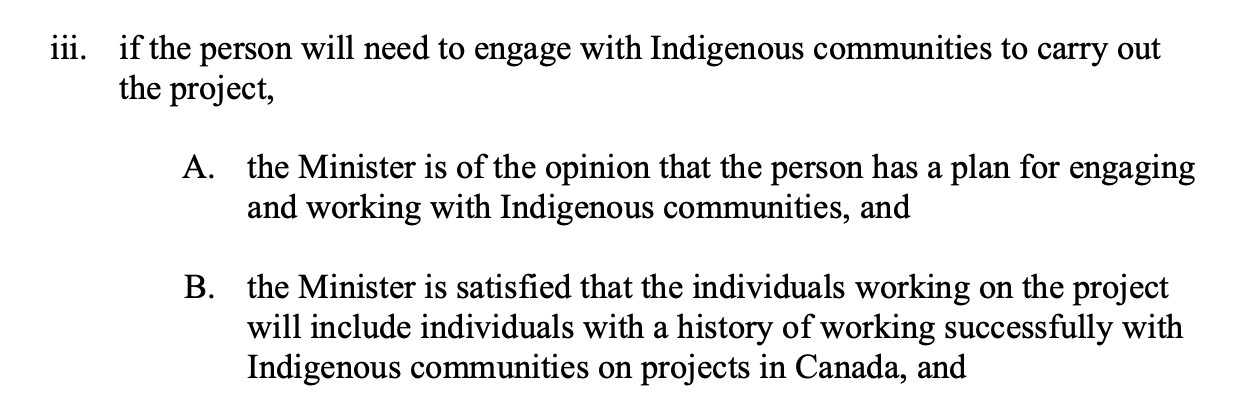
Though the draft regulation includes some vague mentions of Indigenous engagement plans, it leaves the final decision up to the minister’s opinion.
(Government of Ontario)
Baggio believes that even though SEZs have not yet been put to use, their threat is already being misused in discussions with First Nations about the roads to the Ring of Fire, an environmentally sensitive area of boreal forest and peatlands in the James Bay Lowlands that act as a massive carbon sink storing over 1.6 billion tonnes of carbon dioxide.
She fears communities already facing pollution or water shortages could see those pressures worsen while SEZs could bypass environmental assessment, further weaken already diluted endangered species protection and override laws designed to prevent flooding and wildfires — creating a “huge ecological liability”.
An interim report on the Ring of Fire regional assessment has already exposed significant gaps in Ontario’s commitment to having those important conversations. The report found the Ford government was absent from the process led by First Nations and the Impact Assessment Agency of Canada to evaluate the cumulative effects of mining and other development in the region despite possessing critical data on caribou, polar bears and other species. Instead, the PCs have withheld information as well as the funding essential for supporting the assessment.
“These Special Economic Zones are hanging over our heads like a sword of Damocles,” she emphasized.
“This government is going to get what they want, and they're willing to do anything to get it…we're all at risk, and it doesn't matter where you live in the province.”
Beck explained the legislation violates the Constitution Act, 1867, which assigns exclusive law-making authority to provincial legislatures. Section 92 of the Act clearly states that “in each Province the Legislature may exclusively make Laws in relation to Matters coming within the Classes of Subjects next hereinafter enumerated” including provincial taxation, property and civil rights, municipal institutions and the administration of justice.
“Section 92 clearly assigns law-making power to the legislature, not the executive,” Beck said.
“The Special Economic Zones Act allows Cabinet to effectively amend the application of any Ontario statute for designated zones, projects, and proponents. That gives the executive branch powers that, under the Constitution, belong exclusively to elected legislators.”
By enabling Cabinet to effectively change how laws apply (or whether they apply at all), the Province has “abdicated” its legislative role.
Legal experts assert that in passing the SEZA, Ontario bypassed the required constitutional amendment procedures outlined in sections 41 and 45 of the Constitution Act. Section 41 sets out the “unanimity procedure” requiring approval from the Senate, House of Commons and all provincial legislatures for changes to core national matters. Section 45 allows provinces to unilaterally amend their own constitutions through ordinary legislation, provided such changes do not conflict with Section 41.
“Doug Ford is doing what Donald Trump does, opening the door for corrupt backroom deals,” Friends of the Earth Canada Chief Executive Officer Beatrice Olivastri said.
“Bill 5 gives billionaires free reign to pollute. No one will be enforcing environmental laws that protect vulnerable people and their communities from toxic dumps, dirty air, and overuse and contamination of water and land.
It undermines Ontario’s “constitutional architecture”, the careful separation of powers between the legislative and executive branches designed to protect democracy and the rule of law. As the Ford government enables itself to bypass those statutory processes, the SEZA subverts both democratic decision-making and legal accountability.
“Even if it's never used, it's going to distort decision-making across Ontario,” Beck warned.
If private interests and proponents realize that lobbying the government could result in being designated as a “trusted proponent” and spared from environmental, health, safety, labour or permitting requirements that their competitors must still follow, it creates an uneven playing field that distorts decision-making across Ontario.
“It invites a type of cronyism that is anathema to the rule of law and to transparency,” she added.
The applicants are asking the court for a declaration that the law is deemed unconstitutional and “of no force and effect” under Section 52 of the Constitution Act, which establishes the Constitution as Canada’s supreme law and allows courts to invalidate any legislation that conflicts with constitutional rights or the division of powers.
If successful, the case could redefine the limits of executive power in Canada as other provinces consider similar fast-track laws aimed at accelerating development.
But the province could appeal and then potentially seek leave to bring the case to the Supreme Court of Canada, which typically accepts a very small percentage of cases.
“It could be resolved at the initial level if the government decides not to appeal or it could drag on for years,” Conacher said, acknowledging that legal fights can be lengthy and demanding at times, but he is ready for it.
“Even while appeals are ongoing, it would be difficult for the Ford cabinet to exercise powers that a court has already ruled unconstitutional.”
The coalition hopes the outcome will help in clarifying how far governments can go in delegating legislative authority to its Cabinet and whether there is a constitutional boundary that cannot be crossed, even in the disguise of economic urgency. As reported by The Pointer previously, even economists are skeptical about SEZs including World Bank senior economist Douglas Zhihua Zeng who called the zones “expensive, risky endeavours that require careful planning”.
“We really reject the dichotomy that we need to suspend environmental legislation in order to advance economic growth in Ontario,” Beck said, as the coalition now waits to get a court date for their first hearing.
“Strong economies are built on predictable laws and special economic zones act injects this element of unpredictability that can be quite destabilizing for investment and for stability across the province.”
Baggio added if there’s one thing she would ask the Ford government to do today, it would be: “roll it back, undo this legislation.”
Email: [email protected]
At a time when vital public information is needed by everyone, The Pointer has taken down our paywall on all stories to ensure every resident of Brampton, Mississauga and Niagara has access to the facts. For those who are able, we encourage you to consider a subscription. This will help us report on important public interest issues the community needs to know about now more than ever. You can register for a 30-day free trial HERE. Thereafter, The Pointer will charge $10 a month and you can cancel any time right on the website. Thank you
Submit a correction about this story

