
‘Budget you’d pass if climate change wasn’t a problem’: Ford doubles down on highways
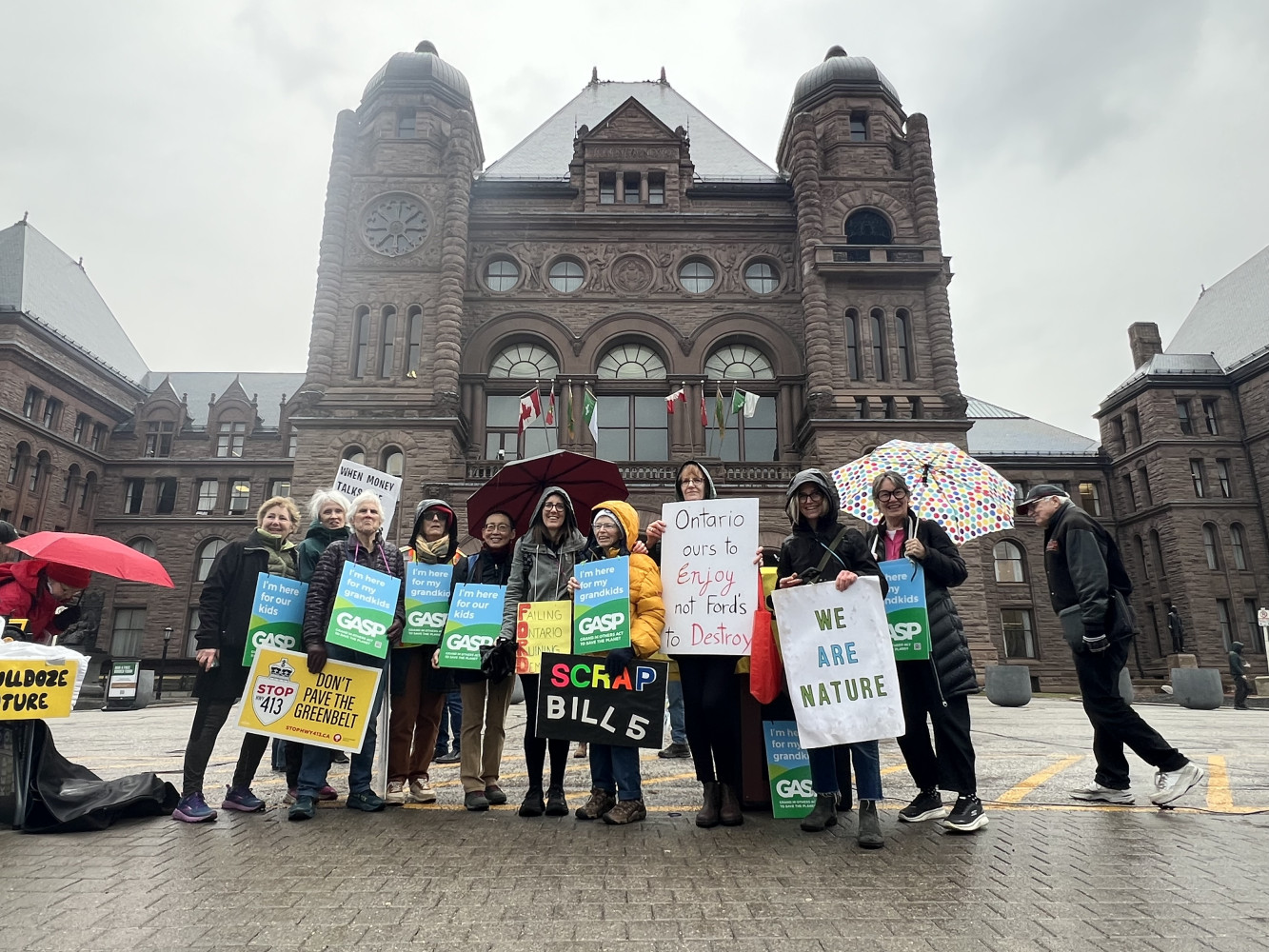
Dark clouds hovered over Queen’s Park. Thunder cracked and the sky wept as Caledon grandmother Betty de Groot and Stouffville grandmother Victoria Creese waited anxiously for what this year’s budget might bring.
On March 26, they stood alongside fellow members of Grand(m)others Act To Save The Planet (GASP) with a single, urgent plea for the Doug Ford PC government: “Don’t bulldoze our future.”
It’s not their own future they fear losing. It’s their children’s, their grandchildren’s. That’s what brought them here — through wind, through rain, through yet another provincial budget day where hope felt increasingly fragile.
Standing shoulder to shoulder, the two women talked about what they hoped to see and about everything they knew was at stake.
“I would like to see protections put into our provincial parks, so that land is no longer able to be removed for development” — Creese said as de Groot held an umbrella to protect them from the heavy downpour — “...and conservation authorities; they were created to protect watersheds. That’s how they work best. We’re in a climate crisis. Storms are getting worse, more frequent. We need those protections to actually mean something.”
De Groot nodded in agreement, recalling how just months earlier, on December 2, they had stood inside the halls of the provincial legislature alongside a broad coalition of youth, seniors and doctors to present Ford with an award for climate betrayal after the PCs passed Bill 68, the Plan to Protect Ontario Act (Budget Measures), with minimal debate repealing the province’s only legal obligations to set and report on greenhouse gas reduction targets, just ahead of a closely watched court challenge where seven youth were set to demand stronger, Charter-based climate action. The same legislation also advanced the amalgamation of 36 Conservation Authorities into seven regional bodies, another move both women had come to see as part of a broader pattern.
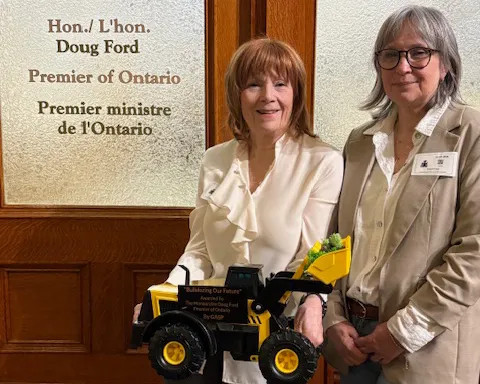
On March 12, Victoria Creese (right) and Sharon Sommerville from Grand(m)others Act To Save The Planet (GASP) delivered the ‘Don’t Bulldoze Our Future’ award to Ontario Premier Doug Ford’s office.
(Dr. Richard Thomas/GASP)
“The Ontario government’s response to the climate crisis under Bill 68 will negatively affect the quality of life for all grandchildren. It abdicates its responsibilities to our young and betrays their right to a livable future,” Creese recalled saying at the time.
The frustration was starting to appear on her face and she found herself unable to stop talking.
“We need wetlands. We need to stop MZOs [Minister’s Zoning Orders] that are paving over them. We need to undo the changes to endangered species protections,” she noted.
“We should be expanding the Greenbelt, not weakening it…especially to protect the headwaters of our rivers.”
De Groot added that she would like to see green development standards being reinforced again: “fully enforced, fully funded, full supported.”
“I’d like to see real investment in renewable energy — solar, wind, even offshore wind,” she said.
“And any funding going to American uranium? Cancel it…There are so many energy options beyond Enbridge. But they always seem to get priority, first access, first protection.
“We should be pushing geothermal, solar, wind not doubling down on fossil fuels.”
Two hours later, the budget was released and there was nothing in it they had been hoping for.
Ontario finance minister Peter Bethlenfalvy tabled Bill 97, Plan to Protect Ontario Act (Budget Measures), officially introducing the province’s $244-billion spending plan with a $13.8 billion deficit, nearly double last year’s $7.8 billion projection and delaying a return to surplus until 2028–29.
“The last year has been marked by significant changes in the world around us…global, economic and trade tensions, supply chain disruptions, shifting markets,” Bethlenfalvy said.
“We must change with it…our plan is cautious where it must be and ambitious where it should be.”
That ambition only applied to spending on mining, infrastructure, innovation and support for businesses. Nature, once again, took a back seat.
“This is basically the budget you would pass if you didn't think climate change was going to be a problem,” University of Toronto, Assistant Professor, Economics, Jeffrey Sun, told The Pointer.
Even as the province frames its spending as necessary to build long-term economic strength, Ontario’s rising debt, which is projected to reach roughly $485 billion in 2026–27, reflects a complicated tale.
It is unsustainable.
“Debt interest charges continue to balloon because Ford’s spending continues to balloon,” Canadian Taxpayers Federation Ontario Director Noah Jarvis said.
The 2026 budget increases overall government spending by $5.8 billion this year, marking a more than 50 percent rise in spending since 2018 when Ford took office, while the province plans to borrow another $25.8 billion to finance its commitments.
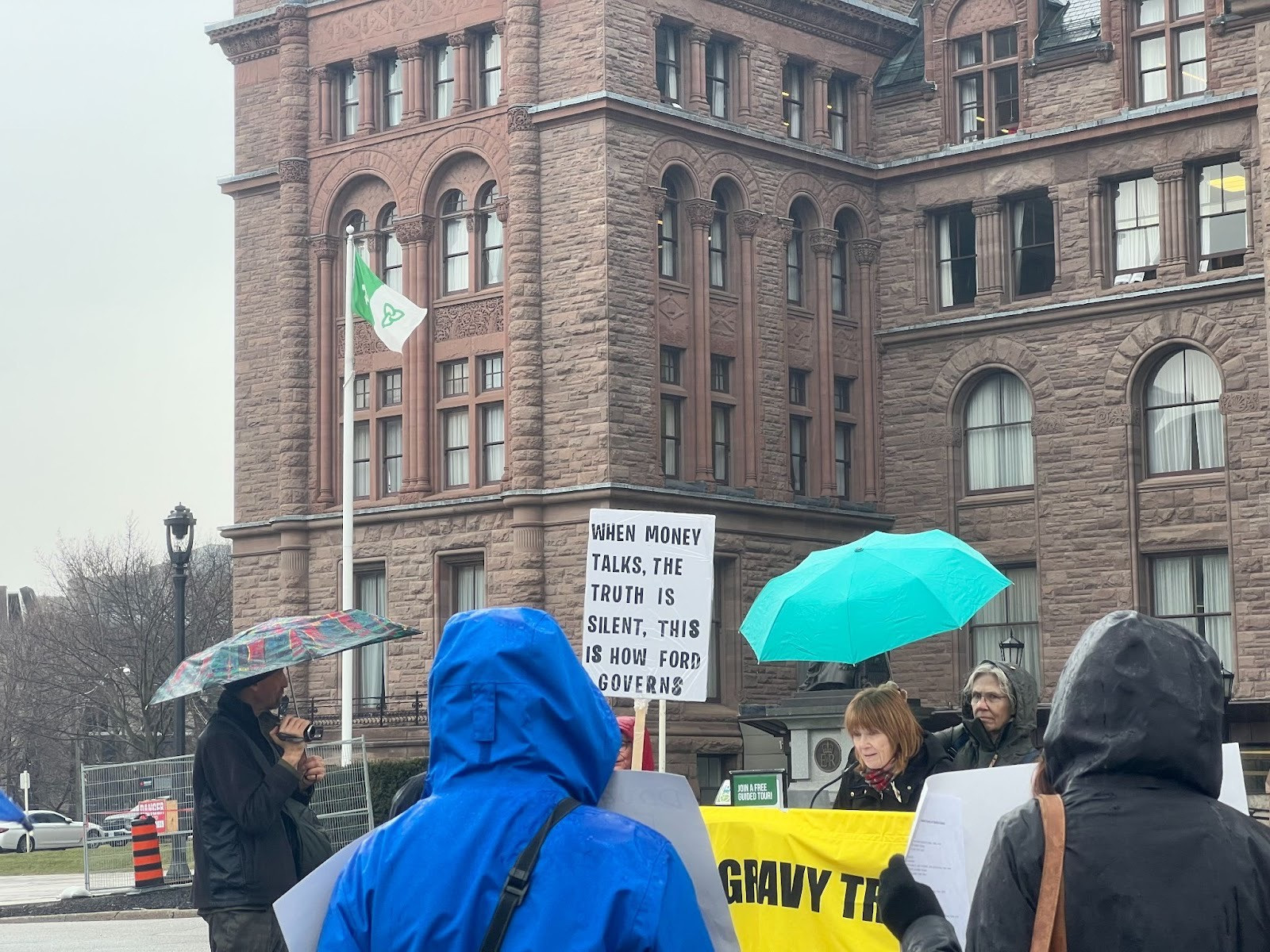
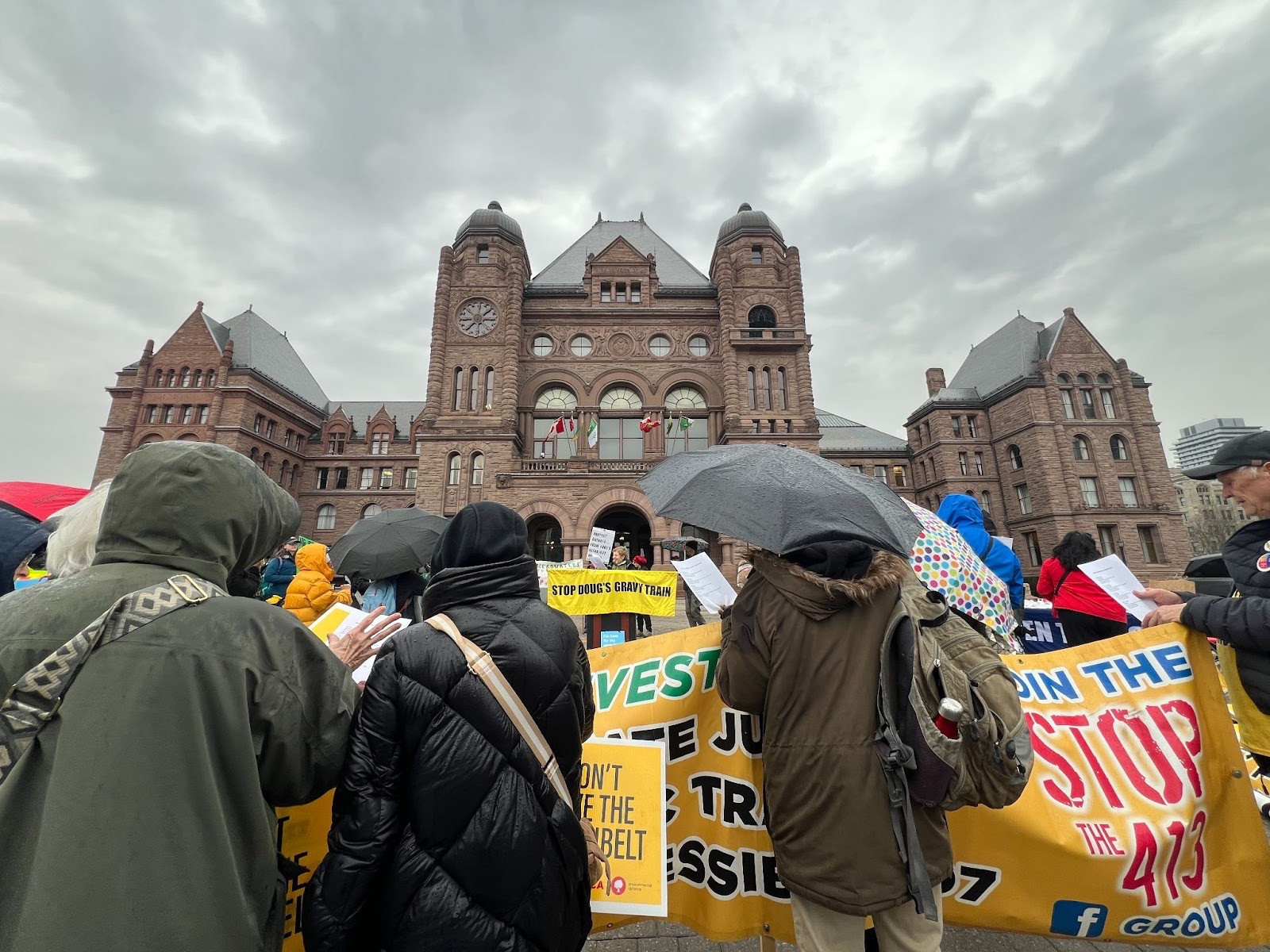
Grand(m)others Act To Save The Planet (GASP) is a grassroots, non-partisan group of grandmothers and grand 'others' who care deeply about the world the next generation will inherit.
(Anushka Yadav/The Pointer)
“Doug Ford is sending a message to everyone in this province struggling to keep a roof over their heads and food on the table: tough luck,” Ontario Green Party leader Mike Schreiner said.
“This budget shows exactly who the Premier is actually working for – PC donors, rich investors, and corporate giants in Toronto looking to make a buck off of everyday people.”
75 percent of Ontarians are concerned about rising debt interest charges as life continues to become unaffordable in the province, pushing many to seek better opportunities elsewhere. Between 2020 and 2024, 104,426 people left Ontario and migrated to other provinces in Canada, according to Statistics Canada data.
In November, Ford told a protester inside Queen’s Park to “go find a job” as a controversial housing bill (Bill 60) was being debated which made it easier for landlords to evict tenants.
In February, Ontario’s unemployment rate rose to 7.6 percent. In 2025, the average salary of an Ontarian was just over $63,000. That same year, Ford made $269,567.49 while the finance minister took home $213,939.75, according to the province’s recently released Sunshine list.
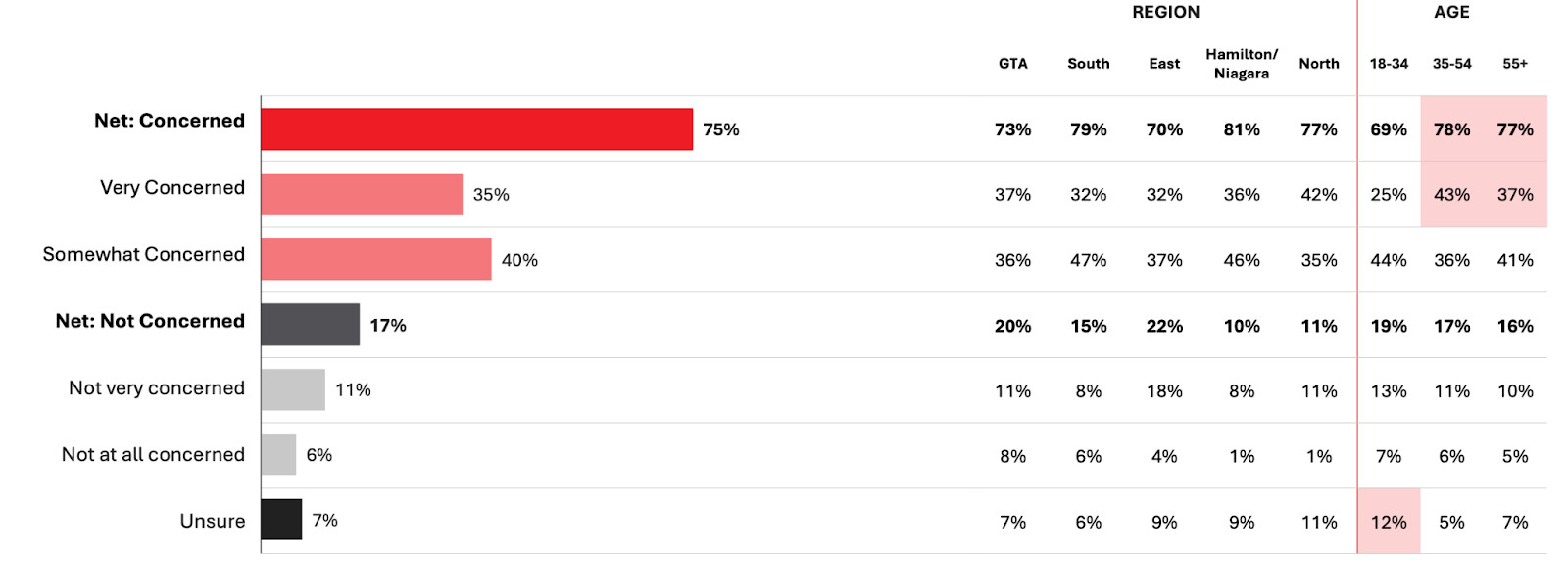
A November 2025 Leger poll revealed three-quarter Ontarians are concerned about Ontario’s debt interest charges.
(Leger)
“Years of government borrowing have driven the province’s debt interest payments to $16.2 billion, or about $1,000 per Ontario resident,” Jarvis noted.
“If debt interest were a ministry, it’d have the fourth-largest budget, higher than the post-secondary education budget.”
For Sun, the budget’s silence is louder than the numbers.
After abandoning Ontario’s climate targets by repealing parts of the Cap and Trade Cancellation Act last year, requiring the government to set targets for reducing greenhouse gas emissions and to create a climate change plan, the PCs conveniently omitted carbon pricing or emissions standards entirely in its latest plan.
There is “little on EV adoption” despite the federal government’s recently announced rebates of up to $5,000 for battery-electric (BEV) and up to $2,500 for plug-in hybrid (PHEV) vehicles.
“The grid in Ontario is already fairly decarbonized. This is an excellent environment for electric vehicles,” Sun noted.
Instead, Ontario announced a permanent reduction to the provincial gas and fuel tax rates, effective July 1, 2025, locking in a cut of 5.7 cents per litre for gasoline and 5.3 cents for diesel, bringing the rate down to nine cents per litre. The PCs claims the change will save families about $115 annually.
“There's no mention of Ontario's 2030 emissions target, which seems to suggest that it has effectively been abandoned,” Sun added.
“If this were a government that was sincerely intending to follow through on the Paris agreement that would be in there.”
In the Greater Toronto and Hamilton Area (GTHA), emissions increased in 2024 and 2025 due to building heating and transportation, failing to meet the required 11 percent annual reduction rate, according to The Atmospheric Fund.
In a special report, Auditor General Shelley Spence highlighted the Ford government was set to miss its 2030 target of reducing emissions by 3.5 megatonnes by “an even wider margin than projected”, driven largely by policies supporting the expansion of natural gas infrastructure.
Ontario was among the two provinces where extreme weather events fueled by climate change caused over $490 million in insured damage in 2025, according to the Insurance Bureau of Canada.
Northwestern Ontario faced one of the driest summers in 75 years as 77 percent of Canada experienced drought conditions.
Southern Ontario continues to lose its wetlands with over 72 percent already lost. Home to 133 at-risk species, the World Wildlife Fund estimates provincial inaction has opened the door to losing 98 percent of those species in the next 25 years — the province has gone a step further and replaced the Endangered Species Act with a watered-down version to open doors to unchecked mining and development.
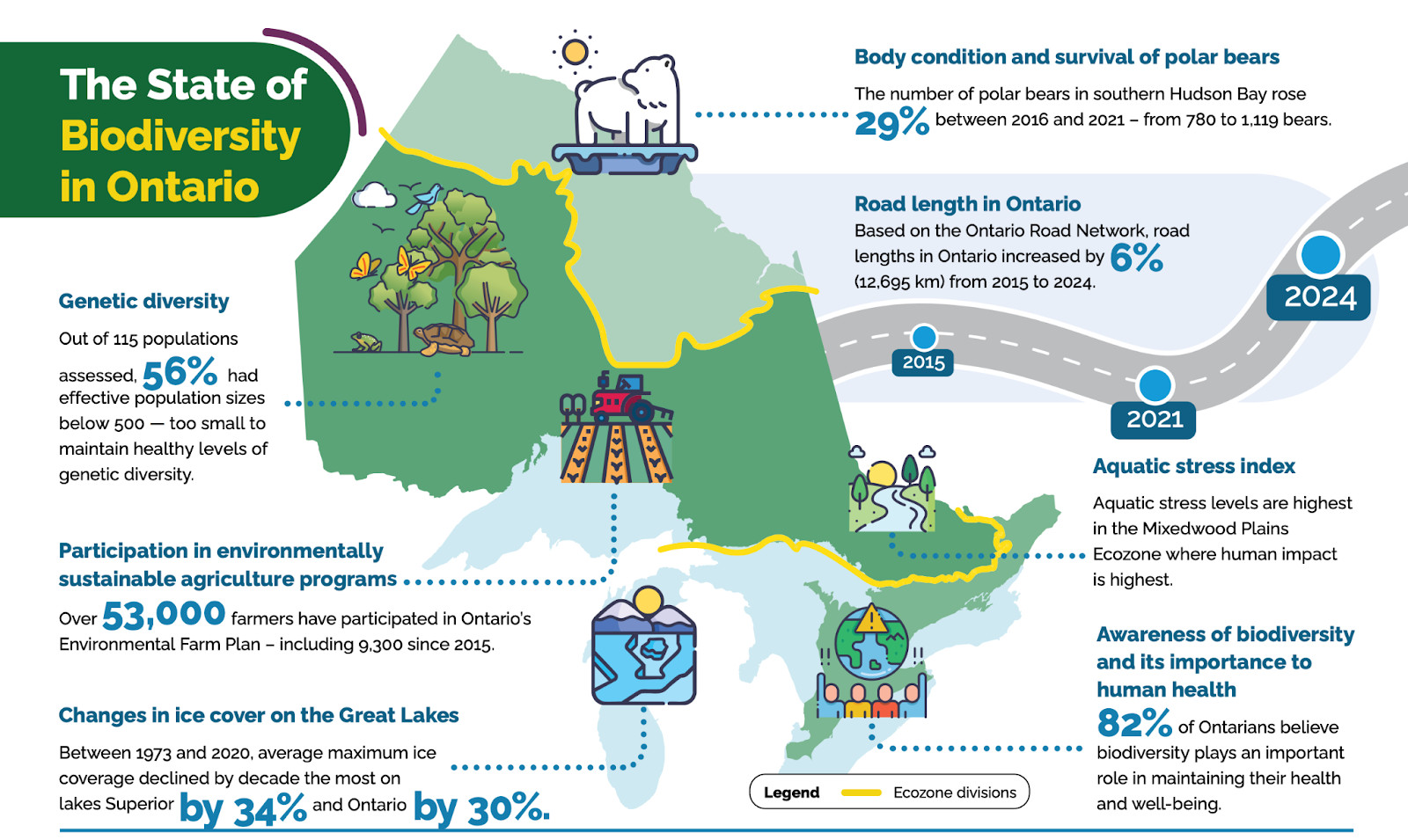
The 2025 State of Biodiversity report by Ontario Nature found between 2015 and 2024, Ontario’s road network grew by six percent (12,695 kilometres) while 56 percent of 115 assessed populations had effective population sizes below 500, too small to maintain healthy genetic diversity.
(Ontario Nature)
Yet, the word “environment” only occurs in conjunction with “economic” or “trade” and never as something that the Ontario government plans to protect or in which to invest, Environmental Defence Executive Director Tim Gray observed.
Similar to last year, the Ministry of Energy and Mines was allocated over $8 billion in funding while the Ministry of Environment, Conservation and Parks received just over $1 billion.
That imbalance may be justified, in part, by global economic pressures and geopolitical uncertainty. But viewed alongside a wave of recent policy shifts — including Bill 5 aimed at accelerating mining and development, building roads into the Ring of Fire, one of the world’s largest carbon sinks while weakening conservation authorities, pushing MZOs, privatizing water, stripping green development standards and local voices — the disparity becomes harder to ignore.
Ontario Nature Conservation Policy and Campaigns Director Tony Morris sees this as “outdated economics”.
The Financial Accountability Office of Ontario warned in 2023 that without adaptation, the province could face an average increase of roughly eight percent or about $2 billion annually in public infrastructure costs for every 1 degree Celsius rise in global temperatures beyond the 0.5 degrees Celsius baseline.
“We need economic solutions that work in harmony with nature, not in conflict,” Morris told The Pointer.
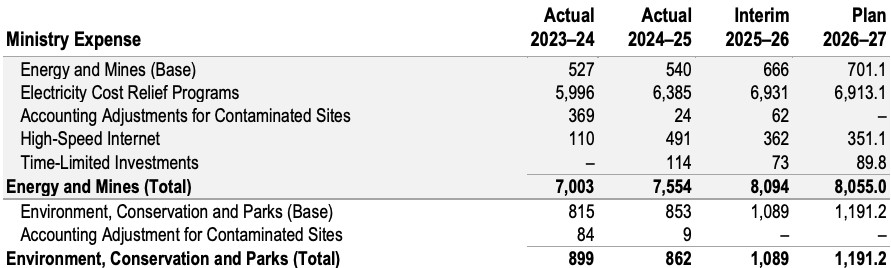
In the 2026 Budget titled ‘A Plan to Protect Ontario’, the Progressive Conservative government maintained over $8 billion in funding for the Ministry of Energy and Mines.
(Government of Ontario)
Like Gray, he noticed that despite being called “A Plan to Protect Ontario, nature and biodiversity are not mentioned once” in the budget.
“The government continues to fail to realize that strategic investments in nature are necessary to strengthening our economy, protecting communities and reducing long term costs,” Morris added.
Much like its 2025 predecessor, the Ford government’s latest budget arrives with no meaningful investment in environmental protection, no clear climate strategy and no roadmap for adaptation, just as Ontario heads into another summer shaped by climate extremes with wildfire season officially underway as of April 1.
“We are ready to protect communities from wildland fires, with all the necessary resources in place,” Minister of Natural Resources Mike Harris said in a statement.
“Our government stands behind the wildland firefighters, pilots and support staff that make up our frontline response and we will ensure they have everything they need for the upcoming fire season.”
But the numbers tell another story: funding for Emergency Forest Firefighting has been slashed by $121 million, dropping to $150 million in 2026–27 from $271 million the previous year. Overall funding for the Ministry of Natural Resources has also been reduced, falling from just over $1 billion to $889.5 million.
Ontario’s 2025 wildfire season saw nearly 6,000 square kilometres burned and 643 fires recorded, almost triple the ten-year average. The Canadian Interagency Forest Fire Centre deemed it the second-worst season on record, as flames pushed closer to populated areas such as Kawartha Lakes.
Veteran fire researcher Mike Flannigan warned climate change is a triple threat to wildfires: intensifying fuel, ignition and weather conditions, making the future increasingly “smoky.”
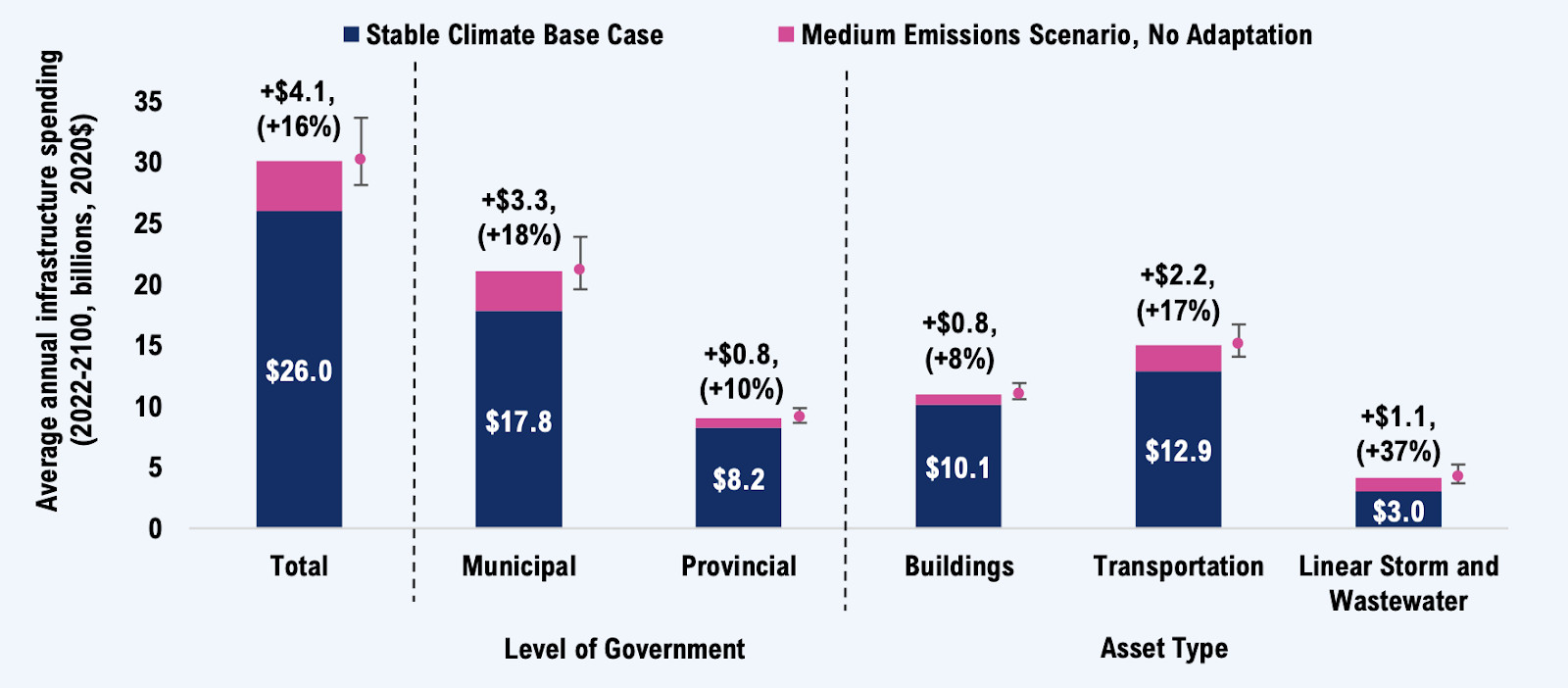
Climate hazards are driving up infrastructure costs: without adaptation, maintaining Ontario’s $708B public assets could cost an extra $4.1B per year and who will bear the brunt? Ontario’s municipalities will be managing over 70 percent of the portfolio at most risk, according to a 2023 Financial Accountability Office of Ontario report.
(Financial Accountability Office of Ontario)
With 2026 forecasted to be among the hottest years on record by Environment and Climate Change Canada, wildfires are not the only climatic beast awaiting Ontario…
Flooding keeps many residents in the province, including in the Region of Peel, up at night every time the clouds roar above their homes, fearing they will be flooded and the insurance nightmare will unfold once again.
This year, the province allocated flood-related funding primarily through the Municipal Housing Infrastructure Program’s (MHIP) Health and Safety Water Stream by $700 million for a total of $875 million to support 120 projects across 127 municipalities and First Nation communities to build, expand or rehabilitate aging water, wastewater, stormwater, flood and erosion infrastructure.
Municipalities can also access up to $1 billion in loans through the Infrastructure Ontario Loan Program’s Housing-Enabling Water Infrastructure lending stream, which can also be used for flood and stormwater mitigation projects.
At first glance, the funding may seem just enough but when compared to the insurance damage, it falls short: In 2024, Ontario floods caused over $1 billion in insured damages. The toll is made worse by emotional losses and the scramble for coverage with many homeowners discovering their properties are uninsurable or carry limited coverage.
The same story is playing out in Ontario’s health care system. On paper, the sector is set to receive $97.8 billion in 2025-26 but when accounting for inflation, population growth and seniors, that won’t be enough, rising just 0.5 percent before dropping 1.6 percent in 2026-27. A report by the Canadian Centre for Policy Alternatives predicts that with a $3 billion funding gap, public dollars will increasingly flow to for-profit surgical facilities and staffing agencies, forcing patients to pay out-of-pocket or rely on private insurance for care that should be publicly covered.
The environmental experts responsible for protecting Ontarians from flooding risks by acting as safeguards against unchecked development were instead short-changed in the budget as the PCs doubled down with plans to consolidate the province’s 36 local conservation authorities into nine regional bodies.
There was no new funding allocated for conservation authorities on top of the already announced $3 million for the new Ontario Provincial Conservation Agency, which critics say is far too little to maintain existing protections after years of consistently weakening their powers.
The only mention of climate change is a two percent allocation within the Green Bond program through which the province selected four projects to fund including GO Expansion, Hazel McCallion Line, Ontario Line Subway and the Scarborough Subway Extension.
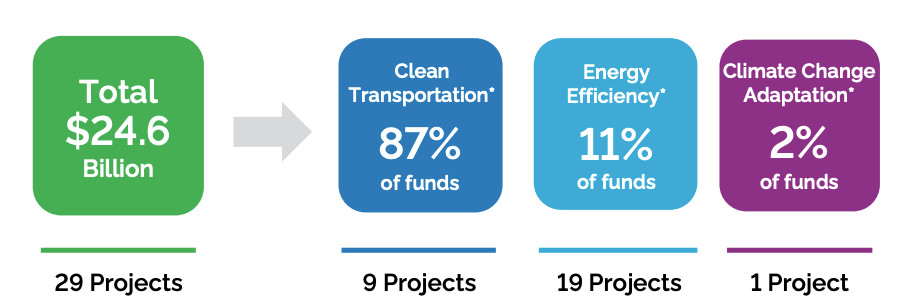
Ontario has issued 21 Green Bonds totalling $24.6 billion since 2014–15: 29 projects have received or are set to receive funding through these bonds, including the recently opened Eglinton Crosstown LRT, which secured $3.7 billion through ten separate green bond issuances.
(Government of Ontario)
But internal documents obtained by the New Democratic Party and shared with The Pointer reveal a starkly different reality behind the province’s flagship transit promise, first announced in 2018.
The long-touted GO Expansion, which was meant to deliver frequent, two-way, all-day service, could be delayed by as much as a decade, with key parts of the network still running on diesel and some lines facing slower travel times, not faster than 15 minutes — as promised by the PCs.
Originally slated for completion by 2032, the $27-billion transformation of GO into a rapid, European-style rail system now appears to have a scaled-back vision with electrification limited to portions of the Lakeshore lines while major corridors like Kitchener, Barrie and Stouffville are left out of near-term plans.
For decades, Ontarians have relied on the province’s Freedom of Information and Protection of Privacy Act (FIPPA) to uncover findings like this and track how public dollars are spent — that access could soon be curtailed by changes proposed under the budget bill.
Information and Privacy Commissioner Patricia Kosseim cautions the changes could severely weaken transparency and independent oversight.
It will retroactively shield records held by the Premier, cabinet ministers and their political staff, and give ministries more time to respond to requests amid ongoing legal battles over Ford’s personal cellphone records and longstanding disputes over disclosures.
On April 9, freelance environmental journalist Paul Webster, who has spent more than three years seeking records on land transactions tied to the proposed Highway 413 corridor, will be heading to the Ontario Superior Court to challenge the PCs.
Despite a 2024 order from the Information and Privacy Commissioner directing the release of the requested documents, the province has refused and is pursuing a judicial review and spending months of public resources to keep the documents secret under cabinet confidentiality already challenged by the commissioner.
The Pointer is also waiting on a decision about documents requested from Ottawa regarding Highway 413.
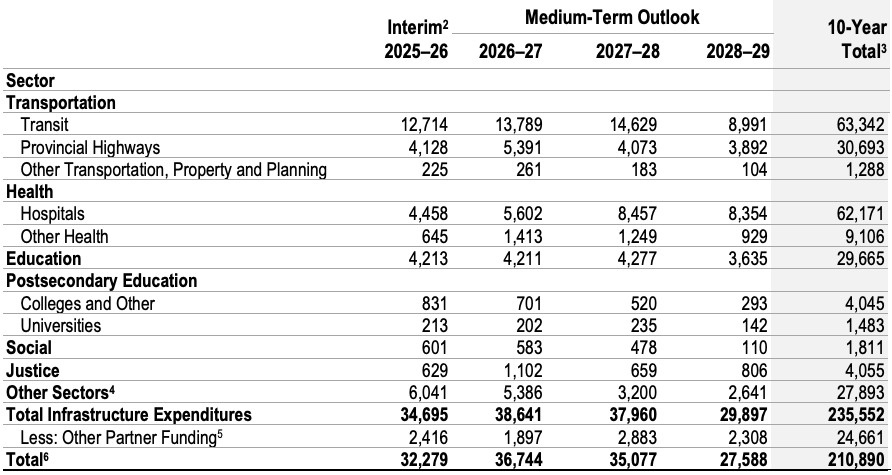
The Government of Ontario has reserved over $5 million in funding for provincial highways for the year.
(Government of Ontario)
Over the next ten years, Ontario plans to spend over $63 million on transit and more than $30 million on highways.
Sun pointed out that shifting more funding from highways towards public transit would have made more sense while also prioritizing transit reliability because “building more lanes and more roads doesn't fix traffic” — as reiterated in a recent report from Environmental Defence, stressing that Ontario’s $80 billion investment in new highways (Highway 413, Bradford Bypass, 401 Tunnel) will not reduce but rather exacerbate congestion.
The report used Highway 413 as a case study to demonstrate that investing $14 billion (the estimated cost of this highway) in transit has the capability of moving more than double the number of commuters per hour.
While Highway 413 continues to await federal permissions, the Ford government has often used the cover of “early construction” to claim that the highway is being built.
“North America has wasted untold billions of dollars building expressways in urban areas to solve gridlock – with no success. To accommodate its upcoming population growth, the GTHA needs to move in two bold new directions: (a) major transit expansion including new lines and better service, and (b) stopping urban sprawl,” Transport Action Ontario President Peter Miasek said.
But the province appears to be doubling down on its sprawl-focused agenda.
“The push for housing is good but it’s poorly designed,” Sun noted.
The PC government announced it was expanding tax relief for homebuyers by removing the HST [Harmonized Sales Tax] for some homes for only one year, saving taxpayers $2.2 billion.
There are two hurdles that come with the incentive.
Even with a lengthy list of fast-tracked legislation recently pushed by the government for putting shovels in the ground faster with minimal red tape, housing starts hit the lowest level in a decade.
“Because of the Premier’s refusal to accept that most family homes must be built as mid-rise and multiplex in existing neighbourhoods, his government’s promise of 1.5 million new homes by 2031 now seems virtually impossible,” Gray said.
Second, the housing crisis doesn’t call for more single-family units but the plan is focused on single-family homes, “even though housing density is crucial for city structure, livability, walkability, transit access and emissions reduction,” Sun added.
Gray believes making a blanket HST rebate rather than targeting mid-rise and multiplex infill housing, the budget’s central housing measure reveals the government’s continued refusal to acknowledge its role in creating the housing crisis.
On March 30, Minister of Municipal Affairs and Housing Rob Flack tabled another legislation meant to speed up housing — Bill 98, dubbed the Building Homes and Improving Transportation Infrastructure Act.
“Bill 98 is not going to speed up construction, nor reduce costs for everyday Ontarians,” The Atmospheric Fund’s Senior Manager of Climate Policy, Evan Wiseman, said.
He found it agonizing to see the fourth bill on this issue taking aim at municipal green standards, a tool that has led to healthier buildings with more affordable bills.
Quebec is increasing access to EV charging while British Columbia’s Energy Step Code, a tiered approach requiring new buildings to meet higher energy-efficiency performance standards, is guiding the industry toward net-zero energy-ready buildings by 2032 by focusing on envelope airtightness, mechanical systems and energy modelling to improve comfort and reduce emissions.
But “Ontario is going the opposite direction,” Wiseman emphasized.
“Why? What I see from industry lobbyists on these issues is out of line with what we hear from actual developers themselves.”
Years ago, former Minister of Municipal Affairs and Housing Minister Steve Clark, who resigned shortly after the Ford government’s greenbelt scandal came to light, had charted a path to bring industry, consumer advocates and energy efficiency advocates together — it was abandoned, leaving Ontarians worse off.
“What we will see after this is increased reliance on American gas in our homes and to rely on to turn on our lights, giving even more foreign control over our lives. Our bills will go up, and none of us will have a say in what our future communities will look like,” he predicted.
“It saddens me to see this debate devolve into villainizing municipal initiatives designed to reduce bills for Ontarians, make our communities livable, and to prepare our cities for our changing climate.”
Bethlenfalvy announced a $36 per month electricity rebate but critics don’t see as an affordability plan.
“Shifting costs from the ratebase to the taxbase isn’t a solution, since ratepayers and taxpayers are the same people,” Gray said.
“The real driver of rising energy costs is a grid increasingly dependent on expensive gas and unproven nuclear megaprojects that won’t deliver power for decades — costs that will land on ratepayers for generations.”
Even as Ford wears his “Canada is not for sale” hat, promising to reduce dependency on the United States, Ontarians won’t just be dependent on their neighbours for gas but also for Ontario’s bet on nuclear energy: the province’s planned Small Modular Reactor (SMR) project at Darlington uses a US-designed reactor (GE Hitachi’s BWRX-300) and requires enriched uranium fuel from American suppliers, leaving bubbles in the long-term energy security vulnerabilities.
Even though the province’s own energy agency, the Independent Electricity System Operator (IESO), has found that wind and solar can meet more than 99.5 percent of Ontario’s electricity needs (both baseload and peaking) at roughly half the cost of nuclear, the PCs have gone all-in on nuclear expansion. They unveiled a new site at Wesleyville and following in the footsteps of Mark Carney, are supporting investment in commercial-scale carbon capture, utilization, and storage (CCUS) projects.
Grandmothers Creese and de Groot were not oblivious to what the budget would bring.
“Do we expect this government to do what we’re asking them for a safer future for our kids and grandkids? No,” Creese had admitted earlier.
“But we’ll be here. We’ll keep fighting.”
Email: [email protected]
At a time when vital public information is needed by everyone, The Pointer has taken down our paywall on all stories to ensure every resident of Brampton, Mississauga and Niagara has access to the facts. For those who are able, we encourage you to consider a subscription. This will help us report on important public interest issues the community needs to know about now more than ever. You can register for a 30-day free trial HERE. Thereafter, The Pointer will charge $10 a month and you can cancel any time right on the website. Thank you
Submit a correction about this story

