
‘Huge gaps’ in Doug Ford’s data centre plan, advocates say. Tech companies could pay higher electricity rate
“People have to learn a lot more about data centres,” Ontario Premier Doug Ford said in the same breath as he critiqued municipalities that have bought more time to study the technology’s impact on the environment, energy use and human health.
“It's ironic that a municipality says, ‘I don’t want a data centre,’ but all my businesses need a data centre. They need AI. My hospital needs AI and everyone that lives in that community uses social media, uses computers. It doesn't add up.”
On July 29, Mississauga Council directed staff to draft an Interim Control By-law to freeze new data centre approvals after Mayor Carolyn Parrish acknowledged the Province and the federal government had “let us down” while talking about “data centres like they're better than sliced bread” without providing assistance or “any guidelines”.
Thirteen days later, Oakville became the first municipality in Ontario to unanimously approve a one-year moratorium on new data centres as Mayor Rob Burton said council was taking the “necessary measures” not “out of fear” but “to be alert” in the absence of provincial regulations.
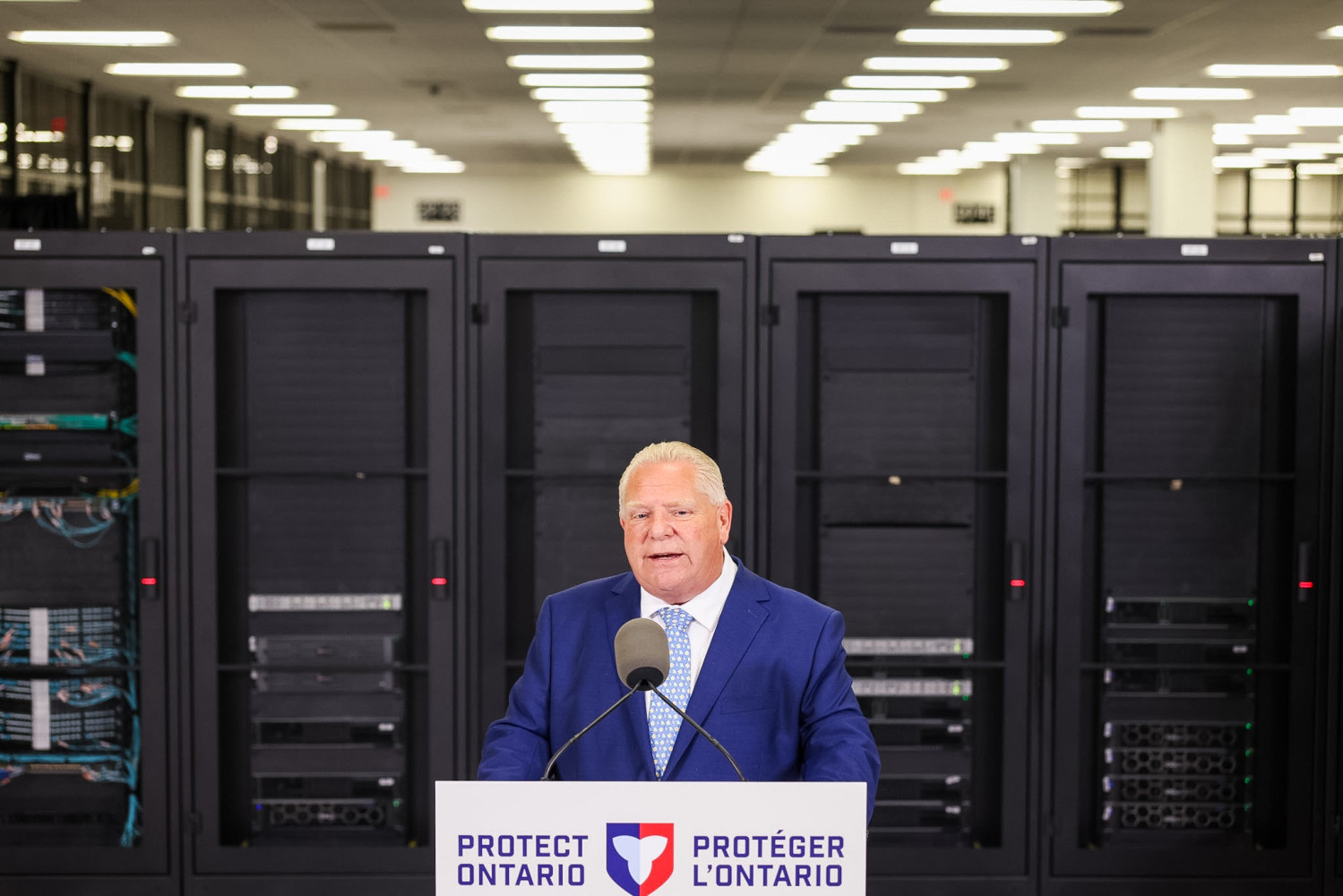
On August 13, against a backdrop of fluorescent lights and data servers, Ford released the province’s Data Centre Playbook — a week after the Green Party called for a province-wide pause on new data centre developments. The move, the PCs say, is to fill the gap that currently exists in provincial and municipal planning frameworks built long before artificial intelligence and the unprecedented demands hyperscale computing would place on water, energy and public infrastructure.

On August 6, Ontario Green Party leader Mike Schreiner was joined by Water Watchers’ Executive Director and Great Lakes Organizer Ilham Abdulkadir (far right), and Shelly Agius, co-chair of the Toronto chapter for The Council of Canadians.
(Anushka Yadav/The Pointer)
“Short-term knee-jerk reactions are no way to do governance,” Shion Guha, a University of Toronto professor and public-interest technologist who studies AI governance, critiqued.
“Municipalities trying to pass moratoriums are a knee-jerk reaction to citizens protesting, and the reason why citizens are protesting is because there is no governance on the books.”
He sees the latest announcement, which lacks details, as a “missed opportunity” that feeds into a “vicious cycle” of reactive governance.
The provincial policy framework, now officially under development, builds on Bill 40, dubbed the Protect Ontario by Securing Affordable Energy for Generations Act, giving the Ford government the final say over which large-load projects are permitted to connect to Ontario’s electricity grid, including data centres. The Playbook is intended to create an “evidence-based, transparent, and consistent” process to inform those decisions.
It is anchored in “three core principles”: data centres must make substantial financial and non-financial investments in Ontario and local communities, pay the full cost of their electricity use and receive only non-financial support from the Province to attract investment, according to a media backgrounder.
Ford emphasized that the guide will ensure “Canadians' data remains in Canada” for an industry that the Province claims will generate “$122 billion in economic growth and more than 17,000 new jobs every year”.
Under the proposed framework, projects would be assessed not only on whether they can connect to the grid but also on their impact on the electricity system, and on whether proponents are prepared to cover the costs of necessary generation and transmission upgrades.
The Province envisions data centres paying the full costs of their operations and grid expansion, preventing those expenses from being passed on to other electricity ratepayers. There is a possibility that decision-makers could consider restricting data centres’ eligibility for the Industrial Conservation Initiative or establishing a separate electricity rate for the industry.
“New data centres above 1 megawatt (MW) in size would pay a higher rate than the industrial rate program for large electricity users,” a provincial statement said.
While many experts have welcomed some form of guidance put forth by the Province, there are still many concerns that have gone unaddressed — ones Ontarians hope will be filled during the 30-day public consultation period that opened August 13.
For Guha, the playbook is a “step in the right direction” because it establishes a provincial process for evaluating data centre applications — “we had nothing before”.
“What the playbook does well is essentially say that we want data centres in Ontario but we don’t want every single data centre,” he told The Pointer.
“We want to have a process for adjudicating a data centre application because right now, those applications go to municipalities and a lot of the time, municipalities have no idea how to adjudicate them.”
He is, however, disappointed to note the lack of clarity on the scoring system for the “three pillars”. It is unclear whether each pillar will carry equal weight or whether economic development, for example, could outweigh data security or community investment.
Similarly, there is no distinction provided between different scales of data centres.
“The playbook does not contain any details, not even any mention about these scales of data centres, which is quite surprising because this is a huge part of the debate,” Guha said.
“A microscale data center could probably work well with one small closed-loop plant but a hyperscale might need 10 of those. So, what exactly exists in the current Ontario laws that would enforce these types of differences? — There's absolutely nothing.”
The distinction matters as it dictates how the Province plans to make a decision for a small, microscale facility, which cannot be assessed in the same way as a hyperscale project with a much larger footprint and electricity demand.
In Mississauga, for example, some councillors have referred to the proposed Prologis facility as a hyperscale data centre, while the company later emphasized that it is not. The site plan also mentions commitment to a closed-loop cooling system that continuously recirculates the same water or coolant to remove heat from the equipment, reducing water use and chemical discharge — a technology the Province promotes in its playbook as one way to reduce water consumption.
The Province claims it will ensure the next generation of data centres use technologies like closed-loop and waterless cooling, direct-to-chip liquid cooling, noise-reduction engineering and waste-heat recovery that are designed to reduce environmental and community impacts.
But it fails to explain how those commitments would be enforced, which is particularly important during the project approval process.
“There’s a carrot and a stick,” Guha explained.
“A carrot is, ‘We’re going to give them incentives to do these things,’ and a stick is, ‘If they don’t do these things, then we are going to take action.’ And the playbook doesn’t really have anything.”
If a company promises to build several closed-loop cooling systems and receives approval partly on the strength of that commitment, there needs to be a mechanism to hold the company accountable if it later fails to deliver.
“If the adjudication is done based on a promise, where’s that set of enforcement actions? That is certainly something the province needs to do,” Guha emphasized.
Ontario Data Centres Tracker creator Katie Steinfeld also highlighted that the Province has not provided any details surrounding water use, renewable energy and reporting requirements, and the rules around local zoning and site plan approval.
“The playbook is a grid connection framework. How a data centre gets approved on a specific parcel is still a municipal process, and in many cases that process requires no public meeting and no council vote,” Steinfeld noted.
It does not clarify the role, or lack thereof, of municipalities in having any meaningful ability to influence or challenge a proposed project.
“Municipalities should be able to say yay or nay to what's actually in their backyard,” Environmental Defence’s programs director Keith Brooks told The Pointer.
Even with closed-loop systems, the Province needs to ensure data centres are not approved in “water-stressed regions” where they end up competing with farmers, municipalities and other users for scarce water supplies.
Brooks pointed to Guelph, where the Premier inaugurated the playbook, as an example of a location where he believes a data centre should not be located because the region relies largely on groundwater and has a history of disputes over water use.
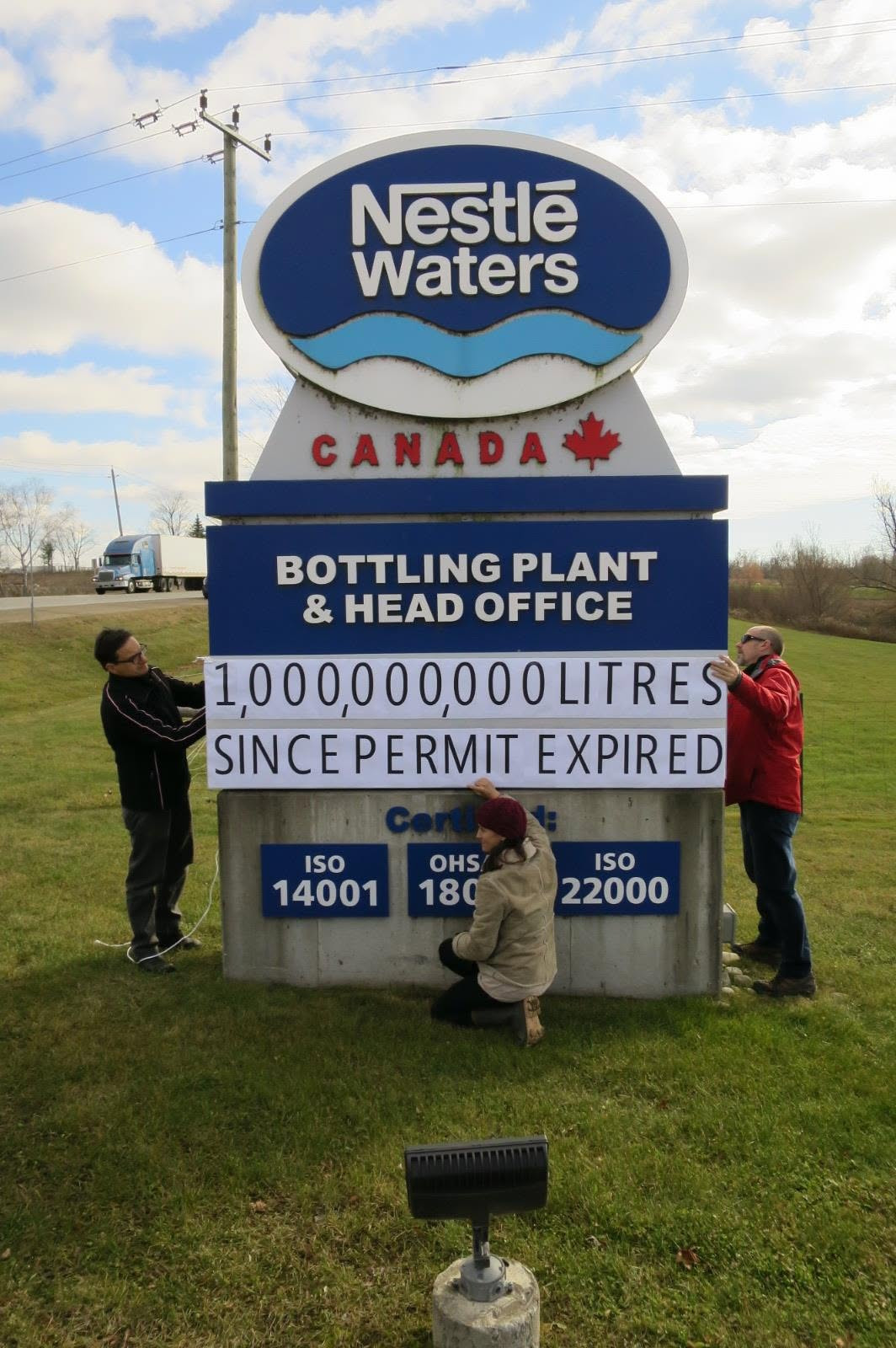
In Guelph, Nestlé’s high-volume extraction of groundwater from the Aberfoyle aquifer during droughts in 2016 sparked concerns that millions of litres were being pumped daily for bottled water while communities faced restrictions on water use. It led to local groups like Wellington Water Watchers and the Council of Canadians protesting that pumping millions of litres daily for nominal provincial fees threatened regional water security and sustainability.
(The Council of Canadians/Facebook)
The challenge extends beyond water. The province is “encouraging projects to build their own power generation” — but Brooks worries it could end up being a “lifeline for gas plants” if the government does not specify that the power generated must be low-emitting or non-emitting.
“There are huge gaps that you could drive a semi-truck through in what the Premier’s proposed,” Green Party leader Mike Schreiner told The Pointer.
While questioning the timing of the Playbook’s announcement, he agreed that the PCs haven’t actually provided the protections municipalities have been seeking; in fact, they might have simply outlined a set of aspirations without the regulatory teeth to enforce them.
“Almost everything they propose has no enforceable components to it,” Schreiner noted.
“It’s clear to me that he’s [Doug Ford] trying to cheerlead to advance the interests of tech billionaires at the expense of local communities without bringing in the kinds of strong protections for communities, for people and for our environment.”
This lack of structure also allows those sitting inside Queen’s Park to decide what qualifies as “economic growth” and shape public policy, the development of Ontario’s electricity grid and the direction of the province’s energy system.
“The Premier and his ministers are going to define what economic growth means,” Liberal MPP Ted Hsu said.
“Because the policies are not really specified clearly, the whim of the government is going to decide what economic growth means, and that’s going to allow the OEB (Ontario Energy Board) to consider something other than the interests of consumers.”
It feeds into the treatment of digital sovereignty in the playbook that asks projects to “preferably” be Canadian-owned and operated—that alone does not guarantee Canadian control over data.
“Just because something is built in Canada does not necessarily make it Canadian,” Guha noted.
“If a data centre is built on Canadian soil but the servers, the chips and the computers are not Canadian, the data inside might be Canadian but the models that run the data are not Canadian.”
The issue echoes longstanding debates around Indigenous data sovereignty, where control over data is central to the conversation: “An ordinary person would say, ‘If my data is in one of those data centres, then how can we call it sovereign if you actually don’t have any control over the data?’.”
Does the playbook mention Indigenous consultation, despite the possibility that data centre projects could be proposed near Indigenous territories?
“No, it’s all missing,” Guha said.
He reminded the playbook is “just a snapshot” or “blueprint for what the legislation could be” similar to the federal government’s launch of the ‘AI for All’ strategy in June — it does not have the force of law, at the moment.
Both Guha and Brooks observed that there is currently no timeline for turning the playbook into legislation. MPPs are not expected to return to Queen’s Park from the summer recess until October 27.
Without a clear timeline, municipalities could continue imposing moratoriums while the province works toward its own regulatory framework, creating further uncertainty over who has authority to make decisions.
“We're going to have 10 moratoriums from different local governments between now and then, and then the provincial government is going to come up with something that says local governments have no power to do moratoriums on this,” Guha said.
“There will be utter chaos…this is no way to do sustainable long-term governance.”
He is still coming to terms with the rationale behind AI adoption and the push for it by both levels of government, viewing AI and data centres as a way to boost productivity and stimulate the Canadian economy—when the evidence for those promised productivity gains remains weak.
“If the government is looking at AI as a big investment in Canada to boost the Canadian economy, that’s also very problematic,” he added.
“The government always says that introduction of AI will boost productivity and efficiency of services and reduce costs, and I can tell you that there’s absolutely no research ever confirming any of this.”
Guha questions, as someone who uses AI daily, whether it can actually increase productivity in many applications, when considering the amount of time users spend to “perfect” AI-generated work.
New research by Workday found nearly 40 percent of the time saved by artificial intelligence is lost to rework: For every 10 hours of efficiency gained, approximately four hours are wasted correcting errors, rewriting content and verifying outputs from generic tools.
The federal government claims AI adoption and commercialization are forecasted to “generate a 0.3 percent to 1.1 percent annual labour productivity increase even before the Strategy’s impacts” while some estimates for “generative AI alone add $187 billion annually to the Canadian economy by 2030 and create hundreds of new Canadian firms”.
“The government buys AI products from all the major tech companies, and those same companies are coming to the government and lobbying for their products, essentially saying, ‘Buy our products, tell your people to buy our products, and all your problems will be solved’,” Guha said.
“That is a major problem with big tech in general because these companies are looking for more applications for AI. But honestly, the best-case application for AI for the common public right now is only to use it as advanced Google search and nothing else.”
As reported by The Pointer previously, the Ontario Lobbyist Registry revealed at least five companies are actively lobbying the province in support of data centres.
In one instance, American alternative investment management company Blackstone lobbied at least nine ministers —including the Ministry of Energy and Mines and the Ministry of the Environment, Conservation and Parks— and four provincial ministries including the Office of the Minister of Indigenous Affairs and First Nations Economic Reconciliation in one instance.
With increasing lobbying efforts, public resistance has concurrently grown with at least five municipalities (Mississauga, Toronto, Burlington, Oakville and Hamilton) having artificial intelligence data centre proposals and/or moratoriums on their agendas, leading to Ontarians flooding council meetings.
Schreiner confirmed that the Green Party will continue its push for a province-wide moratorium on new data centres “until strong regulations are in place to protect people, communities, the environment, protect us from hiking up electricity prices or constraining our grid”.
“What the Ford government has proposed through their playbook doesn't even come close to the kinds of strong regulatory guardrails that are needed in Ontario,” he added.
But data centres are just one part of the debate; Guha argues Ontario and Canada need a rigorous regulatory framework for AI: “If we're going to make AI part of our national infrastructure, then we need to discuss ways to make our public institutions accountable.”
Email: [email protected]
At a time when vital public information is needed by everyone, The Pointer has taken down our paywall on all stories to ensure every resident of Brampton, Mississauga and Niagara has access to the facts. For those who are able, we encourage you to consider a subscription. This will help us report on important public interest issues the community needs to know about now more than ever. You can register for a 30-day free trial HERE. Thereafter, The Pointer will charge $10 a month and you can cancel any time right on the website. Thank you
Submit a correction about this story

