

‘Shut it down’: Mississauga residents fighting against first hyperscale data centre proposal
For nearly 20 years, Harbinder Khangura has called Mississauga's Black Walnut Trail neighbourhood home, raising his family of four in the peaceful, tight-knit community he thought would be the backdrop to the rest of their lives. Now, a proposed hyperscale data centre, among the largest data centres in the Greater Toronto Area, just a few metres from his property has unwillingly made him consider leaving the neighbourhood he once believed he would never have to.
“If I knew there was going to be a data centre, I wouldn't live close to one,” he told The Pointer. “If this application goes through, I might have to move. I don’t want to, though. I like my neighbours; we get together and have barbecues; I know everyone and it almost feels like a village.”
When Khangura moved to the neighbourhood in 2008, he knew it would not be quiet. Its proximity to Lisgar GO Station and Highway 401 was a trade-off he was willing to make, offering an easy commute to downtown Toronto by train.
But a recent conversation with a neighbour, just as May was ending, led him to learn about a proposal that could bring new concerns over noise, environmental impacts and property values, potentially upending the life he had scrupulously built.
On August 19 last year, Vaughan-based building consultants, Mainline Planning Services, submitted a Planning Justification Report to the City of Mississauga, on behalf of U.S.-based real estate firm Prologis, seeking approval for a Zoning By-law Amendment and Site Plan Approval to facilitate a proposed two-storey data centre of approximately 220,015 square feet at the northwest corner of Tenth Line West and Argentia Road.
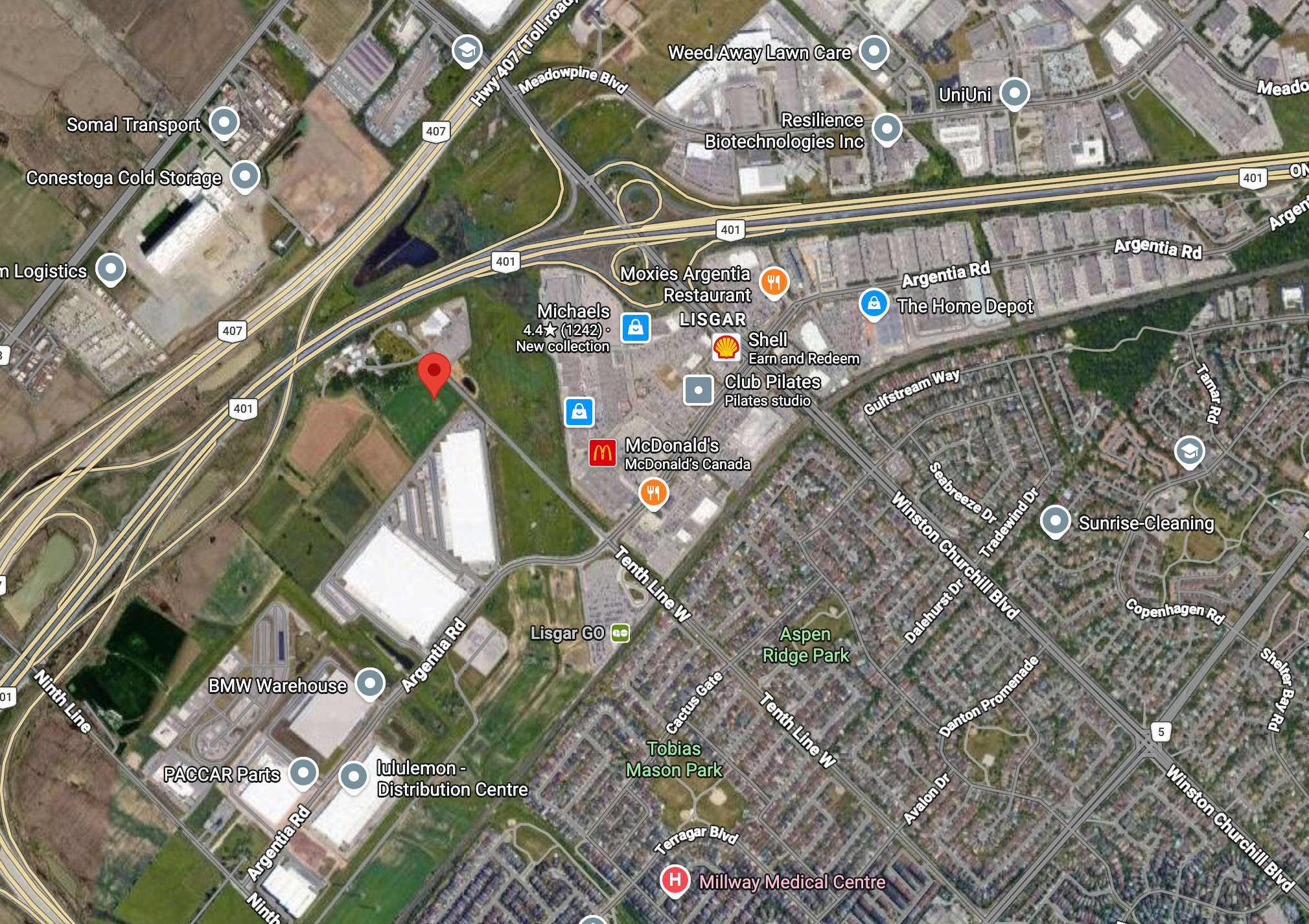
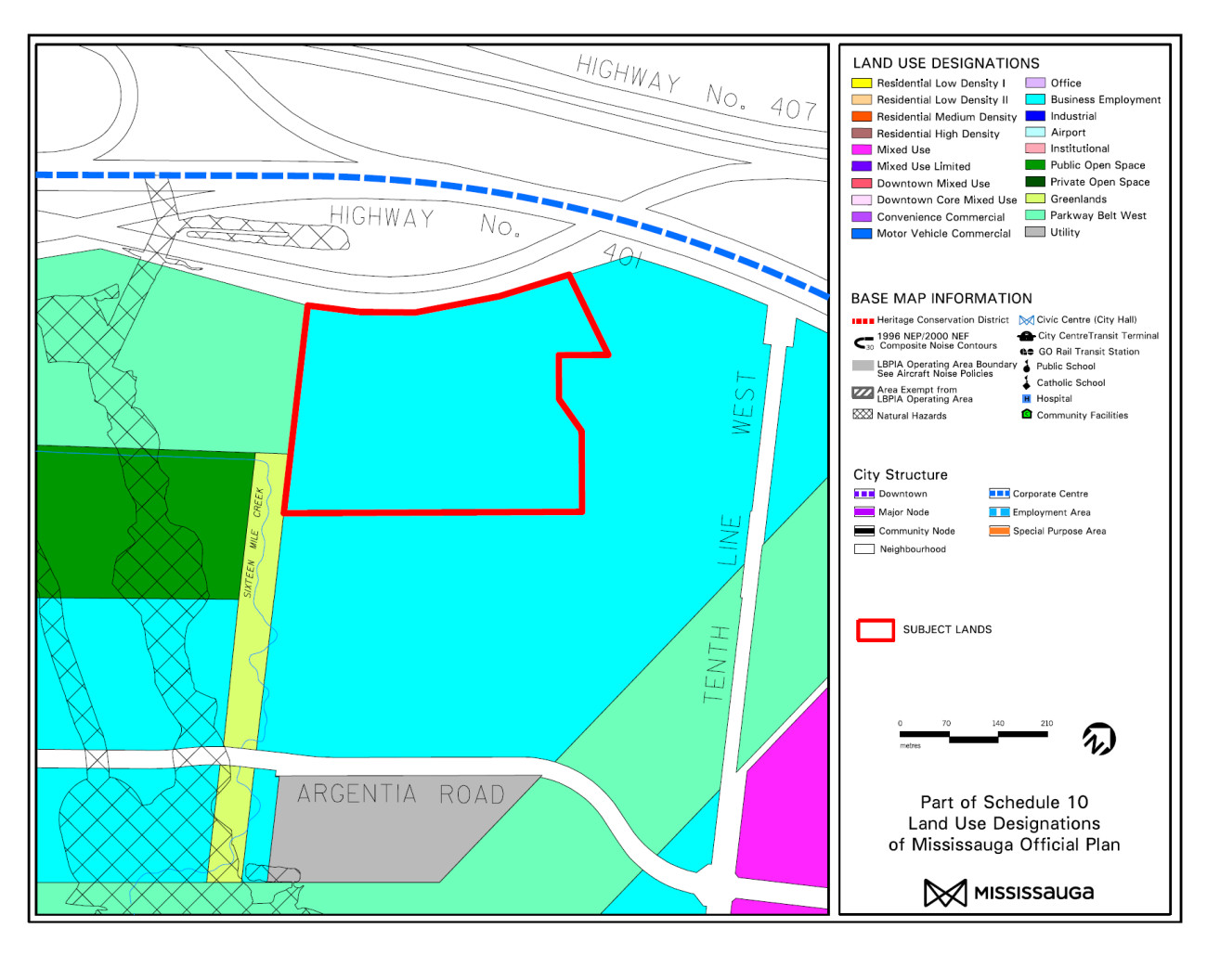
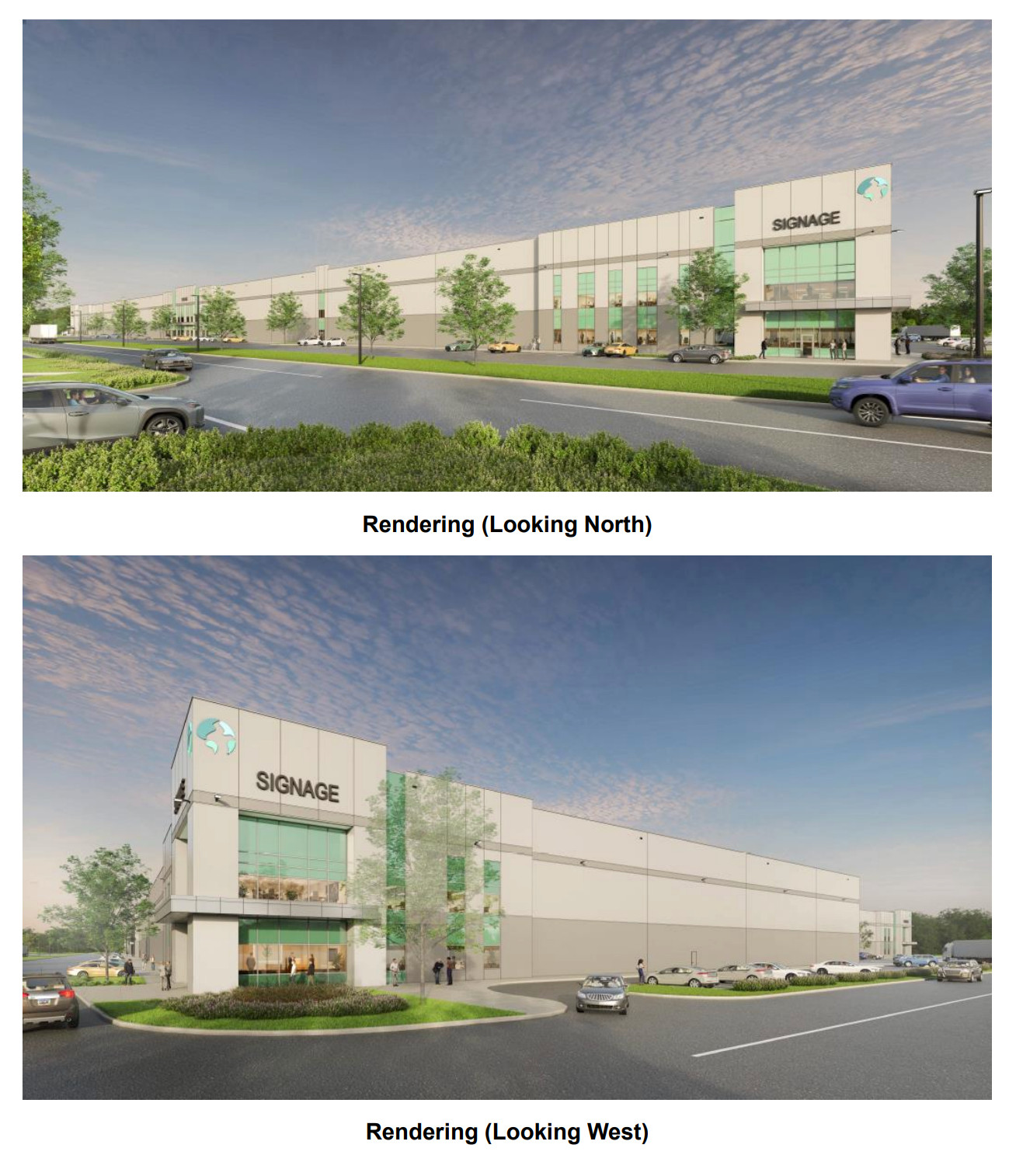
Two applications were submitted for the property with OZ 25-22 W9 proposing two one-storey industrial buildings on one portion of the site and OZ 25-21 W9 proposing a two-storey data centre on the adjacent parcel. “The applicant is in the process of satisfying severance conditions to create a new parcel for the data centre,” City Planner Connor DiPietro said at the June 25 Town Hall.
(FIRST IMAGE: Google Maps, SECOND IMAGE: City of Mississauga, THIRD IMAGE: Renderings from Prologis)
Two days later, the proposal appeared before the Committee of Adjustment, where it was reviewed as part of a consent application involving a proposed severance and lot addition linked to the redevelopment strategy for the site.
Planning staff identified the property as a largely vacant parcel within an employment area, noting its historical severance from the former Hustler farm lot and its strategic location within the Meadowvale Business Park Corporate Centre. The application proposed consolidating lands with the adjacent Prologis-owned property at 3255 Argentia Road to support future industrial expansion including warehouse development on one portion and the planned data centre on the retained lands.

The historic Hustler Farm, once Mississauga’s last working family farm dating back to 1838, was sold to Prologis in September 2024. The Hustler family retained the heritage-designated 1828 farmhouse, Sylvan Oaks, which is protected under the Ontario Heritage Act and was built circa 1828 by Jacob Scott. In 1978, the province earmarked the land as a potential corridor to build future 400-series highway infrastructure.
(Kyle Hanna/LinkedIn)
While staff confirmed the proposal was generally consistent with the Provincial Planning Statement and the Mississauga Official Plan and raised no fundamental objection to the land division, some technical, heritage and environmental constraints were highlighted.
Region of Peel’s development engineering team warned that severance may “adversely affect” existing water and sanitary sewer servicing, potentially requiring new service connections or private easements in compliance with the Ontario Building Code.
“The subject property is adjacent to a tributary of Sixteen Mile Creek and is adjacent to and may contain the flooding and erosion hazards associated with that watercourse,” Conservation Halton’s Planning and Regulations Analyst, Ashley Gallaugher, noted in line with the Conservation Authorities Act.
She highlighted that development within or near regulated areas required permits and compliance with natural hazard policies under the Provincial Planning Statement.
While Conservation Halton did not object to the application, it recommended that lands containing regulated or hazard areas be carefully classified and cautioned that future development would require site-specific flood hazard delineation and regulatory approval.
On December 8, the proponent submitted a zoning bylaw application to the City along with 44 technical studies and supporting reports for its proposal. (Once the zoning bylaw application is received, the City’s Planning and Building Department must bring forward a recommendation report to the Planning & Development Committee within a 90-day decision timeline as prescribed under the Planning Act.)
At the March 30 Planning and Development Committee, while presenting a joint report, City Planner Connor DiPietro explained the applicant is in the process of “satisfying consent conditions” to merge a portion of the site containing the industrial buildings with lands to the south while creating a separate parcel for the data centre.
“The applications seek to amend the zoning bylaw of the property from D8 development exception to E2 employment exception zones to permit the industrial buildings in the data centre,” DiPietro told the Committee.
The portion proposed for the data centre has an approximate frontage of 58 metres along Tenth Line West. He confirmed the proposed data centre would be classified as a warehousing use from an Official Plan land-use perspective since there are no sections designated for a data centre currently.
The staff recommended that both applications be referred back to staff following resubmission by the applicant to address outstanding issues including updating drawings to identify natural hazards and setbacks, redesign the data centre’s entrance and office frontage to face Tenth Line West, secure a land dedication for a stormwater diversion channel, confirm sanitary servicing connections for both development parcels and provide additional technical studies related to stormwater management, water demand, cooling strategy, parking justification and zoning compliance.
“I am supportive of this in principle. I'm really appreciative of the team at Prologis for walking us through this many times and being able to answer some more questions, and where they are in the process,” Ward 9 Councillor Martin Reid said, adding that the proposal would be “one of the biggest data centres in the GTA” and would bring significant employment and tax benefits—a stance he would change after three months.
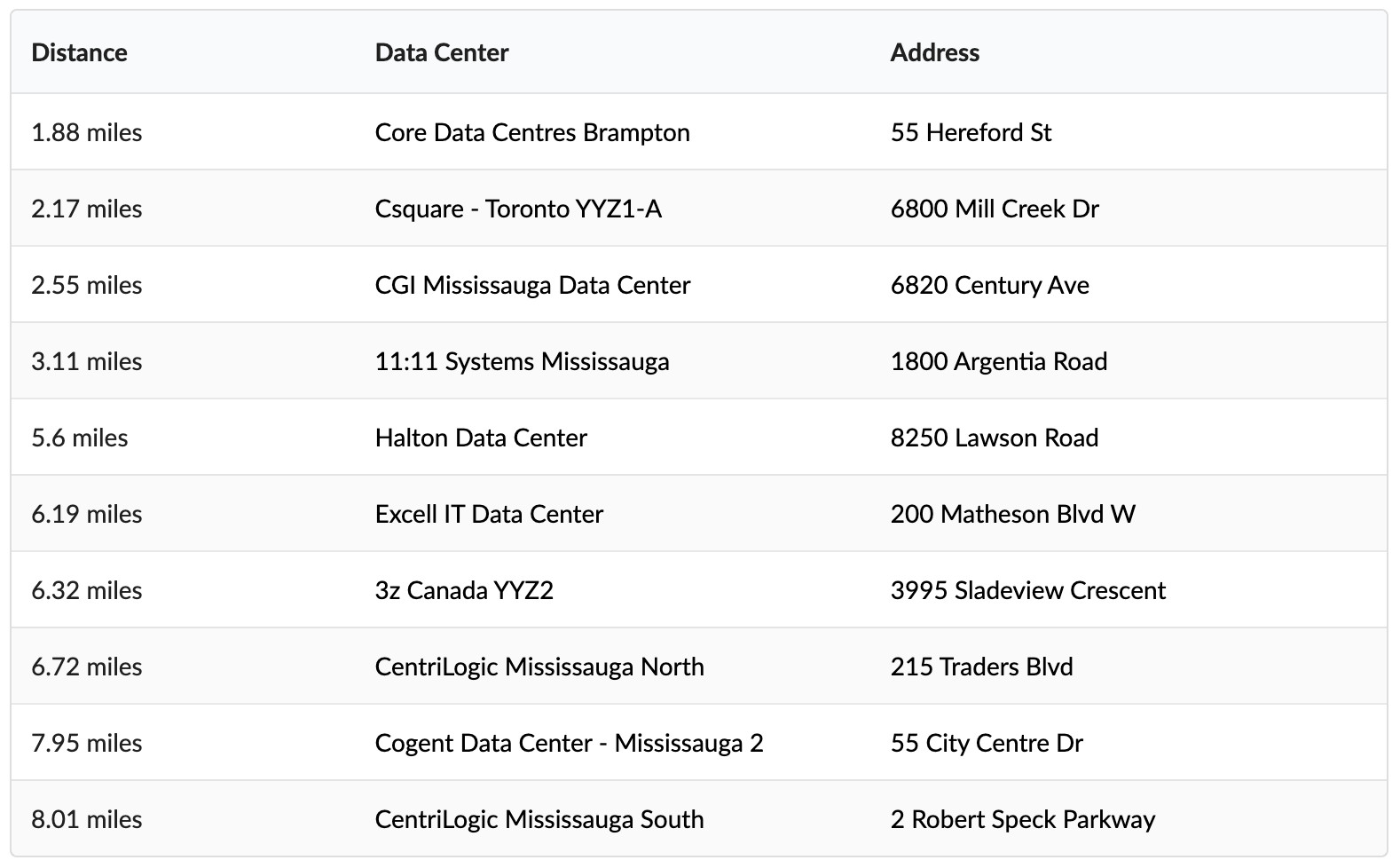
There are 10 data centres located close to 7564 Tenth Line West, but the proposed data centre is the City of Mississauga’s first application for a hyperscale data centre.
The City of Mississauga confirmed there are approximately five to seven data centres located in the city but “staff have yet to confirm that this use is still present on each site”.
“Staff will verify this information through the upcoming research (i.e. physical assessments/site visits) which will be included in the report to Council later this year,” the City shared in a statement with The Pointer.
“At this time, the Prologis application for the proposed data centre is the only such [hyperscale] planning application for a data centre the City is reviewing.”
A hyperscale data centre is a bigger computing facility designed for cloud, artificial intelligence and large-scale data workloads that houses millions of servers (often owned by technology giants such as Amazon, Google and Meta) while an enterprise data centre usually serves a single company, often for internal use.
Both zoning applications were then unanimously referred back to staff for further refinement and resubmission.
“Whoever turns down Prologis; haven't seen anybody yet,” Mayor Carolyn Parrish said after the vote.
Following the meeting, the applicant submitted revised plans addressing some staff concerns, but outstanding issues remained under review including utility requirements, parking, archaeological assessments and site design. Once resolved, planning staff will return to the Planning and Development Committee with a recommendation after which Council will decide on the application.
Prologis has a projected timeline of construction beginning from “September into end of 2028”.
In the meantime, a comprehensive review of the “emerging sector” is also being undertaken to include a detailed analysis and recommendations on how the City plans to manage data centres moving forward.
Much about the long-term impacts of hyperscale data centres remains uncertain, but a growing body of research is beginning to dig into the enormous environmental footprint underpinning the global push for artificial intelligence.
A new report by United Nations in partnership with Government of Canada found training advanced AI models can use tens of gigawatt-hours of electricity and hundreds of millions of litres of water while its everyday use to create prompts, images and videos accounts for 80 to 90 percent of AI’s total energy demand.
“Artificial intelligence can accelerate climate solutions. It can help cure disease, transform education, and enable humanity to tackle challenges once thought beyond our reach. We must harness that potential,” UN Secretary-General António Guterres said on June 23 at London Climate Action Week, when the UK and countries across the world were already grappling with record-breaking heatwaves.
“But AI is also hungry for land, water and power. The data centres behind it already consume more electricity than most nations.”
Across the globe, data centres used an estimated 448 terawatt-hours of electricity last year — projected to more than double by 2030.
“GPT-4 likely consumed 50 to 70 GWh of electricity over 100 days, roughly 40–55 times more than GPT-3 (1.287 GWh over a 34-day period)...equivalent to the annual residential electricity consumption of over 460,000 people in Sub-Saharan Africa,” the report noted. GPT-4 is OpenAI’s multimodal language model that can generate text using textual and visual inputs.
Physical AI infrastructure is also estimated to generate up to 2.5 million metric tons of e-waste annually by 2030, “equivalent to discarding nearly 250 Eiffel Towers every year”.
If current trends continue, data centres could consume nearly three percent of the world's electricity within the decade, alongside trillions of litres of water annually.
But that’s not the only trouble that this massive infrastructure brings with its existence.
In Chandler, Arizona, residents of the Brittany Heights neighbourhood spent years complaining about the constant hum from a nearby data centre that opened in 2014, saying the noise persisted day and night. After nearly a decade of community opposition, the City tightened its zoning rules in 2022 and it was not until last year that Council unanimously rejected another proposed data centre with noise concerns at the core of the debate.
The fear of such horror stories prompted residents in Hamilton to get together to protest against a waterfront data centre proposal by Slate Asset Management, prompting a planning committee to reject a land severance request in June. By June 16, the City’s Planning Committee unanimously supported a motion introduced by Ward 3 Councillor Nrinder Nann calling for a citywide pause on new data centres. On June 24, Council voted 15–1 to advance a formal moratorium, even rejecting exemptions for smaller research-oriented facilities.
The wave of people power has trickled to Mississauga.
On June 23, resident Camila Gargantini started a petition calling to reject the Prologis data centre proposal for Lisgar. Gargantini has since closed the petition and redirected visitors to sign the “Stop The Data Centre” petition instead.
Amid growing public outcry, the City convened a Town Hall on June 25 at the Erin Meadows Community Centre, drawing a room full of residents from Wards 9 and 10 including Khangura, who showed up to hear details of the proposal and voice their concerns as well as opposition directly.
Prologis’ Vice President Data Centre Preconstruction, Brett Skyllingstad, described data centres as secure facilities that house computer equipment and support everyday digital services.
“Each one of us interacts with a data centre every day,” he pointed to online banking, ATMs, healthcare systems and navigation apps such as Google Maps.
The proposed site was selected largely because it was “right next to the transmission lines”.
Traditional data facilities are designed for general-purpose computing (web hosting, databases, cloud storage and everyday enterprise applications) using standard Central Processing Unit-based servers that handle a wide mix of workloads. But AI data centres are purpose-built for intensive machine learning and generative AI tasks, relying on high-performance Graphics Processing Unit (GPU), Tensor Processing Unit (TPU) and other accelerators that can process massive datasets in parallel.
The shift in hardware is where the major differences in infrastructure lie: AI facilities need far denser computing environments, far more electricity and advanced cooling systems such as liquid cooling because of extreme heat output. They also depend on ultra-fast, low-latency networking to move huge volumes of unstructured data like images, video and sensor inputs between processors.
GPUs like NVIDIA’s H100 run really hot, operating around 87 degrees Celsius and can reach nearly 98 degrees Celsius before throttling or shutting down to prevent damage. Because sustained high temperatures reduce performance and hardware lifespan, data centres must rely on advanced cooling systems to keep chips operating efficiently and protect their investment. Air cooling alone is often insufficient, so operators use more intensive methods like liquid cooling to manage the heat.
While traditional data centres are also typically easier and cheaper to scale, AI data centres are more expensive and complex but can expand rapidly to meet surging computational demand.
Skyllingstad explained that the proposed project would use a closed-loop water system, meaning it is filled once at the outset and then continuously recirculates the same water, with no discharge into municipal sewers or the surrounding environment.
“The estimated maximum daily usage is about 2,000 litres, which is the equivalent to an entire hockey team showering after a game,” he said — gathering sarcastic chuckles and gasps from those attending the Town Hall.
“The Region of Peel has confirmed that there is existing [water] capacity in the system, and there will be no impact to residential use.”
In theory, a closed-loop system sounds self-contained: cold liquid is pumped through servers, absorbs heat from high-performance chips, then flows into a heat exchanger where it is cooled and recirculated again and again in a sealed circuit with no direct loss of fluid.
However, that’s only half the picture.
“The closed loop isn’t closed…It never was,” AI ethicist Masheika Allgood said.
To cool the heated liquid, the system depends on a second loop connected to chillers or cooling towers. Unlike the internal loop, this outer system is not closed. It uses large volumes of water and often relies on evaporative cooling, where heat is released by turning water into vapour. The process continuously consumes water that must be replaced.
So while one loop recycles fluid, the supporting cooling infrastructure draws and evaporates water at scale.
Water and Wastewater Infrastructure Planning Project Manager at Region of Peel, Gareth Clemens, noted while his team is taking a “rigorous review” of the proposal given global concerns about data centre water use, the Prologis project relies on a “closed loop” refrigeration system similar to those used in “a refrigerator or car” with only a “small amount of top-up water” required with an estimated demand of about 2,000 litres per day or roughly two cubic metres is relatively minor in scale: “That's like the size of a fridge”.
Clemens said the data centre would connect to a 300-millimetre watermain on Tenth Line, subject to Regional approval, limiting how much water can be drawn. The water comes from the Region’s treated supply at the Lorne Park Water Treatment Plant and is not discharged into the environment. Instead, it circulates in a mostly closed system with heat removed through air cooling and fans.
Skyllingstad added that their system will take around 275,000 litres or 72,000 gallons on the initial fill, which will be purchased through the Region of Peel.
Bill Bates, Vice President, Investment Officer at Prologis emphasized the facility did not rely on hybrid water-intensive systems. The system is cleaned before activation, treated with corrosion inhibitors and designed to circulate continuously without constant draining or refilling. The water use is largely limited to “toilets, showers, sinks, as well as a little bit of humidification”.
Khangura cautioned that “a closed loop system doesn’t mean water is not a concern” and discussions must also account for “startup and worst-case daily demand,” not just the estimated litres per day.
Regional staff explained applicants are required to submit a “maximum day demand” estimate, which is then tested through a hydraulic model simulating the entire water network to identify any potential pressure or flow issues. Prologis had provided its maximum demand figures, which, when run through the model, showed no concerns with existing service levels.
“We did not just accept the typical Region of Peel standards that we have as guidelines for water usage. We actually have them [Prologis] provide us with more specific calculations for what this data centre can realistically be using based on the closed-loop air-chilled cooling system,” Principal Planner, Development Services at Region of Peel, Joy Simms, said, highlighting that the region is not treating it as a “typical warehousing application”.
“Any designer, when you're looking at building any sort of a building, has to evaluate trade-offs, whether it's using an evaporative cooling system that uses a ton of water but a little bit less electricity, or a closed-loop system that uses a little bit more electricity but next to nothing for water,” Bates added, addressing electricity concerns.
However, residents shared anxieties about existing electricity constraints in the area, questioning whether local grid capacity could handle additional high-demand users like data centres without increasing costs or reliability pressures for nearby households.
Questions were raised about claims that the developer would fund necessary electricity upgrades, noting that power generation and transmission fall under provincial jurisdiction rather than municipal or local utility control. How were those upgrade costs going to be allocated through the system and would they be passed on indirectly to households through broader rate increases or infrastructure charges?
“These data centers are going to use unprecedented amounts of electricity and water and obviously, that's going to mean that we need to generate more electricity, have more distribution systems,” Ward 7 Councillor Dipika Damerla, who is also running for mayor in the October municipal election, told The Pointer.
“Who pays for it? And that's not clear. Because for me, these are for-profit companies run by billionaires and for me, the red line is there is no way that residential utility-payer should ever cross-subsidize these billion-dollar companies. That makes no sense.”
In Ireland, data centers consumed 22 percent of all electricity used in 2024 compared to five percent in 2015. The usage also outpaced the combined power usage of all urban households in the country, around 19 percent. In its pursuit to become Europe’s data centre hub, Ireland has hit the highest electricity costs in the region as major suppliers like Electric Ireland and Yuno Energy have instituted additional eight to eleven percent hikes for residential customers.
“Over the next ten years, they expect residential utility rates to go up by an additional $1,000,” Damerla added.
“This [Prologis data centre] decision is more than a zoning decision and I think what's regrettable is that the original lens was sort of a zoning lens but this decision really isn't about just land use or zoning; it's about what's in the best interests of Mississauga.”
While representatives from Alectra Energy Services were not present at the meeting, Councillor Reid read a letter from its chief executive officer, Brian Bentz, noting customers must submit detailed technical information including location, expected electrical demand, operating characteristics and timelines after which Alectra conducts an engineering assessment of available capacity, transformer station constraints and potential reliability impacts.
“Where existing distribution infrastructure has sufficient capacity to accommodate the proposed load, Alectra determines an optimal point of connection and identifies any customer-specific distribution facilities for local system reinforcements required to provide service,” the letter explained.
“The assessment also includes coordination with municipal planning including ensuring road allowance, utility corridors and existing municipal infrastructure are considered.”
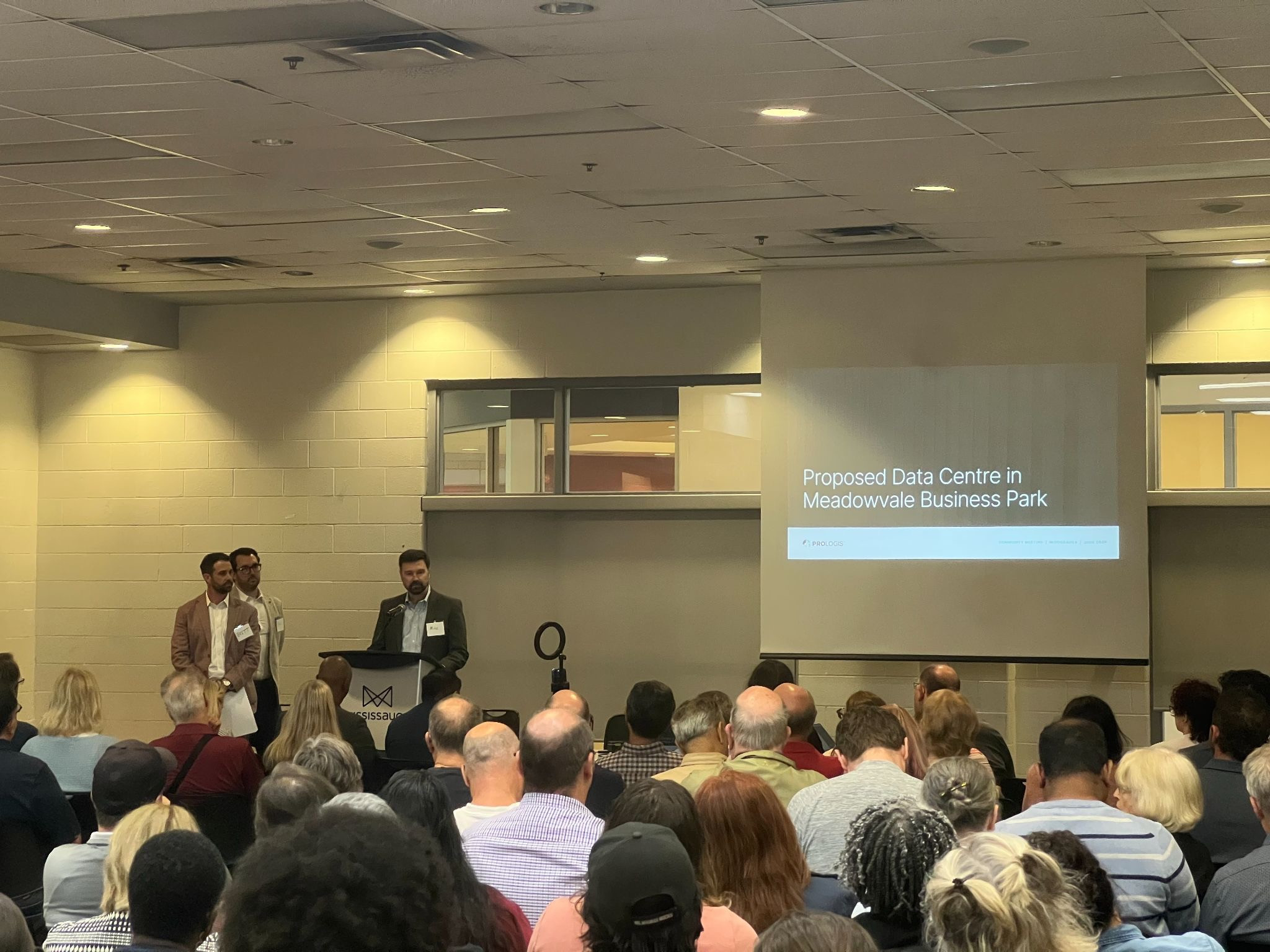
Three representatives from Prologis walked attendees through basic information about the proposed hyperscale data centre, but residents felt key details that relate to their concerns were missing.
(Anushka Yadav/The Pointer)
Ward 2 Councillor Alvin Tedjo, who has also thrown his name in the City’s mayoral race, said Mississauga’s grid can't handle the “mega centre’s” appetite for more than 100 megawatts of electricity — “enough to power 100,000 homes or ten percent of the city”.
“Alectra is already struggling to keep up with demand while trying to build the infrastructure for the future like future housing,” he said.
“The challenge is users are the ones that pay for the electricity, but all of us pay for the infrastructure. Now, I think Mississauga needs to be building a better future that obviously puts our families first, not the ones that fund the needs of American AI companies.”
The Prologis team attempted to reassure residents by saying they had experience developing data centres with the “exact same design” but that claim drew immediate pushback when it was revealed those reference projects were based in Texas and did not reflect the Canadian regulatory, climate or infrastructure context.
Residents living roughly 800 metres from the proposed site questioned the lack of detailed technical information, particularly around noise, water use and electricity demand and pressed the applicant to clarify why specific operating details had not been provided including expected decibel levels and duration of operations—if the developers had built similar models.
The applicant said third-party engineering studies showed the proposed facility would comply with municipal requirements and that generators could reach approximately 72 decibels at 23 feet with sound levels decreasing with distance and were designed to meet all applicable standards across HVAC, cooling and backup systems.
Staff added that the noise study was under review and would be made available for public inspection. But residents pressed staff and the Prologis team on whether those studies were done in different weather conditions given sound travels further during winter—they did not get an answer.
Residents also asked whether emergency operating scenarios (when multiple generators may run simultaneously) were considered in municipal and provincial noise exemptions.
City of Mississauga’s Executive Manager, Development North, Aiden Stanley, said the City has the ability to secure mitigation measures through the approval process as part of the noise study review and these requirements can be registered on title to ensure compliance.
Vionna, a young resident living steps away from Lisgar GO station and struggling with asthma, shared she is already sensitive to poor air quality and questioned whether impacts like diesel emissions, noise and other pollutants had been studied.
“Even when it's smoggy during the summer, I don't go outside. I can't,” she said.
“And I live in that neighbourhood, I walk in that neighbourhood and I'm wondering if that's gonna be something that I need to worry about on a day-to-day basis for construction. Will that limit my ability to go around the neighbourhood safely?”
The applicant responded that all equipment would meet existing Ministry of the Environment, Conservation and Parks regulatory requirements and environmental standards.
Beyond residential impacts, when apprehensions about environmental effects on nearby Meadowvale Conservation Area, potential heat island impacts and ecosystem stress were brought up, staff said they could be raised through the planning process and incorporated into future reporting.
Tedjo, a Credit Valley Conservation Board Member, said the agency has “just started looking” at the potential impacts and will be submitting comments soon even though it is not a “commenting agency”.
Attendees at the Town Hall expressed dissatisfaction about not getting any answers to their questions, but their frustrations mounted when they learned that Prologis does not even have a customer yet, prompting them to ask why the application was even being considered at this time.
“We're not an operator of these facilities, we’re a developer,” Bates said.
“We will work with any customer that's interested in what we develop…The local team will work with us to identify a customer for this data centre if it's approved. And it's not even necessarily an AI data centre. It could be a data centre for enterprise businesses. We just don't know because we do not yet have a customer.”
As one of the world’s largest warehouse owners and developers, Prologis made a jump into AI infrastructure in the last few years. Last year, the firm announced an $8 billion investment to build 20 new data centers over the next four years and possibly expand to 100 facilities.
“I see data centers as one of the largest value creation opportunities in the company’s history,” Prologis CEO Dan Letter said in an interview.
He is not the only one, and Mississauga is not the only municipality at the center of this stage.
On March 26, the provincial government launched a public consultation after receiving a request for a Minister's Zoning Order (MZO) from Matthews Canada, on behalf of QuadReal Property Group, to fast-track an 82-hectare employment development in Caledon.
“The requested MZO specifically seeks to permit a wide range of uses such as storage, warehousing, offices, data centres, industrial uses, manufacturing, transportation and trucking uses, motor vehicle related services, factory outlets, financing institutions, restaurants, and retail uses,” the ERO posting detailed, which closed on April 25.
The province also received a letter from the Minister of Economic Development, Job Creation and Trade expressing support for the proposal, stating the ministry backed initiatives that “contribute to job creation, industrial growth, and regional economic development”.
Even if the City of Mississauga shuts down the Prologis application, residents fear the Province may still have the authority to override local decisions since municipalities are “creatures of the province”.
This is not just an Ontario problem. It seems to be part of a larger global push in which governments, technology companies and business leaders have painted the rise and adoption of artificial intelligence as inevitable—at a time when climate change is no longer knocking on our doors, but violently bashing inside.
“AI is the greatest disruption of our time. It is here to stay, and we don't want to be left behind,” Prime Minister Mark Carney said.
On June 4, Carney unveiled a national artificial intelligence (AI) strategy, AI for All, backed by more than $2 billion in funding to accelerate AI adoption across the economy, especially among Canadian businesses from 12 percent to 60 percent by 2034 and create up to 250,000 AI-related jobs by 2031.
Prologis’s Director of Data Center Investments, Mike Kenny, said the announcement is a big reason why the Lisgar Data Centre is being put forth.
On June 18, at a Town Hall hosted by the Canadian Union of Public Employees (CUPE) about the Doug Ford government’s push for water privatization through Bill 60, Goldblatt Partners lawyer Simon Archer pointed out that since artificial intelligence itself is not a physical asset people can invest in, investors are increasingly directing their capital toward the data centres that power it.
The Maple-8, Canada's eight largest public pension funds, collectively hold more than US$6 billion in investments tied to data centre and digital infrastructure companies listed on U.S. stock exchanges.
On July 31 last year, Canada Pension Plan Investment Board (CPP Investments) announced it was committing $225 million to finance a 54 MW hyperscale expansion in Cambridge, Ontario and partnering with TransAlta and Brookfield to develop a major data centre at the Keephills power plant in Alberta.
While the wealthy continue to cash in on the supposed AI boom, residents continue to remind their municipal governments that they work for them, not foreign investors.
On July 29, Councillor Reid is expected to bring forward a motion to Council asking the City to pause new data centre applications for one year while staff develop a dedicated planning framework that reflects the unique impacts of these facilities.
“I believe we must get this right before making decisions that will affect our community for generations,” he said in a newsletter addressed to residents.
“After listening to residents, consulting with experts, and spending considerable time researching the proposal, I have concluded that this application should not move forward in its current form.
“While I initially supported further study of the proposal, the information that emerged throughout the process—including the limited long-term employment benefits, unanswered questions around energy and water use, noise impacts, and the lack of a planning framework specifically for data centres—led me to change my position.”
Councillors Tedjo, Damerla and Sue McFadden have also expressed support for a one-year moratorium on megascale data centres.
Meanwhile, Khangura says he will continue to knock door to door, spreading awareness about the project since many of his neighbours are still uninformed about the issue and its potential impacts on their beautiful community.
“I'm not against technology. I’ve worked in technology for over 25 years, but the effects of the choice of location is not something I agree with,” he added.
“I just hope that Council shuts it down because it's not a good idea.”
Email: [email protected]
At a time when vital public information is needed by everyone, The Pointer has taken down our paywall on all stories to ensure every resident of Brampton, Mississauga and Niagara has access to the facts. For those who are able, we encourage you to consider a subscription. This will help us report on important public interest issues the community needs to know about now more than ever. You can register for a 30-day free trial HERE. Thereafter, The Pointer will charge $10 a month and you can cancel any time right on the website. Thank you
Submit a correction about this story

