
Mississauga becomes first Ontario city to pause new AI data centres, but proponent likely to appeal
A Mississauga Council decision Wednesday is being heralded as a victory for sustainability in the face of technology’s relentless consumption of finite resources.
It could be short-lived.
The company behind a push to construct a Mississauga-based data centre is already vowing to challenge the decision by locally elected officials.
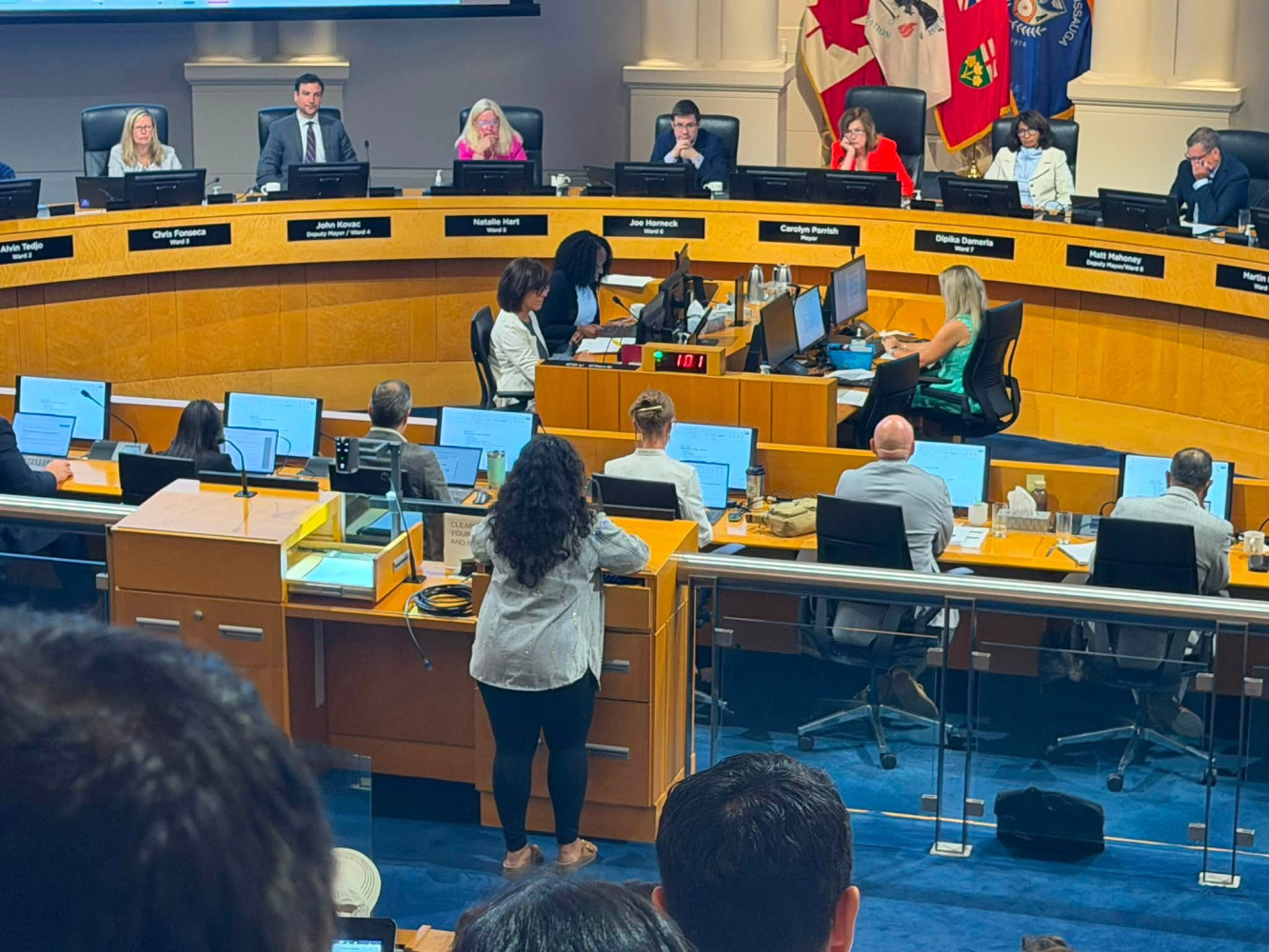
Just a month after residents packed a town hall to voice concerns about Mississauga’s first AI data centre, many returned to City Hall, where more than 20 delegations and over five hours of debate concluded with council voting to pause new data centre developments for one year—becoming the only municipality in Ontario to do so.
The decision to pause any approvals for at least twelve months came after residents raised questions about the scale of the operation, the impact on local water resources, the electricity drain on the city’s grid, air and noise pollution, the actual density of hardware in the facility and numerous other matters which illustrated just how little is known about these spaces that distant technology corporations seek to plant around the globe.
On August 19 last year, Vaughan-based building consultants, Mainline Planning Services, submitted a Planning Justification Report to the City of Mississauga, on behalf of U.S.-based real estate firm Prologis, seeking approval for a Zoning By-law Amendment and Site Plan Approval to facilitate a proposed two-storey data centre, approximately 220,015 square feet, at the northwest corner of Tenth Line West and Argentia Road.
Since then, the proposal has moved through the City’s Committee of Adjustment and Planning and Development Committee where staff confirmed the proposal was generally consistent with the Provincial Planning Statement and the Mississauga Official Plan, with no fundamental objection to the provisional proposal.
However, some technical, heritage and environmental constraints were raised along the way including staff’s need to analyze “emerging sectors” to manage data centres moving forward: while Mississauga currently permits data centres in designated Employment Areas, the City's zoning framework does not specifically define them; instead, they are classified under “Warehousing, Distribution and Wholesaling or Science and Technology Facilities” rather than as dedicated AI infrastructure.
Data centres have exploded around the globe as the use of machine learning and computer-generated applications and processes proliferates. The amount of water and electricity needed for the massive spaces that store all the data created, and house the increasingly expansive server infrastructure required to maintain system-wide-scale computational power, has raised concerns among advocates and experts who question the sustainability of these rapidly developing technologies.
Fairness is an emerging issue: who should pay for the mass-scale resources needed to power the facilities that will power our new world? Technology companies are making billions of dollars in profits, while taxpayers are increasingly expected to underwrite these handsome returns.
“We've been aware of data center development as early as 2010, but they were much smaller in scale,” John Farner, an executive with the U.S.-based Lincoln Institute of Land Policy, a non-profit that researches the implications data centres have on water and electricity resources, told Time Magazine last week. “What we're seeing now, especially with the advent of hyperscale data centers, is that they're much larger, much more powerful. They're much more resource intensive.”
Prologis is a multinational warehousing property management and ownership giant based in California, and has previously bought up hundreds of acres of Peel agricultural land in Caledon for conventional warehouse development.
The company’s Senior Vice President of Data Centre Investments, Alireza Harandi, maintained that the proposed facility is not a “hyperscale AI data centre” with a “peak demand of 40 megawatts” (what roughly 20,000 to 40,000 homes use) and “no planned expansion”. At the June 25 Town Hall, Prologis executives mentioned not having a customer yet for the site but Harandi said the company is currently in talks with a potential customer.
Medium-sized open-loop data centres can use the equivalent amount of water as 50,000 people. Data centres were responsible for four percent of American electricity consumption in 2024, a figure that is expected to more than double in less than half a decade. Electricity prices have almost tripled in some jurisdictions where data centres have been welcomed in large numbers.
The proposal for Mississauga involves a closed-loop water system, according to the proponent, and only 2,000 litres of water would be used daily, the amount a hockey team requires to shower after a game, according to the company’s claims. An initial requirement of 275,000 litres of water, to fill up the closed system, would be purchased from the Region of Peel.
In a statement shared with The Pointer Thursday, Peel Public Health noted it is “currently reviewing available information and evidence to assess whether there are any public health considerations associated with data centre operations” in consultation with Public Health Ontario.
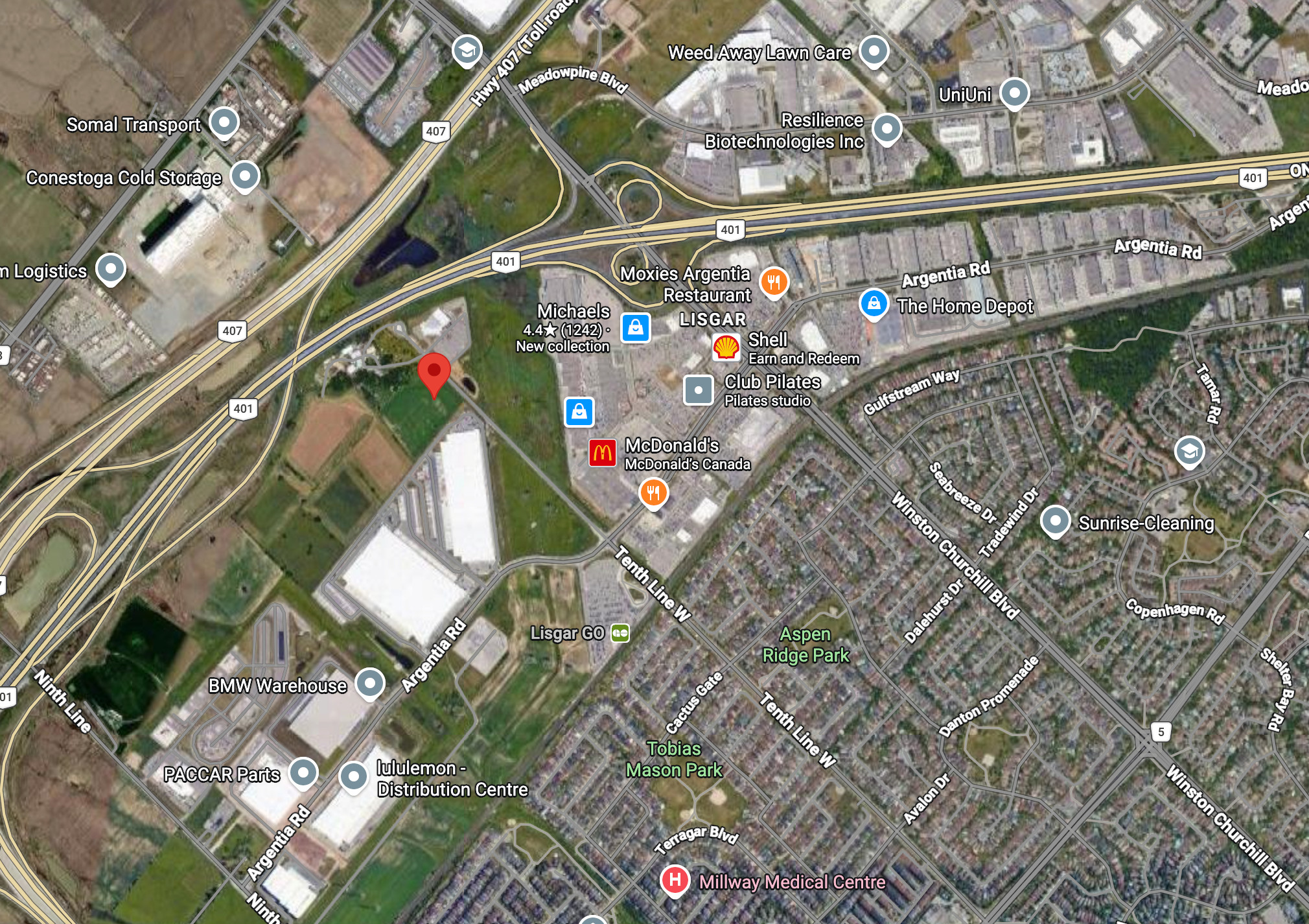

Two applications were submitted for the property with OZ 25-22 W9 proposing two one-storey industrial buildings on one portion of the site and OZ 25-21 W9 proposing a two-storey data centre on the adjacent parcel. “The applicant is in the process of satisfying severance conditions to create a new parcel for the data centre,” City Planner Connor DiPietro said at the June 25 Town Hall.
(FIRST IMAGE: Google Maps; SECOND IMAGE: City of Mississauga; THIRD IMAGE: Renderings from Prologis)
“I am no expert in data centres. This process made it resoundingly clear to me that none of you are either,” Ward 9 resident Ashly Batista told City Council, candidly, on Wednesday.
“Your glowing and unanimous advancement of a hazardous project that you blatantly misunderstood made the approach to this year's elections very frightening for me.”
She did not just speak in favour of the motion calling for a moratorium put forward by Ward 9 Councillor Martin Reid, who was initially “supportive” of the Prologis proposal “in principle”, she also prepared a detailed petition with over 1,600 signatures from residents who “unwaveringly” supported a city-wide data centre pause.
“Mississauga stands together on this issue,” Batista said.
“It is clear that we lose nothing from a one-year pause for clarity. Conversely, all it takes is one improperly assessed and approved data centre to ruin the lives of thousands of your residents.”
Harandi, warned the company would appeal the decision at the Ontario Land Tribunal (OLT).
“We want to work with the City in developing a thoughtful framework for future data centre proposals,” he said.
“The question today is whether the study requires a city-wide prohibition that would also apply to an application already deemed complete and undergoing detailed technical review.”
Harandi, a San Francisco resident (as stated on his LinkedIn profile), asked council to pursue a “practical middle ground” by directing staff to report back “no later than December” on the scope and implications of any “Interim Control Bylaw” that would effectively prevent such applications from being approved for at least one year. He argued that an interim control bylaw would act as “a blunt instrument” halting an application already well into the City's review process.
“While this application continues through the existing review process, during that defined period and subject to an agreed process, Prologis is prepared to refrain from filing an appeal and to continue working with staff, the Region [of Peel] and residents,” he added.
“That approach gives council time to study future policy without prejudging the project, suspending established review process or treating every data centre as though its scale, design and impacts are identical.”
Staff cautioned that a city-wide freeze could have broader implications for businesses already operating or expanding data centres in Mississauga—with impacts that are not yet fully understood.
“The city was not built to serve one unusually demanding unit. Every business should have a fair opportunity to invest in Mississauga—this is true but no business should be permitted to consume unreasonable shares of public infrastructure,” resident George Tavares, who is running for Ward 7 Councillor, said.
Similar fears of scaring off billions in technology investments resulted in Hamilton City Council rejecting a one-year moratorium on AI data centres in a 10-6 vote on July 15 after the municipality was one of the first in Ontario to consider a pause.
“Our province has let us down and the Feds have let us down,” Mayor Carolyn Parrish critiqued.
“They're talking about these data centres like they're better than sliced bread but they're not giving us any guidelines. They're not assisting us in any way and they're not answering your questions.”
On December 11, Ontario became the first province in Canada to introduce legislation specifically governing new, large electricity-intensive data centres seeking access to the provincial grid after it passed Bill 40, the Protect Ontario by Securing Affordable Energy for Generations Act.
Bill 40 gave the Province the authority to prioritize and screen new, large energy-intensive data centres seeking connection to the electricity grid, adding economic growth as a core objective for the Independent Electricity System Operator (IESO) and the Ontario Energy Board (OEB) by amending the Electricity Act, 1998 and the Ontario Energy Board Act, 1998.
“We want to see community benefit and community support. We want to see the power costs paid 100 percent by the companies and not borne by everyday families and ratepayers,” Ontario Minister of Energy and Mines, Stephen Lecce, said at a press conference on July 28.
Even though Queen’s Park reassured Ontarians that new data centres will only be connected to the provincial electricity grid if companies agree to cover the full cost of their energy use, critics have pointed out the regulations (currently being drafted) needed to enforce that commitment have not yet been finalized.
“Municipalities recognize that domestic data centres are strategic opportunities to improve Canada’s data sovereignty, cybersecurity, and high-tech sector,” the Association of Municipalities of Ontario’s submission to the Bill 40 Environmental Registry of Ontario noted.
“At the same time, municipalities are concerned that the high utility demand that data centres place on finite and in some places, already-strained, local capacity could lead to data centres ‘blocking’ other high priority projects.”
The Canadian Union of Public Employees (CUPE) has also expressed concern that the legislation “opens the door to the provincial government paying data centres’ electricity bills with public funds” while the growing demand from large-scale data centres could eventually place more pressure on the electricity system, contributing to higher costs for other users.
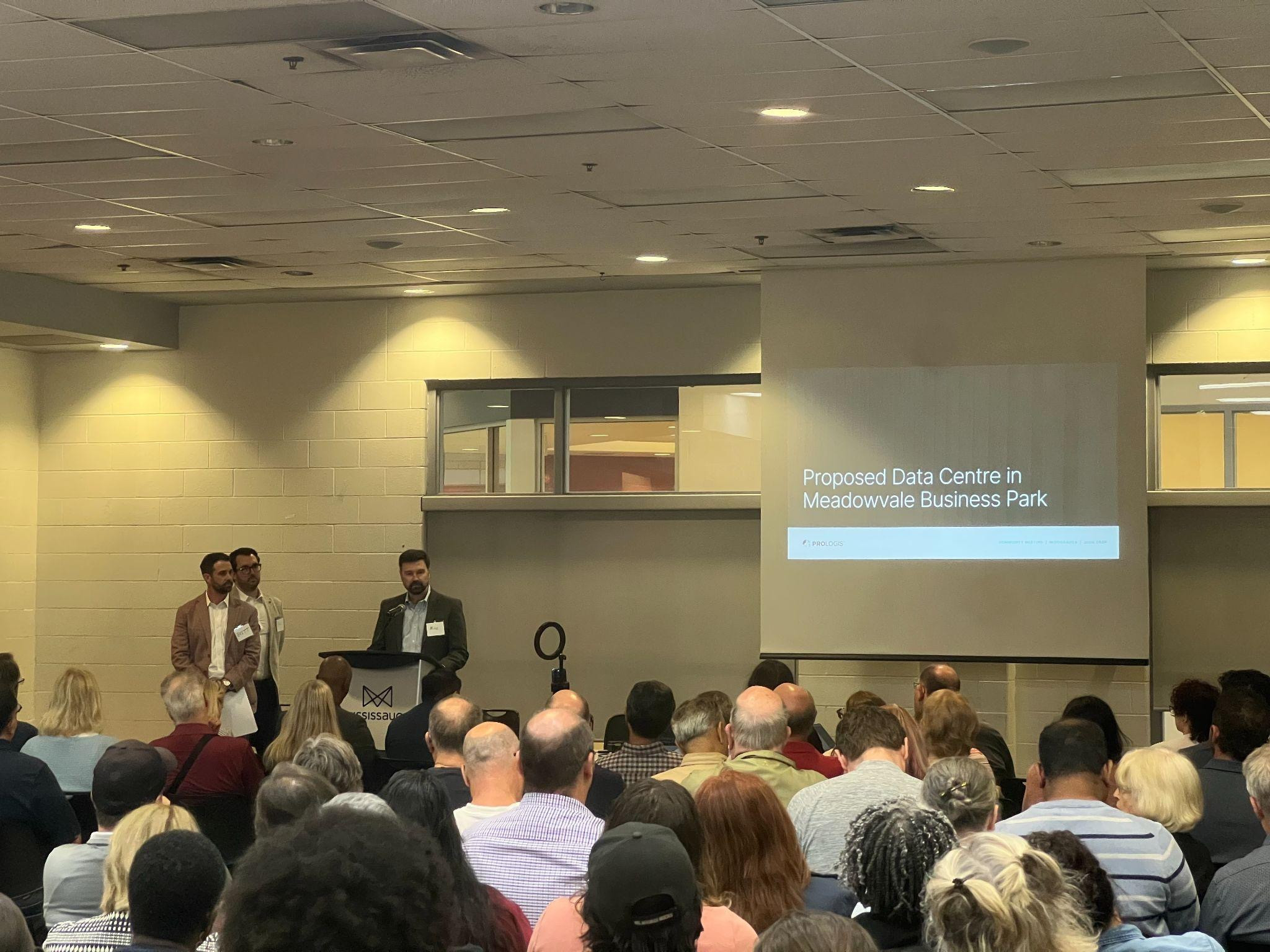

Three representatives from Prologis walked attendees through basic information about the proposed data centre at a Town Hall in June but residents felt key details that relate to their concerns were missing.
(Anushka Yadav/The Pointer)
Ward 10 Councillor Sue McFadden asked if Prologis had taken the initiative to reach out to the community that the proposal is going to affect—“the residents of Lisgar”?
“Since 30 days ago [the Town Hall], no, we have not,” Harandi responded.
Ward 2 Councillor Alvin Tedjo, who is running in the Mayoral race, acknowledged that while Prologis was voluntarily proposing safeguards including a closed-loop water system and potential controls around noise and energy use, there is currently nothing in the City's framework requiring Prologis or future data centre operators to maintain those standards.
“Everything that is being proposed in terms of what could be controls, these are things that you are in favour of,” Tedjo sought to confirm.
Ward 9 resident Nina D’Souza challenged Prologis to back the moratorium if the company was confident its facility would meet rigorous safety, environmental and sustainability standards.
“You claim that your facility is harmless; then prove it—support the moratorium and show that it meets all the performance standards that a safe and sustainable data centre should,” she said.
“Be an example of industrial excellence in the GTA and show that you care for the future of Mississauga and its residents, not just for votes during the upcoming election.”
City of Mississauga’s Commissioner of Legislative Services and City Solicitor, Graham Walsh, acknowledged that while “no one on staff is in disagreement with a pause”, an ICBL (which halts approval of particular development applications related to the focus of the interim control bylaw) is an “important” planning tool that should not be used “lightly”.
Staff typically prefer to complete the necessary analysis before implementing an ICBL, particularly given the possibility of an appeal, to avoid being less prepared to defend the decision since an appeal at the Ontario Land Tribunal (which decides outcomes in land use disputes) would require evidence and a clear rationale to support council’s position.
Walsh cautioned that the provincial government’s ability to issue a ministerial zoning order (MZO) can “override everything” that comes under the umbrella of municipal planning tools, including an official plan or an ICBL, which would allow a development application to proceed. Even though MZOs were created as an emergency tool to be used only in rare circumstances such as a weather-related disaster, to speed up development approvals when work has to be completed immediately, the PCs under Premier Doug Ford have used MZOs as a steamroller, to force municipalities to approve development applications the PCs want to push through. MZOs were rarely used before Ford came to power.
Developers have “consistently” argued they need provincial intervention when they believe municipalities are not advancing applications fairly, regardless of whether that argument is supported with facts.
“What we are seeing, though, as a government, this provincial government is willing to issue those MZOs in numbers that we haven't seen previously to prioritize development,” Walsh noted.
Ward 8 council candidate Rahul Mehta reminded councillors that Mississauga has relied on ICBLs several times in recent years to pause proposals on Ridgeway Plaza, Mississauga Road and the Dixie-Matheson Employment Area, to name a few.
“How long did we spend debating how risky and extreme that was?” he questioned.
“We have shown leadership before, and some of those ICBLs have not worked, but we took the chance, we took the time, we were willing to take a risk, and we should do that again.
“I am happy as a taxpayer to contribute to a legal fight, to show leadership and to set a precedent for other municipalities to finally follow someone that has the spine to stand up against corporations that love to lobby and make a quick buck.”
Just after 2 p.m. on Wednesday, July 29, Mississauga became one of the first municipalities in Canada and the only one in Ontario to approve a moratorium on new AI data centres after council unanimously directed staff to prepare an ICBL, pausing approvals of data centres for up to one year with the flexibility to extend the freeze for an additional year if necessary.
“I do want to express, as the mayor of this city, my confidence in our staff. We listen to them almost 99 percent of the time; we're not listening to them today and I hope it goes well,” Parrish said.
“I also want you [residents] to know that I sympathize 100 percent with the fear—this is fear of the unknown…We don't know what data centres are gonna do to our communities.”
The ICBL will be brought forward for final council approval on September 16. “If approved, data centre development would be prohibited until the ICBL expires,” a statement from the City of Mississauga said.
“Staff will also bring an interim report to council this fall”, which will provide more details around the study scope, consultation strategy and review timelines.
Email: [email protected]
At a time when vital public information is needed by everyone, The Pointer has taken down our paywall on all stories to ensure every resident of Brampton, Mississauga and Niagara has access to the facts. For those who are able, we encourage you to consider a subscription. This will help us report on important public interest issues the community needs to know about now more than ever. You can register for a 30-day free trial HERE. Thereafter, The Pointer will charge $10 a month and you can cancel any time right on the website. Thank you
Submit a correction about this story

