
Green Party calls for province-wide halt on AI data centres until safeguards are in place
A week after Mississauga became the first Ontario municipality to pause new data centre developments for one year, Green Party leader Mike Schreiner called for a province-wide moratorium until proper studies could be completed on the technology’s impact on the environment, energy and human health.
AI data centres sprouting across Canada may have ignited a fear of an increasingly unpredictable future, but they have also exposed a deep crevasse in the provincial and municipal planning frameworks established long before artificial intelligence and its unprecedented demands on water, energy and public infrastructure due to hyperscale computing.
“Right now, municipalities are on their own, trying to protect their communities,” Schreiner said at a press conference on August 6 at Queen’s Park.
“The Ford government has not yet put proper safeguards in place to ensure that these data centers will not harm our communities, and that any benefits are for community members and workers, not American big tech billionaires.”
On July 29, many Mississauga residents made their disdain for AI data centres very clear following a proposal from a U.S. based multinational warehousing property management and ownership giant Prologis. Resident pushback to the proposal contributed to council’s decision to put in place a moratorium with the possibility of extending it for two years while staff study the potential impacts from these facilities.
During the council meeting that lasted over five hours as staff and council assessed the legal risks of a data centre halt, Prologis representatives warned the firm will likely appeal the City’s decision to the Ontario Land Tribunal. According to company representatives, the impacts from the facility will be limited as their proposal is not for a hyperscale data centre and it will use a closed-loop water system, using only 2,000 litres of water daily with an initial requirement of 275,000 litres of water to fill up the closed system. This water would be purchased from the Region of Peel.

On August 6, Ontario Green Party leader Mike Schreiner was joined by Water Watchers’ Executive Director and Great Lakes Organizer Ilham Abdulkadir (on right), and Shelly Agius, co-chair of the Toronto chapter for The Council of Canadians (left).
(Anushka Yadav/The Pointer)
“Our province has let us down and the Feds have let us down,” Mayor Carolyn Parrish critiqued during the council meeting.
“They're talking about these data centres like they're better than sliced bread, but they're not giving us any guidelines. They're not assisting us in any way and they're not answering your questions.”
Just 10 days earlier, Ontario’s Ministry of the Environment, Conservation and Parks (MECP) were notified about an “odorous milky white substance” in a stormwater management pond at a Cambridge data centre at 17 Vondrau Drive on July 19.
Initial reports and local concerns claimed it was due to a chemical leak from server cooling systems. While MECP officials noted testing showed no evidence of contaminants of concern, regional assessments pointed to naturally occurring bacterial bloom — another impact of climate change — as the answer to the mysterious substance. The real cause has yet to be determined.
With Queen’s Park currently in the midst of a 21-week summer break–returning October 27, the day after municipal elections across the province–it’s unclear what will happen with Schreiner’s request.
What is clear is many PC ministries are being lobbied by companies looking to build AI infrastructure in the province.
According to Ontario’s Lobbyist Registry, at least five companies are actively lobbying the province in support of data centres.
In one instance, American alternative investment management company Blackstone lobbied at least nine ministers —including the Ministry of Energy and Mines and the Ministry of the Environment, Conservation and Parks— and four provincial ministries including the Office of the Minister of Indigenous Affairs and First Nations Economic Reconciliation in one instance.
With increasing lobbying efforts, public resistance has concurrently grown with at least five municipalities (Mississauga, Toronto, Burlington, Oakville and Hamilton) having artificial intelligence data centre proposals and/or moratoriums on their agendas, leading to Ontarians flooding council meetings.
While the City of Mississauga persevered despite staff highlighting the risks of scaring off billions in technology investments resulting from a moratorium, Hamilton City Council rejected a one-year moratorium on AI data centres on July 15 despite being one of the first municipalities in Ontario to consider a pause.
In June, Prime Minister Mark Carney launched Canada’s new national artificial intelligence strategy, AI for All, aiming to “increase AI adoption from just over 12 percent to 60 percent by 2034” and targeting “an additional $200 billion of economic growth to create 250,000 new AI-related jobs over the next five years”.
“While Canada has world-class talent and one of the fastest-growing digital sectors in the G7, we are among the slowest countries to adopt AI at scale,” a statement from the Prime Minister’s Office noted.
“This gap risks undermining public trust, driving Canadian talent and startups abroad, and leaving critical parts of our AI ecosystem under foreign control.”
With the announcement, Carney promised to introduce “new legislation, investments, and programs that ensure AI is adopted responsibly” — a future that does not meet the demands of the present, with over 200 data centres proposed across the country as of June, according to York University researchers. Ontario currently holds the largest share of active AI and digital data centres in Canada.
“This expansion is spatially concentrated and increasingly rural: Alberta accounts for 92 percent of planned capacity (in megawatts) despite a grid emissions intensity nearly three times the national average and disproportionately high exposure to local water risk,” the new study reported.
“Quebec, Ontario, and British Columbia offer cleaner grids and have each introduced legislation constraining grid access for new large loads.”
On December 11, Ontario became the first province in Canada to introduce legislation specifically governing new, large electricity-intensive data centres seeking access to the provincial grid after it passed Bill 40, the Protect Ontario by Securing Affordable Energy for Generations Act.
Bill 40 gave the Province the authority to prioritize and screen new, large energy-intensive data centres seeking connection to the electricity grid, adding economic growth as a core objective for the Independent Electricity System Operator (IESO) and the Ontario Energy Board (OEB) by amending the Electricity Act, 1998 and the Ontario Energy Board Act, 1998.
“We want to see community benefit and community support. We want to see the power costs paid 100 percent by the companies and not borne by everyday families and ratepayers,” Ontario Minister of Energy and Mines, Stephen Lecce, said at a press conference on July 28.
Even though Queen’s Park reassured Ontarians that new data centres will only be connected to the provincial electricity grid if companies agree to cover the full cost of their energy use, critics have pointed out the regulations needed to enforce that commitment have not yet been finalized.
“Until we see the regulations, that's all talk and no action,” Schreiner noted. “The pace of data center development is happening much faster than the pace the Ford government is acting, putting us at risk.”

“This is about transparency and what true democracy looks like: Who gets to decide what's built in our backyards, and who pays for it. Ontario does not deserve the loss of our freedom of information nor shady backroom deals. We must all remember that our public servants serve us. We must remind them that they are responsible for our lives, our children's futures, and what is in the best interest of all the people of Turtle Island,” Shelly Agius, co-chair of the Toronto chapter for The Council of Canadians, said.
(Anushka Yadav/The Pointer)
For Mississauga, troubles have not settled with a moratorium. There might be a danger creeping at the municipal border with what’s expected to be the largest AI gigafactory in Canada.
On July 17, the Town of Oakville released a statement saying it was “aware that lands may be under consideration by a proponent for a data centre” rumoured to be at 3480 Ninth Line, a 25-acre parcel south of Burnhamthorpe Road and west of Ninth Line.
The project, understood to be a proposed 320-megawatt AI gigafactory by Hive Digital Technologies, would sit less than a kilometre from a residential neighbourhood in Oakville’s Ward 8—a 15-minute drive from Prologis’ proposed site at 7564 Tenth Line West in Mississauga, and less than 1,000 meters from the residential area neighbourhood of Ward 8.
While the firm claims to build the infrastructure “with no-water use approach”, it has already raised alarms among residents on both sides of the border.
On July 18, Mississauga Ward 9 resident Chris Erskine penned a letter to Mississauga Mayor Carolyn Parrish urging her to work with neighbouring municipalities like Toronto, Hamilton, Burlington and Milton to establish a coordinated regional response to the rapid expansion of AI data centres.
“This sudden, massive demand on the electrical infrastructure and its impact on our locals are out of control,” Erskine wrote. “The challenges posed by the unchecked expansion of data centres are not isolated to Mississauga; they represent a regional crisis.”
Municipalities “need to modernize their own bylaws” with tech-specific zoning for high-impact digital infrastructure, stricter property-line and low-frequency noise standards, limits on water use and minimum 300-metre buffers between data centres and sensitive residential areas.
He also encouraged the mayors to push the Doug Ford government for stronger municipal protections under regulations being crafted as part of Bill 40 including lowering the “specified load” threshold to 5 megawatts to cover mid-sized and phased data-centre developments, and requiring municipal zoning approval before provincial grid access is granted while preserving municipal authority over land-use planning and infrastructure connections.
Mayor Parrish assured Erskine she has been told that “the Provincial Minister of Economic Development is currently drafting ‘guidelines’ for Data Centres in Ontario” and she is hopeful that all councils will participate when given the “opportunity to comment on new reports and legislation”.
“I am also attending the Association of Municipalities of Ontario (AMO) conference next weekend and will ensure it’s a topic of serious discussion,” she said in an email to Erskine, shared with The Pointer.

On August 11, the Town of Oakville council imposed a one-year freeze on data centre development.
(Supplied/Chris Erskine)
On August 11, the Town of Oakville council voted in favour of a motion for an interim control bylaw to freeze data centre development for a year.
Mayor of Oakville Rob Burton noted the Town would rather be proactive than wait for the situation to escalate at a time when council was facing the prospect of multiple data centres setting up operations.
Schreiner added that his call to the Ford government for a regulatory framework includes requiring data centres that connect to the grid or generate their own power to use clean, low-cost renewable energy (“wind, solar, battery storage”) instead of ramping up fossil fuels, or nuclear energy — which he is “not opposed to” but warns will spur electricity costs.
“Right now, Ontarians are paying twice: once through straining our energy grid, causing hydro bills to skyrocket, and again through our tax dollars as they subsidize building these centres,” Shelly Agius, co-chair of the Toronto chapter of The Council of Canadians, said, supporting the Ontario AI data centre moratorium.
“In return, we will get the possibility of noise, water pollution, loss of jobs as well as our personal data weaponized against us.”
In June, Hydro Power CEO Bryce Conrad predicted with confidence that surging power demand due to future requests to connect to the grid, along with 34 large-load projects requiring 1,075 megawatts in total, will “exceed the total amount of power that is used today by residents and businesses within the city of Ottawa”.
“We are being asked to build and support in the next two to three years what has taken us more [than] the better part of 110 years to build, and to be clear, that growth is not expected to slow anytime soon,” Conrad said during a council meeting.
“In fact, our expectation is that it will continue to scale exponentially.”
In 2025, AI workloads accounted for an estimated 20 percent of total electricity use in data centres, consuming roughly 93 TWh, equivalent to the annual residential electricity consumption of about 715 million people in Sub-Saharan Africa (more than half the region’s population), a new report by United Nations University Institute for Water, Environment and Health highlighted.
At the global average intensity, that electricity use generated an estimated 40 million tonnes of carbon dioxide, consumed more than 900 billion litres of water and required about 1,400 square kilometres of land.
The global water footprint is equivalent to roughly 365,000 Olympic-sized swimming pools—enough to meet minimum daily water needs for 125 million people in Sub-Saharan Africa for an entire year.
Despite lagging on AI adoption at scale, Canada already has the second-largest water footprint of electricity used by data centres, driven primarily by hydropower generation.
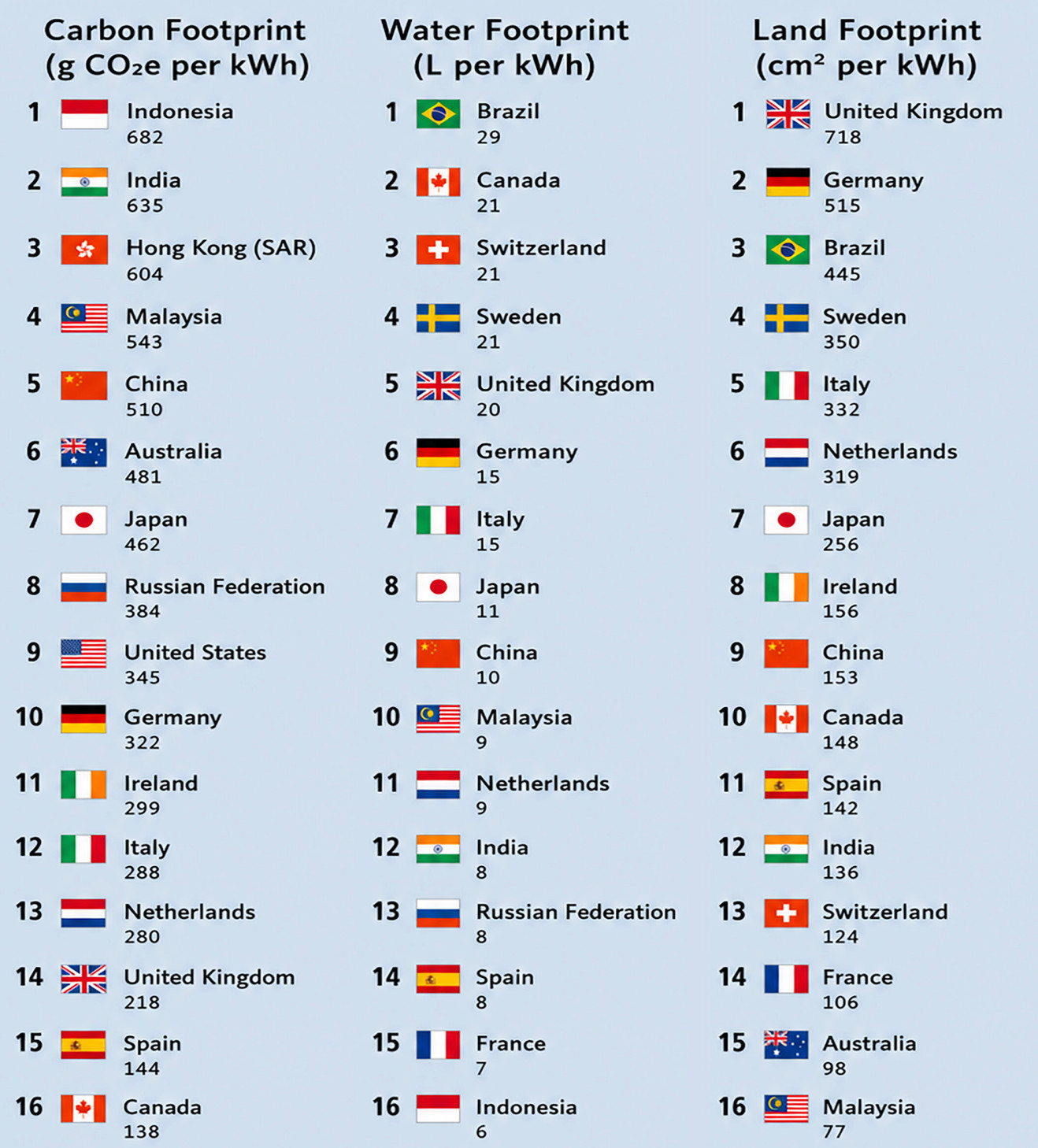
Canada is among the top 20 countries with a large footprint of electricity in the world’s top 20 data center hubs.
(United Nations University Institute for Water, Environment and Health)
While Canada’s electricity grid is roughly 70 percent renewable and 12 percent nuclear, 18 percent still relies on fossil fuels—and that mix could change quickly as electricity demand grows.
This is where the Rebound Effect, often referred to as Jevons Paradox, comes in.
Named after 19th-century economist William Stanley Jevons, the concept describes how improvements in resource efficiency can actually lead to greater overall consumption. Jevons observed that as coal became more efficient to use in England, demand for coal did not decline; instead, lower costs encouraged greater consumption.
AI is the new coal, in that context.
As technology becomes more efficient and cheaper to use, demand can increase enough to offset those efficiency gains. Improvements in AI models and hardware may be reducing the energy required for individual tasks, but they are also making AI cheaper and enabling its use at an unprecedented scale. As a result, energy use per AI task can fall while total AI energy consumption continues to rise.
Therefore, as AI drives up electricity demand, fossil fuels could remain in the power mix for longer, delaying the transition to cleaner energy.

Clover Power Station in Virginia, United States, is a coal-fired plant whose retirement has been postponed until 2045 as electricity demand grows with the expansion of AI-related data centers.
(United Nations University Institute for Water, Environment and Health)
“This rapid expansion of data center development cannot be separated from the reality of climate change,” Ilham Abdulkadir, Great Lakes Organizer at Water Watchers, said. “The climate crisis is increasingly manifesting as a water crisis. Longer droughts, more frequent floods, larger wildfires and shifting seasonal water cycles are changing both the quantity and the quality of fresh water.”
She reminded Ontarians that they can no longer assume clean water will always be available where and when required.
“Every watershed has ecological limits, and every community has a finite capacity to supply drinking water and treated wastewater. That means every new industrial demand on our freshwater sources deserves careful scrutiny,” Abdulkadir remarked.
“Protecting water cannot be an afterthought; it must be the foundation of how we fund the future. Water is life, and it's time our governments and our policies reflect that.”
Email: [email protected]
At a time when vital public information is needed by everyone, The Pointer has taken down our paywall on all stories to ensure every resident of Brampton, Mississauga and Niagara has access to the facts. For those who are able, we encourage you to consider a subscription. This will help us report on important public interest issues the community needs to know about now more than ever. You can register for a 30-day free trial HERE. Thereafter, The Pointer will charge $10 a month and you can cancel any time right on the website. Thank you
Submit a correction about this story

