
‘It feels performative’: Mississauga residents left with questions about climate plan six years after declaring emergency
“A few years ago, we passed a motion at council to get to net zero by 2050, I know those are no longer realistic targets,” Mississauga Councillor Alvin Tedjo recognized at a recent Environmental Action Committee.
He was referring to a 2023 council motion, adopted four years after Mississauga declared a climate emergency and approved its $450 million Climate Change Action Plan (CCAP), that reaffirmed and strengthened the City's commitment to climate action by directing staff to examine new interim 2030 targets aimed at reaching net-zero emissions by or before 2050 and supporting the global effort to limit warming to 1.5 degrees Celsius. That year, Mississauga’s total greenhouse gas emissions were 6,741,568 tCO2eq (metric tonnes of carbon dioxide equivalent), according to The Atmospheric Fund’s annual report. Getting to net zero would require the City to reduce emissions by approximately 249,700 tonnes of carbon dioxide annually on average.
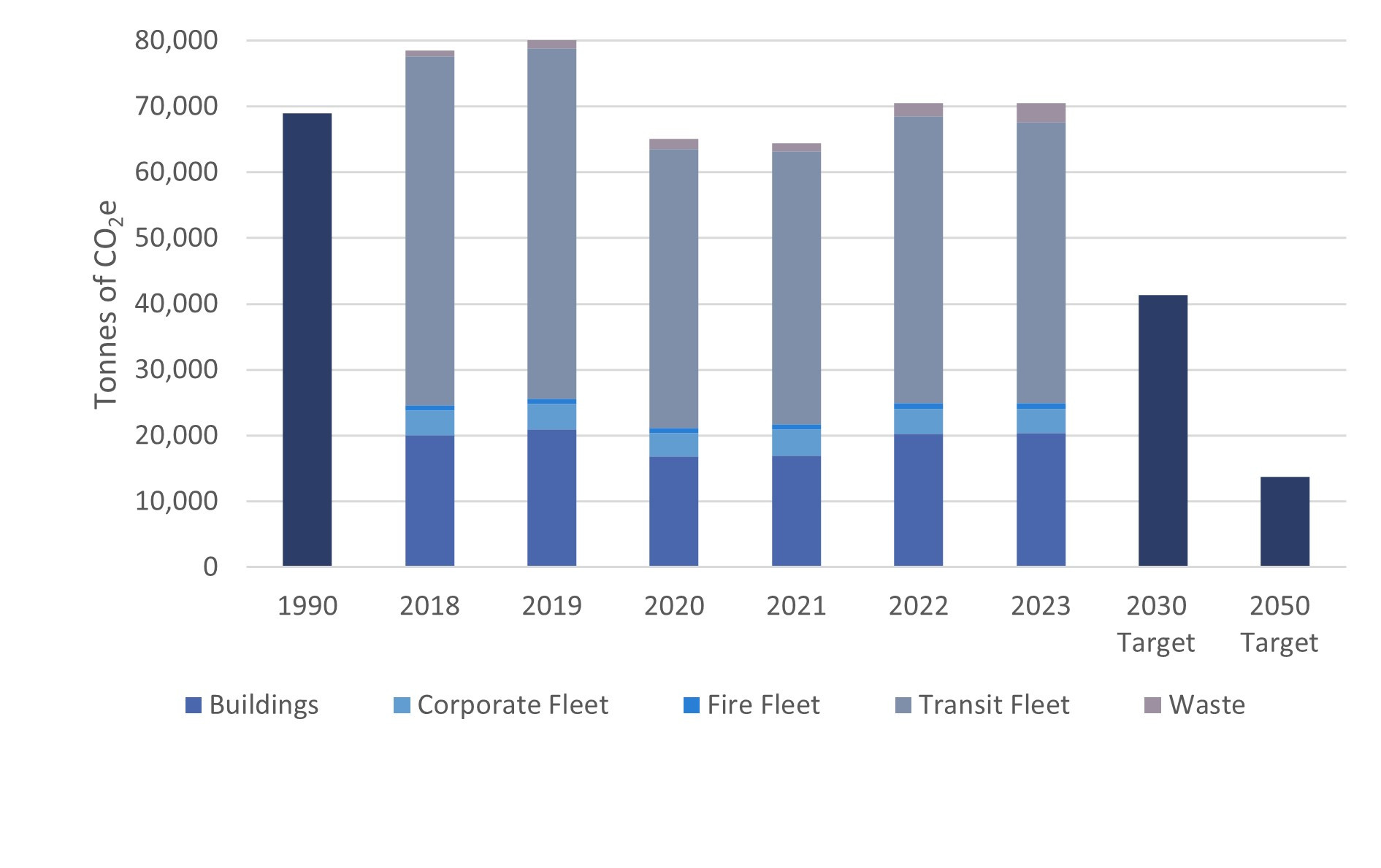
In 2023, the City of Mississauga’s corporate greenhouse gas emissions totaled 70,556 tonnes of carbon dioxide equivalent, representing a two percent increase compared to 1990 levels but a 12 percent decrease since the Climate Change Action Plan was approved in 2019.
(City of Mississauga)
A year later, Mississauga’s GHG emissions were 6,709,406 tCO2eq—the highest in the Region of Peel and reduced by only less than one percent (32,162 tCO2eq) since 2023.
How did that look on the ground?
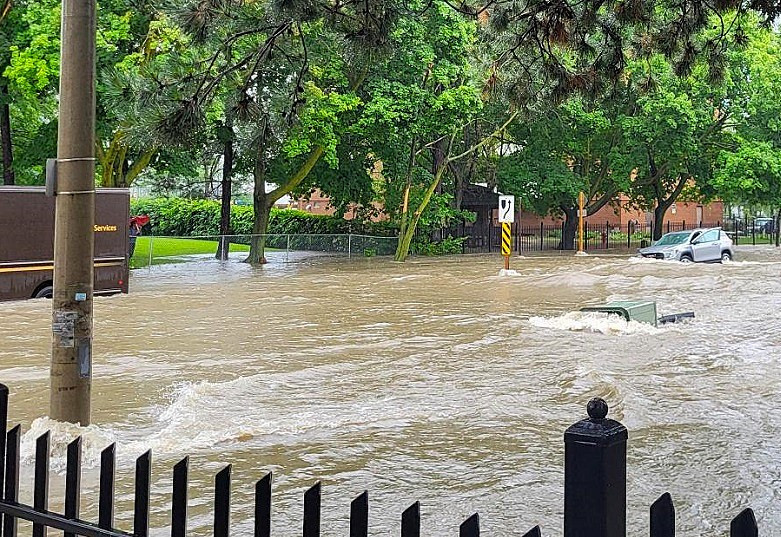
In 2024, Mississauga experienced two 100-year storms within a month during the summer of 2024, overwhelming local water management systems, shutting down major highways and flooding hundreds of basements while costing residents millions—impacts from which many residents are still recovering financially, physically and emotionally.
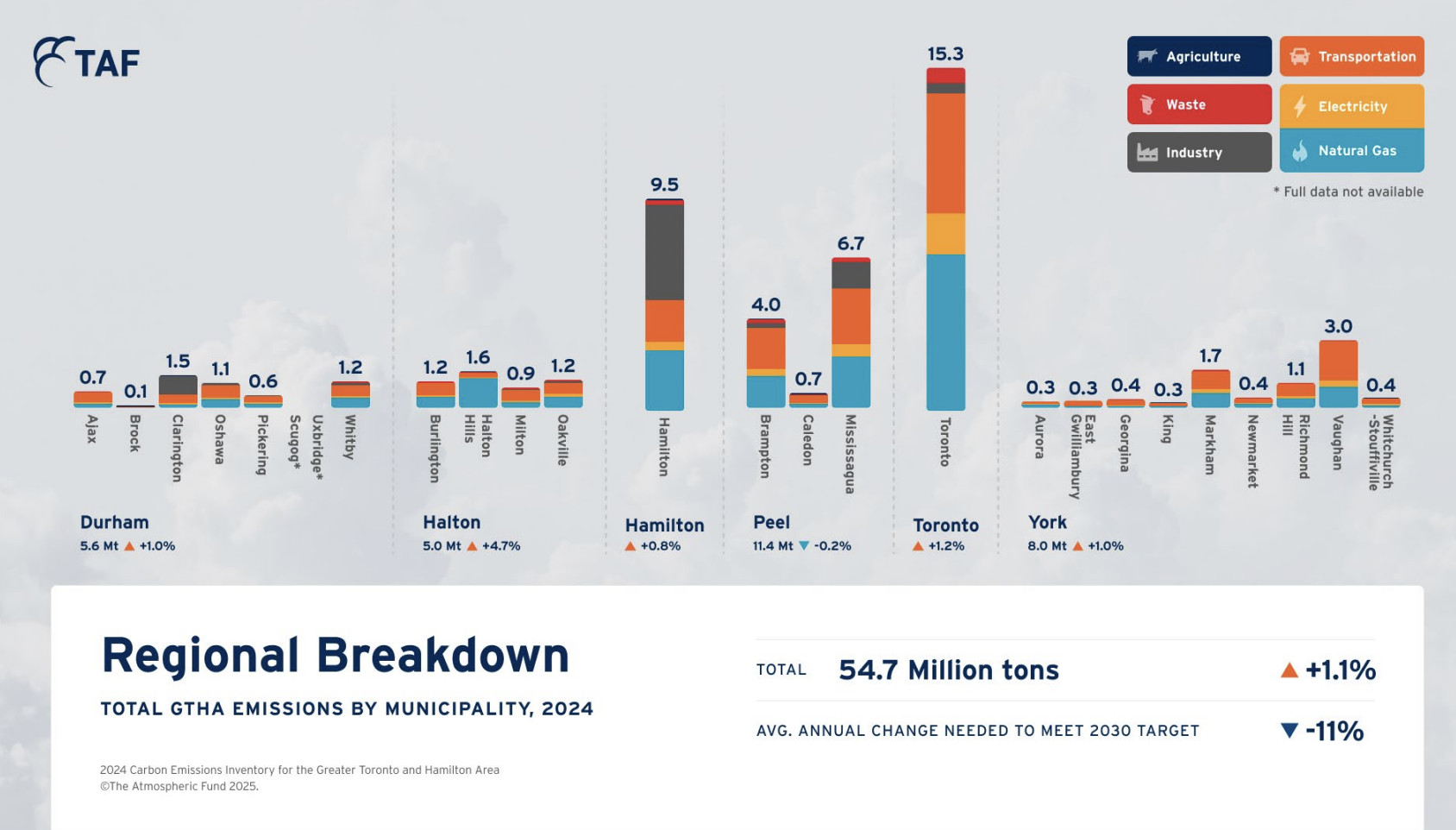
Mississauga has the highest GHG emissions in the Region of Peel.
(The Atmospheric Fund)
As one of Canada's fastest-growing cities, Mississauga is especially vulnerable to flooding because its basin-like topography funnels water through five major watersheds while decades of rapid urbanization have replaced natural drainage areas with hard surfaces, increasing runoff during the more intense storms driven by climate change; thereby, making the need to accelerate its fight towards achieving its targets urgent.
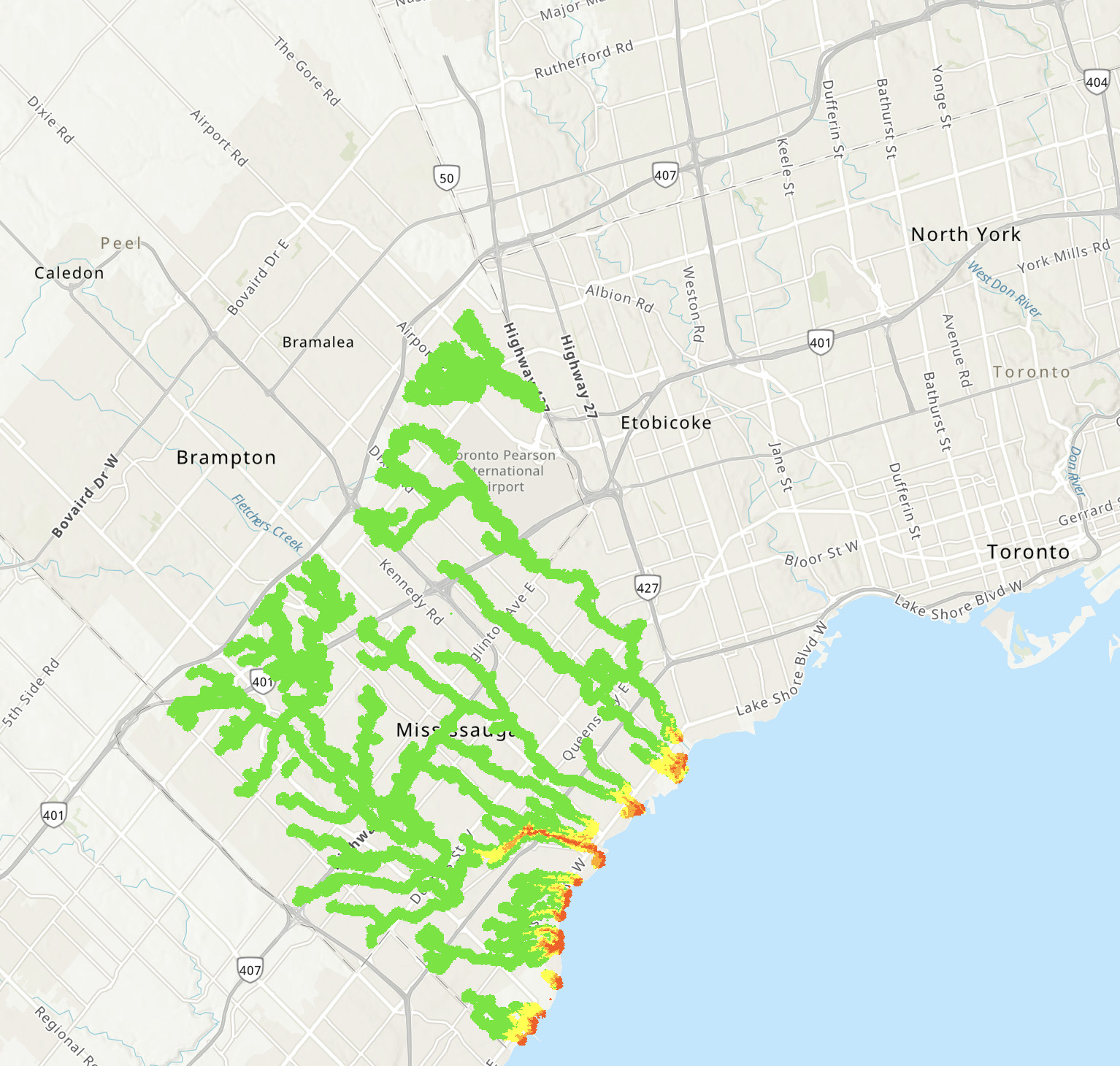
Mississauga's vulnerability to flooding is rooted in both geography and urban development. The city sits within a natural basin where water flows from northern headwaters toward Lake Ontario through five major watersheds including the Credit River, Humber River, Etobicoke Creek, Mimico Creek and Sixteen Mile Creek. During heavy rainfall, water moves rapidly across paved surfaces and into these waterways, overwhelming systems already strained by decades of urbanization, aging infrastructure and increasingly intense storms linked to climate change. Some neighbourhoods face particularly acute risks like Dixie-Dundas and Applewood are vulnerable when Little Etobicoke Creek exceeds its engineered capacity while Cooksville Creek and the Rhonda Valley have long been among the city's hardest-hit flood zones. In Lisgar, slow-draining soils and water accumulation in utility trenches contribute to chronic basement flooding. Along the waterfront, communities such as Port Credit and Lakeview face additional threats from elevated Lake Ontario water levels, powerful wave action and shoreline erosion.
Mississauga resident and Youth Climate Corps’ Executive Director, Bushra Asghar, has watched water creep across her parents’ basement floors almost every season. When she looks at the City’s ambitious climate plan of reducing GHG emissions 40 percent by 2030 and 80 percent by 2050 compared to 1990 levels, the conclusion is ostensibly apparent to her.
“There's no way they're gonna meet their targets,” Asghar told The Pointer while expressing disappointment with the City not including updates on stormwater infrastructure projects or funding as part of the recent discussion.
City data shows that gap playing out across both corporate and community emissions.
Corporate emissions that originate from City operations such as transit, buildings, fleet and waste were responsible for roughly 64,000 tonnes of carbon dioxide equivalent in 2024. Staff say corporate emissions have declined by about 1.5 percent per year on average since CCAP was introduced with a sharper dip between 2023 and 2024 largely driven by changes in MiWay’s transit fleet including the transition to second-generation hybrid buses and the use of B20 biodiesel.
Between December last year and June, MiWay added 18 percent of second-generation hybrid buses (more than 40 percent in December and 58 percent or 288 buses this year so far).
“We have 15 electric ice resurfacers in our arenas and over 99 percent of the MiWay light duty fleet is fully electric, with many other city fleets moving to electric for light duty vehicles across the city,” Mississauga’s Climate Policy Supervisor, Carrah Bullock, shared during an Environmental Action Committee meeting on June 2.
MiWay is also working on some net zero pilots that are planned for 2027.
Other initiatives included the development of a hydrogen hub aimed at promoting a hydrogen ecosystem for transit and industrial users.
In January last year, Ottawa announced over $123 million in transit funding for the City of Mississauga through the Canada Public Transit Fund and the Zero Emissions Transit Fund for long-term upgrades to MiWay infrastructure and the transition to low- and zero-emission transit. The investment included more than $112 million in baseline funding over ten years starting this year till 2036 to help maintain and modernize transit assets and improve state of good repair, alongside up to $10.9 million to support the acquisition of hydrogen fuel cell buses and related hydrogen fueling infrastructure at the Malton Bus Depot.
City staff reported work on the hydrogen program is ongoing, supported by federal funding and a grant from Natural Resources Canada, with the final report recently submitted and continued collaboration through a working group. The first hydrogen bus is expected to arrive later this year with additional buses anticipated in early 2027.
For green drivers, Mississauga installed more than 105 electric vehicle (EV) chargers throughout the city in the last five years for both “public and corporate use” — that number has not changed since December.
In alignment with its 2019 goal, the City expanded active transportation and community resilience initiatives including more than 80 kilometres of new cycling infrastructure and over 500 additional bike parking spaces. In 2024, a Shared Micro-Mobility Program was launched, which included more than 300 e-bikes and 900 e-scooters available for rent.
Even though corporate emissions represent about one percent of the City’s total emissions inventory, transit continues to be the largest source accounting for 54 percent, followed by buildings at 34 percent.
While City council approved updated Green Development Standards (GDS) in 2024, recent provincial legislation including Bill 17, Bill 60 and Bill 98 has removed their mandatory status, making them voluntary for developers.
But the City continues to advance climate-focused infrastructure where it can.
“We're working on district energy with a feasibility study complete for the downtown, and additional feasibility studies planned and underway on low emissions mobility.” Bullock noted.
After opening its first net-zero energy facility at Fire Station 125 in 2024, the City marked another milestone on May 23 with the official opening of Fire Station 123, its second net-zero fire station that has 161 solar panels on the roof that produces enough energy to power itself throughout the year.
Sumeet Jhingan, Manager, Energy Management, pointed to the one-megawatt solar installation at the MiWay Central Parkway transit garage as an example of how onsite generation is increasingly helping to offset daytime electricity demand across municipal operations.
As a result, over the past two years, the City has achieved a 2.6 percent reduction in energy use and a 3.5 percent reduction in GHG emissions, alongside a nine percent reduction in natural gas consumption driven by efficiency upgrades and early-stage decarbonization efforts. While short-term changes in the provincial electricity grid mix temporarily impacted emissions intensity, Jhingan emphasized that long-term projections point to a cleaner grid supported by increased nuclear generation, renewable energy expansion and energy storage capacity.
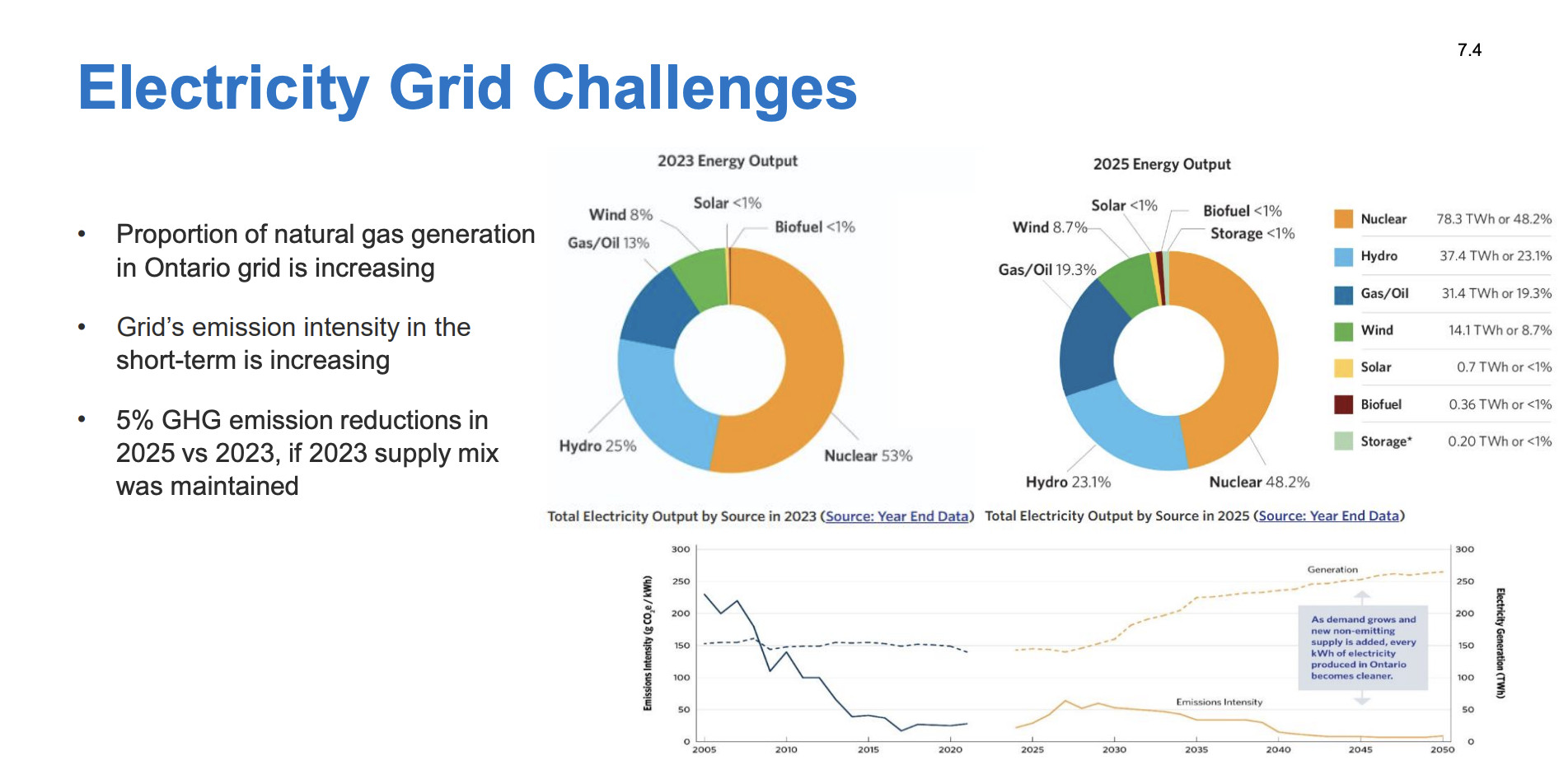
City of Mississauga staff highlighted that the proportion of natural gas generation in Ontario’s grid has increased resulting in an increase in emissions.
(City of Mississauga)
“In order to meet our 2030 target, at this point we need to reduce emissions by approximately seven percent per year, so that requires a significant acceleration in action,” Bullock acknowledged.
But the larger challenge exists at the community level.
Community emissions driven primarily by buildings and transportation across homes, businesses and industry remain just under seven million tonnes annually. Buildings account for 53 percent of this total while transportation contributes 34 percent, industrial facilities about ten percent and waste roughly two percent.
Overall, community emissions have declined by about 2.5 percent annually since the 2019 baseline. But Bullock estimates reductions would need to accelerate to six percent annually to meet the 2030 target.
“Mississauga is the third largest in terms of total emissions in the GTHA [Greater Toronto and Hamilton Area], second or third to Toronto and Hamilton,” she said.
The sobering emissions data stood in contrast to a progress report that portrayed a municipality steadily advancing its climate agenda. Bullock reported 95 percent of the 89 actions outlined in Mississauga's 2019 CCAP have either been completed or are underway: 13 actions have been completed, 46 have been completed but remain ongoing through continuous improvement efforts and 26 are currently underway.
As part of its urban forestry goals through the “one million trees” program, more than 649,000 trees have been planted across the municipality since 2012.
Community partnerships and engagement programs including neighbourhood sustainability hubs in areas such as Burnhamthorpe, Malton and Cooksville in collaboration with conservation authorities were established. The City is working with the Centre for Community Energy Transformation (CCET) to provide residents with tools and education to support home energy efficiency improvements, primarily through workshops, webinars and outreach. However, data on how many families used these services or turned to renewable energy was not made available.
After piloting its first repair hub at Malton Library in 2024, Mississauga expanded the program to five repair hubs last year with seven additional events planned for this year, achieving a repair rate of 73 percent for items brought in to date. The initiative has worked in harmony with circular economy efforts such as reusables at community events and surplus asset reuse programs. The City diverted more than 120,000 kilograms of materials from landfill through reuse, recycling and donation activities associated with the Hazel McCallion Central Library renovation project, distributing items to local not-for-profit organizations.
Staff also outlined corporate climate reporting and governance tools including the City’s adoption of the Task Force on Climate-related Financial Disclosures (TCFD) framework, the integration of climate considerations into major infrastructure planning, and ongoing annual emissions reporting through the CDP.
“There are four actions that were not started…because there's just been a change in direction since the plan was developed,” Bullock added.
While residents appreciate the City reporting annual emissions and updates on completed projects, Asghar believes the approach still leans toward incremental action rather than the radical change required to respond to a climate emergency; she warns that claims of most climate actions being complete or underway risk creating a misleading impression of progress for residents.
“It just feels so performative. They're meeting 95 percent of their calls to action while failing to meet all their emissions. It's a bit greenwashy,” she said.
“What they're doing is creating tasks that they can checkmark. But what are the actual reductions in emissions in real time? At this pace, how many years behind are you on the pathway to meeting your own targets?”
Asghar sees a fundamental gap in how the City reports on climate action: a lack of clear, accessible metrics that directly connect municipal initiatives to real-world emissions outcomes. Instead of emphasizing the volume of initiatives delivered, she would prefer “honest” reporting that focuses more transparently on the remaining emissions gap, how far the City is from its targets and what level of action is still required to close that gap within the required timelines.
“Better reporting is the least that they can do,” Asghar emphasized.
“I really don't believe that we're gonna successfully deal with the climate crisis at an individual level, it has to be at the systemic level.”
Current efforts do not reflect the scale of change needed in the largest emissions sources: buildings and transportation.
“There isn't really a conversation on how do you dramatically expand use of public transit or other alternative things like bike lanes, repair hubs,” she observed.
“You've declared an emergency, you can't use a voluntary measures approach to deal with it, like we do…we need mandatory policies.
“We know that developers don't respond to encouragement, they need regulations like the GDS.”
Asghar would like to see a more proactive, large-scale programming which could include “door-to-door energy audits” to help residents reduce consumption as well as expanded public education and engagement efforts. She argued these kinds of interventions are not prominently reflected in current plans or reporting, despite their potential to drive meaningful reductions at the community level.
She was pleased to see the investments on the transit and transportation front but the current approach does not sufficiently address the need for a rapid and sustained shift away from car dependence, which remains prominent in Mississauga.
“For me, a strong climate plan should clearly show how the transition can also save people money and deliver co-benefits,” Asghar said, noting many residents are currently facing high energy bills because their homes are not retrofitted, along with significant costs for things like gas, car and home insurance.
Climate change is responsible for half of the increase in home insurance premiums over the last 16 years with Canadians paying more than $500 extra annually on property insurance as a direct result of climate-related impacts.
“Homeowners have likely paid more than $3,000 in extra insurance costs over the past six years due to the effects of worsened climate-driven extreme weather events,” a recent research by Environmental Defence and the University of Toronto noted.
“Insurance companies are forecasting that losses from storms, fires and extreme heat are rising 11.5 percent every year, making home insurance even more expensive.”
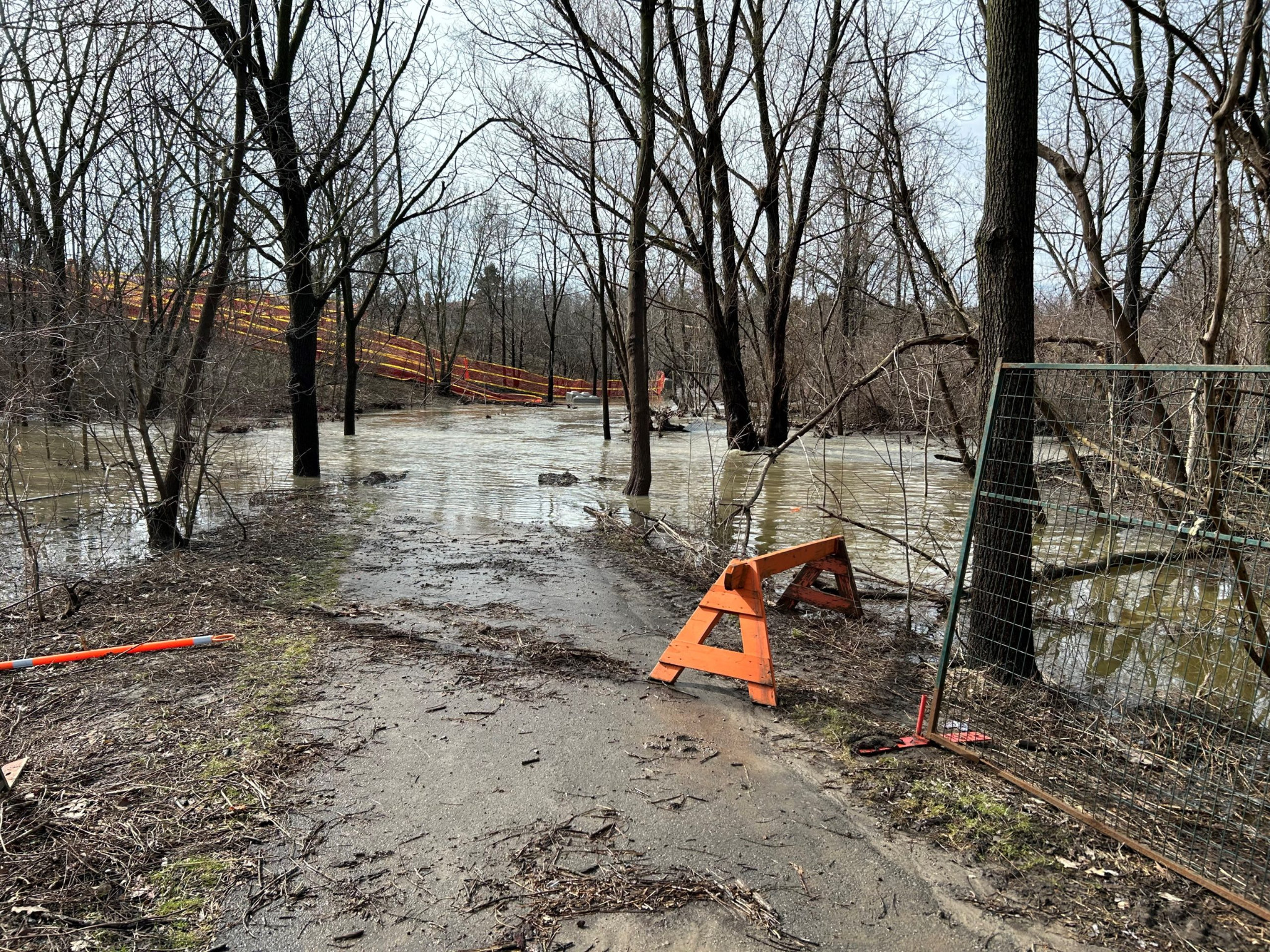
In April 2025, the City of Mississauga reported at least five parks and trails were impacted due to flooding following heavy rainfall.
(City of Mississauga)
Since 2008, the Lisgar neighbourhood alone has been hit by at least nine significant floods, leaving homeowners with an estimated $125 million in out-of-pocket costs. Insurance companies have largely walked away, premiums have soared and families remain trapped in houses they cannot sell, insure or fully protect.
Asghar strongly believes a well-designed approach to climate action should reduce these everyday expenses by enabling people to protect their homes through timely installed stormwater infrastructure, a strong transit system and lower their household energy use, ultimately saving hundreds of dollars each month. But this economic dimension along with a dialogue on green jobs is largely missing from both CCAP itself and how it is communicated to the public.
Bullock indicated the Climate Change Action Plan is currently being updated with a draft expected over the summer and planned for review by the Environmental Advisory Committee following the election before returning to Council in the new year. It will also include biodiversity targets that are not part of the current plan.
When Councillor Alvin Tedjo wondered whether the City’s 2030 climate targets remain achievable given the pace of progress to date, Bullock believed “it's possible”.
“It will be a significant challenge. But I choose to stay hopeful and believe that there's an opportunity there,” she said.
Email: [email protected]
At a time when vital public information is needed by everyone, The Pointer has taken down our paywall on all stories to ensure every resident of Brampton, Mississauga and Niagara has access to the facts. For those who are able, we encourage you to consider a subscription. This will help us report on important public interest issues the community needs to know about now more than ever. You can register for a 30-day free trial HERE. Thereafter, The Pointer will charge $10 a month and you can cancel any time right on the website. Thank you
Submit a correction about this story

