
‘Wildfires are now a crisis’: Indigenous communities knew how to care for the land; then the rest of us arrived
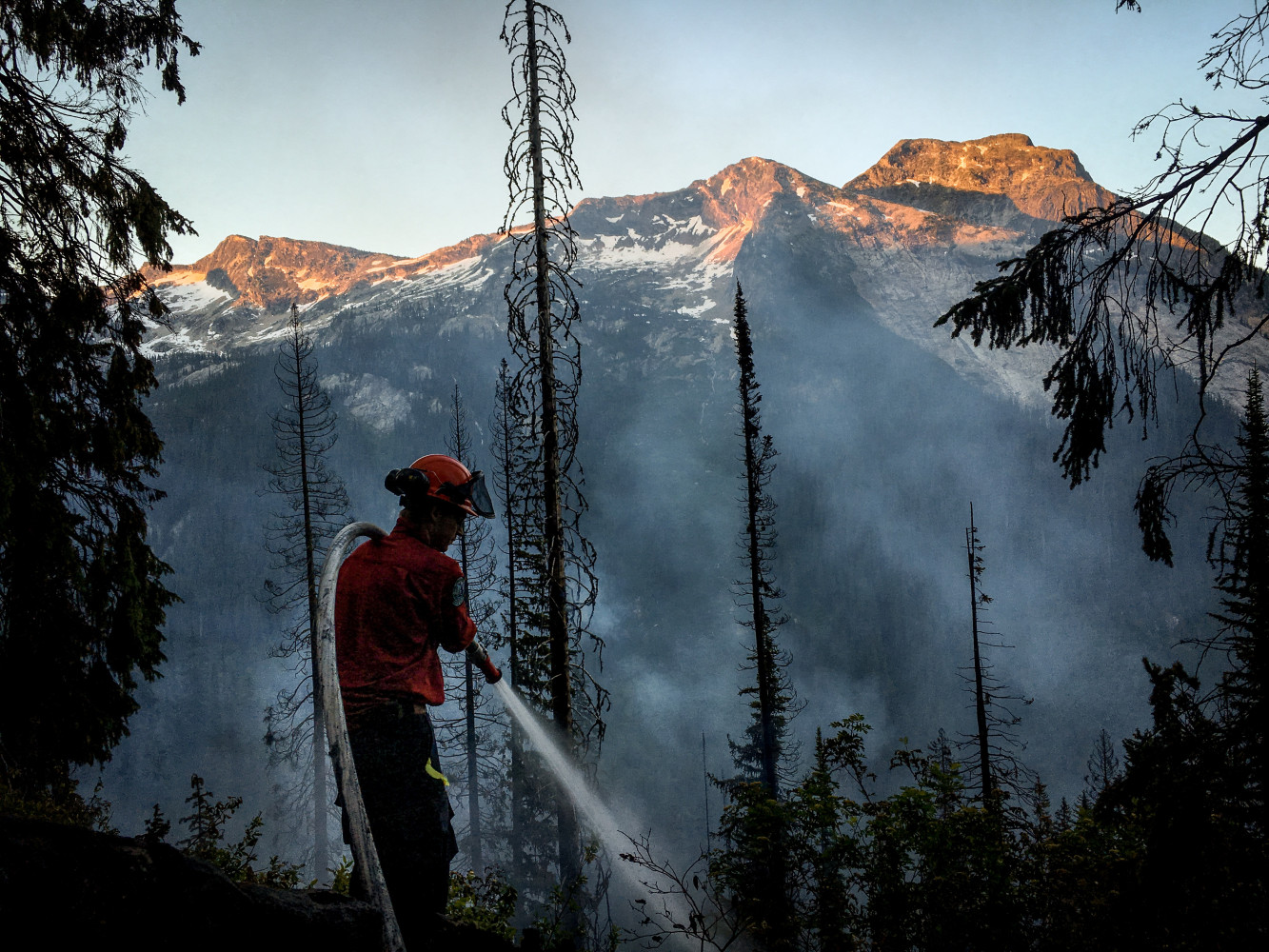
Much of Canada is ablaze.
Ontario has become the face of nature’s wrath with the highest number of active wildfires in the country. As firefighters battle nearly 200 forest fires — 70 not under control — Ontarians woke up to a yellow Wednesday sky with the worst air quality in the world, and things only got worse today in parts of the province.
The ominous pearl grey chemical air that eventually descended upon millions, as the smoke became too thick for even the sun to affect its colour, was not all that July 15 brought. Shortly after 11 a.m., dystopia and irony were packaged into a parody brought to you by the stalwarts of “Protect Ontario”.
“Canadians know that we can no longer depend on the U.S., we must build energy corridors and pipelines that are sovereign to Canada,” Minister of Energy and Mines, Stephen Lecce, said in a statement announcing Doug Ford’s “vision” for the Northern Shield Energy Corridor, a proposed 3,300-kilometre pipeline between Alberta’s oil sands and Sarnia’s refining and petrochemical complex.
“Nowhere is the opportunity greater than in Sarnia, home to one of North America's largest refining and petrochemical complexes, a highly skilled workforce, and the industrial capacity to anchor Canada's energy future. Advancing the Northern Shield Energy Corridor means we can connect Alberta crude directly to Sarnia — averting the threat of pipeline closures by the U.S., while refining more Canadian oil here at home.”
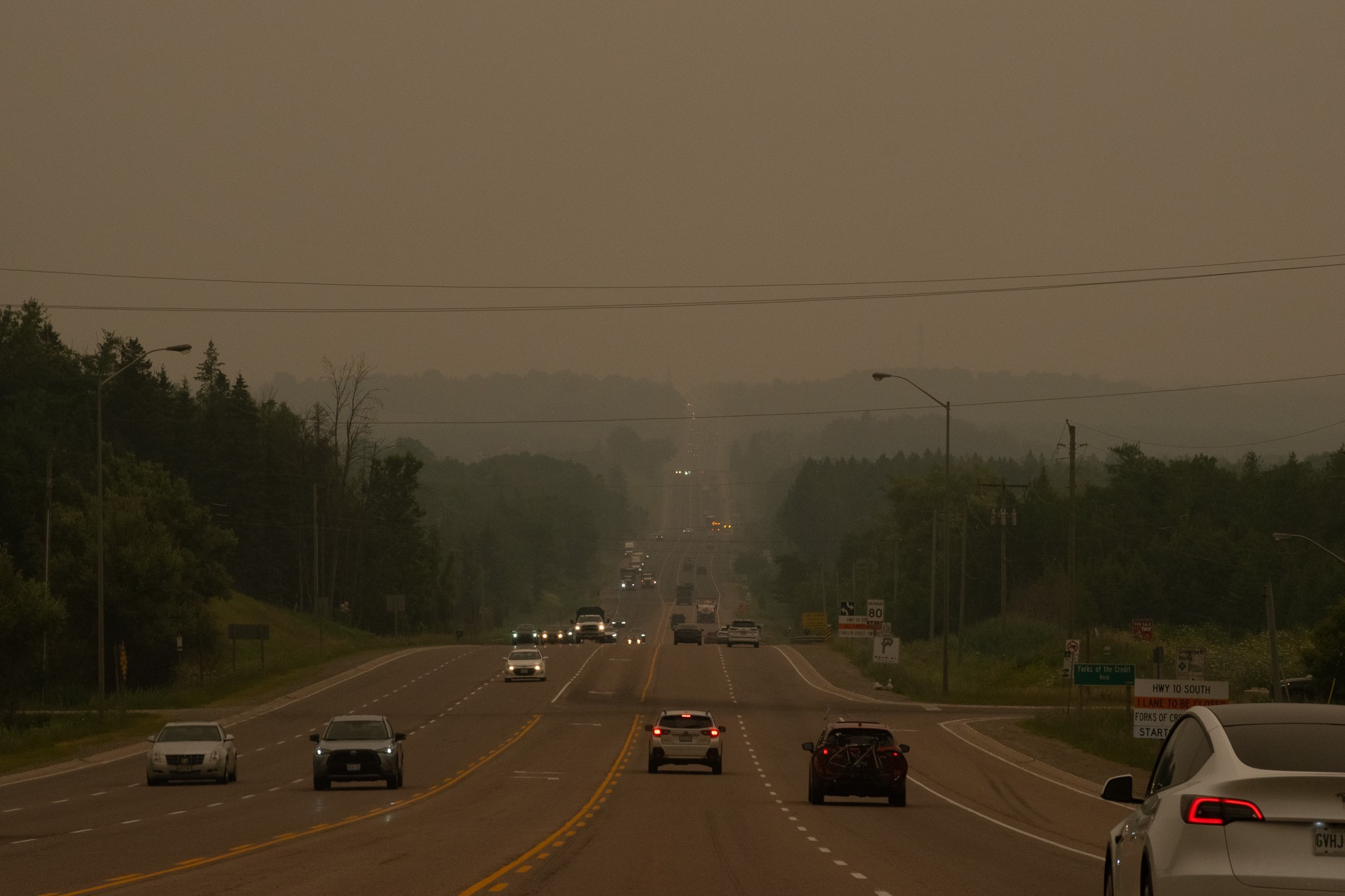
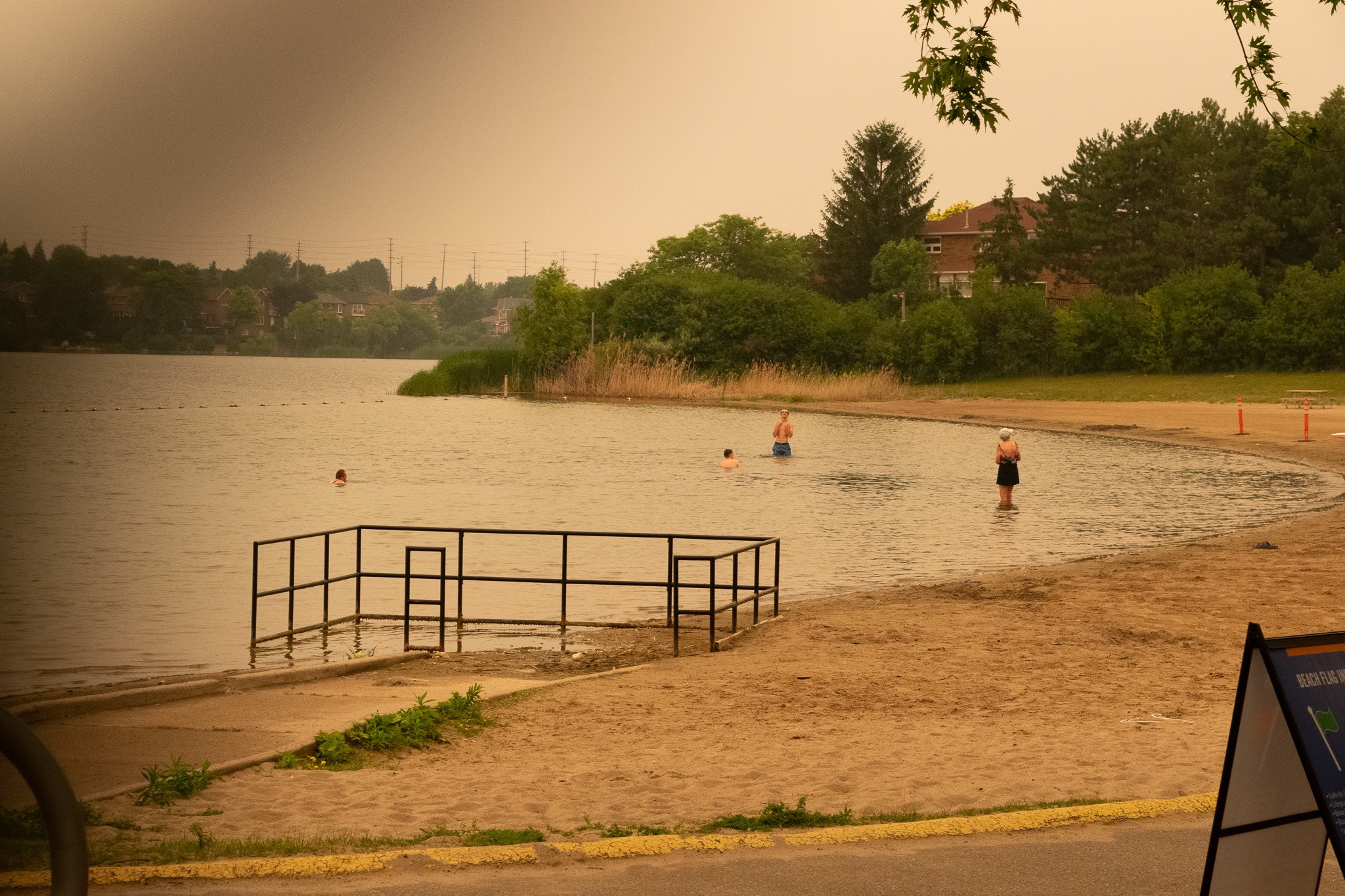
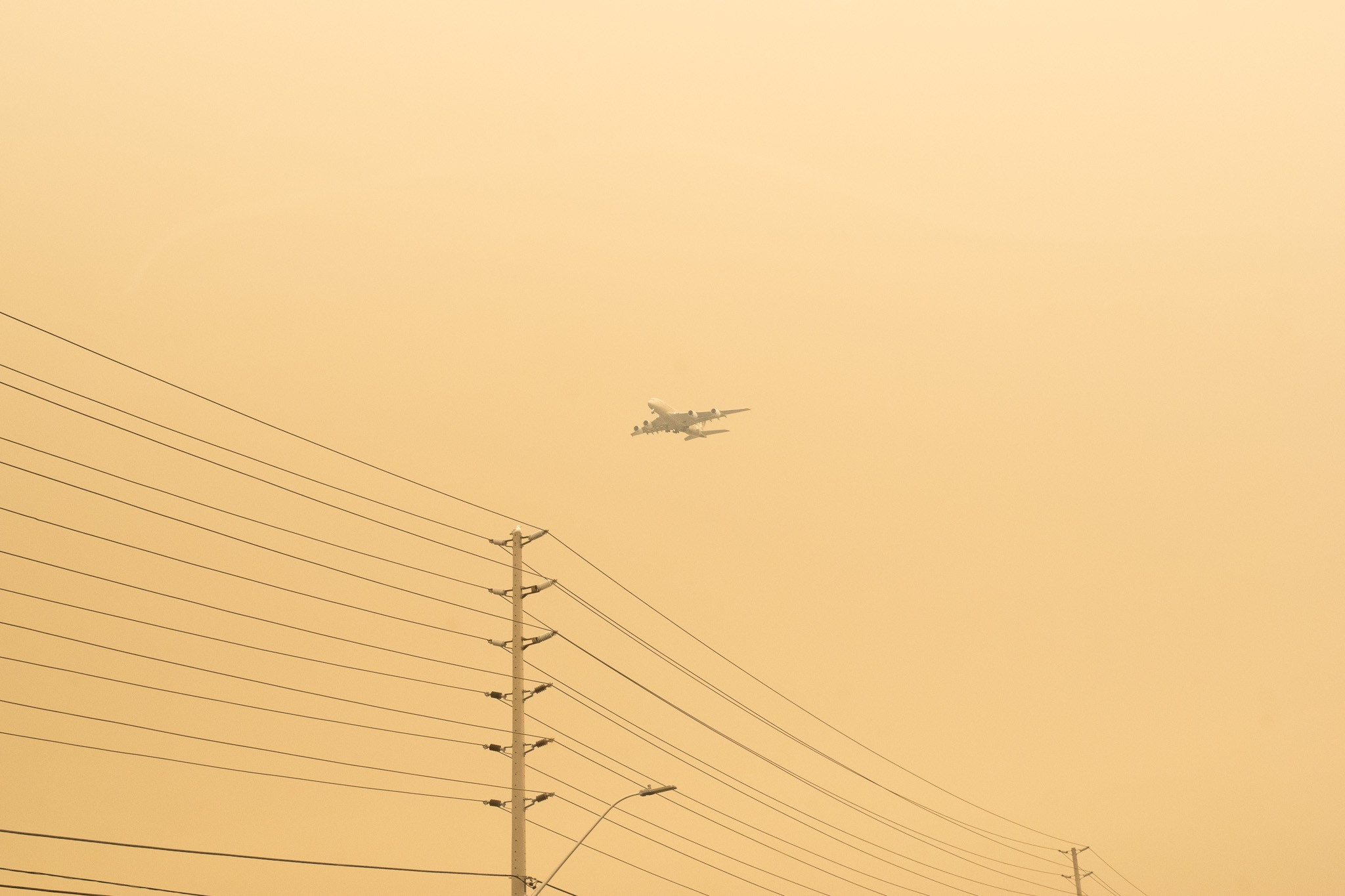
In Premier Doug Ford’s Ontario, the sky, the air and the water are polluted. On July 15, the sky was rendered to sepia as the air thickened with wildfire smoke, prompting an orange alert across the Greater Toronto Area. The first photo is from Caledon, Highway 10/Hurontario Street — a municipality where the Ford government wants to pave the way for the environmentally destructive Highway 413. In the second photo, Brampton residents were seen swimming in Professor’s Lake, which Peel Public Health had declared unfit for swimming due to elevated bacteria levels since July 10. The lake was reopened to visitors on July 13, two days before the skies turned orange.
(Alexis Wright/The Pointer)
If Sarnia’s Chemical Valley exposing residents to high levels of cancer-causing benzene and more than 131,000 tonnes of air pollution were not reasons worthy enough to abandon the project, the Ford government is surely going against the provincial Auditor General’s dire warning about the impacts of burning even more fossil fuels — the reason Ontario won’t be meeting its own emissions targets.
While high emissions might just appear to be numbers on paper, they take the form of wildfires every summer — and the brutal health, social and economic impacts that come with them.
In its 2025 budget, Ontario allocated $135 million (down from $177 million) to its Emergency Forest Firefighting Fund. But when the flames erupted, the Province ended up spending more than double that amount: $271 million. Despite the surge in costs, the PCs slashed funding by $121 million, dropping to $150 million in 2026–27 — Ontario’s budget was described by experts as one created as if “climate change wasn’t a problem”.
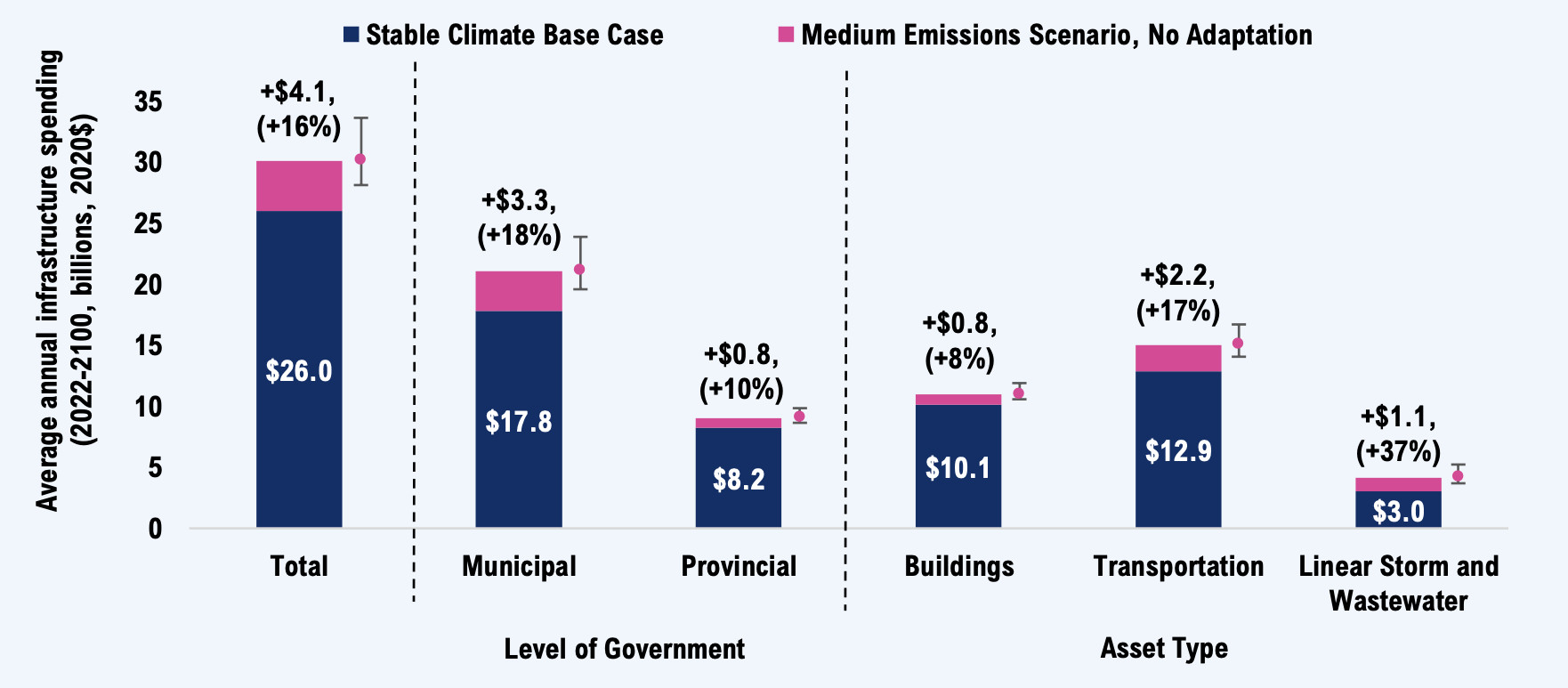
Climate hazards are driving up infrastructure costs: without adaptation, maintaining Ontario’s $708 billion of public assets could cost an extra $4.1 billion per year. Ontario’s municipalities will be managing over 70 percent of the portfolio and face the most risk, according to a 2023 Financial Accountability Office of Ontario report.
(Financial Accountability Office of Ontario)
If Ontario is looking for a glimpse into the future, it need only to look west.
When towering flames tore through Lytton, British Columbia on June 30, 2021, a day after the village recorded the highest temperature ever recorded in Canada (49.6 degrees Celsius), scared residents had only minutes to flee — while everyone left behind their homes and watched their belongings reduced to ash; two residents succumbed to the forces of nature, fuelled by human folly.
Restoring a landscape devastated by one of Canada's worst climate-driven disasters was a daunting challenge, made even harder by the disproportionate toll the fire took on Indigenous communities—a reality witnessed in climate disasters across the country.
In neighbouring Northern St'át'imc, the community turned to restoration ecologist Jennifer Grenz for help to replant what was lost and understand how forests recover in an era of accelerating climate extremes.
For the last five years, when Grenz is not teaching at the University of British Columbia, she has been returning to her traditional territory, where she sits on the Lytton First Nation Lands Committee and leads a large post-wildfire recovery research project near Lillooet with Northern St'át'imc Nations after the devastating McKay Creek fire.
During one of those visits on July 3, Grenz drove past a “small fire” near Boston Bar while on her way to a committee meeting before going to the research sites.
At the time, the blaze covered approximately six hectares. When she returned three days later with her graduate student, it had exploded into the Brunswick Creek Fire with flames stretching across both sides of the highway.
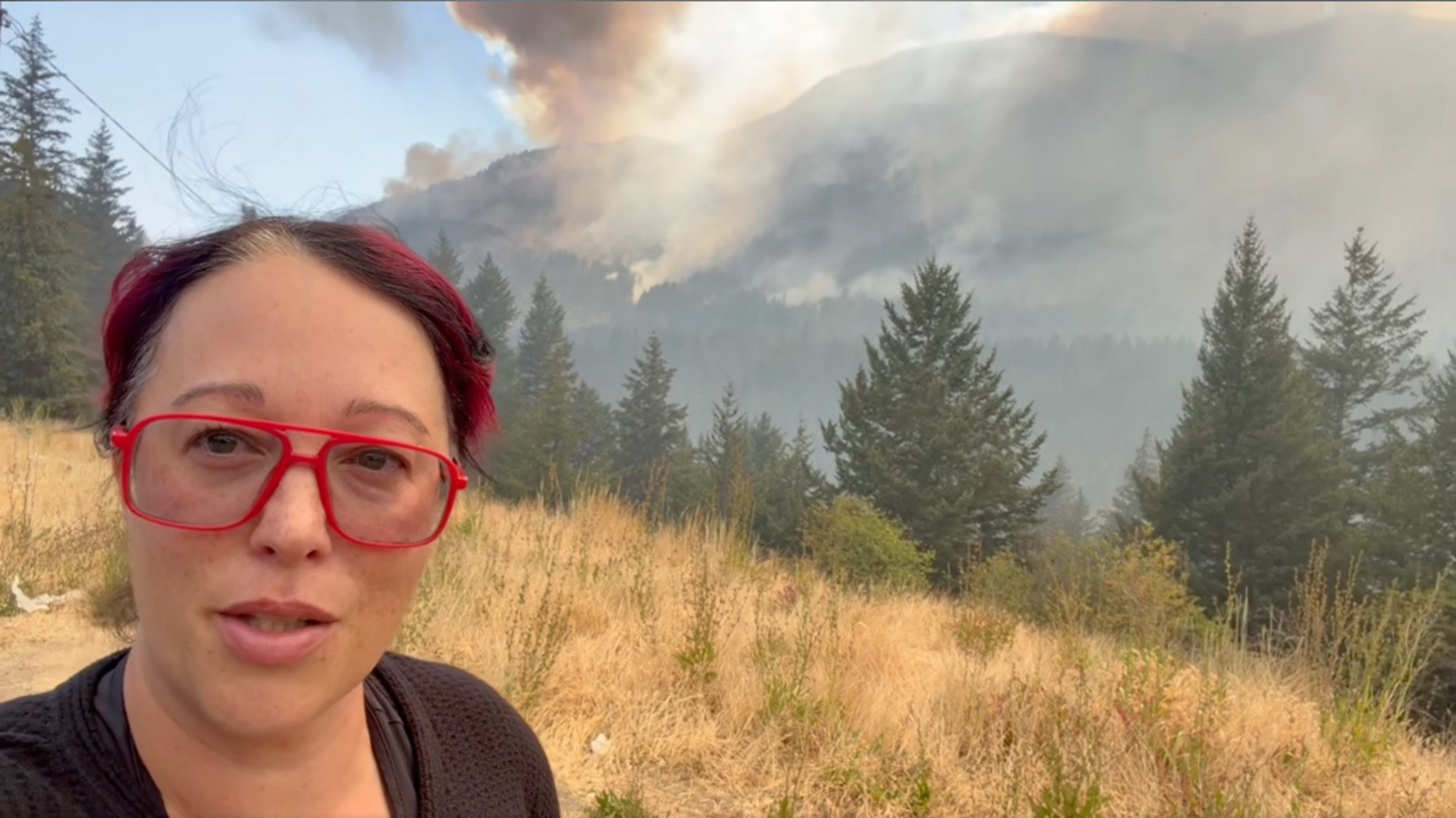
“We just left our research site where the next generations’ fires are being replanted by the Ministry of Forests in places where we finally have diversity and mosaics on lands that can feed us and our animal relations. Bringing cultural and even prescribed fire onto land have substantial hurdles on the scale that’s needed. Hands up to everyone trying. We need everyone else to write the Premier and demand change,” Jennifer Grenz wrote.
(Jennifer Grenz/LinkedIn)
Tears streamed down her face as she inhaled the smoke from the wildfire—an unwelcoming reminder of a changing relationship between Indigenous people, forests and fire perpetuated by the practices of those who started arriving here thousands of years after the First Nations had first carefully protected the lands.
“It is becoming increasingly difficult as an Nlaka'pamux person to just keep seeing that this has to be the reality for our people. It wasn’t necessary,” Grenz said, her voice trembling at the sight.
“If it weren’t for forestry and a century of fire suppression, we wouldn’t be in this mess.”
Far east from British Columbia, Ontario’s Indigenous communities are also finding themselves among those facing the greatest disruption and uncertainty due to a warming planet at a time when Prime Minister Mark Carney has admitted that Canada will miss its 2030 emissions targets and will see a rise in emissions in the short-term as he greenlights Alberta's proposal for a west coast pipeline project; keeping the fossil fuel industry, the largest greenhouse gas emitter, responsible for over 30 percent of Canada's total national emissions, alive.
A sweltering heat-dome phenomenon kicked off on July 13, just a week after Premier Doug Ford announced a pipeline project proposal with Alberta Premier Danielle Smith. The rising temperatures pushed many regions to experience some of the hottest and most humid days of the year with a dangerous humidex hovering above the mid-40s. The oppressive conditions culminated in 185 active wildland fires with 148 in northwestern Ontario alone (as of July 15), according to the Ministry of Natural Resources.
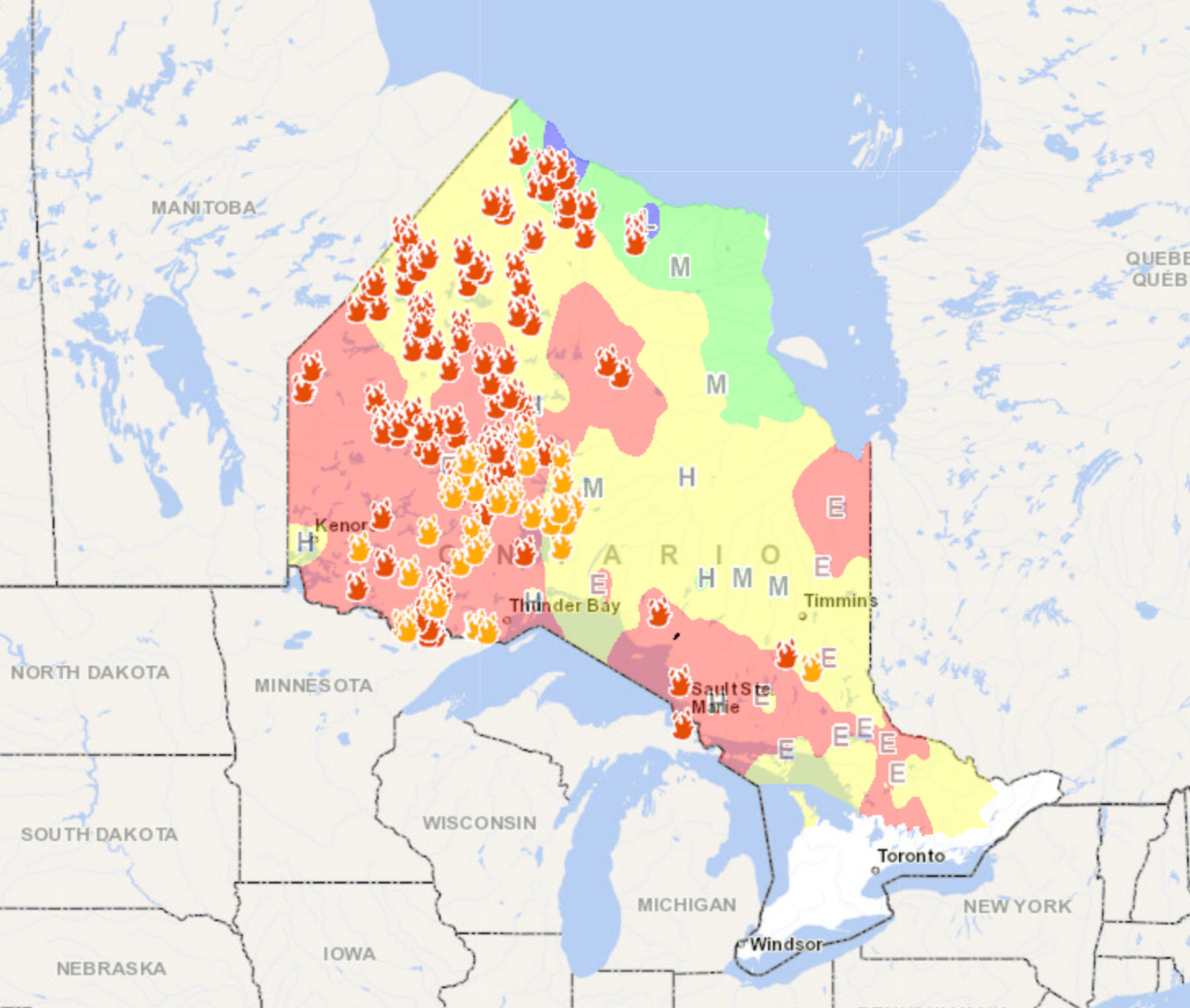
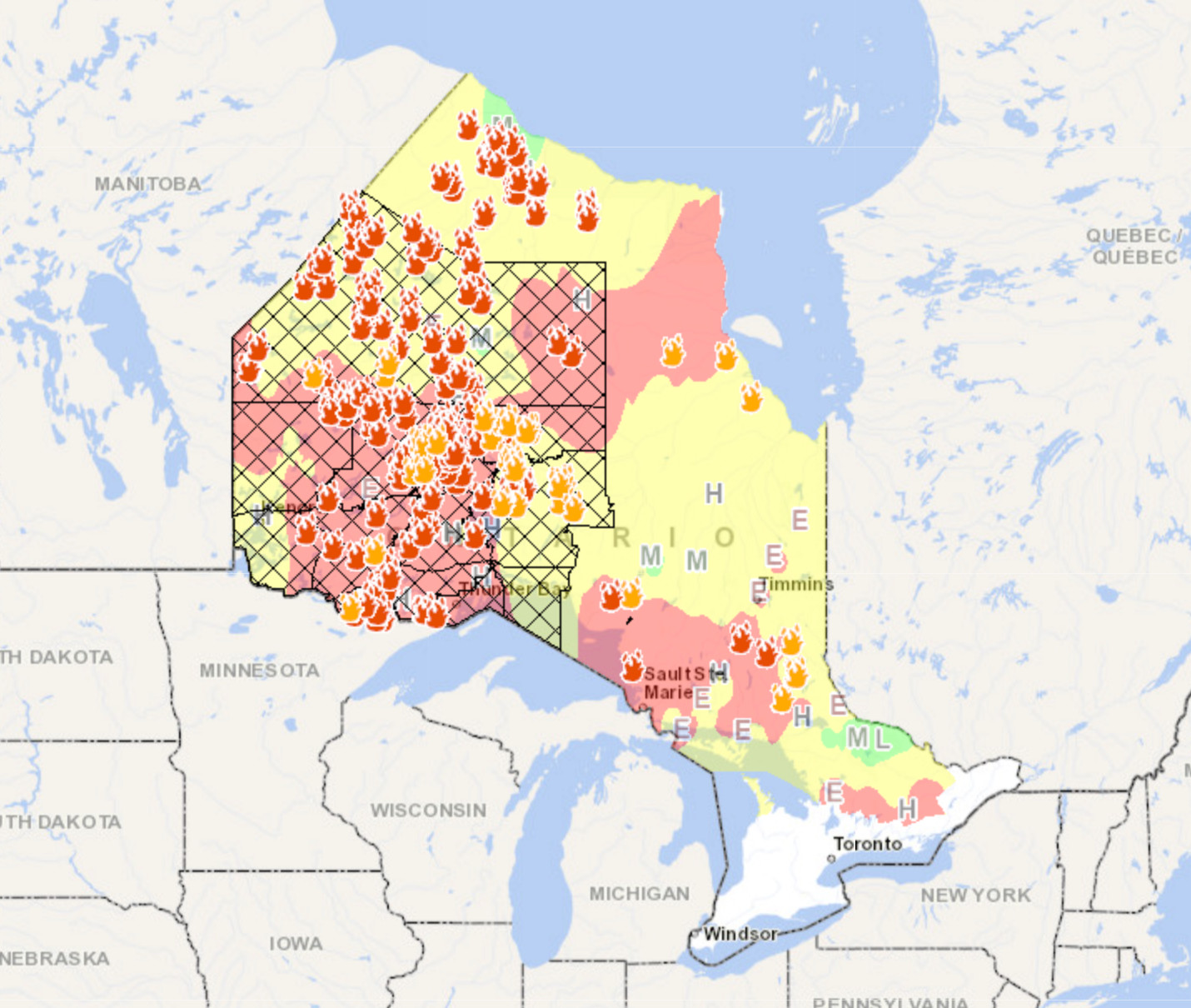
The difference between just two days: the first map is from July 14 while the second map is from July 15 — with nearly 200 wildfires burning across Ontario.
(Government of Ontario)
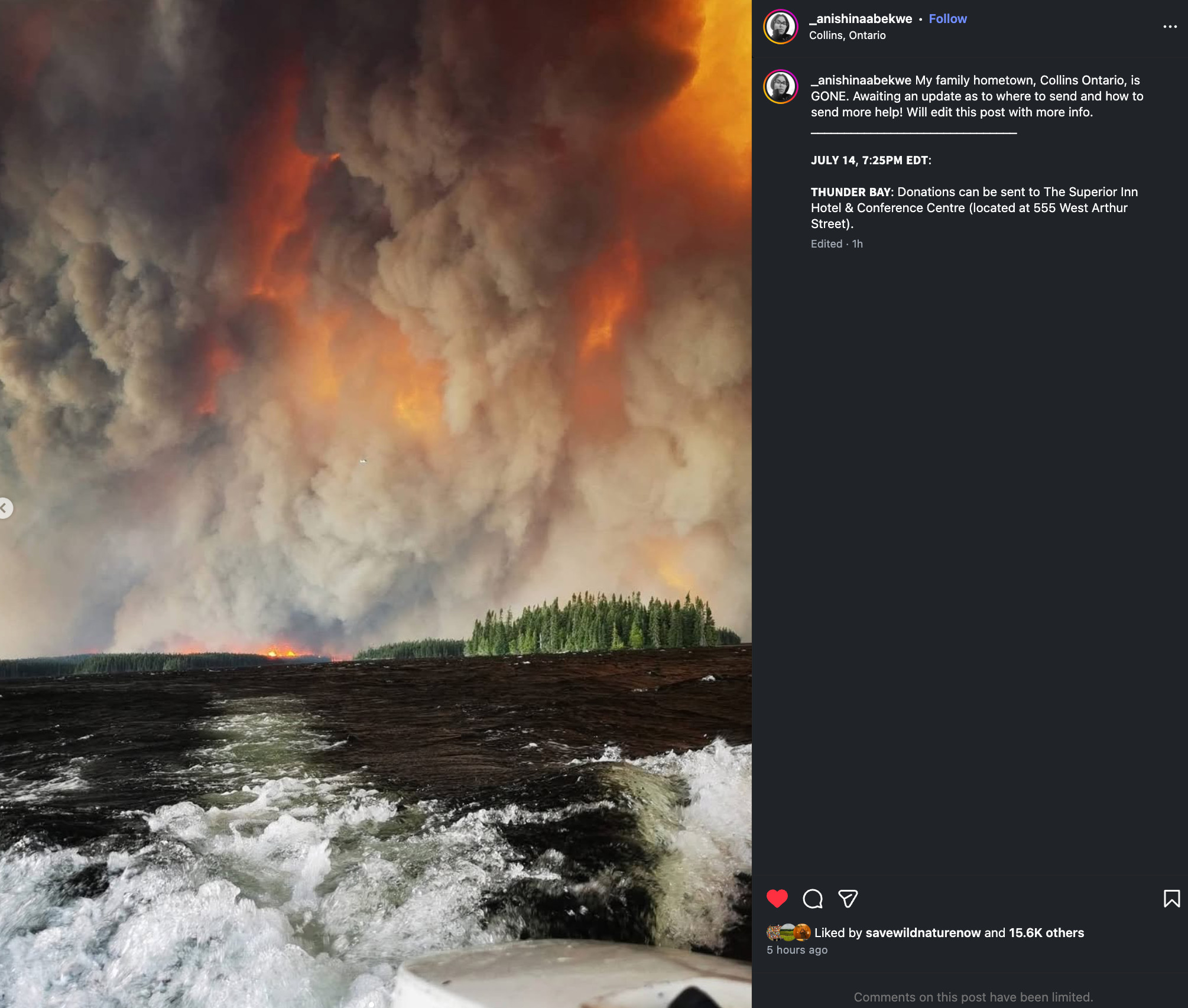
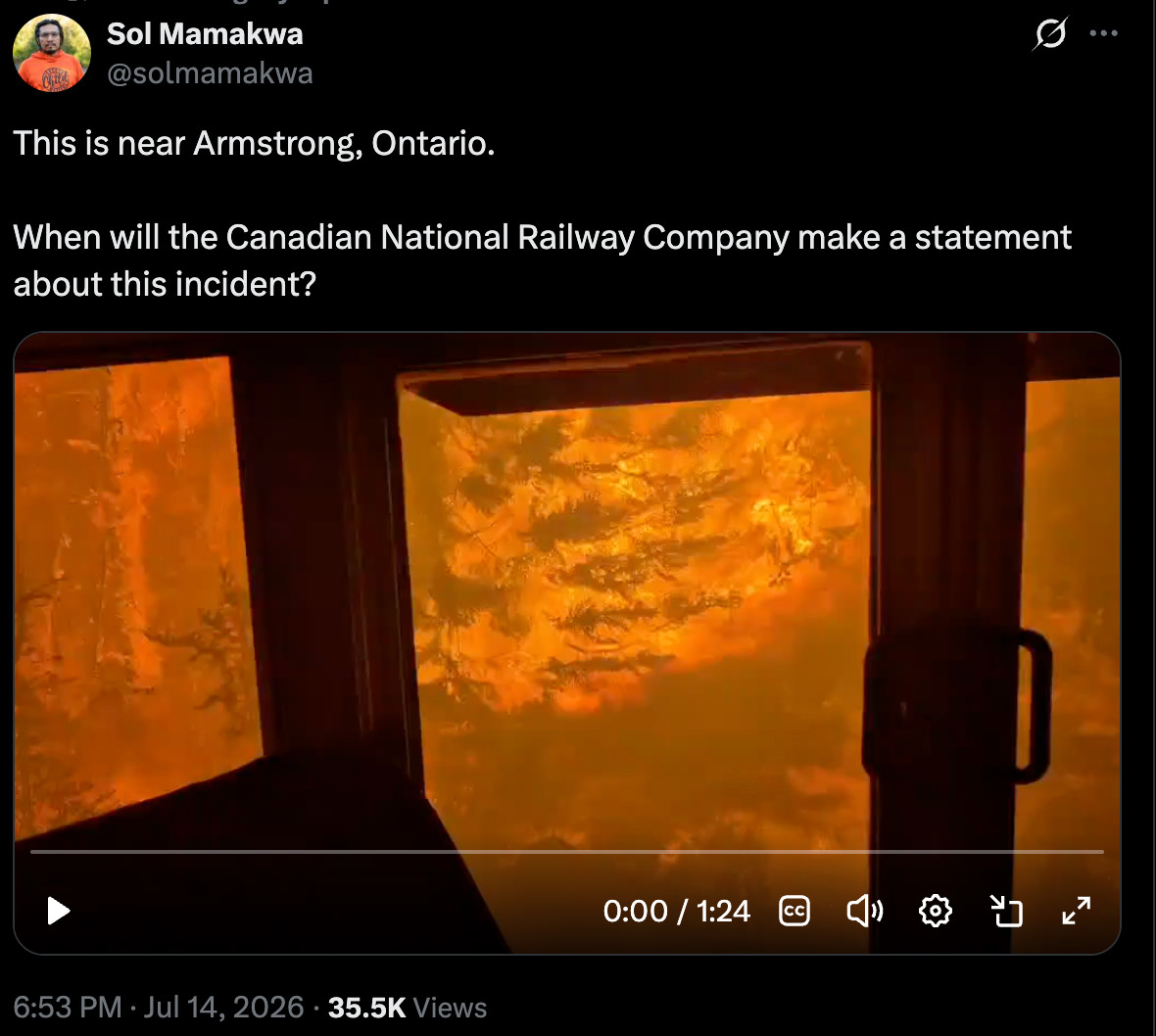
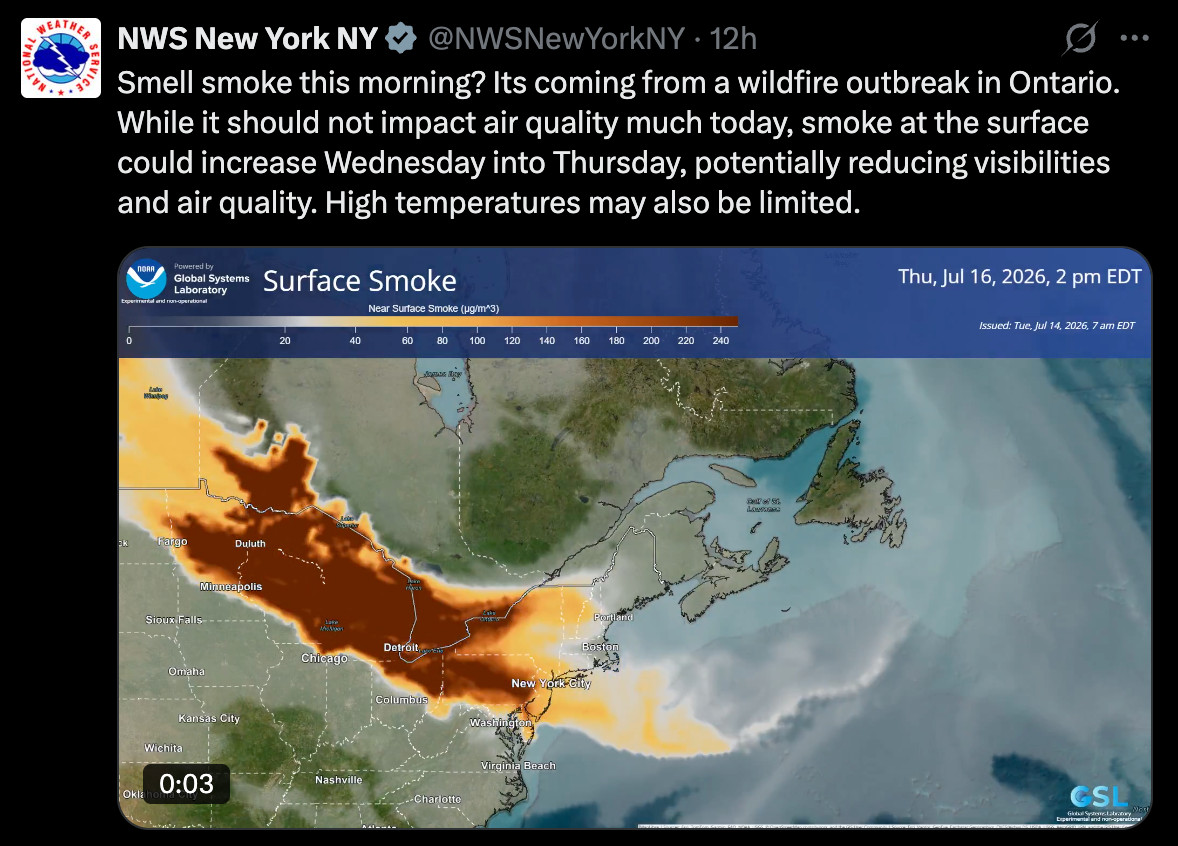
According to the province’s Forest Fire Info Map, there are over 180 forest fires across Ontario as of July 15. A day before, energy minister Tim Hodgson announced that five First Nations are taking a stake in LNG Canada Phase 2—liquefied natural gas has a greenhouse gas footprint 33 percent worse than coal, when processing and shipping are taken into account, according to a 2024 Cornell research.
(First: Nadya Kwandibens/Instagram, Second: Sol Mamakwa/X, Third: NWS New York/X)
By July 14, residents of Armstrong and Whitesand First Nation, Lac des Mille Lacs First Nation, Collins First Nation and Cushing Lake were ordered to evacuate, the Ontario Provincial Police (OPP) North West Region reported.
As of mid-July, Canada experienced a total of 3,372 wildfires with 835 active wildfires and over 100 deemed out of control.
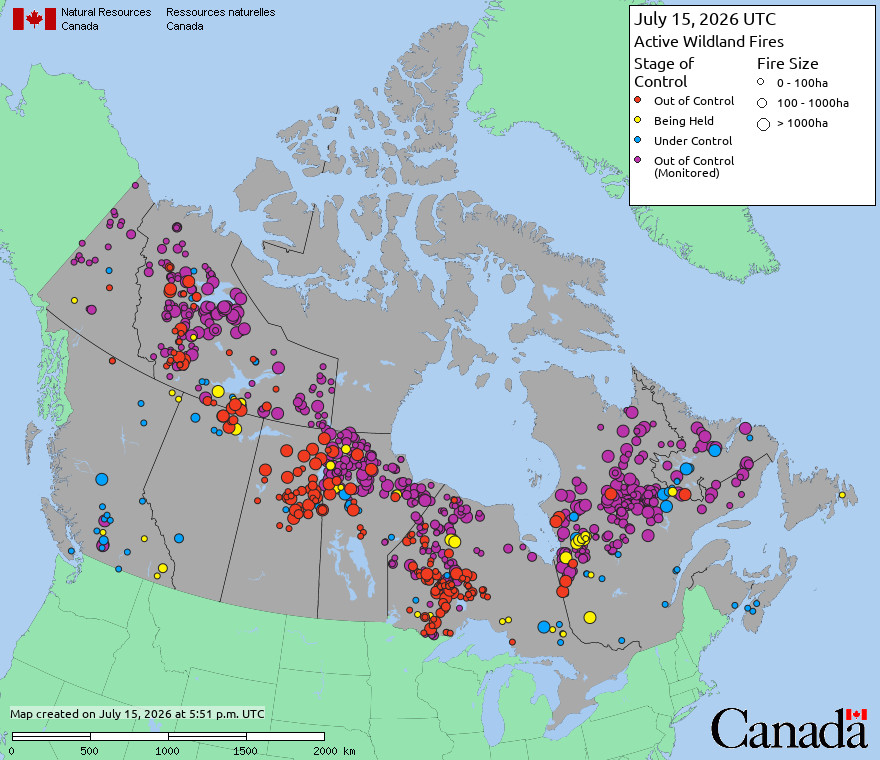
By July 15, a cumulative area of 1.9 million hectares was burned as a result of the wildfires across the country with 2,259,179 hectares being the ten-year average.
Last year, Canada recorded 6,199 wildfires, burning over 8.3 million hectares, making 2025 the second-worst wildfire season in history, just behind the record-breaking season of 2023 that torched 14.6 million hectares of land from 6,837 wildfires—“an area larger than England”.
“There’s no question, extreme weather, record high temperatures and dry conditions caused by climate change intensified this year's [2023] wildfire crisis,” Canadian Forest Services scientist Jonathan Boucher said in a study that found climate change made the extreme intensity of the fire season “at least two times more likely than under preindustrial climate while the persistence of these conditions were at least seven times more likely”.
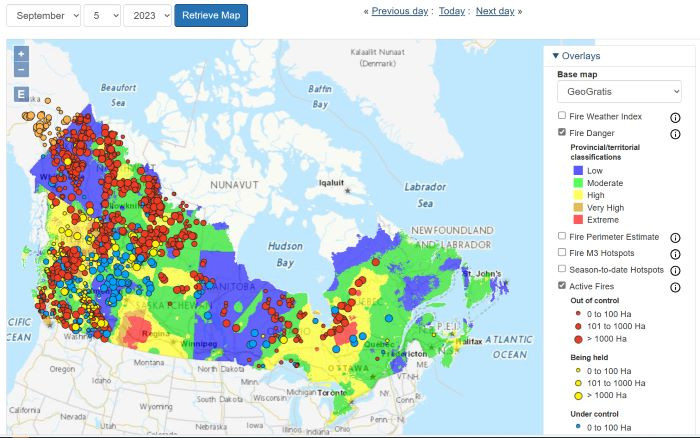
Screengrab from Natural Resources Canada’s interactive map showing active fires by September 5, 2023.
(Government of Canada)
It has been a tragedy in the making: Between 1981 and 2018, more than 300,000 wildfires prompted over 400,000 evacuations including the 2016 Fort McMurray disaster that displaced nearly 90,000 people and left behind approximately $9.5 billion in losses. In the decade since, Canada has averaged more than 5,000 fires annually and burned roughly 2.9 million hectares of land each year.
“Wildfires are now a crisis,” a new federal report released on June 10 alerted.
Canada’s wildfire response system is failing to keep pace with the scale and intensity of the national crisis.
The Senate Committee on Agriculture and Forestry argued that the current approach remains mostly reactive, mobilizing resources once fires have already become disasters, despite evidence that climate change is driving hotter temperatures, longer fire seasons, stronger winds, prolonged drought and increasingly severe fire behaviour that existing systems were never designed to handle.
“Millions of Canadians are exposed to toxic wildfire smoke for days, weeks or sometimes months at a time,” the report highlighted.
“The physical health and mental health consequences are significant, particularly for children, pregnant women, older adults, people with chronic conditions and remote Indigenous communities who often have limited access to both clean air spaces and long-term mental health support. The economic costs of wildfire smoke now exceed the costs of fire suppression itself.”
A 2022 study out of McGill University suggested those who live close to wildfire are at higher risk of developing lung and brain cancer, the same way it would be living in a highly polluted city.
Nearly one million Canadians already suffer from eco-anxiety or climate anxiety at a “clinically significant levels” as wildfire smoke becomes the new normal every summer and wildfires crawl closer to populated areas as well.
“Wildfire smoke is now a national hazard,” Canadian Climate Institute’s Research Director on Adaptation, Ryan Ness, said.
Repeated evacuations also leave lasting psychological scars in communities forced to flee year after year with multiple studies documenting elevated rates of post-traumatic stress disorder, anxiety and depression long after the flames have been extinguished.
But wildfires are not only impacting Canadians’ health, it is hurting the economy as well—one that so many in Ottawa seem to care more about.
“Canada is an agricultural nation,” the report noted.
“While Canada’s food system is resilient, innovative, sustains the environment and supports the economy, the committee heard that is also increasingly vulnerable to the impacts of climate change including drought—the underlaying condition for wildfires.”
Increasingly frequent fires are destroying timber supplies, damaging infrastructure, disrupting supply chains and threatening the long-term viability of forest-dependent communities. Every year, farmers lose livestock, crops, fencing, equipment and grazing land while facing mounting insurance costs and emergency assistance programs that often fail to respond quickly enough during disasters.
“Wildfires, droughts and floods go hand in hand with climate change. Our warming planet is warming faster in Canada than anywhere else, and the further north you go or the higher the elevation you go,” Director of the Global Water Futures Observatories freshwater research facility, Dr. John Pomeroy, explained.
“Warmer winters mean shallower snowpacks, earlier springs and more intense early summer wildfires. Hotter summers mean drought, low soil moisture, more extreme and erratic rainstorms and more wildfires.”
Despite the grim reality that stands before a nation part of a planet long ignored, senators noted Canada has the tools to better prepare for future wildfire seasons and made 15 recommendations to the Carney government.
One of the most important and the first recommendation is to “designate forests as a strategic national asset and recognize forests as critical and renewable infrastructure” while investing more heavily in wildfire prevention, adaptation and response while building stronger partnerships with provinces, municipalities and Indigenous communities.
“Wildfires are national catastrophes and governments must adapt their response to match the scale of the crisis and mobilize at the speed of the flames,” Senator Mary Robinson, chair of the committee, said in a statement, calling for establishing a dedicated federal wildfire coordination office similar to those operating in countries such as the United States, Australia and the United Kingdom.
The committee also recommended creating a nationally funded fleet of modern firefighting aircraft strategically positioned across the country with substantial investment in drones, satellite monitoring and predictive technologies, a national wildfire hazard mapping program, stronger support for prescribed burns and FireSmart initiatives, expanded mental health services for wildfire survivors and sustained funding for Indigenous-led firefighting and emergency management.
While Grenz welcomed the detailed report, she said governments have long paid “lip service” to incorporating Indigenous knowledge into wildfire planning without addressing the “root cause” of today's crisis: the historic suppression of Indigenous stewardship and cultural burning practices.
“The very people who are contributing to this problem are the same ones being assigned the task to try and solve it,” Grenz told The Pointer.
“As a researcher that has become involved in wildfire research and policy, I have to sit in meeting after meeting, conference after conference of people trying to fix something that they don't even understand.”
Long before fire was perceived as a threat to be extinguished, Indigenous communities understood it as a force to be guided…
Even before history was recorded in Canada, First Nations, Métis and Inuit people practiced cultural burning, regular, carefully timed, low-intensity fires used to restore ecosystems, open travel routes, enhance food sources and reduce the fuel loads that now feed catastrophic wildfires.
Across B.C.’s Interior and Rocky Mountains, there were intentional fires “every five to 15 years” — “which meant that forests were much more wide open and they actually contained different species”.
“They are mostly sun tolerant species because you'd have a forest where the sun is actually reaching the ground beneath the canopy,” Grenz added.
However, settlers that first came to Canada brought with them colonial forestry practices that fundamentally altered those landscapes by suppressing cultural fire and transforming forests into dense, tree-dominated stands.
“What we think of as normal forests today are mostly tree plantations, which is different than a forest,” she said.
“If you walk beneath the canopy, there’s no life because there’s no sunlight. It’s dry. It’s dark. And that is not how these forests were.”
A 2022 study of Ne Sextsine, a 5,900-hectare Douglas fir-dominated forest in the traditional territory of the T’exelc (Williams Lake First Nation) in British Columbia, reconstructed centuries of fire history by examining tree rings.
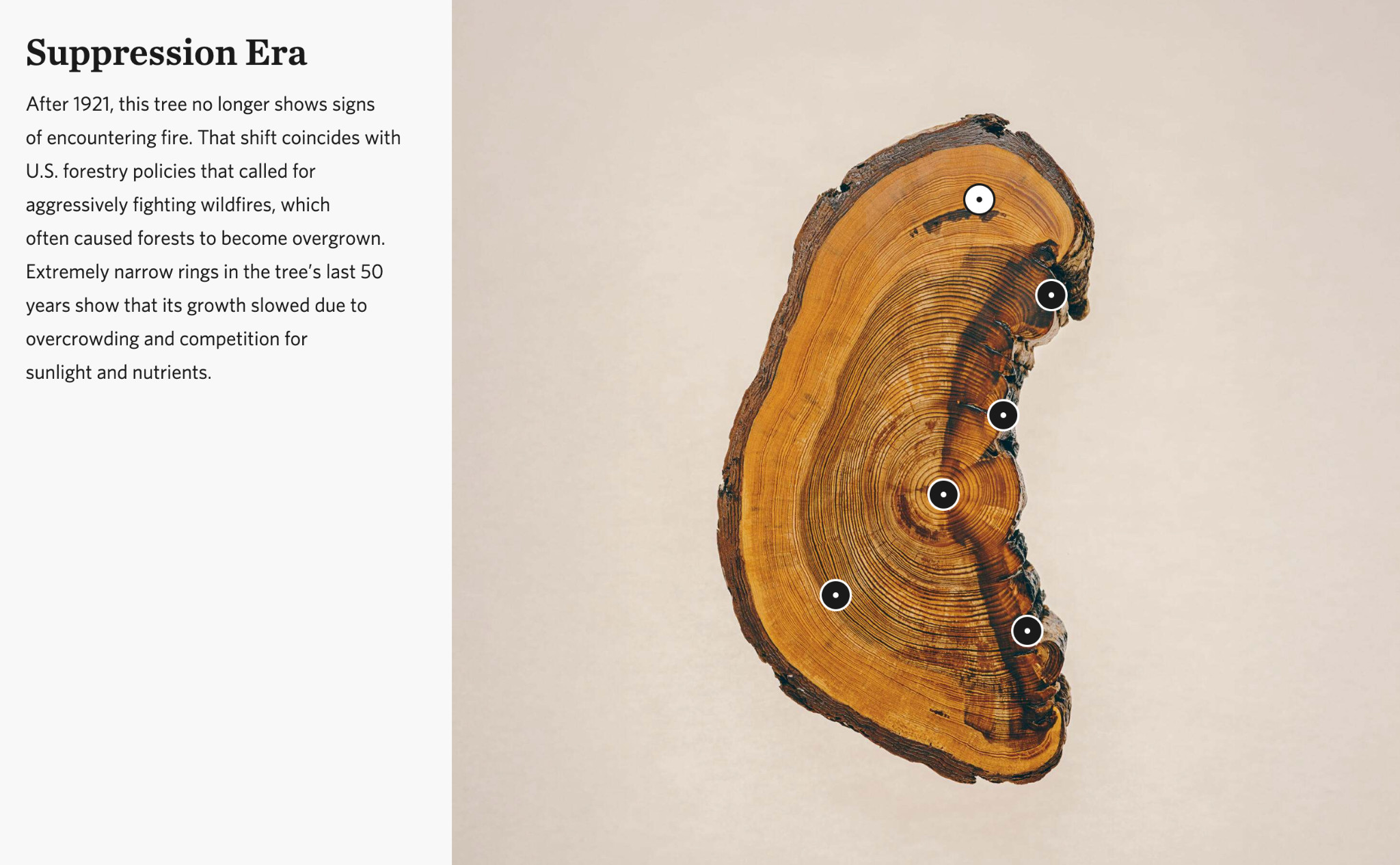
Tree rings act as a living archive that preserve a record of how forests and fire have interacted for centuries. The science of dendrochronology aids researchers to read natural timelines by examining growth patterns and fire scars left behind in tree trunks that provide evidence of when fires occurred, how often they returned and how intensely they burned. It has helped understand that fire was not an unusual disturbance but a recurring ecological process shaped by lightning as well as Indigenous stewardship practices.
By analyzing fire scars and tree cohorts, researchers found the Douglas fir-dominated forest was once shaped by frequent, mostly low-intensity fires that helped maintain a diverse, open landscape. Many of the frequently burned areas overlapped with places of cultural importance to the T’exelc including village sites, fishing camps and travel routes.
However, the relationship with fire began to change following colonial disruptions including the displacement of Indigenous Peoples and the prohibition of cultural burning. The 1874 Bush Fire Act in B.C. was one such colonial law that criminalized burning for decades with those found guilty subject to fines and in some cases, arrests.
As fire was removed from the landscape, forests became increasingly dense and uniform, with many trees establishing and growing without the regular disturbances that had historically shaped the ecosystem.
Dr. Lori Daniels, Director of the UBC Tree Ring Lab, found the altered landscapes to be more prone to the severe, high-intensity wildfires seen today.
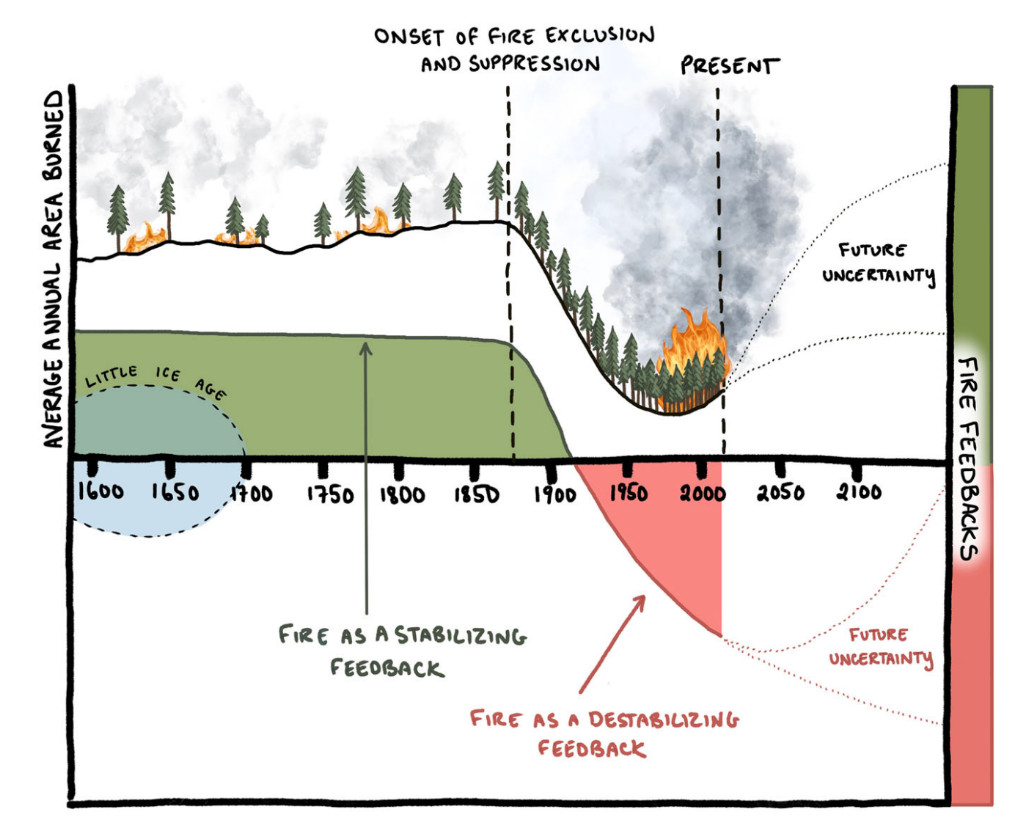
A 2025 study reiterated that a century of fire suppression disrupted the natural cycle of frequent, low-intensity burns that once maintained healthy forests, allowing fuels to accumulate and contributing to the larger, more severe wildfires that have become a common occurrence—also contributing to an uncertain future for the life of forests.
(Nature)
Grenz, who made a presentation with Daniels at the World Biodiversity Forum in Davos, Switzerland this year, explained one Douglas fir tree disc appeared to be only 25 or 30 years old based on its “small” size but was actually more than 120 years old.
“It also speaks to the fact that not only were our lands converted into timber plantations but they're not even growing trees very well because they're so crowded, they're so dense,” she added.
“This is a legacy of colonialism.”
Unlike the misconception that Indigenous fire knowledge is rooted solely in tradition, it is rarely static and evolves with changing conditions including climate change. Communities combine generations of lived experience with scientific research to understand shifting wildfire patterns, adapt cultural burning practices, and restore healthier, more resilient forests.
Grenz’s research focuses on what happens to ecosystems after megafires including how plants, soils, animals and Indigenous land-use practices recover in the aftermath when all that’s left are charcoal moonscapes. Northern St’át’imc communities are helping her generate that data so it can help guide land management decisions after fires.
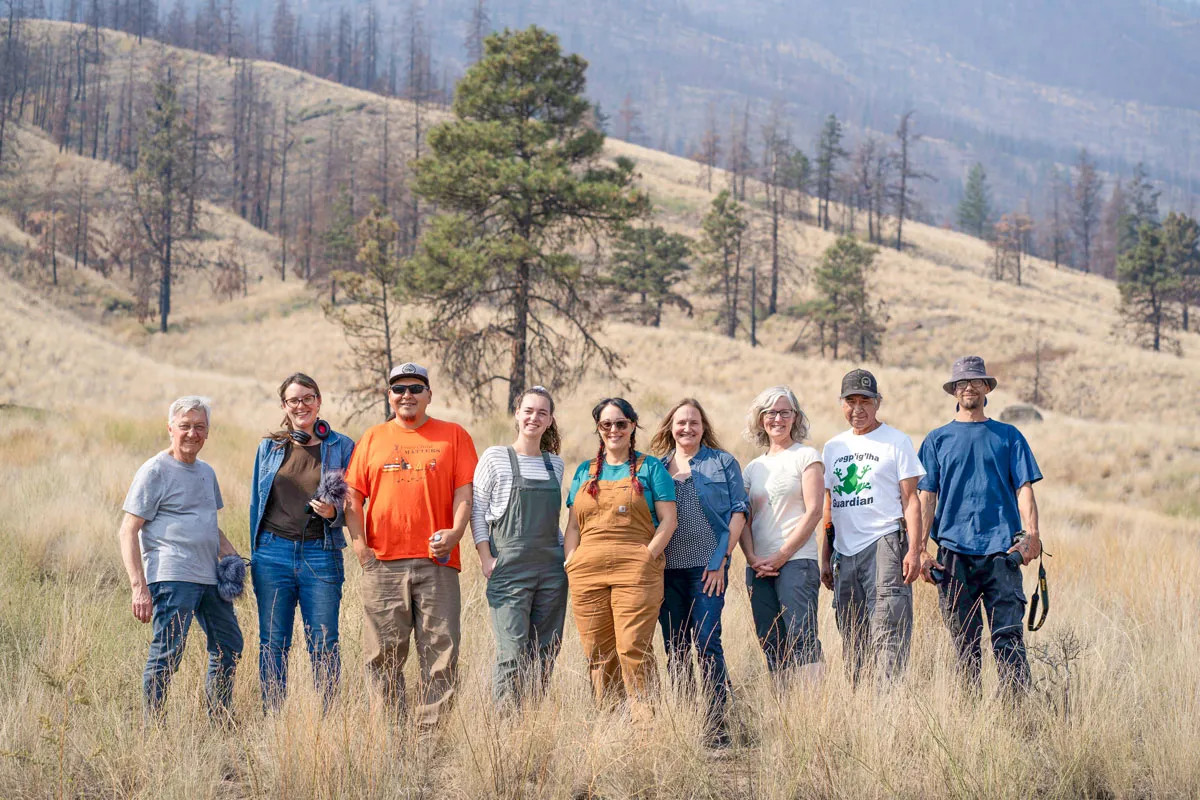
Dr. Jennifer Grenz is working on a wildfire recovery initiative that applies an Indigenous food systems lens to post-fire landscapes, analysing how vegetation changes after wildfires and developing management tools to support the return of culturally important plant species while limiting invasive species.
(Indigenous Ecology Lab)
One area of focus has been identifying “berry protection zones” that are areas where traditional berry-gathering sites have re-emerged after wildfires despite extensive soil damage.
“We’ve seen moose, wolves, bears, deer — five years after wildfire,” she said.
“It started out as a catastrophe and now is this mostly beautiful mosaic on the landscape that is so needed because that’s where the food is.”
But here’s where the forestry industry comes in by introducing the risk of replanting with commercial tree plantations that make sense economically but not ecologically.
Compared with historical forests that contained fire-tolerant trees like ponderosa pine and western larch, new age forests have 1,407 percent more trees with species highly sensitive to ground fires like Balsam Fir, White Spruce, Eastern White-Cedar, Sugar Maple and American Beech, competing for limited water and nutrients leading to slower growth and rising mortality, a 2021 study found. In Ontario, this problem is further exacerbated with the use of herbicides like glyphosate on broadleaf, fire-retardant trees like poplars and birches after logging which creates highly combustible monocultures that allow fires to spread rapidly.
“This is profitable for forestry companies but causes enormous side effects, ecosystem pollution, killing insects and understory plants, and contaminating food chains and water,” Forest ecologist Sanghyun Kim told The Pointer.
“Herbicides also reduce biomass, drying out forests and making them more flammable, increasing wildfire risk, which then impacts Southern Ontario’s population. Everything is connected.”
Grenz firmly believes restoring Indigenous stewardship practices is not just about Indigenous rights but about creating safer and healthier landscapes for everyone.
“Ecological health, safety, a place to live — those are the rights of most people,” she said.
While the “solutions are there”, governments at both federal and provincial levels need to move beyond acknowledging Indigenous knowledge and create actual pathways for communities to apply it.
Prescribed and cultural burning are currently difficult to carry out on Crown land even when there is evidence showing its benefits.
“Knowledge has been broken through colonization to the point there’s a shifting baseline syndrome, where our perception of normal is just what we know,” she noted.
“But with B.C.'s recent colonial history, we still have people with lived memory within one generation who know about the times before. We can learn from that and gain wisdom from it in our practices going forward.”
As she shares her thoughts, she is transcended back to her great-grandmother and grandmother’s garden where she learned to love plants, grow food and establish a deep connection with Mother Nature—seeds that later blossomed into her choice to pursue ecology restoration and forest resources management.
“When you're grounded in the truth of the land, that really changes how you assess things.”
Email: [email protected]
At a time when vital public information is needed by everyone, The Pointer has taken down our paywall on all stories to ensure every resident of Brampton, Mississauga and Niagara has access to the facts. For those who are able, we encourage you to consider a subscription. This will help us report on important public interest issues the community needs to know about now more than ever. You can register for a 30-day free trial HERE. Thereafter, The Pointer will charge $10 a month and you can cancel any time right on the website. Thank you
Submit a correction about this story

