
Pay up or find somewhere else to grow: Region of Peel rejects Doug Ford’s ‘major financial burden’ on taxpayers to fund his growth
In Doug Ford’s Ontario, no one knows who will pay for the one million-plus new homes he wants built over the next half-decade. What we do know is that his developer friends, whom he promised to work for if they helped fund his political campaigns, will not be paying for the growth-related costs the industry has been responsible for over the last seven decades.
We also know that municipal taxpayers will have a lot of those costs downloaded onto them, thanks to Ford’s generous gift to his powerful developer friends.
“I hear from people every single day how the cost of living is going up…that's exactly the reason we've never raised a tax in our 2026 budget alone,” Ford said in a video published on the official Premier of Ontario page on May 26. “We're going to keep moving forward and make sure that we put money back into the taxpayer's pocket, not into the government's pocket.”
Ontarians are growing tired of his claims, shifting more and more of the burden for his radical policies and inexplicable spending onto consumers, property taxpayers and those that fund his own government’s coffers.
In April, Ford purchased a pre-owned 2016 Bombardier Challenger 650 jet for $28.9 million. Following public backlash after buying a “gravy plane” during a cost-of-living crisis, Ford tried to walk back the lavish expense, selling the fancy plane back to Bombardier days later for the same price.
While the province recouped the base price of the aircraft, taxpayers are still on the hook for nearly $191,000 in non-refundable legal, aviation and administrative fees that Ford is refusing to pay from his pocket.
“No one’s more ticked off about the 200 grand,” Ford responded.
“I pride myself on saving taxpayers $12 billion every single year. That’s what we’re going to focus on.”
Ontario’s rising debt is projected to reach almost half-a-trillion-dollars, roughly $485 billion in 2026–27. It is the largest sub-national debt in the world. The province has the second-highest debt per person in Canada at $28,254, according to a recent Fraser Institute analysis.
Unemployment in Ontario is among the worst in Canada, and in April the province’s cities had the highest rates in the country: London Region and the Barrie area were the worst across the nation, with unemployment at 9.2 percent; followed by the Kitchener-Waterloo area at 9 percent; with Toronto, Windsor, and Oshawa all at 8 percent or above, among the highest rates of all the major areas in Canada included in the Statistics Canada report.
Despite the financial problems across the province, Ford insists, “if there was ever a time to buy a home, it's right now.”
Really?
(Alexis Wright/The Pointer)
The Region of Peel is already getting crushed under provincial decisions rammed through to reach Ford’s goal of building 1.5 million homes by 2031. Housing starts in the province are projected to fall to near two-decade lows: currently under 54,000, less than 30 percent of the Ford government’s 175,000-unit annual target.
On May 28, following two dire reports by staff and a nearly two-hour council discussion, the Region decided to pause hundreds of millions of dollars in new water and wastewater infrastructure projects starting June 11, to avoid putting residents under “major financial burden” due to “large increase in utility rates”, if it does not receive financial support from the provincial and federal governments.
Regional officials warned that continuing to build the pipes, pumping stations, trunk sewers, reservoirs and treatment infrastructure needed to support rapid housing growth would place unsustainable pressure on utility ratepayers and property taxpayers.
Peel Region’s Chief Financial Officer and Commissioner of Corporate Services, Davinder Valeri, explained that development charge (DC) collections and debt financing had historically been sufficient to support the Region’s water and wastewater capital program including principal and interest payments, while keeping reserve balances near zero.
However, beginning in 2023, accelerated infrastructure spending tied to provincial housing targets, combined with changes to development charge legislation, created a widening gap between the revenue Peel collects through DCs and the cost of funding major infrastructure projects.
The Region has increasingly relied on debt to manage the mismatch, issuing more than $900 million in DC-backed debt since 2024. Despite those decisions, projected expenditures continue to outpace revenues while borrowing costs are also on the rise.
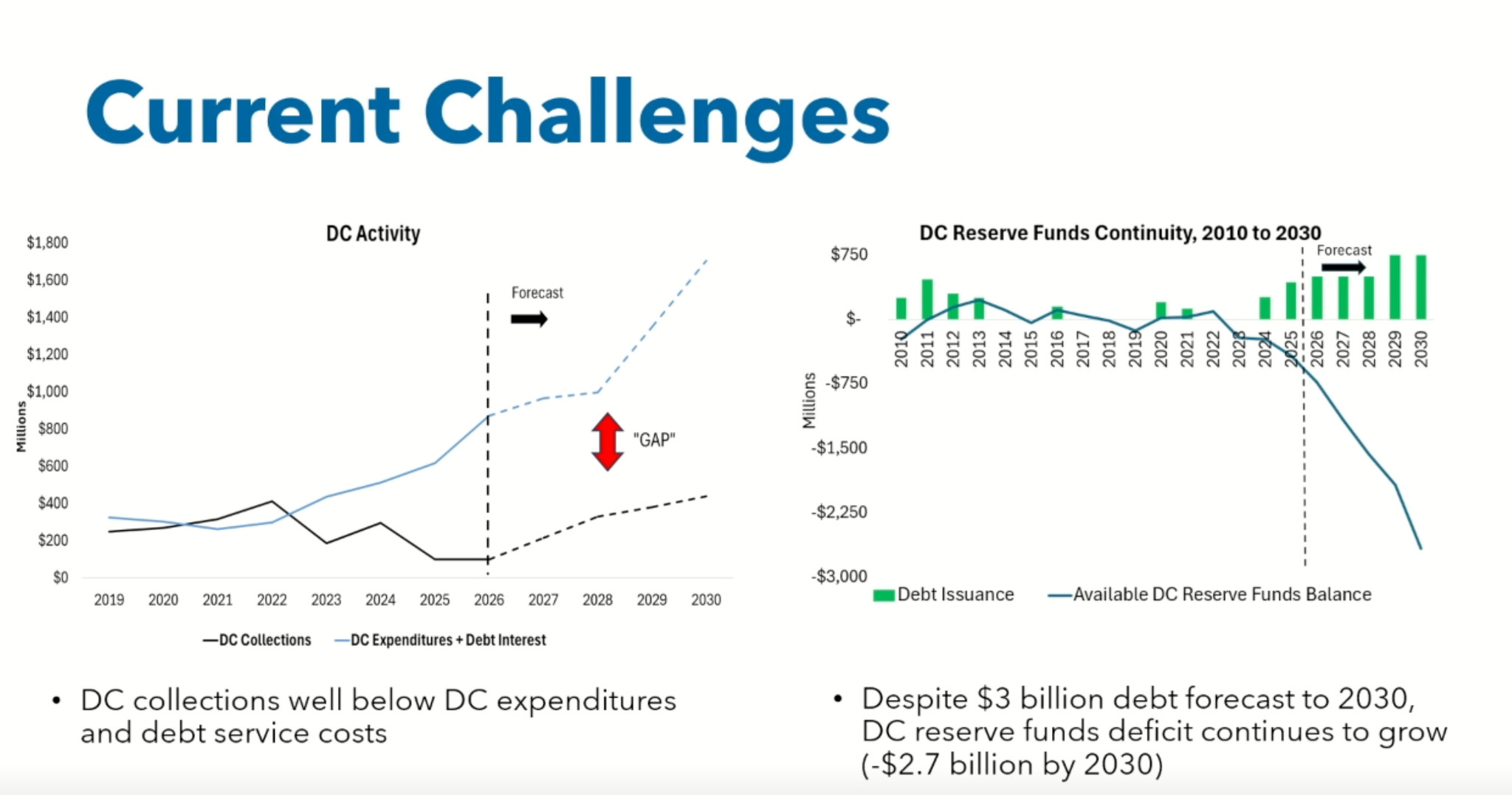
Peel Region’s Chief Financial Officer and Commissioner of Corporate Services, Davinder Valeri, warned that while short-term reserve deficits can be managed, the scale of the current projected shortfall is unsustainable if all planned water and wastewater construction projects proceed as scheduled.
(Region of Peel)
As a result, Peel’s Development Charge Reserve Funds, the accounts used to finance growth-related infrastructure, are projected to plunge deeper into deficit, growing from approximately $728 million by the end of 2026 to nearly $2.7 billion by 2030, even after taking on roughly $3 billion in additional debt if current construction plans continue.
“A small deficit in the DC reserve funds can be managed for a short period of time but the current deficit is too large and cannot be sustained,” Valeri stressed.
To keep Peel’s original water and wastewater infrastructure program on schedule while balancing the reserve funds, staff estimated the Region would require roughly $700 million from upper levels of government this year followed by another $650 million in 2027.
The findings were not surprising as previous council discussions and multiple staff reports warned this day would arrive soon after the province passed Bill 17, officially titled the Protecting Ontario by Building Faster and Smarter Act, last May.
While Ford claimed the loss of municipal revenue would be covered by the province to ensure existing property owners are not unfairly burdened with the costs of local infrastructure, details of how Queen’s Park planned to make that happen were never clarified.
While Mississauga benefited from a development model that generated a strong commercial tax base and denser urban growth, the same approach failed to sustain Brampton and Caledon, where decades of sprawling subdivision expansion has left both municipalities facing growing financial strain.
On June 26 last year, despite Brampton Mayor Patrick Brown and Caledon Mayor Annette Groves’ threats to walk out of Regional meetings if Peel continued pursuing aggressive DC reductions, council narrowly passed a scaled-down version of Mississauga Mayor Carolyn Parrish’s original proposal, voting to reduce regional development charges by 50 percent to lower upfront costs for developers and accelerate construction.
The decision followed a letter from Ontario Municipal Affairs and Housing Minister Rob Flack to the three Peel mayors and Regional Chair Nando Iannicca confirming the province would provide $1.3 billion through the Building Ontario Fund to help offset lost revenue tied to the reduced charges.
A previous investigation by The Pointer had warned that amount won’t be enough since Peel’s $1.3 billion, combined with the federal $6 billion program, still wouldn’t cover all costs, as much of that funding is for unrelated projects.
While all three mayors welcomed the provincial commitment at the time, council included a safeguard clause in the motion allowing the Region to terminate the discounts if Queen’s Park failed to fully commit to covering the infrastructure deficit by October 17, 2025.
Brampton councillors Navjot Kaur Brar and Gurpartap Singh Toor were the only members who voted against the motion.
“I don’t believe this province when they tell you one thing and then flip-flop on it; they have the best record of doing that,” Toor said.
“So until we talk to them in the fall and actually have a cheque in our hands, until we see the money hit the bank, that’s when I will feel confident to move forward in this direction.”
There has been no word on that funding as of May 29. Mississauga Mayor Carolyn Parrish said the province has provided “no signals” that any money’s coming the Region’s way yet.
“This is high noon. I've heard from the beginning, money's coming, money's coming, money's coming,” Mississauga Councillor Dipika Damerla, visibly frustrated, said.
“How many more times are we going to wait for the province to give us the money? Even the province doesn't have the money.”
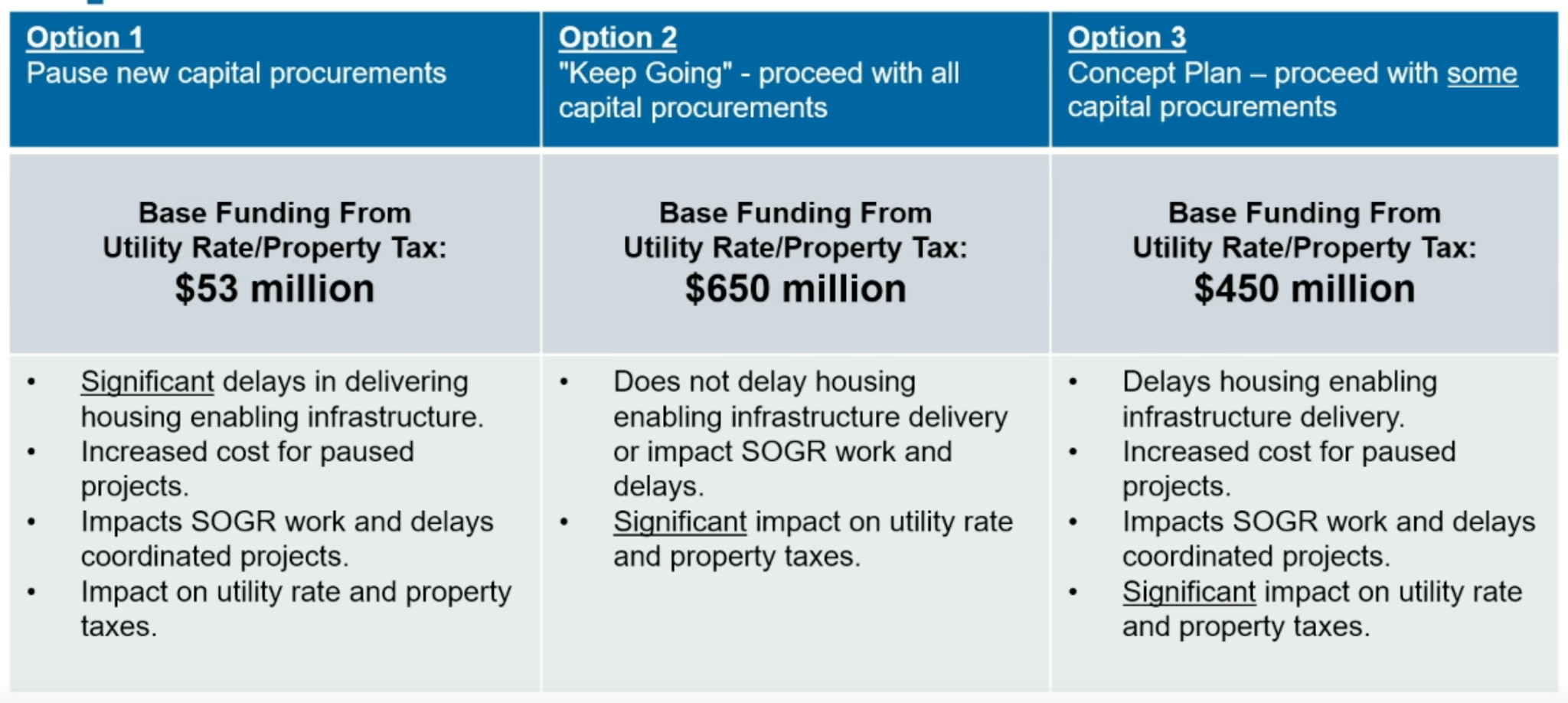
Council was presented with three options to address the funding shortfall.
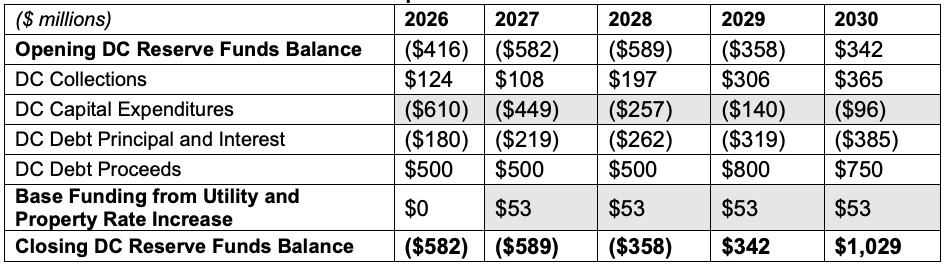
Under Option 1, staff explained the DC Reserve Fund deficit would be gone by 2029 if only projects that have already been awarded for water and wastewater were allowed to continue. “The Region could also reduce DC-supported borrowing in 2029-2030 to bring the balance back to zero”.
(Region of Peel)
The first option, also recommended by staff, would delay all new growth-related water and wastewater procurements that had not yet been awarded and only projects already underway or contractually committed would continue. Staff estimate the Region would still need approximately $53 million annually from higher utility rates and property taxes beginning in 2027 to stabilize finances.
The second option was to “Keep Going”, which would allow the Region to continue its full capital program as planned. However, staff estimate that doing so without upper-level government support would require approximately $650 million annually in additional funding from ratepayers and taxpayers beginning in 2027.
The third option titled “Concept Plan” involved the conceptual infrastructure phasing plan itself, delaying selected projects while still moving ahead with some priority infrastructure. But even under that reduced-capital scenario, Peel would still require approximately $450 million annually in additional funding from utility rates and property taxes beginning next year if government funding does not materialize.
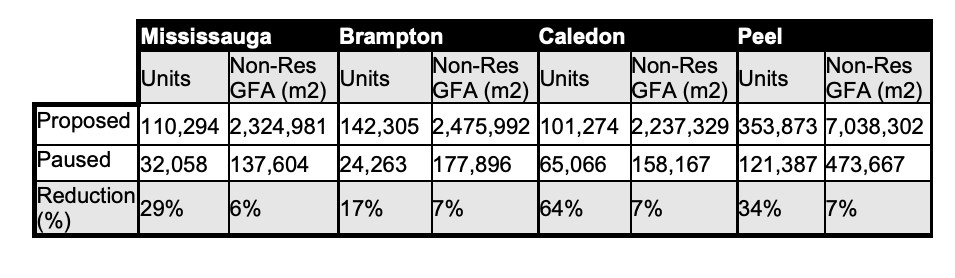
Approximately 121,387 proposed residential units across Peel could be impacted by the conceptual phasing plan including about 32,000 units in Mississauga, more than 24,000 units in Brampton with Caledon experiencing the largest proportional impact: 64 percent of proposed residential units (over 65,000) affected under the plan.
(Region of Peel)
On March 30, Prime Minister Mark Carney joined Premier Doug Ford to announce the Canada-Ontario Partnership to Build, an $8.8 billion cost-shared plan over ten years aimed at funding housing-enabling infrastructure, transit and affordable housing projects while supporting municipalities that reduce residential DCs between 30 to 50 percent for a duration of three years.
But Damerla warned the funding commitment falls far short of Peel’s infrastructure needs since the Region alone would require roughly $650 million annually, nearly the same amount the federal and provincial governments are offering municipalities across Ontario each year combined.
“It's not happening. So, unless we are really comfortable with putting this on the property taxpayer or ratepayer, and I am not. Then we have to pause this,” she said.
“If we stick with the status quo, next year probably taxpayers are going to be hit with a $1,150 bill.”
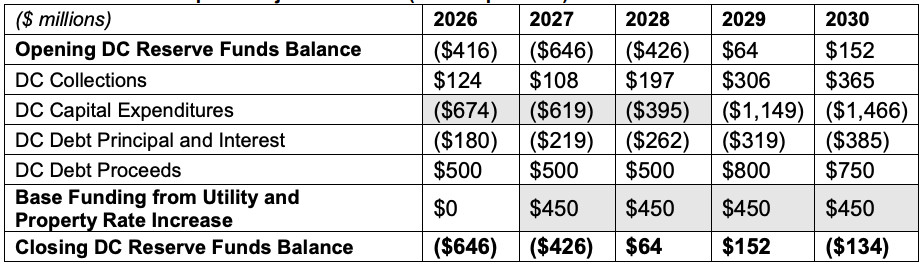
Under Option 3, staff estimated Peel’s financial position would improve but with risks including “higher costs for paused projects, challenges for future development depending on market conditions, impacts on current and planned repair projects, delays to coordinated work, and postponing inspections and repairs of important infrastructure” while putting “significant financial burden on residents because of the large increase in utility rates”.
(Region of Peel)
Brown, however, was apprehensive about pausing roughly $450 million in growth-related infrastructure projects, which would cause “significant damage” by slowing housing development and halting critical tenders. Instead, he suggested deferring the reports for 30 to 60 days while sending a letter to the provincial and federal governments warning that new housing tenders would cease without immediate financial assistance.
“If they [the province] care…there'll be a phone call in the morning to the three mayors saying, okay, this is how much we can send you and I would be shocked if it's more than $250 million but it's a start,” Parrish said.
“I won't be supporting a deferral.”
However, Groves warned that “starting and stopping will also cost us [Region of Peel] more.”
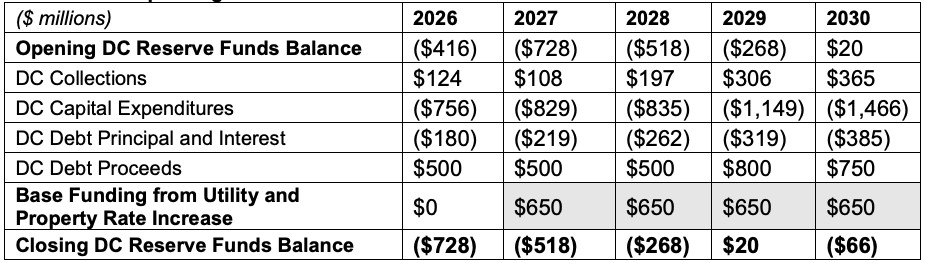
The option to ‘Keep Going’ would have strengthened Peel’s financial position and allowed new growth-related capital procurements to continue as planned but it would have also placed a “major financial burden on residents” due to a large increase in utility rates.
(Region of Peel)
She wanted the Region to continue with the capital program and planned projects as originally scheduled. That option, not recommended by staff, required utility rates and property taxes to increase to raise an extra $650 million in ongoing funding starting in 2027 if no new money came from upper levels of government—which means a 124 percent utility rate increase or $1,169 per year.
Delaying some of the planned growth-related capital projects would lower the projected utility rate increase from 124 percent to 86 percent while also reducing the property tax impact from 3.5 percent under the second option (that Groves supported) to 2.4 percent.
Damerla responded to Groves: “if the province does not come back with funding, Caledon’s property tax in 2027 would go up by $1,458”.
Regional staff added that a decision should be taken considering Peel’s AAA/Aaa credit rating could be at risk: Earlier this year, S&P Global Ratings revised Peel’s outlook to negative, citing record capital spending and weaker-than-expected development charge collections.
Peel is also projected to hit the province’s 25 percent annual debt repayment limit before the end of the next decade, potentially restricting future borrowing capacity not only for water infrastructure but also for other regional services including policing, housing and paramedic services.
Another major change came through Bill 60, the Fighting Delays, Building Faster Act, which received Royal Assent on November 27 last year and put Brampton’s mobility plan at risk. It amended the Municipal Act to transfer responsibility for water and wastewater utilities to lower-tier municipalities by a date set by the province or automatically by January 1, 2029, if no date is prescribed.
Region of Peel’s Chief Administrative Officer Gary Kent defended the staff recommendation to pause new growth-related capital procurements, saying the Region’s financial position had become impossible to justify.
“We don't want to be here,” Kent admitted.
“If you’re saying someone we’re going to give you $1 and I’ve only got 50 cents in two or three years’ time, just, as an accountant, as the CAO of this organization, as someone who loves this community and loves the growth, I can't reconcile that at all.”
When Councillor Mario Russo brought up a concern about shifting the burden on taxpayers unfairly by pausing projects, Councillor Damerla pushed back stating the Region was “already doing it” by continuing to build infrastructure while collecting less in development charges.
When the discussion shifted to a possible two-week deferral, some in the room, including Mayor Groves, supported giving the province more time after hearing Queen’s Park was expected to launch its long-awaited development charge funding program within days with negotiations involving Peel set to begin Monday.
Regional Chair Nando Iannicca hinted behind-the-scenes discussions with the province were underway, suggesting Peel’s warnings were finally gaining attention at Queen’s Park. While Iannicca stopped short of guaranteeing funding would arrive, he told council he believed the Region was “being listened to”.
But not everyone agreed.
“I apologize—but the three mayors and Mr. Chair, you have been put in this embarrassing spot multiple times about the province, where you've said we've had the chats, the money's coming,” Toor responded.
“We've heard that again and again, and we’ve got to do what is right at this point.”
By the time the clock had almost hit 4 p.m., council members voted in favour of the motion put forward by Councillor Joe Horneck to pause “all new growth-related capital procurements for water and wastewater” projects “until a sufficient commitment of funding is received to be ratified by Regional Council at its next meeting”.
Email: [email protected]
At a time when vital public information is needed by everyone, The Pointer has taken down our paywall on all stories to ensure every resident of Brampton, Mississauga and Niagara has access to the facts. For those who are able, we encourage you to consider a subscription. This will help us report on important public interest issues the community needs to know about now more than ever. You can register for a 30-day free trial HERE. Thereafter, The Pointer will charge $10 a month and you can cancel any time right on the website. Thank you
Submit a correction about this story

