
‘We’re failing to recognize individual & community cost of car dependency’: Ford’s Bill 60 puts Brampton’s Mobility Plan at risk
Bike Brampton Chair David Laing felt a rare sense of optimism in September when City Hall officially adopted its long-awaited Mobility Plan. In 2024 he said it was “a bad time to be an environmental advocate” but the move gave him renewed hope that a place known for its dependence on the car, could join active transportation movements gaining momentum elsewhere.
For a community where large areas remain difficult to access without a vehicle, thanks to ‘70s and ‘80s-era planning designed to create sprawl, the new strategy promised a shift toward a multimodal transportation system to move Brampton from a suburban mindset to the type of urban setting that can efficiently, and sustainably accommodate a city of one million residents—a milestone Ontario’s third largest municipality is set to reach in a couple of decades.
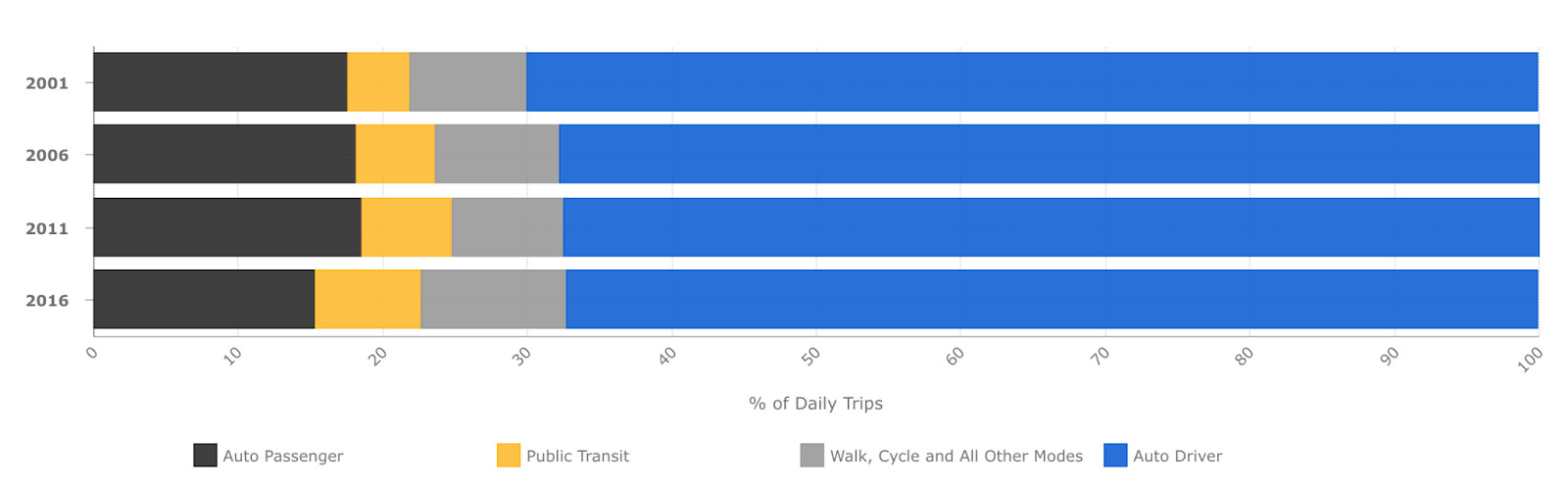
In 2016, 67 percent of trips made by Brampton residents were in single-occupant vehicles, while only 33 percent used sustainable modes such as walking, cycling, public transit or ridesharing. Under its Active Transportation Master Plan (endorsed by City council in 2019) and Mobility Plan, the City of Brampton aims to reverse that pattern, targetting a shift so that 58 percent of residents rely on carpooling, transit, walking or cycling as their primary mode of travel by 2041.
(Transportation Tomorrow Survey, 1996-2016/City of Brampton)
Under the Mobility Plan, the City committed to expand sidewalks, build higher-order and priority transit lanes and protect and enhance cycling infrastructure.
That was before Doug Ford stepped in.
On December 9, Laing reminded the City’s Active Transportation Advisory Committee that members might have to hit the brakes and “rethink” the strategy, with the PC government’s Bill 60-Fighting Delays, Building Faster Act, putting a giant pothole in the middle of the plan.
Ford’s preoccupation with municipal transportation planning, particularly infrastructure for cycling, which goes against his own suburban car-dominated lifestyle, has thrown a giant wrench into planning for active transportation, just when trends were moving in the right direction.
Based on forecasts using a range of data, by 2051 daily short-distance trips in Brampton were expected to nearly triple from roughly 440,000 to 1.2 million, Laing explained to the committee. Total daily trips could reach 2.5 million.
Historical data also suggests walking and cycling trips are projected to increase organically from about 80,000 to 223,000 per day.
But the city’s Mobility Plan to capitalize on factors sparking these trends would depend on convincing an additional 49,000 residents every day to walk or cycle instead of driving.
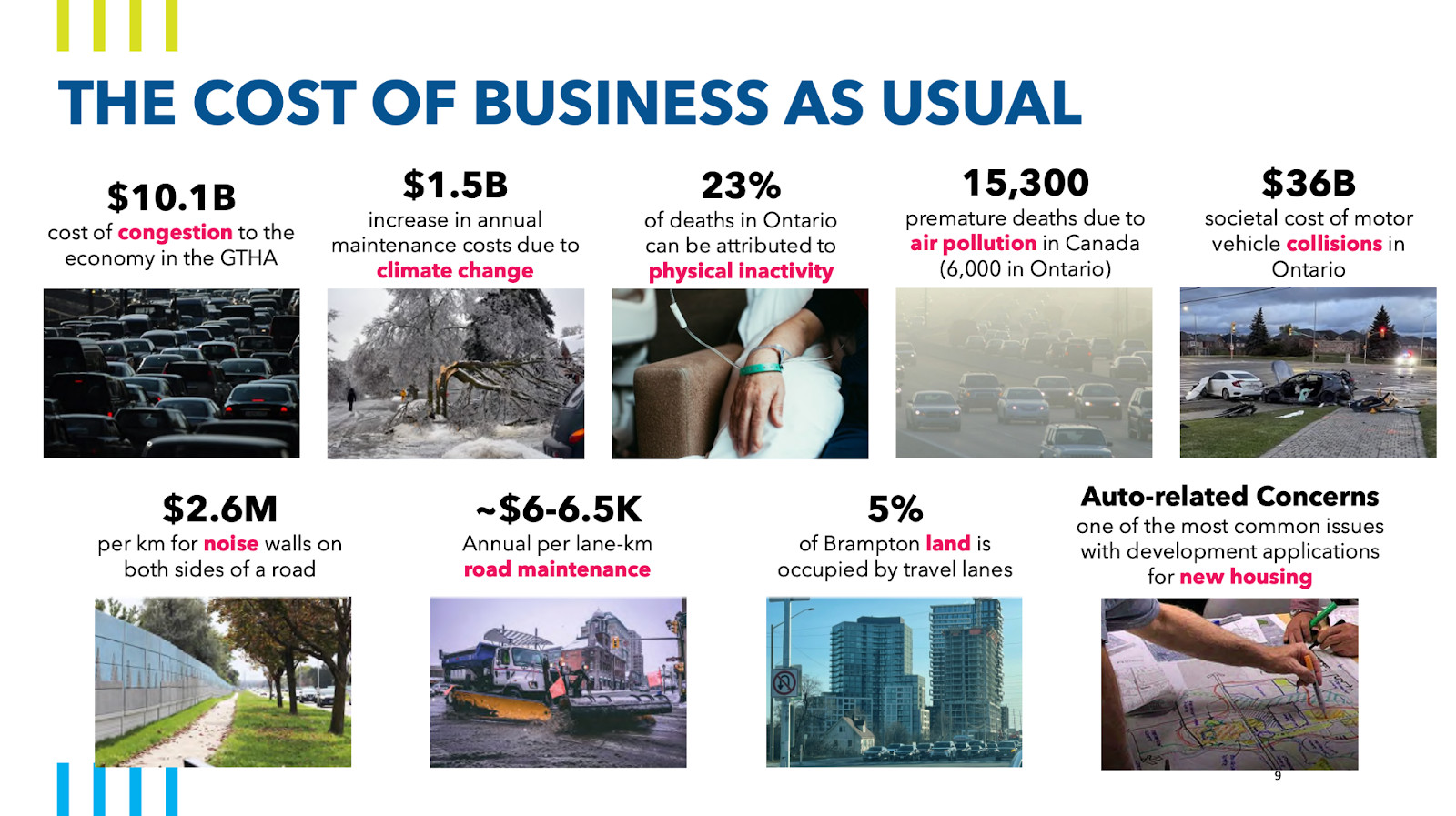
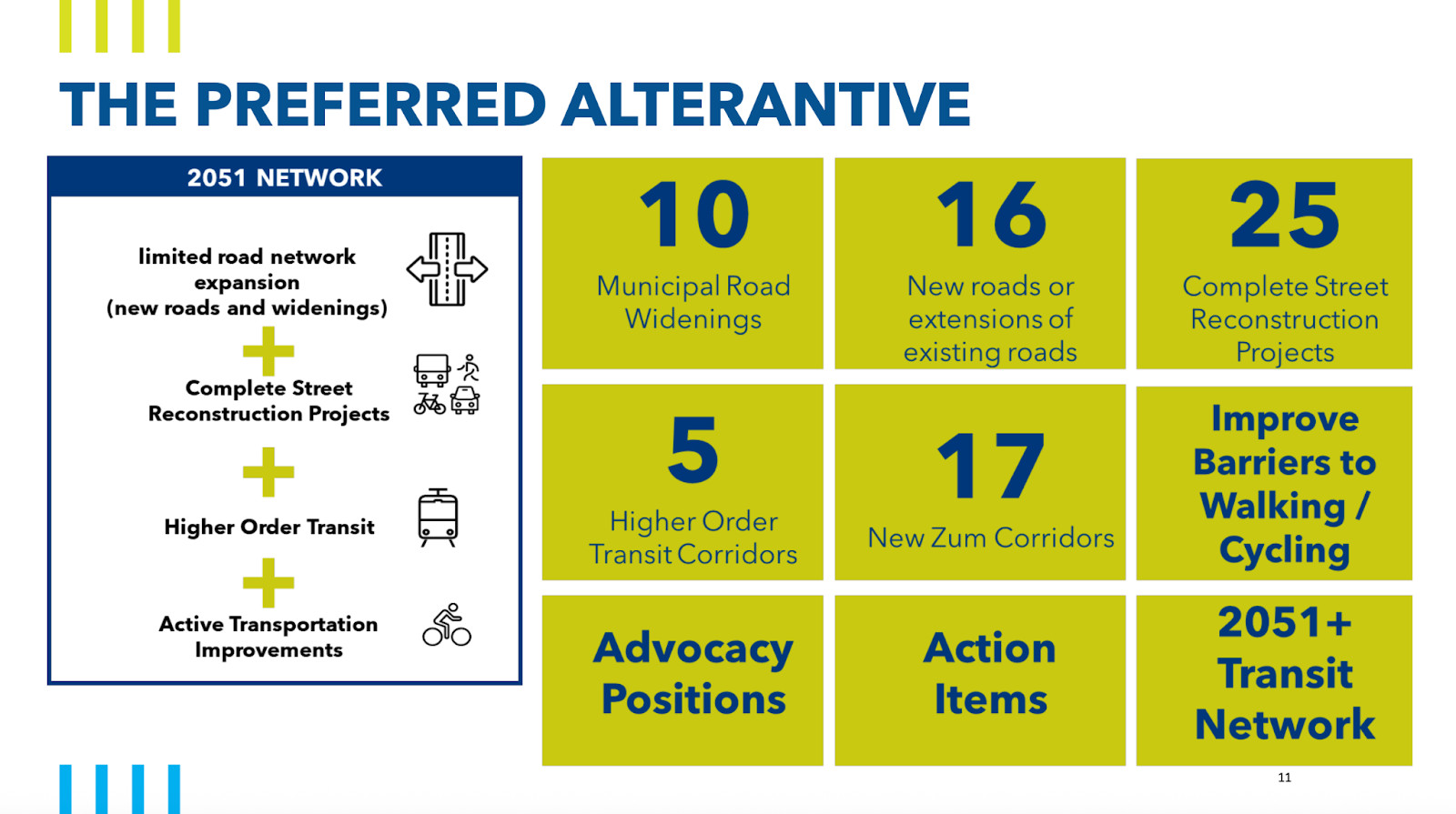
In a staff presentation on September 22, Richa Dave, Project Manager, Integrated City Planning, cautioned council that failing to adopt the Mobility Plan could result in substantial financial pressures, including an estimated $1.5 billion rise in annual maintenance costs due to climate change.
“The success of the Mobility Plan depends on shifting transportation mode share from personal automobiles to more sustainable options, including walking, cycling and transit,” he said.
“Without this shift, Brampton’s road system will be unable to handle forecasted traffic loads as the city grows to a million people over the course of the next 30 years.”
Bill 60 creates a “significant dilemma”, Laing warned.
”I see concentration now of decision making happening at the provincial level, and the municipalities are effectively losing control over their own decision making capability,” he told The Pointer, lamenting the Ford government’s tunnel vision, which he says has lacked long-term thinking from the outset.
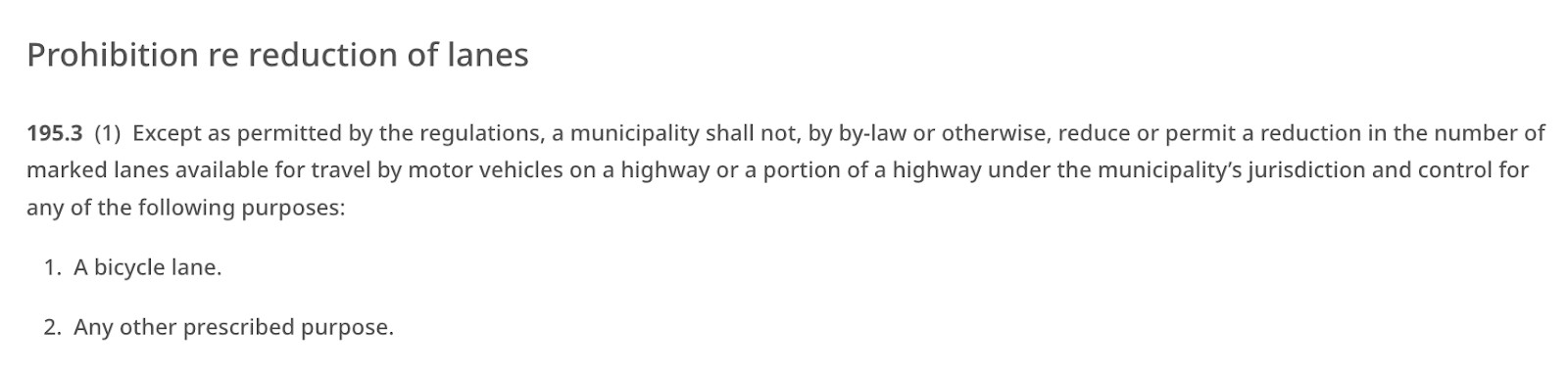
Bill 60 makes it illegal for municipalities to remove or reallocate any existing car lane to create a bike lane, which is one of the primary methods cities rely on to build safe cycling infrastructure. Because the Highway Traffic Act defines a “highway” as virtually any public street, avenue, bridge, square or roadway used by the public, the restriction applies across almost every road in Ontario.
(Legislative Assembly of Ontario)
On November 27, the PC government passed Bill 60 which prohibits municipalities from reducing car lanes for the purpose of adding bike lanes and prohibits dedicated bus rapid transit lanes on existing residential streets, a move made with minimal public consultation as Ford distracted Ontarians with issues like eliminating speed enforcement cameras by trampling on the authority of municipalities.
“Banning surface bus lanes would also jeopardize many of the hundreds of thousands of mid-rise and four-plex apartments recently pre-approved by municipalities like Toronto and Hamilton, which are the only realistic path to ending Ontario’s housing shortage,” Environmental Defence’s Ontario Environment Program Manager Phil Pothen said in a statement.
“By jeopardizing plans for bus rapid transit and zero-parking homes within existing suburbs, Bill 60’s amendments to the Highway Traffic Act and Planning Act would also swamp any gains from a promised- and long overdue- review of the Ontario Building Code.”
Laing says he is not proposing to “eliminate” car use altogether. He admits he himself drives in addition to cycling and using public transport but Bill 60 reinforces a deeply ingrained belief that because communities were built around automobiles, drivers are entitled to priority over everyone else.
“We’re failing to recognize the massive individual and community cost of car dependency,” he noted.
“There’s the land cars consume, the environmental impact, the health impacts from sedentary lifestyles, the air pollution that causes premature deaths and the devastating number of pedestrians and cyclists killed every year.”
In 2024, cyclist fatalities went up by 100 percent and pedestrian deaths rose 82 percent compared to 2023, according to the Ontario Provincial Police (OPP). By October 2024, the province had recorded 296 road deaths, with cyclists and pedestrians making up a significant share of the toll.
In June, the danger was underscored again when a 67-year-old man in Brampton suffered a brain bleed and neck fracture after a Peel Regional Police cruiser struck the back of his bicycle as the officer turned right from the Highway 410 off-ramp onto Queen Street.
The Special Investigations Unit (SIU) reported the cyclist had entered the crosswalk with a green light when the impact threw him to the pavement. The officer immediately rendered aid and called for paramedics.
In an October decision, SIU Director Joseph Martino concluded there were no reasonable grounds to lay criminal charges against the officer but the case serves as one of several underscoring the vulnerability of cyclists in the Region of Peel.
Laing calls bike lanes “the cheapest, most effective tool” municipalities have to shift trips away from cars especially in communities trying to build complete, transit-oriented neighbourhoods. But to drivers who view any reallocation of road space as a loss, “it feels like something is being taken away, and they rise up. And right now, those voices are winning because of Bill 60 and because of Bill 212 before it.”
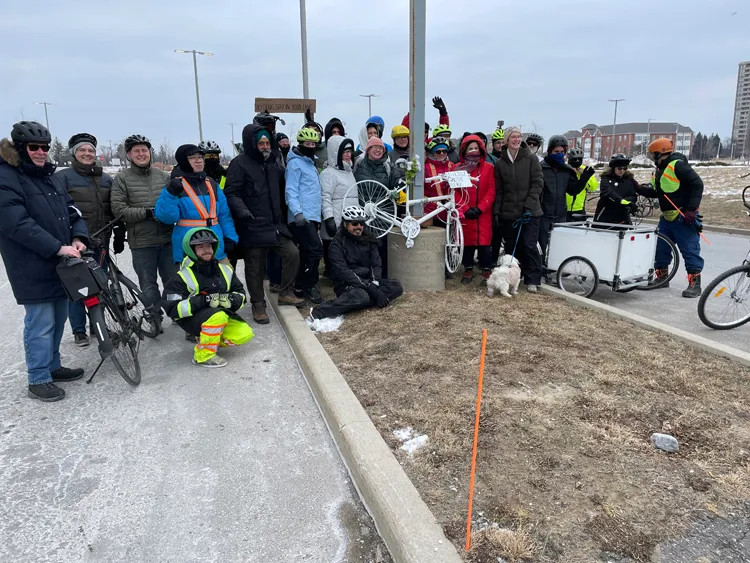
“Seven cyclists have been killed in Toronto in 2024, and that’s unfortunately a record. And we’ve seen more and more deaths in the outer suburbs, we’ve placed ghost bikes in Brampton, in Oakville. This has got to stop; something needs to be done,” Jun Nogami, a member of Advocacy for Respect for Cyclists, told The Pointer on January 25 when David Laing had hosted a bike ride in opposition to Bill 212, Reducing Gridlock, Saving You Time Act, which gave the province authority to block new bike lanes that reduce car lanes and allowing for the removal of existing ones, particularly affecting Toronto's protected lanes on Bloor, University, and Yonge Streets.
(David Laing)
On September 22, during a presentation to Brampton’s Planning and Development Committee, Richa Dave, Project Manager of Integrated City Planning, made it clear to council that widening roads does not solve congestion. Instead, it makes roads more appealing for people to make more trips and longer trips and more trips mean more traffic on the roads — the cycle continues and this creates what’s known as induced demand.
But on December 9 in Caledon, as the Ontario government announced a Request for Proposals to design an extension of Highway 410 to connect with the future Highway 413, Brampton North Member of Provincial Parliament and Minister of Citizenship and Multiculturalism Graham McGregor dismissed the concept entirely.
“You see bypass, highways in communities around Ontario. All of a sudden, we had a highway proposed to go around Brampon and everybody had a problem with it,” McGregor said during a press conference.
“Imagine if we listened to those naysayers and we didn't invest in new highway construction. Frankly, there are politicians that are in office today that don't even believe in building new roads across Ontario. They hide behind academic buzzwords like induced demand.”
Induced demand is far from an academic abstraction, it is the reality that haunts rapidly growing places like Ontario.
“Imagine it’s Saturday morning at the grocery store. Five of the six checkout lines are operating and filled deep with shoppers. In an effort to alleviate the congestion and speed up the flow, the manager has an employee open the final register. We all know what happens next,” The Pointer highlighted previously in a story about another one of the province’s controversial highway projects: The Bradford Bypass.
Now imagine the store manager tries something different—instead of opening another identical checkout line that will encourage more shoppers to quickly fill the space to capacity, they introduce two express lanes: one for shoppers with just a few items and another one for prepaid pickup orders.
The result? A portion of people who would otherwise jam the regular lines have a faster, dedicated path to move through the store. The pressure on the main checkouts eases not because they have been widened but because some shoppers now have a better option that saves time, reduces gridlock.
That’s what bike lanes, pedestrian-friendly streets and priority bus lanes do to a region’s transportation network.
“What I don't like is that we're (as a province) moving away from fact-based decision making [towards] something that's more ideologically driven,” Laing said.
“That's a bad move.”
He explained if we, as Ontarians as well as Canadians, keep building highways unchecked to let people drive as fast as they want, “we’ll consume vast amounts of farmland, destroy the environment” and encourage urban sprawl, while studies have proven the induced demand new highway space creates, attracting more and more and more drivers to the already packed roads, will only worsen congestion.
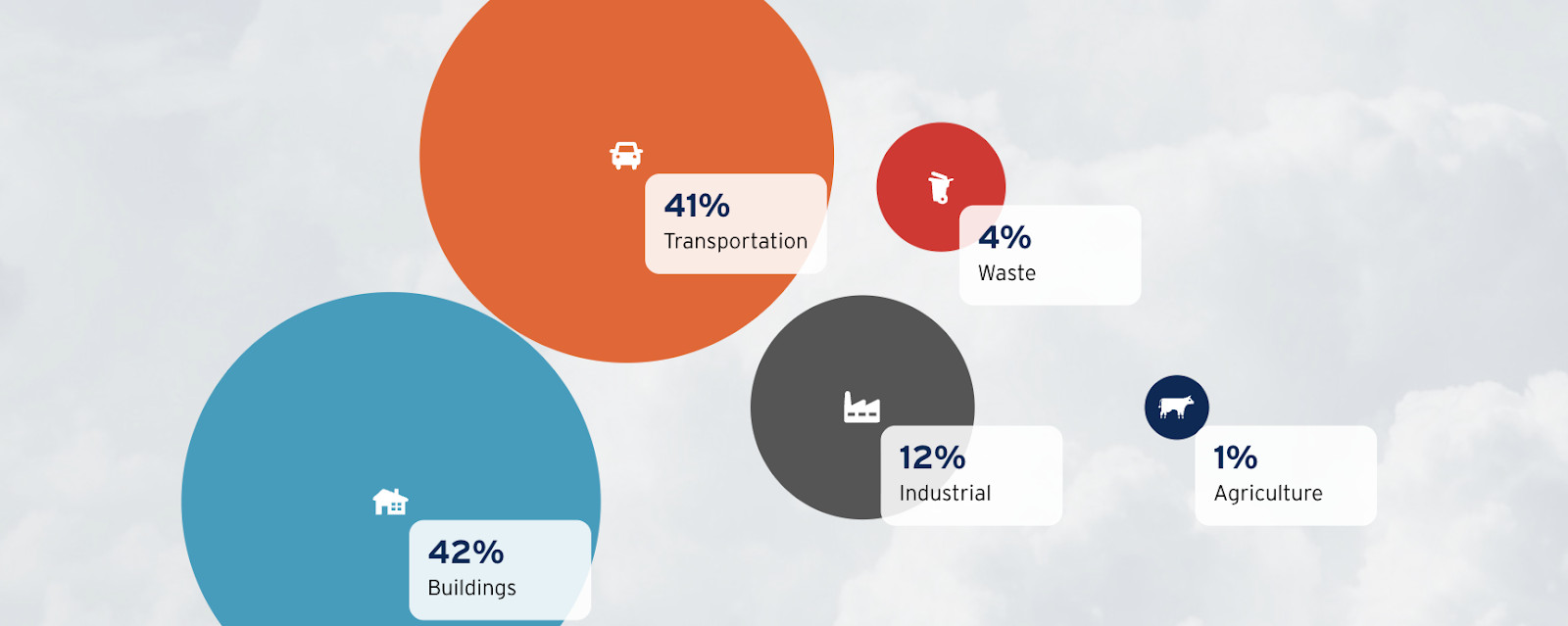
Transportation currently accounts for 37 percent of emissions in the Greater Toronto and Hamilton Area (GTHA) and 41 percent in Peel Region, making it the second-largest source of emissions in the region. However, it continues to be the single largest contributor in both Caledon and Brampton: transportation emissions fell the most in Caledon (down four percent) and Mississauga (down one percent), while Brampton saw a slight increase of 0.4 percent. These findings make it all the more important for Brampton to meet its Mobility Plan and Active Transportation Master Plan targets.
(2024 Carbon Emissions Inventory Report/The Atmospheric Fund)
“That makes distances longer, commutes heavier and people spend more time travelling instead of living,” Laing added.
In his book ‘Happy City: Transforming Our Lives Through Urban Design’, urbanist and journalist Charles Montgomery contends the age old question: what makes people living in a city happy? Spoiler alert: it’s not more highways.
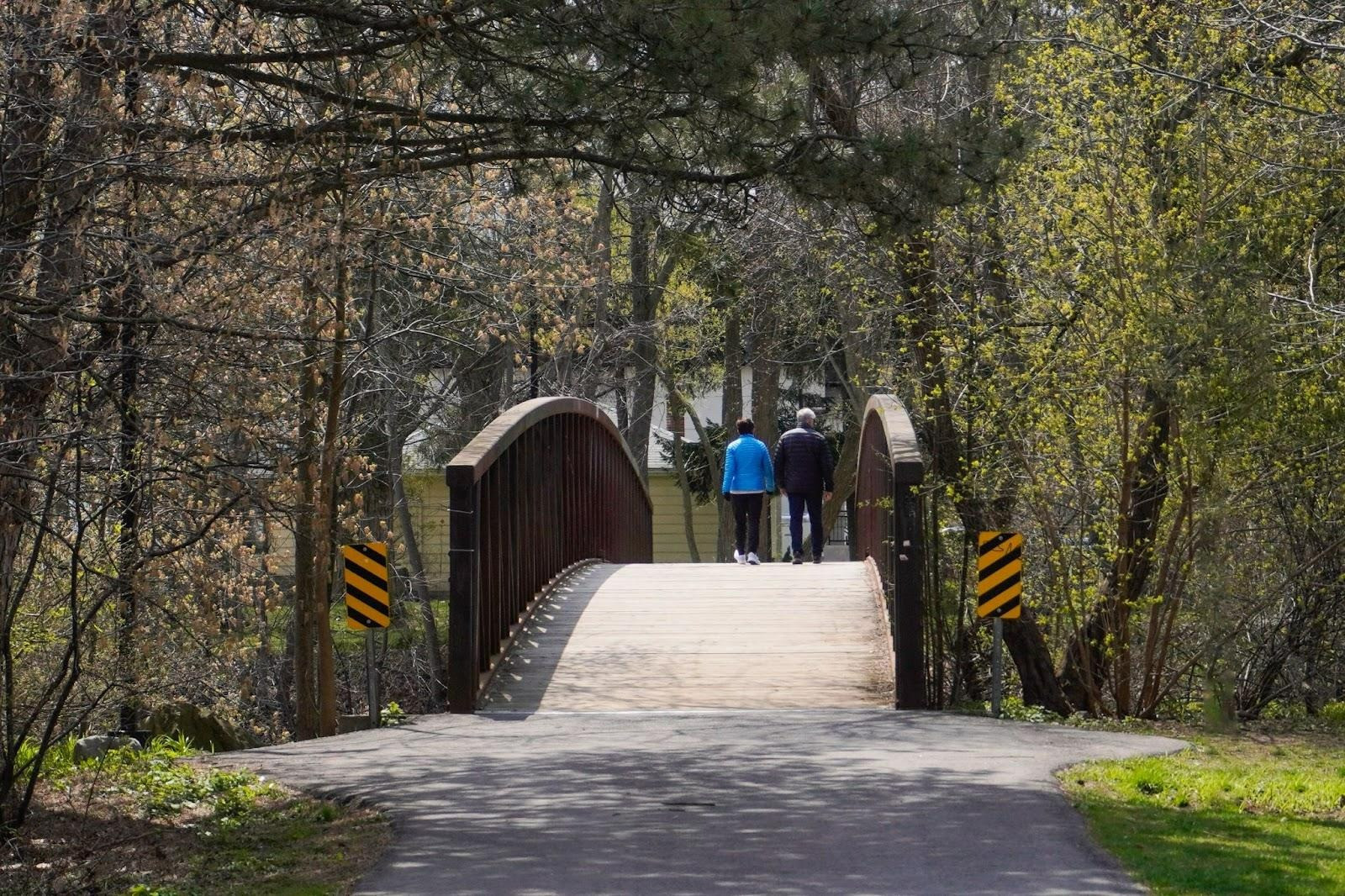
“One almost-ideal urban geometry was perfected in many North American cities more than a century ago…during the golden age of streetcar suburbia, property development and streetcar development went hand in hand…Market streets were lively and bustling, while the residential streets behind them were quiet and leafy. Most people got their own house and yard,” Charles Montgomery wrote in his book ‘Happy City: Transforming Our Lives Through Urban Design’. “Without modern suburbia’s massive yards, wide roads, and strict segregation of uses, almost everything you needed was a five-minute walk or a brief streetcar ride away. In the streetcar city, greed helped produce density’s sweet spot.”
(Alexis Wright/The Pointer)
Montgomery makes the case for compact, walkable communities where residents can bike or walk to work, school, grocery store or the gym leading to a higher quality of life. He also advocates for integrating nature into the modern-day “urban fabric”.
Isn’t that what the PC government want as well, supposedly?
“We need more people to get from point A to point B in a much more faster fashion that they can spend time with their families,” Ford said in a press conference in 2021. A statement both him and transportation minister Prabmeet Sarkaria have repeated.
In 2022, the Auditor General of Ontario Bonnie Lysyk noted in her report that the Ministry of Transportation manages provincial highway assets (excluding culverts and bridges) valued at $56 billion including over 40,000 kilometres (km) of highway lanes covering a distance of about 17,000 km.
It is 2025, the numbers have only increased and so has congestion.
Modelling by Metrolinx shows even with an additional $45 billion in transit funding beyond currently planned projects, the share of trips made by transit and active transportation would rise only modestly while road congestion would continue to worsen. Particularly, the Ministry of Transportation’s own projections indicate severe highway congestion would persist even if Highway 413 is built.
“Expanding public transit will ease congestion by getting cars off the road with 700,000 more rush hour trips on transit each day throughout the region,” a Metrolinx report highlighted.
A new report by Environmental Defence and Transport Action Ontario recommends redirecting the estimated $80 billion slated for Highway 413, the Bradford Bypass and the Highway 401 expansion alongwith reversing recent car-focused subsidies to creating 400 km of new transit in the Greater Toronto and Hamilton Area (GTHA), building 120 km of GO Train service and 290 km of LRT and BRT lines across the region, reinstating gas taxes and road tolls, exploring congestion pricing like New York and using Highway 407 for freight.
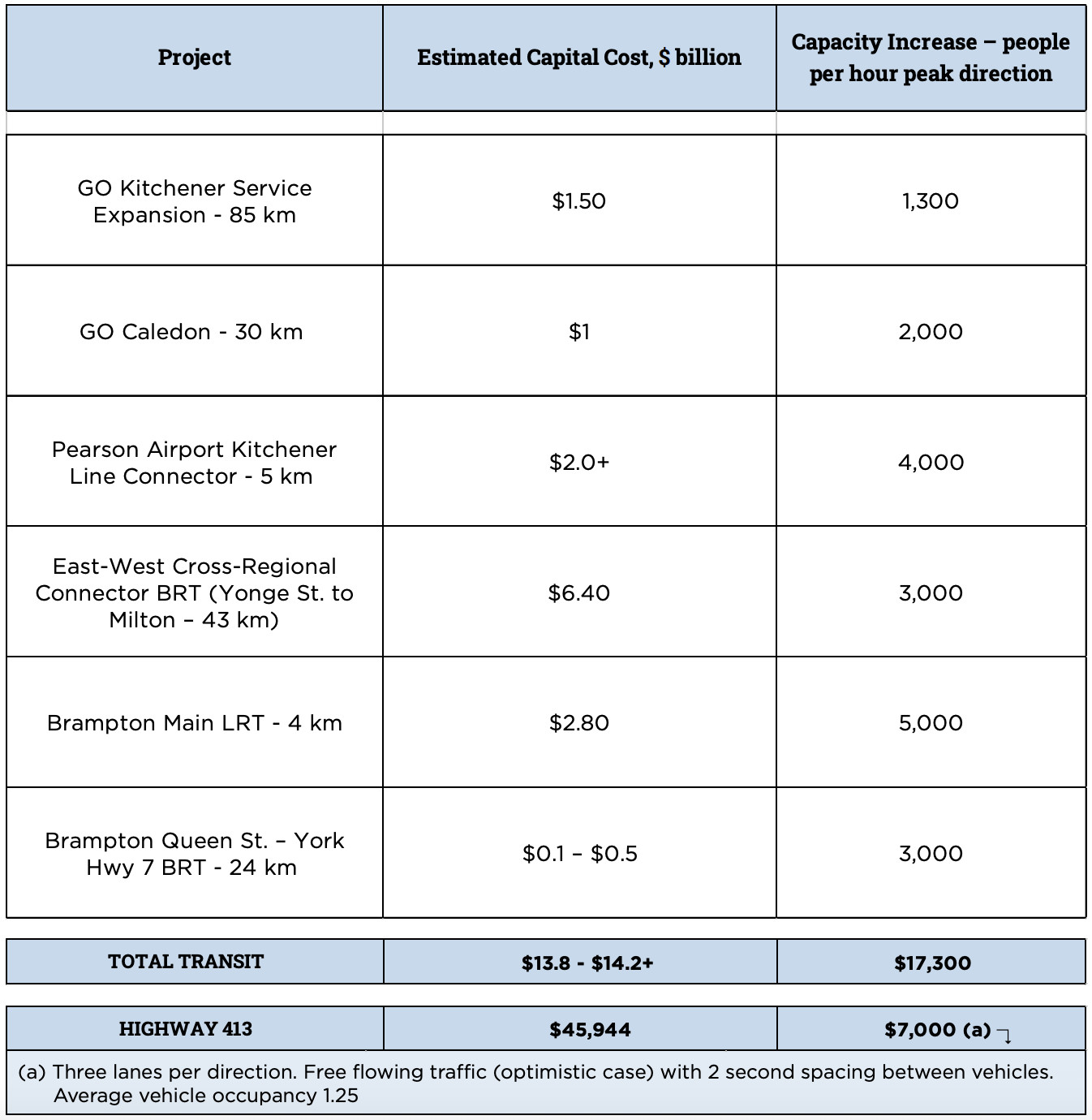
Beyond the $30 billion GO Expansion project, Environmental Defence suggests shifting financial support towards several unfunded projects in the western Greater Toronto Area including the GO Kitchener line (85 km, $1.5 billion), GO Bolton/Caledon line (30 km, $1 billion) and a Pearson Airport spur (5 km, over $2 billion) alongwith municipal rapid transit projects such as the East-West Cross-Regional BRT (43 km, $6.4 billion), Brampton Main Street LRT (4 km, $2.8 billion) and Brampton Queen Street/York Highway 7 BRT (24 km, $0.1 to 0.5 billion). Altogether, these projects could carry over 17,000 people per hour per direction, which is more than twice the capacity of Highway 413.
(Environmental Defence)
“To solve the congestion problem, we need to focus on moving the most people, not the most amount of cars. Only frequent, reliable, convenient transit service across the entire region will get people out of their cars,” Environmental Defence Associate Director Mike Marcolongo said.
On December 9, Brampton’s Active Transportation Advisory Committee unanimously approved a motion urging council to reevaluate the City’s Mobility Plan in light of Bill 60 and directed staff to report on which streets could adopt road reconfigurations similar to those proposed in Toronto and called for sufficient annual budget funding to complete prioritized active transportation projects.
Wards 1 and 5 Councillor Rowena Santos added an amendment to include the mayor’s budget process, ensuring that funding considerations would be integrated into the city’s upcoming budget deliberations.
“Our goal of building a connected, inclusive transportation network has not changed, despite Bill 60,” the City of Brampton said in a statement shared with The Pointer.
“The City will continue to explore practicable solutions within the legislative framework to advance our active transportation objectives. This may include enhancing multi-use paths, improving pedestrian infrastructure and integrating transit-friendly features to ensure Brampton’s streets remain safe and welcoming for everyone.”
Email: [email protected]
At a time when vital public information is needed by everyone, The Pointer has taken down our paywall on all stories to ensure every resident of Brampton, Mississauga and Niagara has access to the facts. For those who are able, we encourage you to consider a subscription. This will help us report on important public interest issues the community needs to know about now more than ever. You can register for a 30-day free trial HERE. Thereafter, The Pointer will charge $10 a month and you can cancel any time right on the website. Thank you
Submit a correction about this story

