
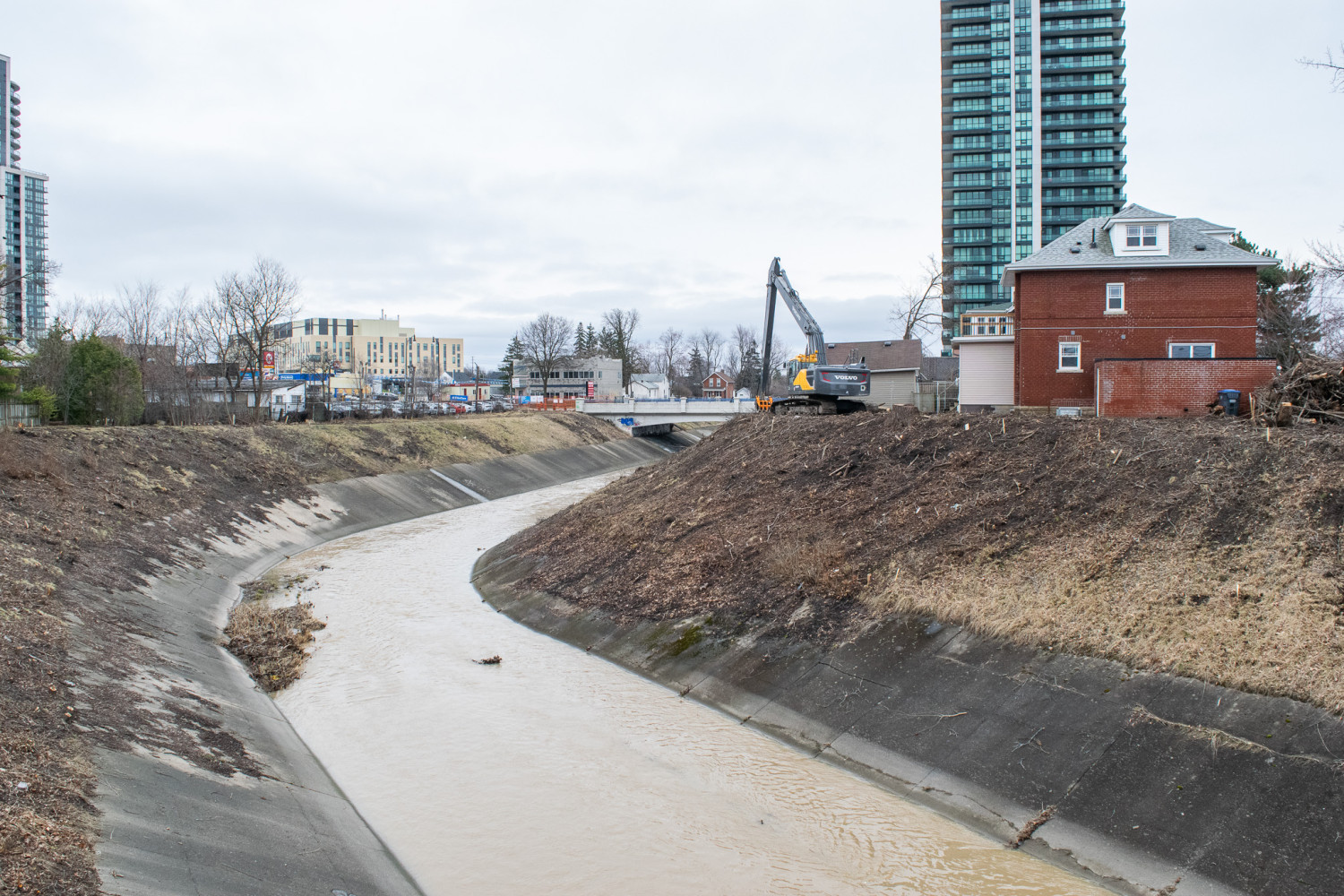
Brampton residents demand answers about Etobicoke Creek clearcutting as part of Riverwalk project
Brampton resident Tyrese Sibbick has passed by Rosalea Park countless times over the last three years since making the city his home.
A recent drive last month left him stunned.
The tree-lined stretch along Ken Whillans Drive, which Sibbick knew intimately, had been reduced to a barren construction site—trees ripped out, soil torn up, machinery in their place.
“What the hell are they doing here?,” he recalls thinking, questioning why an intact ecosystem and “an important piece of city history” had been destroyed.
Sibbick went home and started scouring social media to get some answers and found several residents asking the same questions.
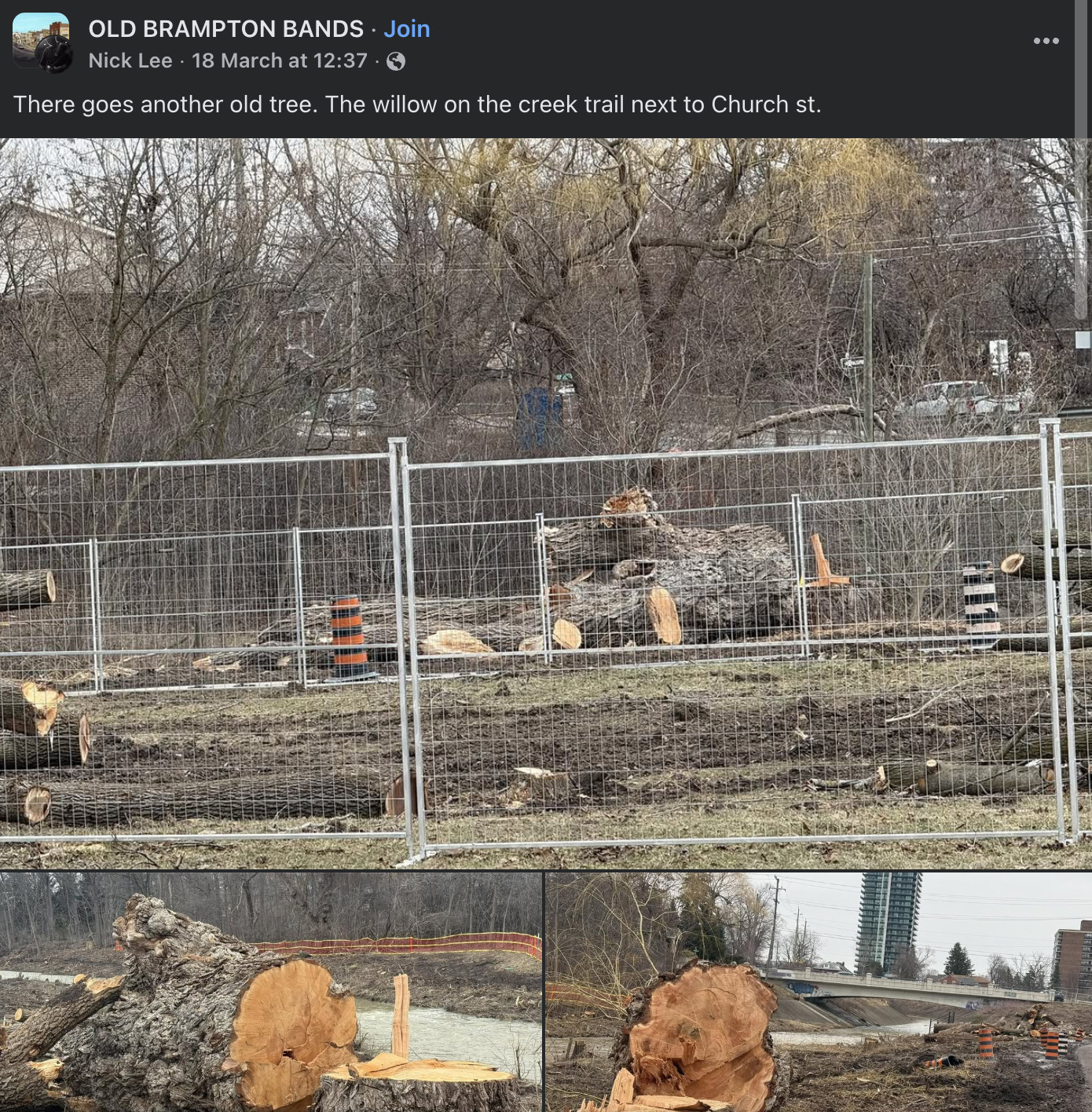
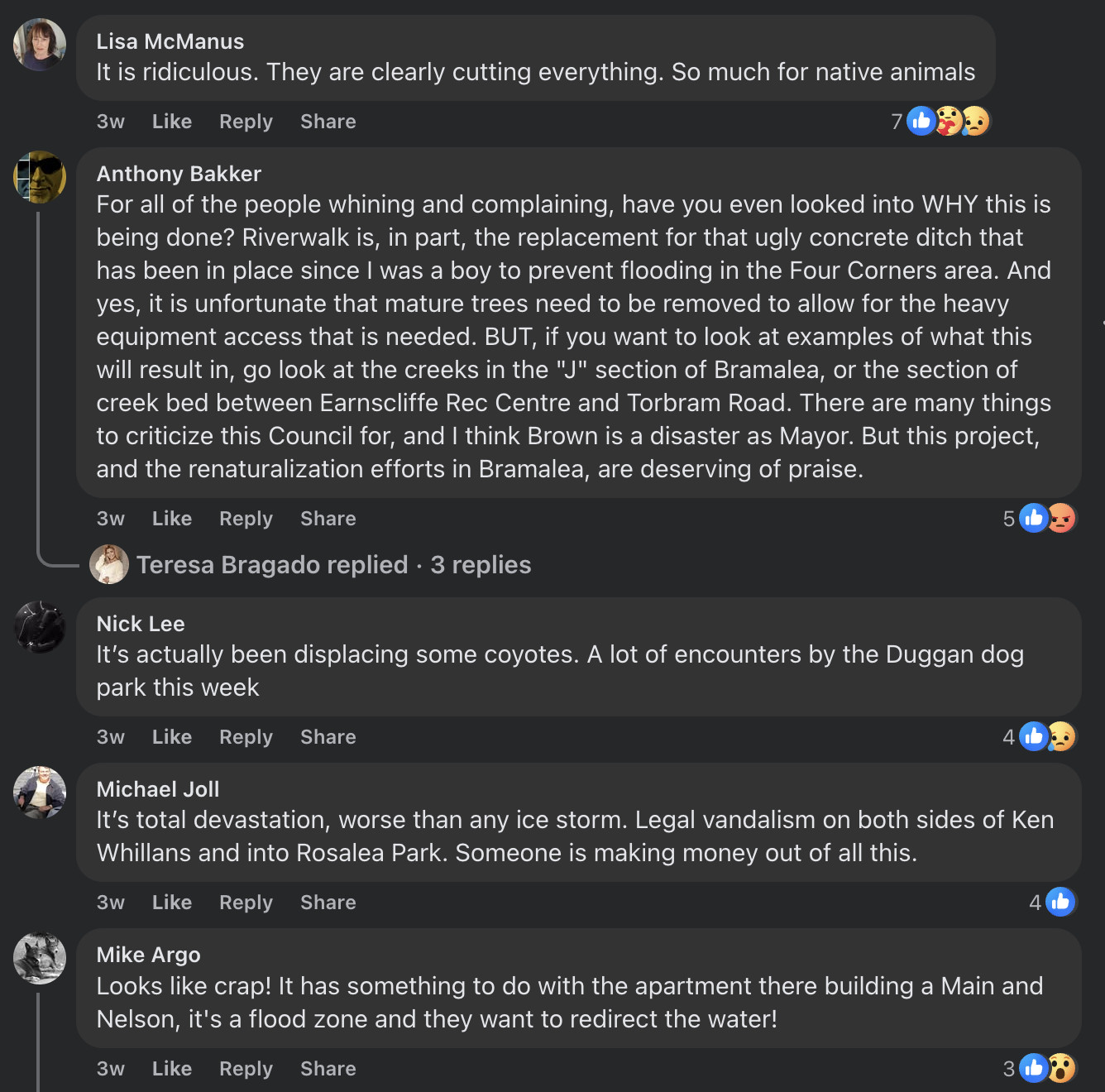
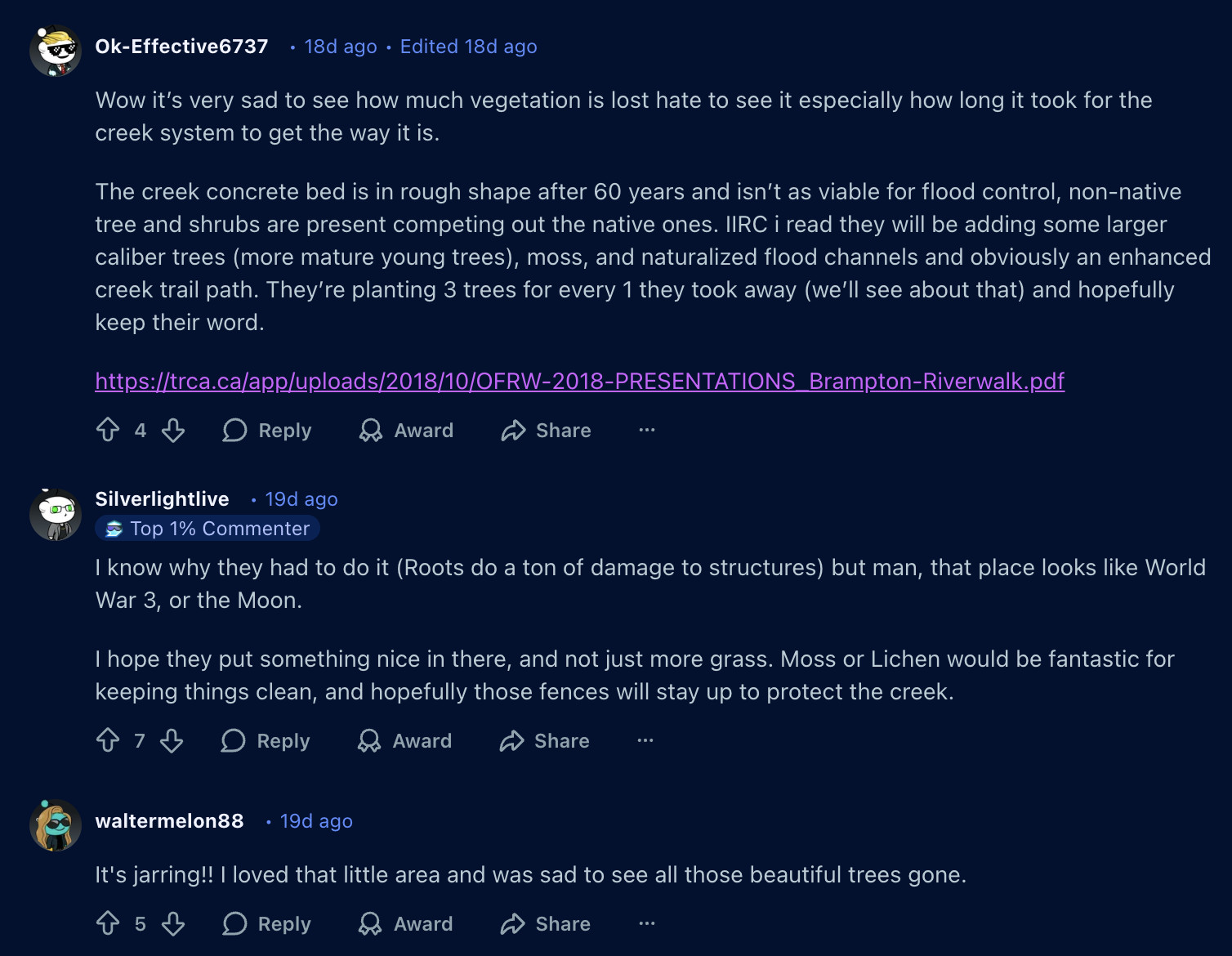
Mixed reactions poured in on social media regarding the tree cutting at Rosalea Park, Brampton.
(Top: Old Brampton Bands/Facebook, Bottom: Reddit)
He learned the trees were removed as part of the Downtown Brampton Flood Protection and Riverwalk Project, an initiative first set in motion in January 2011, when council directed staff to amend the Downtown Special Policy Area (SPA) to address ongoing flood risks. The SPA designation was applied after the Province recognized the area sits within a floodplain, where Etobicoke Creek, running through the heart of the city, poses a risk of overflowing during major storm events like the devastating 1984 flood that submerged downtown. The designation has long imposed strict limits on development, complicating zoning and construction in the area.
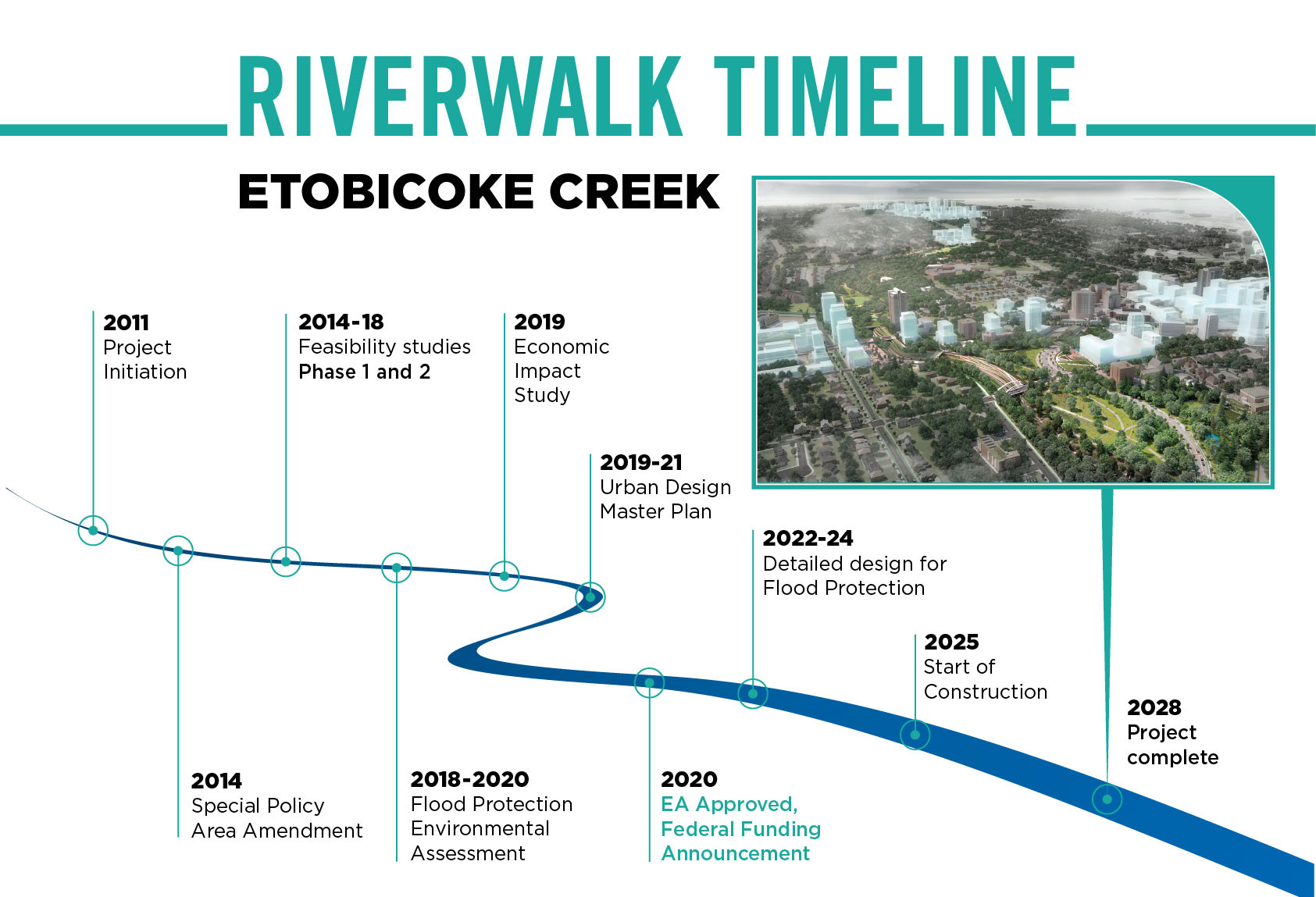
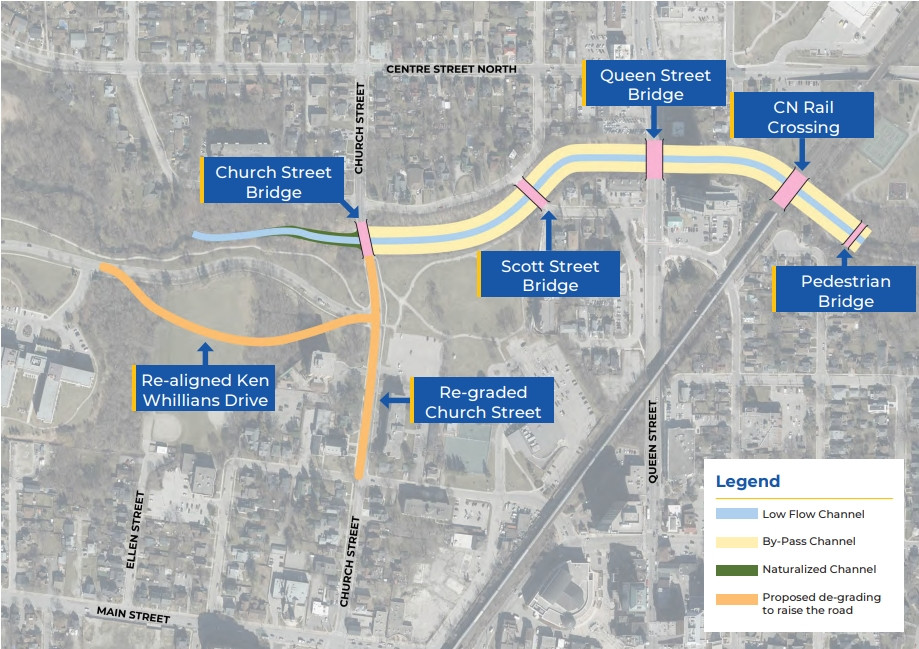
The City of Brampton first initiated and approved the planning stages for the Riverwalk flood mitigation project in January 2011, when Council directed staff to submit an amendment to the Downtown Brampton Special Policy Area (SPA) to address flood risks.
(City of Brampton)
He decided to drive by the area once again but something still didn’t sit right deep down.
A contractor by profession, Sibbick grew up in Alliston, where historic features were typically preserved or built around, an approach he believes the City of Brampton could have followed rather than removing longstanding, mature trees.
He wasn’t alone.
Unlike Tyrese Sibbick, Rhonda Collis, a longtime Brampton resident of over four decades who lives in a downtown condo overlooking Etobicoke Creek, knew the first phase of the Riverwalk project would begin soon, finally, after being delayed throughout Patrick Brown’s time as mayor due to his refusal to fund critical city building projects. Brown has failed to get runaway spending on staff, particularly highly paid non-unionized management employees, under control, so key initiatives have suffered under his required budget cuts while salaries continue to soar.
Eventually slated to start last year, residents were not told about the clear cutting of trees to do the Riverwalk work. They were caught completely off guard when the canopied landscape was completely ripped apart.
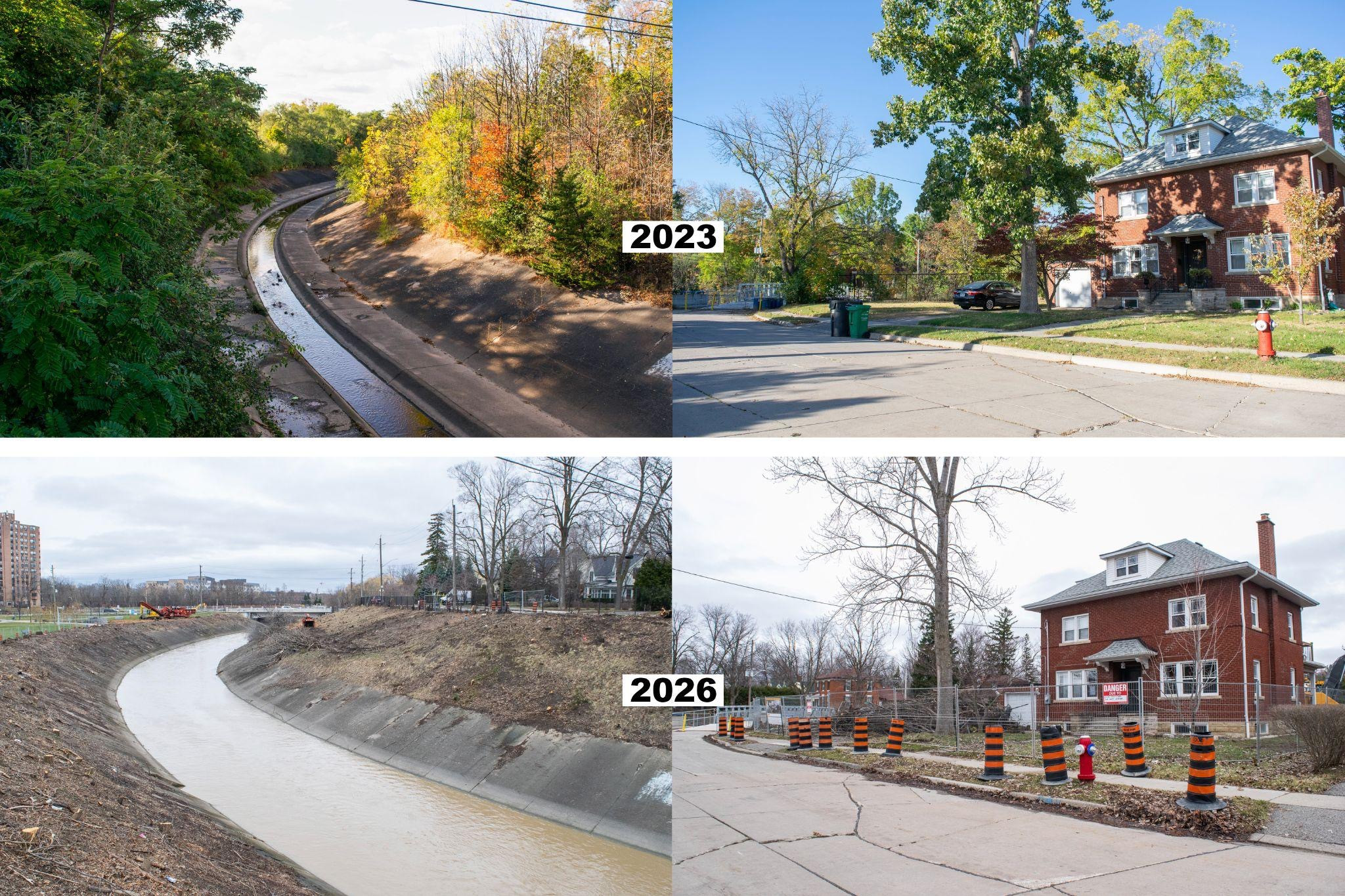
The difference three years made as trees were cut as part of the Riverwalk project.
(Alexis Wright/The Pointer)
“I have a beautiful view of the creek, and I walk that pathway a lot. I love it, especially in the summer, because I would be able to sit down under a big, beautiful tree and just appreciate life and the environment,” Collis told The Pointer.
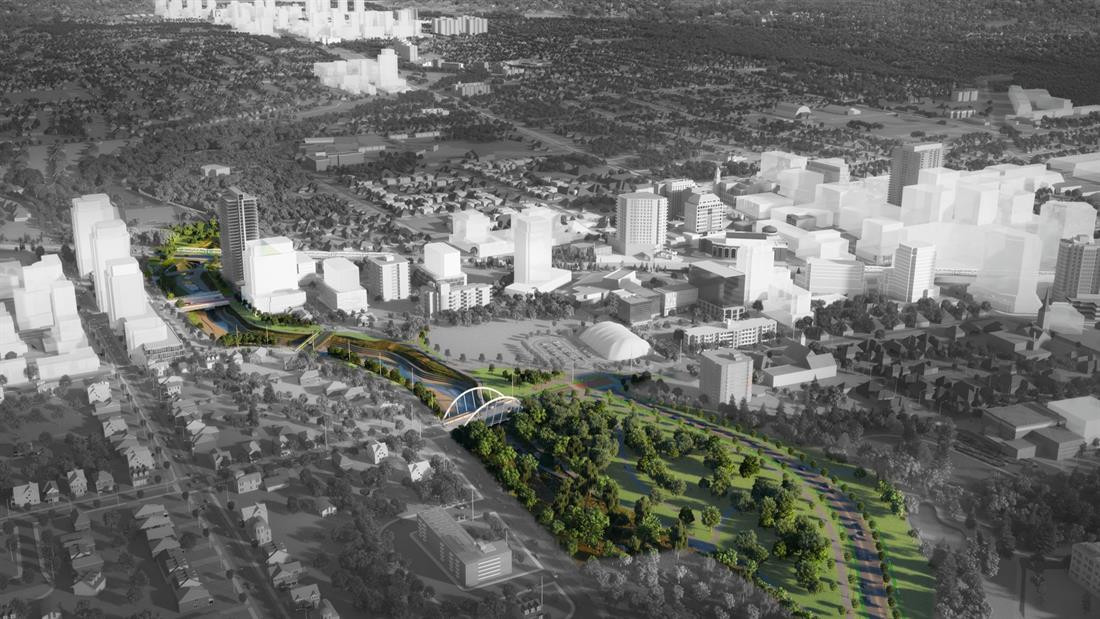
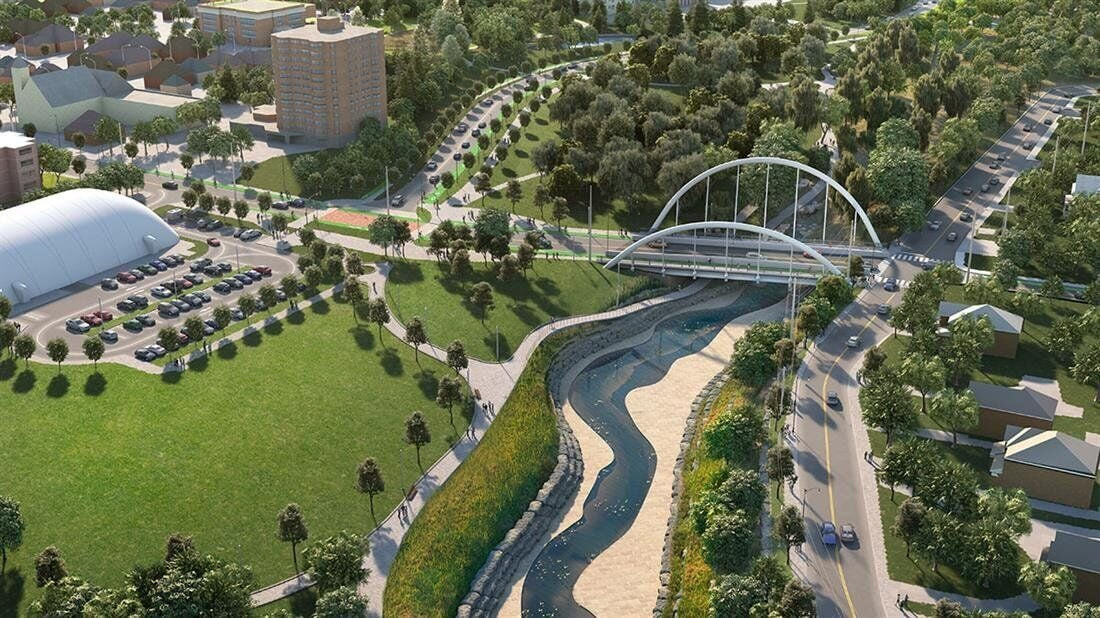
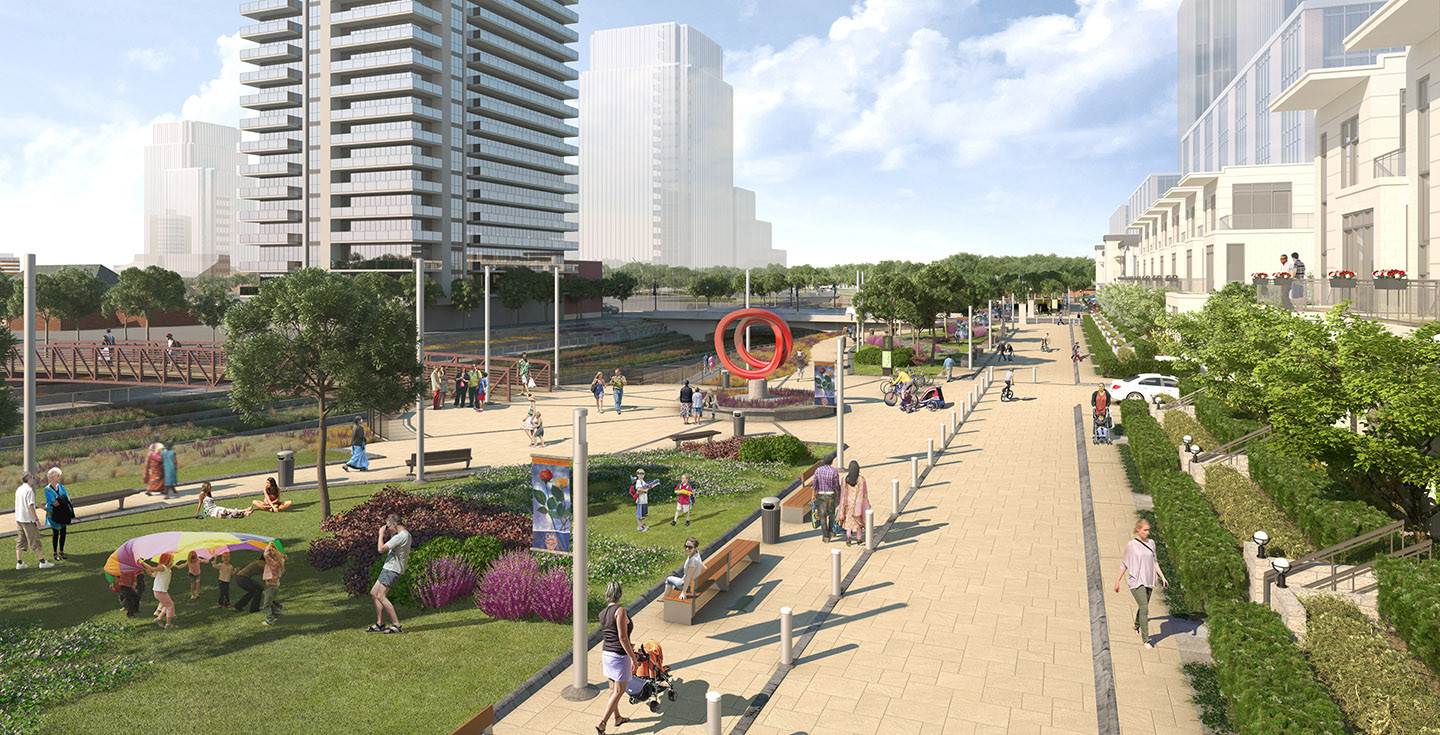
Renderings of the Riverwalk project by the City of Brampton. “Phase One of the project focuses on flood protection infrastructure by deepening and widening the Etobicoke Creek Channel. Phase Two will implement the Urban Design Master Plan, introducing new parks, open spaces, trails, homes and business areas along the Etobicoke Creek,” the City’s website states.
(City of Brampton)
For decades, the City has been handling the risk of water rising above the banks of Etobicoke Creek by diverting it through a concrete-lined bypass channel. But with torrential rain linked to climate change, the channel is no longer sufficient to handle the increased water levels projected in years to come.
In September 2020, the Ministry of Environment, Conservation and Parks approved an environmental assessment (EA) by the Toronto and Region Conservation Authority (TRCA), outlining a major flood mitigation strategy for the creek as part of the Riverwalk project which included widening and deepening sections of the channel, making bigger bridges and creating additional floodplain storage. The EA process cost $3 million, with $1.5 million coming from the federal government, about $1.2 million from the City and $300,000 from the Region of Peel through federal funding — but the approval allowed portions of the SPA lands to be redeveloped for future downtown investment, as restricted floodplain areas are reconfigured. Later that year, Ottawa pledged further funding of more than $38 million through the Disaster Mitigation and Adaptation Fund and the City committed $58.2 million as part of it, but failed to move forward with the work.
On September 2, 2024, the City received a $29.8 million investment from the PC government through ​Ontario’s Housing-Enabling Water Systems Fund, and plans were finally put in place to begin the long-delayed project.
After seeing early Riverwalk plans that appeared to preserve “numerous mature trees amongst the renovation”, Collis believed the City would work around the trees while solving the flooding problem.
“Well, this is really good,” she thought.
“The City is going to enhance the floodplain and they’re going to leave these beautiful trees. And as someone who is often a critic of the City, I think they’re getting this right.”
But weeks later, looking out her window, she felt “physically ill” as she watched multiple trees including some with commemorative plaques, being chopped down far more than she expected, even beyond the immediate floodplain area.
“It felt like we were walking through an apocalypse,” she said, “panic-stricken” as she walked through the aftermath with a friend.
“This may improve flood control, but don't trees improve flood control, and don't we need the grass and the trees? And what happened to that poster that the City promised us we were going to have mature trees?”
City of Brampton officials said that as part of the construction of the new Etobicoke Creek channel, select trees and vegetation were removed while protective fencing was installed to safeguard those remaining. Logs, root wads and branches are being reused for habitat features or recycled into mulch for “other projects”.
A 2018 TRCA report noted construction will require “removal of approximately 1.5 ha [hectares] of potential terrestrial habitat area,” including forest, grassed areas and riparian vegetation. It also details the measures to offset these losses such as completing a tree inventory, preparing a “Tree Compensation Plan to offset tree removals,” and developing an ecological compensation strategy to “re-establish healthy riparian corridors…with native species.”
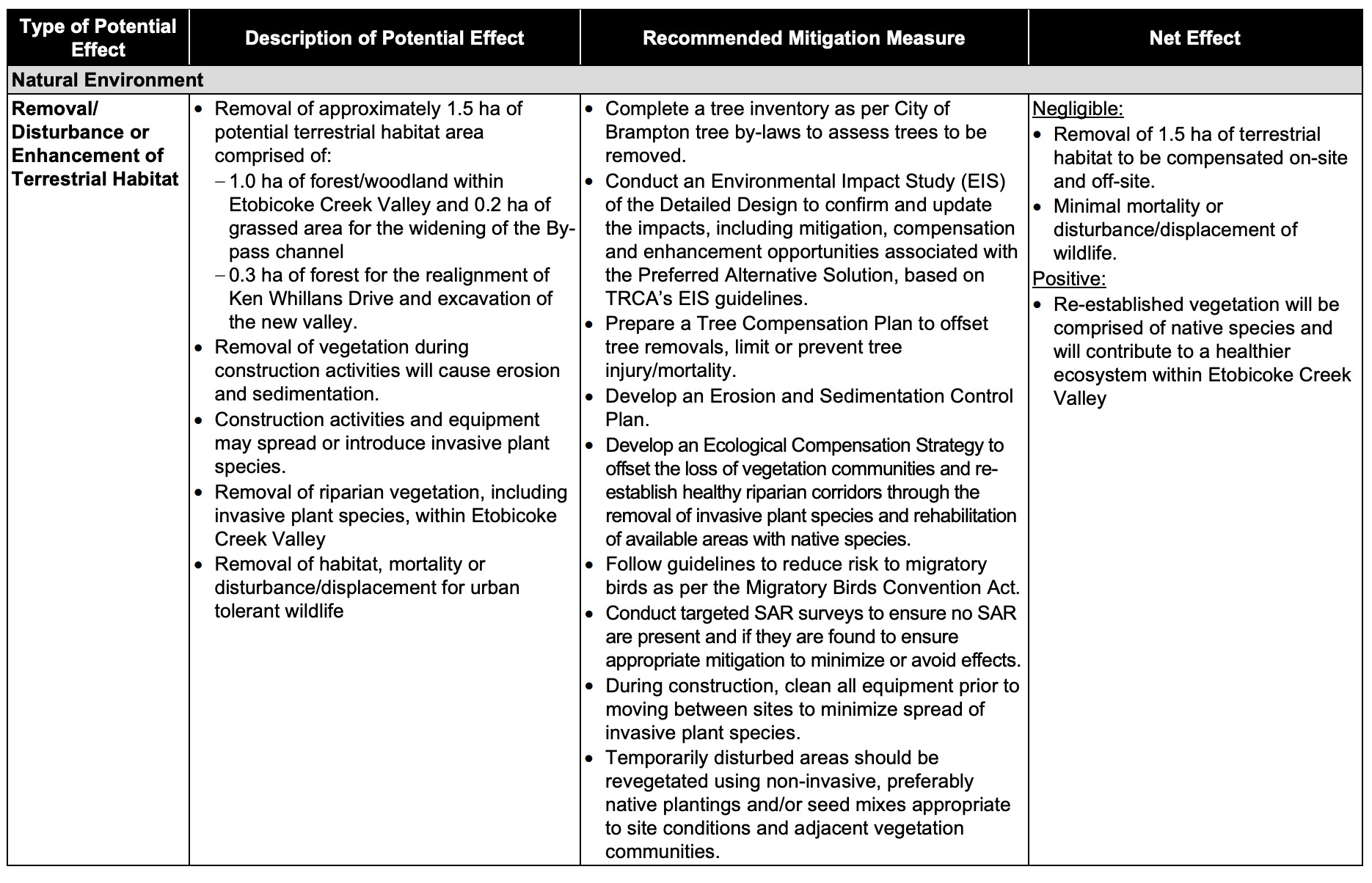
The Toronto and Region Conservation Authority (TRCA) recommended in 2018 that the City prepare a Tree Compensation Plan to “offset tree removals, limit or prevent tree injury/mortality”.
(TRCA)
Throughout the project, the creek’s water quality will also be closely monitored, with erosion and sediment controls in place to protect the waterway, according to the City.
The TRCA assessment highlighted risks such as “temporary diversion of flow” and sediment entering the watercourse, and mandated mitigation including sediment control systems, water quality monitoring and scheduling in-water work outside sensitive periods. Specifically, construction was recommended to be avoided at key fish windows “from April 1 to June 30” and fish are to be relocated from active work zones by qualified biologists before construction begins. The treecutting was completed in March, immediately before these sensitive timelines.
“As set out in the EA and the [Environmental Mitigation] strategy, work is being carefully timed to avoid bird breeding seasons [in accordance with the Migratory Birds Convention Act] and sensitive fish life cycle periods,” a City spokesperson said in a statement shared with The Pointer.
Brampton Environmental Alliance Vice President Steve Papagiannis said there might be short-term ecological disturbance, but it should be managed through strict mitigation with the long-term goal of a more stable, naturalized and climate-resilient river system.
“This isn’t an environmental disaster. It’s needed. It’s part of the broader climate change mitigation we now have to focus on,” Papagiannis told The Pointer.
“We’re going to see more flooding, and if we can address that through mitigation while minimizing disruption to native habitat, then it’s work that has to be done. Not every environmental group is against all development…there is necessary progress, but it has to be thoughtful.”
TRCA’s 2018 Watershed Report card gave a ‘D’ or poor grade overall to the Etobicoke Creek watershed which is “heavily urbanized” contributing to poor water quality, erosion and low natural cover.
While many acknowledge the necessity for taking certain tougher measures as the City moves forward with the project that promises to breathe renewed life into Brampton’s downtown, unanswered questions continue to swirl around the multi-million dollar initiative.
Collis had previously reached out to Wards 1 and 5 Councillor Paul Vicente, demanding answers about the lack of transparency.
On April 7, Vicente finally gave her a call back and told her that while some tree loss was unavoidable, replanting would follow a 3:1 ratio (for every tree cut, three trees will be planted), with replacement trees approximately eight to 12 years old and about four inches in diameter once planted.
“I will be holding Council accountable for the information that Paul shared with me,” she said.
Collis added that she was also told the project had been planned for years and funding was already allocated, leaving limited flexibility in the budget to relocate or transplant trees. She questioned why contingency funds could not be used, but Vicente shared that delays and construction logistics contributed to the decision to remove trees to allow easier access for crews, with the expectation that the canopy would be restored through later replanting.
“Once complete, the project will deliver a more natural river corridor with native plants, pollinator meadows and enhanced habitat for fish and wildlife,” City officials said in a statement.
The community looks forward to those improvements but concerns remain around the six memorial trees that were removed as part of the channel widening.
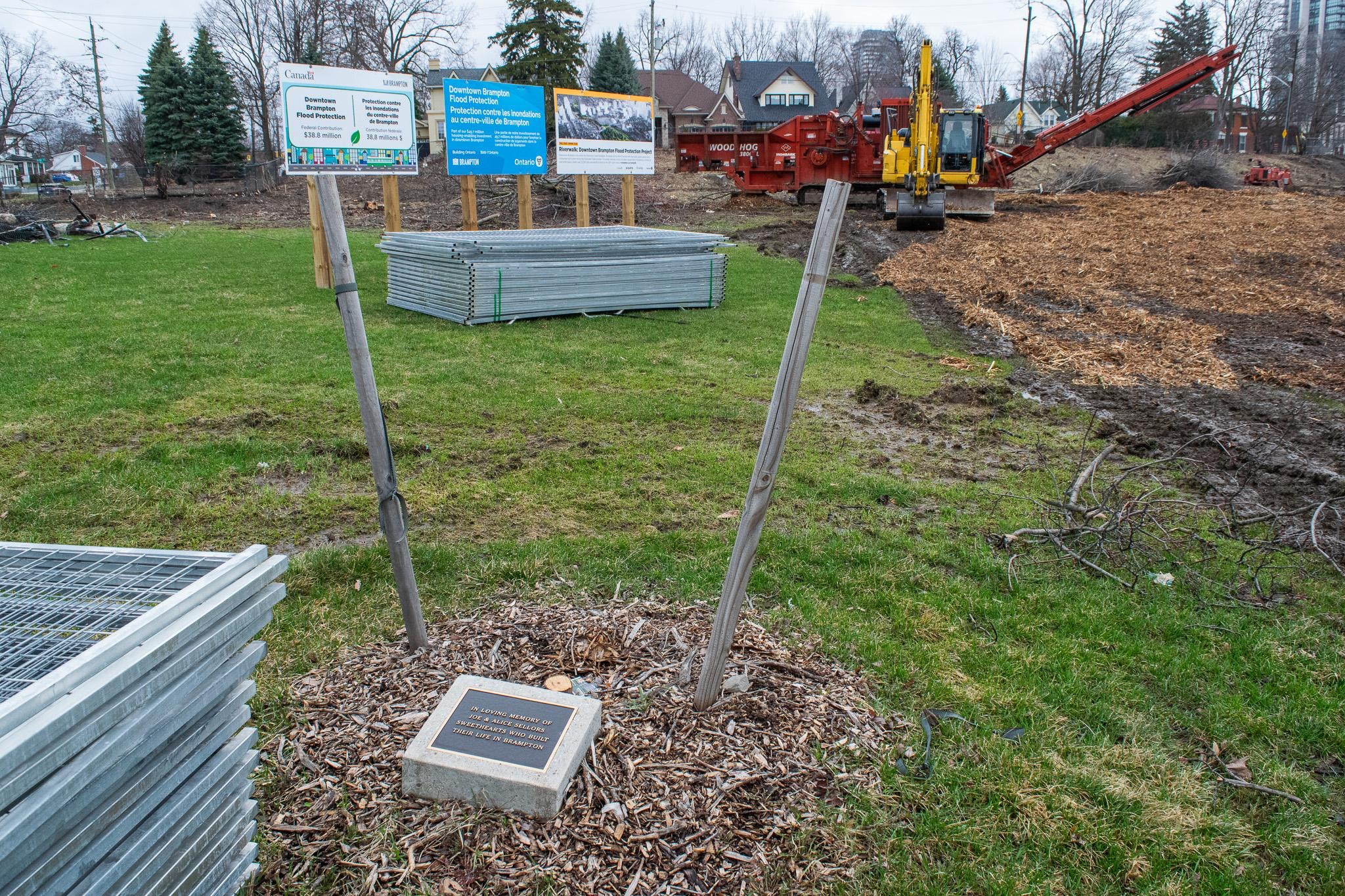
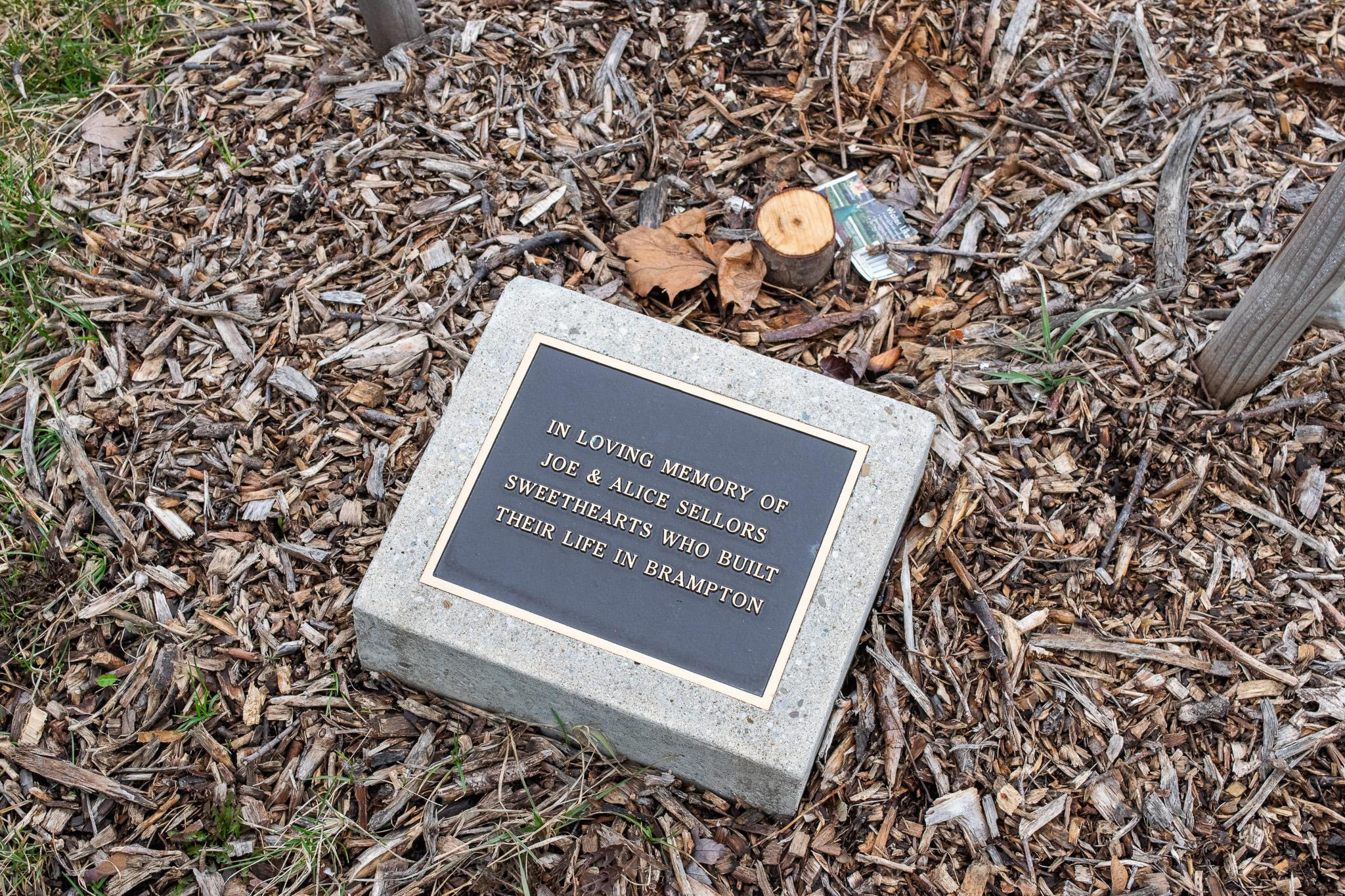
A total of six memorial trees were also removed as part of phase one of the Riverwalk project, which involves flood protection infrastructure by deepening and widening the Etobicoke Creek Channel and is expected to be completed in spring 2028.
(Alexis Wright/The Pointer)
One of them was dedicated to 18-year-old Alicia St. Clair, who had tragically lost her life to an overdose and is now remembered by neighbours on Church Street as kind and gentle. They had placed a plaque on the tree as a small site of remembrance, which they said offered a sense of safety and connection to her memory.
Brampton resident Tracy Pepe, who is considering a run in the upcoming municipal election, shared in a social media post that she received a detailed response from the City outlining that six memorial trees were identified within the project limits and required removal for flood mitigation work.
According to the City, the Cemetery Services team has since secured all associated plaques, including St. Clair’s, and is reviewing the site for any additional memorials that may not have been captured in the original arborist report.
Efforts are underway to contact affected families and memorial trees will be replanted on City-owned lands, with families consulted on new locations and plaque placement. The City’s Riverwalk Project Management Strategic Leader, Kevin Thavarajah, shared the same information with Collis.
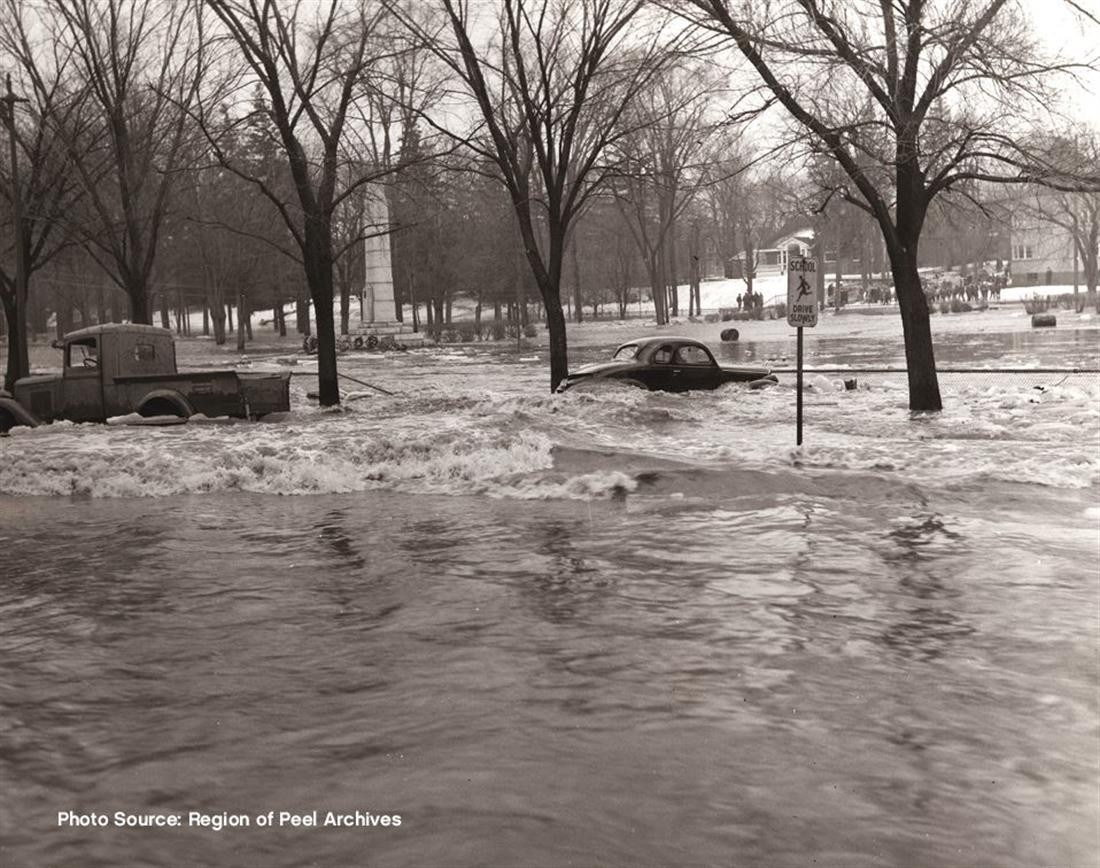
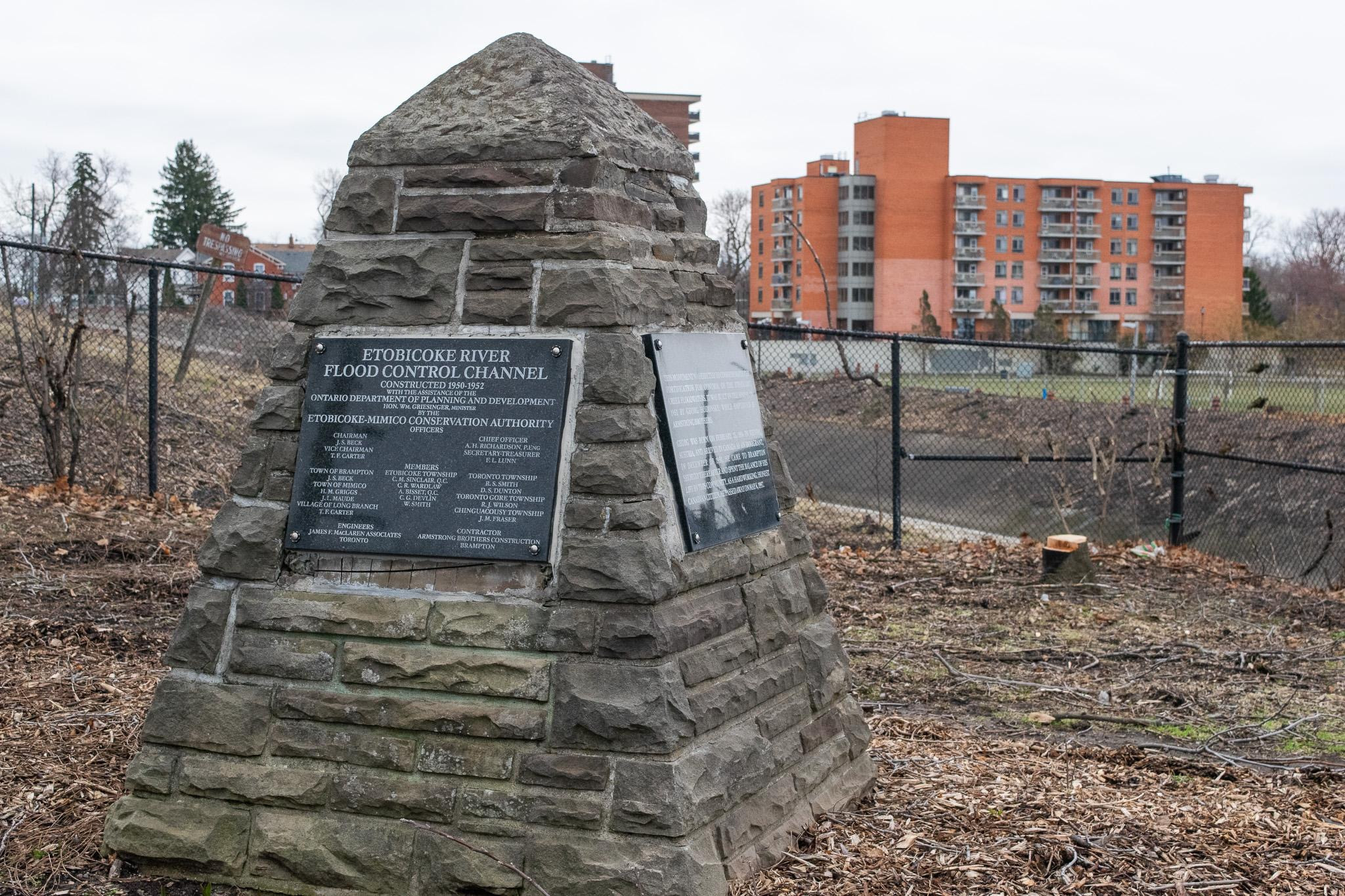
Downtown Brampton sits within the Etobicoke Creek floodplain, an area historically prone to severe flooding that has limited development, most notably during the March 1948 flood when nearly six feet of water submerged parts of Main and Queen Streets, leading to the construction of a diversion channel in 1952 that has protected the city for decades. The Riverwalk Flood Protection Project will upgrade the same system to withstand extreme storms comparable to Hurricane Hazel, while also enabling significant growth supporting approximately 17,700 new residents, creating nearly 24,000 jobs and unlocking 3.6 million square feet of residential, retail and commercial development, according to the City of Brampton.
(Top: Region of Peel Archives, Bottom: Alexis Wright/The Pointer)
While Pepe appreciated the clarification and confirmation that the plaques had been preserved, she noted the situation highlighted a broader issue around communication and consultation.
“Families should always be clearly informed in advance when memorials are impacted,” she said.
“The Riverwalk project is a monumental development, and we need councillors who will do the work and provide information proactively. The lack of consultation, education, and communication has been unacceptable. This should never have been brought to anyone’s attention in this way.”
Residents who were affected by the expropriation, a process that typically involved clear timelines and advance notice to allow homeowners to prepare, also reported they were left largely in the dark about key details such as design, phasing and when their properties might be impacted. In some cases, they were not even informed that council meetings included decisions directly impacting their homes while repeated attempts to get answers from City officials or express opposition were left unanswered.
The lack of clarity extends beyond recent updates, pointing to broader concerns about how the project has been communicated and understood from the outset.
Former Wards 1 and 5 Councillor Elaine Moore, who represented the area for 18 years, questioned the overall transparency of the project’s financing, noting that Riverwalk has been discussed in various forms for almost two decades but was not clearly presented as a single consolidated capital project in municipal budgets.
“When I first heard estimates years ago, it was in the hundreds of millions,” Moore told The Pointer, referencing earlier projections for flood mitigation work in the downtown core.
“But I don’t see a clear, complete figure in front of taxpayers now.”
The City’s fourth quarter documents from 2025 revealed AECOM was contracted for the detailed design of the Downtown Brampton Flood Protection Works at a value of $6.57 million (with a subsequent extension of $394,761.23) approved due to additional out-of-scope requirements. These included relocation of the sanitary sewer along the east bank of Etobicoke Creek between Nelson Street and John Street, relocation of a watermain from the Scott Street and Queen Street bridges to a new crossing under the creek, assessment work to avoid a siphon solution for sanitary servicing, lowering of an existing 600 millimetre water main at the John Street crossing, as well as added costs for trunk sewer locates, updated cultural heritage impact assessments for affected properties and archaeological monitoring.
The same documents also show EllisDon was awarded the construction management contract for the Downtown Brampton Flood Protection project, valued at $13.6 million, with the work scheduled for completion by July 31, 2031. According to the City’s timeline, the Riverwalk project is meant to be completed in 2028.
Moore shared early estimates from the 2000s that placed the Riverwalk at a roughly $400 million undertaking, while later figures referenced in 2017 discussions appeared to describe a different flood mitigation option altogether.
In December, the City released a report proposing that development could proceed before flood mitigation is complete.
A February 2 report that came forward to the Planning and Development Committee clarified that large-scale development or residential occupancy would still be restricted until flood risks are fully addressed.
As reported by The Pointer previously, in the 2021 budget, only $4 million was allocated through the 2022 and 2023 capital budgets to fund the planning process of the Downtown Brampton Flood Plan and the Riverwalk Urban Master Plan.
In 2023, the approved Capital and Operating Budget stated $20 million would go toward the development of the Riverwalk while the 2024 approved budget listed $87.4 for the Riverwalk, including the $28.4 million from the federal subsidy and $58.8 million from the Stormwater Charge Reserve.
The City’s approved budget for last year allocated $15 million for Riverwalk and $23.8 million for Downtown Revitalization. However, no new funding has been allocated for Riverwalk in the 2026 budget and the City has not answered if this might impact the project’s timeline; the Riverwalk appears to have received $15.3 million of previously approved funding that has been shifted from Subsidies and Grants to “other” with no clarification provided of what that means.
“Taxpayers deserve to know what the full project costs from planning to environmental assessment, engineering, construction and replanting,” Moore said.
“If you’re telling people this is a five-year project, then show them the timeline, show them the budget and show them exactly what is being done when. Otherwise, people are left guessing.”
Email: [email protected]
At a time when vital public information is needed by everyone, The Pointer has taken down our paywall on all stories to ensure every resident of Brampton, Mississauga and Niagara has access to the facts. For those who are able, we encourage you to consider a subscription. This will help us report on important public interest issues the community needs to know about now more than ever. You can register for a 30-day free trial HERE. Thereafter, The Pointer will charge $10 a month and you can cancel any time right on the website. Thank you
Submit a correction about this story

