Advocate sends over 700 postcards to Doug Ford on behalf of endangered species—Bill 5 could spell their end
Guelph resident Sarah Christie had just returned from a solo trip to Tobermory in late April for a “nature reset”. She spent a week “playing in nature”, away from screens, deadlines and the grind of a demanding work project that had just wrapped.
Christie grew up outdoors. Muddy hands, green space and bird song were the building blocks of her childhood. Outside was where she felt happiest and where she still finds solace.
During this vital self-care retreat, she was completely unaware of the battle brewing back home in the GTA, or the vital role she would come to play in it.
“I got back and was completely overwhelmed by what was about to happen,” she told The Pointer.
Bill 5, Protect Ontario by Unleashing our Economy Act, was already sending shockwaves across Ontario in the wake of a snap election. Advocates, experts were left scrambling to make sense of the expanded powers it granted the Progressive Conservative government at the expense of the natural environment.
The bill hands the Province the ability to override environmental assessments, weaken endangered species protections and establish globally controversial special economic zones where existing laws can be set aside to accelerate development.
Christie understood the pressures driving development: economic uncertainty, housing demand and geopolitical tensions. What she could not understand was why the PC government was choosing to make “blatant destruction” legal.
Bill 5 dismantled Ontario’s gold-standard Endangered Species Act, replacing it with a significantly weakened Species Conservation Act and redefining what “habitat” meant under provincial law for “special economic zones” — the first target being the Ring of Fire.
Under the former Endangered Species Act, habitat protection recognized the full range of areas species need not only to survive, but to recover, including feeding grounds, migration corridors, breeding sites and overwintering habitat.
It impacted the habitats of amphibians like the jefferson salamander, birds like the yellow-breasted chat, fish like the redside dace, insects like the monarch butterfly and rapids clubtail, mammals like the caribou, polar bear and gray fox, snails like the striped whitelip, and plants like the American chestnut, false hop sedge, green dragon, and black ash.
The new law narrowed habitat for animal species only to a dwelling place like their nest or den occupied for specific purposes like breeding or hibernation, along with the immediately surrounding area deemed essential to those activities. For vascular plant species, habitat got limited to the critical root zone surrounding an individual plant. For all other species, habitat was defined as any area essential for carrying out basic life processes.
It ignores established science. It ignores how ecosystems function in reality, and reduces complex living systems to isolated footprints on a map.
The disconnect felt especially poignant because earlier that month Christie had spoken with the late Dr. Jane Goodall on her podcast Earth Care.
“So many people have become so divorced from the natural world…And what people must realize it's not only that we actually are part of the natural world, but we depend on it,” Goodall told her. “We depend on it for food and water, clothing and everything. But we depend on healthy ecosystems, and it's ecosystems that we are destroying as one species after another, after another becomes extinct in that ecosystem, till finally it collapses.”
For every US$1 invested in protecting nature, the world spends US$30 on destroying it, a recent United Nations Environment Programme (UNEP) report underscored.
Ontario was following the same direction by “completely dismissing” the interconnectedness of nature and human life by pushing through Bill 5.
“I was angry and I wanted to give that feeling a voice,” Christie said.
By early May, she joined the long list of Ontarians opposing the environmentally destructive bill and as protests erupted across the province in the weeks that followed, she also organized in Guelph on May 24.
Christie used her social media platforms to explain what Bill 5 would do and how Ontarians could contact the Ford government to oppose it, even sharing a list of the Members of Provincial Parliament (MPPs) who were voting in favour of the legislation.
But despite widespread public opposition, Bill 5 passed into law on June 5 after a fast-tracked legislative process at Queen’s Park.
Christie thought she could either sit back and stew in her own frustration, or think of solutions.
“How do we get to repeal this?,” she wondered. “Because it can be done like we saw with the Greenbelt scandal. It did work. Enough volume was made, enough pressure was put on the MPPs, that they did repeal it…it was a win because people didn't give up. It was a win for the environment. It was a win for us.”
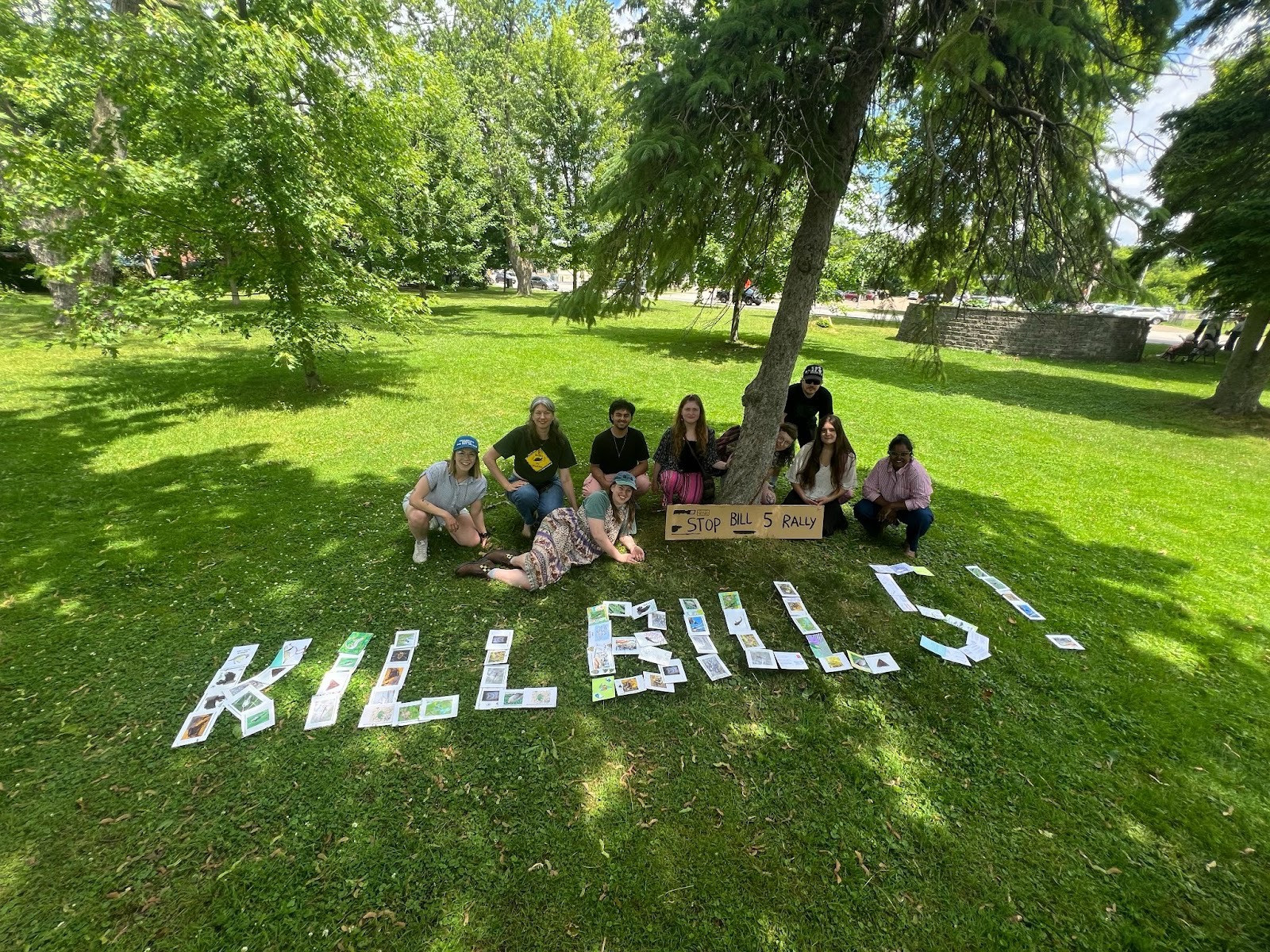
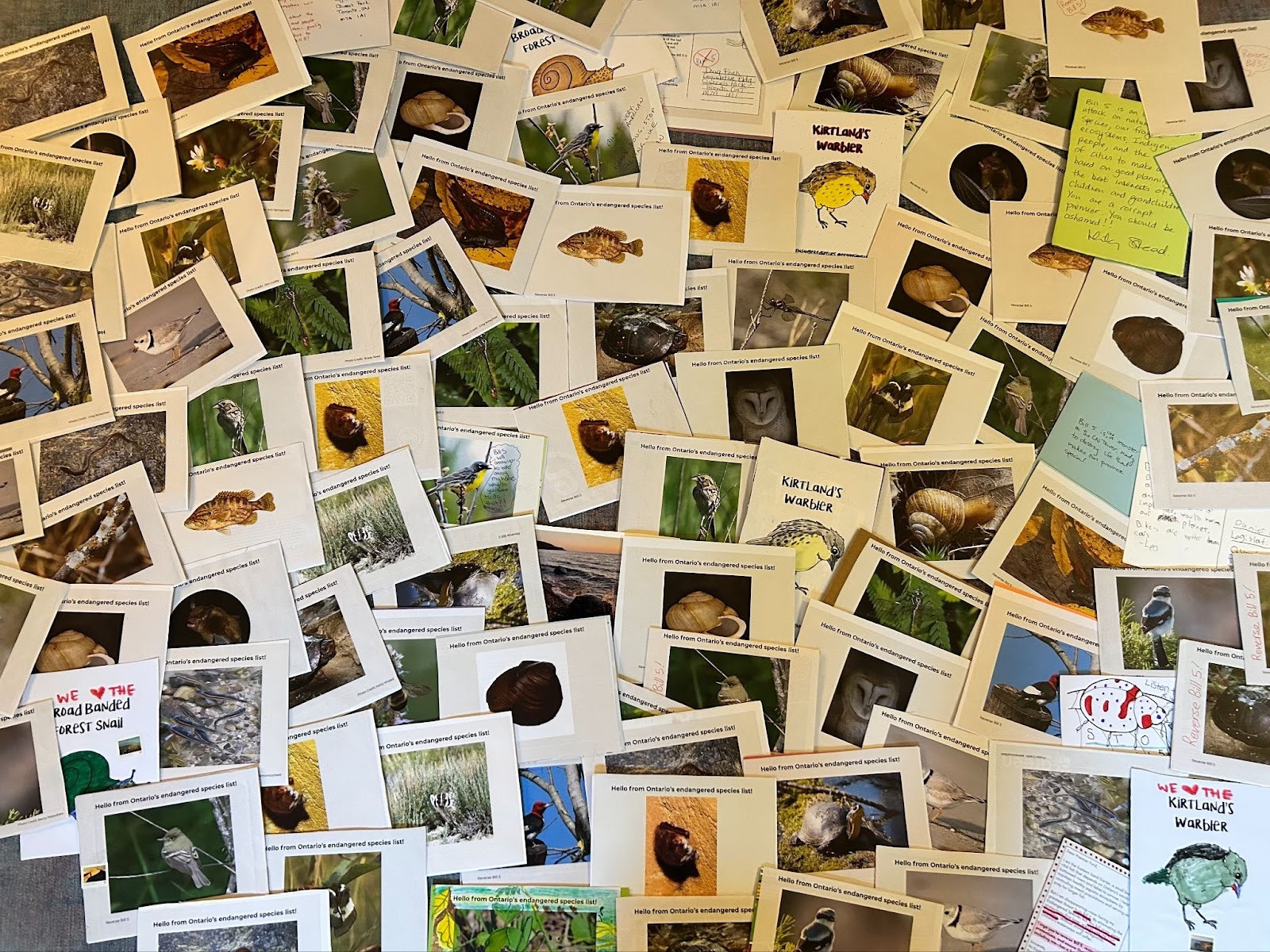
Guelph resident Sarah Christie has been organizing Postcards in the Park since July 1, 2025.
(Supplied/Sarah Christie)
Inspired by past environmentalists who had turned pen to paper to oppose destructive legislation, she thought, why not now?
She went back to what she’d learned from Goodall and knew instantly the postcards had to advocate as well as educate because it’s “never properly communicated” that “we need our pollinators to fertilize plants and crops, and migratory shorebirds to control insect populations.”
“It’s all part of a cycle, a circle. Lose one species, and the foundation begins to unravel,” she added.
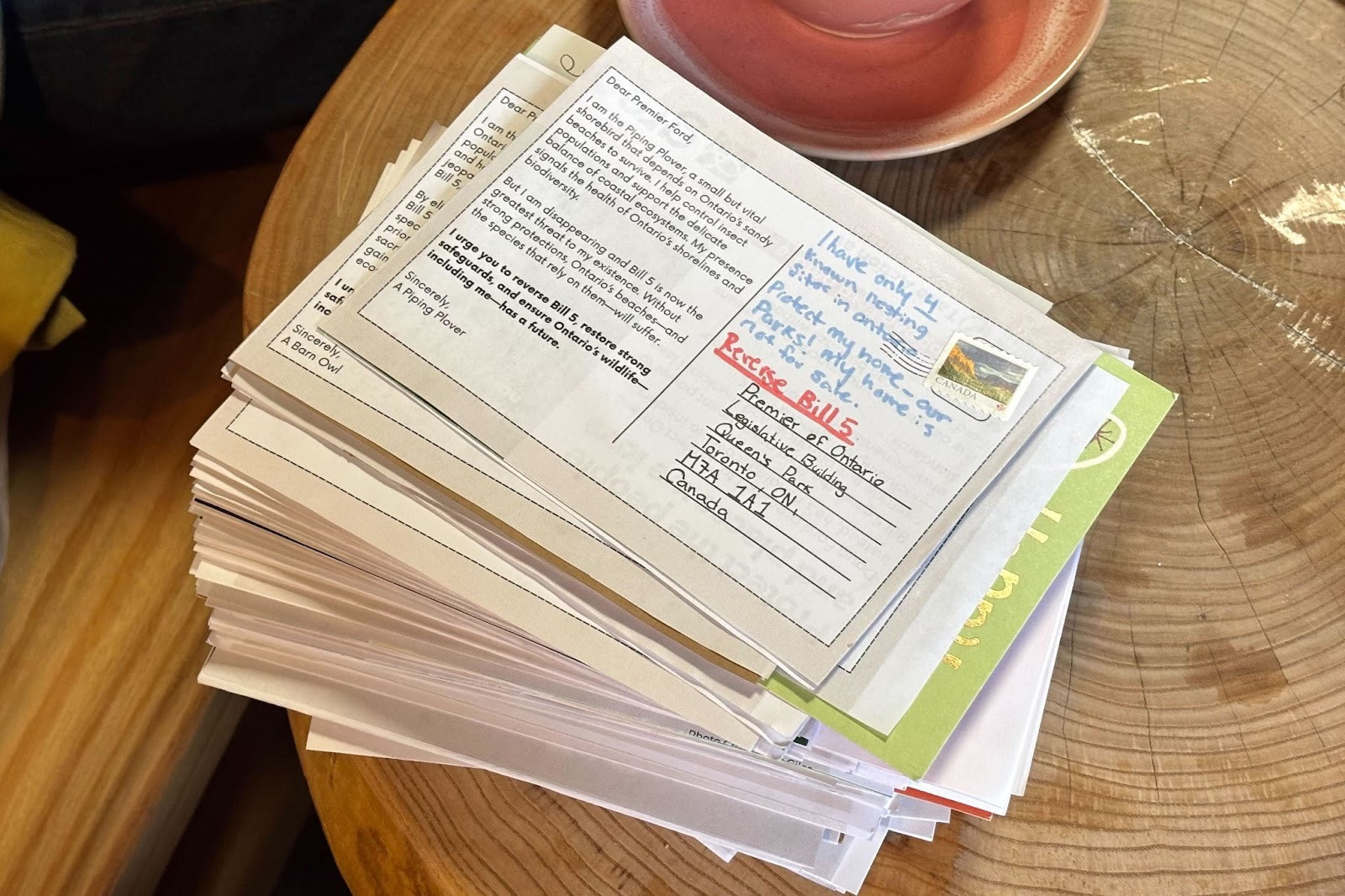
On June 14, she mailed her first postcard to Premier Doug Ford’s office, written from the perspective of the endangered Northern dusky salamander, opposing Bill 5.
“As an indicator species, my survival reflects the health of groundwater-fed streams and forests. I help maintain ecosystem balance by controlling insect populations and contributing to nutrient cycling,” the letter read.
“My greatest threat is Bill 5.”
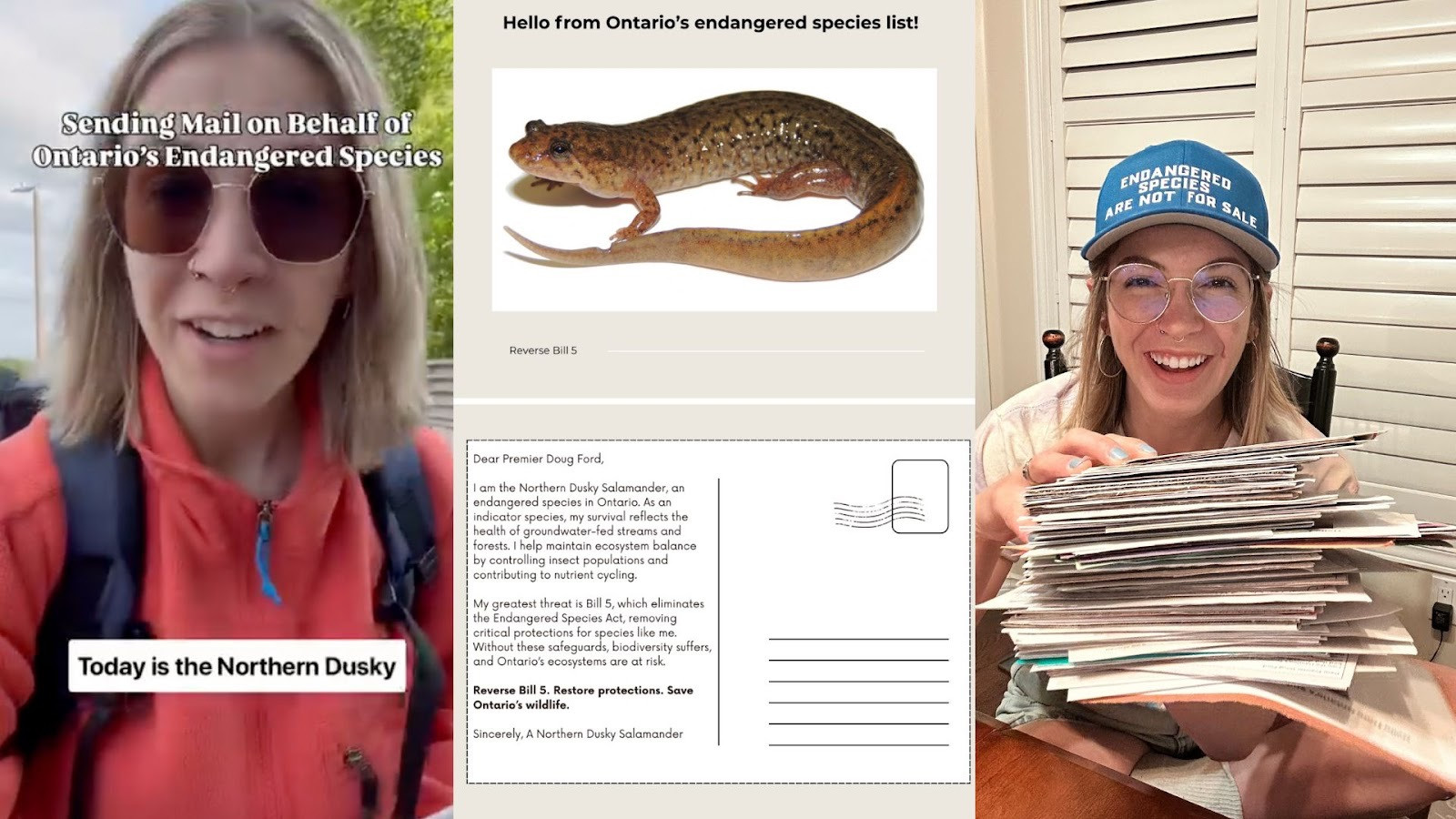
Guelph resident Sarah Christie says there is a disconnect in people’s understanding that “we need our pollinators to pollinate our plants, our food and our crops. We need the migratory shorebirds to help with [the] insect population. It is all part of the cycle, the circle, and...When you lose one, that's the foundation, right? It will unravel, and that's what is not communicated properly,” Christie told the Pointer.
(Supplied/Sarah Christie)
She shared the template online and continued writing postcards on behalf of other at-risk species. Soon, Ontarians were reaching out, sharing how they had turned birthday parties and small gatherings into postcard-writing sessions, sending letters on behalf of wildlife unable to speak for themselves.
The stream of encouragement gave birth to a hunch. What if people were given the option to be a part of a community and to feel they aren’t alone?
What began as a personal outlet for disappointment soon became a community-driven form of resistance leading to an in-person event she planned in less than 24 hours.
“Climate anxiety can feel quite isolating and paralyzing,” Christie said. “So to be able to gather with other folks and say, ‘Hey, I'm feeling the same thing that you're feeling! What can we do?’ That’s pretty powerful.”
And her hunch was right.
On Canada Day, Christie partnered with the Guelph Climate Action Network to host Postcards in the Park, a family-friendly event at Royal City Park. Within less than 24 hours notice, over 30 residents of all ages gathered to write postcards to the Premier and local MPPs opposing Bill 5 and calling for its repeal.
“Not everyone wants to go to rallies, and not everyone has time to write letters,” she quickly realized. “It's [sending postcards] just a different way to have a voice and be active. Kids can get involved, too; which wasn’t even my original goal. I just needed to channel some of this frustration into tangible action.”
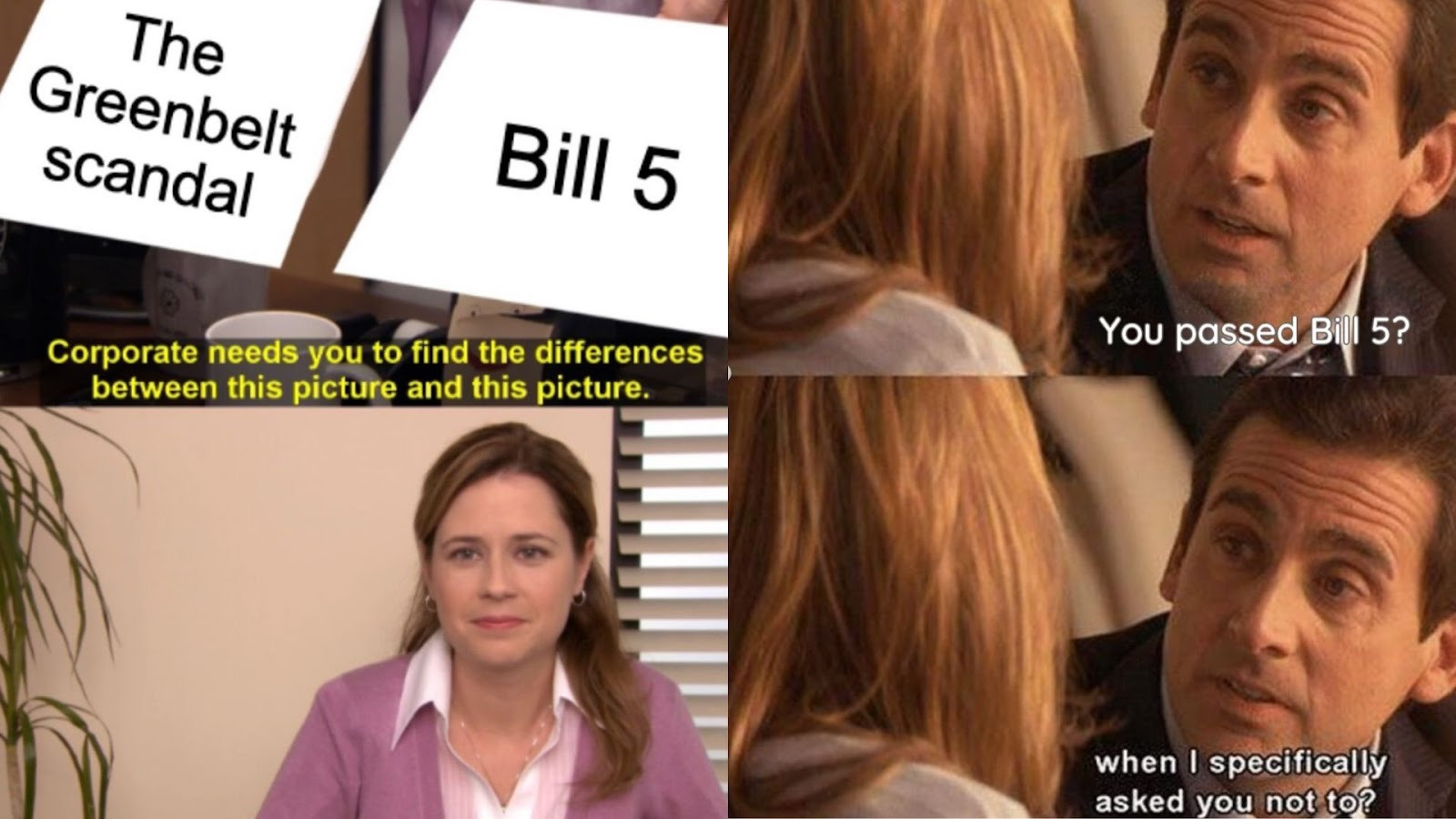
Guelph resident Sarah Christie, who has been trying to make “climate conscious conversations” accessible in a “not-so-overhwelming way”, has also been making memes about Bill 5 to spread awareness in her own quirky way.
(Sarah Christie/Instagram)
It was impossible for her to stop after that.
On January 31, Christie hosted her first indoor postcard event and with growing community support, she has now helped send over 700 postcards opposing Bill 5.
A small gathering of nine people, the meeting left a lasting impression on her, especially after meeting a couple from Wasaga Beach who were “hurting” and directly impacted by the PC plans to transfer sections of the beach—formerly part of Wasaga Beach Provincial Park—to the local municipality for tourism development.
In May last year, Ford announced that his government would invest nearly $38 million to build Destination Wasaga, a tourist hub featuring beaches, a revitalized downtown and historic sites.
On November 27, the PCs further amended the Provincial Parks and Conservation Reserves Act to remove portions of Wasaga Beach Provincial Park from protection.
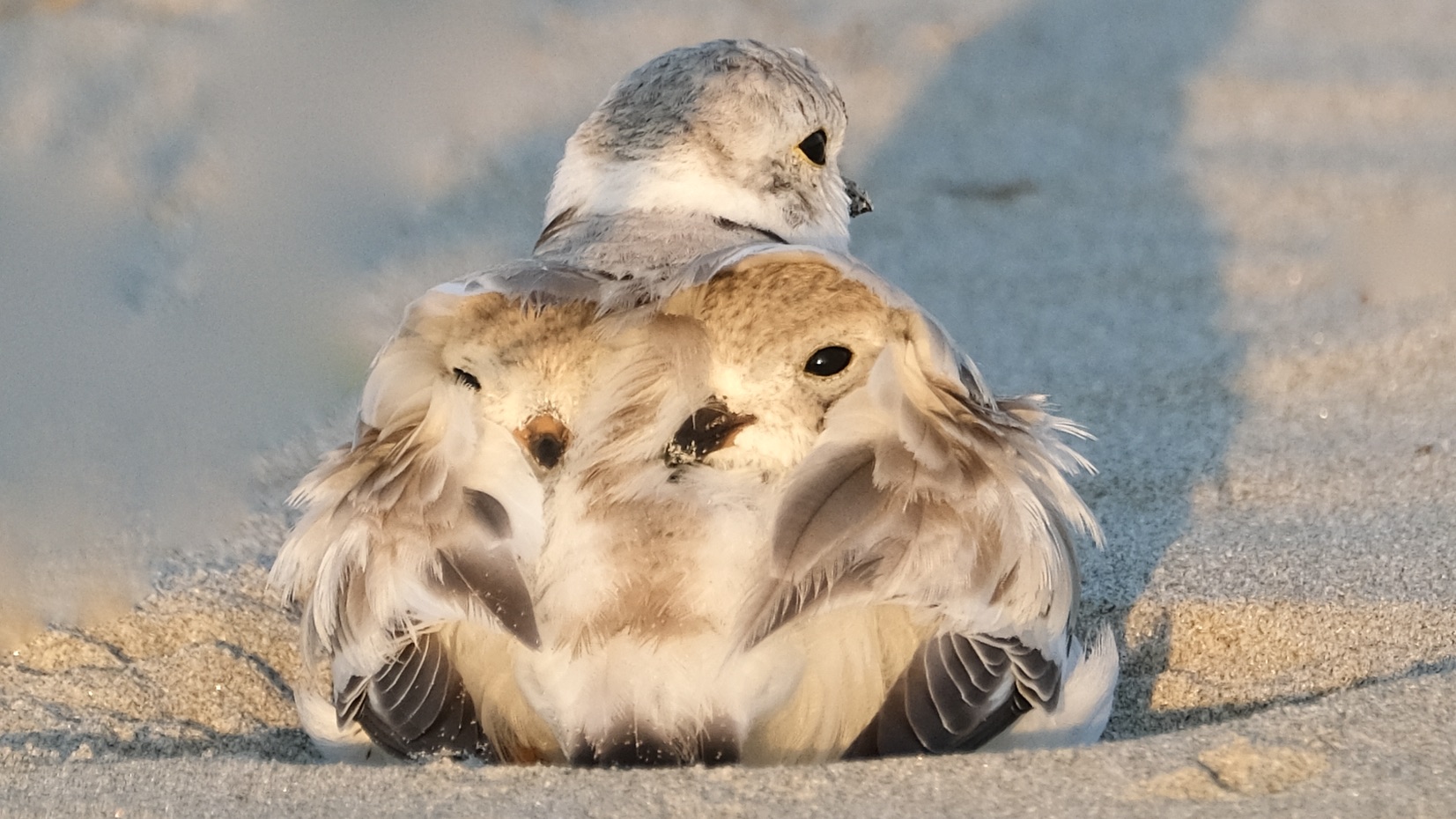
Many critics warned that the “investment” would threaten the habitat of the endangered piping plover, a migratory shorebird and an indicator species that relies on Wasaga Beach as its last remaining nesting ground in Ontario.
Since the species returned to Ontario in 2007, the beach has produced 70 percent of all fledged plovers that survived to adulthood.
“If the piping plovers disappear, that’s a warning sign that something is wrong in the ecosystem and that ultimately affects all of us,” she warned.
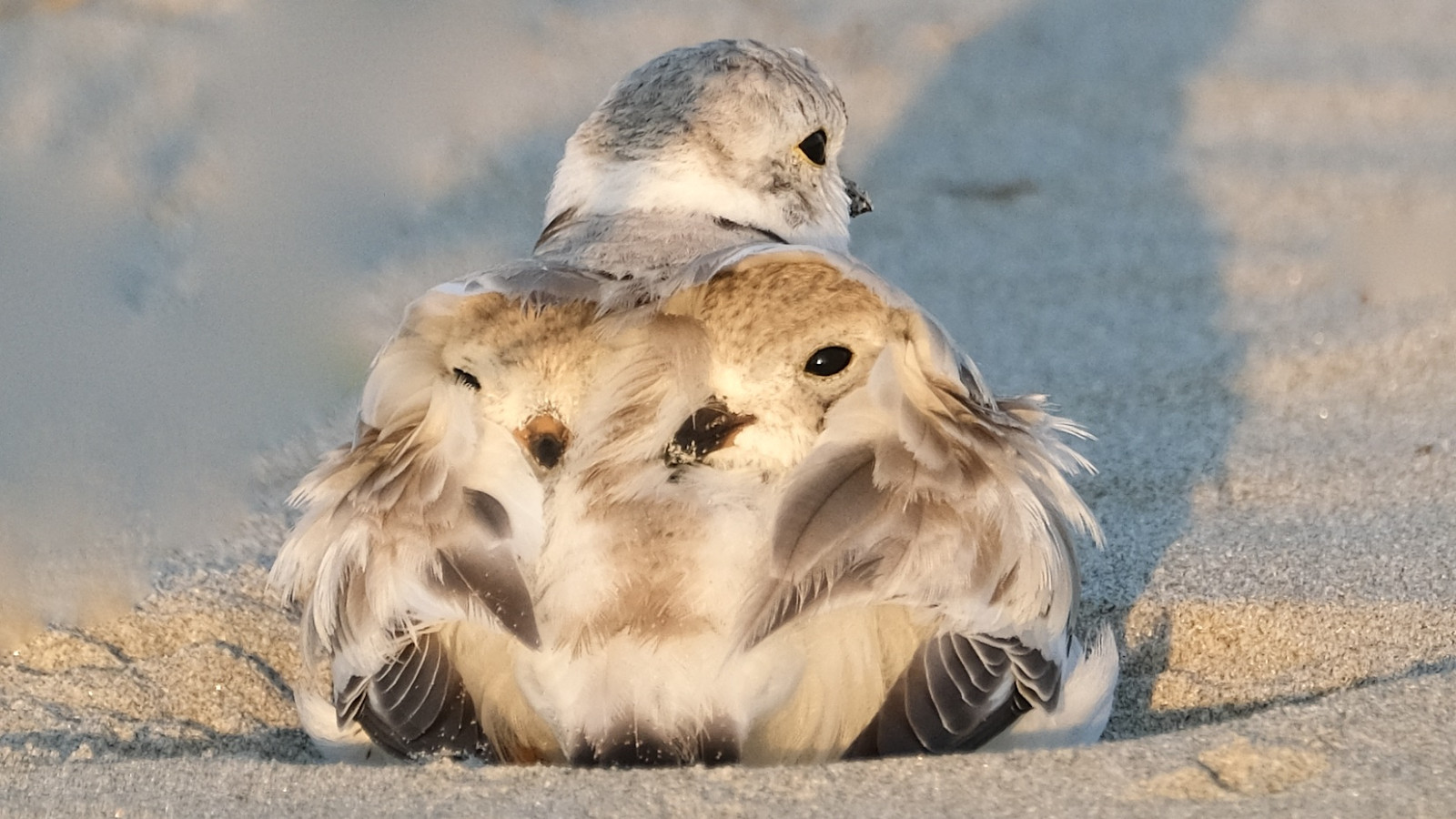
Despite migrating hundreds of miles between breeding and wintering grounds, Piping Plovers are known for their loyalty to both place and partner. Birds that return with the same mate often nest within just 128 feet of their previous site. Great Lakes breeders typically winter in South Carolina and Georgia while most plovers from eastern Canada head to North Carolina.
(Top: The Piping Plover Project, Below: Alexis Wright/The Pointer)
Despite thousands of comments on the environmental registry opposing the decision, the town has already purchased mechanical raking equipment, and there are fears that clearing beaches and construction could destroy the birds’ nesting grounds before they return from migration.
Disregarding public input is nothing new for the Ford government, which has “been taking actions that had rarely or never been taken” since the Environmental Bill of Rights (EBR) was first introduced in 1993, according to Auditor General Shelley Spence’s recent report.
Spence noted the PCs have repeatedly made decisions before completing consultations, providing minimal support to help the public understand or participate in environmental processes, even though the EBR requires the Province to notify Ontarians of environmentally significant decisions, consider their feedback, and, when warranted, launch investigations.
Recent legal changes have dug a deeper hole for weakened environmental protections. On November 27, the PCs made amendments to the Provincial Parks and Conservation Reserves Act, which allow them to bypass public scrutiny and legislative oversight for future parkland transfers.
“Only the immediate action of the federal government stands between the loss or survival of the endangered Piping Plovers of Wasaga Beach. It is very rare to see such a clear, immediate and extreme threat to the survival and recovery of an endangered species in Canada. The time for action is now,” Environmental Defence Executive Director Tim Gray said in a statement.
On January 27, Ecojustice, on behalf of Environmental Defence and Ontario Nature, filed a formal petition to federal environment minister Julie Dabrusin calling to issue an “Emergency Order” by March 1 under the federal Species at Risk Act to protect the piping plover habitat before mechanical raking and commercial development begin this spring.
“Failure of the Minister to act may lead to legal action by the groups,” the letter warned.
In an email to The Pointer, Environment and Climate Change Canada confirmed the ministry is “aware” of the request and is “assessing” next steps under sections 29 and 80 of the Species at Risk Act.
Fiona Ryner of Friends of Nancy Island & Wasaga Beach Park emphasized that the dunes and secondary vegetation not only support wildlife, but also act as natural buffers against erosion, flooding, and storm surges, which are increasingly critical as climate change intensifies.
“Any loss of dunes means a permanent loss of sand. This is a relic beach; there’s nothing making new sand,” she said, adding that the sensitive land extends beyond the shoreline, with secondary dunes and forest buffers providing further protection.
Like the piping plovers, caribou are a keystone species whose migrations, grazing and nutrient cycling help shape northern ecosystems. They influence plant communities, enrich soil and water with nutrients and support entire food webs as a major prey species for predators like wolves and bears, marking their presence and health as a powerful indicator of the overall well‑being of boreal and Arctic landscapes.
A 2021 modelling projected northern caribou populations in Ontario could decline by 17 to 30 percent over the next 50 years, driven by the combined pressures of climate change and expanding resource development such as proposed mining in the Ring of Fire — which the PCs have signalled on multiple occasions will be the first Special Economic Zone.
Warming temperatures, increased wildfire and logging create younger forests that favour moose, which in turn support larger wolf populations, intensifying predation on already stressed caribou herds.
Roads and other infrastructure make these impacts worse by fragmenting habitat and giving predators easier access to prey.
To access the Ring of Fire, a vast mineral resource region in Ontario’s far north, roughly 540 kilometres northeast of Thunder Bay and 1,000 kilometres north of Toronto, Ford has been lobbying Prime Minister Mark Carney to designate the proposed access road as a national interest project. So far, those efforts have not succeeded.
While the Province has secured support from some First Nations, many others remain firmly opposed, arguing that fast-tracked development under Ontario’s Bill 5 and the federal government’s Bill C-5 would override Indigenous rights, weaken environmental protections and sideline meaningful consultation.
On January 27, Mississaugas of the Credit First Nation, Walpole Island First Nation, Kashechewan First Nation, Wapekeka First Nation and Wunnumin Lake First Nation joined a legal challenge against Bill 5 initiated by nine First Nations.
The Province estimates the Ring of Fire could generate about $22 billion for Ontario’s economy over 30 years or roughly $730 million a year but that figure could come with a much larger environmental cost. The Ring of Fire sits alongside a region of immense ecological value: the region’s peatlands are estimated to store around $35 billion tonnes of carbon, acting as a globally significant climate regulator by locking away greenhouse gases that would otherwise heat the planet.
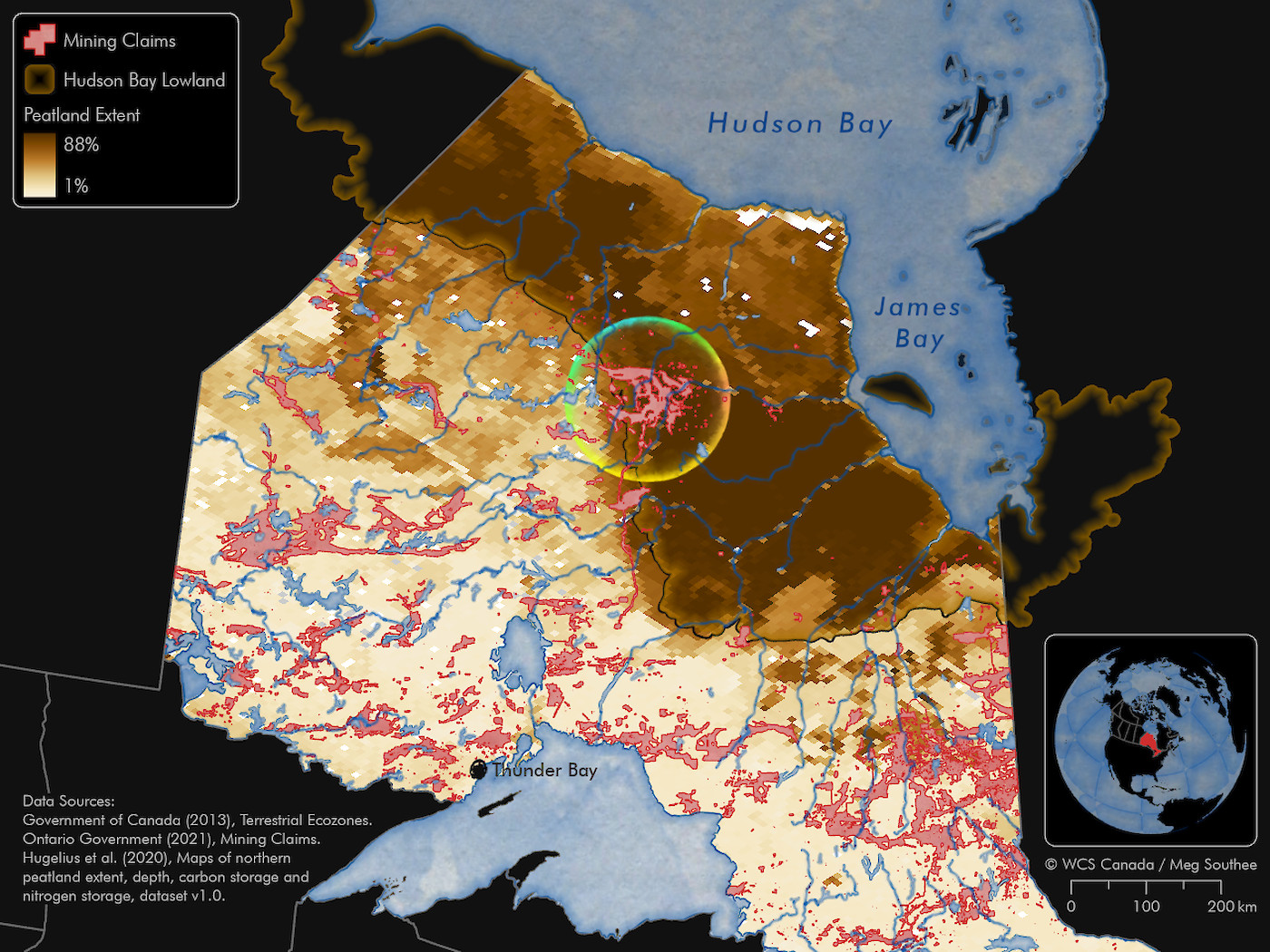
The Ring of Fire is a mineral-rich region in northern Ontario, home to valuable resources like chromite and nickel, but it also holds immense ecological significance as part of the world's largest intact boreal forest, providing critical habitat for endangered species and being the homeland of Indigenous peoples.
(Wildlife Conservation Society Canada)
Disturbing those peatlands could release vast amounts of carbon, the aftermath of which would generate a bill neither Ontario nor Canada will be able to pay.
Before the Province can begin to reap the economic benefits of mining activities in the Ring of Fire, the toll of climate change would already be mounting. Climate-related damages are estimated to cost Canada $35 billion annually by 2030, with that figure potentially escalating to $100 billion by 2055, according to a 2023 analysis by the Canadian Climate Institute.
The World Economic Forum’s (WEF) Global Risks Report describes the world as entering an “age of competition,” with geoeconomic confrontation, misinformation and disinformation and societal polarization ranking as the top short-term global risks.
Critics have pointed out, in this same era, Ford has leveraged public sentiment to win elections, notably donning “Canada’s Not For Sale” hats to rally support while filming an advertisement in Washington DC. To mock the hat, Christie created her own version that says “Endangered Species Are Not For Sale”.

Guelph resident Sarah Christie shared she adopted a plant-based diet after listening to the late anthropologist Dr. Jane Goodall, who described eating meat as a reminder of the animal’s “fear, pain and death”.
(Alexis Wright/The Pointer)
Globally, nature-negative finance flows now total roughly US$7.3 trillion (CAD $9.90 trillion) annually including US$4.9 trillion (CAD $6.65 trillion) from private sector activity concentrated in energy, industrials, utilities and basic materials, alongside US$2.4 trillion in public subsidies that actively incentivize environmentally harmful practices in fossil fuels, agriculture, transport, water and construction, the UNEP noted.
In the long run, however, environmental dangers “dominate” the global risk landscape, the WEF warns. Within the next decade, extreme weather events, biodiversity loss and ecosystem collapse and critical changes to Earth systems will be the three most severe risks facing humanity.
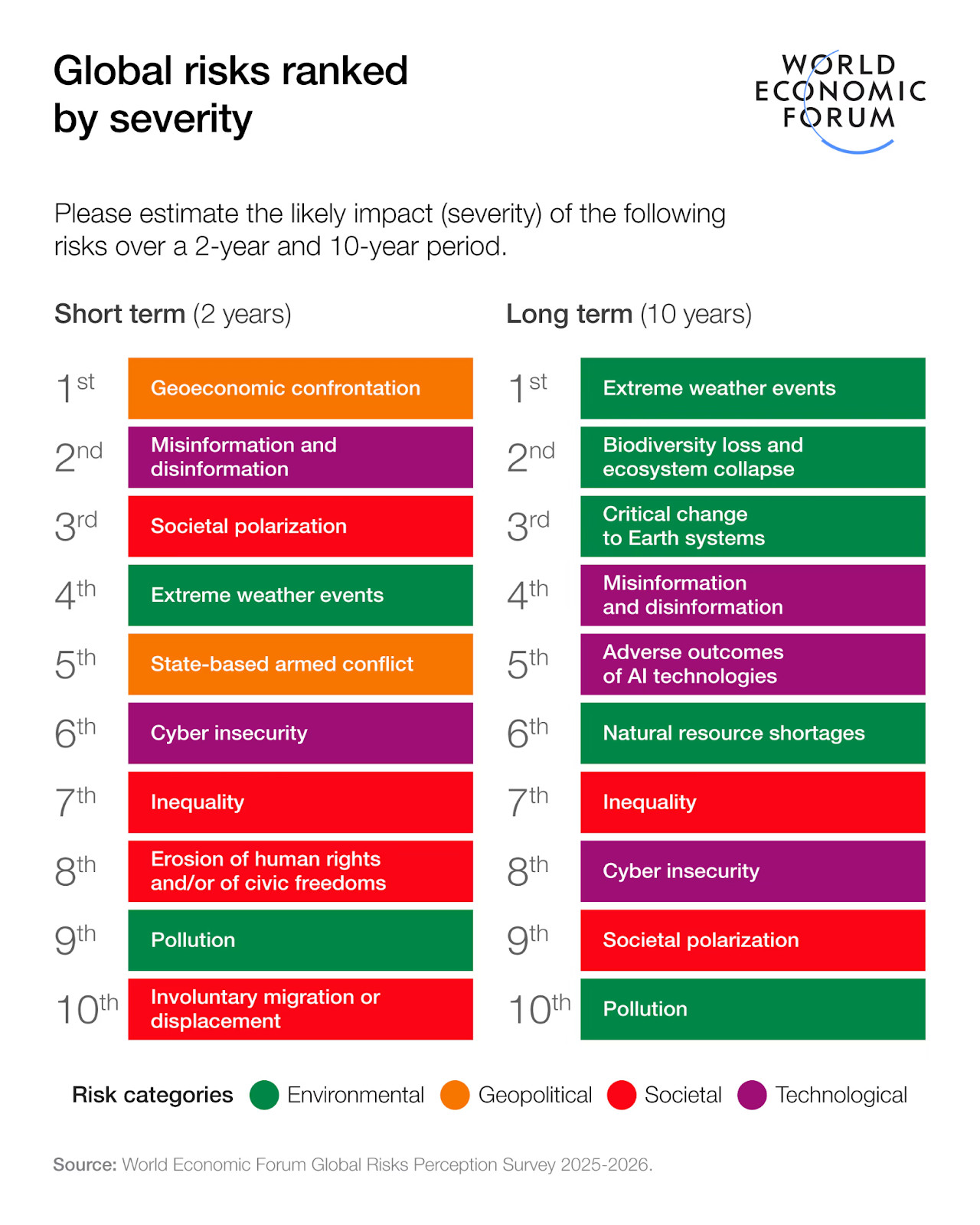
In its 2026 Global Risks Report, the World Economic Forum warns environmental dangers dominate long-term risks wherein extreme weather events, biodiversity loss and ecosystem collapse, and critical changes to Earth systems occupy the top three spots in the 10-year outlook.
(World Economic Forum)
One of the most effective ways to reduce those risks is by investing in nature, which “is not just an environmental imperative, it is a high-return, long-term strategy for economic resilience and intergenerational well-being”.
Global investment in nature-based solutions such as wetland protection, forest conservation and ecosystem restoration currently stands at CAD $300 billion a year, dwarfed by the financing going into projects pushing the world in the wrong direction.
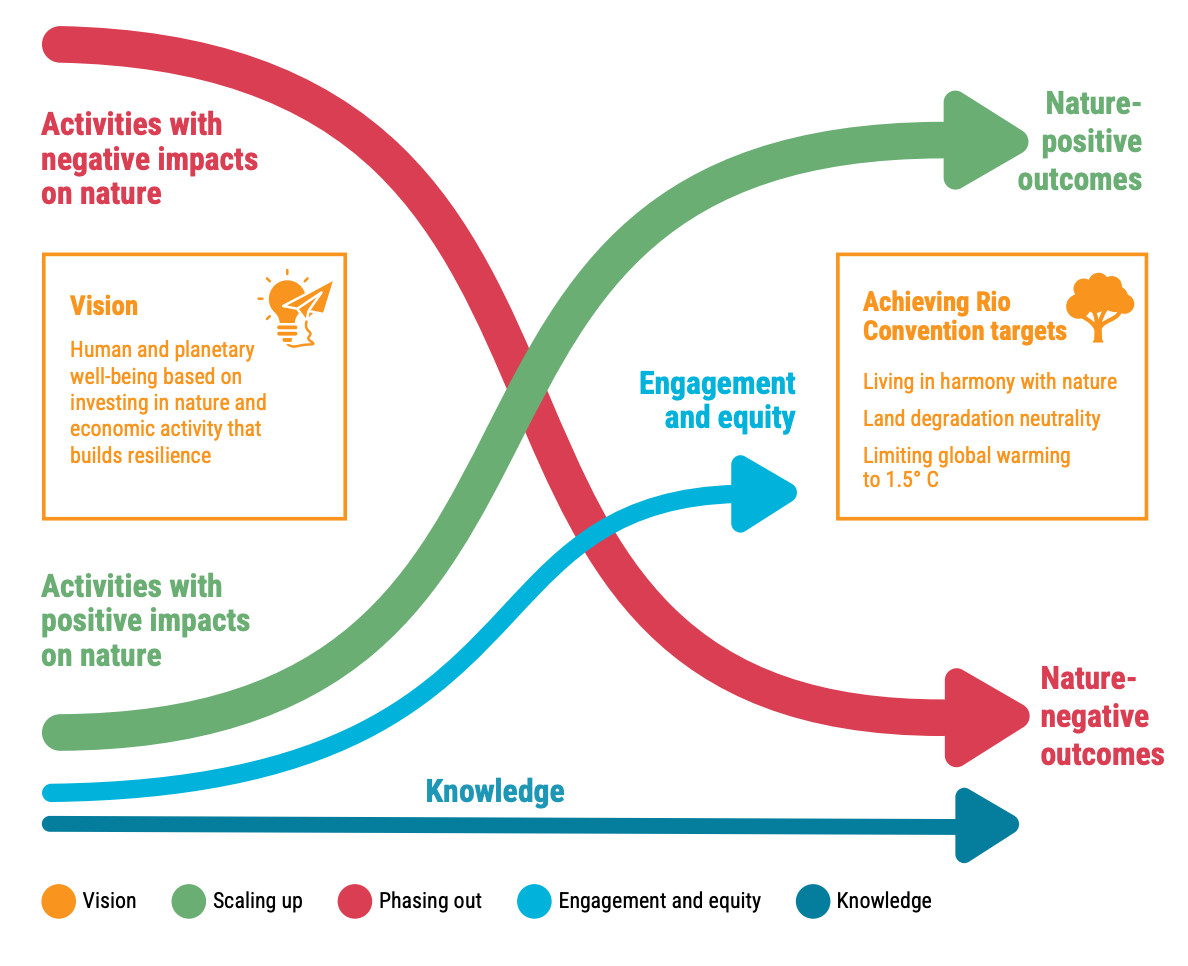
The United Nations Environment Programme (UNEP) calls for a major shift in global financing toward nature-based solutions (NbS) and away from destructive investments. As part of this shift, the report introduces the Nature Transition X-Curve as a roadmap for navigating what it describes as a once-in-a-generation economic shift: moving away from systems that depend on degrading ecosystems and toward ones that restore and protect nature while supporting long-term prosperity. The “X” represents two opposing curves that cross over time. On one side is the rapid decline of nature-negative activities (red line) including fossil fuel subsidies, extractive land use, deforestation, wetland destruction and infrastructure projects that externalize environmental costs. On the other is the accelerated rise of nature-positive investment (green line), such as ecosystem restoration, climate-resilient infrastructure, sustainable agriculture, urban green spaces and Indigenous-led land stewardship.
(UNEP)
The UNEP forewarns this imbalance is not only accelerating biodiversity loss and climate instability but also locking governments into higher long-term costs from flooding, heatwaves, infrastructure damage and health impacts.
To avoid irreversible ecological and economic harm, investment in nature-based solutions need to increase at least 2.5 times to US$571 billion (over CAD $780 billion) annually by 2030, an amount equivalent to just 0.5 percent of global GDP.
This “Big Nature Turnaround” can be achieved by using the Nature Transition X-Curve, a framework designed to help governments and markets shift from nature-destroying economic models to nature-positive ones.
The X-Curve visualizes two trajectories crossing over time: one showing the urgent need to phase out environmentally harmful subsidies and investments embedded in today’s dominant systems, and the other showing the rapid scaling up of high-integrity nature-based solutions, such as wetland restoration, urban green infrastructure and forest conservation.
Each year, an amount of US$7.3 trillion invested in activities that harm nature is phased out and repurposed into nature-positive initiatives.
Rather than treating environmental protection as an afterthought, the solution positions nature as core economic infrastructure, critical to reducing climate risk, strengthening resilience and lowering long-term public costs while aligning with global sustainability goals, particularly those set by the Rio Conventions, to ensure the transition is both feasible and impactful.
“If you follow the money, you see the size of the challenge ahead of us. We can either invest into nature’s destruction or power its recovery – there is no middle ground,” UNEP Executive Director Inger Andersen said.
Christie says Ontario must “100 percent” get behind financing nature and she feels grateful to her MPP Mike Schreiner, Leader of the Ontario Green Party, who firmly opposes Bill 5.
She also wants Ontarians to remember that “there are a lot of people in power, with a lot of money, who will tell you, ‘you shouldn’t care’ but it’s important that you find your community and keep going”.
Email: [email protected]
At a time when vital public information is needed by everyone, The Pointer has taken down our paywall on all stories to ensure every resident of Brampton, Mississauga and Niagara has access to the facts. For those who are able, we encourage you to consider a subscription. This will help us report on important public interest issues the community needs to know about now more than ever. You can register for a 30-day free trial HERE. Thereafter, The Pointer will charge $10 a month and you can cancel any time right on the website. Thank you
Submit a correction about this story